Showing posts with label relationships. Show all posts

22 February 2022

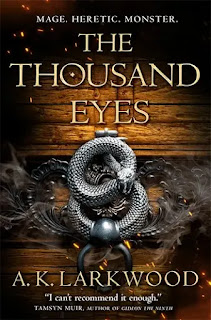
#Review - The Thousand Eyes by AK Larkwood

The Thousand Eyes (The Serpent Gates, 2)
AK Larkwood
PanMacmillan, 17 February 2022
Available as: HB, 400pp, e, audio
Source: Advance copy
ISBN(HB): 9781529032796

I'm grateful to the publisher for an advance copy of The Thousand Eyes to consider for review.

The Thousand Eyes was for me a welcome return to the Maze and to the myriad worlds that connect into it, first explored in The Unspoken Name. And also, of course, to my favourite apostate orc priestess, Csorwe, and her girlfriend Shuthmili. It's a tricky relationship, albeit perhaps easier since Csorwe abandoned her former mentor Belthandros Sethennai. Both Csorwe and Tal Charossa, Sethennai's other apprentice, competed for Sethennai's favour and that was a VERY complex threesome indeed. 

With Sethennai out of the picture, a girl's still got to make a giving and at the start of the book we see Csorwe, Shuthmili and Tal engaging in a spot of Indiana Jones style temple robbery in a cursed world reached through the Maze.

The only problem is, in this universes, "abandoned" temples can harbour more than spiders, snakes and traps. This a world where the gods are real, and terrible. And they may inhabit you (as we see from the inner dialogue Shuthmili has with the entity she addresses as her "corruptor"). I loved the contrast in this opening part of the book between the banal everyday chatter of the three fortune-hunters and the weird, creepy, and frankly terrifying world that are navigating. Fantasy doesn't have to be high, sonorous and dusty - Larkwood expertly spins a tale that just feels real because of the triviality that offsets all the shadows and terror.

So far, The Thousand Eyes may sound similar to The Unspoken Name. Which would be absolutely fine by me - it's a great read. But Larkwood delivers still more. A third of the way through the book, a Thing happens which completely overturns the narrative, upping the stakes considerably and placing our friends into a very different situation. It's frustrating, but I don't want to say exactly what, as it would spoil the story. 

I will say though that how things turn out will depend on the very particular strengths and weaknesses of the different characters, especially Tal and Csorwe, and on the tensions and stresses in those apparently mundane relationships that we saw earlier. It's a story of love and loss and devotion and one of waiting and hoping - but also of how those things, pushed without limit, can sour into hatred and pride. A certain goddess here has had enough of the waiting and hoping and decides to take action - but with terrible consequences. A certain mage bears her loss and remains devoted to her lover, but finds she must commit terrible crimes to achieve her ends. A certain rogue... oh, well, it's Tal... has a lot of time to ponder his life choices and to regret those moments when he played the hero. (Tal, especially, is amazingly depicted here - his emotional quirks, his stormy relationship with his family, his love-hate relationship with Sethennai, a bewitching villain if ever there was one).

It's a page-turning, life-filling monster of a book which, once begun, you simply HAVE to finish. And that finish is cruel and filled with loss: but as we know, 'What is saved is saved only for a moment. All voices sound in silence, but before the echoes die away, their sound is sweet'.

I think it will be a long time before the echoes of The Unspoken Name and The Thousand Eyes die away. And they are, indeed, very sweet.

For more information about The Thousand Eyes, see the publisher's website here and AK Larkwood's site here.


22 July 2021

#Review - a strange and brilliant light by Eli Lee

a strange and brilliant light
Eli Lee
Jo Fletcher Books, 22 July 2021 (HB), 17 February 2022 (PB)
Available as: HB, PB, 292pp, e, audio
Source: Advance review copy kindly provided by the publisher
ISBN(HB): 9781529407754 (PB) 9781529407747  

I'm grateful to the publisher for an advance copy of a strange and brilliant light to read and consider for review.

Sometimes, to see plainly, to understand just how strange things have becomes, you have to step back a bit. 

That, I think, is what Eli Lee does in her riveting SF(ish) novel about the future of artificial intelligence (AI) and its effect on society - or perhaps, society's effect on society, because nothing is inevitable, it all depends what WE do.

The book is set in a recognisably modern world with laptops, the Internet, cars, trains, coaches - and poverty. Teenagers meet for parties in the sanddunes and do slightly naughty things. There are coffeeshops and trades unions, venture capital startups, conglomerates, and meditation retreats in the mountains.

But it is not OUR world. The geography, place names (Dhont, Mejira) and countries are clearly different, as is the history (which is alluded to but never explained - this book is very good at involving its readers without a great deal of exposition). There is no made-up language but Lee coolly uses comprehensible but not familiar English words such as 'unancestral' to hint at unseen depths, at concepts and structures shaping the visible narrative. Most tangibly, the different cultures we meet here have their own cuisines, with meals - both traditional and intercultural - described in, frankly, delicious detail. Overall, the effect is to distance the reader slightly from the locations and action, so that we question what is being shown and think about what is happening (and what we're taking for granted).

In Lee's imagined society, we are on the cusp of AI automating most of the work hitherto carried out by humans. The focus is on a chain of coffee shops, Slurpees, where "auts" are being introduced to replace human staff - early on we meet Lal, who is about to transfer from her job as manager of one such shop to a more senior position in the company, where she will be helping to plan future automation. This transformation is proceeding, at pace, without much thought being given by Government or there conglomerates to the consequences - that is, how people will make a living. Things are, I'd say, closer to the edge than in our world - but it's a matter of degree.

As the story moves on, Rose, one of Lal's team, takes on the managership. More concerned than Lal at what is happening, she attends protest meetings, falling in with the surprisingly uncharismatic Alek who leads the group but doesn't seem to regard the members as having much to contribute apart from their numbers. He might be a radical and agitator, but he's making the same mistake as the big corporations in discounting the input of actual humans, reducing even the activity of process to an assembly-line of placards. (Perhaps they could get auts in to do that, too?)

Alek knows what he thinks the solution is - something he calls 'source gain', what we'd describe as universal basic income, an entitlement for all to part of the fruits of automation, enabling a minimal, tolerable lifestyle. Rose seems less committed and more questioning of this concept - late in the book she lights on the idea of ownership, by the people, of the means of production (the auts). So, yes, there's Socialism in this alternate world - and indeed we get a good description of the alienation of the workers from their labour. But there are other ideas in the mix, too - wider elements in the protest movement are taking direct action, smashing the auts. 

I thought that Rose's and Alek's protest meetings might be highlighting the dangers of an unstable society becoming more authoritarian, as they seem to occur clandestinely in a remote abandoned warehouse - but this is not really followed up and on the whole I don't think a strange and brilliant light is meant as a novel of political action. It's rather one where the wider forces in society are played out between a few characters and within their families. This comes across most strongly in the third central character, Janetta, who completes the picture by giving an insider's view on the progress of AI itself.

Janetta is a PhD student at a prestigious university (contrasted with the local college which was all Rose could afford to attend, despite having higher aspirations) worked on making AI empathetic, considered a key step to developing conscious artificial intelligence. She's also going through emotional turmoil, having split up with her girlfriend. Lee has a twist of fate link Janetta up with the founder of one of the top AI start-ups, so allowing a dialogue between Janetta's approach to the AI problem, informed by her loss of Malin, and Taly's more functional attitude.

The relationships between the three women, their wider families and the workplace, played out over job changes (a particular grim description of Lal's arrival at a dream corporate campus, the antithesis of all her hopes and dreams), holidays and meet-ups, creates a fascinating tapestry of life which, yes, serves to illustrate the dilemmas and risks of the new technology but at the same time is simply riveting to follow. The process of automation is marked by the progressive elimination of people from Slurpees, while Lal's supposedly favoured management position becomes more and more dehumanising and Janetta finds her progress frustrated by relationship entanglements and doubts over the ethics of what it's doing.

In what is actually quite a short book, Lee gives the reader a massive amount to ponder as well as delivering a brilliantly written and absorbing story about some very real people.

I would unreservedly recommend a strange and brilliant light.

For more information about a strange and brilliant light, see this blogpost by the author, explaining the inspiration behind the book and the publisher's website here.


4 December 2019

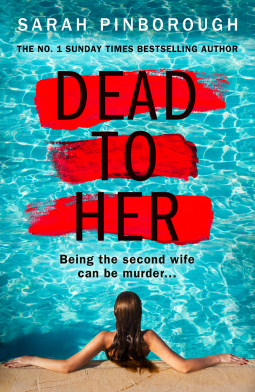
Review - Dead to Her by Sarah Pinborough

Dead to Her
Sarah Pinborough
HarperCollins, 2020
Available as: e, audio (4 June), HB (6 August), 416pp
Read as: Advance e-copy
ISBN: 9780008289072

I'm grateful to the publisher for an advance e-copy of Dead to Her via NetGalley.

When I saw there was a new novel by Sarah Pinborough coming in 2020, and that it was available on NetGalley, I got very excited and put in my request as soon as I could. And when I was lucky enough to be approved, I read it straight away, rather than waiting till next Summer. I appreciate this review is way early but it's been a year or two without a book from this author so just couldn't delay. Look at this as a peek into the future - what you may be reading next August...

You can't tame a wild thing

Dead to Her opens with a party and an entrance.

'Eyes scanned the new wife's gold dress - Versace maybe - figure-hugging but an inch too short for this society crowd. The heels - half an inch too high. The jewellery, thick coils around her neck and hanging from her ears, impressive but attention-seeking. All of the women - nearly all over fifty - would be making the same assessment: She's not one of us.'

William, a wealthy and influential, but ageing, (and White) lawyer practising in stately Savannah, Georgie, has invited his wealthy, influential (and mostly ageing) White friends to meet his new English wife, Keisha (young, not wealthy, Black).

Returned early from a trip to Europe he'd taken after the death of first wife, Eleanor, he's eager to present Keisha to Savannah society... and to begin moulding her into someone that will do him credit. There was an element of Pgymalion in William's attitude to Keisha, if Professor Higgin, besides being sexist and a snob, also had a streak of malice. William may have been taken with Keisa when he spotted her waitressing in a strip club, attracted by her youth and looks and even because she was not like his friends, not like Eleanor.  But that is past. William is home now. Keisha has to fit in, take golf and tennis lessons, behave herself. If she's going to keep her place, she needs to earn it not just by meeting his needs in bed (those little blue pills are stern masters) but by becoming something she's not.

Keisha - one of the two main viewpoint characters - is on the cusp of discovering this, and the first part of the novel follows her as she realises how things are going to be. She comes to recognise the fix she's in, that William is not what she thought he was. But that's actually the least of her worries. She has secrets of her own. She was brought up by a ghastly uncle and aunt who think she's now their meal ticket. She's addicted to tranquillisers ('Thank fuck for her Valium') and she's in a very unfamiliar society. Under the eye of the first wife - in the form of portrait hung over the staircase - living in a house where Eleanor's bedroom, left as it was when she dies, mustn't be touched, intimidated by William's housekeeper Zelda, there are Gothic echoes here from the outset. Add to that Keisha's conviction that she is cursed, her memory of seeing a ghostly boy, and a sultry, voodoo-laden atmosphere, this is a book that seems to invite the uncanny.

From that first appearance Keisha is under suspicion by Marcie, young second wife to Jason, William's partner, who thinks Keisha has an eye on her husband. Marcie knows the ground here, having won Jason away from his first wife, Jacquie (who is also, we soon learn, back in town). Having a lot in common with Keisha - Marcie also come from the wrong side of the tracks, and also, as we will see, has secrets too - she's not unsympathetic to Keisha, but business and position come first in Savannah. Marcie won't be poor again and she won't lose Jason, despite the shine having come off her marriage too. ('It was amazing how you could contain yourself - imprison yourself - if you really tried')

So when the two women are thrown together - Jason is keen that Marcie befriend Keisha and persuade her to put pressure on William to retire - there is bound to be trouble. I often found myself holding my breath as the scenes between them teetered on the verge of blowing up into something truly scandalous. Keisha has a streak of recklessness, of daring, in her which leads her to cross lines and, combined with the tension between the two women, this gives the early parts of the book a real sense of danger, of things getting out of control.

Pinborough has a deft hand at sketching such relationships, giving both the light and the dark sides as she's shown in previous books such as 13 Minutes - there is something of the same atmosphere here, a mix of respectability and naughtiness with boundaries mutable and a sense of risk. That is articulated by Marcie, the other main character here, who's consciously rowing back at times from the "fun" out of concern at provoking Jason and falling from grace. As I've said, Marcie has her own secrets - and she becomes concerned that someone else knows them. Just how much will Jason put up with from her? Just how much will she put up with from him?

But this book is more than a study of male control of women, though it is grounded in that: that's the reality of life among the privileged in Savannah, however much it's disguised by the Club, the parties, the charity fundraising drives. There are obvious nexuses of rebellion such as gay party planners Julian and Pierre, who seem at first as though they're going to be a bit of a cliché - until Pinborough demolishes that: 'I was born Peter. I became Pierre.' There are deeper and more dangerous fractures in the elegant structure too, glitches in the family connections, the twisted links going back generations - more challenging, more scandalous secrets. Jason's father, for example, committed suicide ('the honourable thing') after being caught embezzling clients' money. And others besides which it would be spoilery to describe.

There is also some design working out here. Someone who knows things. Who pulls strings. Keisha, in her fear and panic, fears Eleanor's ghost, thinks she sees evidence of even darker things going on - but neither actually sees what's coming to them. As you'll know if you read Pinborough's books, things can get very nasty, very tense, very quickly. Part of the thrill here is realising just how wide the web has been spun - when that's made clear it drops with the surprise of a master.

Pinborough also has a gift for description. There is some perfect language in this book. The 'luxuriously slow' pace of leisured Savannah life is compared to 'a cat's stretch'. As Keisha suffers withdrawal from her Valium we read that 'The ants in her head were starting to emerge...' In particular there are some very evocative descriptions of sex (not all of it good sex!)  We hear about William's 'lips cold and rubbery - old man mouth' as well as Keisha's fantasy of 'younger hands and warmer lips pressing her back onto the hood of her new red sports car'. The furniture sees a lot of action, so that sometimes it's easy to take an innocuous phrase the wrong way. After reading 'He'd fucked her over the dining table, huffing and puffing at her back' I didn't know for a moment quite how to interpret 'having Marcie across the luncheon table' but it turns out to be just a meal. (That time). We're left in no doubt that Keisha and Marcie may be privileged, may be more comfortable that their backgrounds would have allowed, but they pay a real price, they are little more than assets or trappings to their husbands who retain all the power and whose word goes.

It's a stultifying, claustrophobic life, even before weird things start happening. When they do - and regardless of who may have been reckless in the first place - those young wives, those second wives, those disposable, outsider wives - are the ones directly in line to take the blame and suffer the consequences.

And even behind that there is something else too...

I really enjoyed this book. It's compelling, scary, sharp-eyed but also written with genuine warmth and sympathy for those caught up in the evolving scandal. And the peril and jeopardy last till the very end, with some revelations about one character there is NO WAY I saw coming.

I would strongly recommend.

(If, like me, you've read Pinborough's earlier books you might also spot - I think I'm right here - a little nod to Murder and Mayhem).


24 October 2019

Review - Ghoster by Jason Arnopp

Cover design by Ellen Rockell
Ghoster
Jason Arnopp
Orbit Books, 24 October 2019
PB, e, 449pp

I'm grateful to Orbit for a free advance copy of Ghoster to consider for review.

It's an often heard complaint that literature hasn't been able to engage with modern communications technology, and that even when a book is set in the present day, you often might as well be from the 1980s, as far as email, mobile phones and social media are concerned.

That may be a little overstated - I think that after, perhaps, a slow start, these things now appear fairly regularly - but authors still seem to struggle with what they mean, how they affect lives. In Ghoster, Arnopp has tackled that head on. Not only do we see text conversations between Kate and best friend Izzy (and that friendship between the two women is at the centre of this book), but the plot hangs on the dangerously addictive potential of such tech and its effect on lives.

We learn at the start that Kate is undergoing a digital detox, that she's smashed her smartphone and walked away from her "socials". It's a little while before we understand what led to this - but anyone with a heart would, I think, then shake their head at what happened. And then think, "There but for the grace of God..."

Kate is an absorbing, frustrating, sympathetic character, nothing unusual in her addiction to that next like, the buzz of the phone reporting a mention, to a swipe on a dating app. She's all of us really - but beyond that Arnopp has an eye for character and quickly brings alive Kate and her quest for confidence (and for a man). She suffers from a degree of awkwardness and is continually self-deprecating (there is some background with a mother who is distant) but seems, at last, to have connected with someone, Scott, who is right for her. There's also that friendship with Izzy, a job (paramedic) at which she excels so things are looking up.

And then it all goes wrong. Scott vanishes just as Kate takes that risky step and moves in with him. The only clue is his cracked phone, left in an empty flat. The phone is full of all those dopamine-squeezing apps that Kate has sworn off. She shouldn't touch, it shouldn't snoop. But this is different, isn't? She needs too get on that phone. Scott may be in trouble...

I loved the way that Arnopp makes smartphone culture central to this novel. It's not only a tool, a means to an end, it's the central fact of Kate's life, the only way she has of - potentially - connecting back with Scott.  And it's the medium by which she learns all about him, how he isn't the man she thought. It's her salvation and her damnation. The story darts backwards and forwards, following the burgeoning relationship between the two, visiting earlier scenes recalled in the later, harder few days that Kate spends hunting Scott down. Those memories haunt Kate as her personal and professional lives balloon out of control with consequences for everyone around her. That, too, is well done: the compromises, the little excuses, the justification, one bad choice leading to another worse one, the swearing that she'll never do that thing again... and all accompanied by an internal chorus of horror and dread - as well as a compulsion to keep looking at that phone.

While there's a real sense of supernatural horror here - whispering voices on the phone, some frightening stuff in the dark - the underlying, creeping dread comes from other places: from hidden lives, obsessions, unearthed secrets, lies. And the whole thing plays out to a background of an unconcerned, hedonistic, partying Brighton, the contrast adding bite to the horror.

The only thing that undercut that sense was the delivery of information in several chunks towards the end of the book, which felt less effective than the slow teasing out in the earlier part. But it was still a book I binged, one I had to keep reading.

Flicking those pages.

Getting another little hit with each chapter end.

Ignoring the family and pets around me and being a little bit cross when I had to put it down and do something else.

Now, what does that remind me of...?

For more about Ghoster, including links to buy the book, see the Orbit website here.

1 August 2019

Review - The Undoing of Arlo Knott by Heather Child

Design by Ellen Rockell
The Undoing of Arlo Knott
Heather Child
Orbit, 1 August 2019
PB, e, 336pp

I'm grateful to Orbit and to Nazia in particular for a free advance copy of The Undoing of Arlo Knott to consider for review.

Following up the success of last year's Everything About You, which explored SF ideas about a future of virtual and augmented reality, Child returns with a more fantasy driven story, focussed on a central idea and its consequences: what if you could turn back time, undoing moments and unpicking mistakes?

Arlo Knott is introduced in childhood, a happy child whose life is about to change forever. After a shocking trauma, he discovers that he has a talent for going back and changing things - not, though, that event.

Child paints a convincing and sympathetic portrait of the boy, and then the the teenager and young man, Arlo. It's an impressive achievement, especially given that Arlo isn't a very likeable character. As he freely admits himself, he is self-centred, oblivious to the needs of others, and self-pitying. One of the clearest aspects of this novel is how, later admitting those failings, Arlo continues to embody them, if in subtler ways. The child and the teenager crave attention and approval (something that has roots both in that previously mentioned event, and in earlier loss - Arlo's father having vanished to the US in quest of an acting career) but the man... ah, the man graduates from using his talent to turn over casinos and scratchcard vendors for easy wins to stage magic, using it to underpin a mind-reading act. He swears there's no trickery even while admitting he's literally turning back time. And it's clearly not about money - it's a quest for adulation, and when the clapping ends, he dumps the stage act.

And so it goes, as Arlo manipulates his way through a succession of careers, and through relationships too. He earlier noted that he never used his "gift" as you might imagine a teenage boy would - though he seems to come pretty close - but when he fancies a girl it proves very useful to be able to backtrack on conversational deadness and reflect her own views and preferences back to her.

For much of the book, then, Arlo is something of a rat and it's only the growing entanglements of family, his girlfriend and the succession of - I'm not sure what word to use - victims, perhaps? - he leaves in his wake that (eventualy) gives him pause for thought. When it does happen, though, the trap that Child sets for Arlo is so clever and so wicked that, as I've said, one actually does sympathises.

This is a breathtaking book, notable not only for a high concept but also for the down to Earth and plausible interaction of Arlo with that and for the effect on his personality and development. We also get a very human take on relationships, family - including ageing, the father eventually coming back from the US for support with his dementia, spending his time, in a metaphor for the book as a whole, devising and building a labyrinthine board game which seems to have Arlo at hits heart. Arlo's stormy relationship with his sister also plays a large part, Child revealing her view of events fairly late in the book and transforming one's understanding of it when she does.

It's a great read, the various sections dealing with Arlo's different careers (self-aggrandising even when allegedly altruistic) keeping the main themes in sight while ringing the changes, so that the book never settles down into samey, soft-centredness but instead keeps surprising and changing the reader. I hesitate to use clichés like "unputdownable' but this is a book that is very easy to keep reading and reading.

And when it runs into its nail biting close... well, as my poor dogs, eating for their evening walk, found out earlier this evening, yes, I think it might even justify that phrase.

All in all a triumphant successor to Child't first book.


9 June 2019

Review - My Name is Monster by Katie Hale

My Name is Monster
Katie Hale
Canongate, 6 June 2019
HB, 320pp

I'm grateful to Canongate for a free advance e-copy of My Name is Monster via NetGalley.

In a ruined world, two hurt women try to find a way to live. The first is called - calls herself - "Monster". We never learn what other names she may have had. Monster was a scientist, working at the seed bank on the Arctic island of Svalbard. After a time of war and plague and the Last Fall, she makes her way south by boat, and reaches the coast of Scotland, which is where the book begins.

Monster starts to walk, avoiding towns - where the Sickness may still lurk - to find her home. Facing starvation, thirst, and packs of feral dogs, Monster visits her home, which seems to make little impression, and then eventually settles in a farmhouse near a city into which she forays for food and other necessities.

We gradually learn a great deal about Monster from her recollections - of her life as a child, her exasperated mother, her isolation at school and her job in repairing and rebuilding things. Monster thinks she doesn't care about other people and many of her memories of resting them - the girl who wanted to kiss her at school, the young woman who, Monster realised too late, had taken her on a date. There is also her reaction to her colleague on Svalbard, and the fact that, when her parents were dying of the Sickness, she ceased contact with them. But Monster isn't self-sufficient, happy at pushing everyone away. There is a history too all these relationships, which we only see hinted at, and we see especially that Monster was developing as a person in relation to other people  - a development that has been stopped now that she is alone, and is very conscious of being alone - she wonders long she can endure like that. Three months, she recalls having been told - underscoring that while there has been a slide to war and disease this isn't a far future post-apocalyptic story, rather the axe has only just fallen: those feral dogs would have been someone's pets or working animals a year or two ago.

Hale's storytelling here is very gentle, very allusive, very powerful. We don't find out exactly why Monster is like she is. She makes it clear that she is in some sense odd (or that she has been made to feel that she is odd) but it seems like an oddness that only exists in relation to other people. Now everyone else is gone, there are only questions of survival, practical matters about food and infections and whether water is safe to drink. The rest is set aside.

But then things change and we meet - Monster meets - another woman, a girl perhaps at that point, finding her starving and feral. She passes on to her the name Monster, deciding instead to become "Mother". She pronounces herself the young girl's creator, and starts to try to civilize her, driving out all the "wildness". And, yes, with all this stress on who is the monster and who is the creator, there are hints of Frankenstein (as well as in the journey from the Arctic, of course).

It's the relationship between Monster and Mother - Monster and Monster - that is at the heart of this book, of course, and it's one which Hale takes her time over, exploring Monster/ Mother's viewpoint first, then switching to the younger Monster. It's a testament to how convincing, how thorough, this depiction is that when we move on to that second part, a real sense of Mother's personality, of her wants and needs, her presence, hangs over the text. It's not always a comforting or welcome presence - Hale makes it clear that, despite being the only two people left in the world (or at least, in their locality) these women are not always good for one another: while Mother's earlier life is often dim, we can see something of the same pattern emerge here as existed between her and her own mother. But it's a pattern that the other Monster won't be drawn into easily. She has her own secrets, memories from before her "creation", and has been through a different trauma in the dying days of the human race. Accepting, at first, what she is told, she inevitably begins to question.

That eventually leads to an action on Monster's part - I'm not going to say exactly what because of spoilers - which supremely strains her relationship with Mother. By the time this happens, both characters have become so real that the rift between them - while anticipated - is as anxiety-inducing and involving as when your best friends fall out. You have to find out what happened/ what's going to happen. Which leads me to one of this book's great joys - it is wonderfully, entrancingly readable, compulsive, a book whose pages simply fly by. At times things come up - coincidences, items of knowledge - that might perhaps seem unlikely - but Hale tells her story with such verve and life that these hardly detract at all.

I really enjoyed this book, and I would happily have read it if it had been twice as long. One of the high points of my reading so far this year and I'd strongly recommend.