Showing posts with label Emma Newman. Show all posts

11 April 2019

Review - Atlas Alone by Emma Newman

Atlas Alone
Emma Newman
Gollancz, 18 April 2019
PB, 320pp, e-book

I'm grateful to the publisher for a free advance e-copy of Atlas Alone via NetGalley. Quotes are from the advance copy so the final text may differ.

This review contains some spoilers for earlier books in Newman's Planetfall sequence. Especially, if you haven't read After Atlas or Before Mars, stop NOW and read those two books next, then come back.

Atlas Alone is the fourth book in Newman's sequence, and the first that is a direct sequel (to After Atlas). The four share a timeline and take place in the same universe, characterised by an Earth gone to the bad, and a neural chip technology allowing users to link their minds, receive and manipulate data in virtual spaces, experience immersive video games, and record their interior lives.

In Planetfall,we saw a human colony on a  remote world, to which people had travelled (aboard a ship called Atlas) on a voyage masterminded by the mysterious "Pathfinder', Lee Suh-Mi, a women who had visions of either a God or of aliens, which gave her the technology to make the voyage possible. After Atlas, an SF-crime mash up written from the point of view of indentured detective Carl,  explored the consequences for Earth of this mission having left, and also introduced Dee, the principal character in Atlas Alone, and Travis. Before Mars was set on a Mars base at around the same time as After Atlas.

At the end of After Atlas, Carl, Dee and Travis escape Earth on a second Atlas. As they leave, they discover that the planet has been destroyed in a nuclear holocaust - something kept from most of Atlas 2's passengers. There can be no return. There will no further Atlases, or any help from home. Atlas 2 is alone.

As Atlas Alone opens, Dee is coming to terms (or rather, not coming to terms) with the consequences of this. She believes that those guilty of Earth's destruction are aboard the ship, and wants to hunt them down and punish them. But the organisation of the ship is mysterious. It's not really clear who is in charge, why the three are aboard, or what is planned for the future. Each of them has a small cabin, minimal possessions - and a twenty year journey ahead.

Like the other Planetfall books, this story is very much seen from the perspective of a single character - here Dee - and is as much about portraying that character's history, psychology and motivation as it is about external plot. Again, Newman succeeds magnificently in this. Dee is a complex, damaged individual ('Making proper friends is something other people do'). She experienced many traumas as a young woman in the 2030s when the world she knew was consumed by riots and political crisis, leading to the fall of democracy and the rise of the 'gov-corps'. This trauma isn't explained in detail: we see some of it through the games/ simulations - "mersives" - that she takes part in and see is recalled.

In particular there's the experience of "hot-housing" - Dee and Carl both fell into the hands of slavers whose business was to condition and sculpt young minds to perform superlatively at some task and them to sell them on to corporate buyers. This dark experience is recalled a number of times. It has given Dee certain skills, but robbed her of the ability to trust, made her terrified of admitting any vulnerability and damaged her in other ways too, which only slowly become clear. ('They trained me to hide what I thought and felt, and the whole time they thought they were removing those feelings altogether').

This interior portrait of a frightened, emotionally choked yet highly capable woman is chilling and at the same time deeply sad. It makes this book absolutely riveting, if often grim reading (Newman did similar things with Carl in After Atlas, and also in Planetfall) and, I'd say, sets a new standard for a convincing and psychologically vulnerable character. Because of course, despite what Dee must make herself believe to keep going ("My face is a mask in front of a mask") she IS vulnerable...

The book is also notable for the rage it conveys at privilege and injustice: while Atlas 2 does offer escape from a literal Hell on Earth, it isn't some idealistic colony ship travelling to establish a new Eden (unless you believe a new Eden would be a white dominated, slave society). But what to do about that? Dee may have found someone who is willing to help, but she has, to put it mildly, trust issues, knowing, absolutely KNOWING, that everyone will eventually let her down - but also, accepting that as fact and working with it ('Do I really want to play in a mersive created by someone who clearly has dodgy opinions about boundaries? Of course I do').

I wasn't surprised at all that I really enjoyed this book. As ever, the writing is sharp with telling observations on society ('I hold my hands still at my sides, school my face into showing what all men like this want to see: agreement admiration') and the Planetfall universe is engaging and credible. Giving everyone neural chips may be a fairly conventional SF idea, but the way Newman gets us inside the heads of damaged characters with recognisable psychologies means she pulls off a kind of literary equivalent of the neural chip idea. And there's a big, deliberately unresolved idea at the centre of this book that left me reeling. Issues of trust, boundaries and control dominate, leading to questions about when it is justifiable to try and 'fix' someone if they refuse to accept the 'fix'. For the duration of the book you are Dee, you feel what she feels, suffer as she suffers and as her certainties begin to crumble, so do yours, until finally, well... you'll have to read the book to find out.

One final point: shortly before Atlas Alone was published, a well known UK author of lithic gave his opinion that novelists might explore "human dilemmas of being close up to something that you know to be artificial but which thinks like you". I couldn't give a better description of this book.

Simply outstanding. You have to read this.

19 April 2018

Review - Before Mars by Emma Newman

Cover design by Adam Auerbach
Before Mars (Planetfall 3)
Emma Newman
Gollancz, 19 April 2018
PB, 352pp

I'm SO grateful to Kate for passing me her proof of this book (see her review here).

This is the third book set in Newman's Planetfall series, following Planetfall itself and After Atlas. Planetfall is set on a distant world some time after it was colonised by humans aboard the ship Atlas. After Atlas shows what happened on Earth after that ship departed, and Before Mars is a companion, happening alongside After Atlas but, as the site suggests, on Mars where the main character, Anna Kubrin, has travelled to paint and to geologise. (If you've read After Atlas that will give you an idea of some of the events here, although you don't need to have done to appreciate this book).

When I say Kubrin is the "main character" here, that is probably understating her role. Why she has gone to Mars, what she leaves behind and why she is as she is are all issues that preoccupy the unfolding story. As in Planetfall, there is an aspect to Kubrin's personality and history that is gradually revealed and which answers a question I asked myself early on - why has she gone to Mars? The colony there - a handful of people - is ostensibly carrying out research, though really it seems to be more of a setting for a reality TV show, but the idea of going there to paint seems bizarre even in a future where everything seems to be run by oligarchs ("gov corps") at least one of whom is quixotic enough to send an artist all that way.

Newman excels here in putting across exactly what Anna is like, what she is running from and what she is looking for. Without wishing to speculate too wildly I think there are some deeply personal things being explored here and it must have taken great courage to write parts of this book. I hope nobody finds that off-putting - the result is a convincing and deeply human protagonist who would be fascinating even outside the pages of a gripping SF story, which this is. In a genre sometimes criticised (fairly or not) for flat characters and tech-based storytelling, this book stands out as a penetrating character study.

It is also, as I said above, a gripping SF story. There are mysteries here. Upon arrival on Mars, Anna discovers a note to herself warning her against one of the crew. then she finds that her neural chip has apparently been hacked, allowing her very memories to be used to send her messages. All of this makes her worry that she may be losing her grip on reality in the same way her father did. And that's before a certain AI begins misbehaving (shades of 2001 here).

Occupying a corner of the Planetfall universe and calling back to some of the same events referred to in the earlier books, this is nevertheless a fairly standalone story albeit one that - I hope - points to further instalments ahead. I certainly hope so: Newman can certainly spin a tale and is second to none in creating real, human, fallible and credible characters.

The author's website is here. I reviewed Planetfall here and After Atlas here. Originally published in the US, they are both now available in the UK, published by Gollancz alongside Before Mars.

25 October 2017

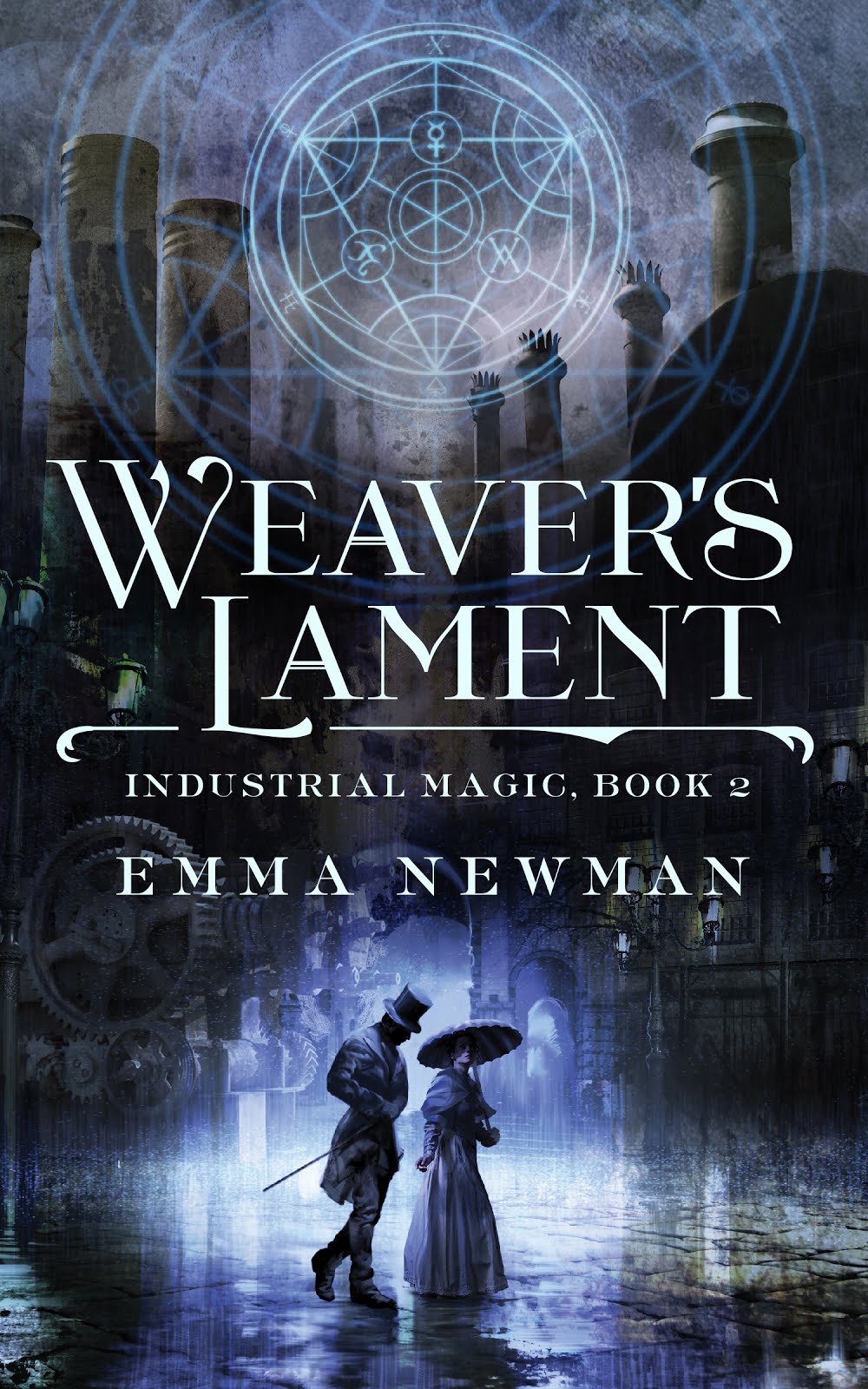
Review - Weaver's Lament by Emma Newman

Weaver's Lament (Industrial Magic, 2)
Emma Newman
Tor.com, 17 October 2017/ 1 Nov2017
e, PB 160pp

I'm grateful to the publisher for an advance copy of this book via NetGalley

If it wasn’t for the weavers, what would you do?       
You wouldn’t have your clothes that’s made of wool
You wouldn’t have your coat of the black or the blue
If it wasn’t for the work of the weavers

- Chartist song (see http://thejovialcrew.com/?page_id=1639)

Another adventure for Charlotte Gunn, following Newman's Brother's Ruin, published earlier this year, and again in novella form as is becoming increasingly popular in SFF.

This time, Charlotte's off to Manchester, Cottonopolis, seat of the Industrial Revolution, where vast profits are to be made by the mill-owners. In Newman's world these mills are driven by magic, not steam, so we can expect less smoke in the air, but the workers are nonetheless sweated by their overseers, put up in filthy, cramped conditions and doing fifteen hour shifts in stiflingly hot, dangerous conditions. And they face other threats, too, as looms shatter and the overseers wield their straps to maintain discipline.

Charlotte's brother, Ben, has summoned her to this living hell (what's the quickest way out of Manchester? Drink) to assist him. Once again, she puts love for her brother first and agrees to go undercover in the mill to investigate the nest of Socialists he believes responsible for the damage. But Ben is working for Ledbetter, the magus who Charlotte knows has dark secrets.

This book was great fun, if that's possible in something that also sets out grotesque inequalities and cruelties that are often lost in the soft focus, Hovis-ad language of drama and storytelling. In particular, fantasy, whether epic, pseudo-medieval fantasy or its edgier urban cousin, still too often sees curation of the social hierarchy as the greatest good. In contrast, what Charlotte discovers here will, I suspect, drive her to seek the otherthrow of the hierarchy. It remains to be seen if she will carry her brother with her in that - I fear not, Ben comes across as something of a milksop, a man keen to ingratiate himself with the bosses, wanting his own mill to run.

I'm even doubtful of Charlotte's mysterious ally/ tutor, Hopkins, who pops up Gandalf-like to give advice a couple of times. Is his heart really in a challenge to the authority of the Royal Society of Esoteric Arts or does he have an agenda of his own? (Charlotte certainly has an agenda of her own when it comes to Hopkins, even if she hasn't realised it yet, one her stuffy fiance George may not like much - I can see some of that absent steam reappearing before long...)

In short - and this is quite a short book - this is an eminently readable and at time unflinching view of the Industrial Revolution, blended skilfully by Newman with a dose of magic. Charlotte's awareness of the world around her is developing and she's pitted against a particularly nasty form of exploitation.

I will look forward to the new Industrial Magic, hoping, though, that Newman will be able to write some full-length stories set in this world. The novella form is great but it would be wonderful to let these stories breathe a bit more.


17 July 2017

Review - All Good Things by Emma Newman

Image from http://diversionbooks.com/
All Good Things (The Split Worlds, 5)
Emma Newman
Diversion Books, 6 June 2017
PB, 357pp

I bought this book from my local independent bookshop.

This is the 5th and final part of Emma Newman's Split Worlds sequence (quintology?)

Across the previous four, she has spun an extraordinary number of stories and deployed many characters (a list might have been helpful by this stage!) Tying everything together would be a formidable challenge for any author. Doing so - as Newman does in All Good Things - while still keeping the story fresh and maintaining a sense of narrative drive must have been even harder. Yet All Good Things succeeds triumphantly. The book moves closes in on its climax like an ocean liner chasing down the Blue Riband, Newman wringing every last drop of emotion - triumph, despair, rage, fear, acceptance - from both characters and reader. While it's tightly plotted throughout, new elements continue to appear. This series has not has tired itself out, the writing continues to dazzle and the description of Exilium (Newman's fairyland) is seriously haunting and beautiful.

The book goes to some very dark places indeed - including long sections narrated from Will's point of view. We readers have now long known - and Cathy learned at the end of the previous book - that he's a liar, a murder and a rapist, having used magic to obtain her compliance wish his wishes. He continually makes excuses, but it's hard to sympathise with him (and nor should we). Yet this story demands that we stay with him, that, to a degree, we understand him. It's very uncomfortable in places yet makes the book very raw (at the same time we are also seeing Cathy's point of view, with her outrage, shock and PTSD. Rest assures she directs some choice swearing at Will...) 

That isn't the only dark aspect. There are several deaths here, including those of well established characters. I felt that in a couple of instances these were handled a bit briefly and at arm's length, but possibly it reflects a desire not to dwell too much on suffering: the fact of what happened remains in the story and perhaps we don't need detail (in both cases the context of the deaths added to the shock - sorry if that sounds a bit convoluted: spoilers).

The redemption, though, is that, for the first time in the series, Cathy is fully aware of what's been done to her and of the realities behind the Fae, the Arbiters and the Elemental Court. And therefore for the first time she is able to fully match herself against her enemies (both persons and things) by practicing magic herself: relentless angry sweary sorceresses FTW! So in All Good Things we get the confrontations and conflict that we've been waiting for - and perhaps a sense of release that very distantly echoes Cathy's sense of liberation. It's been a long time coming but the wait was worthwhile.

Some thoughts on the series as a whole may be in order. I think these books are not only a terrific example of storytelling but, with its completion, we can now see that the books are also very important in the present moment of SFF storytelling. Newman has taken an old fantasy idea - the possibility of a fairyland and of dealings with those who live in it - and upended things, creating a mythology of sorts, and one that doesn't retread tired ideas about princesses, princesses and magic. Instead her theme is power: individual power, power structures and our relationships and responses to them. The books explore a number of possible reactions to the codified privilege embodied in the Spilt Worlds - acquiescence, quiet dissent, collaboration (get to the top and then we'll sort things out - Will's self justifying refrain right to the very end), more or less polite agitation and, in this book, an additional option, burning the whole place down. (But what then?) 

It's clear that, by this point, nobody's hands are totally clean (though some are dirtier than others), nobody has a certain answer, and nobody really knows what's going on. To a degree everyone here is a victim, but that doesn't make them all innocent.

That's not only true of the Fae and the puppets of Society - it applies too to the resource barons of the Elemental Court where Sam faces the same dilemmas as Cathy, to the Arbiter Max and his Gargoyle and to the Sorcerors as well. (Let me just taken a few moments to appreciate how Newman also twists the trope of the bluff, no nonsense industrialist - that would be Lord Iron - in contrast to the foppish toffs (the Fae touched).

What's the answer? Not an easy one, I'm afraid. Newman shows courage I think in even raising these issues - this definitely isn't escapist fantasy - and it would be wrong to expect her to announce an entire political platform as well. Truth, friends and courage feature: as Cathy goes into her future at the end of the book it's clear that more challenges are ahead and that she will need all those. A "Happily ever after" is far from certain, although taking command of one's own life is a beginning.

In short: I loved this book, and the whole sequence. The writing starts good and gets better and better and the books deserve a wide audience. I'm grateful to Emma for writing them - I hope they find and delight many, many readers for a long time to come.

You can buy the book here or here. 

19 March 2017

Review - Brother's Ruin by Emma Newman

Brother's Ruin (Industrial Magic No 1)
Emma Newman
Macmillan-Tor, 14 March 2017*
PB, 160pp, e-book

*Online booksellers give different dates but the author's website says 14 March

I'm grateful to the publisher for an advance e-copy via NetGalley.

I hadn't heard the term "gaslight fantasy" before but I think it fills a definite need, describing fantasy books set an an alt-Victorian world but which aren't in that genre full of clockwork, goggles and brass - you know the one - and most importantly, which may involve MAGIC.

In what we're promised is the first of a series, Newman has reimagined the 19th century as undergoing an Industrial Revolution driven by magic, rather than science, with the key group being the mages of the Royal Society of the Esoteric Arts. It's a crime to keep magical ability secret - if you do, enforcers will drag you away to who knows what fate. Rather it must be developed and used for the good of the Empire.

But equally, anyone falsely claiming magical powers will also suffer penalties. A dilemma then...

We don't see much of the wider picture in this book. Rather it's focussed on a particular family and the effect on them of these rules. Sister and brother Charlotte and Archie Gunn are close. He's a sickly boy: she secretly earns money to support the family, much of it poured away on Archie's studies. If either were tested by the Royal Society and passed, the family could come into money. But if they failed, it would mean ruin.

So it's concerning when there's a rap on the door one day, and the Society's agents announce that Archie, who is the weaker of the two at magic, is to be tested...

Newman tells the story through the eyes of Charlotte, a determined and clear headed young woman, who's pretty much holding the family together. She hopes she can manage the Royal Society's testers. She's not so sanguine about the debt collector who's been hanging around, apparently planning to drag her father off to a sinister address in Whitechapel. Perhaps if she investigates the place she'll find a way...?

This is a short book with a relatively straightforward story - although Newman drops a few surprises too - and it runs at a breakneck pace once the setting has been established. There are some nice touches of characterisation, such as the genteel racism of Mrs Gunn when, to Charlotte's horror, she asks brown skinned Master Judicant that fatal question, yes, but where are you really from?

We also see Charlotte's internal turmoil - 'Once she got upset about something, it pummelled her insides like a demon trapped within her...' - making her human and vulnerable: just being a hero in a novel doesn't make you immune to anxiety attacks.

There are some very nice bits of language - 'a bold red coat that looked like it cost more than their coal bill for a cold winter', 'she wouldn't have been surprised if someone told her he was actually an artist's sculpture made flesh' (Charlotte develops a VERY close interest in one of the mages from the Society) as well as calls to action - 'It was time for this rude young woman to make a difference'.

The book ends on a distinctly promising note 'I need you to be ready for adventure' SURELY promising more with these characters and this setting? I am ready, Ms Newman, I am - bring it on!


27 November 2016

Review: After Atlas by Emma Newman

Image from http://www.enewman.co.uk/
After Atlas
Emma Newman
Roc, 10 November 2016
PB, 365pp

Source: Copy bought from Forbidden Planet at author signing (see below)

Emma Newman continues to impress me with her smart, slightly twisted takes on SF - in this case, she asks "what about those left behind?"

The earlier book, Planetfall, set in the same universe as After Atlas, focussed on human settlers to a new world some 20 years in. It showed how they had been drawn there by almost religious fervour, and what happened next - with a startling twist. The concept reminded me of classic Star Trek except for the deep, empathetic portrayal of the main character and her weaknesses which gave the book so much heart.

Now, we're back on Earth at the same time (I think) as the Planetfall events. We see the awful place earth has become, which the colonists on Atlas wanted to escape. The remorseless march or corporatism has swallowed governments, which have become "gov-corps". Everyone is surveilled all the time, most people have chips embedded and there seem to be no human rights, only contracts - and some are trapped by those contracts into something not far off slavery.

Carlos is one such. Owned by the Ministry of Justice in the UK, he's been trained and formed ('hot-housed') into the perfect criminal investigator. He will work to 80 or thereabouts to repay the cost of his purchase with any failure, any rebellion punished by extra years on the contract. Yet as we find out later he has an easy time compared to some.

Carlos is brought in to solve a high profile case involving the leader of a religious sect - the Circle - from the US. The Circle consists of the people left behind when Atlas flew - one of whom was Carlos's mother (Newman makes a telling point that there's more blame heaped on the mother who left her child than the many fathers). he used to be a member of the Circle so he's ideally placed to understand what happened in a remote hotel in Devon. (The case also gives him the chance to enjoy real - non printed - food: Carlos's love of good food is an enjoyable diversion against a fairly grim background).

The book then adopts the mode - if not the normal setting - of a police procedural, with forensics, pathology, the search for evidence and a rising sense that something is off, someone isn't playing by the rules. We gradually come to sympathise with Carlos more and more, not least the grief and anger which he is clearly bottling up - assisted by the lessons from his hot-housing. He's an awkward, slightly spiky character and so, so alone.

Then - things change. I can't say too much about this for fear of spoilers but the book moves into a different mode. Something awful happens to Carlos and the stakes are suddenly much higher. Then Newman redoubles the jeopardy yet again, boosting things both to a new level of danger but also changing the sort of book this is in a heartbreaking conclusion. I was left standing in the dark on a cold railway platform so that I could read the last few pages before I drove home - it's that compelling. This is, in short, a compulsive and disturbing read. As well as sheer, relentless story we get to see the lives of those shut out of the glamorous space adventure described in Planetfall. Of course we know how that turned out - they don't, and many are damaged: Carlos's father, driven to grief and despair, for example. That's an angle on space-faring and the Final Frontier that you don't normally see.

It isn't perfect - I wonder if perhaps that first twist might come a bit sooner, as there is relatively little time then to explore the consequences? Things then seem a bit rushed at the end. But it's a testament to the power of the writing that I'm only saying that in hindsight: when you're in this book you just want it to keep coming and coming.

The best thing of all is, though, that there surely MUST be more books to come now in the Planetfall universe? It can't just end like this, can it? Please Emma?

The author reading from After Atlas at Forbidden Planet London
(12 November 2016)


20 August 2016

A Little Knowledge

Image from www.enewman.co.uk
A Little Knowledge
Emma Newman
Diversion Books, August 2016
PB, 359pp
Source: Bought

This is the fourth book in the Split Worlds series from Emma Newman, coming after a gap of nearly three years. If you haven't read the other books, this isn't a good place to start: not because it's inaccessible - she makes sure, without info dumping, to remind the reader what's been going on - it's more that this inevitably, reveals things which happened in the earlier books. You will want to spend more time in the Split Worlds so it's much better to go back and read the others (Between Two Thorns, Any Other Name and All is Fair) in order.  (Links are to my old Amazon reviews of the books, which I've tidied up and resposted here). I've written this review on the assumption that you have done that, so there are spoilers here for them, and I'm not going to explain who the Fae are, or the Elemental Court or the Arbiters.

The publication gap was unfortunate for several reasons. First, this is a cracking series and it was frustrating to have to wait for more. Also, the action in this book picks up only a few days after All is Fair ended, so the flow especially broken. Also, rereading online reviews, it seems to have led some readers - fantasy trilogies being so common - to believe that the first three books were a self-contained trilogy and so to complain that things were left unresolved. While I'd defend the right of any author to leave things unresolved if they want, that's unfair. The three strands in these books - Cathy and her forced marriage to horrible rapist husband Will, Sam (Lord Iron's) exploration of his inheritance and newly gained powers, and the adventures of Arbiter Max - have been running in parallel through all the books and only gradually coming together, but that did accelerate in All is Fair giving a degree of closure, but making it clear that there was much more to come.

A Little Knowledge takes this forward but with an even stronger unifying theme.

Cathy has stuck with Will, it becomes clear, not only because of the Charm he used on her (without her knowing) but because she thinks she can use his new role as Duke of Londinium to bring about social progress and especially to improve the position of women in the strange world of the Fae-touched. There is a great deal of impassioned, even angry feminism in this book (which is a GOOD thing) showing how the claustrophobic, archaic world of the Fae-touched, with its brokered marriages, male power and stultifying conventions, bears down on women. In point of fact, everyone here - not just the women - is a puppet, with the so-called patroons, the male heads of the various families, answering in turn to the Fae. No-one has much say over their own lives. But the men at least have the illusion of some control - and they have the women to bully and sneer at - so they're resistant to change. (It could be mistaken for a very deft and biting social commentary, except that, thankfully, our world isn't like that at all is it?)

However, no progress is being made. In reality, change never comes from above and both Cathy and even Will are powerless to actually do anything from within the system that controls them.

Cathy is magnificently angry, frustrated and sweary.

And Will? What can you say about Will? Basically he's an appealing slimeball with a few feeble good intentions.

As the books have progressed, Newman's handling of her characters has developed in subtlety and power and Will is its culmination. He is, I think, at bottom a weak man. In the earlier books there was a moment when it looked as though he might act to help Cathy escape from the political designs of her father, and he was certainly appalled that her father was violent to her. However in the Split Worlds there are no white knights. Will eventually used the magical equivalent of Rohypnol - a Charm spell - on Cathy, and he has even worse in store for her in this book, while all the time telling himself that he's "protecting" her. So he could be a hateful, despicable figure and on one level he is" but instead - the way that Newman writes him - he remains complex and human, almost a tragic hero.  (almost). If only he'd learn to cut the puppet strings and stop dancing to another's tune!

At the same time, Sam - now Lord Iron, inheritor of a vast mining empire and also gifted with his own magic, strong against the Fae - is learning the same lesson as Cathy. The other members of the Elemental Court are not going to listen to him, reform, and begin respecting the environment and their workers. Power will not reform itself just because you have good intentions.

Whatever is to be done - both in the Elemental Court and in the Nether, the world of the Fae - isn't going to come till those puppet strings are cut.

I felt this was easily the best book in the series so far, not simply because the pace has picked up - though it has - but because of the confidence of the writing, and the way the central dilemma is faced up to rather than being fudged. Fantasy is often thought of as an inherently conservative genre: all you have to do to put things right is follow the Prophecy, restore the True King or find the Chosen One (who is often the True King disguise) and accompany him (usually him) on his quest. The Split Worlds emphatically turns all that upside down - nobody really knows what's going on, not in the mess of Nether politics, not in the spreadsheet fuelled Elemental Court, not in Aqua Sulis where Max the Arbiter tries to rein in the Fae touched. There is no quest, no sense of destiny, and it doesn't offer any easy answers to how things might be made better.

The books deal in big themes and Newman's writing is well matched to them.

Frankly I've no idea what's going to happen and I await the fifth and final book with impatience!


19 August 2016

All is Fair

Image from http://fantasy-faction.com/
All is Fair
Emma Newman
Diversion Publishing, 2 August 2016
PB, 350pp
Source: Bought

This is an updated version of my review of the first publication of this book, posted on Amazon in 2013. I have revised it and am posting to the blog for the first time to celebrate the republication in 2016 and the publication of the fourth book in the series, A Little Knowledge.  

This is the third part of Newman's Split Worlds sequence, after Between Two Thorns and Any Other Name. Newman has a flair for world-building and has created a wonderful setting in which the ordinary world ('Mundanus') coexists with a 'Nether', a ghostly world where nobody ages, inhabited by a pack of immortal toffs and spongers, the "Fae-touched". They are maintained in some opulence by the mercurial Fae, which inhabit a third world, Exilium. This place is really their prison: under an ancient treaty they are forbidden form meddling with the 'innocents' of Mundanus, but allowed their way with the folk of the Nether. All this is overseen by a kind of supernatural police, the Arbiters.

Over the course of the three books, this system has begun to collapse. It still isn't clear at the end precisely why, but we do learn who has been killing off the Arbiters - and why those in London are so corrupt. It has also been challenged from within by our heroine, Cathy, who is a modern woman trapped in a Jane Austenesque world. Newman uses Cathy's position to dramatise, very starkly, the unequal position of women through most of history, and the urgency of change. She does this at the same time as telling a convincing and involving story, and portraying characters that one (well, I) really cared about. (Don't bother with Will, Cathy! He's not good enough for you!)

If by any chance you're reading this review and you haven't read the first two books, go and read them NOW. I'm about to inflict a few spoilers on you, and you've had fair warning.

Still here?

OK. In "All is Fair" we do learn some answers, and Cathy becomes again the active heroine she was through much of the first book, and who I missed in the second where she was rather firmly kept in her place. The different threads - Max, the Arbiter, Sam and his strange friend Lord Iron and the shenanigans in London Society - come together in a deftly woven plot which finally - finally! - brings what we might think of as the "goodies" into one faction. (But Will is among them. Boo!) There is also rather less of the irritating sorcerer, Ekstrand, whose place is taken by a rather different magician.

So there's lots to love in this and, as I said above, it left me wanting to know more: About Sophie. About what Lord Iris is really up to. About Iron's true significance, and that of the "Elemental Court" (remember right back at the start where Sam had a pin put in his leg and saw that as having been "contaminated"? We still don't know exactly what that means). And lastly, but most importantly, how Cathy and her reformers will address the knotty question of making social progress in a bitterly hierarchical system supported by the quixotic (at best, malignant at worst) Fae...

Any Other Name

Image from http://fantasy-faction.com/
Any Other Name
Emma Newman
Diversion Publishing, 2 August 2016
PB, 344pp
Source: Bought

This is an updated version of my review of the first publication of this book, posted on Amazon in 2013. I have revised it and am posting to the blog for the first time to celebrate the republication in 2016 and the publication of the fourth book in the series, A Little Knowledge.

This is the second volume of Emma Newman's Split Worlds series (if you haven't read Between Two Thorns yet, go and do so - this isn't a series to pick up mid way). It improves on the first, which was already promising, building the tension up nicely. The book picks up from right where the first left off - this is one story not separate books - with Cathy Rhoeas-Papaver dragged back into the Nether by her tyrannical father, about to be married to a boy she doesn't know.

The Nether is a parallel world whose inhabitants seem to think they're living in the pages of Jane Austen (without the good bits). They are encouraged/ motivated by links to the Fae, supernatural beings who live (or are imprisoned?) in a third world, Exilium. The Fae act out their quarrels and plans through the families of the Nether, named after flowers associated with the Fae. This setup is policed by Arbiters, spell-wielding policemen, and Sorcerers.

The meat of this novel consists of Cathy struggling against the marriage her family wish on her, and William, the boy she is to marry, on the one hand, and Max, the Arbiter, on the other, dealing with some fairly tricky loose ends from Between Two Thorns. We also learn more of Sam, who featured in the first book, but whose relevance to the rest was a bit of a puzzle. Cathy is - necessarily - more constrained here, which could have made the book sag, but Newman avoids that by using her plight rather shrewdly to illustrate the position of women in a patriarchal society (yes, I know that sounds dull and worthy, but please believe me, it's not). William is also a focus both as he comes to terms with Cathy - and this isn't all nice by any means - and joins in Londinium politics, seeking to become "Duke" (on his patron, Lord Iris's, orders). It is a society of morning gowns, ball gowns, duels, etiquette, and hidden drudgery and oppression - one Cathy sought to avoid - all buttressed by the devious Fae. And there is another faction - the shady Elemental Court - which also seems to be manipulating the "puppets".

An excellent read, with the main characters becoming more distinct and three dimensional and in places rather contradictory (even those we're meant to boo are allowed partially redeeming details, such as Cathy's abusive father, whose life is shown to have been constrained by the Fae - if not as much as his daughter's).

The only slight defect (perhaps) is that in the first few pages a fair amount of information is repeated from the earlier book through helpful exposition by passing characters, and it seems a bit forced. It's not that the information isn't helpful - it is, because even in a few months one tends to forget the detail - but I wondered if this might have been done through a short synopsis. But that's a minor criticism. In this book Newman seems more confident with her characters and her invented world and she really spins the story along.

Between Two Thorns

Between Two Thorns
Emma Newman
Diversion Publishing, 2 August 2016
PB, 334pp
Source: Bought

This is an updated version of my review of the first publication of this book, posted on Amazon in 2013. I have revised it and am posting to the blog for the first time to celebrate the republication in 2016 and the publication of the fourth book in the series, A Little Knowledge.

The first volume of Emma Newman's Split Worlds series gets the series off to a flying start.

Image from http://fantasy-faction.com/
Cathy Rhoeas-Papaver is a runaway, a girl trying to live a normal life away from her domineering parents. If they catch her she'll be forced back into a restricted, subservient role and probably married off, like it or not. Happy with her similarly SF-obsessed boyfriend, she understandably wants to avoid this.

The twist is, Cathy doesn't just come from some traditionally minded family - they are residents of the Nether, a weird parallel world whose inhabitants seem to think they're living in the pages of Jane Austen (without the good bits). The Nether is supported or sustained by the Fae, supernatural beings who live in a third world, Exilium. The Fae act out their quarrels through the inhabitants of the Nether (the Fae-touched), but are themselves unable to leave Exilium because of the zealous Arbiters, spell-wielding policemen. Which brings me to the other main character, Max, the grim Arbiter. Max has a quest of his own - I can't say any more for fear of spoilers - which he must put aside when the Master of Ceremonies disappears. The Master is an important figure in Society - and Society seem to be the the most important part of life for the dim and snobby inhabitants of Aqua Sulis, the Nether version of Bath, so his loss is a disaster.

So, a strong setting, albeit one where the exact workings are kept tantalisingly vague. There are lots of allusions to how this world works and how it became like it is, but little detail.

And, in Catherine, a likeable central character in a horrible fix. The story is genuinely interesting and certainly keeps the pages turning, as a sense builds up of how ghastly life is for those who want to live in the real world rather than the Nether. I did have a slight problem remembering all the main characters and families, especially Cathy's siblings and those of William (won't say who he is, spoilers!) There are a number of annoying, spiteful sisters and pompous brothers who make life difficult for the central characters and at times I forgot which was which. (I'm a hoot at family gatherings as you can imagine...)

This is the first volume in a sequence of five books. It's really a single continuous story rather than separate books), so there are a number of loose ends which become clear in later volumes - for example the story of Sam which doesn't seem to have much to do this the rest of the book does join up in time!

I wrote in 2013 that 'I believe and hope that Emma Newman will do great things with this series...' That hope was fully justified in later books, and indeed greater things are still being revealed.

22 September 2015

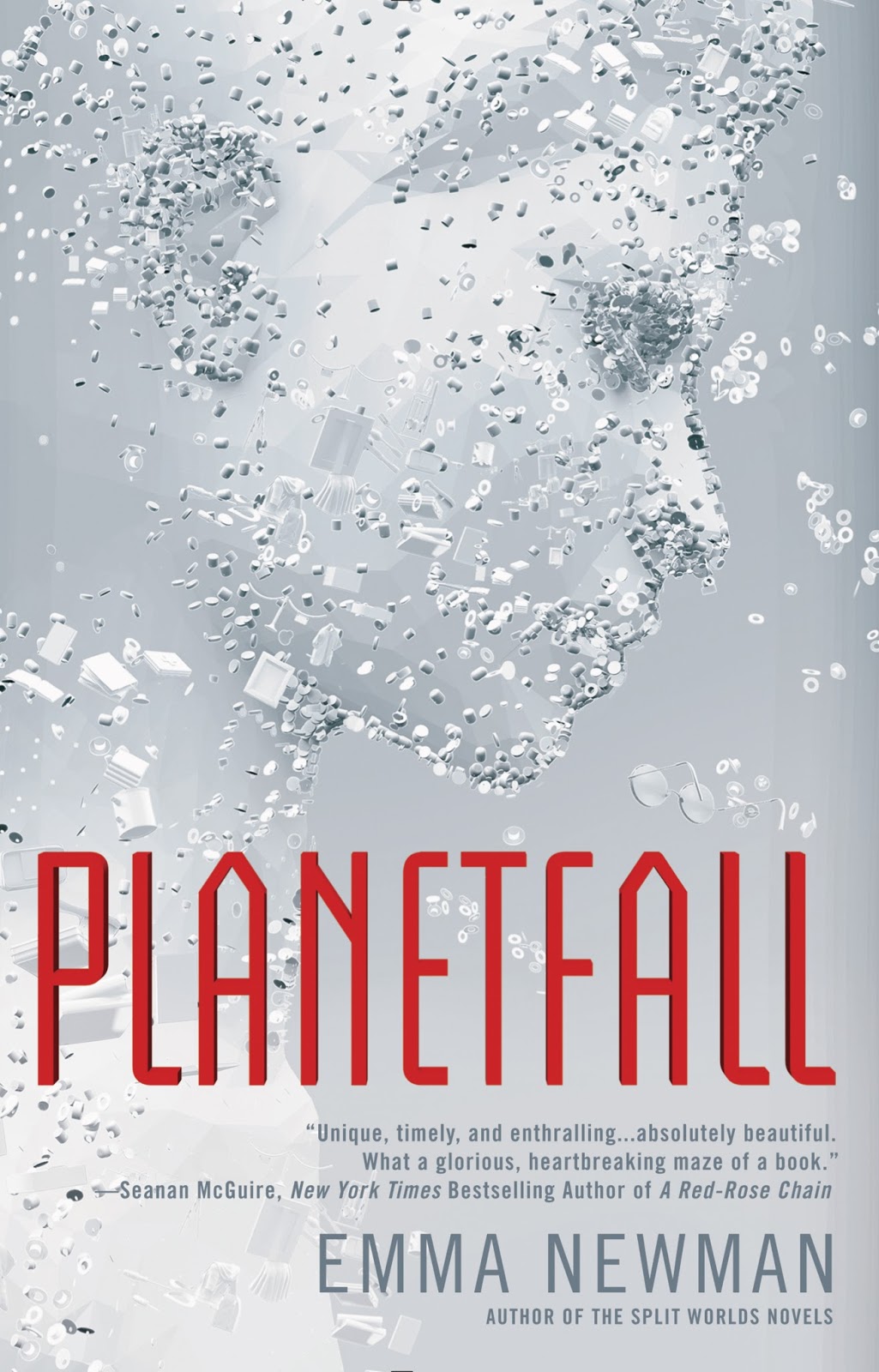
Planetfall by Emma Newman

Planetfall
Emma Newman
Roc, 5 November 2015
PB, 320 pp

I'm very grateful to the author for an advance copy of this book.

I apologise in advance if this review comes over as gushy, but I was quite simply blown away by this book.  I greatly enjoyed Newman's well observed, magic-with-manners Split Worlds series, and I hope there will be more of them, but in my view, with this book, she simply takes her writing to a new level: indeed, several new levels.

Renata Ghali - Ren - is part of a human settler group on a distant planet.  It is 20 odd years since they arrived (the "Planetfall" of the title) and the group has hunkered down and established a colony on this distinctly Earth-like world (the day length and gravity are nearly the same, and once they developed vaccines against the indigenous microbes, the group were even able to breathe the air). They live in domes, recycle pretty much everything (human waste goes into each dome's compost system, other stuff down pipes to be digested and turned back into feedstock for the 3D printers that make almost everything needed) and have built a harmonious and even idyllic little community.

And they watch for the return of their prophet from God's City.

Because the purpose of this one-way trip wasn't primarily scientific curiosity, or colonisation. Back on Earth - where, the book hints, things have got rather nasty, though we never get many details - Lee Suh-Mi received a vision, which revealed both the location of the planet and how to reach it. She gathered a group of pioneers (most of them psychologically screened) and leaving family, friends and careers behind, they travelled to their new world... where Suh-Mi disappeared into the strange, living City.  Now there are two members of the colony on guard over the entrance at all times, waiting to welcome her back. Periodically, the City has dramatic revelations for them, supporting their faith and hope. It is a community of believers.

The dichotomy between the sophisticated science that keeps the colony alive - recycling waste, 3D printing everything needed from food to clothes to buildings, monitoring the health of every member via chips embedded in their heads (which also allow them to communicate with each other in a kind of human Internet) - and this conscious, even ecstatic, vein of religion gives the book an immediate tension, a tension that crackles from every page.

Ren herself brings another sort of tension. The colony's 3D printer engineer, she was Suh-Mi's oldest friend, and mourns her absence. But Ren seems to have secrets, and as we go deeper into the story it's clear that loss has affected her deeply. The whole book is seen from Ren's viewpoint, and it would spoil the story to say much about her secrets: I will only note that Newman does a brilliant job at gradually - oh so gradually - revealing both what her problems are and what caused them. Along the way we learn about Ren's relationships with her parents and her daughter, none of whom she will see again. There are passages here which have an almost haunting intensity, for example Ren remembering sitting beside a hospital bed in which a loved one lay dying.

But this isn't only a story about Ren, although she is the heart and centre of the book. This is also the story of Sung-Soo, a stranger who walks out of the wilderness and sets events in motion. It seems that the colonists weren't as alone as they thought. Sung-Soo has an affinity with Ren, and wants to spend time with her and even help her, but his naive enthusiasm seems calculated to upset her carefully maintained balance and risk exposing those secrets. And it is also a mystery story - the mystery being, what really brought the colonists to their new world, and what is supposed to happen next? They have, it seems, been stuck for decades, moving neither forwards or backwards. There are questions that nobody will ask, answers, perhaps, that no-one wants to hear.

If the colony as a whole is stuck, so is Ren herself. Newman gives us a very human, very fragile yet also steely hero. You can't help but sympathise with Ren, but at times she - or perhaps, her situation, which she won't face - can be irritating. You cheer her on, while wishing she would, actually, move on. That's very much the reaction of Sung-Soo. As an outsider coming he in from the wilderness he put me in mind rather of the Savage in Brave New World, a proxy for the reader showing up the absurdities of the colony. But Ren has her feelings and experiences and instincts, and they are valid, and she insists that they are respected - didn't I say she was steely?

So - in the general and in the particular - there is frustration; the dilemma - I must do this thing, I fear to do it - with its resulting moral trauma is played out to the end.  The resulting emotional see-saw between Ren and Sung-Soo is yet another source - or effect - of the tension at the heart of this story.

Brilliantly written, haunting in places, with a constant narrative drive, this is the best science fiction I've read for a long time. Above all, Ren is a magnificent and magnificently written character who Newman does an excellent job of making real. When I arrived at my Tube station with 20 odd pages of this book left, I simply had to stand there on the platform, let myself be late, for work and finish it.

I think you'd want to do the same.