I like talking about books, reading books, buying books, dusting books... er, just being with books.
10 February 2023
#Review - Princess Floralinda and the Forty-Flight Tower by Tamsyn Muir
15 March 2022
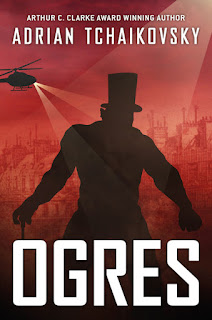
#Review - Ogres by Adrian Tchaikovsky
Adrian Tchaikovsky
Rebellion, 15 March 2022
Available as: HB, 144pp (17 March), e, audio
Source: Advance copy
ISBN(HB): 9781786185280
29 July 2021
#Review - What Big Teeth by Rose Szabo
22 April 2021
#Review - Near the Bone by Christina Henry
![]() |
| Design by Julia Lloyd |
I'm grateful to Titan Books for an advance e-copy of Near the Bone via NetGalley to consider for review.
Near the Bone is an exciting and absorbing, if at times harrowing, read. Above all it's a MEGA page turner - if you pick this one up, you'd best clear your diary for a few hours because you won't want to put it down again until the last page.
We first meet Mattie, out in the woods where she lives with her husband William on a remote mountain in the US, on an errand. Mattie discovers something new and strange. Mattie debates what to do. Should she stop and investigate, at risk of making herself late? Or should she hurry on? We soon see that her dilemma is framed entirely in terms of what William would want her to do.
She's terrified of getting it wrong.
And she will get it wrong. Because William is a manipulative abuser who has Mattie at his mercy. ('She wasn't going to think of how strange it was, because William told her what to think and she was sure he wouldn't like her thinking on this').
I won't give much more detail on that, because it would be spoilery. Henry reveals the detail of what has happened to Mattie slowly, layer by layer, building up a picture and showing us Mattie's unenviable life, every detail calculated to keep her under William's sway: starved, beaten, denied any warmth or humanity ('That's why William was always starving you, always working you when you were exhausted. Without food and sleep you couldn't think, couldn't fight him...') Much of her own history is lost to her, and it is only revealed as we learn about it, over a harrowing and desperate period of two or three days which turns her life inside out.
I also do not want to be too specific because there are some really dark themes here - themes of abuse and control - which may be triggering for some. For me, it was a mark of how good Henry is at spinning a story that even in the darkest moments I wasn't tempted to put this book aside. I had to know what would happen. It helps that, alongside the tense drama between Mattie and William, there is another strand here - that discovery of Mattie's leads to glimpses of something strange and deadly in the woods. Something that has been killing the local game. Something with uncanny grace and strength, and a greater than animal cunning.
William becomes obsessed with this thing, whatever it is, seeing it almost as a supernatural test of him. That might have given Mattie some respite except that is short-lived as other complications come into her narrow world. And the one things she has learned in her life with William is that complications are trouble, and trouble is HER FAULT.
This story was creepily, scarily believable, William a true monster but one who seems, increasingly, familiar, his attitudes those of men that we all know about, his sense of entitlement and dominance recognisable from tragedies that happen aria and gain. The comparison of man and monster is explicit: William in the cabin is bad, the beast outside apparently worse, and Mattie is trapped between the two of them. For other writers that dilemma might seem overdone, but Henry's writing gets under the skin of both Mattie and William so well that it just seems, well, true.
This is both a cracking good read and a real exploration of human darkness. Not a dark fairytale, despite the overtones of big-bad-monster-in-the-wood, but much more uncomfortable, closer to home and raising urgent questions.
Finally, they say never judge a book by its cover but... that cover!
For more information about Near the Bone, see the Titan website here.
2 December 2019
Review - Trail of Lightning by Rebecca Roanhorse
Trail of Lightning (The Sixth World, 1)Rebecca Roanhorse
Hodder & Stoughton, 28 November 2019
PB, 304pp
I'm grateful to the publisher for an advance e-copy of this book via NetGalley.
I love a book with a big, bold premise. Trail of Lightning certainly delivers this - Maggie Hoskie is a Native American monster hunter in a post-apocalyptic world where climate change ('the Big Water') has inundated much of the US and left the Diné (Navajo) people clinging to a precarious existence on part of their ancestral land, albeit (and ironically) subject to endless drought.
Maggie herself is an orphan, rescued and raised by the god Neizgháni - who trained her as an apprentice hunter before disappearing. Put baldly that sounds a lot of backstory in a short book (and there is more) but Roanhorse very skilfully parcels it out, only revealing details and facts as they are needed and allowing the reader to piece things together. The setup gives Maggie a degree of vulnerability - she is alone and mortal, facing supernatural threats that don't pull their punches, and her past has left her unpopular among the cops ('Law Dogs'), gangs, mercenaries and trade bosses who vie for power in Dinétah. There's sexism, too, highlighted when she's negotiating with a family over the price for monster-hunting job when their daughter has been snatched away by a 'tsé-naayéé'. ('Maybe they don't want to pay because I'm a woman').
I was impressed by the gritty reality of the world that Roanhorse describes, the impoverishment and general air of scrabbling for existence in a hard world. Of course it's not too much of a stretch to suggest that for Native Americans that is less an awful dystopian future than a version of their present lives and that they are already living in a post-apocalyptic world. Indeed, as described here the Big Water and its aftereffects have brought benefits such as independence ('Dinetáh risen') and - for some - even wealth. That's not a point overtly made - the story is really too fast paced to allow much time for such comparisons (though nor does the book gloss over injustices and marginalisation, past or present). Indeed it is pretty much contentious action from introducing Maggie on that first monster hunt to a final, awful confrontation with gods, monsters and vigilantes.
In between she's basically on the run, collecting a ragged assortment of allies who (of course) have their own agendas and trying to work out what's going on. Something really bad is at large, slaughtering people in the towns and leaving that trail of lightning. Even the best organised places aren't immune.
To solve the mystery, Maggie has to dig deep into her people's traditions, telling us in the course of that of a fantastical collection of gods and heroes from the old stories who are now, it seems, all to real in Dinetáh (I loved that Roanhorse makes no concessions to the English speaker, or indeed, review writer or typesetter, using spellings that I literally can't find the symbols for - for example, a word like 'wóshdee' where the two final "e"s ought to have both an acute accent é and a little mark underneath ę. My keyboard will allow one or the other but not both at once.) I loved this sense of thinness between two worlds, of the inhabitants of story walking this world, and it's done very plausibly (one god, Ma'ii/ Coyote, is a particularly natty dresser).
Maggie herself is a wonderful character - resourceful, slightly bitter in a way that's almost noir ('I lean back and start at the ceiling of the truck, asking the heavens for help dealing with men with their heads up their assess. I'm pretty sure no help will be forthcoming, but I feel the need to ask anyway') and always, always, slightly disappointed by those around her but carrying on anyway. She doesn't know everything, she's not always right (for example, she misjudges one young man she meets - he's handy with a gun, and she's surprised when her turns out to be gay) but is always ready to admit that and do better. Is she perhaps a bit overfamiliar with present day cultural references and technology? perhaps - but who knows what's current in 2030+ Dinetáh and that's intrinsically more plausible than gods and monsters anyway.
Overall then: I loved this book. I galloped through it, enjoying the buildup to the finalé, caring about the characters, refreshed by its not being another Western European strongmen in furs type of fantasy, and thoroughly liking the plot, characters and setting.
Best of all there is a sequel coming (the e-ARC had an extract in it, hopefully the publishers books does too) and I am keen to read that.
3 February 2019
Review - Down Among the Sticks and Bones by Seanan McGuire
![]() |
| Jacket design by FORT |
Seanan Mcguire
Tor, 2017
HB, 187pp
I'm continuing to review some books that have been on my shelves far too long, having taken the chance of a lengthy car journey to listen to the audiobook of Down Among the Sticks and Bones. (I bought a physical copy of this book from Wallingford Bookshop and the audiobook from Audible via Amazon. The audiobook, read by McGuire herself, is excellent, although Dr Bleak's signature whisper of a voice does at times make him a little hard to follow when driving!)
In this, the second part of her Wayward Children series, McGuire tells the other side of the story she began in Every Heart a Doorway (my review here). I won't say too much about that in case you haven't read it, but EHAD featured twins Jacqueline and Jillian - Jack and Jill ("because our parents shouldn't be allowed to name children") and their adventures at Eleanor West's School for Wayward Children. Down Among the Sticks and Bones tells more about the two and about their time in the world known as The Moors, under the care, respectively, of the strange Dr Bleak and the commanding Master. It forms a whole with the earlier book and I think the two are best read together.
McGuire has written more recent books about the Home and the Wayward Children, but moving onto other characters and with a slightly different focus. Here, though, we have an almost clinical dissection of lives, of parenting and of the weight of expectations, the story going back to Jack and Jill's parents, Chester and Serena Wolcott. Despite a disclaimer that the story hasn't actually started yet, McGuire devotes nearly a third of the book to this complacent, insufferable pair, showing how their sheer conventionality, their refusal to admit wonder to their kids' lives, above all their sheer stuffiness, warps and forms the two girls, laying the foundations for what will occur after. There are perhaps shades of the Dursleys here though I think McGuire writes with much more psychological grip.
Indeed, she writes wisely throughout and shows, I think, a deep understanding of children: appropriately, the atmosphere reminded me of writers such E Nesbit and CS Lewis who - whatever their other failings may be - understand and glory in the differences between adults and children/ young adults, and take the latter seriously. This book is, McGuire is, on their side (something that shines through all the books in this series).
I'm not going to try and précis the book because it speaks for itself, but while telling an exciting story (you find a hidden doorway in your house and go through it to a world of monsters! A world of werewolves, vampires and mad scientists! A world where you can be yourself!) McGuire also teases out the damage done by expectations and just how hard that may make finding "yourself". While the Moors may ostensibly be a place of freedom from a certain sort of adulthood, there is Authority there and it happily, greedily, feeds on what is presented to it. So Jack and Jill are set on their way well before they cross that threshold, past that notice saying "BE SURE". The story thereafter is one of McGuire teasing out how the little faults and fractures between the sisters grow, are worked on by events and undermine their relationship, their unity, until... well, until things happen.
It's a short book - all of the books in this series are - and McGuire impressively draws on our knowledge of genre conventions to save having to spell out what could otherwise take a great deal of space. In a sense the Moors (like the others worlds visited by the Wayward Children) are narrative come alive, the book referencing films, novels, poems and art to give a much clearer impression of the place than mere words might but also to prefigure how things may go in the story. This saves a lot of explanation, yet the book remains novel, fresh and compelling.
After reading Every Heart a Doorway it's good to explore one of the worlds in more detail. In the next book, Beneath the Sugar Sky, McGuire develops this idea in a very different sort of world, also making a major theme of this series - diversity - more explicit.
But that's for another review: watch this space.