Showing posts with label Matt Johnson. Show all posts

7 March 2018

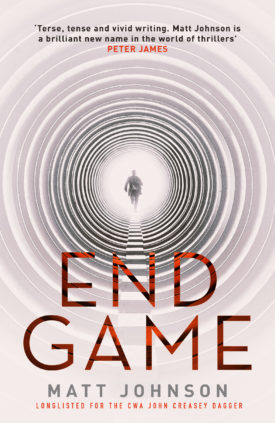
Blogtour review - End Game by Matt Johnson

End Game (Robert Finlay 3)
Matt Johnson
Orenda Books, 31 March 2018
PB, 299pp

I'm grateful to the publisher for an advance copy of the book and to Anne for inviting me to take part in the blogtour. (Full disclosure: I also reviewed the previous two books in the series for their tours and one of my reviews is quoted in this one).

End Game, as you might expect, brings to a close the trilogy of books (Wicked Game, Deadly Game) featuring Detective Inspector Robert Finlay, ex SAS. If you've read those you will want to read this and see how things pan out - I can tell you that this book is every part as twisty, as tense and as gritty as they are. If you haven't read them then, first, shame on you and, second, let me try and persuade you.

NB I will warn when approaching spoilers for the first two books - read on without fear!

End Game opens in 2002 with Finlay in the middle of an operation as part of his Scotland Yard anti-trafficking unit. The action very quickly moves back to the conspiracy that has dominated the three books: the mysterious document in Arabic whose existence must be protected, the string of murders, and all the cross purposes, suspicions and double motives among the police and MI5 officers.

As in the previous books, Johnson adopts a risky - but in his hands, successful - strategy of seeming to show us everything, narrating things from Finlay's perspective in the first person but also giving other characters' viewpoints in third person. So we'll get Finlay's take on a meeting and then read something like 'After Finlay walked out, Grahamslaw picked up his phone...' At other times we don't get this seamless transition but we do see what the antagonists (not naming them because that's a spoiler for the earlier books) are up to. They are though distanced by that third person voice. The result is that the reader identifies strongly with Finlay but also knows more than him - which is, as I said, a risky thing for an author to do but works well here, helping to emphasise the general murkiness of the world that Johnson creates (and building tension by showing just how deep Finlay's in - something he doesn't realise till very late in the book).

Yet some things are kept back from the reader: there are aspects that aren't revealed, leaving us, too, worrying about what is happening and why...

That murky world is one of the strengths of these books. Struggling to think of a way to explain it, I can only think of comparing the book to other genres. This book and its predecessors are clearly thrillers - set in modern London, they have guns, cops, spooks, ploys and tension. Yet there's also something of the fantasy about them. No magic or anything like that, but the atmosphere evoked isn't far off one of those stories where assassins roam the capital with impunity and the characters accept that anything can happen. For example (and this is a mild spoiler) people have been killed to protect the secret of that document. In a certain sort of thriller this would be the central scandal in itself: State sanctioned murder! It must be exposed! How do we get the truth out there?

Yet here it is very much taken for granted as the kind of thing that might happen and nobody wastes time getting outraged. Rather they process the facts and consider what it means for their safety and that of their families. At one level that's rather liberating, at another it makes for a very grim, dangerous world.

If somebody died, was it an accident? A suicide? A simple criminal act?

Or were State forces behind it?

If so, was that sanctioned or does someone have a private thing going on?

This ambiguity creates a whole world of doubt quite aside from the realities of what happened.

It's a very strong premise for a thriller, a world where nothing is off limits (in the previous books Finlay has basically mounted Special Ops actions under the radar and got away with it, and the bad guys here are just as prepared to do the same). In End Game it becomes even more iffy than in the previous books because new players join the deadly game - in particular a hunter from Complaint Investigation Branch who's got it in for Finlay and his friend, Kevin Jones. Between that hostility, the ambiguous roles of the various MI5 officers and a suspicion that he's being bugged, Finlay has a lot to worry about from the start.

And he's right to be worried. There's no safety net in these books, no margin for error. Past mistakes won't go away, cupboard doors swing open to reveal their skeletons, the skies are filled with chickens coming home to roost. It's all very compelling and amidst the mayhem Johnson does a very good job at tying up the many plot threads from the previous books and bringing things to a satisfying end (insofar as an end can be - I wouldn't say no to more stories about Finlay!) I wasn't sure if, in the end, we ever quite had an explanation for the full importance of that document, but maybe there are things it's better not to know...

Taken together the three books are a considerable achievement, all the more impressive given that they are Johnson's first books - he had an extensive police career before turning to writing and they arose from his need to process what he'd been through and confront his PTSD. I don't mean that to be faint praise of the "good books considering..." sort: they are good books, full stop. The octane is so high that if you sniff this book too hard you're likely to ignite. In particular Johnson's first person/ third person style makes the story come over as very visual and the chicanery and multiple agendas here presents here aren't a million miles from the world seen in current TV hits like David Hare's Collateral.

Which - given Johnson was in the Met and presumably closer to some of this stuff than Hare - might be just a teeny bit worrying... but thank goodness it's only fiction.


23 March 2017

Review - Deadly Game by Matt Johnson

Deadly Game (Robert Finlay No 2)
Matt Johnson
Orenda Books, 15 March 2017
PB, 352pp, e-book

I'm grateful to Orenda books for a review copy.

First, full disclosure. I reviewed Johnson's first book, Wicked Game, on a blogtour last year and my review is quoted inside this one (Yay! Fame! Fortune! Prizes...) I also attended the launch of that book at which the author spoke very movingly of his experiences in the Met Police and the PTSD which was part of his reason for writing these books.

I'm also reviewing this on 22 Match 2017, the day of a terrorist attack in Westminster close to where I work, and I spent this afternoon watching the incredibly brave and professional police managing the situation.

So I may seem a teensy bit biased about this book, which I enjoyed greatly, but I'll try not to be.

In fact, it's actually quite a hard book to write about. Johnson's writing isn't perfect but it has something, a distinctive voice, a blend of the matter of fact and the down right incredible, which makes it compulsively readable.

I'll say a little bit more about both these aspects in a moment. First, in case you haven't read Wicked Game, the setup.

Inspector Robert Finlay is a bit of a misfit. Ex SAS, then Royal Protection, he had just moved into uniformed policing - with a lot to learn - when he got caught up in a terrorist campaign that seemed to target him and a group of his ex-Regiment comrades. Johnson pursued this thrillery concept with zest, having Finlay dust off a cache of weapons and mix it with the bad guys, including, at one stage, taking pot shots at SO19, the Met's armed response specialists. (Bit awkward in the canteen afterwards, obviously).

Things got straightened out and blame for the killings laid at the door of Monoghan, an MI5 maverick. In Deadly Game, the Met are trying to find a role for an Inspector who's now shunned by his uniform colleagues as a bullet magnet but isn't qualified to be a detective. In the end he's attached to a human trafficking taskforce. (Johnson refers throughout to the trafficked women as 'slaves' which is either a bit quaintly old-fashioned or plain non-PC: take your pick. See also references to a WPC, a top firearms officer, as a 'girl').

At the same time, he has business remaining with MI5 over the Monaghan debacle, and his liaison there also tries to use him to get a line on an ex SAS man who's just published his memoirs. Involvement in that inevitably leads Finlay into deep trouble, in a fast paced adventure blending conspiracy theories, a 'state of the world' sub-plot reminiscent of a Richard Hannay story, and an expose of the human trafficking racket.

It's all unbearably tense, with what I'm coming to see as Johnson's characteristic blend of deeply credible detail (weapons, procedures, tactics, inter-Service relationships, personalities) with some frankly fantastic twists of fate, actions, and events. If one wanted to criticise, the latter might be a sufficient excuse, although I think that would be unfair as they don't in any way hamper enjoyment of the story. I'll only give one example - because I don't want to spoil the story - which is when a key fact becomes known because, at just the right moment, one of the trafficked women escapes and is picked up by the police.

If you want every last detail of your books believable, things like this - and there are more - may be a problem for you. Yet I find myself not particularly bothered about these things. Why? Is it because I'm biased (see above)?

I don't think so. I think the reason is rather different and goes to the heart of the appeal of Johnson's writing.

First, I've learned to be wary of saying 'X is just not believable'. It seems to be a fact in today's world that the unbelievable happens more often than you would think, and that a writer striving simply for believability might actually have to tone down the real world rather to write something convincing - and where's the fun in that?

Secondly, Johnson is, simply, a born storyteller. He does it all with such verve, switching between Finlay's first person narration and as much third-person following other points of view as is needed to paint the background -  but without ever getting bogged down. In so doing we are introduced to facts Finlay doesn't know (and never learns), characters he hardly meets (but who populate the pages of the book like figures in a soap opera, suggesting there's a whole world out there beyond what we're told) and events that took place long before. It all creates such a convincing impression of depths, of a teeming community of spies, police and crooks, that you can - well I could - forgive the odd apparently far fetched plot feature.

Finally - Johnson has been there. He won't, obviously, talk about stuff he shouldn't, but perhaps we can take on trust that, yes, the unlikely does happen, cases are moved on by strokes of luck, and both criminals and spooks do indulge in baroque extremes of behaviour from time to time (I'm looking at you, MI6 man Howard Green...)

So, to sum up: this isn't a slick book, it has a raw quality such that the unlikely events described actually seem to make the story more credible. Again I go back to John Buchan and his 'shockers'. They weren't elevated literary writing perhaps but they were - and are - cracking good stories, still readable after a hundred years or more. For sheer readability and entertainment I'd see Johnson in that tradition. But unlike Buchan, at the same time, he's exploring Finlay's slow recovery from PTSD - not at all a quick or easy theme, but a journey I'm looking forward to him continuing in future books.

To sum up even more: READ THIS BOOK!


20 March 2016

Blogtour review: Wicked Game by Matt Johnson

Wicked Game
Matt Johnson
Orenda Books, March 2016
PB, 392pp

I'm grateful to Karen at Orenda Books for letting me have a copy of Wicked Game as part of the book's blogtour. (See below for details of the tour).

If, like me, you did most of your growing up in the 70s, there are things you may remember. Not just the long hot summers, the year of the ladybirds, and punk rock. No, I'm thinking of the politically heated times. Bombs going off - both in Northern Ireland and on the mainland. Rumours about disgruntled cliques of ex military types plotting in London clubs, of "shoot to kill" in Northern Ireland. Trade unionists targeted on the mainland. Shady, semi acknowledged arms law enforcement over the water known only by cryptic initials.

Set firmly at the opening of the present century, Johnson's book nevertheless looks back to those times through the eyes of his protagonist, Robert Finlay. While it might be stretching things to give Finlay - ex Army, ex SAS - an active past in the 70s, his background in the murky world of Northern Ireland policing, and his contacts among those ex officers, mercenaries and spooks - now gearing up for a different, even more deadly, counter terrorism campaign - can't help but evoke that atmosphere as Finlay becomes embroiled in the deadly game on the streets of London.

Certainly the air of suspicion, of paranoia, effortless sweeps him up, making him contemplate actions that should form no part of modern policing under the rule of law... especially since The trouble is, Finlay is now an Inspector in the Metropolitan Police, sworn to uphold law and order. He will fall far and low if he's caught taking part in any of these "deniable" activities. Yet he's also convinced that his life, and the lives of the wife and daughter he loves, are at risk - and that only he can protect them.

This book is in a genre I don't read very much, the fast paced action thriller and that did mean I had a little acclimatising to do in the early part of the book where we are briskly introduced to Finlay's past, and to some of the elements of the later mystery. 

The writing is direct: facts and histories stated, not left for the reader to pick over: there isn't time to stop and sift the finer aspects of motivation - to do so would only slow the plot. That style of writing may not be to everyone's taste but it becomes a real strength in this book as events cascade, ruthless killers spill into the open, and the agencies who should be tackling them are far less united and coherent than one might expect. Johnson marries form and subject very well, almost as if Robert Finlay himself was giving an urgent briefing to his superiors en route to the scene of yet another murder.

This is I think where Johnson's experience at the sharp end of anti-terrorism really shows - he's good at portraying how events unfold, the roles of the different agencies, their shifting agendas and the very human dilemmas and failings of those who work for them. And also, how little they may really be able to affect events. 

He also really gets into the minds of the terrorists - there are some great passages of writing that seem to be banal monologues until you realise you're in the mind of a would-be killer stalking their victim. The ordinaryness is very convincing, as is the self-justification 

Finlay himself is straightforward: he does what he has to do now, he did what he had to do in the past. When he needed to kill, he killed: when he needed to plan, he planned. These skills come back in the present, and serve him well even though the mess he's wandered into in knottier and has many more layers than anything he dealt with before. What he doesn't do - much - is brood: unlike the heroes of many crime novels, his life isn't a mess, he lives for his family.

And he's prepared to kill for them...

You'll enjoy this book if you're into thriller and action: even if you think you're not, the pace of the writing will carry you away. Robert Finlay's not a man who gives up easily.