Magpie, 8 October 2027
Available as: PB, 352pp, audio, e
Source: Advance copy
ISBN(PB): 9780861541645
I like talking about books, reading books, buying books, dusting books... er, just being with books.
I'm grateful to Inspired Quill and to Anne Cater of Random Things Tours for an advance e-copy of The Wildest Hunt and for inviting me to take part in the book's blogtour.
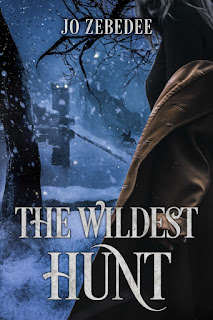
Amelia, a struggling young artist, thinks she's struck lucky when a mysterious, wealthy client offers her £15,000 just for one painting. Enough money to sort Amelia and her boyfriend Joe's debts, maybe even replace their wreck of a car.
The only catch is - Jean wants the painting of remote Glenveagh Castle in Donegal to be done over Christmas. Tempted by the prospect of spending the alone time at Jean's remote cottage, and imagining a romantic, cosy time together, Amelia and Joe instead find themselves isolated in the worst winter anyone can remember with no power - and something has noticed them...
There's a time-honoured link between Christmas and the supernatural (as I write this, I'm preparing for a trip to see A Christmas Carol tomorrow) and it's one Zebedee draws on in The Wildest Hunt, blending the season of cold and darkness with powerful, mythic themes: not only the ancient entities that haunt the Glenveagh estate, but also a lost child, the propitiatory sacrifice of an innocent, and a greed for power and control. All of these play out in both of the couples about whom the story revolves - Amelia and Joe, and Jean and her husband Robert.
Amelia isn't exactly a stranger to the uncanny - she's had disturbing experiences before, and at the start of the book, we see another one. It's not something she actually wants to explore. However, she may not get to choose - the powers rising here are cunning and Amelia's weakness may be Joe, something of a reformed bad boy with whom she's very happy but who may be just a bit too enchanted by the atavistic threats awaiting here. The tension thrums as the story unfolds, Amelia perturbed by the reactions of her partner and unsure how far she can trust him.
There's a similar tension in the relationship between Jean and Robert, although for them, things have already been soured by Jean's suspicions about events forty years ago at Glenveagh. Zebedee's portrayal of the marriage here is stark - two people who seem to at best dislike, at worst hate each other, but who remain tied together as much by bitterness and suspicion as by circumstance. The darkness of Glenveagh will be eager to exploit this rift, posting the question, what does Robert really want?
I loved the way that Zebedee uses the relationships between these four people to sound the depths of the ancient darkness that confronts them. They face a struggle at two levels - understanding the supernatural forces that threaten, and keeping a hold on their humanity, their love, to resist those forces. With almost no other characters featuring for more than couple of pages, it's an intense, emotional read, the coldness without only endurable because of odd moments of inner warmth, alongside the short respites from that coldest of winters which Zebedee allows her characters.
A truly chilling read in every sense!) strongly recommended for the fireside on an iron-hard night, a book with both complex and intriguing characters and real sense of place - as well as an absorbing and knotty plot. But if you stay up late to finish it, don't blame me if you think you hear hoofbeats snd something snuffling outside...
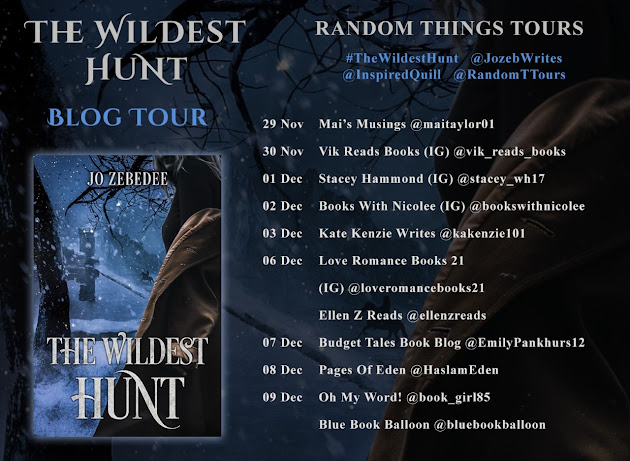
For more information about The Wildest Hunt and Jo Zebedee, see Jo's website here, the publisher's website here and the stops on the tour, listed on the poster below.
You can buy The Wildest Hunt from your local bookshop, or online from Hive Books, Blackwell's, Waterstones or Amazon.
![]() |
| Cover photo by Nicholas Royle |
![]() |
| Design by Andy Allen |
It was about time I caught up with the Six Stories world. These books feature podcastist Scott King's take on a recent mystery, presented not from all angles, as he admits, that would be impossible, but through - yes - six episodes, six stories, six perspectives.
In Deity, the focus is on recently deceased musician Zach Crystal. You have heard of Crystal, who burst into celebrity in the 90s and then grew increasingly weird and reclusive. You'll have heard the rumours, of visits to his remote Scottish compounds, Crystal Forest, but young fans. Of cover-ups and non-disclosure agreements. Of hush money and deaths in the forest. Of the fire that took Crystal's life.
Well now, Scott King is going to sift fact from fiction, and truth from rumour. To give a rounded picture, letting those involved with Crystal speak for themselves - the fans and the critics, the former colleagues, those who came up against Crystal's formidable PR machine, and those who know him early in his career.
Between these accounts we get Scott's own contextualisation, and also a transcript of a late TV appearance by Crystal, a sort of apotheosis of his strange and tragic life. It isn't just the #MeToo accusation that make his life notorious - Crystal Forest is located in a region of the Grampian mountains haunted by dark folktales, takes that seem to have taken root in Crystal's life, music and imagination. The two threads are entwined in what happens here: but are those stories of things stalking the forests a cause of his paranoia Or are they the result of it? Or a distraction from the scandalous rumours that engulfed him in the end?
Wesolowski weaves together all these threads expertly. It's a deliberately obscure, complex story. We have many examples before us now of celebrities - musicians, actors, DJs, impresarios - who abused their power and access. We have many examples of how even apparently selfless humanitarian work can be a cover, or even a means of gaining access to the vulnerable, so the outline of Crystal's life will seem familiar, spark connections. But at the same time, Wesolowski is at pains to show how there are always other versions of the truth, other perspectives, available and to leave open a shifting gamut of realities to explain what happens here. There is still altruism in the world. Crystal has his passionate defenders. Some of his accusers may not bear much scrutiny themselves, and the early lives of Zach and his sister, Naomi, who started out singing together are such that they also arouse genuine pity.
It is an absorbing and at times, genuinely scary story, told in hints and suggestions, rags and patches, less a linear narrative than a piece of truth crystallising slowly out of a murky solution. Each time I though I had the answer another narrative would pull the rug out form under my theory, before Wesolowksi spiralled back to a similar, but different, perspective which would then itself be laid low. I genuinely did not know where this was going and - whether you see it as a crime novel, a story of the supernatural or a chronicle of human frailty - the ending will I think come as a real shock.
I the course of the story, Wesolowski revisits themes and contributors form earlier Six Stories, adding to the complexity and inner reality of his invented world, and also hints at consequences for King from the choices he makes in the course of this book, perhaps setting up future books to complicate and develop that reality further. While sometimes dark in subject matter, I felt the book - by taking to fiction - was able to illuminate some recent high profile scandals and in doing so it creates a totally readable, indeed often compelling, narrative which I'd wholeheartedly recommend.
For more information about the book, see the Orenda Books website here - or any of the stops on the blogtour (see poster below).
You can buy Deity from your local bookshop - check whether they are doing click and collect - or from UK Bookshop dot org, Hive Books, Blackwells, Foyles, WH Smith, Waterstones or Amazon.
'The whole affair was about power, manipulation, ownership'.
Agnes lives in mid-Victorian Bath with her mother and young nephew, Cedric. Times are hard and she struggles to make ends meet, earning a precarious living by cutting silhouettes. But that craft is increasingly being crowded out by the new craze for photography. Perhaps Agnes will be forced to accept help from her brother-in-law, Simon Carfax?
I loved the characters of this book. The self-reliant but dreamy Agnes. The reserved Simon - doing all he can to help, but yet..., the two sisters, Pearl ("the White Sylph") and older Myrtle, who make their living from seances and consultations. Pearl and Myrtle seem to have secrets - who are they and what are they about?
And I loved the setting. This isn't the elegant city of Jane Austen, rather a Bath that's had fifty years of coal smoke bled into it, and fifty years of decay for the fancy buildings. It's a town of soot, railways, rot and mould, seen in the depths of a gloomy English winter. Agnes' house is shabby and unkempt: Pearl and Myrtle's lodgings damp and draughty. The reader senses just how tenuous the lives of these women are in a patriarchal society. The point is brought home when, through ghastly coincidence, Agnes has to report a strange death to the police and her home and business become of interest to the unpleasant (and suspicious) Sergeant Redmayne.
But that's only the beginning. It seems there's a killer loose in Bath, a killer who seems to be threatening Agnes and her family. Unable to trust the police, Agnes turns to Pearl, the young medium, for the help she needs. As the two investigate - observed closely by the jealous and resentful Myrtle - we gradually learn more about the tragedy in Agnes' own family, and the mysterious (and missing) naval officer, Montague, who seems to be at the heart of it all.
In Purcell's latest Gothic romp, the supernatural - if that's what it is - isn't confined to a remote dwelling but is intertwined with the bustling life and grimy streets of a provincial town - just as the fashionable Spritualism in which Agnes seeks answers is located in comfortable parlours and fashionable salons. Contrasts are everything here - between the past and the present; science (represented by the medicine and rational outlook of Dr Carfax) and the supernatural; men and women. It's a churning, teeming world that Agnes, infirm after a recent bout of pneumonia, has to negotiate. Her sister Charlotte, Cedric's mother, may have been dead twelve years, but her shadow still looms over Agnes's haunted life.
The Shape of Darkness is the perfect Gothic novel, a book that combines an elusive but growing sense of dread with an uneasy atmosphere of confinement - despite the proximity of the sprawling streets and parks of Bath, it mostly takes place in shut-up rooms, windows blocked. And more, there is a palpable sense of limitedness, of confinement by, and obedience to, rules of society, of choices made and sealed years before. And it's confinement with - or very near to - a monster, whose form, motives and methods are as shifting as all that fog. In asking Pearl for her help, Agnes is leaning on someone who is still a very young girl and who is also ill (nearly everybody in this book is ill!)
Purcell is the absolute master of this sort of thing, playing detective story-like tricks with red herrings, subplots and dead ends, until the reader is - well I was! - totally muddled, wound up with tension and fearful for everyone in the book. Then, the hammer falls...
If you enjoyed this author's previous books, you'll love The Shape of Darkness. If you didn't, that must mean you haven't read them yet, so you have a treat in store and The Shape of Darkness would be a good place to begin.
I'm grateful to the publisher for an advance e-copy of The Shape of Darkness to consider for review.
For more information about The Shape of Darkness, see the publisher's website here.
I Am Dust