Showing posts with label Sarah Pinborough. Show all posts

4 December 2019

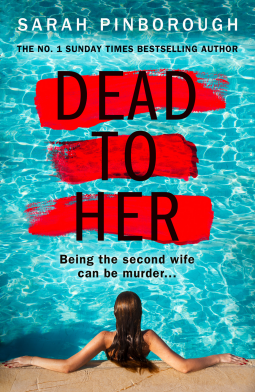
Review - Dead to Her by Sarah Pinborough

Dead to Her
Sarah Pinborough
HarperCollins, 2020
Available as: e, audio (4 June), HB (6 August), 416pp
Read as: Advance e-copy
ISBN: 9780008289072

I'm grateful to the publisher for an advance e-copy of Dead to Her via NetGalley.

When I saw there was a new novel by Sarah Pinborough coming in 2020, and that it was available on NetGalley, I got very excited and put in my request as soon as I could. And when I was lucky enough to be approved, I read it straight away, rather than waiting till next Summer. I appreciate this review is way early but it's been a year or two without a book from this author so just couldn't delay. Look at this as a peek into the future - what you may be reading next August...

You can't tame a wild thing

Dead to Her opens with a party and an entrance.

'Eyes scanned the new wife's gold dress - Versace maybe - figure-hugging but an inch too short for this society crowd. The heels - half an inch too high. The jewellery, thick coils around her neck and hanging from her ears, impressive but attention-seeking. All of the women - nearly all over fifty - would be making the same assessment: She's not one of us.'

William, a wealthy and influential, but ageing, (and White) lawyer practising in stately Savannah, Georgie, has invited his wealthy, influential (and mostly ageing) White friends to meet his new English wife, Keisha (young, not wealthy, Black).

Returned early from a trip to Europe he'd taken after the death of first wife, Eleanor, he's eager to present Keisha to Savannah society... and to begin moulding her into someone that will do him credit. There was an element of Pgymalion in William's attitude to Keisha, if Professor Higgin, besides being sexist and a snob, also had a streak of malice. William may have been taken with Keisa when he spotted her waitressing in a strip club, attracted by her youth and looks and even because she was not like his friends, not like Eleanor.  But that is past. William is home now. Keisha has to fit in, take golf and tennis lessons, behave herself. If she's going to keep her place, she needs to earn it not just by meeting his needs in bed (those little blue pills are stern masters) but by becoming something she's not.

Keisha - one of the two main viewpoint characters - is on the cusp of discovering this, and the first part of the novel follows her as she realises how things are going to be. She comes to recognise the fix she's in, that William is not what she thought he was. But that's actually the least of her worries. She has secrets of her own. She was brought up by a ghastly uncle and aunt who think she's now their meal ticket. She's addicted to tranquillisers ('Thank fuck for her Valium') and she's in a very unfamiliar society. Under the eye of the first wife - in the form of portrait hung over the staircase - living in a house where Eleanor's bedroom, left as it was when she dies, mustn't be touched, intimidated by William's housekeeper Zelda, there are Gothic echoes here from the outset. Add to that Keisha's conviction that she is cursed, her memory of seeing a ghostly boy, and a sultry, voodoo-laden atmosphere, this is a book that seems to invite the uncanny.

From that first appearance Keisha is under suspicion by Marcie, young second wife to Jason, William's partner, who thinks Keisha has an eye on her husband. Marcie knows the ground here, having won Jason away from his first wife, Jacquie (who is also, we soon learn, back in town). Having a lot in common with Keisha - Marcie also come from the wrong side of the tracks, and also, as we will see, has secrets too - she's not unsympathetic to Keisha, but business and position come first in Savannah. Marcie won't be poor again and she won't lose Jason, despite the shine having come off her marriage too. ('It was amazing how you could contain yourself - imprison yourself - if you really tried')

So when the two women are thrown together - Jason is keen that Marcie befriend Keisha and persuade her to put pressure on William to retire - there is bound to be trouble. I often found myself holding my breath as the scenes between them teetered on the verge of blowing up into something truly scandalous. Keisha has a streak of recklessness, of daring, in her which leads her to cross lines and, combined with the tension between the two women, this gives the early parts of the book a real sense of danger, of things getting out of control.

Pinborough has a deft hand at sketching such relationships, giving both the light and the dark sides as she's shown in previous books such as 13 Minutes - there is something of the same atmosphere here, a mix of respectability and naughtiness with boundaries mutable and a sense of risk. That is articulated by Marcie, the other main character here, who's consciously rowing back at times from the "fun" out of concern at provoking Jason and falling from grace. As I've said, Marcie has her own secrets - and she becomes concerned that someone else knows them. Just how much will Jason put up with from her? Just how much will she put up with from him?

But this book is more than a study of male control of women, though it is grounded in that: that's the reality of life among the privileged in Savannah, however much it's disguised by the Club, the parties, the charity fundraising drives. There are obvious nexuses of rebellion such as gay party planners Julian and Pierre, who seem at first as though they're going to be a bit of a cliché - until Pinborough demolishes that: 'I was born Peter. I became Pierre.' There are deeper and more dangerous fractures in the elegant structure too, glitches in the family connections, the twisted links going back generations - more challenging, more scandalous secrets. Jason's father, for example, committed suicide ('the honourable thing') after being caught embezzling clients' money. And others besides which it would be spoilery to describe.

There is also some design working out here. Someone who knows things. Who pulls strings. Keisha, in her fear and panic, fears Eleanor's ghost, thinks she sees evidence of even darker things going on - but neither actually sees what's coming to them. As you'll know if you read Pinborough's books, things can get very nasty, very tense, very quickly. Part of the thrill here is realising just how wide the web has been spun - when that's made clear it drops with the surprise of a master.

Pinborough also has a gift for description. There is some perfect language in this book. The 'luxuriously slow' pace of leisured Savannah life is compared to 'a cat's stretch'. As Keisha suffers withdrawal from her Valium we read that 'The ants in her head were starting to emerge...' In particular there are some very evocative descriptions of sex (not all of it good sex!)  We hear about William's 'lips cold and rubbery - old man mouth' as well as Keisha's fantasy of 'younger hands and warmer lips pressing her back onto the hood of her new red sports car'. The furniture sees a lot of action, so that sometimes it's easy to take an innocuous phrase the wrong way. After reading 'He'd fucked her over the dining table, huffing and puffing at her back' I didn't know for a moment quite how to interpret 'having Marcie across the luncheon table' but it turns out to be just a meal. (That time). We're left in no doubt that Keisha and Marcie may be privileged, may be more comfortable that their backgrounds would have allowed, but they pay a real price, they are little more than assets or trappings to their husbands who retain all the power and whose word goes.

It's a stultifying, claustrophobic life, even before weird things start happening. When they do - and regardless of who may have been reckless in the first place - those young wives, those second wives, those disposable, outsider wives - are the ones directly in line to take the blame and suffer the consequences.

And even behind that there is something else too...

I really enjoyed this book. It's compelling, scary, sharp-eyed but also written with genuine warmth and sympathy for those caught up in the evolving scandal. And the peril and jeopardy last till the very end, with some revelations about one character there is NO WAY I saw coming.

I would strongly recommend.

(If, like me, you've read Pinborough's earlier books you might also spot - I think I'm right here - a little nod to Murder and Mayhem).


12 May 2018

Review - Cross Her Heart by Sarah Pinborough

Cross Her Heart
Sarah Pinborough
HarperCollins, 17 May 2018
HB, 373pp

I'm VERY grateful to the publisher for an advance copy of this book which I've been eagerly awaiting.

Cross Her Heart must be a strong contender for THE psychological thriller of 2018. Building on the success of last year's Behind Her Eyes, Sarah Pinborough has packed in even more reversals, even more revelations, combined with a sense of sheer page-turning dread that made me equally desperate to find out what happened next - and fearful of knowing.

In this book, innocence is abused, the past explodes into seemingly orderly lives and secrets corrode relationships.

Lisa has worked hard to build a safe home for her daughter, Ava, far from her abusive alcoholic father, Jon. Their life might be quiet but it's secure.

Marilyn has secrets of her own. But she doesn't want to burden her best friend Lisa. 

But when Ava heroically saves a young boy's life, and it makes the national press, it looks like Jon has found them at last.

As danger draws closer Marilyn is the only person Lisa can turn to for help. But can they protect Eva when the threat seems to be everywhere?

Cross Her Heart escalates quickly. Almost from the start there's an atmosphere of menace. We sense that Lisa is in danger. We see clearly that she's troubled by the past and fearful, on edge - though we don't know why. But to distract Lisa there is the day to day routine of her work, rivalry with an unwelcome new colleague who may have secrets of her own, worry over ordinary teen problems with Ava. Maybe, just maybe, Lisa's a bit paranoid.

Alison, in whom she confides, certainly thinks so.

Pinborough excels at describing the day to day anxieties, insecurities and concerns of the women in this book. Eating. Dissatisfaction with their bodies. It's not only Lisa and her workmates, there's sixteen year old Ava too and her gang in the swimming club. They are so young, so insecure, but so much want to be grown up and at the same time they think they're so wise, so worldly, so much cooler than fuddy duddy mothers - just like every generation before them. Portrayed warmly and with heart, their lives are vivid and yearning. As the sense of dread builds, it's entwined with these mundane concerns, Lisa's work worries both fuelling her other fears and taking the edge off them.

Taking her edge off, too, so she doesn't see what's coming, despite spending years looking over her shoulder. The reader sees some, not all of it - several times I was almost shouting "LOOK OUT!" at Lisa. But of course she doesn't want to be worried, she wants to believe that all is well.

And then it hits.

Even as the storm rises and catastrophe strikes, Ava still focusses, though, on her own concerns, her boyfriend, sex, the uncertain tides and currents of her friendship with Angela, Jodie and Lizzie, the fraught relationship with her "weird Mum" who's oh so clingy and should just BACK OFF. Because it's all about Ava, isn't it? With great sympathy and compassion, Pinborough has I think absolutely nailed that desperate stage of life when everything is changing too fast and yet not fast enough, especially if your mother won't let you alone, texts three times in the evening to check you're OK, insists on driving you to school.

But why IS Lisa so overprotective? Parents always are, yes, but... there's more here. What's Lisa hiding, and why doesn't she just come out with it and tell Ava? But then everyone here is hiding something.

Ava certainly is.

So is Marilyn.

DON'T let anyone spoil this book for you by telling you what's going on. DON'T flick to the end. DON'T, above all, trust the book. It escalates quickly, yes, but it's twisty too, indeed even the twists have twists. Always remember it may not be going where you think!

All in all, an electrifying read but also, such a sad book. At times - be warned - it makes very dark reading and these characters really suffer. But Pinborough is never gratuitous. There is abuse here, and there are desperate, stunted lives. But there are also friendships, and loyalty, and trust given against all appearances and there is a moment towards the end of the book when a character says "I'm not going to wait around for a man to save the day. Fuck. That. Shit" and after what you've read through up to that moment you will, I guarantee, punch the air (please bear this in mind if you're reading the book on a crowded train).

This is vintage Pinborough, clever, insightful, deeply human, compassionate and perceptive. If you want to read about how modern lives work, and don't work, you need to read Sarah Pinborough's books. You need to read THIS book. Remember, though, the tricks that she plays with you, the reader, in them.


22 January 2017

Behind Her Eyes

Behind Her Eyes
Sarah Pinborough
HarperCollins, 26 January 2017
HB, 373pp

Source: Advance copy kindly provided by the publisher

I may be a teeny bit biased when it comes to Sarah Pinborough's books - I have yet to read one that I didn't enjoy. But really. You have to read this book, just do. I'm going to be nagging everyone to do that and you may as well give in sooner rather than later.

Not only is it Pinborough at her very best (and that's something in itself) but it's Pinborough leaping and vaulting over genre boundaries, authorial conventions and the reader's sense of where the book is going. You may think you're got it sussed, but you haven't. Not for nothing has the hashtag #wtfthat ending been going round.

Which sort of makes it hard to review. I'm generally not precious about spoilers but - for once - I really, really mustn't say anything about the ending. Beyond, perhaps... no. Nothing.

Begin at the beginning then? It opens with what might almost be a spell:

Pinch myself and say I AM AWAKE once an hour.

Look at my hands. Count my fingers.

Look at clock (or watch), look away, look back.

Stay calm and focused.

Think of a door.

What's going on? Whose spell is it? What do they want?

This is the story of Adele, of David and of Louise.

Troubles Adele (we hear some of her thoughts) who desperately loves her husband David

David, who denies Adele a phone or credit cards, and has control of her money. Who seems himself desperately unhappy. Stressed. But controlling, in charge. Who moves the household from one place to another, changing jobs, sloughing off friendships.

And who fancies Louise.

Insecure Louise, still smarting from her divorce, a bit heavier than she'd like, devoted to her six year old son, ready for a little love or even just some tenderness.

It's also the story of a girl and boy in a lonely institution. Of the mind games and cruelties that people play on each other when they think they are in love, when they want things, when they are afraid. Of the lengths they'll go to.

It's a psychological thriller, very much so. But. If you've read Pinborough's last two books there is a sense in which it's the natural outgrowth of, a sort of thematic sequel to, both The Death House and 13 Minutes.  The flashbacks show a deep understanding of the younger versions of the characters and while the "now" parts are more adult-focussed, the truth of what's going on rests very much on how those people were formed, who they really were and as in those stories, Pinborough infuses naturalistic settings and real - oh how tangibly real - people with a delicate sensibility of horror. Like a little speck of blight in the perfect rose, or the whiff of death in a still life. Remember that thou shalt die.

Which I think distinguishes this story from the currently popular 'grit-lit' of the The Girl who did the Thing type. Yes, there is psychological tension here, by the bucketful. David - controlling, watchful, but desirable. What's his real agenda? Adele - well, we see her point of view, she tells us she's up to something but it doesn't quite make sense. Is she the victim, trying the regain her freedom? Or the villain? Does she want revenge? For what exactly?

And Louise - what's her game? Is she really Adele's friend or will she betray her with David?

Together these three wheel and leap through the story like gymnasts. The reader is never quite sure what to expect. Louise is the one who sets herself the task of solving the mystery: she feels that only by understanding Adele's and David's past can she understand their present and free herself from them. She's helped by a battered notebook - but we, the readers, know more than her as tricksy Pinborough gives us both Adele's thoughts and the occasional flashback. It's all about viewpoints, I think, the past seen through different pairs of eyes.  And information: who knows what about who, and when. Towards the end of the book one character compares things to a jigsaw puzzle that's about to be completed - but that's optimistic. These pieces keep changing shape and colour.

If that all sounds a bit clever-clever, don't worry - this is more than a pacey thriller, but it is, also, a very pacey thriller. From that first page, it casts its spell (Pinborough's also done some compelling versions of classic fairy stories, and it shows) and the reader - well, this one - just has to keep on, sympathising by turns with Louise, Adele and David: wary by turns of Louise, Adele and David, baffled at what's happening, but knowing, just knowing that there's stuff bobbing under the surface.

And praying it's just a lump of weed, not a putrid corpse.

This book remained in my thoughts long after reading - it's not so much (or not only) what happens in the story, but what you realise will happen after.

Creepy as hell, and simply brilliant.


4 March 2016

A Bookish Evening

I had a fun evening last night. Working in the middle of London does have advantages - I managed to get to two book events after work.

Leaving early, I made my way to Sloane Square underground and walked up Sloane Street (interesting, but not a place I'd naturally go) to the Embassy of Iceland for the launch of Quentin Bates' Thin Ice (which I'll be reviewing on the blog tour in a few days).

It was a great event with bloggers, authors and event the Ambassador present (no Ferrero Rocher, but there were lots of nibbles). I found out what Deal Noir is (thank you, Susan Moody) and exchanged a word or two with the great man himself - some of whose translations I've read but none of his own books. Here he is with Jo Parker of Life of Crime.

And here's the Ambassador, welcoming the book and proving he has read by pointing out it mentions his home town THREE times. I also had a helpful chat with Guinevere Glasfurd who  explained that the best times to visit Iceland are winter or summer but not in between. I might try and persuade the family that this should be our next destination. (The Ambassador agreed that this was a good plan).

The second event I wanted to get to was at Waterstones Piccadilly. Left out of the Embassy, on up Sloane Street, into Knightsbridge Tube then three stops on the Piccadilly Line to Piccadilly Circus which is very handily placed for Waterstones - or do I mean Waterstones is handily placed for Picc. Circus? I don't know. Anyway, I arrived just before 7, and the event was in full flow - AK Benedict (author of Jonathan Dark or the Evidence of Ghosts), Sarah Pinborough, whose 13 Minutes is just out and Steve Cavanagh whose latest book is The Defence - he very kindly signed a copy for me to give my mum on Mothers' Day (nooone tell her).

The three authors were being interviewed and it was enlightening to hear their contrasting thoughts - especially on how their books mirrored (or didn't) their real lives. Steve Cavanagh explained how he got inside the mind of a conman (and how, as a lawyer, he was told by a senior colleague that he had a criminal mind). AK Benedict pointed out that her book was, unintentionally, about loss: the main character is having a breakdown after the collapse of his marriage, with death and failure also featuring. And Sarah Pinborough distanced herself, as a responsible adult, from the teenage sex and drugs of her book while speaking very movingly about the pressures that teens face - and about that attitude of invincibility, just starting to crack at that age.

At the end I got books signed by all three: here's the picture I tweeted next as "authors signing" although perhaps I should have entitled it "Authors drinking wine".

Most frustratingly I had a bout of authorstruckness (which IS a thing: it's when your mouth moves but nothing sensible comes out because the sheer amazingness of meeting such WONDERFUL AUTHOR-Y PEOPLE) and the aftereffect was that I paid for my new books and hurried away, totally forgetting that I'd brought along some I already had and I ended up taking them home UNSIGNED.

So I have some unfinished business with my authors... but never mind. It was a wonderful, if frantic, night and, I think, a totally fitting way to spend World Book Day evening.

So thanks to everyone who arranged these events, spoke at them and for having me at them.

15 February 2016

Review - 13 Minutes by Sarah Pinborough

13 Minutes
Sarah Pinborough
Gollancz, 18 February 2016
HB, 416pp

I'm grateful to NetGalley for an advance e-copy of this book.

Sarah Pinborough is well known as a horror writer. With recent books she has blended her horror with YA (The Death House), detection (Murder/ Mayhem and The Dog-Faced Gods) and even fairy stories. Now she turns more squarely to teenage life even than in The Death House.

You might think a story of a young woman who was drowned, died for 13 minutes but then returned to life would be a tale of darkness and haunting, and of course this is - but not in the kind of supernatural way you might expect. Pinborough continues to surprise, though, and you shouldn't take anything on trust: the group of teenagers affected by the events in this book may be ordinary but that doesn't mean everyone is happy, secure or - perhaps most of all - safe.

Tasha Howland is a successful girl, popular at school, leader of the cooler-than-cool clique known as the Barbies. So how did she end up, the middle of one night, in an ice cold river, clinically dead? 13 Minutes follows Tasha's attempts to rebuild her life and to make sense of what happened to her. The story's told from multiple viewpoints: mainly Tasha's onetime BFF Becca but we also see a lot of Tasha herself, of the detective assigned to the case, and of Becca's boyfriend. There are texts, transcripts of sessions with a counsellor, newspaper cuttings and excerpts from Tasha's diary. And it all comes together, oh so cleverly, oh so slowly. Pinborough has written a very clever book, on several levels.

First, she gets under the skin of the sixth formers - Tasha, her cohorts Jenny and Hayley, Becca and her uncool friend Hannah. The book revolves around them and to a great extent they form a little world of their own, looking out, everything seen through their motivations - rivalries, anxieties, popularity and unpopularity. There is history between them, but we only discover it gradually. The author was, I understand, a teacher and I'd guess a very good one - the observation and understanding here is razor sharp.

Secondly, she... oh I don't know if I should even say. No spoilers, but this book is tricksy. There are lots of narrators here, OK? Are they all telling themselves the truth all of the time? Are there things that are known but hidden, not referred to, lurking under the surface? Are there things, under the surface, that even the confident, sassy teenagers don't know about?

And then, the book is so skilfully plotted. It seems to be one thing and then something happens - you'll know it when you reach it, you might even see it coming a little way ahead and congratulate yourself, but watch out, it's the consequences that matter more than the event itself.

From that moment the rather careful choreography of the group of girls - not friends, but pushed into shifting alliances by the event that befall Becca - changes pace, as though a performance of Swan Lake suddenly turned into The Rite of Spring - and secrets emerge like little dancing devils. It becomes more and more clear that something is badly wrong, but Pinborough keeps a final understanding from the reader till almost the last page, when the book closes with frenzied action.

It is, I would say (as one who'd a long long way from teenage) a realistic, not moralistic, portrayal of teenage life. There's a bit of sex, there are drugs, but it's not a book about those things or their Dire Consequences: they aren't markers for Out of Control Youth or Moral Decay, just stuff the characters are coping with. If such things bother you, be aware.

Most of all though, it's a great read. Pinborough continues to delight her readers, refusing to be confined to simple genre categories and increasing her range all the time.

Goodness knows what she'll do next.