Showing posts with label Victorian. Show all posts

14 September 2026

Review - The Crooked Medium's Guide to Terror

The Crooked Medium's Guide to Terror
Stephen Cox
Independent, 12 September 2026 
Available as: PB, e   
Source: Advance copy
ISBN: 9781068164439. 

I'm grateful to the author for sending me a copy of The Crooked Medium's Guide to Terror to consider for review.

This is the second volume of Cox's series featuring Mrs Ashton, the crooked medium of the title (though she's now more honest than she used to be, I think "crooked" is still probably reasonable) and her companion and lover Mrs Bradshaw ("Braddie"). The two women make a precarious living in the Spiritualism racket that flourished in the 19th and early 20th century, with a sideline in burglary (though this may now be in their pasts). In Terror, their living is slightly better, than in The Crooked Medium's Guide to Murder, since Ashton has found a patron (an Earl no less) who supports their work (though this outrages Braddie's Socialist principles). So the two women are not quite so much up against it here, nor so close to being enmeshed in scandal, or even arrested, as before, though they are still not secure, or respectable. Their love must still, of course, remain hidden with Braddie treated at times as a servant to allow them to fit into the rigid patterns that society allows. The price, in stress and fear, that this inflicts is a running theme in the story, Braddie suffering most (Ashton herself is often maddeningly uncomprehending).

The Earl's patronage aside, Ashton's new attitude of honesty - and to a degree the two womens' prosperity - may also reflect that, due to the events of The Crooked Medium's Guide to Murder, she has acquired more of a genuine insight into the spiritual realms, along with a spirit guide who readers of that book will recognise. (That detail apart though, the books could be read entirely as standalones - though you'd be missing a treat if you didn't read the first book too).  But she still doesn't really understand the rules, and in this adventure Braddie and Mrs Ashton will encounter others who have both more understanding and more psychic power than she does.

It all starts when Mrs Ashton is retained to investigate the death of a carpenter, David Gittens, who leaves behind a heartbroken (and pregnant) lover. There turns out to be a disturbing psychic aspect to this death, which is not the only supernatural cause for concern in London. A seance held in fashionable society, and involving the new darling of Spiritualist circles, Madam Moray (a woman for whom Ashton undoubtedly feels some mild jealousy) goes catastrophically wrong as well, and Mrs Ashton, the former crooked medium, is well placed to investigate whether it was all fakery, or whether something rather nasty may be stirring.

The story spirals from here into an agreeable and action-filled blend of opportunism, dark forces and endangered reputations. The family of Lord Hanbury, father of Tommie, best friend to Ashton's protégé Maisie, is enmeshed in the affair and indeed threatened. Maisie herself fell in with Tommie - a young woman of independent mind - at the posh academy to which she was admitted as part of the fallout of the first book, and she's making use of the opportunity for education. Ashton though misses her lieutenant who was always able to marshal assistance for investigations from the London street kids. Maisie is, however, in exactly the right place to provide an inside track to goings on in the Hanbury household.

And she'll need that, because mysteries abound in this complex, fast-paced story. Both spiritual and mundane evil are afoot. At the heart of it all is a very human quest for retribution which has drawn something much darker to its aid - a darkness that may have its own allegiances and motives. Mrs Ashton's instinct is to look for the good everywhere, and to trust to redemption and forgiveness. Madam Moray, by the end of the story, is less sure and issues a warning. 

With hints of other unseen hands in play, and the potential spiritual defence of the country itself at stake, I can see all sorts of ways this dilemma may play out. Cox has rather brilliantly identified a psychic vulnerability for the empire on which the sun never sets - the decidedly iffy lives and pasts of its foremost statesmen, and it seems as though, despite Braddie's disdain for empire and power, the two investigators are going to be drawn back to that arena.

I loved this book. Not only do we get a sort of Buchanesque thriller (washed of the more dubious aspects of the 1870s - 1930s "shocker") but in Mrs Ashton and Mrs Bradshaw we see the dilemmas of two women with a love that can't be declared openly. We see not only their happiness but the strain they're under, their jealousies, and fears of abandonment, of separation. 

In many ways this is an outsider story - it may feature lords and earls and the top brass of Scotland Yard, but Ashton's world is one of ex-boxers, of thieves, of a Chinese magnate who may have power and wealth but is stranded between "respectable" society and his own nation, of the whole disreputable Spiritualist movement, riddled with frauds and existing on the whim of fashionable society. It's a cause for concern that an upcoming production at the Savoy Opera is to lampoon both Ashton and Moray - acceptability to polite society can be hard-won and easily lost. That outsiderness adds a distinct frisson to the action, with the protagonists risking much as they go about their business.

Recommended, and I'm keen to see what comes next in this series!

For more information about The Crooked Medium's Guide to Terror, see the author's website here - and if you want a copy (you should!) you can also find links there to buy the book, both from online retailers and some bookshops.


19 January 2024

#Review - The Curious Affair of the Missing Mummies (Jesperson and Lane, 3)

The Curious Affair of the Missing Mummies (Jesperson and Lane 3) 
Lisa Tuttle
Jo Fletcher Books, 4 January 2024 (PB)
Available as: HB, PB, 432pp audio, e   
Source: Advance copy
ISBN(HB/ PB): 9781529422757 

I'm grateful to Jo Fletcher Books for providing me with me an advance  e-copy of The Missing Mummies to consider for review.

I missed the chance to review The Missing Mummies when it appeared in hardback last summer, but by fortuitous blogging happenstance, that has simply made the timing better for a story focussing on thefts from the British Museum. And one might argue, on somewhat unethical collecting and conservation policies although I suppose to do might though be seen as anachronistic because of course these stories are set in the high 19th century when the British Empire had little regard for such niceties.

The story opens with the the duo of Jesperson and Lane engaged to investigate the theft of a few minor artifacts from the Museum. To begin with, their task seems fairly straightforward - one of recovering the missing pieces without tipping off Mr Budge, the chief curator, that anything has gone missing. But it seems these are not the first thefts. Given, though, that casual attitude to acquisitions - and the full blown market in looted antiquities which feeds it - it's soon clear that it can be hard to tell what has actually been stolen. Complications pile up affecting Museum politics, with more significant items found to have gone astray, a death, and the involvement of a collector who seems to have a link to Jesperson's childhood in Egypt...

I enjoy these books, which are told from the perspective of Miss Lane: at first sight a Doctor Watson to Jespersen's Sherlock Holmes, but in reality much more than that, since her unprivileged position (a woman! Not wealthy!) actually gives her many insights - and also reasons to check the impetuous Jesperson. Here, it aids her in befriending Matilda, a young heiress whose view of life, marriage and friendship Lane decides needs some amendment (beginning with her relationship with that collector, referred to as her "uncle", and proceeding to address the idea that marriage should be the peak of her expectations in life). What follows is the development of a complex relationship. You can't really conclude that the two women like each other that much, and there are story elements going on which it would be spoilery to reveal and which mean not everything is what it seems. But Lane acts - how can I put this? - she acts with a sense of responsibility towards a young and vulnerable person which is refreshing to see and the twists and turns of which are enjoyable to follow. (As is Jesperson's evident infatuation with the young and pretty Matilda - do a see a little jealousy from Miss Lane? Perhaps her motives are not completely unmixed...)

The book, like its predecessors, treads the line between a rational explanation of events (leading tom a to and fro business with the museum to track down what is missing, who had access to it and where it all went) and the possibility of an extra dimension to things, represented by Violet Dawes, a psychic who has appeared before in the series. Given Miss Lane's previous experience in this regard - her last employer was a bogus medium, but Jesperson and Lane have encountered the unexplained in previous adventures - I felt that things were perhaps a bit compartmentalised here with the earlier part of the book proceeding on the former lines but not entertaining the latter at all - until things realign. I felt perhaps our heroes, and especially Miss Lane, might have been slightly less sceptical at the start and more so more so later on: but that's a minor point really, perhaps reflecting that they are a little slow to recognise what's going on.

Once they do, however, the story really takes wings with a potent threat taking shape - a deadly threat to Matilda, and perhaps a wider one too. Plenty of action follows with a dash by train in the middle of the night and a combination of skills needed to address the danger - Jesperson's practicality, Lane's courage and empathy, Violet's esoteric abilities and the Egyptian learning of the redoubtable pagan Brown, a scholar who I hope we will see more of in future.

In all, a fun adventure.

For more information about The Missing Mummies, see the publisher's website here.

14 November 2023

#Review - The Death of Sir Martin Malprelate by Adam Roberts

Cover for book "The Death of Sir Martin Malprelate" by Adam Roberts. A pair of railway tracks recede into the image of a Victorian man, with stovepipe hat, portrayed I genitive. To either side the steep rooves of terraced houses.
The Death of Sir Martin Malprelate
Adam Roberts
Datura Books, 14 November 2023 
Available as: PB, 400pp, audio, e   
Source: Advance e-copy
ISBN(PB): 978-1915523020

I'm grateful to the publisher for providing me with an advance e-copy of The Death of Sir Martin Malprelate to consider for review.

It was an unexpected treat to have a new book from Adam Roberts, and as we move into the season of Christmas ghost stories what better than one with a whiff of the uncanny, a story set in Victorian London - and a London beset by unease and coming change?

In 1848, much is in flux. Across Europe, revolutions and revolutionary movements swell. Even in Britain, the Chartists agitate. At the same time the new railways are redrawing the map of London, and of the wider country. Roberts catches a moment when these things are in process, but not complete, where the future is uncertain. The Middlemarch Grand Congruence Railway is imagined, and being built, laying waste to swathes of Camden, but it is not yet a reality. Despite the bustle of progress, many of the journeys taken in this book are on foot, by stagecoach, on horseback or in carts. Political agitators push the People's Charter and are seen as firebrands, radicals, though pursuing an agenda which to modern eyes seems a very modest step towards democracy. There is a great deal of "Dickensian" atmosphere (and Roberts plays games, dropping in characters and events from Dickens, and from other 19th century novels) and language but also a sense that this is looking backwards. In another strand of the story, literary ideas are formed from the fantastic, from the dawning of science fictional ideas. It all produces a feeling of dizziness, a loss of certainty, a sense that anything might happen.

The novel opens with the death that gives it its title and this event is, like much here, uncertain. We're given many alternative explanations for Sir Martin's - the chief architect of the railway company's - death, from murder at the hands of mobs of disaffected agitators or citizens whose homes and gardens he's seized, to some kind of supernatural, devilish influence, to others even more fantastic. But as Sir Martin's own character proves slippery - his deeds contradictory, both a grasping Scrooge of a man and also a philanthropist - so does the reason for his death. Both end up as ways into the fantastically complex society that's being built, which is explored by two men seeing to understand what happened to Sir Martin. These are Bryde, an engineer, and Holmes - Vavasour Holmes, father of the more famous Sherlock.

These sleuths can't though be detached from the events whirling away here, but are picked up and jostled by the forces at play. Indeed there's a whole subplot where Holmes is spirited away to Middlemarch itself, making this not just a London novel but one engaged with progress and resistance across the whole country.

It's a truly absorbing read, a detective story - complete with a Scotland Yard Inspector, of course - but also plenty of bustling Dickensian figures - sneering company grandees, pernickety clerks, loquacious women serving soup, servants at inns who clearly imagine themselves as central characters in a narrative not walk-ons as here. It's a deeply literary mystery, not just in its atmosphere and characters but in the way it examines the world and in the alternative theories it considers for the accomplishing of the central murder. This was, it's clear from the start, intended to be a spectacle, and a puzzling one - but that doesn't mean there isn't a perfectly human motive behind it, even if it's obscured by the means adopted.

I loved the atmosphere here of an uneasy 19th century, not a self-satisfied, grand edifice but a society very uncertain of itself, not a place blessed with the perspective of hindsight at all but a fractious, provisional, turbulent society people by fractious, turbulent people.

A truly enjoyable read.

For more information about The Death of Sir Martin Malprelate, see the publisher's website here.

23 June 2023

#Blogtour #Review - The Fascination by Essie Fox

Cover for book "The Fascination" by Essie Fox. An intricate design, done in blue and gold. The design features a series of concentric hexagons radiating from the centre of the cover. In the resulting bands blue and gold alternately predominate, the detail featuring swans' necks and delicate wings as well as bullrushes.
The Fascination
Essie Fox
Orenda Books, 22 June 2023 
Available as: HB, 305pp, audio, e  
Source: Advance copy
ISBN(HB): 9781914585524

I'm grateful to Karen at Orenda Books for sending me a copy of The Fascination to consider for review, and to Anne for inviting me to join the book's blogtour.

The Victorian era. Where can one even begin in drawing out its themes, its achievements, its darknesses? Perhaps Charles Dickens, in the famous opening to A Tale of Two Cities, sums it up well by listing a series of contradictions (the best of times, the worst of times...) Yes, I know Dickens was writing about pre-Victorian France, not Victorian England, but aren't all writers working with an eye to their own time? 

One might certainly think so in Essie Fox's new novel which, to me, casts a cool eye over an age of reason, progress and confidence: but also one of superstition, fear and vast social inequality. Highlighting the outsiders on the fringes of society - the travellers, the fairground folk, the "freaks" who offend against a rigid idea of nomality and the misfits who don't have a place in the highly structured social order - The Fascination shows both the freedoms such people could enjoy and the price that might be demanded.

The story is told from two viewpoints - those of Keziah and of Theo. Keziah, with her twin sister Tilly, suffers early in the story when her mother dies. Her father, a rather feckless drunk, takes up a new way of life as a travelling peddler of quack medicines, using the two (identical, except that Tilly stopped growing at the age of five) as part of his sales pitch. 

Theo is the orphaned grandson of dissolute Lord Seabrook, who keeps a private collection of horror and curiosities which both fascinate and repel the boy.

The face of author Essie Fox, a white woman with dark hair
Essie Fox
Both the sisters and Theo are eventually cast out - the girls sold at the fair in a scene reminiscent of The Mayor of Casterbridge, and Theo dispensed with when Seabrook takes up with a new woman who gives him a son and heir. One of the joys to me of this book is Fox's willingness to use such tropes (banishment, inheritance) of Victorian melodrama - and, as the story develops, gothic - but in an intelligent and knowing way that supports, rather than distracting from, the story. So, the shop and museum of horrors owned by Dr Summerwell, where Theo eventually finds employment, is not just a grotesque flourish but has a deep connection with events here, suggesting a hidden side to Victorian society within which all kinds of dark things can flourish.

I wouldn't though want to overemphasise that darkness. Fox's villains are grotesque, but the main characters are an intelligent, resourceful, motivated and above all, loving, group of outcasts who live in a little community in Chiswick. The bustling London world may shun them - except when it wants a "freak" as the centrepiece to a pantomime or to perform at a fair - but they have a respect for each other and a sense of interdependence and trust that is heartwarming. Nor are they afraid to challenge the conventions or double standards of that wider society - Keziah for example taking great pleasure from a copy of Fanny Hill that comes into her hands.

The Fascination is a story which explores Victorian society in some depth, but more importantly it's a book that tells a vivid and engaging story with plenty of shocks and surprises - and which is written with great heart and soul. I'd strongly recommend it.

For more information about The Fascination, see the publisher's website here - and of course the other stops on the blogtour which you can see listed on the poster below. 

You can buy The Fascination from your local high street bookshop or online from Bookshop UK, Hive Books,  Blackwell's, Foyle's, WH Smith, Waterstones or Amazon.

Blog tour poster for book "The Fascination"


11 May 2023

#Review - The Other Lives of Miss Emily White by AJ Elwood

Cover for book "The Other Lives of Miss Emily White" by AJ Elwood. In the centre, the title, in a black disc. Around the disc, a lighter annulus in which is repeated a standing figure in a black dress. Around that, various motifs: an open book, a skull, an artist's palette.
The Other Lives of Miss Emily White  
AJ Elwood
Titan Books, 11 April 2023
Available as: PB, 317pp,  e  
Source: Advance copy
ISBN(PB): 9781803363707

I'm grateful to Titan Books for sending me a copy of The Other Lives of Miss Emily White to consider for review.

AJ Elwood/ Alison Littlewood is of course a master of suspense whether in a modern or a historical setting, so I was expecting great things from The Other Lives of Miss Emily White, but I have to say this story surpassed even them.

Introduced by Ivy, an elderly woman living alone in the 1920s, the action takes place 60 years before in an unremarkable Yorkshire Victorian girls' school, a slightly down at heel establishment devoted to applying some polish to young ladies so that they can find themselves husbands. The teenage Ivy is a farmer's daughter who's looked down on by her snobbish classmates - and there's a whiff of scandal about her. Children can, of course, be very cruel and while there's little overt bullying here, Ivy is very much a target. She recalls how how poverty brought her to this place and what it means to her to have been wrenched from her happy life and especially from her sister, Daisy.

The arrival of a new teacher, Miss White/ Madam Blanc, brings drama to Miss Dawson's Seminary from the very beginning. Drama, tragedy, and the malign attention of Ivy's peers as they sense a potential victim in the young schoolmistress. So begins a battle of wills, made more confusing and dangerous by apparent sightings of Miss White in places where she's not.

There are secrets here - secrets belonging to Ivy, secrets belonging to Sophia, Miss White's chief tormentor, and secrets belonging to Miss White herself. Secrets, and layers of pretence. The farmers' daughters being made into gentlewomen. The horse, painted with a blaze to resemble his dead predecessor. The solidly English teachers, always called by French names. Perhaps, too, a level of pretence so fundamental that it's subconscious, invisible to those taking part. 

Pretence, and doublings. Around them swirl the currents of emotions of those young ladies, isolated from their families and being moulded into something they're not - the book opens with a chilling prospectus written by Erasmus Darwin, setting out how girls are to be educated. You can sense the  contradictions and the turmoil. Who, exactly, is Miss White? What are her intentions regarding Ivy? What are Ivy's intentions, if it comes to that? Just what is going on? It's a deeply uneasy setting even more a whiff of the supernatural appears...

I felt this story really captured the confusions of late childhood/ early adulthood, an age when reality is malleable and outrageous fancies may be spun into truth. That, and a sense of hauntedness, drive a taut and lingering horror story that will remain with you long after you close the book.

For more information about The Other Lives of Miss Emily White, see the publisher's website here.

21 February 2023

#Review - The Whispering Muse by Laura Purcell

Book "The Whispering Muse" by Laura Purcell. All monochrome. Around the edges of the cover we see flowers in shades of white and grey. In the centre, a dark space - the black background - over which are the author's name (in white) and the title (in red) and the words "Obsession. Superstition. Tragedy".
The Whispering Muse
Laura Purcell
Bloomsbury Raven, 2 February 2023
Available as: HB, 293pp, audio, e
Source: Advance e-copy
ISBN(HB): 9781526627186

I'm grateful to the publisher for an advance e-copy of The Whispering Muse via Netgalley to consider for review.

The Whispering Muse is an absolutely top-rate historical horror which makes some trenchant points about women's lives being bent out of shape by the society - and especially the men - around them. As I've come to expect from Purcell, we're given nuanced, layered horror, deeply coiled around human lives and circumstances - but also, moments of shocking, scary climax as those human lives crumple and break. It's a heady mixture, making every page both a 'must read' and a 'dare I read?'

Jenny is trying to hold together her family - comprising only her younger brothers and sisters, as their parents are both dead - and is desperate for any work she can get. An offer of a role as a dresser at the Mercury Theatre comes as welcome news, but it will soon bring Jenny face to face with divided loyalties, the prospect of ruin, and indeed utter terror when the company embark on a production of 'The Scottish Play'.

All Jenny's problems trace back, in one way or another, to the men around her. Formerly a lady's maid, she lost her place because of the feckless behaviour of one of those men. Another of them, the manager of the theatre. seems to be taking too close an interest in one of the actresses, but inevitably things go wrong and he demands Jenny's help in managing the situation. Meanwhile, his wife also expects Jenny to break up the relationship (or else). And just when it seems things can't get any worse, another man from Jenny's past turns up threatening to break up her little family.

I loved just how complicated things became for Jenny, but particularly her relationship with that actress - Lilith - to whom she's appointed as dresser. The two women have very different outlooks - Lilith daringly Bohemian, ambitious, willing to flout Victorian morality (but, if she wants her career to progress, does she have any choice?) Jenny more conventional, perhaps, as shown when she's told to turn round three times, spit, and swear because she said 'Macbeth' - and she can't bring herself to do it.

The most moving moments of the book, in counterpoint to the gothic horror, are those when these two women are learning to trust one another,  to get to know each other.  That doesn't always turn out well, indeed little in this book turns out well, but possibilities open then, experiences are shared and alternative futures open up.

Those moments of respite never last long, though - there is a drumbeat in The Whispering Muse and it is a drumbeat of terror, horror stalking the theatre and its unfortunate cast and crew. What seems at the start like theatrical whimsy and self-indulgence - I thought of the Blackadder parody of that spitting-and-turning round thing - comes back to claim a price, as events grow progressively darker. That darkness is only pointed up by a sort of disjointed reaction from the wider world to the horror taking place. There is a prurient interest in what happens (not going to spell out what that is because spoilers) but a distinct lack of concern, of empathy, with those affected by it. (An attitude I think sadly true to life, not only of the Victorian era but of those since and up to the present day - it would be easy to imagine the cursed Lilith racking up huge numbers of social media followers, rather than stage door Johnnies, all to abandon her as she crashed and burned).

In the end though, and despite The Whispering Muse deploying quite the tide of gory horror (it features productions of both Faust - in two different versions - and MacBeth) I think it's actually in may respects  hopeful book, both showing ways in which solidarity and fellowship can defeat, or at least elude, power, and celebrating human companionship and love.

For more information about The Whispering Muse, see the publisher's website here.


27 May 2021

#Review - The Angel of the Crows by Katherine Addison

The Angel of the Crows
Katherine Addison
Solaris (Rebellion Publishing) 
23 June 2020/ 17 September 2020/ 27 May 2021
Available as e, HB, 500pp, PB, 464pp
Source e: Advance e-copy via NetGalley/ audiobook
ISBN: 9781786183224 (e), 9781781088500 (HB), 
9781781089101 (PB)

I'm grateful to the publisher for an advance e-copy of The Angel of the Crows. I also read parts of the book as audio.

The Angel of the Crows is probably the most thorough reworking, yet also the most authentic reworking, of the Sherlock Holmes stories that I have seen. 

The book adapts several of the original stories, including novels (A Study in Scarlet, The Sign of Four and of course, The Hound of the Baskervilles) and short stories (The Copper Beeches, The Speckled Band, and more) into a magical, alternate 19th century. The two friends - a Dr Doyle (of course) recently returned injured from Afghanistan, and the eccentric, brilliant Crow - share rooms at 221b Baker Street. Gregson and Lestrade still appear, as (in slightly different guises) does Moriarty. The Baker Street Irregulars are replaced by Crow's reliance on a corps of undifferentiated angels... did I mention that Crow is an angel?

We also meet vampires, werewolves, Hellhounds, Haemophages and countless other supernatural creatures, in a world familiar - if not always at ease with - mediums, aetheric disturbances and the Fallen (but you don't REALLY want to meet one of them). You might think all of this would detract from the logic and induction which is supposed to be at the centre of the original stories, but it really doesn't. First, Crow is formidable at sifting through the data and inferring what is going on (and Doyle is no slouch either, he's not a limited Watson). Secondly, those original books were unashamedly sensationalist and The Angel of the Crows gleefully echoes that, whether in a pursuit of a suspect across London carried out with the help of a Cerberus automaton, a fight between Hellhounds on Dartmoor or an expedition into a vampire lair. 

Most importantly, this book is not simply derivative - it reinterprets and develops its subject matter, giving it a genuinely new and different sensibility that is much more than mere Victorian pastiche. In the course of these adventures we come, for example, on a character here who isn't conforming to this society's gender expectations, and have to consider the consequences of that. The novel also confronts the legacies of Imperial looting and of racial diversity in London, that most cosmopolitan of Victorian cities. 

All this is done while maintaining an exciting and intricate storyline, weaving together its chosen episodes with new adventures and twists on the familiar (look for the reference to "The Sherlock Arms"!)

My only reservation is, in the 1888 set novel, to the background of the (real) Whitechapel Murders. It's hardly original to set the Great Detective and sidekick (though Doyle is more than a sidekick) against that killer and I did wonder if there is really any more that can or should be said here. This was a real killer and the crimes described are real crimes. In discussing them The Angel of the Crows provides plausible analysis and, within the framework of the story, a satisfying conclusion, but on the whole I preferred the properly fictional elements in this book. And those parts certainly deliver a lot, from the thrill of a client arriving with a new case, to the sinister atmosphere of the Great Grimpen Mire to the emerging and troubling position of Crow within the hierarchy of angels in London - almost an outcast, a subject of suspicion, a cause for worry to his friends.

The audio version of the book is excellent, Imogen Church's narration inhabiting a dizzying array of characters and always evoking just the right nuances of language and disposition. Just when you think she can't possibly conjure up another one, there it is - from the slightly babbling enthusiasm of Crow to the stolid Doyle, the Irish of Moriarty and the stiffness of the London police.

I have hopes that this may be the start of a series - there are threads here which could clearly be taken forward - and I hope that is the case. Would definitely recommend.

For more information about The Angel of the Crows, see the publisher's website here.


4 April 2021

#Review - Hyde by Craig Russell

Hyde
Craig Russell
Constable, 29 April 2021
Available as: HB, 400pp, e, audio
Source: Advance e-ccopy
ISBN: 9781472128393

I am grateful to the publisher for an advance e-copy of this book via NetGalley.

In Victorian Edinburgh, Detective Superintendant Edward Hyde is uneasy. In one case of frightful murder, leading to a hanging, he worries that the police have got the wrong man. In another, he finds himself conveniently close to the victim, but can't remember how he came to be there. And there are nagging requests from Special Branch in London to investigate a rising nationalist politician.

And Hyde's sessions with Dr Porteous, who he relies on to cure the memory loss and associated troubling dreams, are not helping at all...

Russell's speculative detective novel, loosely framed around Robert Louis Stevenson's novel Doctor Jekyll and Mr Hyde (there is a prologue in which Hyde tells Stevenson his story as inspiration to the latter) is a heady blend of many elements. 

There is the brooding, unrestful Hyde, half convinced that he is a monster - people tend to draw away from him, as though sensing something troubling about him. Hyde is I think suffering (alongside the epilepsy that Porteous diagnoses) from PTSD, after serving in the army in the East. Russell makes a point not only of the awful things that Hyde has witnessed and indeed taken part in, but also of the taint, the fundamental badness, of the campaign that Hyde took part in, devoted to theft and looting ('cruelties performed under a sun-blazed sky in the name of Empire'). Fragemented personalities recur ('he had been a different man, back then).

This links in turn to political turmoil, as Scots radicals seek to free themselves from what they see as English domination and from being associated with that same infection of Empire. This is an interesting connection to make, the focus on colonialism and its relation to English and Scottish history and society being a truly hot topic in today's politics and one capable of provoking strong emotions (see the UK Government's defensiveness over challenges to the interpretation of colonial-era figures and artifacts).

Underlying this is a third layer - a preoccupation both with the Celtic supernatural, as both occultists and mountebanks move in various secret circles overlapping both with nationalist politics and with the apparently staid Establishment. That preoccupation bleeds into national myth-making about the origins of the Scots and their real destiny. And alongside all this, Russell also reflects the place of gay men in society, and the constraints under which women exist. We meet Elspeth Lockwood, heiress to one of Edinburgh's great department stores, a woman who very much wants to go her own way, and I really liked Dr Cally Burr, who performs many of the autopsies for Hyde; as a female doctor, she's treated with a great deal of suspicion and is short of work (we see her being helped out by the famous Dr Joseph Bell, mentor to Arthur Conan-Doyle who is mentioned but does not appear in the story). Burr is smart and resourceful, practical where Hyde seems likely to wilt under the various stresses that he suffers, and certainly the kind of person you want beside you in a creepy Gothic house at night.

Because this book is Gothic, whatever else it may be. There is an isolated mansion of bad reputation, whispers of supernatural beasts, devils and ancient gods and of secret sects and guilds behind the bland face of respectable Edinburgh ('fine Presbyterians of good birth and standing leading double lives') as well as secret tunnels beneath it, at least some of which are certainly real. There's a danger, I thinks in overdoing the Gothic, but for my money, Russell gets it just about right: enough, combined with the theme of madness and loss of identity and control, to darken the atmosphere (alongside the various horrific murders) but not enough that solid, systematic police work becomes self-evidently pointless. Truly, Edward Hyde lives in more than one world at one, but he is sufficiently rooted in the "real" one, enough of a respected, credible figure that he makes progress, gets things done (aided by Burr's shrewd insights).

The book is also grounded in the medical science of the time (even if it looks primitive to us) and it is convincingly, pleasingly Victorian without were seeming a pastiche. Russell has fun with erudite bits of language and Hyde will certainly broaden your vocabulary, adding words such as muliebrity, supervenient, brumous and peccancy. I did see a couple of the plot twists coming (such as the identity of the Hanged Man) but there were also some jaw-dropping surprises and, above all, Hyde is a book that hooks the reader and builds to a tremendous climax.

An interesting counterpoint to Russell's The Devil Aspect which also dwelt on issues of good and evil, divided personality and the relation between individual responsibility and political crime. 

Definitely recommended.

For more information about Hyde, see the publisher's website here.


4 October 2018

Review - The Corset by Laura Purcell

Cover by David Mann
The Corset
Laura Purcell
Raven Books, 20 September 2018
HB, 416pp

I'm grateful to the publisher for an advance copy of this book via NetGalley.

The Corset stitches together the lives of two young women in (I think) the early Victorian period.

Dorothea Truelove is an heiress in her mid 20s, unmarried, socially isolated since her (deceased0 mother converted to Roman Catholicism and in danger of being labelled a spinster. While she fills her time productively with prison visiting and the study of phrenology (the notion, long since disproved, that character and behaviour could be inferred by measurements of the head) this isn't enough to satisfy her father that she has a decent place in Society and she's being encouraged - rather, pressured - to find a husband.

Ruth Butterham has fallen on very hard times. Raised in genteel poverty, she has lost both her parents and, though a truly awful chain of circumstances, ended in prison, still in her teens, accused of murder. The irony of this is that as we gradually learn, her situation in New Oakgate Prison is less precarious - the charge apart - than much of her life to date.

We hear Ruth's story as told to Dorothea, who has her own agendas and prejudices - trying to reconcile what she's told with head measurements, musing on how far the character is fixed or can improve (we learn the reason for her obsession with that very late in the book) and, very gradually, falling apart because of the tension between her love - or perhaps infatuation - with David, a handsome (but poor) police constable, and the pressure to marry some fusty (but rich) suitor.

I found Dorothea, for much of a book, to be a rather annoying character. At first she seems introduced mainly as a device to narrate Ruth's much more interesting (and often harrowing) story and as such, she often seems to slow down, comment on or filet what Ruth's trying to tell us. While Dorothea's own family situation is less than ideal she seems, to use a modern concept, very unconscious of her privilege and it's easy to dislike her.

That would, though, be a mistake. I won't say much because of spoilers but Dorothea does have her own interest in Ruth's story and while her situation may seem less desperate, she is also a woman in a nakedly patriarchal society, unlikely to be able to find happiness or indeed, any life at all in which her own choices are respected.

In that respect Dorothea's in the same situation as Ruth. Purcell is an adept at plotting, and you can only really appreciate how the two women's experiences intertwine and question each other once you've finished the book. In the same way, you can only understand the hints of the supernatural which runs like a silver thread through the story when all the acts of this tragedy are completed. And when you grasp both those things I think you'll forgive a lot - not least Dorothea's air of self-satisfaction ("David lacks my discipline, even with his police training") and judgement, and Ruth's fatalism and self-doubt - because it's clear these things have been instilled in the two. Dorothea notes that "As with most female subjects, a hollow is apparent at Self-Esteem". Ruth is convinced of her own guilt, and who's going to take the trouble to review what really happened and decide whether that actually is the case? The arm of the patriarchy here is indeed long, and strong. A great theme of this book is the way men treat women and indeed, the way they treat women with whom they have become bored, or who are inconvenient or socially embarrassing: the book is scathing and illustrates this cruelty from many different angles - without ever yielding men the chief place in the story. What happens here is sometimes painful to read, but I found my reading sustained by a sympathy for Ruth and a growing sympathy for Dorothea. They are great characters.

What I found slightly harder at first was what I saw as a sense of unevenness in the language. This is a Victorian set novel, and the characters generally behave and speak as Victorians yet we also sometimes get what to me look like very modern phrases: "I'm going to check you",  "set it up", "crime scene" or "We're in this together, now". It's hard to think Purcell would be sloppy about such matters - much of the prose in this book is so on point: (repeated references to the copper smell of money, "The spirit went but the filth lingered", "It whispered of revenge and power, of taking back control" and many, many more) that I suspect either she knows from her research that these phrases are perfectly apt (I recal my reaction the first time I came across the mention of baseball in Jane Austen) or, perhaps, more daringly, that they are a hint we should be a bit more generous in seeing "historical" characters as "people like us".

After all, unless you were Boris Johnson, you wouldn't pick up a book set in Ancient Rome and expect it to be in Latin. And there's little that is worse that an over-fusty pastiche, Wilkie Collins style.

I hope this is, in the end, a minor criticism.  The book as a whole is so convincing, has so much truth and, to continue the (relevant) fabric metaphor, is so deftly woven together. It is a heartfelt book, a damning book, an exciting book and above all, a thoroughly enthralling book which simply demands to be finished.

For more information about The Corset, see the publisher's website here.


25 October 2017

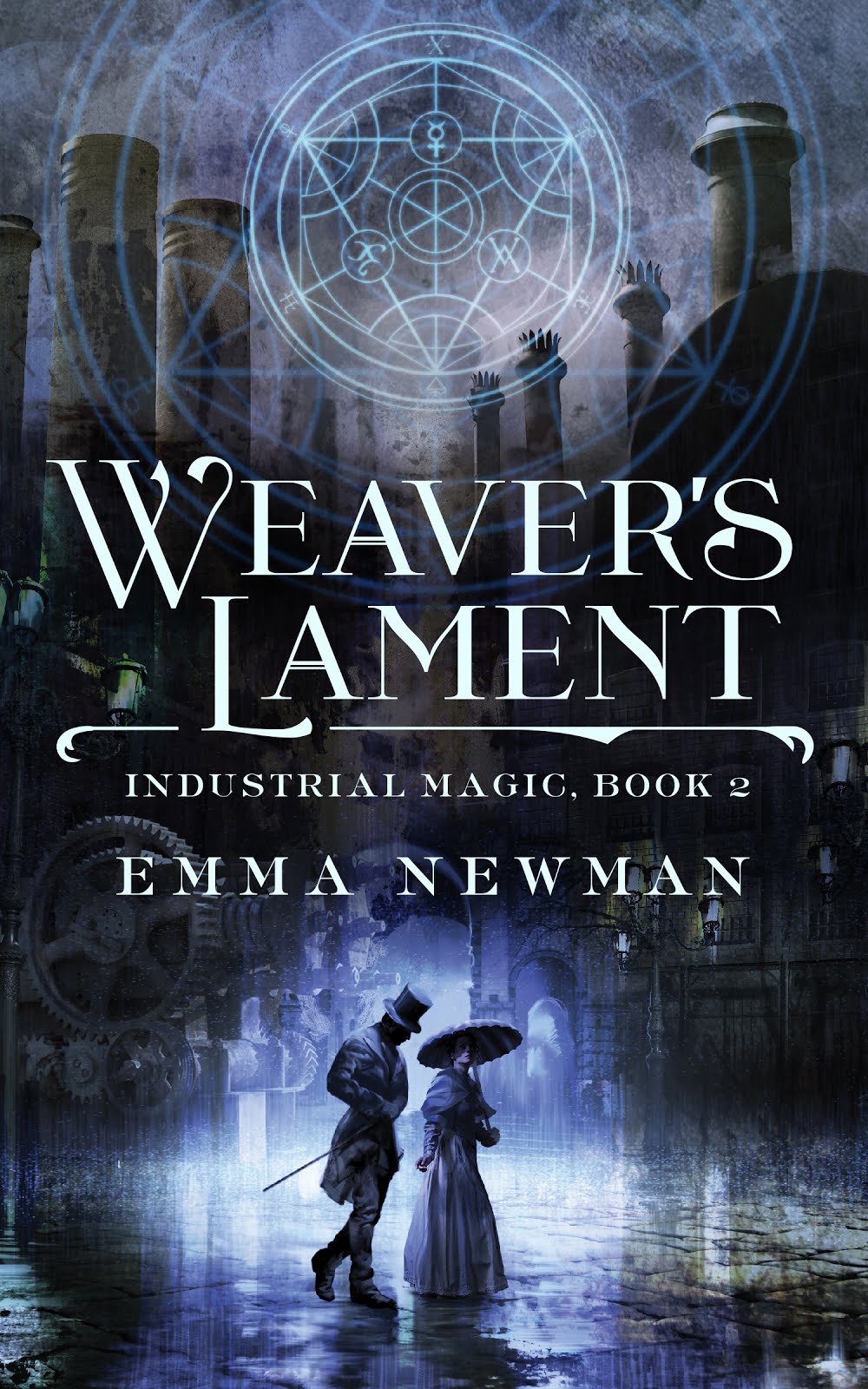
Review - Weaver's Lament by Emma Newman

Weaver's Lament (Industrial Magic, 2)
Emma Newman
Tor.com, 17 October 2017/ 1 Nov2017
e, PB 160pp

I'm grateful to the publisher for an advance copy of this book via NetGalley

If it wasn’t for the weavers, what would you do?       
You wouldn’t have your clothes that’s made of wool
You wouldn’t have your coat of the black or the blue
If it wasn’t for the work of the weavers

- Chartist song (see http://thejovialcrew.com/?page_id=1639)

Another adventure for Charlotte Gunn, following Newman's Brother's Ruin, published earlier this year, and again in novella form as is becoming increasingly popular in SFF.

This time, Charlotte's off to Manchester, Cottonopolis, seat of the Industrial Revolution, where vast profits are to be made by the mill-owners. In Newman's world these mills are driven by magic, not steam, so we can expect less smoke in the air, but the workers are nonetheless sweated by their overseers, put up in filthy, cramped conditions and doing fifteen hour shifts in stiflingly hot, dangerous conditions. And they face other threats, too, as looms shatter and the overseers wield their straps to maintain discipline.

Charlotte's brother, Ben, has summoned her to this living hell (what's the quickest way out of Manchester? Drink) to assist him. Once again, she puts love for her brother first and agrees to go undercover in the mill to investigate the nest of Socialists he believes responsible for the damage. But Ben is working for Ledbetter, the magus who Charlotte knows has dark secrets.

This book was great fun, if that's possible in something that also sets out grotesque inequalities and cruelties that are often lost in the soft focus, Hovis-ad language of drama and storytelling. In particular, fantasy, whether epic, pseudo-medieval fantasy or its edgier urban cousin, still too often sees curation of the social hierarchy as the greatest good. In contrast, what Charlotte discovers here will, I suspect, drive her to seek the otherthrow of the hierarchy. It remains to be seen if she will carry her brother with her in that - I fear not, Ben comes across as something of a milksop, a man keen to ingratiate himself with the bosses, wanting his own mill to run.

I'm even doubtful of Charlotte's mysterious ally/ tutor, Hopkins, who pops up Gandalf-like to give advice a couple of times. Is his heart really in a challenge to the authority of the Royal Society of Esoteric Arts or does he have an agenda of his own? (Charlotte certainly has an agenda of her own when it comes to Hopkins, even if she hasn't realised it yet, one her stuffy fiance George may not like much - I can see some of that absent steam reappearing before long...)

In short - and this is quite a short book - this is an eminently readable and at time unflinching view of the Industrial Revolution, blended skilfully by Newman with a dose of magic. Charlotte's awareness of the world around her is developing and she's pitted against a particularly nasty form of exploitation.

I will look forward to the new Industrial Magic, hoping, though, that Newman will be able to write some full-length stories set in this world. The novella form is great but it would be wonderful to let these stories breathe a bit more.


5 October 2017

Review - The Crow Garden by Alison Littlewood

The Crow Garden
Alison Littlewood
Jo Fletcher Books, 5 October 2017
HB, 366pp

I'm grateful to the publisher for an advance copy of this book.

In Littlewood's latest horror story we are back in Victorian England, visiting that quintessential Gothic location (second, perhaps, to the ruined Priory), the lunatic asylum.

Dr Nathaniel Kerner has taken up a post at Crakethorne Asylum, described most encouragingly in the opening chapter: a brooding, chilly building beset by wind and haunted by the crows after which it is named (Grey stone was unleavened by lightness or decoration") and presided over the Dr Chettle who, we soon learn, has little interest in his patients and spends most of his time pursuing phrenology - even then, a marginal and quackish science. Kerner has tragedies in his own past and is driven to earn the (posthumous) approval of his discredited father, indeed one might think he's not the most stable and suitable of characters to be treating the "insane" (as they're labelled).

Despite this, Kerner's ideas of treatment by talking seem modern and enlightened compared with the regimes of blisters, bleeding, electric shocks and cold baths apparently in vogue at the time. The book is sharp in its perceptions, discussing what's almost a hierarchy of establishments practicing more or less modern or primitive treatments, and of the way this plays into the choices made by those responsible for committing unfortunate relatives to their "care".

In particular, Kerner's life is to become entangled with that of Mrs Victoria Harleston, committed for shrinking form performing her "wifely duties". Mr Harleston is eager that his wife be brought to obedience and presses Kerner and Chettle to do whatever is necessary. The scenes in which Littlewood exposes the situation of a woman at the mercy of the (male) law and society are some of the most chilling I've read in fiction, supernatural or otherwise - but that isn't the end of this story. Rather there is much, much to be told with Victoria herself emerging as a fascinating, passionate and contradictory character - especially compared with poor Nathaniel who's mostly two steps behind her. (indeed, as a viewpoint character he can become a bit tiresome at times, with his assumptions about women's fragility and a rather touchy ego to boot - at others his pomposity becomes almost endearing).

Littlewood uses a clever motif to explore Victoria and Nathaniel's relationship, quoting from Byron (for her) and Robert Browning (for him). These are their preferred poets (the good Doctor rather huffily confiscating her book of Byron's verse which he declares unsuitable and likely to make her delusions worse) and indeed as the story proceeds they take to referring to "my poet" or "your poet", the subtlety of the relationship marked by Kerner's beginning to see more passionate depths in his Browning that he had realised before. The whole effect has something of the Gothic romance - and claustrophobia - of Wuthering Heights combined with the menace of Wilkie Collins or Dickens exposing the cruelty of the Victorian mental health system. At the same time, this system is contrasted with short but spells that do, indeed, promise "asylum" from the darkness without, moments when the reader does begin to hope for some good resolution.

Reading over this I realise I have said anything about the supernatural elements in the book - well, they are there, contributing especially to the brooding menace of the final part but in this story the burden of the horror is, I think, really borne by darkness that emanates from humanity. The questions the story raises - about sanity, madness and evil - are independent of whatever it is those restless crow spirits may be up to, and in the end, it's man (or Man) who is the monster here, I think.

An excellent, chilling, autumn read, all about the dangers of power, obsession, and guilt, this is sure to be another hit from Littlewood to follow up The Hidden People.


18 August 2017

Review - The Witch at Wayside Cross

The Witch at Wayside Cross (Jesperson and Lane, Book II)
Lisa Tuttle
Jo Fletcher Books, 10 August 2017
PB, 361pp

I'm grateful to the publisher for an advance copy of this book.

Jesperson and Lane have just solved their first major case when a man bangs violently on their door - and almost immediately drops dead. The police rule death by natural causes, but the detectives are determined to find out what really happened.

Mr Manning was screaming about witches before his death....

If you loved the first Jesperson and Lane book, The Somnambulist and the Psychic Thief, you'll enjoy this - though Tuttle has written a rather different story, it's every bit as good.

While The Somnambulist and the Psychic Thief was very much an action story with lashings of penny dreadful menace, this is a slower, more reflective book. It particularly showcases the abilities of Miss Lane: indeed, while Jesperson comes and goes on a rather erratic schedule, much of the discovery is driven by Lane and her ability to get alongside the inhabitants of the various dwellings - whether vicarage or wise woman's abode - where the clues to Mr Manning's death may be found. (My wife being a vicar, I was rather alarmed at the idea - which I think is accurate for Victorian days - that strangers could just turn up at a remote vicarage and expect to be put up!)

The story that Lane draws out is fascinating, much of the book gradually exposing the range of views that Victorians might hold on witchcraft, cunning-men, fairies and the like. The Norfolk that Jesperson and Lane visit is a mesh of rivalrous arcane practitioners with Manning himself having been involved in something called the "School of British Wisdom" whose purpose is to revive the learning of the "druids". They, and pretty much everyone else our duo meet, have all sorts of views on the so-called "screaming pits" to be found in local fields and woods, as well as different attitudes to witchcraft, whether historical or modern. The book is a reminder - like The Somnambulist and the Psychic Thief - of the spread of opinion about the supernatural, and the blurred distinction between that and science, that obtained then. Like the Victorians, we're in real doubt whether or the events have a "natural" explanation (or even what that means).

The key to Manning's death is apparently located somewhere in this complex web, which also draws in a missing baby, poisonings and the "good neighbours" (nothing to do with Ramsay St). But there are many false turns, misleading theories and a startling lack of hard evidence, so it's a tough case to crack with surprises right to the end.

As I said earlier, there is less action in this story than in the previous book, and I felt at times that the conversations over tea in drawing rooms used, especially in the first half, to establish the facts of the case teeter on the edge of becoming long-winded. Teeter, but don't fall over - Tuttle avoids that, not least because alongside the investigation, there are darker veins running through the book.

First, she maps the attitude of men towards women, seeing them as means to ends, whether those are commercial, such as obtaining property, or more "spiritual". This attitude comes out quite nakedly on a couple of occasions but is always simmering away. It's something Lane is alert to, and even the presence of her friend Jesperson makes her uneasy at one point:

"His eyes glinted in the moonlight and I suddenly felt unaccountably nervous, and looked away at the empty, tree-lined road ahead".

Apart from a sense of menace, the books shows women not being listened to. Often, men whom Lane is asking question of respond to Jesperson instead, and at one point we're told, "...the men were not so ready to believe she knew what she was talking about..." These moments give the story a real bite, counterpointed, of course, by the recurring debate about witchcraft and the treatment of women regarded as witches.

As well as the treatment of gender, there are also some carefully observed class attitudes. One may draw a comparison between the treatment by the Rev and Mrs Ringer of their servant, Maria, and the superstitious attitude to the fairies (those "good neighbours"). You mustn't, you see, acknowledge or thank the fairies of they do you a good turn. Similarly, Maria's toil in the kitchen goes unremarked: when she's ill one evening and Jesperson and Lane do the work instead, nobody remarks on it. I'm reminded of George Orwell's observation of old women carrying firewood in North Africa: that it was just wood going by.

So, within this apparently charming and engaging fantasy crime novel, there is a good deal of shrewd social commentary.

Overall, a solid follow-up to The Somnambulist and the Psychic Thief, showing that Tuttle isn't simply planning to repeat a successful formula - popular though I'm sure that would be - but is letting this series evolve. I wonder what she'll do with it next?


19 March 2017

Review - Brother's Ruin by Emma Newman

Brother's Ruin (Industrial Magic No 1)
Emma Newman
Macmillan-Tor, 14 March 2017*
PB, 160pp, e-book

*Online booksellers give different dates but the author's website says 14 March

I'm grateful to the publisher for an advance e-copy via NetGalley.

I hadn't heard the term "gaslight fantasy" before but I think it fills a definite need, describing fantasy books set an an alt-Victorian world but which aren't in that genre full of clockwork, goggles and brass - you know the one - and most importantly, which may involve MAGIC.

In what we're promised is the first of a series, Newman has reimagined the 19th century as undergoing an Industrial Revolution driven by magic, rather than science, with the key group being the mages of the Royal Society of the Esoteric Arts. It's a crime to keep magical ability secret - if you do, enforcers will drag you away to who knows what fate. Rather it must be developed and used for the good of the Empire.

But equally, anyone falsely claiming magical powers will also suffer penalties. A dilemma then...

We don't see much of the wider picture in this book. Rather it's focussed on a particular family and the effect on them of these rules. Sister and brother Charlotte and Archie Gunn are close. He's a sickly boy: she secretly earns money to support the family, much of it poured away on Archie's studies. If either were tested by the Royal Society and passed, the family could come into money. But if they failed, it would mean ruin.

So it's concerning when there's a rap on the door one day, and the Society's agents announce that Archie, who is the weaker of the two at magic, is to be tested...

Newman tells the story through the eyes of Charlotte, a determined and clear headed young woman, who's pretty much holding the family together. She hopes she can manage the Royal Society's testers. She's not so sanguine about the debt collector who's been hanging around, apparently planning to drag her father off to a sinister address in Whitechapel. Perhaps if she investigates the place she'll find a way...?

This is a short book with a relatively straightforward story - although Newman drops a few surprises too - and it runs at a breakneck pace once the setting has been established. There are some nice touches of characterisation, such as the genteel racism of Mrs Gunn when, to Charlotte's horror, she asks brown skinned Master Judicant that fatal question, yes, but where are you really from?

We also see Charlotte's internal turmoil - 'Once she got upset about something, it pummelled her insides like a demon trapped within her...' - making her human and vulnerable: just being a hero in a novel doesn't make you immune to anxiety attacks.

There are some very nice bits of language - 'a bold red coat that looked like it cost more than their coal bill for a cold winter', 'she wouldn't have been surprised if someone told her he was actually an artist's sculpture made flesh' (Charlotte develops a VERY close interest in one of the mages from the Society) as well as calls to action - 'It was time for this rude young woman to make a difference'.

The book ends on a distinctly promising note 'I need you to be ready for adventure' SURELY promising more with these characters and this setting? I am ready, Ms Newman, I am - bring it on!


5 October 2016

The Hidden People by Alison Littlewood

Image from http://www.jofletcherbooks.com/
The Hidden People
Alison Littlewood
Jo Fletcher Books, 6 October 2016
HB, 368pp
I'm grateful to the publisher for an advance copy of this book

I've come to look forward to a new ghost or horror story from Alison Littlewood as an Autumn treat, timed to come alongside the smell of bonfires, falling leaves and of course the darkening evenings. The Hidden People - while set at the height of Summer, indeed, in a place where it is always Summer - doesn't disappoint although it's a departure for Littlewood, being set in the past, the mid Victorian age.

Albie Mirralls is the son of a prosperous family, working at his father's firm in the City. Early in the book we see the two visit the Great Exhibition of 1851 along with Albie's cousin, Lizzie, and her father. A connection is made between the two that endures, albeit sleeping, until after her death a decade later.

When Lizzie is horrifically killed by her husband, who has come to believe that she's a changeling, a fairy, Albie sets off for the Yorkshire village of Halfoak, to investigate...

So the main story begins. It's an ambiguous tale, on several levels. First, what does Albie make of events? He's presented as a great rationalist (introduced, remember, at that most modern and scientific of celebrations) and he confidently scorns the Yorkshire locals and their strange beliefs (for example opening the curtains of his inn room despite the warning from the landlord that it's unlucky to gaze on the full moon: lots of things in this story are said to be unlucky and Albie makes a point of doing most of them). What, then, can there be for him in Halfoak? The husband is imprisoned and will no doubt hang, the funeral is soon arranged (none of the villagers will attend), what more, as  rationalist,  can he do? He surely can't expect that, somehow, Lizzie, that girl he met so briefly, will come back from under Pudding Pye Hill?

This is all the more inexplicable given that Albie has a wife, Helena, who soon arrives from London, clearly feeling somewhat neglected. The relationship doesn't seem to be very healthy. As Albie mopes around, investigating ever stranger and more tangential angles to the 'mystery', Helena begins to get... strange.

The attitude of the villagers is also shifty. They clearly accept and even welcome the eruption of the supernatural into their lives, yet it also drives them to dreadful ends - the murder of Lizzie, the boycott of her funeral - and to a degree they seem to have the same relationship with the modern world: Albie, arriving from London is as much an over-worldly intrusion on their centuries old way of life as the fairies are, or would be if they were real.

This reality of this last is a matter which Littlewood also keeps hidden - there is no out and out splurge of horror or the supernatural here, only things (such as Helena's midnight walks, her strange use of the local dialect, or the cleaning of the house) which are suggestive. I'd go so far as to say that she writes the book in such a manner that neither a purely rationalistic explanation nor a clear supernatural one quite fits. This produces an unease throughout the story, paralleling the odder and odder behaviour of Helena and, especially, Albie. It's clear that there has been more going on in Albie's mind with regard to Lizzie than is healthy for the state of his marriage and I'd suspect it's been going on longer than he admits. (Another way the unease is heightened is through numerous references to clocks and other timepieces, to time lost track of, to the fact that the summer ought to be ending but isn't: most notable, to the church clock with three hands so it can show not only London but local time - what is the time, really? Perhaps we're not in 1862 any more...)

So the horror comes not only from a straightforwardly supernatural threat but from a real sense of unease at what seems to be a relationship fragmenting slowly before our eyes, and the fear of what that might lead to (the book exposes, without being heavy handed, how the belief in child-swapping fairies is helpful in legitimising not only wife but child murder) as well as a loss of hold on time itself, which becomes slippery and inconstant.

All of Littlewood's previous books had some sense of ambiguity, of being between two worlds, but The Hidden People makes it much more perfect, producing a story that's exquisitely unsettling rather than out-and-out Gothic (yet also, clearly at least second cousin to all those tales of mistreated wives shut up or driven to an early grave which were so popular in the period described here).

Strongly recommended.