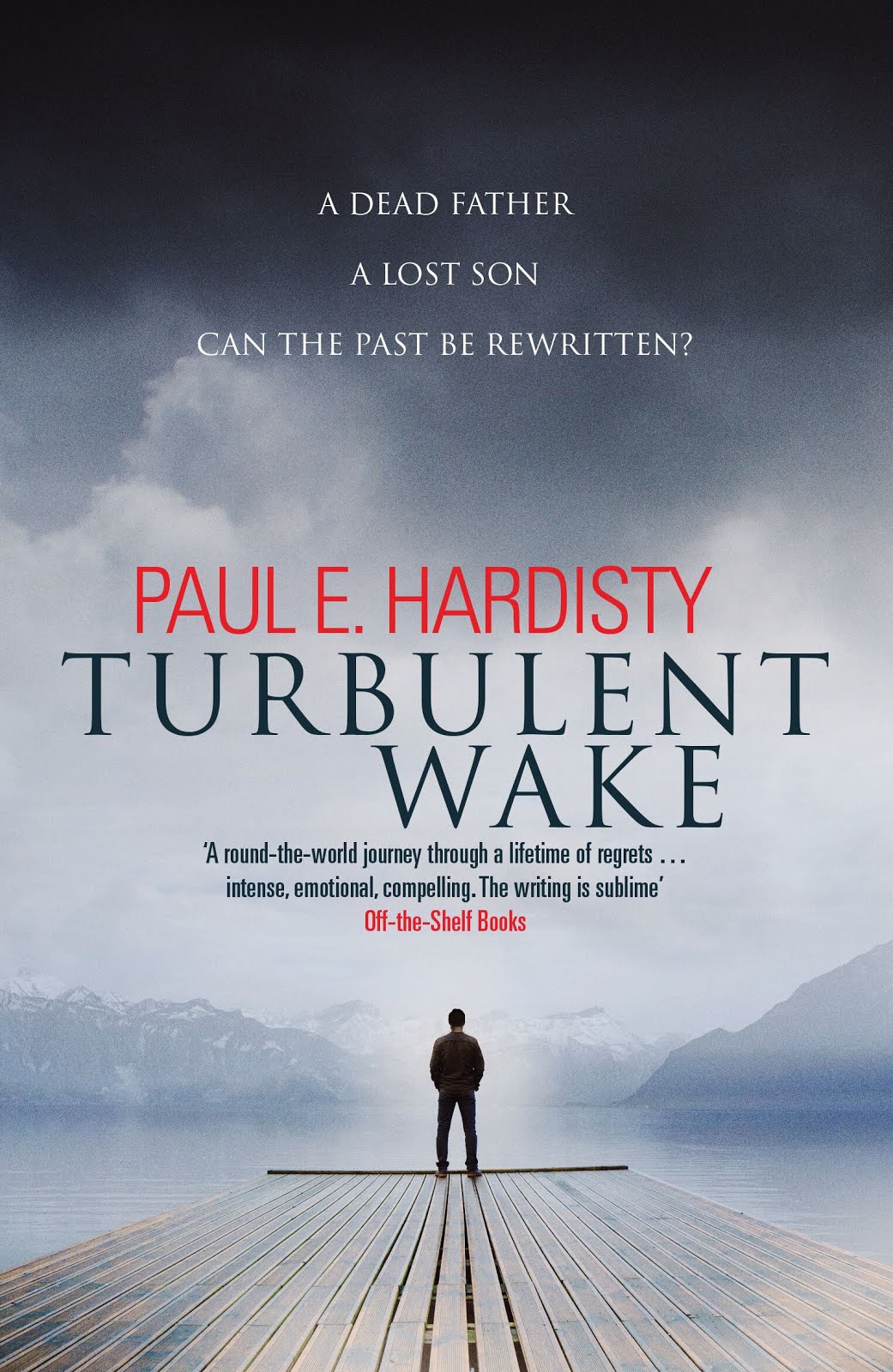
 Turbulent Wake
Paul Hardisty
Orenda Books, 16 May 2019
PB, 258pp
I'm grateful to Orenda for a free advance copy of Turbulent Wake and to Anne Cater of Random Things Blogtours for inviting me to take part in the tour.
Turbulent Wake is a bit of a departure by Hardisty. His previous books for Orenda have been popular thrillers featuring soldier, mercenary, and all-round tough guy Claymore Striker. Turbulent Wake is more reflective, consciously literary, following two mens' - a father and a son - journeys through life and relationships. There is no plot, no threat, at the centre of this story apart from the harm we do to ourselves and others and the bruises that life inflicts. A secondary theme - heartbreakingly realised in places - is environmental devastation caused by greed and stupidity, and the beauty of what we are, it seems, about to thoughtlessly lose.
This change of direction is clearly something of a risk, but Turbulent Wake fully justifies that - while it was obvious from his previous books that Hardisty could write, this one shows him engaging critically with issues of living, with the pain of living, and he does it brilliantly.
The book's title, a physics reference, is apt (Hardisty often adopts science based titles). Turbulence is what happens when the easily modelled, "smooth" behaviour of fluids breaks down and you get churning, chaotic results. Run a liquid down a wide smooth channel relatively slowly and you can easily calculate its behaviour at any point. Increase the speed relative to the size of the channel, or replace the fluid with a thinner one, and there comes a point where the flow stops being smooth and becomes hard to model and predict. It's a fundamental issue for physics with practical consequences for the design of ships, turbines, aircraft and other machines whose operation depends on understanding how fluids work.
In this book it is, I think, a model for life. Neither of the two men we meet here is in that predictable state of laminar flow. Unexpected eddies, changes in the parameters of their lives, changes in themselves, keep them off balance and a great deal work will be required if they are to understand what is happening and, perhaps, control it. Or at least, live at peace with it.
That work is being undertaken by Warren, the father. Dying, he completes a manuscript describing his life, in what is essentially a series of vignettes. This is read by his son Ethan, mainly during plane journeys and a business trip to Geneva. Warren seems to have been out of Ethan's life for decades, and his writing attempts, perhaps, to explain why this was, or at least, how it happened.
Warren is rarely named in the writings, rather he is "the boy", "the young man", later "the young engineer", "the engineer" - and inevitably, "the old engineer". This gives the effect of almost making him absent in his own narrative - often the stories could be simply that, self-contained Hemingway-esque narratives about a tough, manly life of the old sort: working on oil wells, dams, getting into fights, being with women. Even the episodes from childhood fit into that pattern, referencing wars, a horrific assault, the formation of a distinctly patriarchal outlook. It's interesting how "the engineer" seeks out projects around the world, bits of work where an aspect of the natural world can be managed, subdued, processed - almost as if a substitute for human contacts and relationships (while there are plenty of the latter, he will, one comes to suspect, always sabotage them before they get too close).
The irony is that while "the engineer" tells himself he is trying to "do good", it becomes increasingly clear through the book that Warren's life, spent in what he refers to in the final story as "All the Good Places", is steady eroding and destroying that natural world. There are numerous examples; logging, oil drilling destroying local water supplies, a dam that will both obliterate fragile ecology and dispossess local people, the almost too hard to bear description of a beautiful, life-filled coral reef about to be razed just to house a marina. That sense of loss is articulated by Helena, who is with Warren for a period; she simply feels that there are too many people and that they only do harm. Given this destruction, and the catastrophes of his personal life, perhaps all he has done has been for nothing?
So much for Warren. What about Ethan? It's his voice that frames this book. Ethan is clearing up his father's affairs, having a difficult time with his ex (they have a daughter who becomes a pawn between them) and slowly, oh so slowly, going off the rails in his corporate world. The book strongly pushes the reader to compare and contrast the father, an outdoorsy type who may be blundering through life but at least knows where he's coming from, and son, whose environment is the air-conditioned office and the departure lounge. Ethan doesn't, on the whole, know where he's coming from. Both had absences in parenting, both had a missing brother (the explanations for which are profound but given almost incidentally and not in much detail). The book suggests that aspects of Ethan's messed up life go back to what his father has done or not done (Larkin's famous couplet certainly applies here) but it's unclear whether the knowledge imparted by Warren's testament will be enough to mend the damage.
While fascinating as characters, both father and son are often difficult to like as people. The father's almost performative manliness (for example his solution to most problems is to thump someone) feels very old-fashioned now but is probably in keeping with the spirit of his age and life (in places it's a bit "Mad Men in the Great Outdoors"). The son''s version of that is, though, definitely out of step with his time. It has soured into a vein of office misogyny, of whining about how women are getting the promotions instead of him. Both have, one feels, some work to do on themselves and as I have said, that is what we see the father doing through his writing. Whether, and how, the son will try and move forward (and break the cycle?) is left open at the end of the book. With the onset of turbulence, it's hard to predict what will happen downstream.
Though in places Turbulent Wake isn't for the fainthearted, it is a thoughtful, chewy book that tells the story of its times through one of the most fundamental human relationships - parent and child - and doesn't spare us the dark bits there will be in any such relationship. I'd strongly recommend it, and I will be VERY interested to see what direction Hardisty takes next.
The tour for Turbulent Wake continues, with further stops at all the brilliant blogs shown on the poster. You can buy the book now from your local bookshop, including via Hive books, from Blackwell's, Waterstones or Amazon and doubtless other places besides.

