Showing posts with label Slough House. Show all posts

11 September 2025

Review - Clown Town by Mick Herron

Clown Town
Mick Herron
Baskerville, 11 September 2025 
Available as: HB, 340pp, audio, e   
Source: Advance copy
ISBN(HB): 9781399800433  

I'm grateful to Baskerville for sending me an advance copy of Clown Town to consider for review.

Clown Town sees a full return to Slough House for Herron after last year's sort-of Jackson Lamb backstory, The Secret Hours. And this is a familiar Slough House, an office gone bad, a dusty, sticky, despair-haunted tomb for the careers of its crew of Service internal exiles.

Yes, the gang's all here again, River, not yet back on active duty after his brush with novichok; Louisa; Roddy; Lech; Roddy Ho; newcomer Ash; Catherine; and, of course, Lamb himself. All the Slow Horses are ready to go... slowly.

And yet. I wouldn't have thought this possible, but the Slough House we see here is actually less jolly, more bleak - somehow - than in the earlier books. It's as though Lamb has, somehow, brought back extra weights from the past Berlin of The Secret Hours, weights that drag on the spirit and chill the mind. Perhaps it's that the Slow Horses are reeling from the losses and near losses they have suffered. From missing faces and empty office chairs. The attrition has been brutal - surely one of the perks of being a down-and-out on Spook Street is that you're insignificant, gently rotting down a side alley, of no interest to the Big Men (and Women) who hunt down the main drag?

Of course that's not how it's turned out, and maybe Lamb's lot are starting to realise. Whatever, when the shadow of past Service malpractice arises, when Peter Judd begins to stir, when Taverner starts to weave her threads, there's more than a smidgen of wariness to be seen. Plus, with key members of the team signed off, pondering jumping ship, or (Louisa) actually resigned, the response to these challenges is particularly fragmented. More so than ever, I felt myself muttering "just walk away". Even Lamb seems, if such a thing were possible, less enthusiastic than normal to look under stones and join dots.

The story kicks off from a minor discrepancy in the library of River's grandfather, the OB, as reassembled in a spook-linked Oxford college. River, still, as I said, signed off, has time to look into this, and it shouldn't open any forbidden doors, should it? Well, of course it does, and we soon discover that Slough House isn't the only scrapyard for the Service's embarrassments. So that's two teams turning through the dustbins on Spook Street, but there are actually more, and there'll be encounters, near misses and misunderstandings.

The ending of the book is of a piece with that. There's a glorious (gloriously written, not a triumphant event) - a marvellous performance by not just the Slow Horses but by several other teams of clowns, which must have been a real swine for ringmaster Herron to write; a tour de force of incompetence, dark humour, muddled motives and bad luck - but that isn't the climax of the book, it delivers another sucker punch just when you think things can't get darker, leaving the already tarnished morality of this world even more shabby at the end.

A gripping, twisty and melancholy story, though one often enlivened by Herron's deadpan humour (the highpoint of which was, for me, the song that goes through Roddy's head. It sounded familiar to me. Where have I heard it? On TV somewhere, perhaps...)

For more information about Clown Town, see the publisher's website here.
21 December 2022

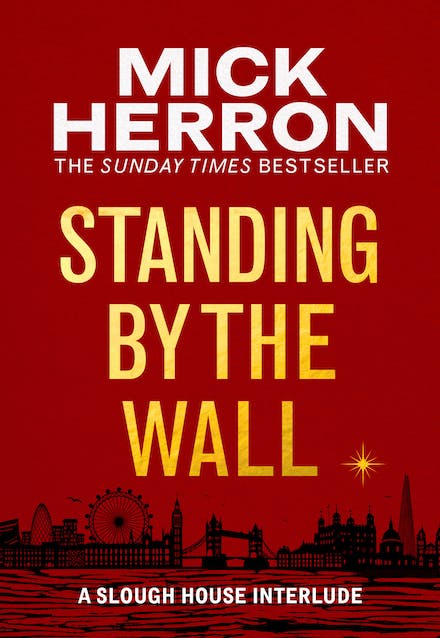
#Review - Standing by the Wall by Mick Herron

Standing by the Wall (A Slough House Interlude)
Mick Herron
Baskerville, 3 November 2022 
Available as: PB, 56pp, audio, e  
Source: Bought
ISBN(PB): 9781399807081

This is perfect Mick Herron, perfect Slough House. On a dank Christmas Eve, as the office workers spill onto rainslicked pavements for some jollity and the failures of Slough House consider leaving early, Jackson Lamb has a little job for Roddy Ho ('Ho? Ho! HO!' - yes, I know, but the idea of Lamb as Santa, is, well, not exactly funny, but...)

That job, plus the angst and lethargy that seep out of the Slough House wall and carpets, give a hint, perhaps of the next main book (The Secret Hours), due in September 2023. They certainly focus on Lamb's - and Molly Doran's - lives, so maybe we'll hear more of those. But they also drop one or two surprises and feature a status report, as it were, on the interpersonal relationships of the Slough House inmates.

Best of all, we get Roddy monologuing at length. I always enjoy his internal narrative, deluded and self-centred as it is, which seems like tidings form a parallel world. I don't think I've come across any character in recent fiction who is so un-selfaware and whose intentions seem so unpleasant yet who one has to accept is at a fundamental level almost completely naive and innocent. Ho is of course only a microcosm of the entire Slough house experience - a pit of darkness and despair which is it seems, at the same time, the nations's last, best defence against the deeper darkness beyond.

A lovely antidote to Christmasness.

For more information about Standing by the Wall, see the publisher's website here.

10 May 2022

#Review - Bad Actors by Mick Herron

Bad Actors (Slough House, 8)
Mick Herron
Baskerville, 12 May 2022
Available as: HB, 352pp, e, audio
Source: Advance copy
ISBN(HB): 9781529378702

I'm grateful to the publisher for an advance copy of Bad Actors to consider for review.

Bad Actors is the lates novel in the Slough House series, focussing on the spooks (the 'slow horses') that MI5 left behind. Left behind in a decaying, seedy, London office, to be overseen by the decaying, seedy Jackson Lamb. Eight novels in (plus a few novellas) this series is still firing on cylinders - and delivering some surprises.

Slough House has recently been brought to TV (rather splendidly, I think) and in his credits in this book Herron makes clear that the title isn't directed at the actors in the series. It's true that it has been trailed in previous books, and it is also a clever pun on the overlap between 'bad', that is, malign figures - several of whom feature here - and more straightforward hopeless losers and misfits - who also appear - who are simply 'bad' at performing their roles. Not all of the latter are Slow Horses. 

I think there is a bit more to it than that, though. I do wonder whether the adaptation of the series as drama has influenced this book. In Bad Actors, Herron seems to be reflecting the drama in a running series of theatrical metaphors. For example, ''No, really, don't. Let's just workshop it, shall we?' during a meeting, or 'the street dazzle of Soho - the neon lights and mirrored windows'. A junior spook who 'wasn’t quite Oscar material' nevertheless 'had her moments' while one of the characters, Nash, is 'stepping into noir, dimming everything to a monochrome rainbow'. There are many more examples, all contributing to a sense of a stage waiting, of the streets of London as an arena, a performance space. And the sections in the book reflect this, dividing the story into 'Acts' (we actually get Act 2 first, something that itself contributes to the atmosphere at the start). 

This sort of leitmotiv is very much in keeping with the earlier books, which I think each tend have a particular language or framing in a similar way. Of course the books in this series are always alive to the context and setting of a crumbling UK in the cold winds of the 21st century (indeed, Slough House itself could be the overarching metaphor for this) but, perhaps, they draw attention to it in different ways. Here, the theatricality perhaps emphasises that the current crop of 'bad actors' (perhaps in both senses) in Westminster and Whitehall are also, largely, creations, acts in fact. 

But Herron also delights in a less subtle characterisation - for example, giving us a failing Prime Minister whose 'sole qualification for the job had been the widespread expectation that he'd achieve it. Having done so, he was clearly dumbstruck by the demands of office: the pay cut, the long hours, the pandemic, and the shocking degree of accountability involved. For a man who'd made a vocation out of avoidance of responsibility, this last was an ugly blow...' as well as unscrupulous unelected advisers, lurking in the shadows to reshape the hapless nation over which they exercise control. 'The PM's enforcer, Sparrow wasn't as high profile as his predecessors had been - it would have been challenging to maintain that level of unpopularity without barbecuing an infant on live television - but those in the know recognised him as a home-grown Napoleon: nasty, British and short.')

One of this doleful band - a 'superforecaster' attached to No 10, no less - has gone missing. Her boss, the Sparrow referred to above, is perturbed, and Slough House may be a convenient scapegoat. A retired spook is reactivated to investigate, and in a story perhaps showing more crossover than usual between the despairing landings of Slough House and the gleaming corridors of Regent's Park, a host of actors, good and bad, seek to take advantage of the situation; or simply to survive. So Louisa, Lech, Roddy and the rest carry their spears (in Roddy's case, a broken broom) onto the stage, pursued by a Lamb. But we also see Regent's Park on high alert as a foreign spy appears, unheralded, on their radar, with a special message for the First Desk, Diana Taverner. At the same time, she is fighting a battle to prevent her empire being absorbed into the nebulous world of the PM's Special Adviser. 

It's a very full, fast-moving and exciting story (as ever) plumbing deep into the minds and motivations of the cast, but often illustrating them as much through petty office politics as through major plot developments; the consequences of pinching a colleague's lunch from the fridge, for example, or of catching somebody out on a personal Zoom call. But make no mistake that the stakes are high. The events of Slough House, the previous book, are still very much with us (especially a particular absence) and various members of the team cope with their guilt, or don't, about that: that straight-into-Act 2  structure of the book allowing the hangover from Slough House to blur with their recollections of an Act 1 which of course we haven't read, all creating a truly disorienting effect. What happened in Wimbledon? Should we know? Why is there shattered plastic all over Roddy's floor? What has Shirley done now? (And where has she gone?) Combined with the fallout from the missing adviser, there seems a distinct possibility here that somebody in Slough House really has stepped out of line - or at least that Lamb may not be able to prove that they haven't. 

It's a very disquieting opening, setting up a book full of subtly shifting (or undeclared) loyalties (watch Slough House's new recruit, and the machinations of the straw men on the fringes of the Park) which nest slightly with the many enjoyable contrasts and juxtapositions. There is both sophisticated verbal fencing between senior officials ('...Regents Park string pullers knew to tread carefully around Diana. String pullers carry weight, but Diana carried scissors') and, of course, Lamb's crude put-downs. There is Roddy's absurd inner monologue and hapless pantomime shadow combat with a broomstick, but also some utterly serious violence. There is the fatuous and solipsistic world of the politicians and advisers where everything is about message and position and we don't want to hear from experts ('lying in office was no longer a career-threatening felony; the consequence of misleading Parliament was nowadays a lap of honour') and, outside in the cold, the chilling realpolitik and tradecraft of the even badder actors. 

Pretty soon, realities will begin to show through the waffle and piffle...

In short this is a terrific addition to the Slough House series, as sharp and engaged as ever. (And oh, there are scenes here that I can't wait to see on the screen, though some of them may be very tricky to translate...)

For more information about Bad Actors, see the publisher's website here.

1 February 2021

#Review - Slough House by Mick Herron

Slough House (Slough House, 7)
Mick Herron
John Murray, 4 February 2021
Available as: HB, 307pp, e, audio
Source: advance e-copy via Netgalley and ARC
ISBN: 9781529378641

I'm grateful to the publisher for an advance copy of Slough House via NetGalley and also to Dave for sending me a spare ARC which he received.

Herron's Slough House series always sparkles, but this one was an especial joy to read. All the usual reprobates are here - River, still coming to terms with the death of his grandfather, hoping for clues of some sort from the contents of the OB's study. Roddy Ho, the most self-regarding and empathetically challenged IT whiz you ever met. Lech, with his self-scarred face. Catherine, sneaking drink home from off-licences and corner shops and then pouting it down the drain. Louisa. Shirley the Dancing Queen. 

And Jackson Lamb himself, who seems to smoke so much you'd imagine it would be easier simply to pump it in from a tank.

The thing about this lot is they're supposed to be the Secret Service's 'Slow Horses' - the losers and also-rans who are still on the payroll to keep them quiet, but who can't, we are told, be trusted with anything important. As we've seen, though, in truth most are parked in Slough House because of who they've offended or what they are (especially, what they are - often, unmouldable into a conventional team, uncorporate, pig-headed or simply embarrassing) or simply because they have messed up and embarrassed the Service - not because they are incompetent or lazy. It's never stated in so many words but when they are called to action they can be formidable, and naturally they save the day.

This time though, things are a little different. Slough House, that standing joke, has apparently become so much of a laughing stock that it's been removed from the Service's records. And some of its ex-members are beginning to die off. That's the second thing that delighted me about this book - a bit more of the continuity in that we see what happened to some of those who dropped out earlier. (Spoiler: not all of it's good).

The third thing I loved was the delicate relationship that Herron's world has to ours, to recent events, especially You Know What, as he calls it - so I won't say it out loud. But You Know What. In his world, it has devastated Britain's alliances, robbed us of cash and influence and emboldened opportunistic populists. A useless, old Etonian PM has risen to power and he's being pressed hard by a "yellow vest" movement, determined to roll back progress and trying to get their hooks into the Service to advance that aim. Wholly unlike our own reality, of course, though you may feel that some of Herron's sharper darts strike home rather well, all the same.

The fourth thing (I should stop counting) I loved was the delicate tribute that seemed to be being paid at times to John Le Carré* and especially to his final novel, Agent Running in the Field. That book complimented Herron by borrowing the Slough House idea but also contained its own excoriating critique of You Know What. Here Herron repays the compliment both subtly - there are a couple of clever references to circuses; Regents Park, the Service's HQ, has 'database Queens' to match le Carré's 'register Queens' and archivist Molly, who oversees them, is a dead ringer for Le Carré's Connie - and through that central motif of exploring why we fight and whether the means adopted might render assumptions of patriotism, moral superiority and rectitude arguably moot. Certainly Diana, First Desk at Regent's Park, has got herself and her Service into some ambiguous places, even if prompted by the (real life) use by the Russian state of chemical weapons in the UK.

Jackson Lamb is of course your go-to man for walking on the dirty side of the street (not least because if he walks one side of a street, it WILL be the dirty side, even if it wasn't before). We cheer on this chain-smoking, foul mouthed, offensive candidate for a COPD ward because he has an authenticity and a morality that contrasts with all the smoother types here, even if he is just as, or even more, arrogant than them. And Jackson has collected his team of oddballs and no-hopers for a purpose, they're not just going to stand by and let things go bad or what wold have been the purpose of their, various, downfalls and exile?

If all the foregoing hasn't convinced you to read this book, I fear nothing may, but I can add more! This is a well, even deviously, plotted story, with a number of central mysteries that keeps the reader hooked right to the end. The wider roster of characters allows Herron to highlight both tenderness (River and one of the ex-colleagues) and amusing (Shirley and Lech) aspects of their relationships - a strength of course of an ongoing series, or at least it is if, as here, the characters are developed consistently and well. It is terrifically sharp, with many asides that are right on the nose. And of course it is very well written, as you'd expect. 

Strongly recommended.

For more information about Slough House see the publisher's website here.


*I know I'm breaking the First Rule of Reviewing here - to not directly compare the book with another - but it's meant as a compliment, I love seeing these two authors in dialogue with each other through their writings and it saddens me that it must now be a one sided conversation.


15 February 2020

Review - The Catch by Mick Herron

The Catch (Slough House)
Mick Herron
John Murray, 9 January 2020
HB, 105pp

I bought my copy of The Catch.

'They came for him at dawn...'

Even seeking, as I do, to look ahead at what books are coming up, I still sometimes get surprised (and it's always a nice surprise) as I was last weekend when I spotted The Catch in an Oxford bookshop.

While it's set in Herron's Slough House universe - that being the repository for the failed spies and burned out cases of the Security Service - this book and its predecessor, The Drop, are really a little sequence of their own. John Bachelor, the main character here, is certainly washed-up enough to belong at Slough House but he has fallen through even that safety net and in The Drop we saw him only a misstep away from sleeping on the streets. Bachelor was saved form that by taking over the flat of an ex-asset who he's been looking after and who conveniently died, but there's always payback and in The Catch, Bachelor wakes to hear the first of the Service knocking on his front door.

Or rather, on Solomon Dortmund's (RIP) front door.

From that moment we're back in Herron's usual, convoluted, battle of wits. Bachelor knows the Service have him bang too rights - but is there anything about the way they've approached him, about who's approached him, most of all, about what they've asked him to do, that might give him an edge?

It's a clever story, right up to date with current events. The "request" made of Bachelor is for him to track down an ex burglar and blackmailer, someone he should have been monitoring anyway but hasn't - so now he has ground to make up.

I really enjoyed this little slice of Service life. We've seen in the conventional Slough House novels those times when the authorities at Regent's Park need to bring in Jackson Lamb's dregs and sweepings, and we've seen them acquit themselves well, but we shouldn't conclude from that that the Park are always incompetent.

Nor should we conclude that Slough House is where all the sleaze belongs. By the end of this story we'll have encountered plenty of that and, as I said, it's very topical stuff.

Perhaps a degree less noirish than the main Slough House novels, The Catch (The Drop) are deeply atmospheric, following Bachelor from pub to pub across London as he seeks his quarry, showing us a shady world of men who don't have quite enough to do, or enough money to do it with, or frankly, anyone to care what they do.

Things don't look too good for John Bachelor - when I read my next Slough House book I'll be thinking of him out there somewhere and wondering if we'll ever meet him again.

For more information about the book, see the publisher's website here.


18 June 2019

Review - Joe Country by Mick Herron

Joe Country (Jackson Lamb, 6)
Mick Herron
John Murray, 20 June 2019
HB, 334

I'm grateful to the publisher for sending me a free advance copy of Joe Country.

I'm torn between introducing this book by describing the series and where it has got to, and launching off in the style of the book itself.

Something like "You know where Joe Country is. It's where you get to if you carry on down Spook Street, out beyond the lights and the pizza restaurants..."

Better not, -a poor pastiche of someone else's style is a sorry recommendation for a book, and the style is one of the delicious things about these books. But to get that urge out of my system,  I'll quote a, non-spoilery, bit, just to give a taster (obligatory disclaimer: this is from an advanced copy, final text may not match)

"It was cold on the street - not long now, and this weather would have its way with her bones. She'd creak on waking, slow to a crawl on frosty pavements. There were so many things age could do to you; so few you could do in return. In the end, she supposed, you just stayed on your feet as long as you were able, then took the rest lying down."

This is Catherine Standish, the closest that Jackson Lamb - the seedy, shady walking health emergency who presides over Slough House, where MI5's dimmest and worst are hidden away lest their failures reflect on the Service as a whole - has to a deputy. Catherine is a recovering alcoholic, who's taken to leaving her Tube train a stop early on her way home so she can buy a bottle from the wine warehouse. She manages the office, gets Lamb to sign things, and worries a lot. (Principally about the fact that Lamb killed her former boss).

And so it goes for all of Jackson's coterie - JK Coe, who's found he has killer instinct; Shirley Dander, who has "anger issues"; Louisa Guy - was it drugs with Louisa?; River, who engineered some mess-up at King's Cross Station; Roddy Ho (don't ask).

And new entrant Lech Wicinski, introduced last year in novella The Drop, who had some very nasty images on his laptop (his Service laptop, moreover). These are the stories of the left behinds, the no-more-hopers, told in Herron's thick, noir-tinged argot which at once distinguishes his books from other popular espionage series (at which he's not above poking a little fun, as with a reference to "the spy who walked round in the cold" or the strapline to this one "less MI5, more 9 to 5"). In this jargon, Slough House really comes to life, or perhaps to near death, a patched, flaking office building of doubtful future where the heating booms and creaks but gives little heat, the carpets are thin and the bloodstains poorly concealed. And, in Lamb's office, the smoking ban isn't so much flouted as continually trolled.

But there's much more to this series, and to Joe Country in particular, than an exercise in noir. The story here is very up to the moment ("...the Cold War didn't really end. It just hid behind closed doors, like Trump in a tantrum") taking in as it does the shady security  backwash of Brexit and also the shifty (I said SHIFTY) behaviour of apparently respectable public figures who Herron comes within a whisker of identifying (except, of course, for the fact that everyone in this book is fictional and any resemblance to real people a coincidence - the disclaimer say so quite clearly).

It's all tangled up with a call for help from an ex colleague's wife, to whom Louisa feels a debt of honour because she was, after all, sleeping with the colleague. Before his death. Responding to that call takes the team, one by one, off into the depths of Joe Country which is of course a cold and careless place where the rule is that any stranger is a hostile.

As always, Herron's writing is superb. That world-weary tone still conveys, I think, that these are colleagues who have strong feelings for each other. they may be strong feelings of resentment, yes, but who, in the end, have they got left - stripped of career, respect and, in many cases, of friends and family? At the start of the book, Lech makes a pilgrimage back to where his grandparents, Polish refugees who served this country in the War, lived. Little remains and he has become, it seems, almost an internal refugee himself, disgraced, fearful and alone. Will the Slough House team accept even him?

At the same time we see political machinations and the steps ruthless men will take to defend their own reputations. The issues in Joe Country are all very personal, about loyalty and trust and, perhaps, a little redemption. Which isn't to say that the stakes, and the dangers, aren't high.

An excellent thriller, culminating in near a hundred pages of knuckle-biting, sustained action, taking the team well outside their discomfort zone (you can't really call Slough House a "comfort zone", but perhaps there are worse things out there). And not all return to it.

It's a close-run thing, but I'd almost go so far as to say that this is my favourite of the Jackson Lamb novels. So, it's STRONGLY recommended.


30 October 2018

Review - The Drop by Mick Herron

The Drop (Slough House)
Mich Herron
John Murray, 1 November 2018
HB, e 104pp

TRANSMISSION BEGINS+++

I received this short report through the usual means (brown envelope through letterdrop, handoff, no contact with operative making drop - although I suspect that originating officer was codename YASSINE - recommend congratulations for excellent work).

Have reviewed contents. File contains extensive background information compiled by operative codename HERRON concerning SLOUGH HOUSE, alleged outstation of REGENT'S PARK to which deprecated operatives are consigned.

Suspect new recruit to SLOUGH HOUSE following events recorded in file LONDON RULES.

Recommend opening new file and close consideration of report at earliest opportunity upon wider distribution, currently scheduled 1 November.

TRANSMISSION ENDS+++

Well. I didn't expect this book, didn't know it was coming out, but I'm SO glad that John Murray sent me a copy.

The Drop is a novella set in the world of Herron's Slough House stories - home to the Security Service's misfits, dropouts and no-hopers (Herron's argument that people like this couldn't just be sacked, and need housed and occupied seems frighteningly plausible).

The book isn't about Slough House itself, or its collection of off-the-boil assets, though its subjects could well belong there - Solomon Dortmund, a retired spook pottering around Marylebone in his decline and ex agent John Bachelor, kept on the payroll to look after those like Dortmund, ensuring they have what they need and don't speak to the wrong people.

The joke is that Bachelor's life is in a spin and he's virtually homeless, resorting to bunking down in the ready room at Regent's Park, HQ of the Service. So when Dortmund thinks he's witnessed a drop and reports it to Bachelor, it's not exactly item number one on Batchelor's to-do list.

In many ways this is a gentle comedy of spy manners, as much about our times as it is about putting one over on the opposition. There is a real agent in play here, actually a double agent, and the way they're being handled shows old alliances shifting, the spooks looking to an uncertain future and trying to get pieces in the game with a very different Europe taking shape.

As intelligence analyst Lech (or Alec) notes "...whereas the general attitude among the boys and girls was that right would ultimately triumph, something in [his] bones sang of doom, or whispered along with the chorus... [he] couldn't entirely suppress the fear that sooner or later... they'd all fail, that their home skies would look down on cataclysm."

Against that doomy background, Herron weaves his normal spell, albeit on a smaller scale and with lower stakes. No other writer I've come across has honed a voice so well to portray a world, developing a vocabulary redolent of the closed world - "...the older knew that Spook Street, like Watling Street, runs backwards and forwards in time"as well as a wicked streak of dry humour -

" 'It was felt that Batchelor wasn't up to the job"

'Why?'

'Because he wasn't up to the job.' "

- and a disturbing insight into character. Batchelor briefly considers suicide, rejects the idea, but knows the thought will come back "...he knew that a seal had been broken, and that he'd be forced to dip into this dark jar again in the future, probably at night."

It's a book about how one is never, never out of the spying game. Even as new contests, new opportunities are born - and new fears - the old players are still in the game, if barely. and when one of them departs, " [he] had finished his journey. This had started many years before, very far away, and ended where the floor began."

One journey ends, another begins. Elsewhere in London is a fresh spy, one who, Herron suggests, will rise to the top of the game: "She was good at this, he registered... Whether she'd had this story up her sleeve, whether it had actually happened, whether she was improvising: didn't matter, she delivered it like a natural."

Endings and beginnings. Mostly there's no room here for the grey and grime of Slough House. But as Batchelor observes, leaving his refuge at Regent's Park early one gleaming, snowy morning, it doesn't stay like that for long. The grey and grime soon shows through and then your feet are soaked in slush.

If I read this book right there's one person who's soon going to get a nasty introduction to that slush, and I'm looking forward to reading more about them in Herron's next book.

Recommended if you want a little gift for Christmas to get a friend or loved on hooked on this series. Or perhaps if you want a little pre Christmas gift for yourself.