ISBN(HB): 9781787587359
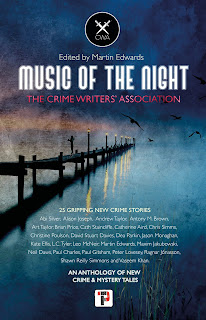
I have a soft spot for themed anthologies and was delighted to have the chance both to read and to review Music of the Night, and to join in the book's blogtour - I'm grateful to the publisher and to Anne Cater for the opportunity.
For me, the themed anthology is a chance to see how a range of authors tackle a subject. As here, there is always great variety - some will use the theme as a jumping off point, others will plan it into the warp and weft of their story. Still others will find a clever angle, a direction to go off in. No approach is right: no approach is wrong. But together, we get a broader picture. And seeing a number of stories together like this is a great way to get tips for new (to me) authors to follow up on - whether for contributing a rattling good story, for introducing serial characters I'd like to hear more about, or indeed, for the ingenuity of the way they've tackled the brief. (Or managed not to).
So, twenty five stories in this book, some of which I enjoyed better than others but each with something to say and so varied that, I think, everyone will find something here. If you want an intriguing mystery with a great premise, you will go for Alison Joseph's A Sharp Thorn, in which Emma Collett is surprised to receive a telephone call from a Cornish care home where a dying man wishes to see her. Just who is Robert Sinclair, and how does he know so much about her? The answer takes her into her past, and an unsuspected crime that centres on a vintage harpsichord. Or perhaps Brian Price's The Scent of an Ending - one of the stories here that takes music as a more incidental feature, introduced at the beginning as a troubled Keith relaxes with a favourite album, this is a perfect miniature detective story, challenging the police to solve what is basically a locked room mystery. (I LOVE a locked room mystery). Satisfying with a number of strands left open - I wasn't sure that they got the right perpetrator in the end.
For stories that integrate music into the narrative really well there's Cath Staincliffe's Mix Tape. It's one of the shortest of these stories and perhaps the one where music is most effectively used. Mix Tape actually tells its story of crime through the titles of the songs on the eponymous tape. And it is bitter, it is pointed and it is succinct. Another great example would be Kate Ellis's Not a Note which takes us to 1950s Manchester where teenage Hester is chafing as her mother tries to make her fulfil the mother's lost dreams of musical stardom. Interspersed by accounts of violent robberies, and revolving around the Coronation, there are hints here of a society under strain, of hidden histories and suppressed desires. Very atmospheric and, in Hester's rejection of a musical career, a confident inversion of the central motif of this volume. Effective and absorbing.
Music wouldn't get far without a whole industry behind it - not just the creators themselves but the world of specialist journalists, lawyers, managers, publishers and backstage hustling. But it's not always a pretty scene, as Maxim Jakubowski makes clear in Waiting for Cornelia. Jakubowski powerfully evoking the atmosphere of the business - his narrator is a seasoned journalist and author (Jakubowski cleverly blends that identity with his own history) who stumbles on an odd connection between the deaths of a series of high-profile artists. Where, though, can he take that information? Why, a fictionalised account... but however coy he is in naming names, it seems that doing so might draw the wrong sort of attention. This story also, like others here, explores the borders between crime and outright horror, and does so especially well. The business of music is also explored by Paul Charles in The Ghosts of Peace, set in the trendy Camden music scene, and turning on the history and rivalries of a band. The twists and turns of commercial reality in the music business creates plenty of scope for jealousy and even for murder, but motive isn't enough. Detective Inspector Christy Kennedy here needs to unpick just how the crime was committed. An ingenious and intriguing crime story - and a great introduction to DI Kennedy.
As I mentioned above, several of the stories here showcase the writers' recurring characters, none of these more intriguing to me than Requiem in which Leo McNeir gives us his Marnie and Ralph, off for a few days on Ralph's canal boat with some good food, good music and a shower large enough for two... their idyll is interrupted when they stumble across the aftermath of a murder. No gore, no overt detection but a definite sense that the two may have spotted something that the authorities missed. I think I'm going to have to read more about Marnie and Ralph.
I've picked out some choice stories above, but really all of these are well worth a read - let me try and persuade you!
In Be Prepared by Abi Silver, three girls at that awkward age between childhood and adolescence attend their annual Scout/ Guide camp. In the early 80s, there is perhaps a greater tolerance for inappropriate behaviour than there would be now and the unnamed narrator witnesses events which seem foreboding from the start - the question being, just when will the blow fall?
Andrew Taylor's Wrong Notes visits the town of Lydmouth in July 1956, where the local paper is a big deal, and their new cub reporter, Roderick, wants to make an impression when he's sent to cover a concert at a girls' school. Reflecting the attitudes of the age it is set in, this is an uncomfortable read in places but a pitch-perfect (unlike the school piano!) mystery in miniature.
The Melody of Murder by Antony M. Brown goes to 1980s London, as the Falklands war rages. The Met confronts a series of artistically-staged murders inspired by album covers. Turning on the sometimes close relationship between art and crime, this story captured, for me, the atmosphere of the times.
Love Me or Leave Me by Art Taylor is another story which often seems about to cross over into outright horror. Garrett is haunted by a sequence of notes which gradually unsettle and even consume him. Counterpointed by hints of something troubling in his early life, this one ends on a genuinely disturbing note suggesting something unresolved - but about to be, and not in a good way.
Catherine Aird's The Last Green Bottle features a telephone tip-off that leads to a bizarre chase across England's green and pleasant land (this could easily be Midsomer) in pursuit of a resolution to a cold case. With the song "ten Green Bottles' providing hints and clues, DI Sloan and his sidekick DC Crosby still have their work cut out to establish what actually happened and whether, indeed, a crime was committed.
Grimmer in setting and theme is Chris Simms' Taxi. A serial killer in preying on young women in Manchester's clubs and bars. Told from both the murderer's, and other, perspectives, this builds up to a tense climax, orchestrated to the killer's favourite music.
In Some Other Dracula by Christine Poulson the "Music" is the original music of the night, referred to by the Count in Dracula and suitable as, again, this book teeters on the brink of horror with crime visiting a posh Cambridge party at Hallowe'en. Some nifty detective work will sort out what's real though - won't it?
Violin – CE by David Stuart Davies is written as a dialogue, exploring the intensity of passion and possessiveness that a fan may develop towards a creator or performer. Scanty in detail, it's nevertheless chilling and raises questions about authenticity, perception and obsession. Well done, and rather scary.
Dea Parkin's The Sound and the Fury opens as a woman takes to the motorway on some desperate errand, following her state of mind, again accompanied by suitable music, whose increasingly troubling lyrics hint at what might be to come when she arrives. This ever more ominous story packs a real punch in its endgame.
A Vulture Sang in Berkeley Square by Jason Monaghan explores the squalor and contrasts of postwar London, getting behind the nostalgic fictions and the collective amnesia over the war years and comparing two men who came out of those years very differently. But are they really so unalike? Bonding when a certain song (no, not that one) is sung in Berkeley Square, there is a hint of menace in the air, reminding me of Margary Allingham's tales at their most sulphurous.
L.C. Tyler's His Greatest Hit takes the musical theme seriously both in form - it's organised loosely according to the structure of a pop sing, with chorus, verses and bridges - and content, delving into the darker side of the music business and exploring events of several decades before, revealing a sharp little tale of ambition and manipulation.
The Crazy Cries of Love by Martin Edwards is CREEPY as Gordon eavesdrops on his young neighbours, taking advantage of the thin walls in their poorly-subdivided house. Listening both to their enthusiastic lovemaking and their arguments, he muses on his own life - one which has left him pretty much in solitude. Edwards cleverly builds up our picture of Gordon - but then something happens which transforms the reader's viewpoint - and then be turns EVERYTHING upside down, all over again.
In The Watch Room, Neil Daws gives us all the makings of a classic, haunting folk ballad - the story of two brothers who are rivals for the same woman - though that isn't the musical hook for the story, rather the "in" is that one of the brothers is a skilled fiddle player. But I prefer the Ballard as background! With its setting in a lighthouse, a wild, brooding coast, and the isolation of the two men, you really have all you need for a tragedy.
Paul Gitsham's No More 'I Love You's' is a story featuring his DCI Warren. As I've said, one of the treats for me in this volume is seeing authors show off their recurring characters. This can be difficult in a short story, but Gitsham constructs here an excellent example, showing the team working together to investigate the suicide of the wife of a prominent businessman, a close friend of the Chief Constable. Almost the only source of friction is the music of Annie Lennox and Eurythmics... which, in the end, supplies the vital clue to close the case. A gem of a detective story.
The title of Peter Lovesey's And the Band Played On refers to a song which the unnamed narrator's grandfather keeps singing. Grandad turned up on the doorstep one day, fresh out of Wormwood Scrubs, and as his past and history unspool we're treated to an account that read to me like something out of Orwell's "Decline of the English Murder" - a tale of dance-halls, gangsters and burials in the woods. It's perhaps stretching the timeline a bit for that world to be within memory of the characters here, but I forgave Lovesey this for the sake of his empathetic and thrilling story.
It was great to see that Ragnar Jónasson had a story in this volume. His 4x3 is a simple story, a very simple little story 'to be read while listening to 4'33" by John Cage'. That piece will certainly put the reader in the right frame of mind for the situation in which the protagonist ends up.
In A Death in Four Parts by Shawn Reilly Simmons, washed up composer Mendoza is desperately trying to recapture the fire of his early career, while fending off kind neighbours who bring him soup and annoying ones who complain about the noise. Then - and I won't say how - he is writing again. But there will be a cost.
In the final story here, Bombay Blues by Vaseem Khan, which is one of my favourites, we travel to India three years after Independence. In Bombay, Persis, the country's first and only (so far) woman DI investigates a perplexing death in the city's flourishing jazz scene. A clever and twisted tale, negotiating not only the facts behind the crime but the social conditions too. Great fun, great atmosphere and yet another story where the messy and unglamorous details of the music business feature.
You can buy Music of the Night from your local bookshop, or online from Hive Books, Blackwell's, Foyle's, Waterstones or Amazon. For more information about Music of the Night, see the stops on the blogtour posters below and also the publisher's website here.


.jpg)