Showing posts with label espionage. Show all posts

28 May 2026

Review - Hurricane Room by Kim Sherwood

Hurricane Room
Kim Sherwood
HarperCollins, 21 May 2026 
Available as: HB, 368pp, audio, e   
Source: Advance e-copy
ISBN(HB): 9780008495480

I'm grateful to the publisher for sending giving me access to an advance e-copy of Hurricane Room, the third part of Sherwood's 007 trilogy, following Double or Nothing and A Spy Like Me, to consider for review.

I first met Sherwood’s writing with her Testament, a superb book about Holocaust survival, memory and recovering history. So, you might think, quite different from a thriller? Maybe actually not...

Like the earlier earlier books, in Hurricane Room, besides the overarching espionage plot there's a preoccupation with loyalty, trust, survival and identity - and with betrayal. (In one brilliant passage, a character whose forbears survived persecution in Europe, coming to Britain, muses on her possible alternate identity if they'd gone to New York). While that may seem a departure from the classic Bond novels, one might argue that Bond's romantic light-footedness was always hinting at these, but here Sherwood makes the point overt with tension between Bond and Johanna Harwood, 003, Bond’s ex (and in his mind, his betrayer) who has been trying to find him.

Because, yes, Bond is back! Hurricane Room, Book Three, is where Bond comes in. He has been missing, possibly dead, throughout the trilogy so far. That is a think a good move in technical terms, if perhaps a risky one. Reading the first book, a Bond-less 007 world took a bit of getting used to but Sherwood's depiction of Harwood soon made up for that whereas I think that if Bond had been here form the start he’d have overpowered everything. Instead Books one and two gave us other 00s, 000 up to 013, M, Moneypenny and a transformed Q, creating an excellently realised and updated version of the classic Bond setup.

It's also an unsettlingly timely version. This evening I've been watching on the BBC News the new head of GCHQ, speaking at Bletchley Park (where Sherwood Avenue is cheekily mentioned), warning of the dangers to the UK of Russian covert action, including sabotage of infrastructure and, especially, Internet cables. In Hurricane Room we find one of Sherwood's characters, head of Q Branch, standing up at Bletchley Park to warn of the "everywhere war" already being fought. The finale of this book may be the long awaited and traditional shoot-out, but what's being fought for is considerably closer to reality than in the classic Bond books.

In keeping with that, Sherwood has made her own Bond, with recognisable DNA from the original books and films, but she has yeeted him and his backstory into the last quarter of the 20th century and the first quarter of this (the timeline is a bit vague, or he’d be too old). As I said, he’s recognisable, but different. More self aware. Torn between Fleming’s playboy, and… something else. Perhaps Bond needs to grow beyond being 007? Sherwood can hint at that because she’s not writing THE Bond, but A Bond. (The endless debate over  who should play Bond in the films, always in the air, came into my mind here as my mental image flitted around between Connery and Moore - the classics I grew up with. It is though a silly argument overall as there is no one Bond. Who should play Sherlock Holmes? Depends which Holmes). Perhaps the film makers don’t have that freedom because to many fans now the film ones are the the only Bond they’ll be aware of, and the producers have to deliver an ongoing franchise, not a single trilogy.)

Anyway, it is good. A high stakes threat, which as I've said is more plausible than you might expect, chilling villain, final fight in a remote secret base, touches of continuity. As well as translating the Fleming continuity into her world, Sherwood also rounds out Bond’s history in her own, which helps offset the sense you sometimes get in Fleming’s books and the films of an unanchored character. She also keeps the story abreast of recent geopolitics (difficult, given how preposterous real world plotting has got in recent seasons).

The author also has some fun here. Look out for her dropping the titles of earlier Bond stories, sometimes a bit rearranged. ("She'd been loved by this spy before", "eyes Bond once called golden"). But there are also references to other espionage novels: 00 Branch is headquartered at Regents Park, like Mick Herron's spies, and there also references to an "agent runner in the field" - a nod I think to one of John Le Carré's last books (A very good one, if you haven't read it). There are other homages as well,  from near familiar language - One dove was a coincidence. Two were dinner - to names and characters (Vesper, Felix) and of course classic Bondisms (Shaken not stirred). There are the deadpan quips ("Hello Conrad. You seem to have lost face" to an opponent badly scarred in a battle with Bond and Harwood, "I've always been attracted to women walking into water with heavy pockets" - which itself inverts a famous beach scene).

Most of all though, and more seriously, Sherwood plays, in a gently meta way, with the idea of Bond himself. Harwood reflects that "He struck her as a man out of time, awake for the first day in centuries" which is a sense is every Bond revival, I think. Similarly, as events resolve and danger falls away "There was something staged about him now" which is just... so right. Bond as a character, any Bond, in any book, which any actor, has to be stagey, camp, oiled, poised. This, you feel, is Harwood's problem with him, this is why they couldn't be together. Behind the facade of the spy novel there is a deeply felt and resoundingly true relationship here, and we don't know how that will end. It doesn't feel as though it can come to any good...

I'd highly recommend this book, and the trilogy as a whole. This is Bond - this is writing - of the most compelling, truthful and engaging class.

For more information about Hurricane Room, see the publisher's website here.

17 February 2026

Review - The Essence by Dave Hutchinson

The Essence
Dave Hutchinson
Newcon Press, 9 December 2025
Available as: HB, 274pp, PB, 274pp, e   
Source: Bought
ISBN(PB): 9781917735148

It's always exciting to see a new book from Dave Hutchinson and The Essence is one of his best. 

This was part of my Christmas present to myself for 2025 and I enjoyed it loads.

Michael is an economist, working for a covert branch of the UK Treasury. After he suffers a breakdown in the office, he's placed in a private hospital to recover. A spooks' hospital, you might call it.

Hutchinson's good on institutional shabbiness - the atmosphere of the hospital, a place with decent treatment, if uninspiring food, but a definite atmosphere of have been left behind in the late 20th century, is nicely evoked. So, on his discharge, is that of his office, on a shabby cut-through behind Oxford Street. 

He's also good when portraying Michael's struggle to retain normality and his measured steps back to independence, with the help of a social worker, Jo. The book leads the reader to understanding something of Michael's past, of what's missing in the cold little house to which he returns from hospital, without over-labouring its point. It's a nice, low key exploration of (part of) a life, taking drama and interest from everyday events and routines. 

Even without major incident, this part of the story was a joy to read. Major incident is coming, however, when Michael is unexpectedly sent to Amsterdam to investigate an issue with his office's Dutch counterparts. This is where the story slips, seamlessly, into what one might call "spook mode" although it's important to understand that Michael sees himself as an economist, not a spy. Nevertheless, he's forced to think differently once it emerges that he's sought after by various factions of an international conspiracy. They all believe that he has knowledge of something called "The Essence", a mysterious and contradictory supernatural phenomenon of which he's never heard. 

The story then takes Michael across Europe, both feeling and negotiating with the different flavours of "Essencehead" while trying to understand just what he's involved in - and why. For man who's recently been hospitalised with mental health issues, the sheer preposterousness of what's stumbled on seems a real danger to his grip on reality. But evidence mounts that the Essence is a real thing, and then Michael has to question why everyone things he knows something about it.

The Essence is a combination of thriller, horror and espionage that will transition in a heartbeat from the bizarre (such as the scenes with a certain dog) to the violent to the intense, all overlaid on a kind of fantastical road trip using the breath of Europe and engagement with its history to give solidity and heft to the incredible storyline.

And behind it all, there's something else going on...

This is a glorious book, great fun, gripping and satisfying. Recommended.


For more information about The Essence, see the publisher's website here.

27 January 2026

Review - The Regicide Report by Charles Stross

The Regicide Report (Laundry Files, 14)
Charles Stross
Publisher, 27 January 2026
Available as: HB, 336pp, audio, e   
Source: 
ISBN(HB/ PB): 

I'm grateful to the publisher for giving me access to an advance e-copy of The Regicide Report to consider for review.

The Regicide Report is the final volume (at least for now?) of Stross's Laundry Files sequence, something that, in my view, has grown into a SFF phenomenon. Over the past two and a half decades I've followed the story of Bob Howard, necromancer, demonologist and computer nerd, through books that began as stories "in the style of" a series of espionage masters, mutated into treatments of classic monsters from horror, and ended up as pretty scathing criticism of UK politics.

Where is the endpoint of all that? In whose name is the espionage carried out out? On whose secret service are Bob, Mo and their colleagues engaged? Who is the most scary monster in the pack? What is at the summit of politics and public administration?

Why, the monarchy itself, of course. So, in a book which I think could probably only have been published following the death of Our Late Queen, here is the apotheosis of the Laundry, its endpoint (literally) as the unspeakable horror which has consumed the British State turns its baleful attention on the Crown itself. And on the billions of person-years of worship and belief that it has accumulated.

Written according  the normal convention of the series (Bob Howard writing his classified work diaries - but we finally see how and why that exercise is being undertaken) The Regicide Files gives us a complex plot hanging on the dilemma of the Laundry and its duty (enforced by geas) to both the current PM (that nameless horror, who was, in truth, the lesser of two evils - as PMs so often are) and to Her Majesty. 

Long-buried External Assets are being awoken, there's trouble afoot at the Palace and Bob's required to wear a fancy suit and shiny shoes. That last may be the thing he worries about most.

This book has all the notes I love in the Laundry Files: the fiendish plot (fiendish in at least two senses of the term), the dry humour, check-ins with most of the vast array of characters Stross has given us to date and a tight, action-filled narrative.  I don't know if this was planned in advance, but it's a story that derives real heft from the recent death of Elizabeth II and indeed probably couldn't have been published before. If you thought that the Royal funeral in 2023 was a big production, well, just look at THESE funeral games... 

I feel this book provides very much the ending that the Laundry (the series, and the institution) deserves. Bob and Mo get plenty of time (I've missed them in the past few books) and development but we're left guessing about just how events will proceed as CASE NIGHTMARE GREEN unfolds and what role the Laundry will play in that. (I'm blurring some detail here so as not to spoil, but I will note that - as evidenced by Bob's being at large to write his casenotes, some form of normality does continue, albeit the warped version of the New Management)

Strongly recommended to long-haul Laundry fellow-travellers. If you haven't read these books yet then no, really this isn't the one to begin with but you have some fun in store if you go back and begin with The Atrocity Archives.  

(It was also fun to see Stross adroitly sidestep issues of continuity in the series...)

For more information about The Regicide Report, see the publisher's website here.

11 September 2025

Review - Clown Town by Mick Herron

Clown Town
Mick Herron
Baskerville, 11 September 2025 
Available as: HB, 340pp, audio, e   
Source: Advance copy
ISBN(HB): 9781399800433  

I'm grateful to Baskerville for sending me an advance copy of Clown Town to consider for review.

Clown Town sees a full return to Slough House for Herron after last year's sort-of Jackson Lamb backstory, The Secret Hours. And this is a familiar Slough House, an office gone bad, a dusty, sticky, despair-haunted tomb for the careers of its crew of Service internal exiles.

Yes, the gang's all here again, River, not yet back on active duty after his brush with novichok; Louisa; Roddy; Lech; Roddy Ho; newcomer Ash; Catherine; and, of course, Lamb himself. All the Slow Horses are ready to go... slowly.

And yet. I wouldn't have thought this possible, but the Slough House we see here is actually less jolly, more bleak - somehow - than in the earlier books. It's as though Lamb has, somehow, brought back extra weights from the past Berlin of The Secret Hours, weights that drag on the spirit and chill the mind. Perhaps it's that the Slow Horses are reeling from the losses and near losses they have suffered. From missing faces and empty office chairs. The attrition has been brutal - surely one of the perks of being a down-and-out on Spook Street is that you're insignificant, gently rotting down a side alley, of no interest to the Big Men (and Women) who hunt down the main drag?

Of course that's not how it's turned out, and maybe Lamb's lot are starting to realise. Whatever, when the shadow of past Service malpractice arises, when Peter Judd begins to stir, when Taverner starts to weave her threads, there's more than a smidgen of wariness to be seen. Plus, with key members of the team signed off, pondering jumping ship, or (Louisa) actually resigned, the response to these challenges is particularly fragmented. More so than ever, I felt myself muttering "just walk away". Even Lamb seems, if such a thing were possible, less enthusiastic than normal to look under stones and join dots.

The story kicks off from a minor discrepancy in the library of River's grandfather, the OB, as reassembled in a spook-linked Oxford college. River, still, as I said, signed off, has time to look into this, and it shouldn't open any forbidden doors, should it? Well, of course it does, and we soon discover that Slough House isn't the only scrapyard for the Service's embarrassments. So that's two teams turning through the dustbins on Spook Street, but there are actually more, and there'll be encounters, near misses and misunderstandings.

The ending of the book is of a piece with that. There's a glorious (gloriously written, not a triumphant event) - a marvellous performance by not just the Slow Horses but by several other teams of clowns, which must have been a real swine for ringmaster Herron to write; a tour de force of incompetence, dark humour, muddled motives and bad luck - but that isn't the climax of the book, it delivers another sucker punch just when you think things can't get darker, leaving the already tarnished morality of this world even more shabby at the end.

A gripping, twisty and melancholy story, though one often enlivened by Herron's deadpan humour (the highpoint of which was, for me, the song that goes through Roddy's head. It sounded familiar to me. Where have I heard it? On TV somewhere, perhaps...)

For more information about Clown Town, see the publisher's website here.

24 October 2024

#review - Karla's Choice by Nick Harkaway

Karla's Choice 
Nick Harkaway
Penguin, 24 October 2024
Available as: HB, 320pp, audio, e   
Source: Advance e-copy
ISBN(HB): 9780241714904

I'm grateful to the publisher for giving me access to an advance e-copy of Karla's Choice  to consider for review.

This is the first of I hope many continuations by Harkaway of his father, David Cornwall (John le Carré)'s series of books about the British Secret Intelligence Service (the 'Circus') in the mid-20th century. Harkaway explains in his prologue that there were always intended to be more of these books, focussing on George Smiley, and indeed le Carré published a couple shortly before his death.

In Karla's Choice, we return to Smiley's heyday, the 1960s, and see George, who has temporarily left the Circus after the events of The Spy Who Came in From the Cold, called back in a crisis (as of course would happen several more times and it's nice to see how Harkaway docks his Smiley seamlessly with the one in his father's books). In true le Carré fashion, an apparently minor event has set alarm bells ringing in the corridors of the Circus and someone is needed to attend to business.

So we get to see the Circus again, perhaps not quite in all its pomp (we'd have to go back to wartime for that) but as a more powerful organisation than the burnt out shell it becomes later. And we also meet its denizens, not least the mole who will be unmasked in earlier books (if you follow the sequence). I won't name them in case you haven't read those books yet, but the knowledge of that person's later betrayal certainly provides a frisson here when secrets are being discussed... 

In the best tradition of these stories, Karla's Choice offers us an apparently dry narration enlivened by a lot of erudition and plenty of secrets - tradecraft, ruminations on the Cold War, both practical and moral, and, of course, humour. There is also the tension between the grizzled inmates of the Circus and a young woman - a Hungarian refugee, Susanna Gero - who is about to be immersed in their life when the secret world, the world of Smiley and Karla, reaches out for her. How and why it does that - and why her boss has disappeared - unfolds unhurriedly, but in detail, throughout the book. There's a sense here of the story being deeply rooted in history, the history of the 20th century yes, very recent events to the protagonists such as the Hungarian uprising but also the century's backstory, the old Tsarist days which led to Soviet Russia. 

Relationships are also central, especially the one that develops in this book between George and Susannah. This is complex. One of them is reluctant to keep playing these games, disillusioned even in his own mind, but still accepting of the twisted logic of the looking-glass war, if always on the verge of smashing the mirror. The other is new to the whole scene and inclined to be judgemental - but also, seems to have a more ruthless streak, understandably given she's crossed Europe seeking refuge (people were still allowed to do that in the 60s).  Perhaps she actually knows more than she's letting on?

We also see various stranded and beached figures who will become the famous faces of the chronologically later stories - incipient alcoholic Connie, for example; Control, before the catastrophe that is a few years down the line. And of course George's wife, with Karla's Choice perhaps equally deserving of the title Ann's Choice...

All in all, a fascinating and thrilling addition to the Smiley canon, the plot meaty, the tone perfect, the revelations and embroidering of the Circus mythology rich, fitting and gorgeous. Harkaway shows here that, yes, the menu is excellent and the chef really can cook.

For more information about Karla's Choice, see the publisher's website here.
25 April 2024

#Review - A Spy Like Me by Kim Sherwood

A Spy Like Me (Double 0, Book 2)
Kim Sherwood
Hemlock Press, 25 April 2024
Available as: HB, 384pp, audio, e   
Source: Advance copy
ISBN(HB): 9780008495435

I'm grateful to the publisher for giving me access to an advance e-copy of A Spy Like Me to consider for review.

In her followup to Double or Nothing, Kim Sherwood returns to the world of the Double 0s, the Section still being threatened by the mysterious organisation know as Rattenfänger. James Bond, 007, is still missing, and the focus shifts to Johanna Harwood, 004 who is determined to track down and rescue one of her disappeared lovers - while mourning another, killed lover, who died during the events of the previous book. 

Meanwhile, Moneypenny has concerns there may be another traitor in the Section...

Like its predecessor, A Spy Like Me captures, I think, the essence of the James Bond universe while refusing to be too deferential to trivia. So, the story is set more or less in the present, taking place a couple of years ago, but with references back to canonical Bond details (such as the the murder of his wife, a plot point that gives Johanna an unexpected source of help when she 'goes rogue' in search of him). Other events and settings are unashamedly modern, such as the prevalence of human trafficking and terrorism. Through it all we get the same mix of high living - the super-rich of the 2020s being perhaps even less abashed at flaunting their wealth than those of the 1950s and 60s - and intrigue, with violence never far from the surface. There are confrontations on Crete and in Venice that could easily be set pieces in a Bond movie, for example, an an ease with fast cars, guns and exotic watches.

And there is a twisty, complex plot, weaving the personal - like Johanna's motivation to recover James - and the political - terrorist outrages finances by dark money and taking place on a regular timescale - that gives the reader just the same sense of a countdown, a final date with evil, and of the risk of being distracted, of going down a rabbit hole in some glamorous resort, as in the original books. 

Sherwood's writing is also sharp - 'Welcome to Dubai, home of ex-pats, concrete and money' 'This woman smiles when she's told to smile because it may never happen and it could be worse, though it's already happened and it couldn't be worse' - and the absence of Bond doesn't diminish, rather it enhances, the shadow he casts over this book, forcing him into everyone's consciousness: Conrad Harthrop-Vane, for example, who's no fan, notes Bond's remark that 'this "country-right-or-wrong business" was old-fashioned in 1952' and that Bond 'is defined by his purpose' (note is, not was). Harthrop-Vane isn't the only one to speculate about Bond's character, personality, purpose or meaning, everyone has a go at one point or another, resulting in this allegedly two dimensional figure (I don't think that but it has been said) being fully alive and drawn as complex and active even when out of sight. 

Returning form those depths, this book is also fun. Sherwood drops plenty of references to Bond book and film titles and also allusions such as to a 'golden revolver' or having 'all the time in the world'. There are sideplots that take their time to join up with the main action, and surprise sprung. All I all, entertaining, nail biting and fun, with a bite of real world issues. It ends on a monster of a cliffhanger, and left me impatient for Book 3, which presumably though I'll have to wait another couple of years for!

Strongly recommended.

For more information about A Spy Like Me, see the publisher's website here.

5 April 2024

#Blogtour #Review - The Grand Illusion by Syd Moore

The Grand Illusion (Section W, book 1)
Syd Moore
Magpie, 4 April 2024
Available as: HB, 368pp, audio, e   
Source: Advance e-copy
ISBN(HB): 9780861541607

I'm grateful to Syd Moore and to Magpie for giving me access to an advance e-copy of The Grand Illusion to consider for review, and to Anne Cater for inviting me to join the book's Random Things blogtour.

The Grand Illusion - set during the Second World War - takes place in the same world as Moore's Essex Witch mysteries (we meet Septimus!) It isn't I think a direct prequel - but this is the first of three, so who knows where things will go...

Daphne Devine is assistant to stage magician Jonty Trevelyan. Adept at being cut in half, tied up, and handling concealed doves, she's about to face a whole new scale of challenge as she and her boss are recruited to a shadowy branch of the UK's Security Service. In the first half of the book we're shown a bewildering number of different activities of Section W, with the two unclear exactly where they fit. I rather enjoyed this tour d'horizon, which creates an authentically wartime sense of barely-controlled chaos, of being sent from pillar to post and back again. Are they engaged in valuable work or is everyone just going round in circles? 

It's a world where the brilliant and war-winning plan may sit on the same table as the bonkers and time-wasting one. Indeed, they may come from the same pen, on the same day. There is a sense of near panic, of a nation and Government which are, behind Churchill's stirring rhetoric, ready to try anything that may bring victory, or avert defeat.

So we see elaborate deceptions, suited to a stage illusionist. These are things it's known took place (although my understanding is that some of the details have never been revealed). We also see more troubling plans - ostensibly directed at a known weakness of the Third Reich, its obsession with occult ritual and pseudohistory. Playing on such a weakness might seem wise, and again, Jonty's and Daphne's talents in illusion and deception might boost the effect of that, but is there more going on here besides? We are in the Essex Witches universe, after all.

Gradually, and teasingly, Moore creates a setting filled with distortions and red herrings, one where it's not clear just who is manipulating who. What matters more, illusion or reality? Is the febrile wartime atmosphere perhaps fertile ground for thinkers who are normally marginalised? Might they use it to their advantage, even if ostensibly what's going on is simply psyops? Just who is falling victim the that "grand illusion"?

Questions, questions - with some answers, but many, teasingly, withheld.

Everything that has happened may have a rational explanation. Or there may be other stuff going on. As tempting as it may be to rush through this book to the conclusion, it bears careful attention though because I think there are some clues... and I'll be looking forward to future novels in this series for some of those answers.

Turning to the characters, I loved Daphne. Trapped by circumstances in a difficult corner - her family connections make her an objection of suspicion to some, and give the Government leverage over her so that in many respects she's not free to say "no" when the Ministry comes knocking - she plays a difficult hand well. Even though those around her frequently underestimate her capabilities (being female, they often don't seem to expect much of her) she continually steps up and sees the way through. Jonty and the others are perhaps a bit less-well defined, but as Daphne is the focus that works fine for me. What does come through, as external circumstances get more desperate, is a rising sense of internal tension in Daphne. She's clearly being swept to some major trial or crisis and she responds to that knowledge, but Moore gives little away and while there is a respite by the end of the book I didn't think that matters had come to a head. In a story with plenty of menace, threats and talk of spies, Fifth-columnists and collaborators it isn't clear whether the threat is of espionage or the supernatural, or both, and I suspect there is more of it to come. 

I'm really looking forward to the next part of this series!

For more information about The Grand Illusion, see the publisher's website here - and of course the other stops on the blogtour which you can see listed on the poster below. 

You can buy The Grand Illusion from your local high street bookshop or online from Bookshop UK, Hive Books, Blackwell's, Foyle's, WH Smith, Waterstones or Amazon.


2 May 2023

#Blogtour #Review - #MoscowExile by John Lawton

Moscow Exile (Joe Wilderness, 4)
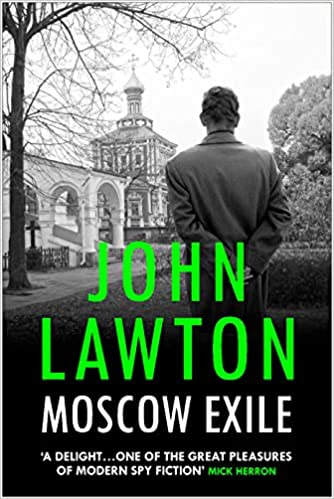
Cover for book "Moscow Exile" by John Lawton. Black and while photograph. In the foreground, a man with his back to us, long coat, hands held behind his back, tousled hair. he is looking at a building in the middle distance: perhaps an Orthodox church, with an onion dome surmounted by a cross, another cross visible under a row of arches to the man's left.
John Lawton
Grove Press UK, 4 May 2023, 
Available as: HB, 435pp, audio, e   
Source: Advance copy
ISBN(HB): 9781804710098

I'm grateful to Ayo for sending me a copy of Moscow Exile to consider for review, and for inviting me to join the book's blogtour.

Moscow Exile is a treat, featuring as it does both Joe Wilderness and Inspector Troy (well, ex-Inspector Troy now) and fleshing out their complicated world. That world exists in a web of relationships which cuts between politics, Society, and espionage, meanwhile  hacking into the private corridors, the dining rooms, and some seedy motels of the mid 20th century.

The book covers lots of ground both physically and temporally. We visit Winston Churchill's inner circle in his wilderness years (no pun intended). There's the Attlee and Wilson Labour governments,  postwar Washington in its pomp, with the US still a rising power, and late 60s Moscow, the USSR's decay well advanced. 

Tying all this together are two fascinating characters. Charlie Leigh-Hunt, field agent for MI6 and a bit of a rogue (he has a scam going passing useless intel back to the KGB, for cash) is posted suddenly to Moscow to replace the disgraced Guy Burgess. (But replace him as what, exactly?) Charlotte Mayer-Churchill, a socialite who burns through husbands like party candles, formerly accompanied HG Wells on his travels, including to Moscow, and her Washington parties are now legendary. The story that emerges when the two meet dovetails with Lawton's previous evolving world, forming part of a work that begins to remind me of CP Snow's Strangers and Brothers sequence, but for espionage rather than straight politics. (I don't think you'd get a Cold War prisoner swap on Glienicke Bridge in Snow, still less that that goes as spectacularly wrong wrong as this).

That said... yes, I say "for espionage" but the thing about this sequence is that while the context, the legend, to borrow a spooky term, may be espionage (and related forms of criminality) what's really going on here is much more about the heart. These books form a wonderfully nested collection of personal stories. For example, the motivations for shifting loyalties, as exposed here, are deeply labyrinthine. A spy's work-life balance must permit some happiness, mustn't it? Some downtime, some compensation? The various British figures seen here, caught in the amber of 60s Moscow, are all caught in enforced downtime. Whether they sought to be there or are trapped by circumstances, whether they are wanted there by their Soviet hosts, or wherever their residence will be permanent or short term, they are all, as it were, on the bench, watching the game but not playing it. How they deal with that struggle, some adapting well, some consumed by homesickness (for a home that no longer exists), by drink, or regret - it's all finely nuanced and meticulously explored.

The focus here is on the intimate, on people not big events, and the victories and defeats chronicle here for the different factions of spooks are marginal ones at best, the particular intelligence scooped up and passed on pretty much anonymous and the results of betrayal by this asset or exposure of that one far form there centre of the story. It's the people that matter, their histories, choices and plans as much as they're worth in an exchange or left in place. 

I felt everybody - will nearly everybody, perhaps not Senator Redmaine, the leftie-baiting McCarthy like figure who features in the second quarter of the book - was treated with some sympathy. Equally, nobody has completely clean hands: events which have been described in earlier books leave them all compromised or trapped, unable to rise to every occasion as they might wish. From racketeering in post war Berlin to scams such as the one Charlie is running here to outright murder, there are secrets here which also have a value and it's anybody's guess how long they will remain secrets.

All in all, an absorbing, intricate and beautifully paced thriller which I greatly enjoyed reading.

For more information about Moscow Exile, see the publisher's website here - and of course the other stops on the blogtour which you can see listed on the poster below.

You can buy Moscow Exile from your local high street bookshop or online from Bookshop UK, Hive Books, Blackwell's, Foyle's, WH Smith, Waterstones or Amazon.


11 April 2023

#Blogtour #Review - The Lazarus Solution by Kjell Ola Dahl

Book "The Lazarus Solution" by Kjell Ola Dahl. A city at night. In the foreground, a dark car, halted. Beside it, a figure seen in silhouette, looking up at one of the buildings.
The Lazarus Solution
Kjell Ola Dahl (trans Don Bartlett)
Orenda Books, 27 April 2023
Available as: PB, 295pp, e, audio
Source: Advance copy
ISBN(PB): 9781914585685

I'm grateful to Anne Cater at Random Things Tours for sending me a copy of The Lazarus Solution to consider for review, and for inviting me to join the book's blogtour.

In The Lazarus Solution, Kjell Ola Dahl gives us a satisfyingly murky, noir-infused thriller set in Stockholm in 1943. The characters are exiles from the Nazi occupation of Norway, spies of various nations, patriots, collaborators. (There's even a femme fatale). Some of the people we meet are several of these things at once. 

Our hero, Jomar Kraby, seems an unlikely participant in all this. A writer (whose works have been censored by the Swedish government, anxious to place the Germans and not be drawn into the war) he's asked by the Norwegian government-in-exile to investigate the killing of one of its couriers on occupied soil. Kraby, whose daily business seems to be drinking and failing to write, proves an unexpectedly skilful, resourceful and determined investigator, so much so that one feels there is more to him than we are being told.

Indeed that's one of the pleasures of this book - while comparatively short, it gives the impression of a peek into a larger world, whether through the presence of the Soviet embassy (which is clearly up to something) under its grizzled spymistress, Kraby's messy unfinished business with his ex back in Norway or the administrative rivalries between various branches of the Norwegian legation. Romantic, professional and ideological motives become confounded - and that's even before we learn more about the dead man, Daniel Berkåk, and his connections to refugee Kai Fredly and his Nazi-supporting brother.

Kai's history and that of his brother provide the opportunity for a bit of necessary exposition, detailing both Marxist and Nazi ideologies and showing the events that might have shaped young men and women in Norway before the invasion. Again, it's complex, and Kjell Ola Dahl illustrates how divided loyalties can become - this isn't a book that deals in moral absolutes at all. For a crime novel, that is of course wonderful as it makes absolutely everybody suspect, but it also drives a story in which what matters is less who was where at a given time, or what the condition of a body tells us about a death, but rather, how each character stands in relation to all of the others.

As such, a writer like Kraby, used to dealing in motivations and weighing characters, is perhaps just the right figure to be investigating what happened. Less a sleuth, perhaps, than the author of a story, he moves through the shadows of wartime Stockholm - as well as Norway itself - to dark corners where all manner of mischief is going on with surprising bedfellows (in both senses of the word) up to a world of chicanery. 

I loved Kraby as a central figure, recognisably walking the mean streets yet keeping his humanity, a witness to what happens in the dark without consenting to it. A witness, one feels, who will be ready to give evidence when the war ends and the reckoning - which many here, on all sides, hope for or fear - finally comes.

Simply a brilliant, compelling novel of humanity and collusion, ably translated by Don Bartlett into flowing English.

I would definitely recommend this one!

For more information about The Lazarus Solution, see the publisher's website here - and of course the other stops on the blogtour which you can see listed on the poster below. 

You can buy The Lazarus Solution from your local high street bookshop or online from Bookshop UK, Hive Books, Blackwell's, Foyle's, WH Smith, Waterstones or Amazon.


21 December 2022

#Review - Standing by the Wall by Mick Herron

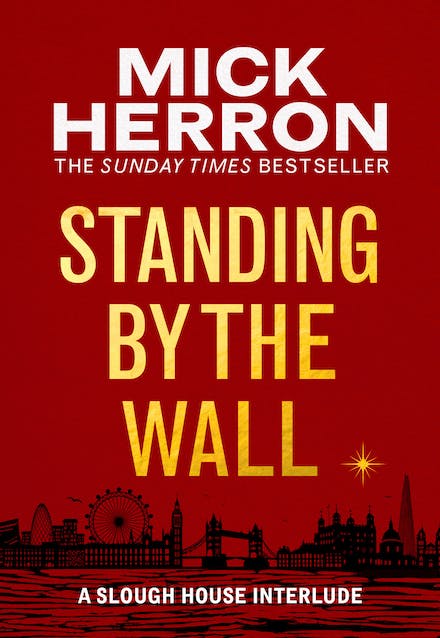
Standing by the Wall (A Slough House Interlude)
Mick Herron
Baskerville, 3 November 2022 
Available as: PB, 56pp, audio, e  
Source: Bought
ISBN(PB): 9781399807081

This is perfect Mick Herron, perfect Slough House. On a dank Christmas Eve, as the office workers spill onto rainslicked pavements for some jollity and the failures of Slough House consider leaving early, Jackson Lamb has a little job for Roddy Ho ('Ho? Ho! HO!' - yes, I know, but the idea of Lamb as Santa, is, well, not exactly funny, but...)

That job, plus the angst and lethargy that seep out of the Slough House wall and carpets, give a hint, perhaps of the next main book (The Secret Hours), due in September 2023. They certainly focus on Lamb's - and Molly Doran's - lives, so maybe we'll hear more of those. But they also drop one or two surprises and feature a status report, as it were, on the interpersonal relationships of the Slough House inmates.

Best of all, we get Roddy monologuing at length. I always enjoy his internal narrative, deluded and self-centred as it is, which seems like tidings form a parallel world. I don't think I've come across any character in recent fiction who is so un-selfaware and whose intentions seem so unpleasant yet who one has to accept is at a fundamental level almost completely naive and innocent. Ho is of course only a microcosm of the entire Slough house experience - a pit of darkness and despair which is it seems, at the same time, the nations's last, best defence against the deeper darkness beyond.

A lovely antidote to Christmasness.

For more information about Standing by the Wall, see the publisher's website here.

5 December 2022

#Review - Cold Water by Dave Hutchinson

Cover for book "Cold Water" by Dave Hutchinson. A distorted image of a silhouetted female figure standing on a bridge, the floor of the bridge and the handrails warped as though by a mirror. In the distance, tall commercial buildings.
Cold Water
Dave Hutchinson
Solaris, 10 November 2022
Available as: PB 417pp, audio, e   
Source: Purchased
ISBN(PB):  9781786187222

Cold Water is a return to the world of Hutchinson's Fractured Europe, some time after the events of Europe in Autumn, Europe At Midnight, Europe at Dawn and Europe in Winter.  It doesn't assume any familiarity with those, although if you are you'll be rewarded by posting some referencing and of course you will have a head start in understanding the background. This is a world devastated by a viral plague; a world where the states of Europe have fragmented into statelets, free towns and pocket republics; and a world interpenetrated by alternate, pocket universes.

Against that background, we're given a twisty, tense and involving thriller mixing espionage, crime and derring-do. Carey Tews, a woman from the Republic of Taxes, has retired from the shadowy network Les Coureurs. She reckons she's getting too old for the work, and besides, her cover blown by what happened in Hungary (don't talk to her about Hungary!) But like Smiley of old, she's invited back to carry out One Last Job when her recruiter, mentor, and sometime lover, Maksim, gets himself killed in a little Polish town that's winding up to declare independence.

The story also follows Krista, a young Estonian police woman, whose investigation into a gangster's operations in Tallinn is rudely interrupted by scandal from the past, by way of Russian agents, a drunken journalist, and a crew of juvenile hackers and forgers who get you any credentials you might need. As always with Hutchinson's books the detail and plotting is meticulous, creating set-ups and pay-offs that are just so good, they could hang as works of art in any museum. There are mysteries here - so I am being vague about what actually happens - and they're fiendishly nested mysteries, so that while I spotted one or two points coming, the how and the why of their fit with the wider story absolutely took me by surprise.

There are some superb characters here too. Carey is just magnificent, a richly portrayed, complex woman who - whatever she believes - is at the top of her game. I love reading stories in which competent, experienced people meet difficult challenges head on: books where you have a sense that there is just so much happening - real danger combined with plausible, calculated courses of action... which don't always come off.

Depicting all that background doesn't make the story slow, not at all - there is plenty going on here from the start, which opens with a clandestine meet that wouldn't be out of place in the (old style, TV) Mission: Impossible, to the conclusion - a tense, high stakes confrontation at a deserted border post. The pace never lets up, with the parts dealing with Carey's history actually adding tension because - as we empathise more and more with her - we see just how impossible is the task she's undertaken (and why she didn't want it).

(In passing, I was particularly impressed by the way that is able to leverage the experience of covid to locate his story even more sharply in the imagined future (middle of the 21st century?) His "Xian 'flu" isn't covid, it is even more devastating - and it was mentioned in the earlier books. Still, the experience of lockdown, of helplessness as friends and loved ones succumb and the reality that things have changed, is deep in the DNA of this book making very real speculative fiction).

Vastly enjoyable, fun, and sharply observed. Read it.

For more information about Cold Water, see the publisher's website here.

1 September 2022

#Blogtour #Review - Double or Nothing by Kim Sherwood

Cover for new James Bon novel "Double or Nothing" by Kim Sherwood. A gold disc intersects two gold circles. Across the centre is the book's title and "James Bond is Missing. And the Time is Running Out."
Double or Nothing
Kim Sherwood
HarperCollins, 1 September 2022
Available as: HB, 432pp, audio, e
Source: Advance copy
ISBN(HB): 9780008495381

I'm grateful to HarperCollins for sending me a copy of Double or Nothing to consider for review, and to Anne Cater for inviting me to join the book's blogtour on this, the book's publication day.

BOND IS... 

...MISSING???

The extended career of Agent 007, in print and on film, must present the author of a follow-on book with various dilemmas - whether or not to write in continuity, what time period to set the book in, and how far to broaden the universes. But equally, with opportunities, of which Kim Sherwood makes full use in this, the first of a trilogy of Bond novels.

The result is an accomplished, exciting and involving book which shows us a great deal more of the world about Bond while the latter is, well, absent. That fits nicely into recent film portrayals in which he goes off-radar, and allows the introduction of other members of 00 Branch, particularly of 009, Bashir, and 003, Johanna Harwood. We also get to meet Moneypenny, head of  the Branch, and a version of Q (I don't want to say any more about this as the realisation of Q's identity came for me as a delicious shock followed by "yes of course, that's exactly right!")

As book opens, 009 is engaged on a daring rescue attempt. The Branch has fallen on hard times, a mole is feared to be giving away vital information and many members have been killed or have vanished. Bond is only one of these, but he vanished on Bashir's watch and the letter is haunted by guilt. The book contains a fair amount of brooding on ageing agents in a world that has moved on and regrets of mistakes and/ or betrayals (on multiple levels). It has a distinct air of unfinished business which makes the immediate threats - an international criminal/ terrorist gang knows as Rattenfänger and an ambiguous multibillionaire who's name is Paradise and who promises to use his satellite and quantum computing technology to fix the climate crisis - seem almost like annoying, if urgent, distractions from a deeper web of relationships and motivations. Sherwood creates this web of backstory without apparent effort and I very soon accepted all the new 00s, their setting, and their priorities, as part of the new Bond storyline.

That's helped by the way the story uses references - such as mentioning the death of Bond's first wife on an Alpine road, or giving Felix Leiter still gamely playing the game - without either relocating those events near to the present or trying to explain how these can be in the minds of people in the 2020s. It makes the continuity work by not trying too hard to make it work, clearing the way for a devious story that - in the text Fleming tradition - presents a perhaps-monster who needs to be approached and understood. The focus on climate change makes the story very modern; the deployment of outlandish technologies, cocktails, exotic locations, fast car chases, and sinister secret organisation, makes it very exciting, very Bond. There are shoot-outs aplenty, narrow and improbable escapes and, in the behaviours of the MI6 agents, that indefinable sense of élan that you'd expect. 

I also had fun seeing how many riffs on book/ film titles Sherwood was able to sneak in - my favourite was "Icons are Forever". As well as being witty, it also summarised a theme of this book, with Bond  cited as believing that an agent's greatest strength is in their myth. For Bond, off stage as it were, it makes him subject him to all sorts of doubts and distrusts. But at the same time, as the actions of 003 and 009 illustrate, Bond is still someone to emulate. Have they swallowed a lie? ('This man, he is a fantasy. The cars, the women, the gadgets, the endurance, the courage, the one man to hold the line and never waver.')

For 00 Branch as a whole, the Bond legend imploding would risk the whole outfit being seen as an anachronism, or worse, as inefficient, a threat to the Service. Better he were dead, perhaps. But equally, several times in this book, for agents with their backs to the wall, captured or threatened with death, it inspires them to come out fighting or to dream up new ploys and strategies to overcome their enemies. 

Which is in the end why we read these books, isn't it? For that moment when the scales fall from the villain's eyes (whether or not accompanied by a clever quip from the hero) and he, or she, releases how they've been played, outmanoeuvred, outclassed by a 00. This book has those moments just where they ought to be, and they kick as hard as should.

I strongly recommend it, it is fun from the first word to the last.

For more information about Double or Nothing, see the publisher's website here - and of course in the other stops on the blogtour which you can see listed on the poster below. 

You can buy Double or Nothing from your local high street bookshop or online from Bookshop UK, Hive Books, Blackwell's, Foyle's, WH Smith, Waterstones or Amazon.

Blog tour poster for new James Bond novel Double or Nothing, listing the blogs hosting reviews.


3 June 2022

#Review - The Knave of Secrets by Alex Livingston

The Knave of Secrets
Alex Livingston
Rebellion, 7 June 2022 (UK), 9 June (US)
Available as: HB, 400pp, audio, e
Source: Advance copy
ISBN(HB): 9781786186072

I'm grateful to Rebellion for an advance copy of The Knave of Secrets to consider for review.

This book simply wowed me from its opening - in which cardsharp Valen Quinol and his crew cozen a rather nasty aristocrat who tried to turn the tables on them through sneaky tricks - to its dramatic, world-shaking ending, by way of compulsive world building, bitterly sharp social commentary and a determination on the author's part not to let the mysterious sect of magicians we see here be the secret hand that rules everything.

There are perhaps many ways to crystallise and make real a fantasy world. It's commonly done through warfare - actual or threatened - religion, or, of course, magic. While these factors are certainly present or threatened, much more important to Livingston's island of Valtiffe and to its surrounding lands though is something else.

Gambling.

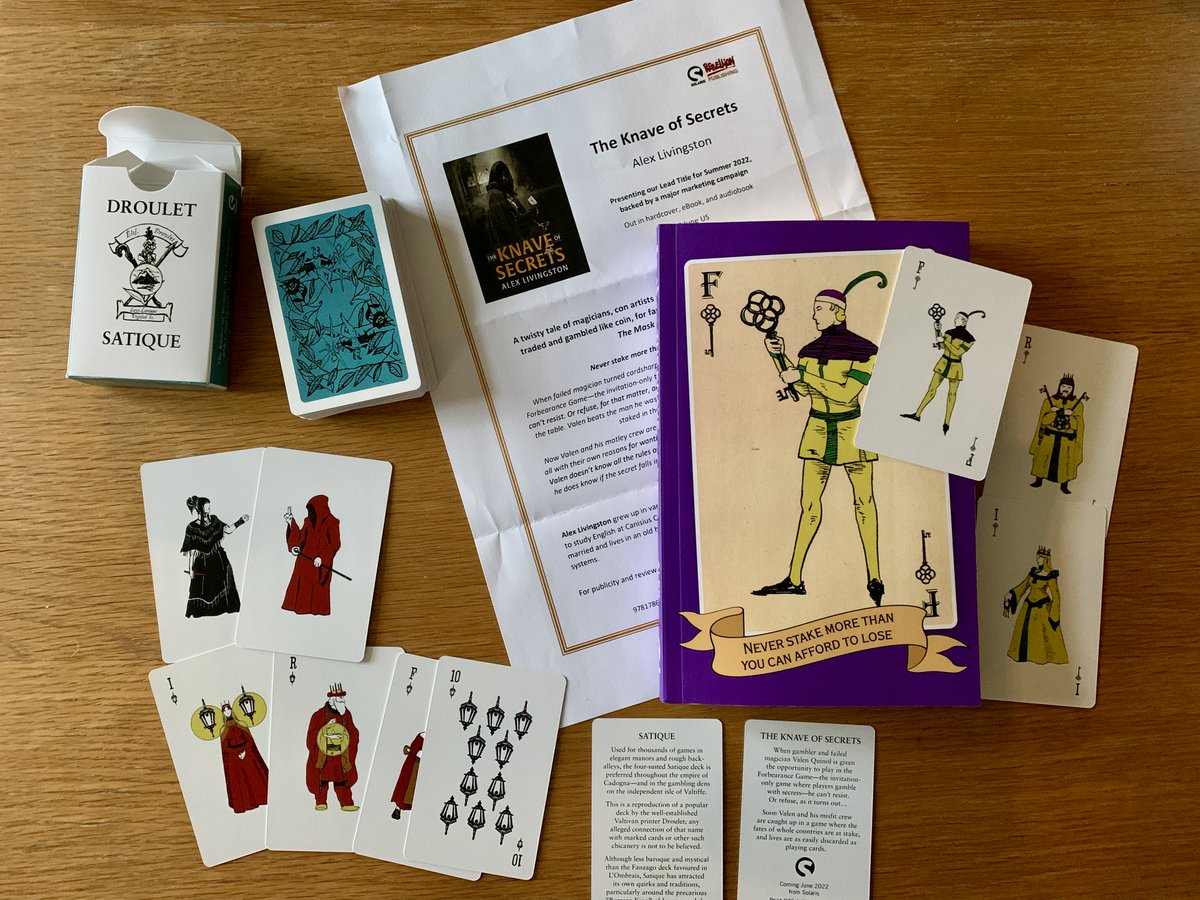
The rich culture of these nations and territories - caught up as they are in a kind of old Mitteleuropa struggle of divided loyalties, languages and origins - is drawn in the games played at table in casino, club and tavern. Or aboard ship, on the dockside, or in back alleys. The book is saturated in accounts of epic card duels, descriptions of the different games, the ways of cheating at them, the different suits of cards, varieties of dice, of boardgames, tactics and of the danger of sharp play. The sources quoted use their accounts of gaming to illustrate or allegorise everything from decent conduct in Society by a "gente" to politics to history to the cultural traits of the various nations and peoplkes that play a part in the story. The maps which are included label each city and town according to the games that are popular there, and - I was delighted to see - the review copy even came with a set of cards and rules (see picture).

It's a cultural milieu in which Valen and his friends Ten(eriève) and Jay, and his wife Margo, are perfectly at home. This group of cheats and sharps are so perfectly well described and realised - Valen and Ten who were turned out of wizard school, Margo the daughter of stolidly middling merchants who despise her raffish husband, Jaq the sailor. Their lives take place not in the stone halls and snowy fells of stereotypical fantasy but in a sort of bourgeois, trading-and-politicking world redolent of ancien regime Europe, though with added magic.

Because this is a fantasy, make no mistake. Valen's first vocation was to magic, from which he was exiled due to something almost like theological differences. Valen wants to develop it to serve him at the gaming table, though he's having little success - but the magic here is always channeled, limited and definitely in the service of distant, vaguely glimpsed political games.

All of this - gaming, magic, politics, spying and more - comes together when Valen receives Ann offer he can't refuse from one of the local mobsters, the chief of the Naughty Knaves: play in the Forbearance Game, the biggest, most notorious, contest in the city, or - well, as I said, there isn't really an alternative.  Not one he'd like, for Margo, or for his friends. Thus unfolds a definite Caper subplot, which is great fun.  Of course that leads to Trouble, to being pursued by all sides, desperately trying to work out what precisely is going on, before the sky falls in and Valen's comfortable, safe life spirals right out of control. 

Livingston gleefully adds to the mixture obscure spymasters and double agents, a cool, aristocratic lady called Ria who may be playing both ends against the middle and a vengeful, deadly force of unknown origin.

It's gloriously readable, whether you enjoy card games or not, a book to savour, not to rush through (so you may have to read not twice - once at a gallop, then more slowly) and one where our heroes may be threatened but the stakes for the world or indeed the universe are pleasingly low.

Until they're not.

Great fun, and I hope I'll be invited to this table again soon...

For more information about The Knave of Secrets, see the Rebellion website here.


12 May 2022

#Review - A Sh*tload of Crazy Powers by Jackson Ford

A Sh*tload of Crazy Powers (The Frost Files, 4)
Jackson Ford
Orbit, 12 May 2022
Available as: PB, 496pp, e
Source: Advance copy
ISBN(PB): 978-0356514673

I'm grateful to Nazia at Orbit for an advance copy of A Sh*tload of Crazy Powers to consider for review.

With book 4 in a series, there can be a risk of things becoming stale. Still readable, yes, still what you came to it to get, but - flat. After all, why change anything and risk putting people off?

It's a trap that Jackson Ford avoids here with aplomb. Crazy Powers - while I don't want to say too much about its outcome - upends the safe little world (well, for rather exotic values of "safe") that Teagan Frost, possessor of awesome psychokinetic (PK) abilities and would-be chef (if she can ever scrape together the money to train) has inhabited so far.

A recap. Teagan ('She has zero strategic skills, no filter, a constant ability to screw up even the best-laid plans. She can be ungrateful and whiny, and she takes sarcasm to an Olympic level') was gifted her abilities by mad-scientist parents who endowed her brother and sister with equally awesome, but different, powers (seeing infrared and never having to sleep, respectively). Teagan's brother then killed her parents and sister, and she herself was snapped up by the US Government which uses her for black ops in the Los Angeles area. Over the previous three books we've seen this situation gently come apart, culminating, at the end of Book 3, Eye of the Sh*t Storm, in Teagan sitting in hospital with her friend Annie, who's in a coma, and blaming herself for that. 

This story picks up exactly where that previous one ended. Teagan is still battered, drained and haunted by the earlier events, and may have fatally exposed the secret of her powers by saving hundreds of people from a horrifying death, but she gets no rest, oh no. Ford plunges her into the midst of a kidnap attempt which leads up to one of those fabled LA police chases, all broadcast live on ghoulish news networks. From that point it only gets worse and worse. China Shop, the outfit for which Teagan works, is tasked with providing security for a convention of arms dealers (in an LA hotel? Something seems a bit off here) - and she's not even started to recover from recent events...

I loved this book. Totally loved it. Ford blends together a pack of irritable, exhausted operatives, living on shreds of their nerves; a new group of antagonists in the form of a weird, religious cult; and a bizarre location - the hotel itself, a gothic pile with rumoured hidden tunnels, a helipad and secret rooms. And a mystery, whose unpicking will show the whole sequence of books so far in a new light. He's also very sharp on the setting - we meet 'people who are able to take a red pen to black budgets' (watch out, China Shop!) in a milieu where 'Like most crowds of rich people, it's a mostly white, mostly male demographic.')

At the same time, old antagonists also return, affording Annie, who's a likeable and interesting character, a whole adventure of her own in parallel to that of Teagan and the rest. Annie is also battered and bruised, and her escapade - accompanied by Teagan's boyfriend Nic (is there a bit of a spark there? Ouch...) - gives an opportunity for her to reflect on her own early life, sharing details with the reader that we didn't know before. It also illuminates the relationship between her and Teagan, revealing a much more human side to both that Teagan's endless banter and Annie's chilliness has so far concealed. (Teagan's friendship with ex-gangster and drug dealer Annie is touching - 'Teagan is one of the most exasperating, irritating and confusing people that Annie has ever met... but she is also her friend. Maybe her only real friend.')

Both women, basically, get put through the mill here - one can almost taste their weariness and pain - and it's made plain that both care about much more than their own survival. There's a bond there, but there's also a sense of wider ethics and involvement in society, and perhaps also a sense of growing up, maturing (a bit. A little bit.) A reminder that they're not just action heroes. As you'd expect, it makes this a compelling and must-read instalment of this series and one which sets things up for another which I'll eagerly await. Truly, Teagan (and Ford) throw lots of sh*t up in the air and who knows where it will ever come down?

For more information about A Sh*tload of Crazy Powers see the publisher's website here.

10 May 2022

#Review - Bad Actors by Mick Herron

Bad Actors (Slough House, 8)
Mick Herron
Baskerville, 12 May 2022
Available as: HB, 352pp, e, audio
Source: Advance copy
ISBN(HB): 9781529378702

I'm grateful to the publisher for an advance copy of Bad Actors to consider for review.

Bad Actors is the lates novel in the Slough House series, focussing on the spooks (the 'slow horses') that MI5 left behind. Left behind in a decaying, seedy, London office, to be overseen by the decaying, seedy Jackson Lamb. Eight novels in (plus a few novellas) this series is still firing on cylinders - and delivering some surprises.

Slough House has recently been brought to TV (rather splendidly, I think) and in his credits in this book Herron makes clear that the title isn't directed at the actors in the series. It's true that it has been trailed in previous books, and it is also a clever pun on the overlap between 'bad', that is, malign figures - several of whom feature here - and more straightforward hopeless losers and misfits - who also appear - who are simply 'bad' at performing their roles. Not all of the latter are Slow Horses. 

I think there is a bit more to it than that, though. I do wonder whether the adaptation of the series as drama has influenced this book. In Bad Actors, Herron seems to be reflecting the drama in a running series of theatrical metaphors. For example, ''No, really, don't. Let's just workshop it, shall we?' during a meeting, or 'the street dazzle of Soho - the neon lights and mirrored windows'. A junior spook who 'wasn’t quite Oscar material' nevertheless 'had her moments' while one of the characters, Nash, is 'stepping into noir, dimming everything to a monochrome rainbow'. There are many more examples, all contributing to a sense of a stage waiting, of the streets of London as an arena, a performance space. And the sections in the book reflect this, dividing the story into 'Acts' (we actually get Act 2 first, something that itself contributes to the atmosphere at the start). 

This sort of leitmotiv is very much in keeping with the earlier books, which I think each tend have a particular language or framing in a similar way. Of course the books in this series are always alive to the context and setting of a crumbling UK in the cold winds of the 21st century (indeed, Slough House itself could be the overarching metaphor for this) but, perhaps, they draw attention to it in different ways. Here, the theatricality perhaps emphasises that the current crop of 'bad actors' (perhaps in both senses) in Westminster and Whitehall are also, largely, creations, acts in fact. 

But Herron also delights in a less subtle characterisation - for example, giving us a failing Prime Minister whose 'sole qualification for the job had been the widespread expectation that he'd achieve it. Having done so, he was clearly dumbstruck by the demands of office: the pay cut, the long hours, the pandemic, and the shocking degree of accountability involved. For a man who'd made a vocation out of avoidance of responsibility, this last was an ugly blow...' as well as unscrupulous unelected advisers, lurking in the shadows to reshape the hapless nation over which they exercise control. 'The PM's enforcer, Sparrow wasn't as high profile as his predecessors had been - it would have been challenging to maintain that level of unpopularity without barbecuing an infant on live television - but those in the know recognised him as a home-grown Napoleon: nasty, British and short.')

One of this doleful band - a 'superforecaster' attached to No 10, no less - has gone missing. Her boss, the Sparrow referred to above, is perturbed, and Slough House may be a convenient scapegoat. A retired spook is reactivated to investigate, and in a story perhaps showing more crossover than usual between the despairing landings of Slough House and the gleaming corridors of Regent's Park, a host of actors, good and bad, seek to take advantage of the situation; or simply to survive. So Louisa, Lech, Roddy and the rest carry their spears (in Roddy's case, a broken broom) onto the stage, pursued by a Lamb. But we also see Regent's Park on high alert as a foreign spy appears, unheralded, on their radar, with a special message for the First Desk, Diana Taverner. At the same time, she is fighting a battle to prevent her empire being absorbed into the nebulous world of the PM's Special Adviser. 

It's a very full, fast-moving and exciting story (as ever) plumbing deep into the minds and motivations of the cast, but often illustrating them as much through petty office politics as through major plot developments; the consequences of pinching a colleague's lunch from the fridge, for example, or of catching somebody out on a personal Zoom call. But make no mistake that the stakes are high. The events of Slough House, the previous book, are still very much with us (especially a particular absence) and various members of the team cope with their guilt, or don't, about that: that straight-into-Act 2  structure of the book allowing the hangover from Slough House to blur with their recollections of an Act 1 which of course we haven't read, all creating a truly disorienting effect. What happened in Wimbledon? Should we know? Why is there shattered plastic all over Roddy's floor? What has Shirley done now? (And where has she gone?) Combined with the fallout from the missing adviser, there seems a distinct possibility here that somebody in Slough House really has stepped out of line - or at least that Lamb may not be able to prove that they haven't. 

It's a very disquieting opening, setting up a book full of subtly shifting (or undeclared) loyalties (watch Slough House's new recruit, and the machinations of the straw men on the fringes of the Park) which nest slightly with the many enjoyable contrasts and juxtapositions. There is both sophisticated verbal fencing between senior officials ('...Regents Park string pullers knew to tread carefully around Diana. String pullers carry weight, but Diana carried scissors') and, of course, Lamb's crude put-downs. There is Roddy's absurd inner monologue and hapless pantomime shadow combat with a broomstick, but also some utterly serious violence. There is the fatuous and solipsistic world of the politicians and advisers where everything is about message and position and we don't want to hear from experts ('lying in office was no longer a career-threatening felony; the consequence of misleading Parliament was nowadays a lap of honour') and, outside in the cold, the chilling realpolitik and tradecraft of the even badder actors. 

Pretty soon, realities will begin to show through the waffle and piffle...

In short this is a terrific addition to the Slough House series, as sharp and engaged as ever. (And oh, there are scenes here that I can't wait to see on the screen, though some of them may be very tricky to translate...)

For more information about Bad Actors, see the publisher's website here.

24 July 2021

#Blogtour #Review - Notes from the Burning Age by Claire North

Notes From The Burning Age
Claire North
Orbit, 22 July 2021
Available as: HB, 403pp, e, audio 
Source: ARC kindly provided free by the publisher
ISBN(HB): 9780356514758

I'm grateful to Orbit for an advance review copy of Notes from the Burning Age to read and consider for review.

Before I start this review I should probably declare a bias - I adore Claire North's books and I've been loving her novels exploring individuals with weird abilities, or curses. Notes from the Burning Age is a little different, featuring ordinary people albeit in a weird future, but I still came to it expecting brilliance and I wasn't disappointed. 

Fiction reflecting and commenting on the environmental catastrophe being visited right now on the planet has never been more important... or harder to do.  Given the scale of what is happening, there is a sense in which all future, or near future, set fiction must be climate/ environmental fiction. But authors face challenges. Make it unremittingly gloomy, and readers might stay away. But implying it's a trivial problem, easily solved, would be reckless and unrealistic.

In Notes from the Burning Age, North finds an ingenious solution. The book is set some way in the future - hundreds of years - in an era when people can look back to our "burning age" and judge it. From that perspective, they can report the catastrophe, but without living it. We can also see that, despite losses, humankind has found ways to mitigate its impact on the planet, limitations to prevent a repeat of the disaster. The book is full of fascinating detail about these, from dependence on bicycles and electric vehicles and use of solar, wind and tidal power, to building techniques using reasons instead of cement to a system of religion and ethics intended to stress interdependence with nature. This is propagated by the Medj priesthood, who 'bowed to each tree in turn and made libations to the kakuy whose gift they were receiving'.

This elusive concept of the kakuy is key to the civilization depicted here. Perhaps gods, perhaps demons, perhaps innate spirits of the forests, the mountains, the seas, the kakuy may be a pious myth, a real and ferocious force that rose in anger when humans defaced the earth, or a personification of the chaos and harm that came from that defacement. The Medj teaching is focussed on not rousing them again - if gods, they are gods who have no regard for Mankind, regarding us an irritant at best. Ancient religions flourish alongside this cult - at one point a character is rescued and sheltered by a Jewish community, and the domes on ancient mosques and churches still stand over the city of Isdanbul - but they are peripheral. 

Ven, the main character in Notes from the Burning Age, is a disgraced former member of the Medj, but hedges his bets about the kakuy. Others, ambitious men (mostly) who chafe under the limitations imposed following the Burning, do not believe, or actively despise the idea. Humanity is paramount, they insist, and only harm can come from denying that essential fact. The book, then, looks both back - at our burning age - and forward - at a potential future one, as humanity, like a dog returning to its vomit, forgets lessons learned and plots harm again. We see this as environmental destruction, seemingly undertaken to demonstrate human mastery, gathers pace. The story, from one perspective, is therefore a set of notes from the "future" burning age, to ours.

Located in Central Europe, the story depicts a loose federation of seven provinces supposedly united under a Council to ensure that "heresies" (the use of destructive, historic technologies) stay suppressed. It isn't clear whether similar conditions obtain elsewhere - there are brief mentions of the 'Anglaes islands' and their 'purity laws' and of an 'Amerika' with 'militia forts'. The the province of Maze is however flexing its strength, overturning the laws adopted for safety and to prevent the kakuy rising. Ven is close to that process, having fetched up as personal assistant to Georg Mestri, the power behind the Brotherhood, a social and political force dedicated to human potential (and to founding an empire with Maze at its head). 

Despite his background in the Medj, Ven comes to admire Georg, for whom he translates ancient documents, stolen by the Brotherhood, describing banned technologies (and including a lot of other rubbish scoured from ancient hard drives - Ven's background has given him some skill in recognising what might be useful). More "notes", this time from our "burning age" to the future one. From this position Ven's able to describe the rapid slide of Maze into militaristic dictatorship and then war, and the progress of espionage between the two sides, espionage that may make the difference in an otherwise uneven war. The book has plenty of excitement, with a mole hunt going on, conflicted loyalties, and a lot at risk on either side. That makes it a pacey and exciting read, even as North refuses to skimp detail of the environmental damage done in our time, and which is starting up again. Her descriptions of shrines made from ancient, sea-washed plastics, of part-ancient, part reconstructed buildings or of simply Medj shrines, and always arresting and often beautiful.

Hovering over everything in Notes from the Burning Age are moral choices, the foremost of which is perhaps, how much damage must one accept to preserve peace? In this book the environmentally sensitive way of life of the other provinces is threatened by Maze's revanchism. Will the other provinces receive enough warning? If they do, will they be willing too act?  Indeed, how can they act when they believe that warfare will wake the kakuy and bring ruin again? Again, placing the action in the future makes the story more palatable since it isn't finger-pointing at us, here, now - even if in reality we face similar dilemmas.

Notes from the Burning Age shows how these choices are inescapable, and perhaps, that there are no good options. It's chock full of ideas, and North is able to paint even her villains as sympathetic (in a certain light) and her heroes as distinctly tarnished, ambiguous types. The dialogue is often brilliant (it always is in this author's books, but even so, here it's superb) with several layers of subtext to the conversations, and the action-y parts of the book (of which there are many) have the urgency and pace of a thriller. 

In short, I think Notes from the Burning Age is a joy to read, and shows North evolving as an author to address difficult themes as well as serving up a rollicking good story. I would strongly recommend it.

For more information about Notes From The Burning Age see the publisher's website here or any of the stops on the tour poster below.

You can buy Notes From The Burning Age from your local bookshop, or online from Bookshop UK, Hive Books, Blackwell's, Foyles, WH Smith, Waterstones or Amazon.