Bantam, 9 October 2025
Available as: HB, 496pp, audio, e
Source: Advance copy
ISBN(HB): 9780857505392
I like talking about books, reading books, buying books, dusting books... er, just being with books.
I'm grateful to the publisher for an advance e-copy of This Charming Man to consider for review.
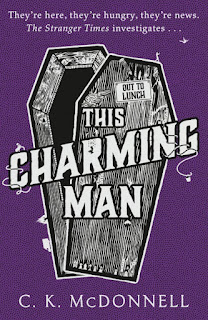
This Charming Man follows on a few weeks after the events of The Stranger Times. Hannah has taken some time off to sort out her divorce problem (or rather, her husband problem). Meanwhile, as the prologue reveals, Manchester seems to be developing problems of its own. Vampires don't exist - as both mundane science and the knowing supernatural Folk attest - but what do you call it when a person develops strange dental features, is burned by sunlight, and craves human blood?
We're back with the misfits who edit The Stranger Times, an organ devoted to the bizarre and the unlikely and which is published from a deconsecrated church under the editorship of Vincent Banecroft, possibly the foulest man in journalism (I know). Hannah is the Assistant Editor, flung into the weird world of the Folk and their oppressors, the Founders and still getting to grips with a whole new world, as is DI Tom Sturgess, formerly the darling of the Greater Manchester Police but now tarnished by the events of the previous book.
The Stranger Times (the book, not the publication) was an enjoyable, though in places flawed, romp through a rather alternative take on urban fantasy. One of its problems for me was the extent to which the sheer outrageousness of Banecroft's character dominated things, with the rest of the team, and especially Hannah, rather flat in comparison (despite Banecroft being hospitalised and therefore absent for a chunk of the story). This Charming Man managed, in my view, a much better balance in this respect. Oddly, it does that partly by giving Banecroft more attention not less, showing his perspective on events, in particular how he is grieving for his wife and why he has land up at The Stranger Times. But it also brings in in another monster of a journalist, Stanley Roper, a freelancer who Bancroft brings in for his undoubted skills to form the "special investigations team" and sets on the track of villains who wish one member of the paper's staff no good at all.
The result is that there are two very strong storylines here with Banecroft playing a largely supportive part in driving them forwards (rather than just being annoying for unknown reasons. Though he still is annoying, of course). That gives more time for the team to bond and for their own different characters to come out, while also revealing a lot more about the supernatural side of Manchester. The denouement to all this was also satisfyingly violent and revelatory, demonstrating that, no, vampires aren't real - but also that power over reality can arise in the most unexpected places.
Overall I enjoyed this book, though a couple of things did strike me. First, as we learned in the previous book that the paper has powerful and wealthy backers, there was less of a sense of jeopardy over the need to get an issue together and keep the show on the road, with the focus on investigation rather than stories. (We do get snippets of typical stories though). And secondly, I'm still unclear which man in all this was charming! Most of them (a couple of the team members aside) seemed thoroughly unpleasant. Indeed, a major subplot is misogyny - which while it does eventually tend to bring those displaying it to a bad end (good) cannot be said to leave much scope for charm.
I'm inclined to view the title as ironic.
For more information about The Stranger Times see the publisher's website here.
![]() |
| Cover by Nick Hayes |
I'm grateful to the publisher for an advance copy of The Rose Daughter to consider for review.
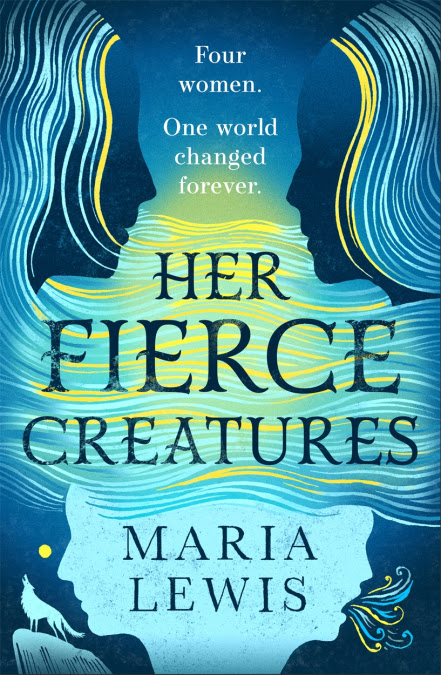
It's good to be back in Maria Lewis's shared supernatural universe, which began with werewolves in Who's Afraid? and has progressed through other magical peoples including witches, ghost, banshees and now, sprites.
Or rather, a sprite. As Dreckly Jones makes clear in this narrative, split between the present day when she is lying low in Sydney and an account of her life up to that point, a sprite is a very rare thing indeed. Offspring of a selfie and an earth elemental, her kind are outlawed by the Treize (why?) the self-appointed government of all supernatural creatures. So Dreckly's life began in prison, locked up by the Treize with her father.
Now, a century later, she's off their radar, and determined to stay that way.
I was entranced by the way Lewis uses the story of Dreckly's life to explore the 20th century from below. Stowing away for the New World, she gets involved in the movie business, drifting into espionage as the times darken. Lewis has her witness some significant moments for the history of women: a period of brief and precious freedom and self-expression for women and minorities in the Hollywood of the 20s and 30s which gives way before a growing climate of moral censure and then the chaos of violence and loss that is the Second World War. Lewis has done her research, introducing us to some fascinating characters who provide the perfect milieu for a misfit like Dreckly. Throughout, though, Dreckly remembers her father's advice that she shouldn't try to be a hero. Though she sometimes disregards it.
The Rose Daughter seemed slightly different to some of the other episodes in this extended story of supernatural creatures, as a large part of the narrative is distanced from the immediate conflict with the Treize which has been developing throughout the series. That reality - of their desperation and willingness to commit atrocities growing - has to break in eventually, though, with Dreckly's hard won safety (hard won both in terms of what she's given up, and the guilt she feels for keeping her head down) inevitably threatened. First, though, Lewis explores what makes Dreckly, Dreckly - who she has loved, what and who she has lost in her long life, and what regrets she has. All of that lies behind her desire to stay out of sight, stay safe, not play the hero. It also illustrates what a competent and ruthless soldier she's capable of being when she has to be - one who will I'm sure reappear in future instalments of this fascinating saga.
A gloriously page-turnery novel that sheds new light on the revolution boiling up against the Treize, meshes nicely with the earlier books (even including some earlier scenes them a different perspective) and introduces a bold and distinctive new character. What else? Well, of course we have handsome, smouldering werewolves, some energetic sex, and plenty of peril. And signs of a team-up that should make the Treize very, very scared indeed.
I'd strongly recommend for fans of paranormal fiction, lovers of a good, exciting story and anyone interested in some of the less well known corners of 20th century history.
For more information about The Rose Daughter, see the publisher's website here.
I'm grateful to the publisher for an advance copy of The Library of the Dead to consider for review.
This book has already received a lot of attention and praise, so came bearing some expectations - but, reader, I have to say that for me, it surpassed them.
I should declare an interest. I spent eight happy years at university in Edinburgh last century, so I'm always a sucker for a book that takes me in and out the wynds of the Old Town. I slogged up and down the tenement stairs of the Southside in the '87 and '92 elections, and used to cycle out to the west to visit friends, so it was all familiar... up to a factor of being set in a near-future, economically (and environmentally?) devastated nation bedecked with camps full of homeless - where if you don't use the greeting "God save the King!" you may be assessed as a malcontent.
Oh, and a world with actual, accepted, and working magic.
A little bit different from my experience, then, but this is a world that T L Huchu makes so vividly real that by the end I was more than half convinced that Ropa, his main character, had been somewhere just round the corner all my time in Edinburgh. It's not just the attention to detail, the sketched background where we don't know everything but we can see the picture, or the plausible inhabitants of this city. No, it's something very subtle in the positioning of this world. There has been a fall of some kind. It's referred to once or twice as the "catastrophe" but we're not told exactly what it was. Clearly the country has been impoverished, and many are suffering, but we're not talking about scavengers living of the corpse of civilisation. Nor about a future world doing very well, but with magic. Things are on a knife edge, plenty of business being done, industry moving, but with many left out. It's all the more credible for the threads of continuity between our world and this one, with recognisable traces of our more cosy lives and characters who remember, for example, when healthcare was free.
Against this background, Ropa, who is 15 or 16 and who dropped out of school so she could earn money to take care of her family (grandmother, sister), acts as a go-between for the recently deceased, carrying their messages to living families. There's money to be made, but also risks in moving round the city after dark and a palpable sense that one wrong step could lead to all three losing their slender security, living in a caravan in "His Majesty's Slum". The contrast between that sense of vulnerability, and the warmth of Ropa's relationship with her gran and sister Izwe (where is everybody else?) is another compelling feature of the book, as is the contrast between Ropa's and her gran's Zimbabwe-inflected magic and the slightly dour atmosphere of Edinburgh itself. (Towards the start of the book, Ropa settles a historic haunting - strictly outside the terms of her licence as a ghsottalker, but a girl's gotta eat - and the unfortunate restless spirit insists that a proper, Presbyterian Minister attend to give him rest, definitely not a florid Episcopalian priest).
All is, kind of, in balance until Ropa is approached for help (pro bono work, but what can you do?) by the ghost of a young mother whose son has gone missing. She can't be at peace until he's found. Investigating this leads Ropa into a darker world than we have seen yet, and this is where Huchu's positioning of the near future as unpleasant, but not hellish, really pays off, because the things that Ropa discovers puts a rather different spin on that. What follows is a breakneck adventure with all manner of perils and unsuspected enemies: but also, with friends and allies and, also unsuspected, sources of knowledge and power. Ropa is discovering things about her city that she previously knew nothing of.
Maybe some of this is revealed to her rather easily, and maybe - when you get to the end - you'll think that the ultimate root of the evil that is loose was a bit obvious. But equally, maybe you'll think (as I did) that Ropa's self-assured expedition into the shadows and her combination of moral and physical courage are ultimately much more important, and deserve much more attention. She is driven into some very tight places, and makes some bad mistakes, but never gives up and never loses sight of what is, after all, a mission of mercy.
And the telling of that story is glorious.
I would strongly, STRONGLY recommend this one. It's urban fantasy with all the joy and wonder boosted and a series - I hope it will be a series - that I sense is really going somewhere.
For more information about The Library of the Dead, see the publisher's website here.
I'm grateful to the publisher for an advance e-copy of The Stranger Times via NetGalley. (I also have my copy on order from the local bookshop, because I need this one on my shelves!)
Is there a subgenre called "cosy urban fantasy"? If not, there ought to be. Not that The Stranger Times pulls its punches, oh no, we see some gruesome deaths here and evil is decidedly on the march, but still, there is that same combination - a strong sense of place, well defined characters and that slight twist of the absurd which I enjoy in cosy crime, an assurance perhaps that while there's a mystery to be solved and a real threat, other things are also important, or more important: office banter, for example, getting the latest edition of The Stranger Times to press, pursuing a good story for the lead. The characters need I think to be at home in some sense - to have found where they belong.
Before you can belong, though, you need to arrive and so for Hannah there's the little matter of a job interview... as this book opens, she is desperate for a job. Accustomed to a life of upper middle class luxury, she's alone, in unfamiliar Manchester, without money or friends, for the first time and desperate enough - just - to seek employment with the eponymous paper. We will find out what Hannah has done, and what's been done to her, in good time. First, she has to learn about The Stranger Times itself and the oddballs who staff it.
The paper glories in the weirder side of life: UFOs, hauntings, conspiracy theories and the like. ('Nessie is the Father of my Child'). Presided over by Vincent Banecroft, a former hotshot Fleet Street editor fallen on hard times who now looks like 'his own corpse waiting to happen', The Stranger Times may have seen better days, but it has ethics of a sort: they don't make stuff up, they don't judge, instead they report what people claim they saw or what they claim happened. The claims may be rather outré, but the obvious liars and sensationalist are weeded out and there's an integrity in the way that it recognises and reports things that are being claimed to have happened.
Nobody expects to wade into a supernatural crisis though, and indeed for a considerable time they don't realise that the bodies in the morgue with strange wounds, and the disappearance of a down-and-out man, have anything to do with each other. McDonnell allows the setting and personnel of the paper plenty of time to establish themselves. The staff - Hannah, Grace, Reggie, Ox, Stella and of course Manny, who prints the thing (he prefers to wear no clothes) are actually stranger than anything it reports. The grotesquerie at The Stranger Times was really entertaining and I enjoyed seeing the interplay between, for example, Grace, the fiercely Christian receptionist and drunken, foul-mouthed Banecroft. In parallel, we are told about a couple of villains who reflect the darker side of things and are clearly Up To Something. During this first third most of the action is with those villains, but what they are up to is still obscure. When things really begin to move along, and the team from the paper are fully in the firing line, they are well established and we really care what happens to them.
I won't say too much about the background that then reveals itself, except that The Stranger Times does (to a degree) follow the template of there being a "hidden" paranormal world that lives in tension with the mundane one - there's a balance that has to be kept and it is, of course, in danger of being upset. McDonnell does, however, bring a real freshness to the concept. The Stranger Times isn't about rivalries between clans of monsters or (much) about humans being drawn into their worlds, rather its's about individual motivations, greed, ambition, survival and the willingness to exploit others in pursuit of those things. As well as about the importance of getting the paper to press, come werewolves, police or rogue sorcerers.
Oh, and about integrity - whether in that mission to report what is being said, in the desire of DI Sturgess to give the dead their due by investigating every case meticulously, even the hopeless ones or in Grace's fierce love for tearaway Stella who broke into the paper's offices one night and has stayed ever since.
The group at the heart of the novel are eccentric, bickering and plain odd, but they have a fierce loyalty to one another which gives this novel real heart and soul. Combined with sharp writing ('Mason himself seemed oblivious to his own halitoxicity', 'Coppers often dealt with people who were having the worst days of their lives. That deserved somebody's best'), a strong plot and a good sense of place - the place being rainy Manchester ('predicting it was beyond the capacity of meteorological science') - that makes for a thoroughly readable and completely enjoyable story.
Here's hoping we meet Hannah, Vincent and company again and soon.
For more information about The Stranger Times, see the publisher's website here.
![]() |
| My copy. MINE... |
![]() |
| Ben and Rebecca in full flow |
![]() |
| ...all mine! |
![]() |
| Cover by Will Staehle and Lisa Marie Pompilio |
![]() |
| Cover by Patrick Knowles |
![]() |
| Cover by Julia Lloyd |
![]() |
| Design by Julia Lloyd |
![]() |
| Cover by Neil Lang |
![]() |
| Image from https://oneworld-publications.com |
Corpselight (Verity Fassbinder book 2)![]() |
| Syd Moore (c) www.danielnewmanphotography.co.uk |