Showing posts with label space. Show all posts

1 March 2023

Cover Reveal - Orphan Planet by Rex Burke

Cover for book "Orphan Planet" by Rex Burke. A blue-grey world floats in black space. A speech bubble leading from it read "Home Sweet... Oops."

Today I'm honoured to be joining in the cover reveal for Orphan Planet, the new novel from Rex Burke and first in the Odyssey Earth series.

About the Book

With Earth in crisis, humans are travelling deep into space. But humanity’s future just took a wrong turn.

A seventeen-year colony-ship voyage – a straight shot to a new planet. Handpicked, single-minded crew, and a thousand settlers in hypersleep. No children, no families, no fuss.

That was the plan, anyway

Captain Juno Washington commands a ship of loners and oddballs. The teenagers of the Odyssey Earth didn’t ask to be born, and face an uncertain future. And Jordan Booth really didn’t want to be woken up early.

After an unexpected change of course, relationships are tested like never before. If they listen to advice, pull together and stop squabbling, they might just make it.

Yeah, right. Good luck with that.

Details

Title: Orphan Planet (Odyssey Earth series, Book 10
KindleUnlimited, 18 April, 2023
Available as: e, 332pp, 70k words
Buy from: Amazon (pre-order from 1 March, 2023)


About the Author

Rex Burke is a SciFi writer based in North Yorkshire, UK.

When he was young, he read every one of those yellow-jacketed Victor Gollancz hardbacks in his local library. He’s sure there are still thrilling SciFi adventures to be told – even if he has to write them himself.

Rex Burke, a white man with brownish hair sitting leaning on a wooden table inn front of an orange brick wall.
Rex Burke
When he’s not writing, he travels – one way or anotherhe’ll get to the stars, even if it’s just as stardust when his own story is done.

Website: https://rexburke.wordpress.com

Contact: scifirex@icloud.com

Twitter: @SciFiRex


Publications 

Odyssey Earth series

First Date (short story) – available now for free: https://subscribepage.io/GPiihl

Orphan Planet (Book 1) – 18 April, 2023

Twin Landing (Book 2) – July 2023

Star Bound (Book 3) – November 2023


1 July 2022

#Blogtour #Review - Six Lights off Green Scar by Gareth Powell

Cover for book "Six Lights Over Green Scar" by Gareth Powell. The cover is seen both on a physical book and on a phone screen. We are above a planet, rising over the horizon ahead is an intense green light. All around is the darkness of space.
Six Lights off Green Scar 
Gareth Powell
Books on the Hill (BOTH), 2022
Available as: e
Source: Gifted copy

I'm grateful to Love Books Tours for a gifted e-copy of Six Lights off Green Scar to consider for review.

Gareth Powell's novella Six Lights off Green Scar is one of eight dyslexia-friendly books for adults that Books on the Hill plan to publish this year. They are raising money for this via Kickstarter, and I hope you'll support that venture - see link and pitch below, but first, a little about this book.

Six Lights off Green Scar is a taut, focussed space adventure that hits all the right notes. Sal Dervish is a washed-up spaceship captain ekeing out a miserable, down-at-heel existence on a remote moon while his ship rots in dock. Dervish is notorious for what he got wrong, shunned by all who know his history, living from day to, regret to regret, bottle to bottle, girl to girl. 

Ripe, in other words, for an offer of redemption - if he can face the consequences.

Powell gives us all this, and more - the 'roulette ships' with their devil-may-care crews jaunting into the unknown, the ambitious reporter who wants to known What Happened, the sinister figure in the shadows - in his dynamic first few pages, which set up a mystery, pose a challenge and point towards adventure. 

He follows up with action, danger and the need for choices. It all cleverly plays on notes and imagery we may be familiar with from the best of crime and adventure stories, but which are transformed here, the noir hints remaining but reborn in a new world, a new universe, in which those choices - and their consequences - may be much larger than we imagine.

A perfect, riveting narrative that you'll want to gobble up in a single reading, I think - so... make it so!

Dyslexic friendly fiction for adults by BOTH Press

Following their successful "Open Dyslexia" Kickstarter in 2021, which led to publishing eight dyslexic friendly fiction titles, BOTH Press is launching on June 7th 2022, their second Kickstarter "Open Dyslexia: the sequel" with more high-profile authors than ever before, lasting 30 days and finishing on the July 4th 2022

The Kickstarter aims to publish eight more titles of high-quality fiction from bestselling authors: including household names such as Bernard Cornwell and Peter James. 

The line-up is full of many front-list authors such as Gareth Powell, J.M Alvey (aka Juliet Mckenna), Scott Oden, Snorri Krisjanason, and James Bennett.

Peter James will also be doing an introduction for the 2022 collection.  

There are very few initiatives for reading for pleasure for adults. The eight titles BOTH Press has already published are the only readily available dyslexic friendly fiction for adults in the UK and can be found in libraries and any bookshop. The scale of accessibility is not nearly enough, as around 10% of the UK population deal with some form of dyslexia.

Despite Jay Blades's (the Presenter of ‘Repair Shop’) unique telling of his own learning to read on the documentary ‘Learning To Read At 51’, which the BBC recently aired. There are still few or no resources for adult dyslexia. A glance at Adult dyslexics charity websites and reading charity websites indicates there are few resources on reading fiction for pleasure for adults with dyslexia.

The dyslexic blogger Suzy Taylor who writes for Dyslexia Scotland, said: 

"It is frustrating that we now have children's books in dyslexic friendly formats. As adults we apparently do not require books in the same form."

There needs to be a choice for people to read for pleasure, where there are books designed to be friendly to them and are not dumbed down, are high quality and enjoyable fiction, which people can chat and socialise about with friends and family.

Darren Clarke, the director of Succeed with Dyslexia, said:

"This books shop is doing incredible things and helping people to fall in love with reading again" [and] "I love the fact and the thought that has gone through on these [titles] with the spacing, the font, with the colour of the paper and the way that the book just flows."

BOTH Press has had many heart-warming responses of how the books have impacted their lives. 

Dr Alistair Sims said: 

"Many individuals who have told us their stories do not want to be mentioned due to fear of stigma about their struggle to read. For example a man in his 50s is Scotland had not read a book since he was a child. His partner found us and bought him one of our titles. He read it. Then called us up to order another. He was so happy to actually read. In fact the partner wrote us a letter explaining how much of difference it is making and then ordered the four more for a Christmas present." 

BOTH aim to raise £16,000 to publish eight titles. Though looking to the future, they will need more than £20,000 a year to keep publishing eight titles regularly. All funds go toward the book production/ life cycle to make them readily available. The bookshop Books on the Hill and their manager Alistair Sims, who created BOTH Press, receives no profits from the project.

To support the Kickstarter, go here.

@booksonthehill
@lovebookstours 
@igbooktours


27 February 2022

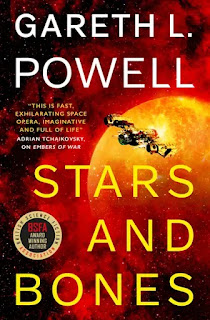
#Review - Stars and Bones by Gareth L Powell

Stars and Bones (Continuance, 1)
Gareth L Powell
Titan Books, 1 March 2022
Available as: PB, 352pp
Source: Advance copy
ISBN: 9781789094282

I'm grateful to Titan Books for a free advance copy of Stars and Bones to consider for review.

The first in a new series from Gareth Powell, Stars and Bones is an ambitious, not to say audacious, space opera that imagines a very different near-future for humanity from that depressing one we may expect - though it is not a future on Earth.

No, rather, within a handful of generations, Powell sees us cast out of our soiled Eden to become nomads, ever sailing the currents of space in a fleet of arks, searching for a place where we are allowed to drop anchor. 

With overtones of "2001" and a distinct sense of judgement, Stars and Bones follows a split timeline, showing us how this came to be through the perspectives of the world's richest man, Haruki, and a couple of scientists, Frank and Victoria, who all witnessed the start of the exile. Seventy-five years into the future, it follows Eryn, Navigator of survey ship Curious Ocelot, which, in the best Star Trek tradition, is about to discover something nasty, very nasty indeed, on a planet known as Candidate-623.

I loved the relationship between Eryn and the sentient Ocelot (represented in physical form by its avatar, a blue-skinned person). There's a level of familiarity and banter between them which hints at how close and trusting they are: bonded for life and with fates linked (elsewhere we see the horror when that bond is broken). I also liked Eryn full stop: her impulsiveness, her looking out for sulky teenage niece Madison. Most of all, the guilt-ridden relationship with sister Shay, Madison's mum, who's missing now creates some complex dynamics between the three and undercurrents which challenge Eryn in discharging her varied duties. There are moments when I just wanted to shout "do the thing!" to Eryn while understanding her hesitation or how she was torn. Life in space circa 2100CE is riddled with dilemmas, perhaps explaining if not always excusing Eryn's general affect of searching for somebody to thump.

There are to be fair plenty of candidates for that honour, from the leader of a survey team who seems determined to court as much danger as possible, to the deadly alien shape-shifters who plague Eryn throughout the book, to the... But that would be to spoil the story. Let's just say there is one entity here, of vast power and ancient origin, that is particularly aloof. And annoying.

It's an action-packed, combat-rich novel, part escape, part race to uncover a mystery dating back to the early days of the exile, and the survival of the drifting human race is (of course) in peril. We see how in the vast fleet, humans have recreated - but also reworked - the divisions imported from Earth, with vastly different takes on abundance. We see how many, life-limiting cultural mores have been overcome - but not everywhere. 

We also occupy one of my favourite situations in SF - the close-knit crew sharing space on a small, slightly rackety spacecraft through a combination of uneventful flight and unimaginable danger and the familiar locations - mess room, cramped quarters, hold and flight deck (seriously, if I could I'd build one of those just to live in). Familiar, maybe, but perfectly realised and deeply atmospheric. 

What else?

Oh yes. Did I mention that we also meet a talking cat? Sam is fitted with an implant and able to vocalise, but he's still all cat, strolling in amidst a crisis to ask when he'll be fed. There's much more as well - a pair of detectives, the universe's most annoying influencer ever, and a fantastic, awe-inspiring location which our heroes must visit to find a recluse who may, just, have the answer that will save humanity.

Exciting, entertaining, scary at times and refreshingly different, I enjoyed Stars and Bones immensely and would strongly recommend it.

For more information about Stars and Bones, see the Titan books website here.

6 November 2021

#Blogtour #Review - Far From the Light of Heaven by Tade Thompson

Against a background of stars, a blockily rendered, blue wolf howls with head and snout raised.
Far From the Light of Heaven
Tade Thompson
Orbit, 28 October 2021
Available as: PB, 350pp; e; audio
Source: Advance PB copy
ISBN(PB): 9780356514321

I'm grateful to the publisher for an advance copy of Far From the Light of Heaven to consider for review, and to Tracy at Compulsive Readers for inviting me to join the blogtour (in fact, to close it off).

I'm having to be very careful writing this review, perhaps more careful that I would normally be since I am not just worried about upsetting people with spoilers but also about not creating a misleading impression for the book. I suspect that's a concern that Thompson himself shares because in the Afterword he explains that he doesn't consider it a space opera (albeit it takes place, mostly, in remote space aboard spaceships). I'd concur with that. 

I'd also add that neither is it really a "locked room" detective story. One might jump to that conclusion, as a crime is committed, on an isolated ship, with a limited roster of suspects and a detective - of sorts - is dispatched to resolve it. However, Thompson robustly - almost gleefully - refuses to go through with the dance moves you'd expect for a locked room mystery. Yes, Fin is an isolated, washed-up investigator who has been suspended form duty, lives in a domestic tip and now has One Last Chance at redemption. Yes, he does insist on procedure, against the protestations of Shell, Captain of the ship Ragtime. Yes, there are inferences and red herrings. But - slight spoiler perhaps - Fin doesn't reason his way to the heart of a fiendishly complex mystery and announce it in a dramatic conclusion. 

Rather, as we move into the endgame of the story, we're given an account of what actually happened. By this time it's fairly clear that the immediate heart of the matter is more about survival in space and the dangers therein - albeit the motivation behind the crime creates a potent threat to that survival. But also that Thompson is using Fin more as a chorus or commentary to cast light on the deeper story (behind the survival theme) than him being the focus of the story itself. 

I have, rather ploddingly, spelled this out because I have seen online reviews of the book which I think came away slightly disappointed, or perhaps perplexed, because they were trying to fit this book into a different template. I could make the point more bluntly by citing one very well known classic SF novel which nobody would ever try to approach in that way, but doing so would probably cross the line into being spoilery so there I will leave it. 

Having got all that out of the way, what do we have in this book? I found three elements of the story particularly notable. 

First, as a survival story, Far From the Light of Heaven is absolutely top class. Shell, the human captain woken from ten years of sleep when something goes wrong aboard Ragtime, is an excellently drawn character. She's strong and prepared but trying oh so hard to keep her doubts and fears in check, alternately helped and hindered by the necessary routines of life in space - necessary to remaining alive, that is. It's her first mission. She trained for years in the knowledge that she would only be aboard the ship as a backup, in case something came up which the AI systems can't handle. Her family background and motivations - including a missing space hero father - are described, and we then see her forced to step up, having to make myriad crucial decisions not only to discover what has gone wrong but to try and preserve several hundred lives aboard the ship. The technical stuff here is first rate - kind of like The Martian but with higher stakes and greater danger - as is the humanity of our Captain, notable in a story which also involves significant portrayals of AI. I also enjoyed Shell's relationship with Fin: both professional and rivalrous, as they have slightly different interests, backgrounds and goals.

A second strand was the background of the voyage, one of merciless plutocrats directing space exploration from afar (we briefly meet the richest man in the Galaxy). It is an interesting thought experiment how these Earth-grown tyrants relate to their distant empires, and how the inhabitants of the planets, colonies and stations feel about that. At one point in this story there's something like a popular show of protest against the behaviour of the trillionaires - something that Thompson leaves to us to decide whether or not it will come to anything, or indeed, is justified in the particular circumstances.

The third element that grabbed me in this story was the one I'd ideally have liked more of - the background and personalities on the space station Lagos, which Ragtime visits some time before the fatal events. Lagos's identity, and its crew/ inhabitants, explicitly recognises that the spreading presence of humanity in distant space is not just about White Americans, but that other cultures have also travelled to the stars. That sets up some promising potential conflicts, and Thompson introduces us to a range of characters, a couple of whom do travel to the Ragtime and intervene (kind of) in the central plot. However I felt that we could have heard far more about Lagos, and I got a definite sense that Thompson could have done that, albeit it would have been a longer book. In the event I wondered if Far from the Light of Heaven might best be seen as establishing a setting within which further adventures can take place? I would welcome that, although I think there's always a risk when work is being done here establishing that setting, work will only really pay off properly if more books do follow.

Which is, kind of, why I'd refer back to what I said earlier - approach this book with the right mindset. I think it is a fascinating introduction to a remarkable universe, and I'd like to read more about that. More, over and above my own selfish motivations here I think this kind of risk-taking deserves to be applauded, both by the author and by the publisher, and it deserves to succeed.

For more information about Far From the Light of Heaven, see the Orbit website - as well, of course, as the other stops on the tour, listed on the poster below.

You can buy Far From the Light of Heaven from your local bookshop, or online from Bookshop dot org UK, Hive Books, Blackwell's, Foyles, Waterstones or Amazon.

Blog tour poster for Far From the Light of Heaven by Tade Thompson.


19 September 2020

Review - Prime Deceptions by Valerie Valdes

Cover by Julie Dillon
Prime Deceptions (Chilling Effect, 2)
Valerie Valdes
Orbit, 17 September 2020
Available as: PB, 436pp, e
Source: Advance e-copy via NetGalley
ISBN: 9780356514437

I'm grateful to Orbit for a free advance e-copy of Prime Deceptions via NetGalley.

In this sequel to Chilling Effect, we're given another chance to sign up with Captain Eva Innocente and her crew aboard the space freighter/ smuggler/ gunrunner La Sirena Negra ('a small ship whose business was composed entirely of side hustles') for another series of madcap adventures. This time, having spent several months prodding the dangerous beast that is The Fridge criminal collective, Eva accepts a commission to track down Josh, scientist brother to her engineer (and retired bank robber) Sue ('I really like your arm cannon. Is that modular?') Having worked for The Fridge, Josh's knowledge of the powerful, banned, ancient Proarkhe tech is considered useful and needed for a Very Secret project.

And at one level that's all you need to know. Eva, co-captain Pink, Min, Vakar and the rest - not to forget the pack of psychic cats who have taken up residence on La Sirena Negra - set about their quest with gusto, beginning with a visit to a perpetual fan con and proceeding to a bot-fighting arena where Eva reencounters one of her least favourite humans, 'Miles fucking Erck', the man who begins every sentence with 'Well, actually...' It's all rather fun, rather genial mayhem, punctuated by speculation about what's really going on, passion between crewmembers and attempts (largely unsuccessful) to keep the cats in line.

But then things get... a bit darker.

You'll recall from Chilling Effect (and you really should read it first) the impact of Eva keeping secrets. Well, she still has one zinger of a secret - and it's to do with the most shameful episode of her life, something she did while working as a mercenary.

Something that won her the title Hero of Garilia...

...or, depending who you're talking to, Butcher of Garilia.

Now, she's going back to Garilia - the one place in the universe Eva really, really wanted never to see again.

Changing the tone of the book to several moods darker, Valdes takes Eva to places and events in her memory she'd hoped to leave buried ('Action meant control, and control was something Eva needed, even if it was an illusion.') And it's not just all in the past: what she did has consequences now both for the inhabitants of Garilia and possibly for the wider universe. Eva has to come to terms with her memories quickly.

Oh, and her mother's turned up as well, also on some super-secret mission.

I loved the family dynamics between Regina and Eva (and also between Eva and her sister Mari). It's genuinely - and generously - portrayed: it would be easy to have Regina come over as a clichéd scary mother and to a degree she is. But this is a complex and deep relationship which also takes in the secrets (again) that Eva kept from her mum when working for her father, and the history between the two sister. There is genuine emotional force here, well realised and at times, rather touching.

It would be easy, I think, to take some of this darkness and family stuff as just slowing the pace down and putting off the fights. Don't fall into that mistake! There is much, much more here than just a breadcrumb trail between hectic combat sequences, and everything has its place and its time in a story that takes in PTSD, moral dilemmas, and guilt as well as silly banter between friends, trust, and, yes, a great sense of wonder and fun (messing up a target's navigation stems by convincing them that they're installing a false software update? A straight faced remark that 'The fourth wall had apparently been broken recently').

This is an unmissable followup to Chilling Effect and, due to some Galaxy-shaking events, sets the next volume up as being pretty epic too, I think.

For more information about Prime Deceptions, see the publisher's website here.


1 February 2020

Review - Bone Silence by Alastair Reynolds

Bone Silence (Revenger, 3)
Cover design www.blacksheep-uk.com
Alastair Reynolds
Gollancz, 30 January 2020
HB, e, 602pp

I'm grateful to Gollancz for a free advance copy of Bone Silence.

The final part of the Revenger trilogy (after Shadow Captain), Bone Silence returns to the universe of Captains Arafura and Adrana Ness. In this far-future solar system, the planets themselves have been dismantled, yielding the material for the construction of tens of thousands of "worlds" - habitable structures a few kilometres across, built in all shapes and sizes (discs, spheres, spindles...) This is where humanity lives now, although civilisation has waxed and waned, with thirteen distinct "Occupations" - phases when people were expanding and settling. The history of this is mysterious, with plenty of powerful artifacts to be recovered from abandoned "baubles".

In this setting the Ness sisters - two young women who ran away from home world Mazarile seeking adventure, but found piracy, fighting and death with Fura ultimately rescuing Adrana from captivity - now scour the spacelanes in their ship the sunjammer Revenger, captured from the dread pirate Bosa Sennen. Unfortunately a bounty has been set on their heads, and they're pursued by a squadron of the Congregation's most ruthless thief takers who believe they are in league with Sennen, or perhaps that they are Sennen (it's complicated).

I love the setting for these books. In Reynolds' hands, the manoeuvrings of the great sail-driven craft, the hazards of calling at unruly and fractious port world, the glory a of a fight, the the salty language, and above all the loot up there for the taking - for me all these evoke the never-was pirate-ridden world of Stevenson and Robinson Crusoe. It's an advanced world with advanced tech but all the familiar themes are there - the long pursuits, the scanning for sight of a sail, the ferocious broadsides (here, delivered with electromagnetic coil guns). And the crew members we meet wouldn't be out of place lurking in a corner of the Admiral Benbow.

If that was all these books had, they might be fun, but no more than a jeu d'esprit (albeit a good one) on Reynolds' part. But there's much, much more than that. Under the surface of this book are serious SF themes: the fate of humanity in the far future, the origins of civilisations, our relationship with alien races. And big human themes: the sisters are coming of age, finding their place in this strange universe, making friends (and enemies) and losing them. Those themes are explored rather more thoroughly in this book than in the previous ones, the Ness sisters having now found one another and constructed some form of relationship again after the traumas they suffered before.

Indeed, solving these mysteries has become more than a matter of casual curiosity. Fura and Adrana have now become convinced that it's key not only to the future of the human race but to their own more immediate survival. There's also a desperation to this book that marks it out from the others. We have had hints before that outside forces may be manipulating events but here it seems there are two sides, rival factions of aliens pursuing some conflict and bringing an even tighter sense of danger to events. It's not clear who can be trusted, or even what is to be gained from those can.

Bone Silence felt to me more focused, basically an extended chase sequence, than the earlier books, and more sober: the sisters are growing up, there's less sheer exuberance and a greater awareness of consequences (as when someone who lost money because of what Fura and Adrana did at the end of the last book plunges to his death. before their eyes). The stakes are higher now - it's not just a question of being dragged back home, and they have enemies with deep pockets and an even longer reach. There is an edge to the battles, a sense of the gloves being off.

It is, though, not all action. I enjoyed the shipboard sections when nothing much seemed to be going on, but the two sisters - and their ragged crew - were learning to trust each other. There are many, many reasons why they wouldn't, and Revenger herself holds dark memories, especially for Adrana. Shudder at what went on in the "kindness room"! Revisit the Bone Room, where the twinkling, alien skull allows communication - at a price - across great distances. In this book the process carries a more deadly edge than ever - there is the prospect of discovery for one thing, and other, darker dangers as well. (The exact origin and nature of the bones and the "twinkly" inside them is never made clear: like many aspects of the Revenger universe, that remains a dark secret, perhaps to be revealed one day, perhaps not). And Reynolds' portrayals of the crewmen and women are rounded and fully formed.

All in all great fun, though this is one trilogy you really do need to read in order.

For more about Bone Silence, and to buy the book, see the Gollancz website here.

Alastair Reynolds' website is here.


17 August 2019

Review - To be Taught, If Fortunate: A Novella

Review - To be Taught, If Fortunate: A Novella
Becky Chambers (read by Patricia Rodriguez)
Hodder & Stoughton, 8 August 2019
Audiobook, 4 hours 47 mins (also available as hardback, e-book)

I'm grateful to the publisher for a copy of the To be Taught, If Fortunate audiobook via titleShare, (a new service which pitches itself as a kind of audio NetGalley. I've only, so far, experienced this book via the service but the listening experience was good and the service intuitive).

To Be Taught... is short (literally, a novella) and suited to the audio format where I find too much length can be off-putting. The recording is also excellent, Patricia Rodriguez providing a nuanced, well paced and expressive reading which suits this story very well.

As a story, the book came over as a punchy, clean version of a classic SF format: the voyage of discovery (in the spirit of "To Boldy Go...") Astronaut Ariadne O'Neill and her handful of crewmates aboard the Lucky 6 have been launched on a lightyears and decades long voyage to investigate nearby, potentially life-bearing planets (remember space is HUGE, people!) Because of the distances and times involved, much of the journey is spent in 'torpor' - suspended animation during which temporary genetic manipulations ('somaforming') are applied to fit the crew for the environment of the target planet - be that high gravity, lack of light or high radiation. We slowly understand that the recording we are hearing is Ariadne's message back earth some way into the voyage, making the format particularly apposite. Ariadne's message explains the background and nature of the voyage - in the 22nd century, with space exploration long moribund, it has been revived by mass crowdfunding which effectively sponsors a space agency. We hear about Ariadne's early life, her emotional parting from her family - torpor and time dilation will mean that on return they will be dead or very old - and her hopes and fears for the expedition.

The story then proceeds through visits to a number of every different planets. Chambers' handling of this material is a joy. We get, I think, some of the sheer unvarnished delight in the wonder of the universe, in the possibilities of scientific exploration and understanding as the crew observe different forms of life and collect all the data they can. This isn't a book of space empires or conflict, it's an older and even dare I say it, purer form of science fiction than that.

Which isn't to say that all goes well. The planets visited are not equally welcoming, with incidents that challenge the astronauts' ideals of 'do no harm' and even place them in some jeopardy (as well as testing how long a group of people can survive in a large tin can). Through all this, Chambers' tone is calm, reflective and philosophical, not just narrating events but - though Ariadne - reflecting on them as well and relating them with a real passion for science and sense of idealism. If you didn't know what you were listening to - if you missed the opening, say - you could easily believe this was the memoir of a real scientist. The story takes the time to explain things - tidal locking, chirality - which not all readers/ listeners may understand but above all to show why those ideas are important.

And, having educated us to the world, the universe, of Ariadne and her crew, and shown why what they are doing matters, Chambers calmly leads the crew - and us - to a moment of choice. A moment when driving through rural Oxfordshire, I found myself shouting 'Yes!' in answer to a certain question. It's a mark of this book's construction and impact that this wasn't, primarily, a matter of what I wanted in the story but an emotional reaction to the case Ariadne was making, to the values portrayed here and the context of her - and her crewmates' - dilemma. (Sorry to be obscure about that but I don't want to be too spoiler.

To sum up, an excellent story with lots of wonder. A SF classic in the making, I think.

For more information about the book, see the publisher's website here.

6 July 2018

Review - Adrift by Rob Boffard

Cover design by Charlotte Stroomer
Adrift
Rob Boffard
Orbit, 7 June 2018
PB, 371pp
Source: Review copy provided by the publisher

While meticulous in its space opera setting - the remote space station, the wormhole "gate", fusion reactors and inertial dampers - this is at hear a very old fashioned survival story, which reminded me of books by authors like Alastair Maclean. Following a surprise attack which destroys Sigma Station, newbie tour guide Hannah, who's on her very first shift, finds herself alone in a beat-up shuttle, the sole crew apart from drunken pilot Volkova and in charge of a vocal and ill assorted group of passengers.

Classic disaster movie material they are - the restaurant critic running from a broken relationship, the honeymoon couple, a high-ranking politician, her husband and sons, a widow who's sold up the business she and her husband built up and gone - literally - to see the stars. None of them are particularly helpful in an emergency, but they all have strong opinions ("I'm gonna sue... I'm here on business, and your company just ignored all safety precautions.") In the face of such an overwhelming crisis, can Hannah hold herself together, overcome self-doubt and inexperience, and survive?

It's a riveting read, barely pausing as one catastrophe flows into the next. The Red Panda was never designed to do much more than paddle round the outside of Sigma Station, allowing tourists to gawp and the might leisure-couplex-cum-mining-colony. But, as it turns out, the ship doesn't even have a minimum of emergency provisions. Low on food, water and medical supplies, beset by internal arguments and menaced by a mysterious attack ship, survival seems a remote possibility.

I enjoyed the way that Boffard animates the story, giving all the passengers and crew distinct characters - there's a real danger with this kind of thing that the reader won't be able to tell who is who, or remember why they should care, but in Adrift you surely will very quickly learn who's who (and what's what).

The political background - which is relevant to the story and setting - is also convincingly portrayed. It's fifteen years since the war between the Colonies and the Frontier (i.e. Earth) ended with a treaty that's only been grudgingly accepted. All the characters look back to that history and the older ones have direct experience - whether fighting, reporting, taking part in the negotiations that ended the conflict or losing someone they loved. I sensed the tension and pain of that in much of the bickering aboard Red Panda, as well as in the heroics that are needed to address the crisis.

In the end it is, perhaps, a very personal story in which the protagonists - especially Hannah (who is, after all, wearing the "red shirt of command") and Jack, the cynical (and, frankly, rather unlikeable) journalist - need to come to terms with who they are and with who they want to be. (That might also be said for another character but I won't mention their name as it would be a spoiler).

This, too, reminded me of survival stories like South by Java Head or River of Death. In the end it's all about character, determination and pushing through.

All in all, a great, entertaining read filled with twists and moments of real dread. Recommended.

For more about the book, see Rob Boffard's website here or the Orbit site here.


11 May 2018

Review - The Rig by Roger Levy

Design by Julia Lloyd
The Rig
Roger Levy
Titan Books, 8 May 2018
PB, 615pp

I'm grateful to Titan for an advance copy of this book.

How to sum up The RigThe Godfather in space, but more tricksy? A SPACE noir? The apotheosis of social media?

None of those are quite right - but they all have a bit of truth.

In the future, Earth is abandoned to ecological catastrophe and humanity has migrated to the System to live on terraformed worlds. It's a hard life (one of those planets is simply called 'Bleak' and it lives up to that) and a short one, fifty being a good age. Contradicting shiny expectations of the future, disease hasn't been conquered (several of the characters here suffer form incurable cancer) and corruption is widespread. Star Trek this isn't.

But with things so hard, and religion - 'goddery' - generally disdained, people need something to believe in and this role is taken by AfterLife, a system of preserving the near-dead in stasis until their condition is curable. Memories are harvested first, and when cures are found, public votes - based on the lives of the preserved - determine who will receive them.

Against this background, two very different boys meet on the sole remaining 'religious' planet, Gehenna, a place of harshly fundamentalist beliefs. (Actually there is another - referred to as 'the unsaid planet', a place so fiercely protective of its secrets that even to mention it risks death). Pellonhorc is cruel, mercurial and obsessive. Alef has difficulty empathising and thinks in numbers. (I sense the author has autism in mind but he doesn't say so). They seem an odd pairing but, forced together by events, go on to be friends - of a sort - and, as the book's blurb says, to remake the System. Certainly their relationship is at the centre of this book. It's complex, incomplete and at times baffling, but drives both men.

The book follows Alef's life forwards through 'SigEvs' - significant events - which are supposed to be what the voter will use to decide whether a subject is to be cured or left in suspended animation. At the same time, we see a separate story unfold, told from various points of view in the hardscrabble town of Lookout, on the planet Bleak. The main characters here are a policeman (Bale) a journalist/ writer (Razer) and an engineer  (Tallen).

Bale has been suspended from duty after joining the pursuit of a serial killer while off duty, and while drunk. Razor has been sent by her AI, Cynth, to record Bale's 'TruTale'. And Tallen, well - Tallen wakes up one day in hospital and is never the same again.

This part of the story is twisty and - with its grim streets, hard bitten cops and air of sleaze and corruption - supplies the nourish tinge to the book, as Bale and then Razer attempt to work our what's been going on. Some kind of cover up, seemingly - but of what? And why? Whatever it is, it's worth killing for and everyone who gets near it seems to be in danger. There's a real atmosphere of menave  here and a distinct sense that nothing is what it seems: trust nobody, not even yourself.

It's a violent book, with plenty of death. Some of this is foreseen (all that disease) or foreseeable (given all that gangsterism), some of it comes out of the blue (despite the efforts of the Lookout policy). There's no saying who will be next, and doubly so once the two parts of the story emerges, which only happens slowly. Indeed it's not till the last hundred pages or so that it all really begins to fit together. If you love a slowly unfolding, satisfying mystery then you'll enjoy this, likewise if you're a fan of convincing, well thought out world building. On the evidence of this book, Levy excels in creating beautiful, and believable, worlds and it helps that this is a longish book, so he can take his time to build up the atmosphere, whether of the seedy town with its dives and pre fab housing, the underground racetracks through which hurricane winds blow, or the heaving seas containing the rigs which are the key to Bleak's economy. He warps language itself to indicate the alienness of the System, even if it is peopled by humans - so, we have, as well as 'doddery', 'putter' and 'screenery' and a slew of tongue twisting character names (Pelonhorc, but also Pireve, Dixemexid, Maerleyand and so on).

Overall a weirdly thrilling slice of SF, with a great deal of human reality to it and some great characters. One not to miss.

For more information about The Rig see the publisher's website here.