Showing posts with label fairy tales. Show all posts

2 August 2022

#Review - The Book of Gothel by Mary McMyne

Cover of book "The Book Of Gothel" by Mary McMyne. A stylised grey tower, set amidst depictions of plants similar to a medieval illumination (or perhaps a William Morris-style wallpaper pattern!) The tower has a single arched window, from which descends a rope of red hair.
The Book of Gothel 
Mary McMyne
Orbit, 28 July 2022
Available as: PB,  366pp, e, audio
Source: Advance copy
ISBN(PB): 9780356517704

I'm grateful to Orbit for an advance copy of The Book of Gothel to consider for review.

The Book of Gothel is a compelling, richly imagined and involving fairy-story retelling. It distinguishes itself from much of this genre by not being set in a vaguely fantastical world but by being firmly rooted in a particular time and place - the Black Forest of the later 12th century. Indeed, the book shows a clear engagement with the political and religious conditions of the time. There is a framing device (the discovery and translation of the book itself by a modern academic) which makes this completely clear, neatly answering the "how do I come to be reading this story?" question.

Our main protagonist is Haelewise, introduced as a young girl at the beginning of the story but who is writing it all down as an old woman. It is her life story, or at least the story of her early life, before she became "Mother Gothel", named from the tower in which she lives. The Book of Gothel is a wonderfully varied story, involving magic, romance, politics, religion and prejudice as well as male power. Haelewise wants nothing more than to be safe with her family, but the times - and her weak father - won't permit this fate for her. After her mother dies, Haelewise - subject from birth to "spells" - either migraines or epilepsy, perhaps - is distrusted by the townsfolk and driven out as being a witch. After that, her existence is precarious, not really fitting in anywhere and full of yearning, for the mother and the life she has lost, and for the sweetheart who might have been hers had things been different.

Haelewise's life is also shaped by her having to compromise to receive any help or support. What she's is being asked to sacrifice is her adherence to the creed of her mother - a system of belief, part magical craft, part old religion, part simply inherited wisdom that challenges the Church - which Haelewise was only just discovering. McMyne makes this very much something that Haelewise sees as her inheritance from her adored mother, so more than simply a creed or faith, it's bound up with her identity and with the love of a parent. A very personal thing, I think. That connection gives Haelewise's dilemma a real depth and heart, one that keeps this book from being at centre a neo-pagan apologia. 

That complexity of holding together different beliefs and faith systems also shows in what to me was the most intriguing aspect of the story - an encounter between Haelewise and St Hildegard of Bingen, well known now for her mystical experiences but also for her music (and much else!) I loved that McMyne let Hildegard show the possibility of a Christian mystical context, and suggest that these matters might be a little bit complex. Like Haelewise, Hildegard is clearly having to compromise and her success both in politics and in church affairs perhaps suggests this may not be a losing game. 

Haelewise can be an annoying character at times, ignoring what seems like good advice not only form Hildegard but also from aged witch Kunegunde and indeed at times from her mother too. (If somebody tells you not to venture outside the charmed circle of stones because it it VERY DANGEROUS and then you do, what do you expect to happen?) However throughout her adventures, she is an active, bold and determined young woman. Her understanding of the situation shifts and her goals alter accordingly. perhaps becoming more attainable, but she never gives up on her determination to be safe with a family - and she is a formidable enemy to those who would stand in her way.

There are only a couple of aspects where I wanted a little more.

The first is the insistence in the publicity - and this is reflected in the cover image - that this is the story behind the witch in Rapunzel (the woman who shuts Rapunzel in the tower). While that may well be true, the main events of Rapunzel take place later than the period covered by this book. They are certainly mentioned but are not at all central to The Book of Gothel. (I would love to see McMyne write that story, but it would definitely be a Part II of Haelewise's story). The other is that I hoped that a little more of Prof. Eisenberg's discovery, which bookends the story. I anticipated that things might jump off from what she learns, with consequences in the modern world. But perhaps that, too, may be written one day?

Those reservations are perhaps a bit unfair ("this book doesn't contain what it doesn't contain!") because the story that IS here is a taut and well-written fantasy novel with some real moral and theological weight. It isn't, in the end, a retelling of a particular fairytale - though you may spot echoes of one or two apart from Rapunzel - but actually I think that's a good thing. The Book of Gothel is its own story, at the same time perfectly comfortable being both set in a recognisable part of the medieval period and on the borders of fantasy, and it is a cracking story at that.

For more information about The Book of Gothel, see the publisher's website here.


7 June 2022

#Review - For the Throne by Hannah Whitten

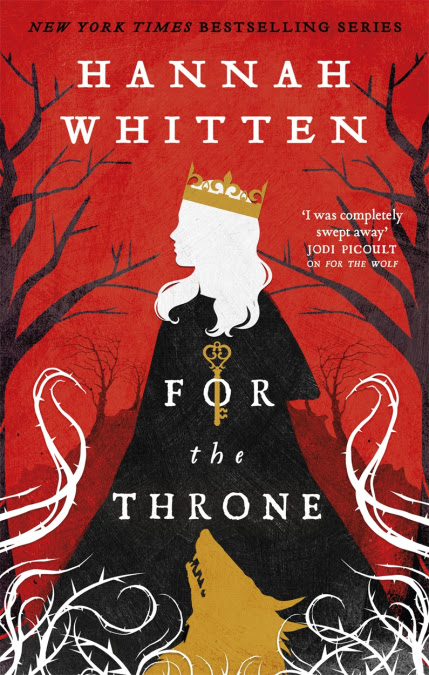
Cover of book "For the Throne" by Hannah Whitten. Against a red background, the figure of a queen in profile, looking to the left. We know she is a queen because she wears a golden circlet on her head and a dark, regal robe. Her profile and hair are blank, white, and about her neck hangs a golden key. Below the key, also in gold, a wold is silhouetted. Behind her, on either side, are black, skeletal trees and reaching up from the bottom of the cover and the lower left and right, below the trees, white tendrils writhe - perhaps mist?
For the Throne (The Wilderwood Books, 2)
Hannah Whitten
Orbit, 7 June 2022
Available as: PB (9 June, 496 pp), e, audio (7 June)
Source: Advance e-copy
ISBN(PB): 9780356516370

I'm grateful to Orbit for an advance e-copy of For the Throne via NetGalley, to consider for review.

It was always going to be a tough gig for Whitten to follow up last year's mesmerising For the Wolf - but she has written another story of the Wilderwood that is just as captivating, knotty and magical.

Caution: mild spoilers below for For the Wolf - don't go on if you haven't read that book, try my review of it instead. For the Throne really isn't a standalone.

In the earlier book, loosely a take on Red Riding Hood, the focus was on Redarys (Red), the Second Daughter of the Queen, whose fate was to be sent into the Wilderwood, to be given to the Wolf and done with according to his wishes. The First Daughter, Neve, in contrast, was reserved for the Throne. That book told how Red accepted, but subverted, her apparent fate; fell in love with the Wolf (who was also the Wood); came to understand that the garbled folk tales of Valleyda missed out a lot, and saved the Wood - and the World - from the evil forces of the Shadowlands. Neve, who featured less in For the Wolf, was determined to fix things. Tusting the old stories she set out to 'rescue' Red - and thereby caused a heap of trouble, ignoring Red's wishes and pandering to an Ancient Evil (I LOVE an Ancient EVIL!) 

Neve ended up enchanted, asleep in a glass coffin in a monochrome Underworld. Thus begins For the Throne, which, if the first book was informed by Red Riding Hood, is clearly riffing off Snow White - Neve has her own dodgy prince with her in the Shadowlands, a realm of rot and decay inhabited by melancholy monsters and dead necromancer kings. Solmir was very much the villain of the previous book, but now he needs something from Neve - and she needs him, because only he can help her escape from the Shadowlands.

The book therefore follows something of the same template as For the Wolf, Neve's relationship with Solmir beginning with the same lack of trust as that between Eammon, the Wolf, and Red in the earlier book. But Whitten doesn't just give us a recap - great though it was, that would have been a disappointment. No, Neve's journey is quite different to Redarys's. We are reminded by the title that Neve was always meant to be a queen, and the way she approaches Solmir - and the other strange and creepy denizens of the Shadowlands - reflects this. Neve's actions in For the Wolf, disastrous as they were, flowed from her wish to be in charge, to control, and from the fact that she had the position to achieve to achieve this.

Now she has no authority, no power, no control. Yet she is the same Neve as before, albeit rather a chastened one, and she soon understands that something about her - what? - is necessary to Solmir, to the Kings, to their Children. Neve is still a Queen, but to survive - to escape the Shadowlands, rejoin Red and prevent a catastrophe - she has to find a different way to be a Queen. Tempted with glimpses of dark magical power - it fairly roils from the creatures and inhabitants of the Shadowlands - the possibility of corruption by way of that power and control lurks at every twist and turn of this fascinating and compulsive story. Neve's story is very internal, very psychological, projected onto her relationship with Solmir, which becomes equally complex. The dialogue between them is perfect, simultaneously negotiating their predicament and a burgeoning relationship, albeit one with Secrets.

We see much less, on the other hand, of Red and her group of friends and allies. From their perspective, Neve is lost and needs to be recovered, but they have little knowledge of how to do this. The repercussions of her vanishing are gradually spreading through Witten's little world of kingdoms and thrones, but they're overshadowed by different rumblings - earthquakes and disturbances, as though the very roots of the universe are failing. Amongst all this, Red does what she can, but is much less active here.

This is a nicely balanced story which, as I have said, is a lot more than a redo of the first book but still retains much the same balance between fairy tale and real, even gritty, atmosphere (and for "gritty", when it comes to some of the scenes between Red and Eammon, read "steamy"). As I have said, it really isn't a standalone. Apart from straightforward spoilers from reading this book first, there is a lovely interplay of development and personality, across the two books, between Red and Neve. Their outlooks and personalities have been shaped by prophecies and their supposed destinies, but there is much more to the two women than those factors - as Whitten triumphantly demonstrates.

Just as good as the first book, For the Throne complements and deepens its consideration of chartist, fate and prophesy, creating something in the duology that is a great deal more than the sum of its parts.

For more information about For the Throne, see the Orbit website here.


24 April 2021

#Review - Malice by Heather Walter

Malice
Heather Walter
Delrey UK (Penguin) 13 April 2021
Available as: HB, 480pp, audio, e
Source: Advance e-copy via NetGalley
ISBN(HB): 9781529101270

I'm so grateful to the publisher for an advance copy of Malice via NetGalley.

Alyce is her name.

Malyce is what she's called...

The young woman who is the hero of this book strives throughout not to be the villain. Not to be seen as the villain. An outcast with no mother, half human, half Vila - a legendary race of dark Fae, now believed extinct - she's the subject of a daring experiment. In the kingdom of Briar, there are houses where Graces - young women touched with the magic of the Fae - sell gifts of beauty, wisdom, healing and wonder, all powered by drops of their precious, golden blood.

What might one do with the green blood of a Vila?

Enter the Dark Grace, groomed and trained for her role. Hated and feared, yet so, so, needed... for those times when a little curse is called for. When a love rival needs to be stopped. When a life needs to be ended. Shunned, yet patronised, Alyce sits in her dark, damp little room in Lavender House and serves her clients. Anonymous clients, cloaked and hooded, yet willing to pay out large amounts of coin for what she can offer. Even the King, one day, will need something from her.

This book is deliciously, subtly constructed. One's sympathies are with Alyce from the start. Even as she begins to discover more about who she is, and to learn the extent of her powers, she doesn't seek power or revenge. Her occasional rages are, we might think, understandable. Rather, she is - unknowingly - looking for love. This poor lonely girl, humiliated when she attempts to attend a Royal ball, has a deep need she isn't even aware of herself. This takes the book to one of the most frustrating, will-they, won't-they romantic plot threads I've read for a long time. No spoilers, but sometimes you just know when two characters are right for each other and that they should just get on with things...

Alyce's origin is deeply bound with the history of the Fae and the Vila, and the origins of Briar. Briar is a troubled realm, where the founding (and ruling) Queens have lost their power to their husbands; where a curse threatens royal daughters unless they find a True Love; where an enemy is imprisoned in a dark tower, waiting an opportunity; where spies watch from the shadows. If Alyce learns the truth, it may, you think, set her free. That's what she hopes. But can she ever be free when what she does, what she is, is so useful, so darkly useful, to the wealthy and powerful?

There are so many layers here. History gone bad. Injustice and genocide. The fate of an individual taking second place to the demands of the State. Also, power, freedom and revenge. Alyce is a magnificent hero, even if all around her - even those she thinks of as friends - would paint her as a villain. The book is described as being "Sleeping Beauty" from the villain's point of view, but it's so much more than that. To begin with, it's an origin story for Sleeping Beauty. All the elements are there, even if in unfamiliar form, and even if Walter also plays with references and hints of other fairy stories (I spotted several) but they don't come together in quite the way you might expect. But it's also a story about patriarchy. About finding oneself - and the deadly consequences of being forced into denying that self.

A riveting book, exuberant, joyful and angry, this was an entrancing and involving read and I enjoyed every word of it.

For more information about Malice, see the publisher's website here.


9 December 2017

Review - The Emerald Circus by Jane Yolen

Cover by Elizabeth Story
The Emerald Circus
Jane Yolen
Tachyon, 24 November 2017
PB, e-book, 288pp

I'm grateful to the publisher for an advance e-copy of this book via NetGalley.

The title of this collection of short stories and poems alludes to the fourth, Blown Away, which is a reworking of The Wizard of Oz - or perhaps a prequel, sequel or accompaniment, featuring a Dorothy who, though blown away by a tornado, does not - or at she claims not - end up in the land of Oz the Great and Powerful but in a circus. When she returns to Kansas with many new skills it seems though as if she might as well have been whisked to that land of magic and illusion.

And so it is with most of the stories here. They present new insights, new takes, on a familiar fairy story or childhood classic. Sometimes, as with Andersen's Witch or Rabbit Hole, the creator is entangled with the creation, as we see the young boy Hans bargaining with a witch over his future, or Alice at the end of her life pondering what her attraction for Mr Dodgson was (genuinely unsettling, the end of this one).

Sometimes Yolen's take is implicit in the original story, once you look, that is, and then you wonder that no-one had joined the dots before. For example, in Lost Girls, we're shown Neverneverland from a distinctly feminist point of view, with Peter shown up for keeping the women cooking and cleaning while he and the other Boys have all the fun (and in so doing he misses something very significant about his world).

Yolen sometimes returns to a setting or a theme. As well as Rabbit Hole, there is Tough Alice in which her younger self is making one of what appear to be a series of visits. As well as the usual Carrollian Surrealism - a pig turning into pork loin and back again, Alice pondering, on seeing that the Caterpillar has gone fishing, whether he uses with worms or whether that would be "too much like using his own family for bait" - there is a darker strand, the need to battle the Jabberwock. Alice looks for a champion, but where will she find one?

A Knot of Toads is a rather different story. It's not a riff on fairy stories so much as a more straightforward take on a favourite author of mine, MR James. This is a tale of Janet, a 1930s scholar from Cambridge (of course) come home to settle her father's affairs in the remote Scottish town of St Monan's. Janet is estranged from her dad ("Father and I had broken so many fences - stones, dykes, stiles and all") but sis till troubled by his mysterious death and his writings about an unsettling encounter with a  toad. In true Jamesian spirit he has meddled with something best left alone, and in true Jamesian spirit he recorded his doings in manuscript, for Janet to unravel. Of course Monty never wrote a female lead and as this nice little story observes the proper forms it dynamites their conventions, not least by bringing in a love interest. My favourite story in the collection.

The Quiet Monk is the first of several stories in this book with an Arthurian theme (but we never meet Arthur himself, of course). Set in Glastonbury in 1191, it features the opening up of a rather remarkable grave, and a brother who claims to have wandered long and who has stories to tell.

The Bird is the story of a raven, and Virginia, and a writer named Edgar - one of several stories in which, like Andersen's Witch or Sister Emily's Lightship (where Emily Dickinson has a strange encounter which shows her the whole world and how she can live in a narrow place) Yolen winds a little magic round a writer's life.

Belle Bloody Merciless Dame is an eerie and effective collision between a gritty Glasgow and the otherness of - what exactly? There is mention of an elf, on a Solstice - and Sam Herriot has an encounter that he'll always remember (if, that is, he ever finds his way home).

The Jewel in the Toad Queen's Crown is a wonderful story, a mashup of 19th century British politics, cabalism and fairytales. It shows the Prime Minister of the United Kingdom as an outsider figure, who, faced with the Widow of Windsor, resorts to certain... unusual... methods of managing his monarch.

The Gift of the Magicians, with Apologies to You Know Who, is a deeply strange take on Beauty and the Beast which both explores the practicalities and possibilities of Beauty's situation. What is the relationship between that castle and the outside world? Where does the food come from? Just how much can you achieve - even which "the magical help"? And what might that drive a girl to do?

Our Lady of the Greenwood is about the birth of Robin Hood. It's a table of moonlight, magic, promises, and protection, taking another, rather mysterious folk hero and plugging him firmly into a wider, yet living, context.

The Confession of Brother Blaise is a kind of counterpart to Our Lady of the Greenwood focussing this time on Merlin and, again, plugging into real history via the real Geoffrey of Monmouth. What is real and what's merely written down? When does the writing make the reality?

Wonder Land, despite its title, isn't another Alice story but has loose overtones of Red Riding hood. A girl is making a journey through the wood to tell her friend where Billy Jamieson had tried to put his hand...and where she let him put it. The animals she meets seem to illustrate her theme -  a fox exposing its private parts, a pair of crows "doing it right there". It's not an innocent woodland, but Allison seems to know what she's about. And yes, there is a wolf too.

Evian Steel again takes us to the world of King Arthur with a simply bewitching tale of pagan women swordsmiths working in the mysterious mists of Somerset. A perfect story and I don't want to spoil it by saying anything about what takes place, but in many ways it encapsulates this book: these are women who are explicitly marginalised, who will be left out of the main story (reduced to an arm holding a sword out of the lake) yet they are central, indispensable, skilled - in control.

Yolen rounds off the book with notes on all the stories and with a poems suggested by each, or which suggested them or explores the same themes. As a way of gently closing down the book, echoing the themes of the stories and showing a wider world there from which they are drawn, this is hard to beat.

Overall a very strong collection of stories showcasing the talents of a master practitioner. Definitely not a book to miss.