Showing posts with label AI. Show all posts

13 April 2023

#Blogtour #Review - Infinity Gate by MR Carey

Book "Infinity Gate" by M R Carey. Darkness, with distant stars. In the left, a planet formed from narrow vertical stripes each of which shows its image in a different overall hue - so one is green-blue, another orange, another very dark red-black and so on. Some of the stripes extend beyond the orb of the planet, and some are displaced so that the star field can bee seen within its boundary. Rising beyond the top right of the planet is a bright light - a sun or a moon?
Infinity Gate (Book One of The Pandominion)
MR Carey
Orbit, 30 March 2023 
Available as: HB, 512pp, e, audio   
Source: Advance copy
ISBN(HB): 9780356518015

I'm grateful to Orbit for sending me a copy of Infinity Gate to consider for review, and to Tracy for inviting me to join the book's blogtour.

It feels a long time since the last new book by MR Carey, but Infinity Gate was certainly worth waiting for. Set across multiple Earths, and mainly in various instances of Lagos, the book delves into the many-worlds interpretation of quantum mechanics - that every time something can go two ways, it goes both, splitting the universe into a structure with countless branches. The twist here is that on some of those worlds at least, that reality is understood, and travel between universes - or at least Earths - is regular.

In contrast, we're introduced to Hadiz Tambuwal, a scientist on our Earth (or at least one very like our own) where climate change, pollution, and warfare are close to destroying civilisation. Working at a research institue which has brought together the best minds on the planet to find a solution, she stumbles on something that may well help - but is it too late?

I loved this book's bold, very classically SF approach to the possibility of other Earths, other worlds, first hitting us with a Big Idea then dismantling it by showing the consequences. The stars themselves may be massively out of rich - but given the prospect of boundless resources less than an atom's breadth away, surely all our problem are solved? If the problem is shortage of stuff, rather than its distribution and management, everything will be alright, won't it? 

No it won't, is the answer that Infinity Gate provides. Behind the veil of the many worlds, we see a society plagued by the same problems as our own - in particular, a colonialist, grasping perspective that sees anything strange as Other and to be overcome. The Pandominion, a network of parallel Earths that have discovered one another and more or less federated, miscalculates spectacularly when it meets a society that is very Other indeed. That is a special irony when its "humanity" is composed of multiple species, from multiple worlds, many of them with a different evolutionary history than H. Sapiens. The Pando thinks of itself as the ideal, most evolved society there can be but it still relies on a massive armed force to secure its ends, it fights endless wars, and oh, when you have a big hammer, what does every problem look like?

We are led from Hadiz's very particular, very personal difficulties to a wider perspective. She is first presented as a sort of Robinson Crusoe figure, left marooned on a dying world, albeit provided with an abundance of resources (abundance and scarcity are central concepts in this book) and with an inkling of how to build a life-raft. As a somewhat introverted scientist who's already more or less cut herself off from friends and family, she doesn't have too much problem with being solitary, but then, as one can see coming, she will also have to cope with the multiverse being less solitary than she expects.

How she copes with that is one strand in this book but Carey follows other characters too - there's also Essien, a rogue (so-called here) who grew up in the harsh Lagos slums and bears their scars, and Topaz, a schoolgirl from a planet populated by rabbit descendents. Much of this story shows how the chain of events that Hadiz sets going influences all three. It's a story of intelligence and adaptability set against crushing forces, of cross and double-cross, of desperate combat and last-moment escapes. On the way we see the brutality of the military, grinding poverty, and bureaucratic cruelty as well as courage and solidarity. 

I particularly enjoyed how the story juxtaposes "big" themes - politics and the futures of worlds - and petty, self-serving ones. Also, human frailty and stupidity.

It is a gripping and imaginatively bold novel, a magnificent start to a series and I hope I can read the next part soon! 

For more information about Infinity Gate, see the publisher's website here - and of course the other stops on the blogtour which you can see listed on the poster below. 

You can buy Infinity Gate from your local high street bookshop or online from Bookshop UK, Hive Books, Blackwell's, Foyle's, WH Smith, Waterstones or Amazon.


7 March 2023

#Blogtour #Review - Beautiful Shining People by Michael Grothaus

Cover for book "Beautiful Shining People" by Michael Grothaus. Manila background. In the centre, an inset square in pale blue, with the faces of a woman and as man, looking slightly upwards and to the left. Their eyes are closed. In the top right of the square, an electric toaster. In the top left, a cartoon Sumo wrestler. Between these, a tree branch in reds and pinks.
Beautiful Shining People
Michael Grothaus
Orenda Books, 16 March 2023
Available as: PB, 384pp, audio, e
Source: Advance copy
ISBN(PB): 9781914585647

I'm grafetul to Orenda Books for an advance copy of Beautiful Shining People to consider for review, and to Anne Cater for inviting me to join the book's blogtour.

Beautiful, Shining People is at its heart a love story, but it is a very unusual one.

It's also near future SF - but again, an unusual example of that genre.

It's the combination of the two themes, and the way they fold together, that creates that distinctiveness together with an exploration of modern Japan, and a real concern for the future, for the impacts of technology, and for world peace. 

A mixture like that sounds as though it's going to be incoherent but Grothaus expertly brings everything together and infuses all these concerns into gorgeous, well-realised characters to create a truly memorable story. You'll worry aboutt Neotnia and Johns, care for them, cheer them on, be appalled by the risks they face and, at times, probably shed a tear at what they go through. 

John is an American IT prodigy, in Tokyo to sell his world-beating software. He has travelled from what seems like an increasingly authoritarian, buttoned-up United States - there are references to lists of 'banned keywords' - itself locked in a new Cold War with China. At first sight be may seen a classic, antisocial geek but - as we learn - there is more to him than that, John is also different in another way but he wants to be 'normal' and there is talk of surgery to bring this about.

Neotnia is a young woman with a vague past. Working in a restaurant run by disgraced ex-Samurai Goeido, she seems a lonely figure with no other family or friends. It's perhaps not surprising that she and John feel some attraction to one another and reading the book I was eager for them to build their relationship but once they do, the secrets that each keeps from the other will make any things between them far from straightforward. As Grothuas describes events over a few short weeks one Autumn, we sense these issues lurking while remaining - initially - ignorant about their exact nature.

The story therefore provokes all kinds of emotions from the outset: concern, curiosity, empathy and a growing unease about where this will all lead. The near-future depicted (the SF strand to the story) adds to that unease, as John begins to receive cryptic messages from the AI-infused bots that seem ubiquitous, and we see casual examples of the uses and abuses of the underlying technology behind them. It's a very believable future, sketched in rather than info dumped, the pluses and minuses senses rather than declaimed. It's an intuitive vision, one arising, as it were, from the cracks of our own present and forming a very credible, version of the mid 21st century. To do this, Grothaus blends demographics, climate change, scientific advances and politics, focussing as much on the factors that drive the future tech and on the scientific whizziness itself.

It does make for a rather worrying picture of the future, one that certainly menaces Neotnia and John but that threat is as much from familiar societal factors - over mighty corporations and superpower politics - as from the tech itself, the solutions therefore being human ones. The book isn't without dashes of humour, from the excesses of a Japanese Hallowe'en (it was especially fun to see that in this world, Epiphany Jones is famous enough to have people cosplay her!) to the dog Inu to that developing, tender relationship between Neotnia and John (and its inevitable strains and collapses). 

There is also plenty of action, and plenty (especially a visit to the Peace Park in Hiroshima) to give pause for thought. But the best parts of this book are those that show John and Neotnia learning to understand each other (even without understanding each other) and the atmospheric depictions of Tokyo  in particular and Japan more widely. 

A book I'd highly recommend.

For more information about Beautiful, Shining People, see the publisher's website here - and of course the other stops on the blogtour which you can see listed on the poster below. 

You can buy Beautiful, Shining People from your local high street bookshop or online from Bookshop UK, Hive Books, Blackwell's, Foyle's, Waterstones or Amazon.


11 November 2022

#Blogtour - The Stars Undying by Emery Robin

The Stars Undying
Emery Robin
Orbit, 10 November 2022
Available as: PB, 516pp, e, audio
Source: Advance copy
ISBN(PB): 9780356519388  

I'm grateful to Orbit for sending me a copy of The Stars Undying to consider for review, and to Tracy for inviting me to join the book's blogtour.

Gosh. What can I say about this one? The Stars Undying really got its teeth into me - it made me resent everyday intrusions (eating, sleeping...) that stopped me reading it.

An achievement, I think, the more so since you'd think a book self-proclaimedly inspired by the empires of Ancient Rome and Egypt (ie the story of Caesar, Mark Anthony and Cleopatra) is going to have to work hard to overcome the reader's assumption that they know what's coming. Some pressure, perhaps?

Well, there's no way Emery Robin lets that pressure show, or that The Stars Undying seems to be straining for effect. Rather, this beautifully written, exciting and sensual novel of rulers, religion, warfare, empire and artificial intelligence (really!) drew me in from the very start. It's a lowkey opening - we see Gracia, a young princess of the planet of Sayzet, fleeing her sister and escaping off planet - but the wiring is immersive and enthralling from there right though to the when Gracia... well, that would be a spoiler, but it's an amazing scene. Gracia's development though all her tribulations and challenges is fascinating, sometime horrifying and always unpredictable: at the beginning she may seem out of her depth, a victim, a loser, but there are depths to her where she finds the resolve to beguile great men - and women - and to plot her own path forward.

Also fascinating is Ceirran, the Caesar figure here, a restless protagonist - I'd hesitate to call anyone here a hero - Commander of the forces of Ceiao, general, politician, schemer, a man in a hurry - but so much more. Both of these, however, are made richer as characters by the complex cultural, religious and political background which Robin sketches - here's where the inspiration from Rome and Egypt really counts, but you also have to  recognise the Hellenistic layer in the background to early BCE Egypt, which Robin also references: the sweep of empires and the deaths of gods and conquerers has left the galaxy portrayed here richly textured, with Gracia, Ceirran and many others having to negotiate a treacherous landscape of historic animosities, debts and paradoxes. 

This is nowhere more true than in the capital city of Ceiao, where Ceirran, an outsider on the make, clashes with the descendants of priests and kings. He's aided by his close supporter, Captain Anita who is one of the most fascinating characters I've come across in science fiction or fantasy for a long time - able, cynical, full of contradictions, equally at home on the training field, speaking in Council for Ceirran or dancing in a scuzzy bar, she attracts and repels Gracia from the start, and the tension between them crackles from the pages of The Stars Undying.

While this is a novel characterised by sweeping distances - it's not bothered about covering billions of light years - towering themes (love, treachery, loss and vengeance to name but a few) - and often, a sensuality that simply grabs - it is also a book where the small things count. Details of conversations. The voices here - Gracia and Ceirran, yes, but who is speaking to whom, and why? And actions on the margins. All matter to the working of a complex and satisfying story that satisfies on many, many levels.

All in all, a brilliant book I'd have no hesitation in recommending (and I'm counting down the days till I can read a sequel!)

For more information about The Stars Undying, see the publisher's website here - and of course the other stops on the blogtour which you can see listed on the poster below. 

You can buy The Stars Undying from your local high street bookshop or online from Bookshop UK, Hive Books, Blackwell's, Foyle's, WH Smith, Waterstones or Amazon.


3 February 2022

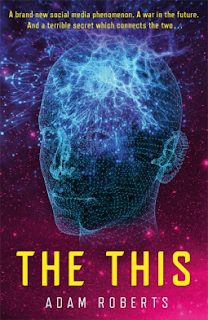
#Review - The This by Adam Roberts

The This
Adam Roberts
Gollancz, 3 February 2022
Available as: HB, 304pp, audio, e
Source: Advance e-copy
ISBN(HB): 9781473230903  

I'm grateful to the publisher for an advance e-copy of The This via NetGalley to consider for review.

'In the Bardo, subject and object are the same.'

As always with Adam Roberts' books, The This fizzes with ideas, the story illustrating, looping around, and developing, themes from philosophy, physics, popular culture, literature, religion, music (and doubtless more I didn't spot. Roberts is, in the best sense of the word, a clever author - not because, or not only because, of this incredible hinterland, but because he is able to share it without making the reader feel they've missed stuff. Rather, one feels gleeful about what one has spotted. 

It helps that while the background (as I learned from the Afterword) may be in Hegel, the actual argument and case developed in the book is very plain to see whether or not you have read that philosopher. The points we see made are about a person versus a collective society, about loneliness ('the odd thing about loneliness is the way it's both an intensely isolating , individual experience and the one thing most widely shared by human beings'), about the experience of loss, about that weird thing we call death. They are all integrated into a portrayal of modern life that feels right (right as in, convincing, real, authentic).

Rich lives that modern life. He's possibly one of the many lives (an entire page of them farmers! But also I think I saw Billy Bragg lyrics?) lived by the "you" that comes and goes from the Bardo in the bewitching opening section of the book. This section allows Roberts free rein devising inventive micro-stories (whole lives told in a sentence or a paragraph, many bringing in those references I mentioned above). Rich is, at least in this life, not really rich - that's more of a nickname - but he is comfortable enough, in his Putney flat, to survive on occasional bits of work from the gig economy. Sometimes he even has a bit of cash left over to pursue his hobby of collecting... cash, in the form of rare banknotes. (We get a couple of pages of digression musing on the nature of banknotes as essentially known lies).

Interspersed with Rich's story, Roberts has included chunks of social media, sort of. Status updates. Locations. Spam. Messages. Complaints. Puns (of course puns! 'He preferred Apple products to PCs, computer-wise. You might say: pomme? - cuter. You might say.' Roberts' way with puns is genius. They aren't just there to be funny, rather they're a tool that adds layers of meaning to the text). The way this material is arranged means that the flow of Rich's story is continually broken up. I had to keep going back and reminding myself where a sentence came from, before my attention was spammed, the whole experience of course redolent of the contemporary struggle for attention in the face of a torrent of jangling content - but also illustrating Rich's particular life as he twiddles and fiddles his days away supposedly working on his novel (an epic fantasy project). 

The story takes wing when Rich is allotted a job interviewing the representative of a company, the 'The This' of the title, which has developed an implant allowing social media to be literally pumped into the brain. Is The This a cult, as some allege? Rich is intrigued by his encounter, but soon discovers that The This may have plans for him. As the behaviour of the company becomes outright stalkery, it seems clear that Rich is somehow important - and not only to The This.

Several centuries on, Adan lives an, I suppose, even more modern life (it's the future so it must be more modern?) focussed on Elegy, an AI sex-toy that Adan is absurdly, sweetly, devoted to. But it's still a slacker existence similar to Rich's, buffered by his mother's money - until she defects to The Enemy. By Adan's time The This has metastasised into a formidable hive mind against which humanity - or parts of it - are at war. And Adan soon finds himself in the army. 

There are other strands too - a whole section set in the world of Nineteen Eighty-Four, expanding on the theme of the hive mind in an interpretation of that book that I'd never have considered but which fitted exactly with the idea of Big Brother. Some writers would take just that idea and make it into a whole story - by no means the only example in this book of Roberts' prodigality with ideas: basically he hoses the reader with them. Loneliness? Here is Father Mackenzie, caught as it were just out of the song, 'wiping his hands on his cassock and talking nervously about God's love'. Ah, we're doing Beatles, well, here is 'a car alarm... going off like Yoko Ono in full song'. The book is like a bulging sack of presents on Christmas Day, with treat after treat to unwrap.

Returning to Adan's story, though, Roberts uses it to add yet another thematic thread with a confused, panicked view of warfare - all fumbles and shock and confusion with comrades butchered and intentions muddled). It's a war in which Adan, inexplicably, seems to play a central role but his place - and importance - are no clearer than Rich's. I'd say the focus of the story switches from one to the other, Roberts giving us clear portrayals of both. Not necessarily people I'd want to meet or spend time with, they are both, nevertheless, rounded, actual characters, something that gives them a sort of edge over the various forces - the military, espionage agencies or The This itself - that are trying to manipulate them. The book returns in the end, I think, to deep questions: what it is that makes us human, whether mere happiness and contentment is enough to satisfy that nature, and what may lie beyond even something like The This which seems - in many respects - like a desirable endpoint for human evolution.

Clever, humane, absorbing and great fun, this is in my view Roberts' writing at his very very best. Just a glorious book to read. Get it now!

(The book also built my vocabulary. Evanishment? Haecceity? Velleities?)


22 July 2021

#Review - a strange and brilliant light by Eli Lee

a strange and brilliant light
Eli Lee
Jo Fletcher Books, 22 July 2021 (HB), 17 February 2022 (PB)
Available as: HB, PB, 292pp, e, audio
Source: Advance review copy kindly provided by the publisher
ISBN(HB): 9781529407754 (PB) 9781529407747  

I'm grateful to the publisher for an advance copy of a strange and brilliant light to read and consider for review.

Sometimes, to see plainly, to understand just how strange things have becomes, you have to step back a bit. 

That, I think, is what Eli Lee does in her riveting SF(ish) novel about the future of artificial intelligence (AI) and its effect on society - or perhaps, society's effect on society, because nothing is inevitable, it all depends what WE do.

The book is set in a recognisably modern world with laptops, the Internet, cars, trains, coaches - and poverty. Teenagers meet for parties in the sanddunes and do slightly naughty things. There are coffeeshops and trades unions, venture capital startups, conglomerates, and meditation retreats in the mountains.

But it is not OUR world. The geography, place names (Dhont, Mejira) and countries are clearly different, as is the history (which is alluded to but never explained - this book is very good at involving its readers without a great deal of exposition). There is no made-up language but Lee coolly uses comprehensible but not familiar English words such as 'unancestral' to hint at unseen depths, at concepts and structures shaping the visible narrative. Most tangibly, the different cultures we meet here have their own cuisines, with meals - both traditional and intercultural - described in, frankly, delicious detail. Overall, the effect is to distance the reader slightly from the locations and action, so that we question what is being shown and think about what is happening (and what we're taking for granted).

In Lee's imagined society, we are on the cusp of AI automating most of the work hitherto carried out by humans. The focus is on a chain of coffee shops, Slurpees, where "auts" are being introduced to replace human staff - early on we meet Lal, who is about to transfer from her job as manager of one such shop to a more senior position in the company, where she will be helping to plan future automation. This transformation is proceeding, at pace, without much thought being given by Government or there conglomerates to the consequences - that is, how people will make a living. Things are, I'd say, closer to the edge than in our world - but it's a matter of degree.

As the story moves on, Rose, one of Lal's team, takes on the managership. More concerned than Lal at what is happening, she attends protest meetings, falling in with the surprisingly uncharismatic Alek who leads the group but doesn't seem to regard the members as having much to contribute apart from their numbers. He might be a radical and agitator, but he's making the same mistake as the big corporations in discounting the input of actual humans, reducing even the activity of process to an assembly-line of placards. (Perhaps they could get auts in to do that, too?)

Alek knows what he thinks the solution is - something he calls 'source gain', what we'd describe as universal basic income, an entitlement for all to part of the fruits of automation, enabling a minimal, tolerable lifestyle. Rose seems less committed and more questioning of this concept - late in the book she lights on the idea of ownership, by the people, of the means of production (the auts). So, yes, there's Socialism in this alternate world - and indeed we get a good description of the alienation of the workers from their labour. But there are other ideas in the mix, too - wider elements in the protest movement are taking direct action, smashing the auts. 

I thought that Rose's and Alek's protest meetings might be highlighting the dangers of an unstable society becoming more authoritarian, as they seem to occur clandestinely in a remote abandoned warehouse - but this is not really followed up and on the whole I don't think a strange and brilliant light is meant as a novel of political action. It's rather one where the wider forces in society are played out between a few characters and within their families. This comes across most strongly in the third central character, Janetta, who completes the picture by giving an insider's view on the progress of AI itself.

Janetta is a PhD student at a prestigious university (contrasted with the local college which was all Rose could afford to attend, despite having higher aspirations) worked on making AI empathetic, considered a key step to developing conscious artificial intelligence. She's also going through emotional turmoil, having split up with her girlfriend. Lee has a twist of fate link Janetta up with the founder of one of the top AI start-ups, so allowing a dialogue between Janetta's approach to the AI problem, informed by her loss of Malin, and Taly's more functional attitude.

The relationships between the three women, their wider families and the workplace, played out over job changes (a particular grim description of Lal's arrival at a dream corporate campus, the antithesis of all her hopes and dreams), holidays and meet-ups, creates a fascinating tapestry of life which, yes, serves to illustrate the dilemmas and risks of the new technology but at the same time is simply riveting to follow. The process of automation is marked by the progressive elimination of people from Slurpees, while Lal's supposedly favoured management position becomes more and more dehumanising and Janetta finds her progress frustrated by relationship entanglements and doubts over the ethics of what it's doing.

In what is actually quite a short book, Lee gives the reader a massive amount to ponder as well as delivering a brilliantly written and absorbing story about some very real people.

I would unreservedly recommend a strange and brilliant light.

For more information about a strange and brilliant light, see this blogpost by the author, explaining the inspiration behind the book and the publisher's website here.


4 November 2018

Review - By the Pricking of her Thumb by Adam Roberts

Design by www.blacksheep-uk.com
By the Pricking of her Thumb
Adam Roberts
Gollancz, 4 September 2018
HB, 260pp

I'm grateful to Gollancz for an advance copy of this book.

This review first appeared on the Shiny New Books blog here.

NB there is a potential mild spoiler below - I will flag it up when it gets close.

Roberts seems to have been very busy lately so I'm glad he managed to include a return to the world of The Real-Town Murders, one of my favourite books of 2017. R!-Town is a futuristic version of Reading (the town on the Thames, not the bookish activity) though the futuristicness is less embodied in what the town's like, but in the fact that almost no-one is around and about: all those who can spend their time hooked up to The Shine, an immersive virtual reality where lives are conducted while bodies gently decay, or at best, are exercised automatically by AI driven exoskeletons.

R!-Town is home to Alma, a down-at-heel PI, and to her partner Marguerite. Housebound by illness, Marguerite operates as part Watson, reporting Alma's cases, and part Mycroft, making links and connections that Alma can't. The connection between the two women is well, and gently, done - the strength of their love for one another conveyed in what they don't say, what they don't - can't - do. Marguerite's illness is a designer smart malady which strikes every 4 hours and 4 minutes with a mutated threat, requiring Alma's presence to diagnose and treat whatever new instance of it has arisen. It has to be Alma, that's coded into the virus, inducing a great degree of urgency to the life of an investigator - Alma simply has to be home when the time comes round or Marguerite will just die.

Of course this predicament doesn't come cheap. Alma is deep in debt, and when she is offered an impossible case by one of the four richest people in the world, she doesn't have many options... though the "crime" (one of the four has allegedly been murdered, but nobody knows who) is baffling and the authorities unhelpful.

Like its predecessor, this is in many ways (despite the desperate situation) a joyous book. Roberts is a good writer - make that a very good writer indeed - and his prose simply sparkles. It's a wonder to read, regardless of subject, plot or context. I think I'd happily read him if he were to draft the telephone directory or washing machine instructions. He really, really observes. Just look at this:

"A concrete wall disclosed a kind of derangement of detail: unsmooth greyness stippled with an astonishing variety of pointillist dots of slightly darker and slightly paler grey. It called to her not only to see, but to touch, so she ran a finger along the wall's five o'clock shadow"

or

"The surrounding trees had swapped their green livery for scarlet, like soldiers putting on dress uniform for a royal parade."

Roberts also brings too bear a vast range of references, whether from memory or knowing where the words are buried - I was pleased with myself for spotting some of them (Ron and Reg Kry, two recognisable criminal henchmen, " 'Search, search, search,' agreed Marguerite, 'searchability, that's the beauty of - me' " is a riff on a British Gas advert from the, 1970s or 80s) but I'm sure I will have missed many more.

The central reference here, which isn't concealed, is, though, the homage that the book pays to the films of Stanley Kubrick and in particular, to 2001: A Space Odyssey. This is explicit, for instance in that Alma is soon approached by "Stan", a self-confessed Kubrick fan (so perhaps a double reference there) who first urges her to "follow the money" (of course!) and then introduces her to a private in_shine 2001 sim which he uses to illustrate theories both about the film itself and about the crime she's investigating. It's also implicit, in ways which I won't disclose because they would be spoilers, other than to say that a key theme of 2001 turns out relevant to By the Pricking of her Thumb as well.

But this isn't just a clever book filled with knowing mentions (even if Roberts makes the title of the very first chapter a nod to one of his one earlier books). It's got some really hefty ideas behind it, from the nature of money and the consequences of "monetising" the Shine (that's what the wealthy "fab four" are about as part of their quest for "absolute wealth") to the limit of State power in the face of wealth to the transformational impact on society of all that virtual action.

Mild spoiler alert - skip the next paragraph if you care about these things

By the Pricking of Her Thumb  is also, in a couple of places, almost unbearably, rawly, moving and true. There is a point here where the story is bobbing along nicely, building to the conclusion - and then stops in its tracks where something truly awful happens. But rather than being something that annoys or detracts, this is a moment that enhances and deepens the story. Roberts makes the response very real, very raw and quite, quite true. I always expect a lot from his books, but here he far surpasses even what I'd expect.

End of mild spoiler alert

By the Pricking of Her Thumb is a sequel, something Roberts famously doesn't do. He has justified writing it by saying that a sequel is, for him, itself a first and therefore justifiable. I'm pleased that this argument is recursive so ought to permit more in this series (and could be extended to allow further series if required, who knows) so I'd like to think there can be more stories of R!-Town to come (the hidden internal war within the Government apparatus that we saw in the previous book continues here, we're told, though it doesn't feature centrally, so perhaps a burger book may be required to resolve that?)


29 April 2018

Review - Everything About You by Heather Child

Everything About You
Heather Child
Orbit, 26 April
HB, 340pp

I'm grateful to the publisher for an advance copy of this book.

In a future London (perhaps 20-30 years from now, some time after a year of riots which have left whole districts derelict) 22 year old Freya survives a dead-end job in an IKEA-like furniture barn. At the start of the story she's selling actual, physical furniture, but there's an air of threat over the job as warehouse space is being converted for housing and the sales soon become virtual, supported by AI powered assistants. All that's left is flipping sausages in the cafe with her mate Chris, closely, too closely, watched over by their boss Sandor.

The AI theme is of course central here, as the book cover hints. It's a future of virtual and augmented reality mediated by specs, visors, hairnets that sync thoughts with the cloud and - the latest innovation from mega corp Smarti - "smart faces", virtual personal assistants that can adopt the persona of anyone (dead or alive) who hasn't declared their digital footprint "private". One example: a pink line overlaying one's field of view shows the best way to go, even to avoid other pedestrians around you. When, towards the end of the book, Freya's specs run out of battery and she has to manage this for herself, even such a simple task is hard and takes conscious effort. Or there is this: "There is no need to memorise or learn other languages, even dentists's appointments are arranged by her toothbrush when it detects enough tartar".

Privacy in such a world is... problematic... with the kind of tracking and inference currently seen online rife in the real world - as Freya moves about London, she's constantly served ads by screens or shop windows, bombarded with advice by her "Smartbit" (for example, her Health score changes depending what she eats or how much sleep she's had) and there's a pervasive system in the background of scoring things, from lattes to sexual encounters (so that "rated" has become a general term of approval). I have to say that following the Cambridge Analytica revelations, this book is brilliantly timed. Child has worked in digital marketing and the proof copy of the book I was sent points out on the back cover that the world depicted here isn't that far off(!).

Yet, while the implications of rampant AI are undeniably attention grabbing, the book is much more than an angry howl at the coming world of digital manipulation. At the centre is a sad story of Freya, her mother Esther and lost (adopted) sister Ruby. The book turns on what happened to Ruby, and on the guilt that both women feel about her disappearance. Child is simply brilliant at showing how, after a Ruby-esque personality surfaces in Freya's new Smartface, everything gradually begins to come apart. Freya is both revolted and enthralled by the opportunity to talk again to "Ruby". What does kt mean, though? Is it a hint that Ruby is still alive somewhere, perhaps trapped, perhaps needing help? As Freya grapples with the reality - or not - of what she's experiencing, we begin to see flashbacks to her life with the "real" Ruby, a vivacious, awkward young woman, a rebel and an explorer of London's weird side, above all a good friend, with a kind heart, who took the lonely Freya under her wing on arrival in London from the "north". (The reason for that arrival - her mother's finding a new job in what seems like a major life change - is never explained, though there might be hints - and I could finally guess at the why. Child uses this tangential approach a lot - for example, she describes how there is "a certain hush pervading neighbourhoods where the government might try to interfere, to recruit or deploy some of its many volunteers" - for what purposes? She doesn't say, but not good ones, surely).

It is though the relationship between Freya and Ruby that is central to the book, both their adventures and closeness as teenagers and, later, Freya's grappling with what's presented, convincingly, as being Ruby.  Child explores ideas about what makes identity, what makes humans human, and how we might, insidiously, come to accept something both less and more as a substitute (so in that way, yes, this book is a warning about the future - or even the near-present - only a more subtle one that you might think). She is I think spot on about the effect on Freya of losing Ruby. It's the hope that gets you. "...hope, once kindled, rages like a wildfire. Every time she has to douse it, a part of her needs to heal, and recently it has been a relief to close her eyes at night and know the next day will bring no firefighting."

This is also an excellent, compelling narrative, depicting a world where many of the currently emerging problems of a connected life are simply seen as the default: online stalking, porn addiction, jobs lost to AIs, predatory men hunting down women both in real life and online, manipulation of those all important "ratings", over-mighty corporations... and the almost incidental loss of privacy (Freya's mum carries a pendant that syncs with her daughter's Smartbit).

Everything About You isn't without hope, there's a strong message here that we can, if we want, keep the option of living our own lives, rather than just following the choices the algorithms make for us - but that it won't be easy and and there isn't long left.

I mean, look at this. Even the book cover is tracking me...


For more about the book see here.

4 April 2018

Review - I Still Dream by James Smythe

I Still Dream
James Smythe
Borough Press, 5 April 2018
HB, 386pp

I'm grateful to the publisher for an advance copy of I Still Dream through Amazon Vine.

In 1997, 17 year old Laura Bow argues with her mother and stepdad over the phone bill she piles up dialling in to AOL.

In 2007, Laura split up with her boyfriend who works in the same Silicon Valley tech startup as her.

And then we see Laura again in 2017, in 2027 - and later.

Each time, her story intertwines with the development by that same tech company of the AI known as Scion - and by Laura of her answer to Scion, her riposte, her own creation, Organon. In one sense this is a story of what tech might become, what it might do to us, as Scion - taught to win, to protect itself - becomes embedded in almost every conceivable product and Laura tries to warn us against it..

At the same time, it's the story of Laura, her husband Harris, their extended family: his father, her mother, of ageing, of decay (in one moving sequence the two see a parent being overcome by early-onset dementia). But that also means it's a story of youth, of growing up, with Laura's 80s/ 90s childhood and adolescence drawn very touchingly, mixtapes, modem squark and all and then carried through into her adult life. Smith has a clever technique of putting things in that you don't see properly until some later detail, remembered in a later decade, tips you off to what is going on. It underlines an idea he explores that memories are reconstructed, dressed up, inferred because of course this "seeing properly" is construction that depends on the two different viewpoints - a kind of temporal hologram. I don't want to spoil the book so won't mention specifics but you'll find there are things about, especially, Laura's life that are revealed later which make you think, of course. But then you wonder...

This richness makes the story so real. The reader becomes aware that there is always more happening than is seen - which complements its jumping from decade to decade, only describing few days, a few hours, in detail. Smythe does something similar with his dialogue, understanding that what's not said is as important in conveying what's going on as what is said (I don't say, what the fuck happens if this goes wrong? If he crashes the car? Because Nor, and Zara? They won't walk away from this.)

A kind of shorthand for the decades-long, unfolding dialogue here about AI, personality, autonomy and privacy is the varying use of pronouns (he, she and it) for the two "intelligences" by different characters. Not consistent at all, we see differences in attitudes conveyed by these terms, as well, of course, as the developing capabilities of, and lengthening relationships with, Scion and Organon. As the story develops, it explores - but not in a tech heavy way - the ideas behind AI, the reality of it: the difference between a machine built to done thing - say, to play chess - essentially a trick - and something that can grow and learn - and the responsibility of a creator in the latter case. This is counterpointed by the theme of decline in capability, loss of memory and ability: again, the contrast between growing up and ageing. We see a husband and wife making breakfast together in a kitchen,  she working seamlessly to make up for his slips and mistakes, the motions almost balletic, almost unconscious, just as - we think - the surprisingly acute remarks of Scion and Organon are unconscious, non-sentient.

This is all deeply rewarding and repays a second or third read, but I don't want to give the impression that this book is all beautiful observation and no plot. There are some thriller-y elements to it, with Laura pursuing her own struggle to secure her father's legacy in tech, with whistleblowers and a crusading journalist, and the extended timeline lets Smythe show how things turn out over realistic periods of time.  Again, we sometimes see an episode unfold but don't learn how it turned out until a later section, just as we don't actually get an answer to the main mystery looming over the story - what became of Laura's father - until near the end, in the only section out of chronological sequence.

For me, that was actually one of the less satisfying parts of the story. Laura's father is such an absence in this story that he's almost a presence: his absence drives the story, drives Laura. It's a very good use of what has become quite a common trope and one feels that there must be something really dramatic behind it. Yet while there is certainly a story there, which is interesting in its own right, when it was revealed, it didn't quite match what I'd been imagining.

Perhaps there's a lesson in that - the drama of this book is very much in the personal things, Laura and her husband, the slow development of Organon (and when you finish the book you realise just how clever Smythe has been in showing that evolution), happy and sad events remembered decades later. And that makes for a very, very good read.

Congratulations to James Smythe for writing this immersive, arresting, uncategorisable novel. I wished it had been longer, I really did.

For more about the book, see here. You can buy it from your friendly local bookshop, or here, here or here.


28 September 2017

Review - Emergence by Ken MacLeod

The Corporation Wars: Emergence (Second Law Trilogy, 3)
Ken MacLeod
Orbit, 28 September 2017
HB, 326pp

I'm grateful to Orbit for an advance copy of this book.

Before I say anything about the book itself, just take a moment to admire that utterly gorgeous cover image by Bekki Guyatt. I know one shouldn't judge a book by the cover but sometimes it's hard not to...

It's a bit tricky reviewing anyway the third volume of a trilogy. Realistically, those who've read the earlier books are likely just to want to know "is it as good as the others?" the answer to which is, "yes, in fact slightly better". Those who haven't read them will want to know if they should do that now, the answer to which again is, yes, and shame on you if you haven't, where have you BEEN?

They also rightly want to avoid spoilers which means they shouldn't really read any more of this review, they should go and read Dissidence and Insurgence first.

All that said, though, this is still very much a book in its own right and, given how the trilogy has evolved, somewhat different to the others. So I would like to discuss it even if I've now excluded most feasible readers.

What's different is that by the time we come to Emergence, the veil of the Temple has, as it were, been rent in twain. The Wizard is in plain sight. What was obscure, if gradually being revealed, through the earlier books, is now plan and we no longer see as through a glass darkly.

We know that those old enemies from 21st century Earth, the Axle and the Rax (progressive and reactionary terrorist forces) both digitized ex-members who've ended up a far exosolar system, embodied in sims operated by the various AI-driven Corporations.

We've gradually seen a complex skein of allegiances, bluffs, double-bluffs and plots fall away, and there's a bit of clarity. The Rax - dedicated fascists all - have coalesced and are making a bid for power. We know that the robots sent to exploit the local moons by the Corporations have developed sentience and rebelled. We know that the elaborate worlds occupied part of the time by Carlos and his comrades are simply sims - and that they are likely, at any moment, to be downloaded into squat fighting frames, like digital Orcs, to battle the robots, or the Rax, or other factions. And we know a lot more that I won't attempt to precis.

What we know less about - and a fair bit of this book fills this gap - is the nature of the planet itself, and of the life upon it. Which gives MacLeod something new to address, besides the dry wit of the robots or the dynamics of space battles. That opens up the story considerably - at the end of the previous book, the Locke module, with digital Taransay Rizzi aboard, was plunging towards the surface. What she finds there, and how it affects the complex, many sided conflict brewing above, is one of the more surprising elements to this book. MacLeod evokes well the wonder of the new planet and its weird biology, and sets up a new conflict which rebounds on the schemes of the other actors, war-game them how they will.

It's a strange though that the utterly alien but biological life there is the first non-digital life that we've encountered in this trilogy. That fact becomes more and more important as the schemes unwind, the balance of power shifts and the final secrets are revealed (but not till, almost, the final page).

This has been a superb trilogy, and the writing remains fresh to the end. There's the degree of expression that MacLeod manages to give to the robots, with their deadpan remarks and utterly convincing robotic quirks (for example, the danger of two or more getting stuck in a loop of logic, which requires the intervention of a third robot to close down). In this book we see what's effectively a robot strike, complete with strikebreakers (who receive a fair amount of abuse). There's also a lot of twisted economics "The price of your souls is tending towards zero") and law (the battles are fought as much by AI-mediated lawsuits as by bullets and lasers). And I could go on.

In short, Emergence is a logically and emotionally satisfying conclusion to a smart and thought provoking trilogy which not only looks back to the troubles of the present (those mountains of bones on Mediterranean beaches) but looks to the future - that future which, as the cover has it, it not ours.


For more about the book see here.

15 September 2017

Review - Acadie

Acadie
Dave Hutchinson
Tor, 5 September 2017 (e)  / 13 October (PB)
PB, 112pp

I'm grateful to the publisher for an advance copy of this book via NetGalley.

The first humans still hunt their children across the stars.

The Colony left Earth to find utopia, a home on a new planet where their leader could fully explore their genetic potential, unfettered by their homeworld’s restrictions. They settled a new paradise, and have been evolving and adapting for centuries. Earth has other plans.

The original humans have been tracking their descendants across the stars, bent on their annihilation. They won’t stop until the new humans have been destroyed, their experimentation wiped out of the human gene pool.

Can’t anyone let go of a grudge anymore?
This is a fun - and thought provoking - novella from Hutchinson. It's very much a change of mood from his Fractured Europe sequence, or at least, it seems to be on the surface.I very much enjoyed seeing Hutchison sketch on a broader canvas (although this is a fairly short narrative - I read it on my commute home - the ideas in play here could easily have filled a full length novel, so in places "sketch" is the right word: we know what's happened and where we are from the few bold strokes we see, but a great deal is implied).

Our protagonist is Duke, "Mr President", a man elected to lead his deep-space Hab largely on the basis that he doesn't want the office. Waking from his hundred-and-fiftieth birthday party, Duke steps into a crisis. The Hab - and all of the others that make up the colony - may have been discovered by deep probes from earth.

Whether they have, why they are on the run and what they do next, is the subject matter of this story and I won't spoil that. What I will say is that Hutchinson delights in easing the reader's feet out from under them: building up characters as sympathetic then gradually casting doubt on their motives, letting the narrative go one way then sowing seeds of doubt.

It's a great example both of daring space opera - the central conceit of how the colony survives - and great storytelling (is everyone telling the truth? If not, who is lying to who?) and, as I said, is great fun while also raising questions about AI, genetic manipulation and reality.

I'd strongly recommend this, not least as a good starter to the author's work.

For more about this book see the Tor website here.