Showing posts with label Pacific islands. Show all posts

5 September 2023

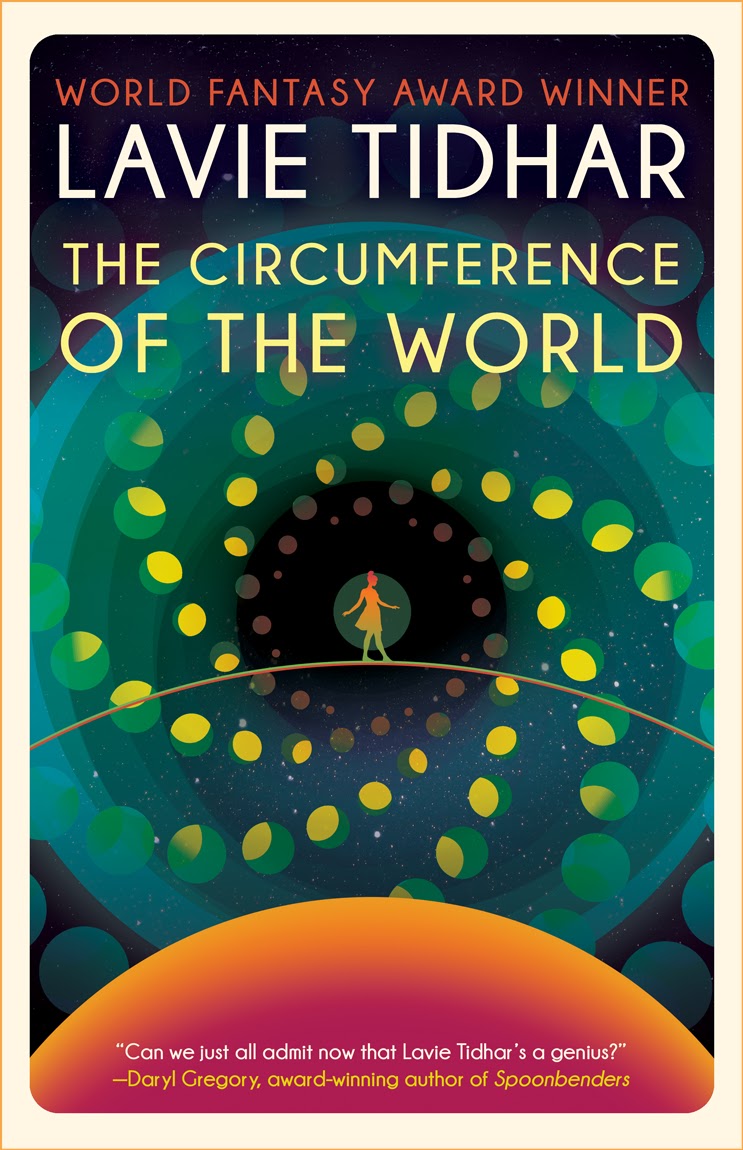
#Review - The Circumference of the World by Lavie Tidhar

The Circumference of the World
Lavie Tidhar
Tachyon, 5 September 2023
Available as: PB, 256pp, audio, e
Source: Advance copy
ISBN(PB): 9781616963620 

I'm grateful to Tachyon for sending me an advance e-copy of The Circumference of the World to consider for review.

Lavie Tidhar's new novel is a fiendishly ramified mixture of narratives. In late 90s London, Delia Welegtabit's husband, Levi, has disappeared. Levi may or may not have owned a copy of the elusive novel Lode Stars, upon which pulp legend Eugene Charles Hartley apparently founded a religion (no, definitely NOT that one, despite one of the categories Amazon has filed this book under). A London gangster and his pliant police stooge want the book and engage second hand book dealer, Daniel Chase, to find it. 

That's the first layer. We also learn about Delia's early life on the island of Vanuatu (also visited by Hartley) and about Hartley's career and life - part of this is told through letters to and about Hartley by various early SF luminaries - Tidhar rendering many different voices here, all totally believably.

We also read an extract from The Book itself, the story of (another) Delia seeking her lost father deep in space, the setting keying into a mythology that Hartley either believed or invented. It's all about the destination of humankind, which is to both swept into a black hole at the centre of the galaxy and preserved as information. All of these narrative levels interact, with coincidences, names and versions of names, apparent timeslips and repeated themes (shadows, eyes). Some of these might be explained by Hartley's authorship of Lode Stars and his making allusions to the works of his contemporaries: others - less so.

Gangster Oskar Lens's career as a black market dealer in the failing Soviet Union features too, as does the London second-hand book scene ('My highest ambition had always been to open my own bookshop on Cecil Court'). It's a bewildering ride through 20th century history and the birth of modern SF (taking in the rise of modern conventions, as well as gatherings in a Holborn pub) something Tidhar has deep knowledge of (it was fun to spot allusions, especially in the Lode Stars extract, to names, themes and artefacts from various genre classics: I'm sure I missed many). It is though much more than that, touching on questions about the nature of reality and the meaning of life as well as - perhaps - commenting on how the SF writer of a religion may be affected by that and, possibly, escape the trap he's set himself. 

There is some lovely wordplay here ('Dewey-eyed librarians') as well as nice pulpy (but culturally appropriate) language ('Paperbacks started back at me from the shelves without saying a damn thing', 'My aunt had died of cancer. She wasted away like a cigarette.') as well as starkly beautiful language ('I felt the press of stars overhead, and they were cold, and bright, and indifferent.')

I really enjoyed The Circumference of the World. As a book, it is a thing of its own, not like anything I'd come across before, but a great read crammed with ideas and glorious writing: there is simply so much material here, I think some writers could and would make 3 or 4 books of it but we have all that concentrated in a short novel. Somehow that compression means that - like matter spiralling into a black hole - everything here simply lights up, bathing the reader with its intense radiation.

An amazing read, strongly recommended.

For more information about The Circumference of the World, see the publisher's website here

15 March 2023

#Review - Hopeland by Ian McDonald

Cover for book "Hopeland" by Ian McDonald. Against a background of stars with constellations marked out, the steeple of a Wren church, with lightning forking upwards.
Hopeland
Ian McDonald
Gollancz, 16 February 2023
Available as: HB, 656 pp, audio (narr Esther Wane), e
Source: Advance copy
ISBN(HB): 9781399605731

I'm grateful to the publisher for an advance e-copy of Hopeland to consider for review. I also listened to parts of the book on audio.

Hopeland is a fierce storm of a book, a story on an epic scale - covering thousands of miles and centuries of time, and also satisfying chunky in the hand. Yet it still has plenty of space for the personal and the small. No, it is the personal and the small - used to tell a big story.

We begin in 2011 as riots engulf London. Amon Brightborne - aka Tweed Boy - a young Irish musician from a wealthy, old established family, is booked for a select gig but unable to find the address. Instead he find Raisa Peri Antares Hopeland - or perhaps she finds him. Raisa is engaged on a sort of parkour selection challenge against the shadowy Finn, the winner to receive a sought-after role in the extended Hopeland clan. Each is to cross London, one from the north, one from the south, not deviating more than 50 metres from an invisible line, the aim being to reach a certain rooftop first. And Raisa is losing - until she enlists Amon to help.

And there, at one level, you have it - like a system of three stars in motion, Raisa, Amon and Finn will weave complex, unpredictable paths through two decades and more, and their perturbations will ring down the centuries. That's the book. At another level of course we have only just begun. We will learn about the Hopelands - a chaotic, sprawling "family" ('Don't fall in love with my family!') which anybody can join, across time, space and cultures and which has its own centres, or 'hearths' everywhere, its own ways of doing things, even its own religion. We will also learn about the Brightbornes, a formidably eccentric clan whose house can't be found unless somebody shows you. Some magic there, surely, but it's matters of fact magic. 

When Brightbornes encounter Hopelands, what might happen?

The setting in which that encounter takes place is a world that's increasingly restive as weather, populations and trends are increasingly disrupted by climate change. The book takes us to Iceland, to Greenland, to the Pacific kingdom of Ava'u and to points in between as humanity struggles to move into its future. I might use the term "sprawling" for this book except that might imply something less disciplined and focussed than Hopeland actually is. Better perhaps to say that McDonald is happy to set things off in one direction, then jump several years and three continents to pick up the story elsewhere, trusting the reader to make the leap with him - which I always did, not least because of the gorgeous writing and command of emotion and pace that Hopeland displays. 

I'm not going to quote bits to illustrate that, I don't know where I'd even begin, you just have to read this and experience the rhythms, the lists (THE LISTS! They are nothing short of poetry!) the almost sneaky way the text comes back to the same point from different directions, the range of reference (McDonald calmly suggests that the word "Padowan" used in Star Wars lore for an apprentice may actually have been lifted from the Hopelands...) The book is like a feast and simply gives so much (my favourite section perhaps being the one where a whisky soaked and self pitying Amon, exiled in Ava'u like a figure out of Jospeh Conrad, or perhaps Graham Greene, becomes involved in political chicanery, a subplot that many writers would base a whole book around).

What else? Corporate and geopolitical shenanigans, the squabbles of gods and an element of possible fantasy or magic that is very much part of the texture of the story but kept as subsidiary theme. Again, any other author I can think of would make 'electromancers' fighting duels with Tesla coils across the rooftops, and declaring themselves the protectors of London, the centre of the story. Or else the cursed family with its own haunting spirit. Or... Instead, here those things are real and important but very far from being at the centre of things, rather they deepen and add weight to what is a glorious, complex and engaging story, one that creates an entrancing world of its own and one that it is simply a joy to visit. 

And McDonald dares not to give answers to some of the mysteries here. It's just the way things are, alongside all the other marvels of Hopeland - the water driven musical engine playing its thousand year melody, for example. In short, Hopeland is a book that simply draws one in, a wonderful book full of so much. I strongly recommend it.

In narrating the story, Esther Wane wonderfully articulates the voices of a dizzying range of characters, form Amon's slightly gruff Irish English to Raisa's sassy Londonish to the Ava'uans to Greenlanders and Icelanders. The audio is magnificent.

For more information about Hopeland, see the publisher's website here.