Showing posts with label aliens. Show all posts

30 May 2023

#Review - Conquest by Nina Allan

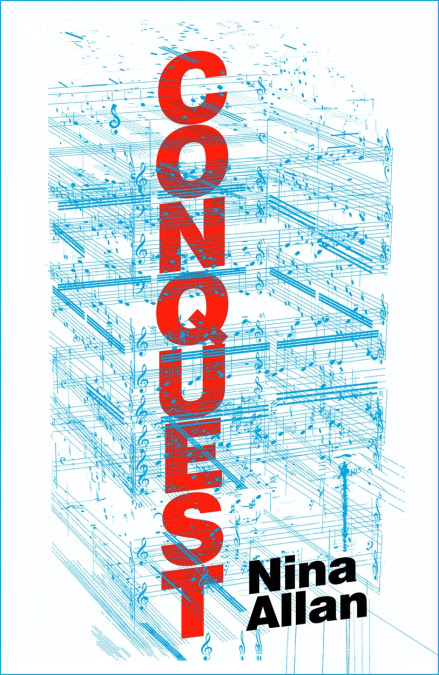
Cover for book "Conquest" by Nina Allan. A tower, formed out of musical staves, with notes flocking on them like figures in a building. The title is spelled out vertically downwards in red letters.
Conquest
Nina Allan
Riverrun, 11 May 2023
Available as: HB, 320pp, audio, e   
Source: Advance e-copy & purchased copy
ISBN(HB): 9781529420777

I'm grateful to Riverrun for sending me an advance e-copy of Conquest via Netgalley to consider for review, this was also a book I had to have on my shelves!

Nina Allan is one of my favourite authors - I love the sense of unease her books deliver, of ordinary lives taking place alongside the "other". In Conquest, we have three characters whose stories are tightly bound. Frank, a rather shy young man who's entranced by the music of JS Bach, has gone missing in France, after travelling (his first time abroad!) to meet "friends" he met online. Has he fallen in with a sinister cult? Are they a criminal ring who have been grooming him? Or "harmless" cranks pushing a conspiracy theory? Or - just possibly - do they see an important truth that others overlook? We don't know.

Rachel is Frank's girlfriend, Allan portraying her, and her (and Frank's) background on a London estate (actually two - the bad estate and the good estate) deftly. She reports Frank missing, but the police aren't very interested, and she's left in limbo, not knowing whether to wait for him, or get on with rebuilding her life.

Robin is the private detective to whom Rachel turns in despair when Frank remains missing. She's the main voice in this story and I really enjoyed Allan revealing Robin's backstory bit by bit. It's a rich and complicated one, taking in Robin's former career with the police (she evidently had a love/ hate relationship with her hard-bitten boss), her personal life (she was adopted, her mother dying when she was young, her father nowhere to be seen) and her run-ins with notorious London crime families. Allan always delivers wonderful characters, people who are many-layered, connected in subtle ways and who simply stroll off the page and into your life.

As does the mystery at the heart of this book. That mystery is approached in several different ways. The book contains the gist of a 50s SF story seen by Frank as key to some sort of cosmic puzzle, but also articles by a film critic who we later meet, and it also connects with Allan's short story "The Lichens" included in the Someone in Time anthology of time-travel romance. It has recurring themes - Frank's (and Rachel's) obsession with Bach isn't coincidental and Allan analyses pieces and even individual recordings and performers to highlight concerns explored here. Ideas of war, of - yes - conquest, and of taint and influence, recur. The atmosphere is haunting, suggestive. Frank's suggestion of an important message coded into a text is relevant, I think, but the "text" is much more then simply a piece of writing and the "decoding" is something that the reader can engage in but that we also see the characters - Rachel, especially - undergo.

As well as resonating with themes form Allan's wider writing - ramified stories, the aftermath of war - there are other echoes too, including to MR James, all giving the sense of a deeply rooted tale, of a heft, a background to the story we read here.

Has Rachel been affected by a war? 

Has the enemy, in fact, already conquered - and if so, what does that leave for her?

Conquest is, simply, a delicious read, that rare book which I wished was twice as long. I'd strongly recommend it.

For more information about Conquest, see the publisher's website here.
21 April 2023

#Review - Some Desperate Glory by Emily Tesh

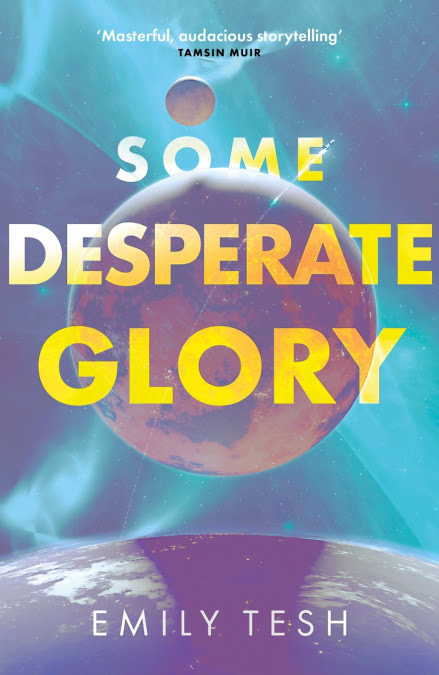
Book "Some Desperate Glory" by Emily Tesh. One planet rises over another, against a background of blue sky and stars.
Some Desperate Glory
Emily Tesh
Orbit, 13 April
Available as: HB, 438pp, e, audio
Source: Advance copy
ISBN(HB): 9780356521831

I'm grateful to Orbit for an advance copy of Some Desperate Glory to consider for review.

"While Earth's children live, the enemy shall fear us".

This is a wonderful book.

Following Kyr, a young woman growing up in a remote space colony, Gaea, which has a very militaristic culture, we learn about a wider universe. About Earth, destroyed by alien attackers. About the humans - the last remnant living on that rock, and the aliens - all conquering, under the aegis of "the Wisdom", a mysterious force or intelligence that guides entire peoples, entire planets.

Kyr is one of the best warriors of her generation, genetically enhanced for warfare, trained remorselessly to avenge Earth, and now hoping for an assignment to one of the military wings of her people. Imagine her horror when instead she's assigned to the Nursery - facing a future bearing a child every two years to replenish Gaea's population. A future where she's offered as a privilege to the fighting men. Appalled at the prospect, Kyr takes her fate into her own hands and sets out on a self-defined mission to wage terror against those she perceives as traitors and collaborators. Because, no, the inhabitants of Gaea aren't actually the only humans left...

Emily Tesh produces a miracle of characterisation with Kyr. She is, frankly, a very unlikable charcetsr - the perfect little soldier, fanatical and devoted to the cause. She's disliked by her messmates, moody, committed, totally un self-aware. Yet you'd have to have a heart of stone not to sympathise with her, faced with a duty - the one duty - she simply can't bear. It seems she's been totally betrayed by the culture she hero-worships, and while the reader will soon spot just how rotten a culture that is, Kyr is conditioned, no radicalised, to serve it so the only way she can rationalise her rebellion is to commit to a higher cause, almost greedily seeking death for glory.

That's the jumping off point for a remarkable journey of self-discovery, change and growth, in which Kyr discovers far more about the truth behind Gaea, about the paradox of the Wisdom, and about the variety of people who occupy the universe. It's an affirming journey in which we can recognise and celebrate Kyr's true qualities (beyond simply the supersoldier thing). She will need those qualities as all she's ever known is thrown into the melting pot and strange new worlds emerge. 

This is far from a simplistic tale of good vs bad (whether gentle, innocent aliens faced by human colonisers, or hapless humans menaced by monsters from space). It raises questions (on multiple levels) about the role of the individual vs the collective, about personal freedom, about just what constitutes personhood - and about giving up on long nurtured revenge. At heart, perhaps, it is about duty and about that moment when one is forced to think for onself and really, really consider what duty means. 

All that, and this is a book of glorious prose with a driving, urgent pace in service of a rattling good story. Really a book you won't want to put down till you reach the last page.

For more information about Some Desperate Glory, see the publisher's website here.


1 April 2022

#Review - Our Child of Two Worlds by Stephen Cox

Our Child of Two Worlds
Stephen Cox
Jo Fletcher Books, 31 March 2022 HB, 13 October 2022 PB
Available as: HB, PB, 352pp, e, audio
Source: Advance e-copy
ISBN(HB): 9781787471627

'Save all the humans!'

I'm grateful to Jo Fletcher Books for a free advance e-copy of Our Child of Two Worlds via NetGalley and for inviting me to join the social media blast.

I was really pleased to see this sequel to Our Child of the Stars coming.  Cox takes us back to his alternate early-70s, which is both familiar - the world is stuck in a Cold War and, in the US, the counterculture is running out of steam - and different. The ripples of Meteor Day, when an alien starship crashed near a small US town with one survivor, the child Cory ('Little Glowing Blue Frog' in his own language), continue to spread. The metal creatures known as Snakes are preparing to assault Earth (Moon landings have been attacked and satellites destroyed). Cory's people, the "Purples", have still not turned up, and Molly and Gene - his adoptive parents - are seeing their marriage under strain. Gene yearns to travel, but roaming Earth is impossible because of Cory and his complex situation. He'd really like to go with Cory to the stars ('He wanted to be the first human to breathe those strange, perfumed winds...') if his people ever return, but Molly can't abide the idea. 

Our Child of Two Worlds is about what happens next - about Molly and Gene's attempts to balance their love for Cory with their own hopes and fears in a world utterly changed; about his need, with no role models from his own people, to control the powerful psychic powers with which he's gifted (there is real fear in his recognition of what he can do: 'Cory not-good no-he-isn't Bad Man!'); and about attempts, by various unscrupulous parties, to use or manipulate Cory for their own ends. (Yes, Dr Pfeiffer appears again). 

When danger looms, with wider family threatened, the faultline between Molly and Gene is under even more pressure, with Cory, too, torn in different directions. Cox's nuanced portrayal of Cory is brilliant. We're not given a physical description, as though he was a different sort of thing, rather we see him through Molly and Gene's love - so occasionally a physical detail drops such as his 'strange striped ear', his inner eyelids (so he presumably has several), his tail - but there is no need to form a picture of Cory, rather all such glimpses are there to illustrate his emotions and mental state and the fullest description of him is as a loving, fearful and generous-hearted little boy on whom the hopes and fears of the word are projected.

I love the way that Cox weaves together big, startling, science-fictional ideas - Aliens! Earth under attack! Scary mental powers! - with very personal ones: a failing marriage where husband and wife want very different things, a scared child, a manipulative husband. And indeed, the wonderful, tiny details of parenthood - 'the trance of the midnight parent' or the beauty in 'seeing a child in healthy sleep'. I felt this portrayal of humans under strain - and not just Molly and Gene - was very realistic, and far from judgemental. Cox is at pains to make us understand the history and in all the arguments and disputes there is no absolute right and wrong (even, perhaps, when said Dr P comes on the scene). And he makes his alt-history seem so plausible - all the little details tell (Simon and Garfunkel have a hit called "Meteor Day", there are rumours (of course!) that the Beatles will get back together to sing for Cory). There are also some fun little points to be spotted, I think; I'd swear Cox has put a sign of his passing by into Molly and Gene's journey, I also thought I glimpsed both 2001 and War of the Worlds references as well as a belief that 'The Truth is Out There'. 

None of that detracts from or diminishes the tension, as Earth's defences are stripped away by the Snakes. Rather, the level of jeopardy is emphasised because the crack that runs through the Myers' marriage is all about Cory - if he returns to the stars, should they go with him or stay behind? Will they have that choice? Is it selfish to think of such things, faced with the threat to both humanity and to Cory's people? Soberingly, as I write this in March 2022, we read that Dr Preiffer, considering that threat, 'had been able to stare in to the abyss that was the possibility of nuclear war because he believed the Soviet leadership was not wholly irrational...' - that suddenly seems very on-point. 

Like the best SF, Our Child of Two Worlds is about us, at our best and worst, and how we respond to the best and the worst in others. Cory's people are from a very different, almost Utopian seeming culture and - as in one of Swift's novels - we're judged by that comparison, Cory himself noting it even as his love for his adopted parents and his friends burns bright. Are we worth saving, if we seem willing to destroy ourselves anyway?

A fiercely intelligent, engaged and often angry novel, Our Child of Two Worlds is moving, exciting and deeply readable.

For more information about Our Child of Two Worlds, see the publisher's website here and catch up with other blogs on the poster below


27 July 2021

#Review - Catalyst Gate by Megan E O'Keefe

Catalyst Gate (The Protectorate, 3)
Megan E O'Keefe
Orbit, 24 June 2021
Available as: PB, 608pp, e, audio
Source: Advance e-copy provided by the publisher
ISBN(PB): 9780356512259

I'm grateful to the publisher for an advance e-copy of Catalyst gate, via #NetGalley.

Catalyst Gate is the third book in The Protectorate trilogy (after Velocity Weapon and Chaos Vector). The Protectorate is absolutely the kind of trilogy you need to read in order and if you haven't read the others, and you want to understand whether to read the trilogy, you need to go back to my earlier reviews and not read on here because spoilers. (Hint: you should read the trilogy).

If you've been following The Protectorate you will almost certainly want to read the third part, so part of me wonders what I'm actually doing in this review. I often have this with trilogies, and my answer is basically (1) How well is the author closing off her sequence - does this book stand comparison well with the others? (2) How good is the trilogy overall?

Taking these questions in order, my answer to the first would be, VERY WELL. There are a lot of moving parts in The Protectorate. The story follows Sanda, a commander of the Fleet who's been through all kinds of weird stuff; experimented on by a hostile power; deceived by the first incarnation of the AI known as Bero into believing that her world has been smashed and that she has been marooned in deep space for decades; romanced by plausible rogue, spy-for-hire and, potentially, artificial lifeform, Tomas; framed for an assassination and hunted by her own side; and much more besides. It follows Sanda's brother Biran, a rising politician and Keeper in The Protectorate, who has discovered that its history and politics and a lot less pure that he believed. There was also the group of gutter rats who, for most of the first two books, were coping with the consequences of their disastrous heist-gone-wrong, as a result of which their leader Jules has become the loosest of loose cannons, allying with the alien entity known as Rainer.

In this third book O'Keefe deftly takes forward all these main protagonists (and more). She still has plenty to say about them all - we aren't just going through the motions - even as Rainier's endgame approaches. There are further surprises, and a series of calculated risks taken by all involved. Things kick off very quickly at the beginning of the book - there is no lengthy recap, but O'Keefe still manages to keep the reader in the frame about backstory and motivations so that the story develops organically and everyone feels "real". Yes, there were a few (a very few) exceptions, when I asked myself "why did he/ she do that?" but I feel that is inevitable in any sequence of this length.

As well as the characters, we are still learning more about this universe and its history. This is far-future SF, following humanity long after it has left Earth, and it turns out there are secrets to be told about that whole history. Topically they're bound up with the originals of "Prime Inventive", which I had always seen as a society but which is actually the descendant of a private company - the one which happened to win out in the contest to explore space. Firmly believing that nothing good can come from over-mighty corporations, I wasn't surprised to learn there'd been dirty work at the crossroads and that it involved the alien tech whose origin and purpose has been a prominent theme through this trilogy. And yes, we finally discover more about that too. 

I am, I think, moving on to my question (2) above and my answer is that while each part of this trilogy has been very good indeed, the whole has a kind of commonality and progression which makes it more than the sum of the three parts. Seen together, these books present questions - and warnings - about our stewardship not only of this planet but of the wider Universe, about loyalty, the nature of humanity and the corruptions of politics. In some ways the most human characters we meet here are composed of bits and bytes or of naneites; or are unregarded outsiders or junior players. The gilded priesthood of the Keepers shows a tendency to guile and self-interest rather than the common good, making it ten times harder to deal with the threat of Rainier and that's not an aberration but totally in keeping with the history and politics of Prime. In contrast, Sanda and her Fleeties, the rogues and criminals of the Grotta, Bero and Tomas, have a sense of humility and fragility that fires their suffering into strength and integrity. As O'Keefe writes of Sanda, 'Those pressures collided against the woman... compressed her, made her as hard and immovable as the deep ice...'

O'Keefe integrates these themes and makes her three novels into a single, coherent whole, no easy task in such a vast story, creating an absorbing and convincing world with compelling characters whose stories are told with humour and grit. I'd unreservedly recommend the sequence, if you've been waiting to see how it would turn out, and Catalyst Gate as its culmination.

For more information about Catalyst Gate, see the publisher's website here.


20 March 2021

#Review - Skyward Inn by Aliya Whiteley

Cover by Dominic Forbes

Skyward Inn
Aliya Whiteley
Solaris, 16 March 2021
Available as: HB, 311pp, e, audio
Source: Advance e-copy provided by publisher
ISBN (HB): 9781781088821

I'm grateful to the publisher for an advance e-copy of Skyward Inn via NetGalley, to consider for review.

Skyward Inn is proper mind-bending science fiction. I read a lot of SF which, while thrilling and fun, is basically... domesticated. People in space ships doing things. Apocalypses. Complex tactical books involving politics conspiracies and manoeuvring. Often, all of these at the same time. And they can be really great. But sometimes I miss a sense of deep weirdness, of unknowableness - a sense that Skyward Inn delivers in spades. The book won't be for everyone, but really did it for me.

In a near future, suffering (in a background way) from climate change, a gateway (the 'kissing gate') has opened in space, allowing travel to an alien world, Qita - an opportunity eagerly taken up by 'the coalition', a suppurate or alliance of states (it's never clear which - though in this future English has become a little regarded, minority language) with dream of conquest. Part of England, the 'Western Protectorate'; has seceded, either in principled opposition to this or possibly just to preserve a self-sufficient, bucolic way of life. Again, it's never clear.

Within the Protectorate, Jem and Isley run the Skyward Inn, serving Qitan 'brew' to the locals. Both are veterans of the war: Jem, a local woman who ran away to space and Isley, a Quitan. Jem is estranged from her son Fosse, who lives nearby with Jem's brother, Dom, a leader in the community.

It's a very simple setup, on the surface, but Whitely uses it to explore so much - ideas about family, about the structure of society, what it means to be human and our responsibilities to each other and to the world. I need to be careful what I say here because the book is one of those which achieves its effect slowly and incrementally. Things seem a bit odd from the start, when Fosse, slipping away to an abandoned farm to do what teenage boys do in private, encounters strangers who Arte, well, strange, but do him the great service of paying him attention, something he's not used to.

At the same time, another stranger, a visitor from Qita, appears at the Inn, needing help. There are suggestions here of prejudice and even violence: their existence must be kept secret. The arrival does, though, trigger Jem's memories of her time in Qita. They're strange, almost hallucinogenic, episodes involving her travels ostensibly involving nothing more than posting bland propaganda leaflets wherever she goes. We're primed for a significant encounter, or a misstep, perhaps the breaking of some cultural taboo, but what Jem was doing eventually turns out to be both more and less significant the that. Less, because there are no incidents, no misunderstandings, no politics or warfare. More, because, as becomes clear to another, later traveller to Qita, what Jem did was, actually, all-important.

In this book, intentions and unintended consequences bounce off one another. As the citizens of the Protectorate struggle to maintain their principled, isolated lifestyle, they're threatened from various directions: shortages of food, materials and medicines, an ominously spreading, mysterious disease which causes some areas to be quarantined, and those strangers that Fosse runs into. At the personal level things are tense between Fosse, Dom and Jem. A lot of family history is being buried as people hold to positions and talk past one another. And that stranger, Won, at the Inn also creates tensions and misunderstandings.

Just how strange all this gets, I can't say. I will say that's it's a growing, creeping weirdness. The alienness of the Qitans in this book is both less than we have been primed to accept by the run of SF - they don't excite horror by their appearance - and more, as we are eventually shown. In exploring both aspects Whiteley creates a truly compelling story, one where I simply didn't know what was going to happen (or, indeed, exactly what had happened!)

There is some gorgeous writing here, whether capturing the turbulence of adolescence ('He never thought he'd miss going to school, but being kept at home for a few days made Fosse aware that school offered a quiet, resilient shape to his day...'), the frustration of a woman torn between standing by her past decisions or attempting to remake her future or the gentleness and thoroughness of Dom checking a dog for injuries (yes, this book contains dogs!) 

In short, reading Skyward Inn was a truly unsettling experience, but an immersive, wonder-filled one. It is a remarkable book.

For more information about this book, see the publisher's website here.

18 February 2021

#Review - Residuum by Dominic Dulley

Cover by www.headdesign.co.uk

Residuum (The Long Game, 3)
Dominic Dulley
Jo Fletcher Books, 18 February 2021
Available as: PB, 497pp, e
Source: Advance e-copy
ISBN: 9781529410747

I'm grateful to Jo Fletcher Books for an advance e-copy of Residuum via NetGalley.

Residuum is the third part of The Long Game, after Shattermoon and Morhelion. (Note - there are spoilers here for those previous books).  SFF being what it is, I suppose that means it may be the final part of a trilogy - or perhaps not, there are some intriguing threads here and I hope there will be more books.  What's undeniable is that Orry (Aurelia) Kent, the hero here, definitely deserves a break, after losing her father to space pirate Cordelia Roag, losing her ship, hooking up with morose loner Mender, and helping the Imperator out of several nasty scrapes.

And at the start that's just what she's doing, relaxing with her brother Ethan on the pleasure planet, Halcyon.

However it isn't long before Orry's in trouble again, fomenting revolution and on the run from the Arbiters. Whereas in previous books Orry and Ethan were in control (kind of), running some grift or other largely with personal gain in mind and only reluctantly getting drawn into Galactic politics, here trouble comes looking for them and the book is essentially a series of heists and escapes as they attempt to turn the tables on whoever - whatever - has them in its sights. They'll make some strange friends on the way (perhaps...) and get deeper into the mysteries hinted at in the previous books: the fate of the race known as the Departed and its sought-after tech, the militaristic Kadirans, and the secrets kept by Roag.

It's a fast and furious story, matching Orry and co's talents (we must also include Quondam, the renegade Kadiran, and Dainty Jane, the sentient ship) against increasingly deadly environments, from a planet infested by rogue, human-eating tech to a waterworld run by cephalopod warlords. That means that an aspect I loved before, something I'd tentatively describe as a sense of cosiness, is lacking. What I mean by this is the situation of the small crew on a small ship, isolated and slightly bored on their long journeys but capable, between them, of dealing with pretty much anything that comes along. The more frantic pace here diminishes that, meaning less time spent on the travels and generally interacting and less attention given to the remarkable ship, Dainty Jane. (She does, though, have some excellent scenes of her own).

However that didn't actually diminish my enjoyment of the book. In a sense Orry has grown rather, though these stories, going from having to step up in Shattermoon after the attack by Roag and her father's death to someone who can drop in confidently on Fleet Admirals and demand support. She's also developed something of a moral core, looking rather disdainfully at the Ascendancy and its Ruuz aristocrats (hence the opening scenes on Halcyon). Watching her engage with a series of challenges, leading up to a true Galaxy-menacing threat, was enthralling, making for an addictive book that simply demanded I keep turning its pages. It's all I might have wishes for as a fulfilment for The Long Game (as I said, I hope there is more to come). The writing is also, as in the previous books, smart and on-point and the characters, with whom we're now pretty familiar, engaging and fun to be with.

I'd recommend Residuum, although it really needs to be read in sequence. (But then, if you haven't read the first two books you shouldn't be down here at the end of this review).

For more information about Residuum, see the Jo Fletcher Books website here.


1 March 2020

Review - Chilling Effect by Valerie Valdes

Chilling Effect
Valerie Valdes
Orbit, 13 February
PB, 437pp

I'm grateful to the publisher for a free advance copy of Chilling Effect.

Valerie Valdes's debut space opera is a galloping spree of an adventure, featuring a resourceful and ruthless human hero, Captain Eva Innocente, umpteen species of aliens, a space Emperor with a bad case of entitlement and a worse attitude to women, kidnappers, ancient artifacts, bad parenting, and cats. So. Many. Cats.

And sex.

Eva is just trying to make an honest living (at last!), captaining her freighter, La Sirena Negra, and avoiding trouble. Possessor of a shady past (we are given hints but not told the full story) she thinks has got out from that but runs into trouble when her latest assignment - those cats! - goes wrong, and into even more trouble when said Emperor attempts to procure her when she stops for a break at a space station.

Then something really bad happens, and she falls into the power of The Fridge, the biggest gangster syndicate in the galaxy.

I loved the style of this book, with Eva fleeing one tight corner after another. It's a fast paced book with plenty of zapping and lots of bangs, as every assignment she undertakes turns - inevitably - into a firefight. There's a bit of the atmosphere of Douglas Adams, notably in the array of alien species - including one, the quennian, that communicates largely by smell - but most evidently in the sheer zest, the absolute intensity, of the writing: Valdes is clearly having fun.

It's more than that, though. Despite the fractured, episodic quality of the story - with little time wasted on travel between the various planets, Gates and other sites of interest - there is emotional heart here as Eva must negotiate her own past, her relationship with her father and sister,  her dealings with her crew who seem devoted to her (a devotion she hardly shows much sign of deserving) and most of all, her feelings for Vakar, one of the quennians and an alien for who she has more then a bit of a thing going.

Reader: prepare for a lot of "Will they, Won't they?", conflicted feelings, Duty vs Desire and even some Secrets as a backdrop to all the mayhem. The two strands balance perfectly, keeping us in tension through most of the story but giving... release... where it counts. It's a fun read.

Also packed with SF and cultural references (a moisture farmer who wants to fly space ships, the possibility of attacking a space station with a lucky shot into an exhaust, a woman in a fridge, a bit of "well actually" that leads to trouble) that you'll enjoy spotting and with psychic cats*, this is an entertaining and joyful novel which seems certain to be the start of a popular series.

(I would say, you might brush up on your Spanish before reading, Eva tends to lapse into Spanish in moments of stress).

For more about the book and to read an extract, visit the Orbit website here.

*We could actually see more of the cats? Please?


17 October 2019

Review - The Rosewater Redemption by Tade Thompson

Cover design by Charlotte Stroomer
The Rosewater Redemption (Wormwood Trilogy, 3)
Tade Thompson
Orbit Books, 17 October 2019
PB, e, 373pp

I'm grateful to Orbit for a free advance copy of The Rosewater Redemption to consider for review.

I'm excited to be able to review The Rosewater Redemption, published today.

Viewed from one perspective, reviewing the final volume of a trilogy is hard verging on pointless. Unless the author is way off their game (spoiler: Thompson is as sharp and focussed as ever) readers who have got this far will want to finish, and Volume 3 will reward them by delivering more of what they love and tidying this up.

All that is true of The Rosewater Redemption, and I could stop here and just say "read this if you enjoyed the other books, read them first if you haven't already".

That would do the trick. There's a BUT and an AND though.

BUT. That feels like shortchanging my follower.

AND. There is something more about Redemption.

So I'll see if I can tease that out... beware, there will be spoilers for Rosewater and The Rosewater Insurrection.

What Redemption does, I think, apart from giving us more time with with beloved (and frustrating) characters and tying off plot strands, is to give a new perspective to the whole story. Not just more story. This is something that - with hindsight - I can see in Insurrection too, but is more obvious here. In Rosewater, the nature and intentions of the alien - "Wormwood" - that has settled in Nigeria are obscure. It heals and provides power but exactly how and why isn't clear. That book is very much about how Nigeria - and the world - are adjusting to this presence, including the remarkable character Kaaro who has with others been gifted a kind of psychic ability by the incursion. The politics of Rosewater the city are backgrounded, it's about Kaaro and his lover Aminat.

Insurrection focusses, as the name suggests, on mayor Jack Jacques' drive to have Rosewater become independent but introduces the m motives of the aliens more clearly - fleeing a disaster they wish too use reanimated human corpses as hosts. There desire to do so gives Jacques leverage for a bargain which achieves independence for Rosewater. It also shows the aliens as potentially vulnerable, helps us see things from their perspective and appreciate the realpolitik that might look for a deal (despite the colonial echoes in a country that had been subject to the British Empire). It's a quite different approach from the usual SF one of humans vs aliens.

Throughout these books we do though get a dizzying series of different perspectives and characters, and in particular Hannah, Jacques' wife, opposes the "grand bargain" as condemning living humans to a form of slavery. That point of view comes too the fore here in The Rosewater Redemption which - among many other things - allows this point to be debated in various ways: political, philosophical, utilitarian and - in a heart rending scene involving a character we have come to love - emotional.

Having read Redemption, I don't think it's putting it too strongly to say that it made me see the previous books in a whole new light. As I said above, it's not just "more plot" it's that these three books make up a tightly bound whole which has to be seen as a single entity. Contributing to that we see some familiar characters here from new directions - for example Femi - and also a lot more of several who have appeared teasingly and briefly - for example "Bicycle Girl" Oyin Da, regarded as a fugitive and a dissident but about whom I think we knew little, gets a lot of time and I think once you see the part she plays you'll realise how much was - designedly - missing previously, and want to go back and reread the earlier books with that knowledge in mind.

There's much more I could say about The Rosewater Redemption but I think that's the essence, without the previous stories aren't complete, not just in extent, but in essence.

The whole thing is a magnificent achievement and deserves to be seen as whole. It isn't one of those trilogies where you can read out of order, or skip the middle book; and given Thompson's gorgeous prose, you oughtn't to want to.

Just read them. Read them now. Read them in order. Then you can thank me.

For an excerpt from the book see the Orbit website here.


13 April 2019

Review - Morhelion by Dominic Dulley

Cover design by www.headdesign.co.uk
Morhelion (The Long Game, 2)
Dominic Dulley
Jo Fletcher Books, 4 April 2019
PB, 436pp

I'm grateful to Jo Fletcher Books for a free advance copy of Morhelion.

Morhelion returns to the universe Dulley created in Shattermoon. Aurelia "Orry" Kent is one of a team of grifters, comprising her, the enigmatic Mender and her teenage brother, Ethan. Oh, and Mender's sentient starship, Dainty Jane. In Shattermoon, Orr and Ethan survived the death of their father and the loss of their previous ship, Bonaventure, and took up with Mender. They a,so earned the gratitude of the Emperor of the galactic Ascendancy and witnessed a war begin with the alien Kadiran.

In Morhelion we first see Orry and the gang doing what they do best - running a scam (these books really are like Hustle in space). Inevitably, things go wrong, and the story soon spins off into a series of fast-paced escapades involving spies, aliens, space Leviathans and some truly seamy characters. There's a slight Wild West atmosphere to the planet of Morhelion where isolated, bubble-enclosed communities floating above the gas giant mostly seem to host junkyards, dodgy lawmen and even dodgier saloons.But also a serious theme as the planet's main trade is in slaughtering those endangered - and sentient - Leviathans, rather proving Orry's point that the Ascendancy is rotten and uncaring.

It's an intensely enjoyable book, pretty much action filled and always very readable - Dulley has a genius for getting Orry & Co into a tight spot and then providing an audacious way out. Audacious, but never downright unbelievable, given the care with which he's portrayed Orry as resourceful, brave and quick-witted. She is a well-rounded protagonist, a couple of the villains here perhaps a bit cartoonish in comparison (unlike the magnificent Roag in Shattermoon). And there are some great one-liners in this book besides.

Morhelion is very much not hard SF - if you want a universe of buccaneering, laser battles and sculduggery without troubling too much over the speed of light, energy or distances, then Morhelion will be for you - that's not to say it's hand waving, Dulley accounts for everything that needs to be, but the book is focussed on the characters, not making the tech plausible. Which is fine by me - I'd rather he made, say, the scamming of a rich banker plausible that worry about hyperspace.

So, a good read, and I hope there are more adventures coming along for Orry and her mates.

22 January 2019

Review - Our Child of the Stars by Stephen Cox

Cover by www.leonickolls.co.uk
Our Child of the Stars
Stephen Cox
Jo Fletcher Books, 24 January 2019
HB, 483pp

Today I'm joining the blogtour for Our Child of the Stars, published on Thursday. I'm grateful to Jo Fletcher Books for an advance e-copy of this book via NetGalley - and indeed for a finished hardback copy too which is a real work of beauty.  If you can, take yourself to a bookshop and hold it in your hands! And then buy it, obviously.

I'd been looking forward to the book, based on advance "noise", and there was a extra layer of intrigue because of it being Cox's first book. That always raises the possibility of something a little different. I mean, obviously some aspiring authors will want to write, say, another space opera (or whatever) in line with all the previous space operas, and there's nothing wrong with that, but I've found that, in contrast, some debut authors produce books that are a little different (and not just in the "X meets Y" sense).

Cox's IS one of those, and the result is amazing. While this is firmly a SF novel - Aliens! Spaceships! - for much of the book that aspect is almost incidental. Allow yourself to suspend disbelief in a crashed alien spacecraft and a Government cover-up (and patently, lots of people do) and you have a story of a frightened, injured child and the woman and man who will do anything to protect him. And, eventually, of the others they gather around them to help.

The sheer verve with which Cox portrays these three - especially Cory, the alien child who wants so much to learn and experience the world and to put behind him the dreadful things that have happened - is a joy be read. After introducing the story with Cory's joyful Hallowe'en, Cox turns to Molly and Gene's background. It's the 1960s, they're a bit counter-cultural, stranded in hyper-conformist middle America under, I think, the Nixon administration with the Vietnam War in the background and the Cold War behind that. Molly finds Gene and Gene finds Molly, but it's not all roses. She suffers depression after a miscarriage and struggles with drink. He... can't cope and looks elsewhere. The effects of this are a major theme, sensitively handled, not just a hook so that their acceptance of the alien boy they call Cory is plausible.

That happens after an event called Meteor Day, bringing death and destruction to Amber Grove but also astounding new evidence of extraterrestrial life. The cover-up follows, something Cox makes very believable. I said above "Allow yourself to suspend disbelief", but remember, this is the late 60s we're talking about. In that period and running into the 70s such things were in the air (something expressed much batter than I can in the Hookland Guide, see https://hookland.wordpress.com/about/). The spectacular conspiracy sketched here, involving the President's Chief Scientific Adviser, the FBI, the CIA and more is actually very convincingly done, pitting the Myers against the apparatus of the State in defence of a child they fear will be treated as a monster. It's not only the US Government that pays attention - they need to worry about criminals, the Russians and inquisitive neighbours, too.

As all this develops, Cox succeeds in portraying the alien - the child - at the centre of everything as an inquisitive and hopeful, if very lonely and scared, little boy. Yes, you could see ET vibes here if you wanted but I think that by providing a substitute family for Cory - even as he mourns the death of his mother and his playmates and wishes for the return of "Cory people" to him - the central theme of love and acceptance is built into the heart of this book. And heart is the right word, this story has a great deal of it, dwelling on themes of motherhood, fatherhood and love that had tears in my eyes several times.

There is, also, a more conventional SF post going on in the background, which perhaps had John Wyndham-esque overtones (the disaster of Meteor Day is never really accounted for, nor a couple of other events which suggests a sequel in the works) but that felt, at times, a little optional to me in what is really a very human story. I said I hoped for something new and different, and the book delivers that, but it also does a very old thing in showing us ourselves through the eyes of a helpless and vulnerable stranger come to challenge and affirm our humanity.

(And if that last sentence feels as though it could have been written over Christmas you shouldn't be surprised. It may be early but this would make a great present for 2019 if you're the ultra organised type).

A great SF story, a great story of humanity, full of action but also of heart. Strongly recommended.

For more about this book, see the publisher's website here.

I really meant what I said about about holding this book in your hands in a shop! But if you want to skip that you can buy from Hive here - supporting local bookshops - or from Waterstone's, Blackwell's or Amazon.