Showing posts with label witches. Show all posts

2 April 2026

Review - A Forest, Darkly by A G Slatter

Cover for book "A Forest, Darkly" by AG Slatter. A stylised tree in the centre. Around its roots, skulls and roses. On the left, a figure in red. On the right, a little cottage among trees with smoke coming out of the chimney.
A Forest, Darkly
AG Slatter
Titan Books, 10 February 2026
Available as: PB, 368pp audio, e   
Source: Advance e-copy
ISBN(B): 9781835412565

I'm grateful to Titan for  giving me access to an advance e-copy of A Forest, Darkly to consider for review.

I think we all have authors whose books are a must read - you just need to know they’re coming to have them on pre-order. Angela (AG) Slatter is one of mine, and her “Sourdough” universe books, especially so.

A Forest, Darkly is described as a “standalone” in that universe. I think that means that the book isn’t directly connected to the recent sequence All the Murmuring Bones/ The Path of Thorns/ The Briar Book of the Dead/ The Crimson Road rather than that it is necessarily ensure unto itself - because having finished Forest, I can see so many ways that Slatter might expand on it; by giving us Mehrab, the forest witch’s, earlier life; or her later history; or the story of Rhea, the young girl who seeks her help. So much to explore and I hope to read some of those in future? It was fitting, though, to begin things with the middle-aged Mehrab, a splendid character.

Mehrab herself came to the forest seeking sanctuary. As a woman practicing magic, she’s hunted in this world, women like her persecuted by the Church and its “godhounds”. While some witches, like the Briars of The Briar Book of the Dead, are able to negotiate a precarious truce, most can only expect torture and death if they are captured, so they hide in obscure places like Berhta’s Forge, a town too insignificant to have either a church or a Lord. Mehrab's made a life there, a life disturbed when Rhea arrives, trailing a whiff of danger.

As if that’s not enough, Mehrab has begun to sense a change in the forest, an upset among the ancient spirits and demigods that live there. Something tries to trap her.

Then children begin to disappear in the village - and the villagers to turn against Mehrab…

While I may be biased (see my comments above!) I really did find A Forest, Darkly a meaty and entrancing read. Mehrab is such a rounded character, down to earth and competent at everything she she does: rather different from the stereotype fantasy lead which tends to be a young person out of their depth and trying to understand life as it changes around them. Indeed, as an older person (by no means old!) Mehrab has a perspective, faces challenges, and has to deal with issues, that are all very distinct. And also baggage from her past, both the distant past she fled from to the Forest, and her more recent life in the woods. Baggage such as lovers, natural and supernatural. Baggage such as her place in the village community. Baggage such as guilt for the things she did.

It all makes for an absorbing and well-realised story with plenty of surprises and new takes on older themes, and for Mehrab, something of a reckoning with her past.

A strong addition to the Sourdough books.

For more information about A Forest, Darkly, see the publisher's website here.


13 February 2024

#Review - The Briar Book of the Dead by A G Slatter

The Briar Book of the Dead
AG Slatter
Titan Books, 13 February 2024 
Available as: PB, 396pp, e   
Source: Advance copy
ISBN(PB): 9781803364544

I'm grateful to Titan Books for sending me a copy of The Briar Book of the Dead to consider for review.

The Briar Book of the Dead is a novel set in Slatter's Sourdough universe, recently explored by her in All the Murmuring Bones and The Path of Thorns. I was very pleased to revisit this intricate and intriguing world, its society centring on the witches who keep everything going and protect everyone else while themselves being persecuted by a venal Church.

This is a world where details matter, where social structures and indeed social infrastructure matter, where people matter. I think The Briar Book of the Dead explores that even more than its predecessors did. The story's set in Silverton, a remote hill town where the Briar family of witches have some prominence, since their powers enable them to fend off the dark Leech Lords. This means they're granted some tolerance by the distant church - so long as they know their place.

But when did Slatter's witches ever know their place? Far from that, the Briars - a matriarchal clan who came to Silverton three hundred years before and rescued the town from decline - actually run the place, dealing with a myriad of administrative, economic and social questions as well as with the magical. Such work isn't easy, however, and we see Silverton at a troubled time when the titular Witch has died suddenly and her role been passed on for the first time in a generation, as has that of the Steward, the family who ensures all those things listed above go smoothly. 

The story is told from the perspective of the new Steward, Ellie Briar, who's a bit of an embarrassment to the family because she has no witchcraft. What Ellie does have, unknown to anyone else, is a talent for speaking to - and for - the restless dead. This will be useful as the power of the Briars is tested to its limits. But it's a secret Ellie's determined to keep because the mere existence of ghosts in the town undermine's her family's mythology.

This was a magnificent story. Ellie is a fantastic mixture of the assured and competent - and the unsure. Being the only non-magical Briar means that while she may be loved, she's endlessly slighted by the others in unthinking ways. Despite recognising all the things that need to be done ahead of anyone else,  grasping how awkward situations can be defused and simply remembering what's next, Ellie has developed a habit of deference. So when only she seems to see what's going wrong, only she takes it seriously and only she knows what needs to be done, a tension inevitably rises between her and the other women of the family.

That is made worse as Ellie fancies the new priest who's been sent to shake up the town - a sign perhaps that the distant Church is finally paying attention to this remote corner? - so she has to juggle personal feelings, family history and romantic inclinations to find a way through. 

A fast-moving, enjoyable and positive (despite the dark things that happen) take on a fantasy world, this is a fun read and it was great to see mentions and hints about other storylines in this world, both those already in print and - dare I hope? - those still to come.

For more information about The Briar Book of the Dead, see the publisher's website here.

3 May 2022

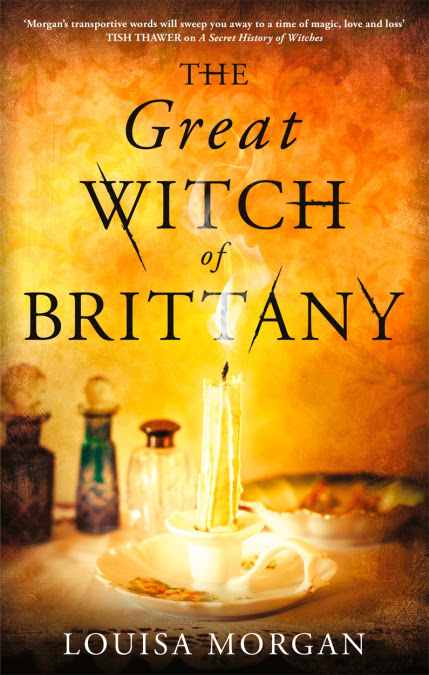
#Review - The Great Witch of Brittany by Louisa Morgan

The Great Witch of Brittany
Louisa Morgan
Orbit, 17 February 2022
Available as: PB, 432pp, e, audio
Source: Advance copy and audio subscription
ISBN(PB): 9780356516820

I'm grateful to Orbit for an advance e-copy of The Great Witch of Brittany. I also listened to parts of the story as an audiobook, ably and atmospherically narrated by Polly Lee (who rises magnificently to the challenge of portraying the range of accents that the setting and characters demand).

The Great Witch of Brittany is I think the fourth in Morgan's "Witch" series (the others being A Secret History of Witches, her first, which I haven't yet read, The Witch's Kind and The Age of Witches). It follows the life of Ursule Orchière, who at the start of the book, in 1741, is a young Romany woman living with her mother and her wider clan in Brittany. Through the course of the story, Ursule and her mother suffer many trials. Ursule discovers and grows over decades into her magical abilities, while her mothers suffers an appalling ordeal that leaves her with mental scars, eventually becoming speechless. 

The story spans decades, including the birth of Ursule's own daughter and, eventually, her grandchildren. We see death, birth, prejudice, the impact of wider events, and always, always, the little details of life, whether's Ursule's tasks on the farm where she has settled or the particulars of her magical practice. Morgan is good on details - whether Ursule is churning milk, tending a sick goat, meaning a wall or brewing a simple to assist in childbirth, there's a directness to the descriptions here, celebrating all those moments which make up a life well lived, despite challenges that may seem overwhelming.

The story is given in several parts, structured around short, legendary narratives of of Ursule's witchy predecessors, their names and titles - 'The Prophetess Liliane, The Lady Yvette, Irina from the East' - recited almost as a liturgy in her magical ceremonies (recalling the names of saints in the Mass) and leading inexorably up to a final section of the book which summarises the deeds of 'The Great Witch of Brittany' herself, Ursule, somewhat embellished, as the reader will realise, after the manner of legendary material.

There is, then, a certain pre-determinedness to the outcome, but Morgan doesn't let that undermine the sense of jeopardy for her characters or, indeed, the losses and reverses they suffer. Nor does she allow Ursule to be all-powerful, all-knowing or invincible: she may come into great power but she isn't, especially at first, particularly wise and she makes innocent mistakes that cause great harm to herself and those around her. Indeed, almost to the end she's prone to fly into a rage when her family is threatened. and in late 18th/ early 19th century France, there are many threats and, as I have said, much prejudice against the Romany. But there is also kindness, solidarity and friendship though it can take Ursule some time to recognise it for what it is.

Overall, an engaging and heartfelt story using Ursule's position and powers as a witch to explore the place of women in a turbulent age. 

I only had two reservations, neither of which really detract from the story. 

First, in a book set between 1741 and 1820(ish) I expected a little more impact from historic events - yes, the story is set in a remote country district and yes, there is an eruption of banditry due to the "Terror" but no other impact on Ursule and Agnes's lives from what was a series of wars, invasions and political turmoil. 

Secondly, Morgan goes further than just making Ursule a (rather powerful) witch and has her practicising what I think is pretty much modern paganism/ Wicca or something like it (complete with feast days borrowed from both Celtic and Norse mythology and indeed - Lammas - Christianity) and portraying it as the religion of her Romany. I was a bit uneasy about that in principle (in her other books that I've read the protagonists are not members of similarly marginalised groups and they are not given such a detailed belief system) but I suppose this is in the end a fantasy, the Romany people described here may I think be inspired by groups in our world, but this is not our world. It is I think done very respectfully. 

And Ursule's outlook is in the end basically syncretistic - in another plot strand, she purloins a relic of St Anne, the mother of the Virgin Mary ("Holy Annie, God's Granny" as I've heard her described). The sliver of bone, housed in its reliquary, is fully integrated into (and clearly, in some way, cooperates with) Ursule's ceremonies  and workings, and "Anne" is recited along with the names of the other "grandmères". A certain pragmatism suits Ursule's character in the end, I think: she is about survival and protection of her family above all, rather than any kind of social or theological purism, and I will therefore take the belief system described as fairly personal to her, in this world, regardless of its resemblance to something in our world..

I'd recommend The Great Witch of Brittany overall. (It was great to see that in Morgan's afterward she gives a shoutout to a book I loved as a child, Rumer Godden's The Diddakoi).

For more information about The Great Witch of Brittany, see the publisher's website here.


29 October 2020

#BlogTour #Review - The Once and Future Witches by Alix E Harrow

The Once and Future Witches
Alix E Harrow
Orbit, 13 October 2020
Available as: HB, 513pp, e, audio
Source: Advance copy provided by the publisher
ISBN: 9780356512488

I'm grateful to Nazia at Orbit and to Tracy Fenton at Compulsive Readers for an advance copy of The Once and Future Witches to consider for review and for inviting me to take part in the book's blogtour.

The idea of witches continues to fascinate in the 21st century. It's a part of culture we all imbibe in waves.  As children there's the raddled Hallowe'en crone with her cauldron, going all the way back to the Scottish Play, sinister figures from fairy tales and L Frank Baum's Oz witches. Then there's the historical corrective that we all (hopefully) acquire later, knowledge of the actual persecutions visited on supposed witches for hundreds of years. Finally, there are revivals and claimed continuities, overlaps with modern Paganism. It all gives a rich field for the fantasy author, and Alix E Harrow has made full use of that latitude to create a kind of unified mythology: her 19th century, USA set story tales place in a world where witches had been real, once a part of everyday life and therefore, neither malevolent magicians nor (wholly) innocent victims, rather simply people, good and bad, using natural powers.

But all that changed with the persecutions and by the time we arrive in New Salem, witches are banished, proscribed, remembered only in children's stories and nursery rhymes. They still serve a purpose, though, for the men who rule this world - a dreadful warning of the powers of women, of the need to keep them under control (shackled and bridled if need be, and always dwelling in the shadow of the stake).

Such is the situation facing the three Eastwood sisters, Juniper, Agnes and Bella at the beginning of the book. Brought up by their widowed and despotic father, the sisters have had plenty of experience of male power and abuse (we are never told exactly what he did to them in that cellar but enough is said for a shrewd guess) but rather than building solidarity between them it has broken the family and they are now scattered - Juniper a wandering fugitive, Agnes toiling in a dark Satanic mill and Bella, after being subject to the regime of what sounds like a dreadful reformatory, a librarian.

So when the sisters meet, apparently by chance, in the city of New Salem, it's not exactly a happy reunion. While it's painful to read at times, Harrow's portrayal of the sisters and their past and present relationships is powerful and convincing. There's a mixture of guilt, blame and fear between the three resulting from their desperate attempts to protect themselves from their father and from the circumstances in which Agnes and Bella, the older sisters, left Juniper behind.

Those breaches can't be wiped away in a happy-ever-after and overcoming them, building trust and looking to the future isn't easy which is unfortunate not only on a personal level but because - as the scraps of story and rhyme included here emphasise - there always need to be three witches, and unless the young women  can unite, they will be vulnerable to a threat far more serious than popular prejudice and the odd Inquisitor.

Harrow's writing here is sensitive and realistic. Each of the three has her own problems, and sees her own solutions - where that's Bella's research among the stacks to discover the lost power of witchcraft, Juniper's enthusiastic, if slightly sung-ho, embrace of Suffragism, or Agnes's aim of lying low while using her few remembered spells for the betterment of those around her. Together, their different experiences give a powerful overview of the persecution and domination of women, reaching beyond fantasy to the struggles for equal rights for women, people of colour and working people in the late 19th century. Because of course the forces that would oppress and destroy witches are the same forces that find a racial divide useful and oppress those workers in factories and mills and on the railroads.

This interweaving of the magical and the mundane is deftly done (there's a down to earth vein of romance here, as when one character remarks to herself that 'she doesn't think that any man has ever brought her hot pies') and brings in a wider cast of characters who open the eyes of the sisters to these wider issues. There is Miss Cleopatra P Quinn, journalist and stalwart of the Colored Women's League. There is Mr August Lee, labour organiser and dabbler in magic. And there will be more, a diversity of women and men with their own secrets and vulnerabilities. And all will be guided by those half-remembered scraps of lore and learning preserved by the Sisters Grimm, by Charlotte Perrault, Andrea Lang and the other classic collectors of stories who you will doubtless have heard of, and in the rhymes and chants that Harrow include at the start of each chapter and which may sound both familiar and unfamiliar.

It's an absorbing, bewitching tale and one that - after The Ten thousand Doors of January - confirm's Harrow's place at the heart of modern fantasy.

For more information about The Once and Future Witches, see the Orbit website here - and don't forget the other stops on the tour which are detailed in the poster below.

You can buy The Once and Future Witches from your local bookshop, who will be grateful for your support, or online from Hive Books, Blackwell's, Foyle's, WH Smith, Waterstones or Amazon.


6 May 2020

Review - The Wailing Woman by Maria Lewis

Cover by Sam Sephton
The Wailing Woman
Maria Lewis
Piatkus, 30 April 2020
Available as: PB, 403pp, e
Read as: advance PB copy
ISBN: 9780349421322

I'm grateful to the publisher for a free advance copy of The Wailing Woman to consider for review.

In a further instalment of her shared-world urban fantasy sequence (following Who's Afraid?, Who's Afraid Too? and The Witch Who Courted Death) in The Wailing Woman, Maria Lewis looks at the banshee, the bean sidhe, the otherworld woman whose voice heralds death.

Dangerous women. Powerful women. Women who, perhaps regrettably, must be hushed - for the good of all, you understand.

There's, obviously, strong feminist potential in this and the point won't be lost on the reader but it is also - indeed primarily - a story of growing up, finding one's voice, of falling in love, doubting one's love, and of holding onto that love in a hostile world.

The story opens with a monstrous (I use the world deliberately) being done to nine year old Sadie Burke, youngest in a family of seven banshees living in Australia to which all of her people were exiled two hundred years ago. Forced ever since to abide by the "Covenant", which circumscribes their powers and keeps them weak and dependant, the banshees are almost outcast, forgotten by most of the supernaturals and only watched, it seems, by the Askari, the police of the supernatural world. It's one of the Askari - Andres Contos - who does Sadie that wrong and it's Andres's son, Texas, who comes back into her life years late, a fully fledged officer of the Askari, entering into all his power and privilege.

Can there be anything between them?

Can Sadie trust her feelings?

Can she trust Texas Contos?

This is a powerful book, but it's also great fun. We feel some familiar figures again, and learn more about Lewis's supernatural world. I loved the fact that there is opposition here to a brutally hierarchical setup rather than acceptance of it because of what might happen if the order is upset. I loved the fact this position is people - supernatural people of all types - rather than a side effect of some sort of external or diabolic plot. It's politics, it's the desire for freedom and justice, it's liberating.

It isn't the sort of read where what's happening is obscure and has to be pieced together from hints and clues, the broad lines are clear and it's only really detail that is filled in. So, yes, we learn that the banshees aren't what is generally believed - but all the same they are being held down and appressed, which is the main point.

It is the sort of read where the action can erupt into a no holds barred fight, with some gruesome consequences - this is not a safe world - as Sadie and Texas find their world upside down and have to save themselves. In calmer moments (well perhaps not so calm...) they discover a great deal about themselves and each other - but that basic issue of trust remains and Lewis makes Sadie's dilemma clear, faced with danger to herself and danger to those she loves, what is she to do?

A book I really enjoyed and clearly Lewis isn't done yet. This series goes from strength to strength.

And finally: I know you're not supposed to judge a book by the cover. But. LOOK AT THAT COVER!

For more information about the book see the publisher's website here.


25 April 2020

Review - The Age of Witches by Louisa Morgan

The Age of Witches
Louisa Morgan
Orbit, 23 April
Available as: PB, 480pp, e, audio
Read as: advance e-copy via NetGalley
ISBN 9780356512587

I'm grateful to the publisher for a free advance e-copy of this book via NetGalley.

Following last year's The Witch's Kind (a book I loved) Morgan has gone back a few decades to the Gilded Age 1890s while still using her "actually existing witches" to shed light on customs and manners and, especially, on the position of women in society.

Annis Allington is a seventeen year old woman living a comfortable life in New York. As daughter of a wealthy manufacturer (her father owns a business making iron stoves) she can have pretty much whatever she wants - except for parental love.

Annis's mother died when she was a baby; her father is withdrawn and money-obsessed. Stepmother Frances is there, but has her own plans for social advancement and only pays attention to Annis as far as those plans require it. The nearest thing Annis has to a mother is Mrs King, the cook - and the love of her life is her horse Black Satin ("Bits") who, in defiance of convention, she insists on riding astride rather than sidesaddle.

We also meet Harriet, Frances' distant cousin (Annis is also a several-times-removed relative). Both Harriet and Frances are witches, descendants of Bridget Byshop, hanged in Salem as a witch two hundred years before. Harriet has followed a path of enabling, collaborative and healing craft, Frances the maleficia, magic used to control and even harm. As Frances begins to see a way to raise the family to the ranks of the Four Hundred, New York's glittering social elite, by snagging an English aristocrat for Annis to marry, the two women's different forms of practice come into opposition...

I really enjoyed this book. Morgan has an easy way of writing - about life, relationships, magic - that carries the reader along so that the other-worldly aspects of her story don't stand out, they just seem obvious. There are matter of fact descriptions of bits of magic, of "knowing" things, of the effects of various workings on their practitioners, which seem just as much in place as Annis grooming her horses or her maid Velma fixing her hair. While there's an opposition between (broadly) good and bad uses for magic, these aren't stand-ins for cosmic good and evil. This isn't the sort of book where the characters are cyphers for contending powers, rather they're simply people, albeit rather unusual ones. Yes there can be consequences to what one does - but that's just life.

Indeed the essence of this story is more a matter of romance - if you called it "Pride and Prejudice and Witches" you wouldn't be going too far wrong, especially in the sense that a major tension is between the aloof English aristocrat whose family seat is crumbling away and bleeding cash, and the (to him) brash American heiress who has the money to fix that but would rather pursue horse-breeding. Not an unfamiliar story or setting but Morgan does it very well, pointing up the powerlessness of Annis as a young woman in what Frances assures her is a man's world, the contempt heaped on her for not following the normal rules of society - and the privilege of great wealth that allows her, all the same, to get away with that.

Being a witch may help one soften the edges of a rigid and patriarchal society, but it also has its dangers since it means being a woman who stands out. Both Frances and Harriet deal with this in their different ways and while that animates conflict in the novel (and leaves Annis having to make hard choices about her path in life) Morgan is careful not to judge anyone's motivations. Frances has had a hard life - she also lost her mother young and grew up poor. Her desire to climb in society arises from being the outsider, and ultimately it's this warped structure of social inequality that is to blame for much of what goes wrong. Annis has, as I've said, the advantage of money and is a sympathetic character but tellingly, we learn that she's never visited the servants' quarters in her own house and that when she does, she is surprised how cramped and cold they are.

The central characters - Annis, Frances, Harriet and James, who we meet in England - are believable, relatable (even wicked stepmother Frances, or perhaps, especially Frances) and all have a degree of moral ambiguity to them - even Harriet isn't quite as pure as she'd have us believe. Indeed, I'd say this is the most perceptive and realistic side of the book. Morgan is very accurately depicting people as they might really be, if able to wield the kinds of magic that exist here and with no oversight or constraint (there's no cosy "Council" of witches to keep everyone in line).

All in all, a fun blend of fantasy, romance and shrewd social observation. The latter is perhaps a degree less nuanced than it was in The Witch's Kind but the book shares with its predecessor a focus on capable, forthright women who are nevertheless constrained by the warped patriarchal society around them.

I think I see Morgan setting things up for a possible sequel and I look forward to that.

For more information about the book, including links to buy, see the publisher's website here.


6 August 2019

Blogtour Review - #Sanctuary by VV James

Cover by Patrick Knowles
Sanctuary
VV James
Gallancz, 8 August 2019
HB, e, audio 448pp

I'm grateful to Gallancz for an advance free copy of Sanctuary for review as part of the blogtour.

You should be aware that I've included a significant spoiler which I think is necessary in order to give a content warning  for the book. That is below the tour graphic at the bottom of this review: if you want to avoid the spoiler don't scroll down past that picture.

I first heard about this book at a Gollancz presentation a few months back at which James spoke. There were a few copies available then but I didn't manage to get one (competition was FIERCE!) so was very glad to be asked to take part in the tour because I REALLY wanted to read this.

James' new novel is set in a different world from her previous trilogy (Gilded Cage/ Tarnished City/ Bright Ruin) and in the US rather than the UK, but like that, it explores the theme of magic - visible, acknowledged, magic - in the real world; what the consequences might be, and how the magical and non-magical communities might see each other.

In Sanctuary, which takes place in contemporary New England, witches are accepted, even valued by some, and expressing prejudice against them can amount to a hate crime, but their activities are heavily circumscribed by law...  and that prejudice is never far beneath the surface. James skilfully uses the real history of persecution in the 17th century as a springboard for present day cultural attitudes in the town of Sanctuary and in the wider US (adding modern colour by including news broadcasts and even tweets from the current President). She also deftly indicates how tolerance could have come about, and some of the complexities that accompany it.

We are though in small town America and magic or no magic, the local culture is dominated by the school football field.  Tensions rise when Daniel Whitman, star player of the Spartans, dies in mysterious circumstances at a party. An outsider detective - not only a woman, but she's Black - is sent in to investigate, and to begin with, local police chief Tad Bolt pressures her ('This is how it's gonna be...') to shut things down quietly. The death was clearly an accident: nothing to see here: smooth things over and get out of town.

However, Bolt soon changes his tune, claiming that witchcraft was involved. It's clearly convenient to have an outsider take the heat of the subsequent enquiry, whatever the outcome so Det. Maggie Knight is  plunged into the dark world of modern teens, complete with High School cliques, a "sex tape", lashings of misognyny - and a bunch of secrets.

Accusations fly, and they are directed especially at Harper Fenn, daughter of the town's only witch, Sarah. This is particularly unfair because, as everybody in the twin knows, Harper shows no magical ability (a great sadness to her mother).  Knight has her work cut out to discover what really happened against a background of rising hysteria stoked not only by Bolt but also by one of the other characters here. (James' writing is very strong, and I guarantee by the time you've finished this book you will really dislike that person - even if you sympathised with them at first). The growing atmosphere of threat, of blame, of fear and hate, is very powerfully rendered and plausible. It's accompanied by references to other sorts of prejudice - for example racial, as when towards the end when a Black character is told by a cop to hand over his phone: ('Pierre does what every black parent, heartbreakingly, teaches their kids to do the minute they see lawmen reach for their guns. He complies instantly.')

I would like to note how well, how convincingly, James portrays this situation. In particular she shows Sarah's disbelief at the way her world is falling apart. For much of the book Sarah thinks she can resolve things by being reasonable, trying to persuade even the most hateful among the townsfolk to calm down and be fair. She even, haplessly, plays into their hands by performing (harmless) magic in public which is then used to undermine her. It is of course a feature of historical persecutions that victims have often only understood too late how far things have gone, how their friends and neighbours have turned against them and what the stakes really are.

It's a thoroughly compelling story with bags of tension. I felt there is actually a really interesting philosophical issue here. From the perspective of the early 21st century (is it still "early"?) prejudice against, and persecution of, witches, was self-evidently wrong since the modern secular worldview takes for granted that there are no witches - so accusations of harm must be mistaken at best, or invented at worst. That approach sidesteps questions of "innocence" since by definition anyone accused in historical witch persecutions must have been "innocent" - even if, at the extreme, they really thought they were a witch.

From that point of view James's aligning anti-witch prejudice with other forms of hate crime (against people of colour, for example) makes sense because both are irrational and patently based simply on prejudice. In our world, there may be people who call themselves witches, but society regards this as a harmless if eccentric practice - a kind of spiritual LARPing - and anyone who doesn't, who accuses them of actually doing harm, would I think be seen as acting from prejudice.

But this is a book where witchcraft is A Thing. In Sanctuary, witches are real and could undeniably cause supernatural harm (even if that would be illegal and most of them would never do such a thing). Against that background, I wondered whether the Salem echoes - and the implicit comparison with prejudice against marginalised groups - were really on point.

In the end, I'm not sure it matters - at the heart of this book is a disturbing campaign waged against a convenient victim, supported by prejudiced law enforcement, a sensationist Press happy to peddle half-truths and outright lies (regardless of the effect on a police enquiry) and a town willingly driven to a frenzy against a hitherto accepted and welcomed neighbour. If that doesn't have spot on contemporary resonances I don't know what does.

The book is also notable for the presence of same gender relationships and for a non-binary Indigenous person who Knight brings in for support on witchy issues (entailing an interesting subplot about different forms of witchcraft, including appropriation of Native ones - James makes clear that in this book she isn't drawing on any real practices or systems of belief, which I think is an important point to make here).

So - I'd strongly recommend this, whether you've read and enjoyed James' previous work or are simply interested in a slightly different take on UF, small town US tensions or modern magic.

The book is out this Thursday (8th August) and the tour runes from Monday 5th to Sunday 11th with lots of excellent reviews scheduled. For more info about Sanctuary, see the Gallancz website here. You can buy the book from your local bookshop, including via Hive books; in various formats online  from Blackwell's, Waterstones, Foyles, WH Smith and Amazon or as an e-book from Apple, Kobo or ebooks.com

Reminder: CW below the graphic includes a spoiler


Spoiler

Content warning: The events behind the story include a rape which has taken place before the main events of the book, but it is partly described and portrayed in the course of the story.

The scene is not, in my view, gratuitous and is integral to the plot.

12 March 2019

Review - The Near Witch by VE Schwab

Cover by Julia Lloyd
The Near Witch
VE Schwab
Titan Books, 12 March 2019
Available as HB (355pp) or e-book
Format read: HB
Source: Free copy from publisher (thank you!)

I was really excited and felt very privileged to be sent a copy of this, VE Schwab's first published book, which - as can be the fate of early books - had fallen out of print in the US (it was never published in the UK). It's wonderful that Titan have put it out again, in a handsome edition with some beautiful illustrations on the cover and title pages well as a new introduction by Schwab herself and an additional, related short story...

It starts with a crack, a sputter, and a spark...

So begins this story of yearning, prejudice, revenge and of love.

If the wind calls at night, you must not listen. The wind is lonely, and always looking for company.

If you ever visit York, do take in the Castle Museum, housed in the old prison. It has its share of the gruesome - you can visit the condemned cell where Dick Turpin spent his last night of life - but more interesting to me is that the wings have been adapted to house displays of everyday Yorkshire life though the ages. Among these is the interior of a moorland cottage form the 18th or 19th century. One family living in a single room, surrounded by the harrowing wind. It could be very cosy - or, if you are at all nervous, it could almost be a living nightmare.

In The Near Witch we see both sides of moorland living. The village of Near is - ironically - near nothing at all, surrounded by wild moors across which the wind plays, almost seeming to talk to the villagers inside the boundary. (And such a clear boundary, almost like that between different worlds). We learn little of the world in which Near is set - I think there is a wider world, but, in a way that reminded me of Meryvn Peake's Gormenghast and Titus Groan, that world isn't present, important or of much interest to anyone.

Instead we have the village - more a scattering of houses and fields than a heavily built up settlement - and the moor, where it's dangerous to go, though nobody seems sure why. Beset by old legends of a Near Witch, of the dangerous wind and by the expanses of the moor, the arrival of a stranger is a big event, a threatening event, announced in dream and visions rather than in the clear light of day. And he's greeted with suspicion as, at the same time, children begin to go missing, vanishing from their beds at night...

I simply loved this book. It reads as Wuthering Heights' younger, weirder sister, with much of the same atmosphere - the moorland otherworldliness, the sense of wild forces at play, forces nobody understand or can control, not Lexi, the hero, not the two Witch Sisters, not Otto, Lexi's Uncle, the fatuous Guardian of the village - but an extra layer of the dark, of the perverse.

Despite searches, the missing children can't be found and it soon seems more important to blame someone than to rescue them. As the teasing winds get stronger and something from the village's past seems to be stirring, a mob mentality, a desire to hurt and blame, begins to whisper through Near.

So there's a mystery at the centre of the story - in fact, two mysteries. Who's taking the children, and who's the stranger?

There's an atmosphere of claustrophobia, of finger-pointing, of fear and recrimination

There's also Lexi, into whom Schwab breathes a spirit of absolute reality. A young woman mourning her dead father, Lexi fiercely protects her sister, Wren, and tries to keep at bay the influence of Uncle Otto. But it's hard when her mother has become hollow and Otto insists on Lexi knowing her place and keeping to it. Lexi's family are hunters and trackers but Otto thinks she should tend the bread ovens and deliver loaves instead - and not carry a knife, wear boots - or interfere with mens' business, like the hunt for the missing kids.

As a Schwab hero, of course, Lexi has absolutely no time for this, setting the stage for a conflict with Otto and his gang. They have muscle, but Lexi isn't without her own resources, whether friendships, knowledge or simple determination. In a way - and I know this is being fanciful and using hindsight - I could see a bit of Lila Bard from A Darker Shade of Magic peeping out of Lexi.

And there's Cole, about whom I shall say nothing at all because you need to discover this elusive, haunted young man for yourself. (The story that's included, The Ash Born Boy, does tell more about him but you should definitely read that afterwards: it is itself a marvel of a story, turning complex emotional truth into unleashed power, but if you read it first you'll just know too much about him).

It all makes for a powerful, even heady story, romantic in all ways at once, imbued with the spirit of moonlight on the purple moor. A haunting story, about a haunted place but one which manages at the same time to keep itself rooted in humanity, in love and in family rather than going totally gothic.

A fine first novel, and I hope that if I'd read it in 2011 I'd have guessed the author was bound for great things.


14 October 2017

Review - A Long Day in Lychford by Paul Cornell

A Long Day in Lychford (Witches of Lychford 3)
Paul Cornell
Tor, 1 November (PB), 10 October (e)
144pp

I'm grateful to the publisher for an advance copy of this book via NetGalley.

This book is a continuation of the Witches of Lychford series, but it's rather different from Witches of Lychford and The Lost Child of Lychford.  The change of approach may put some readers off: I felt it makes this book decidedly the best of the series so far.

The story again revolves around Autumn, Judith and Lizzie, shopkeeper, wise woman and Vicar, collectively the Witches of Lychford, protectors of that ancient Cotswold town from outside supernatural threats. Except that, in this book, they're not. Not exactly.

That's where the review gets tricky because I don't want to give too much away. I'll just say that this is a more psychological book, more internally focussed, more driven by the character and experiences of the three and especially, of Autumn. Indeed, Autumn's identity as the only woman (indeed person) of colour in the town is key, here, to understanding what happens. In a story that cleverly hooks into threats in the wider outside world - the divisions caused by the Brexit referendum, the evil banality that is Trump - we see the impact on what are now well-loved characters.

That political angle may alienate some, like Cornell's last book, Chalk, which picked up on the Thatcherite 80s, although of course that is further off and less relevant, perhaps, to non British readers. But it gives the book a real sense of groundedness.

The other respect in which this book is different is that - to a degree - it challenges some conventions of fantasy. For example - and relevant to Autumn's experience - the use of the word "dark" for "evil" is questioned (by Lizzie). And in a story that's pointing up real-world developments around control, exclusion and access, the role of the Witches in "guarding Lychford's boundaries" raises some discomfort. Does this whole outlook not come uncomfortably close to the "let's build a wall and keep them out" rhetoric that we're now seeing?

Cornell isn't so presumptuous as to provide answers to all this, but in a short novella, he certainly raises issues and that gives this story a freshness and interest. No, some may not like it, but I think this is nonetheless an important book in its genre and more widely.

Excellent, and with the seeds, clearly, of further stories planted, I'm looking forward to more.

4 May 2017

Blogtour - Essex and Strange Magic by Syd Moore

It seems to be Essex week for me. On Monday - Bank Holiday - I went to Banbury museum to see Grayson Perry's tapestries which are on tour. Entitled "Julie Cope's Grand Tour" the two pieces tell the lifestory of the eponymous Julie, an Essex girl. Supported by Perry's own narration of a ballad for Julie, they are tender and moving and I'd urge you to see them if you get the chance

Coming back up to date, I'm delighted today to be joining the blogtour for Strange Magic, the new book by author Syd Moore which is published TODAY, 4 May. I've reviewed it here but before that, Syd has written a piece for the blog examining a key aspect of the background to her book - the curious history of Essex girls... and Essex witches. Over to Syd!


Essex Girl, Essex Witch

Essex Girls and witches. You might be forgiven for thinking that these two stereotypes (or are they now archetypes?) have nothing to do with each other. Certainly on first impressions they appear to be polar opposites. The Essex Girl, after all, is often depicted as blonde, in heels (possibly white, possibly of the stiletto variety), with a shed load of makeup plastered across her face. The witch, on the other hand, tends to evoke images of gnarled and scrawny limbs poking from tatty black robes, ‘Wicked Witch of the West’ style green hooters and masses of matted black hair. Different, no? Physically perhaps, but actually they share a lot of similar characteristics.

Syd Moore (c) www.danielnewmanphotography.co.uk
Witch persecution in England in the 16th and 17th centuries hit the county of Essex very hard. Between 1560 and 1680, for instance, in Surrey, Sussex and Hertford there were 185 indictments for witchcraft.  For the same period of time Essex, on its own, saw over 500. In fact, at one point Essex was widely known as ‘Witch County’.  The witches, of course, were mostly poor and often vulnerable, scapegoated for natural disasters or illness by villagers, picked on by neighbours, rounded up by witch hunters.  A fair few were accused of being lewd and lusty, of fornicating with men and the Devil himself.  A good portion of those who went through to the courts were considered ‘loose’, meaning they were not under the protection, shelter or control of a man.  And as, at that time, women needed a man to represent them at trial - a husband or a son, brother, nephew – many of these women were legally ‘dumb’. So - carnal, low of social class, loose and dumb. Sounds awfully like another stereotype doesn’t it?

I have a theory that the stigma associated with the women of Essex never faded. That this idea that females from this particular county were a bit off, weird and/or ropey persisted for a long time. So when the stereotype of the Essex Girl appeared in the Eighties/Nineties she was taken up quickly and very decisively spawning a wave of jokes and books and articles. Most of the jokes had the effect of neutralising what was in fact quite a powerful type of woman. Scary even. The Essex Girl was generalised to be promiscuous i.e. independent and sexually autonomous. Or was that ‘carnal and loose’? She worked hard and spent her money how she liked on what she liked. So what if she fancied spending some of it on beauty treatments. As far as I’m aware nobody has produced any evidence that beauty treatments correlate to IQ.  But indeed the OED begs to differ. In their definition she is ‘unintelligent’ too. So, she’s ‘dumb’?

Again, carnal, loose, low of social class and dumb – are you reading me?

I think it’s time to put prejudice aside, take a long hard look at where the stereotype might have come from, and try and put it to bed. If we can’t do that then we should realign the girl with some of the other qualities she’s become known to possess – confidence, sass, strength and fun. High profile women who have been associated with the stereotype, for better or for worse, have done remarkably well for themselves showing canny business acumen and drive. Amy Childs used her fifteen minutes of fame to launch a beauty range and fashion collection which is still thriving. And in today’s current climate with its problems of grooming and cyber-bullying, confidence and sexual autonomy in girls and women should surely be something to applaud.

Changing the attitude to the stereotype might take some effort but it’s not impossible. Witch to Essex Girl, after all, is a pretty miraculous transformation.

STRANGE MAGIC by Syd Moore is published by Point Blank, an imprint of Oneworld, paperback £8.99

Blogtour review - Strange Magic by Syd Moore

Strange Magic
Syd Moore
Point Blank, 4 May 2017
PB, 392pp

The Only Way is Witchcraft...

I'm grateful to the publisher for an advance copy of this book as part of the book's tour (and to Syd for writing here about her book).

When Rosie Strange inherits her grandfather Septimus's run-down Essex Witch Museum, her first thought is to close it down, sell it and take what she can. Estranged from Septimus for many years, her branch of the family has eschewed his interest in the weird and supernatural and got on with making a living. Rosie herself is a benefit fraud inspector -  neither the most glamorous or popular job in the world but one that certainly plants her feet firmly on the ground.

Of course, things don't go exactly according to plant. Rosie didn't expect to step into a mystery, and she didn't expect to run across the enticing (but annoying) young curator, Sam Stone in whose company she undertakes a hair-raising roadtrip across England, against a looming deadline...

Three things motivate the action in this book. There's the background of the Essex Witch Trials - real events, more deadly than the Salem persecutions and which inspire the (fictional) museum Rosie now has charge of. (And by the way, how cool is that? Having your own museum? If it was me I'd literally never leave again...) Moore clearly feels passionately about what took place and that really comes though in her writing.

Secondly, there's the whole Essex Girl thing. Rosie is an Essex girl and proud of it, as well as being many other things, and to a degree I think, again, Moore's righteous anger at women being stereotyped and sidelines animates some of Rosie's and Sam's attitudes in this book. Which is OK by me - it never becomes merely a vehicle for a point of view, and there's a curious and interesting interplay between the witchy bits of the plot and this aspect.

The third angle (come on, we're talking witchcraft, there have to be three aspects...) is a good old-fashioned mystery. A boy is in danger: saving hims is all tied up with finding the remains of Ursula Cadence, one of the original Essex victims. And so we get a wild chase via Boscastle, Porstmouth and points East enabling Rosie and Sam to spark off each other and work out how they really feel... or not. The creepy bits are creepy, Sam is a bit mysterious and something really nasty is brewing, which all comes to a head in a scene reminiscent of The Omen.

I enjoyed this book. It's not perfect - I felt that the characters hurried rather into the mystery, when they would surely have asked more questions and taken some persuading to become involved, and towards the end a great deal of information is conveniently provided by a hitherto unmentioned contact - but it is a great deal of fun, lighthearted and dark at the same time but with real heart and some serious issues at its core.

The central mystery - a tension between rationalist Sam's belief that the witch hysteria was only prejudice, its victims mere scapegoats and the looming presence of something darker here - is never quite resolved, nor, perhaps, ought it to be (especially if, as I hope, Moore plans to continue the series).

Overall, a fun, engaging read.

One final note in passing: I don't know if it's intentional but in having her action run up to a climax on Good Friday/ Lady Day, Moor has chosen a very significant and rare conjunction of festivals - the two don't often coincide. This blogpost explains why that is - for reasons I won't spell out for fear of spoilers, one might well see this as a very appropriate conjunction...