Showing posts with label Audiobook. Show all posts

18 December 2019

Review - Agent Running in the Field by John Le Carré

Cover design by Superfantastic
Agent Running in the Field
John Le Carré
Penguin, 17 October 2019
HB, 281pp
Source - HB purchased at my local bookshop, audio via online subscription.

Agent Running in the Field is another book that I have been catching up with on audio. Again, I cheated and switched to the hardback as I approached the end (I had to finish!) It was a surprise to me to find that the story is narrated by the author himself who does a very good job of inhabiting the range of accents and intonations needed for the different characters. (I did feel though that at times, the characterisations do cross the line from giving someone a distinctive voice that conveys their nationality or social background, to demonstrating that Le Carré likes or dislikes them: see Dom, for example, as one who is voiced as unpleasant and almost slimy.)

I love Le Carré's thrillers, I always have and I always will, and I've been delighted in his recent books to see him returning to core territory, focussing on what he used to call the Circus, now the "Office". (I don't know if that is accurate jargon, when I have heard "Office" used in Civil Service circles it's always referred to the Home Office). They are pared down, short, books giving us protagonists up to their eyes in the minutiae of the new Great Game, the revived concentration on the "Russia target" as it's put here. Agent Running in the Field has the added complication of launching a salvo against Brexit and Trump - and what a salvo! Le Carré portrays his service as diminished, struggling as old alliances fracture, friends turn hostile and certainties melt. Yet still, the day to day work remains and so we see Nat, the first person protagonist, returning from a shady career under diplomatic cover in various Eastern European capitals, appointed to head the Haven, a forgotten outstation staffed by no-hopers and those who have fallen from grace.

(Yes, I think there are overtones here of Joe Herron's Slough House. Or perhaps Le Carré knows of such a place for real?)

I found Nat's background here perhaps a little anachronistic. He seems, at least in part, to have been running operations out of the glory days of Smiley's Circus - infiltrating agents over the border from the Baltic States, for example, engaging in the kinds of derring-do that seem more post-war that early 21st century. Combined with the fact that Le Carré's voice is, obviously, that of an elderly man, his narration of Nat did keep making me think that his career had been in the 70s or 80s and that he was somehow emerging in the present to deal with unfinished business, much the scenario of Le Carré's last, Legacy of Spies, where there is definitely some elasticity to the timeline.

In fact, nothing could be further from the truth. There is no unfinished business here. The challenges faced by Nat and his colleagues arise directly from the present and concern the US, Russia and the EU. But Nat and the Office bring to these problems their repertoire of tricks and tradecraft (wonderfully described and acted out: I really enjoy this stuff) as well as loyalties and attitudes from an age before authoritarian populism and malign shadow of Putin (which name Le Carré gives a distinctive pronunciation, 'putter').

It feels like a glorious miniature piece, the stakes less control of the Office and victory over Moscow Centre than the loyalty and even soul of one individual or another. The certainties have melted away, one officer storming out of the Office because 'I don't feel like fucking lying any more' and - when it comes - a real sympathy for the potential defector. I think Le Carré's work has always been about the morality of the game as much as the tricks and traps, but here those questions are open, urgent - Nat visits a former asset and seemingly agrees with him that it had all been for nothing. It is in many ways a depressing picture, but Nat - and Le Carré -  won't give up, but seek to rescue what they can from what seems like impending darkness.

My they, and their counterparts in reality, be successful in that.

This is a wonderful read, a wonderful listen, and I'd recommend it to anyone.

For more information about the book, see the publisher's website here.


13 December 2019

Review - The Secret Commonwealth by Philip Pullman

Cover design by Tom Sanderson
The Secret Commonwealth (The Book of Dust, 2)
Philip Pullman
David Fickling Books and Penguin Books, 3 October 2019
Audio, 686pp (also available HB, e)

OK: The Secret Commonwealth then!

I listened to this book via an audio subscription service.

It may be an exercise in vanity or futility to review a book whose launch was such a high profile event. The Secret Commonwealth may have been the most anticipated book this year (unless that was The Testaments). But we are where we are. This is a blog and I am a blogger. I don't think anyone is waiting for my say-so to buy The Secret Commonwealth (I certainly hope not) but I do have a few thoughts so I will share them.

And I have even done footnotes!

Warning - this may be a slightly more spoilery review that I would normally do. That's partly because (see above) I don't believe anyone who hasn't read the book will hear about it first from me, partly because when I cross post this to Amazon my review will be the (*checks*) 191st or something like that.

But most of all because I think the book demands it. I see for example that the most "useful" (how I hate that feature!) Amazon reviews wrestle with it, but fail to "get" it. Too long, one says. Too dark. Not for younger people. (This latter is something Pullman has been quite upfront about - READ THE ******* AUTHOR'S NOTE!) As to the length - I'm with Tolkein who lamented that the greatest failing of The Lord of the Rings was that his book was too short. I love a big book. If it's good, I want more.

As to the content - I think I do "get" it. And I won't say it is perfect (see below). But this book is trying to do something brave and difficult, and I think any decent review needs to engage with that and discuss it.

Yes, this IS a dark book. It is very dark in places - for example, there is (CW) an attempted rape, but even without that, the story would not be a happy one. Most obviously, The Secret Commonwealth undermines, contradicts, the hard-won sense of happiness we got at the end of His Dark Materials in a way that La Belle Sauvage didn't, it being set before His Dark Materials and also, as a more self-contained story than Commonwealth, ending on its own note of triumph, almost a prequel to His Dark Materials.

Yes, I know that Lyra and Will were to be separated for ever, sitting each on their own version of that bench in the Botanics. I know they would have to deal with the consequences of having been separated from their dæmons. But when we checked in with Lyra in Lyra's Oxford, set between The Amber Spyglass and Commonwealth, Lyra and Pan were on good terms[1].

Here, they hate each other. HATE.

The first half of the book is punctuated by furious quarrels between Lyra and Pan, the atmosphere this creates overshadowing even grim events in the outside world and what are clearly moves against Lyra herself by the Magisterium. (There's an irony here. In Amber Spyglass, we saw the death of the Authority, the gnostic-tinged demiurge which is behind religion in Pullman's world[2], and Lyra's and Will's victory over the Magisterium which made them into a kind of second Eve and second Adam. However news of that never - I think - came back to Geneva,  so in Commonwealth that body carries on much as ever, indeed in some ways worse.) We saw in La Belle Sauvage what could become of someone wishing ill to their dæmon so there is a tinge of horror to this whole process. As a parent of a young person (Lyra is in her early 20s) I admit that at times I wanted to take Pan aside and tell him just to give Lyra a bit of time and space. She seems taken with some fashionable nonsense, that's all, but she'll soon see through it. But of course he's part of her so that would hardly work.

If I had a criticism of this, it would be that - spoiler ahead! - this discord seems a bit confected, in terms of the book it seems designed to separate Lyra and Pan, to enable her to explore the consequences of "separation" which form a theme later on. Looking at the specifics of the fashionable nonsense Lyra has swallowed - a kind of ultra Dawkins-esque reductionist realism, on the one hand, and a solipsistic denial of reality, on the other, neither allowing any time for wonder, imagination or the supernatural - it's hard to believe that the girl, now a woman, who lived through the events of His Dark Materials would be taken in for a moment, because that lived reality so strongly contradicts both. So this whole conflict seems a bit, well, staged, and therefore, slightly annoying.

But never enough to detract from what is a pacey and exciting story. (I didn't mind too much that the main inciting event - spoiler! - the murder of a clandestine agent on the bank of an Oxford canal, seemed a bit familiar from La Belle Sauvage). Pullman's construction of his alternate Oxford is also, as ever, a joy. I am lucky enough to live near our Oxford, and the resonance, the reality, that Pullman extracts from little references and in-jokes (such as that 'Little Clarendon Street had been adopted by Oxford's jeunesse dorée as a fashionable destination') is impressive (there's even a callout to Boswell's, a much loved and venerable department store that is sadly to close in a few weeks). His wider world, too, makes sense - the smoky atmosphere, the Gyptians, the machinations of the remote Magisterium and the collaborationist bureaucracies, men (mostly) who are not "bad" as such (or not all) but want an easy life.

If the darkness in the first part of the book came from Pan and Lyra's squabbling, in the second, it arises much more from world events. Lyra's world is, as Pullman gradually reveals, in crisis. There is religious and political turmoil in the East and refugees are heading away from this, to be treated with the same lack of care and lack of welcome that has been shown in our world to those fleeing the troubles in Syria, Iraq and elsewhere.

We first hear about these troubles from a distance, as a cause of economic crisis, and then see them more closely as Lyra travels East. She first sets out because she's menaced, hunted, threatened at home - it's not clear exactly why, though Pullman gives us some hints through glimpses of the inner Magisterium - but her journey gradually acquires a focus, and it is one that takes her into the heart off the storm, into greater peril than any sage faced in the previous trilogy, I think. In the course of that we are shown and told many dark things, not least that the match between dæmon and human is less permanent than we might have thought. I think Pullman is slightly retconning his world here - in His Dark Materials, separation from a dæmon was so traumatic, so vile, that it seemed it almost led to death (poor Billy clutching his fish) or at least, to psychic damage. Lyra and Will seemed to be the exception to that and as we will see, many people still won't accept the idea of a human with no dæmon. But as Lyra finds out, it is much more common that you'd think. That troubles her, alongside the gathering clouds of war, the personal threat to her and the cruelty meted out to the poor, the weak. There is not much sign here that the Republic of Heaven, which Lyra and Will swore to build, is being established. Perhaps Lyra was sidetracked by those fashionable philosophies? Will the quest she's on, headed, ultimately, in the heart os Asia, put her back on course?

Unlike its predecessor, The Secret Commonwealth doesn't come to a tidy end but leaves things in the middle of the action, with Lyra, Pan and Malcolm Polsted (making a welcome return from La Belle Sauvage) all in danger and other loved characters suffering too.

I found it a gripping read. It isn't a book for children, but Pullman understands how to hook his readers - adult or child - and isn't above throwing in startling, nailbiting incidents which may deviate a bit from the main plot but which keep the tension high and allow his characters to shine - think of Alamo Gulch in His Dark Materials[3].

I did, as I have said, listen to this book rather than "reading" it and I found that the audio, narrated by Michael Sheen, really brought the story alive. Sheen uses dozens of voices, including giving Lyra a proper Oxford accent (the real, local accent, not the posh one) and imbuing the villains with appropriately menacing tones.

The story isn't perfect. I agree with those who think (more spoilers!) we would better have been spared the whole Malcolm-fancies-teenage-Lyra bit. While very tastefully achieved, told from a distance and with Malcolm portrayed as very honourably distancing himself form any hint of anything bad, it still comes over a bit icky. Just no.

Also, I could have done with more followthrough on some of those startling incidents - several times in this book, something startling happens, I mean something really AMAZINGLY salient (you'll know these things when then they happen) and then - nothing. No passing mention in the following days, no reaction in the (often overheard) secret councils of the Magisterium. Nothing.

But this is still a better book to read than many that you'll see piled high on the bookshop tables this Christmas. I'd say it lives up to the expectations. It's fun, it's scary - deeply, morally scary - it's pertinent and warning (look what's happening to two of the main characters on trains towards the end). A book not to be missed.

[1] Do read Lyra's Oxford, before or after this - it provides a wealth of helpful hints and material that support The Secret Commonwealth.

[2] Don't ask me if by "Pullman's world" I mean, Lyra's world, or the whole set of parallel ones that includes Will's - but which is meant to be ours. I don't know. I would like to ask him (Pullman, not Will).

[3] Pullman loves his filmy references, doesn't he? Look at the title of the other "companion" book, Once upon a Time in the North.


23 February 2019

Review - In An Absent Dream by Seanan McGuire

In An Absent Dream (Wayward Children, 4)
Seanan McGuire
Tor.com, 1 February 2019
HB, 208pp

I reviewed In An Absent Dream as an audiobook (even though I've cited the availability of the hardback version above, probably because I fetishise the physical object or something, don't get me started).

The fourth volume in the Wayward Children series is actually a prequel, the events taking place a few decades before the other books. We enter the world of (Katharine) Lundy, an intense, studious girl who has no friends. It's the 1960s, and teachers can easily get away with saying things like, girls need more help with maths. Because her father is the Principal of her middle American elementary school, no-one wants to know her. It's all not fair, and Katharine longs for a world where things are fair and there are rules that everyone follows.

In the manner of the Wayward Children books, of course, she finds just that: a doorway leads her to the Goblin Market where everyone must always give "fair value". (To fail to do so would lead to an escalating series of changes and losses, eventually resulting in... well, I won't spoil that).

The story is bookmarked by two references. At the beginning is an extract from Christina Rossetti's bewitchingly enticing poem, also Goblin Market, stressing the ripeness, the juiciness, the taste, of all those fruits that are on offer. Towards the end, McGuire's authorial voice declares sadly that "this is not a fairy story". (I may slightly misquote, I listened to the audio so can't easily check the text).

It certainly isn't that sort of fairy story - you know, where the Princess and the Handsomse Prince kiss and live Happily Ever After. But I think McGuire's warning is slightly deceptive. That first quote has already given us some orientation as to what sort of (fairy) story the book is. Rossetti's poem may be interpreted as a sort of yearning warning to Victorian young womanhood against temptation, in the form of those oh-so-sweet goblin fruits, but there is more than one level of meaning to it and McGuire deftly exploits another that is a common theme of fairy stories - the bad bargain. Lundy (she chooses to use her surname after a warning that names have power) is told what the rules of the Market are, and soon learns the consequences of failing to keep them, but she is, as well as being a rule-taker, always on the lookout for loopholes. This leads her to (in a sense) gamble with the Market, the stakes becoming higher and higher. Whether that will ultimately buy her freedom and her heart's desire or... not... you have to read the book to see.

It's in some respects a curious book. Part of the Wayward Children series, it is very much a standalone, with little involvement of Miss Eleanor and her School.

Curiouser (and curiouser) still, the focus of this novel is very much on the progress of Lundy's bargaining and how that develops. We hear about high adventures - much Questing goes on, there is talk of defending the Market's borders and even a death of a friend of Lundy's - but this is all off camera, as it were with the book dwelling instead on Lundy's comings and goings, the tension between The Market, the world where she belongs (her "home") and our world, the world of her parents and sister. So we see a lot of her coming and going, with her life in the Goblin Market glossed over. That felt frustrating at times, you just have to trust McGuire though - in a sense we can imagine what we don't see, and putting all that in would make the book a lot longer and smother the theme she's trying to develop. Still, I would like to know more about those skipped over episodes.

Finally, I've referred above to bargaining, to "fair value" and the central metaphor of this book is a market. The Archivist, the nearest thing Lundy has to a guide and mentor in that strange world, is rather fond of lecturing her on the workings of that market. If you listen carefully (remember, I was listening, not reading) I think you'll conclude that this market is not a "market" in the sense that the modern neoliberal consensus would recognise (it's too fair for that; a Goblin Market is, after all, a fair, and so has to give fair value?) but it's still hard for these passages not to resemble economics seminars. And in at least one of them (which explained the background to Lundy's first big gamble) I never quite understood the reasoning. (Sorry this is obscure, spoilers, spoilers, spoilers). I think two things are going on here - first, since Rossetti's day, terms like "market" and "value" have become tainted by what is, after all, referred to as the "dismal science" and secondly, the ideas at the heart of this book are quite complex to convey in what is a short book.

That seems to have taken us a long way from fairy tales and magic doors. Rest assured, those are present here, it's really an enchanting extension to the Wayward Children series. Also present - of course - is Lundy, an engaging and steely young woman whose love, loyalty and courage shine through.

It is really a very enjoyable book, and confirms that McGuire is continually taking this series to new places. I hope she does so again soon.

For more info on the book see the publisher's website here.


15 February 2019

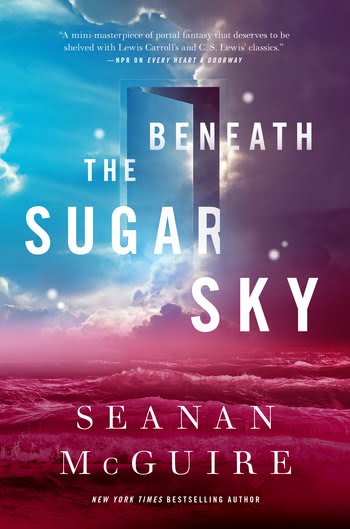
Review - Beneath the Sugar Sky by Seanan McGuire

Cover by Sean Rodwell
Beneath the Sugar Sky (Wayward Children, 3)
Seanan McGuire
Tor, 1 February 2018
HB, e 174pp

Warning: this is the third book in a series and there are some spoilers below for earlier ones.

I bought my copy of this book (another 2018 book I'd left unread too long, and caught up with over Christmas).

I'm loving McGuire's Wayward Children series. To start with the concept is brilliant - Eleanor West runs the Home for Wayward Children, those who've wandered through doorways into other worlds, returned to this one, and don't fit in - but the execution, ah, the execution is sublime. These are real kids, people you will recognise or even people you might have been. Or indeed, be. This series is just so well written, has so much heart and soul and I really, really enjoyed this latest instalment.

Beneath the Sugar Sky opens out the themes of the series somewhat. While the first two books, Every Heart a Doorway and Down Among the Sticks and Bones, told different parts of the same story - that of Jack and Jill, their time on the Moors and their time in the School - in Beneath the Sugar Sky, Rini - daughter of Sumi, who we met in Every Heart - appears from the land of Confection, a place of sugars and baked goods... where everything has now gone wrong. What happened in the earlier book has brought about a catastrophe. The Queen of Cakes is rising again, and Rini's very existence is threatened.

A party of friends sets out to put things right, travelling through various worlds, meeting the Lord and Lady of the Dead and then, inevitably, coming up against the Queen herself.

It's smart, funny, touching and has a pace and tension to it that will keep you turning the pages, as well as smart characters out of their depth - they're in a strange world, not one they would have travelled to. But there is more here and I thought that - after the third book - it might be worth saying something about this series in general.

I understand that one of the hallmarks of science fiction or fantasy is to make metaphors actual. I do find this a hard concept to grasp. I can see for example that "time travel" leaps over our short lives to consider the effect of what we do on the future - or pushes us into the past to consider how similar, and different, we may be to our ancestors. But it's hard to feel this idea other than as a clever talking point, it seems to add little to one's understanding of a book.

In the Wayward Children books, though, McGuire takes this idea and makes it dance and sing. her series has a very clear focus: the kids she conjures up literally don't fit into this (our) world. They want to find a world where they do fit and, if they fall back out of it - those doorways have a pesky habit of reopening just when you don't want them - they need to find their way back in. Eleanor West's Home is a kind of waystation, a safe space where such kids can wait and learn, while they hope to go back.

So we have here, for example, Cora, who's curvy and excellent at swimming and has spent time as a mermaid in a water world. Back home, though, she's taunted for being "fat". Or Kade, whose misfortune is to have been exiled from the world he really wants, where he would be a brave prince - because it identified him, as his parents do, as female. (Not every story has a happy ending).

The Home provides a place to wait, to hope that the door will eventually reopen and - however imperfect this is - the society of others who are in a similar position. It isn't all sweetness and light (witness what happened in the first book) but it is better than a disbelieving and, well, adult world.

The writing therefore speaks to the sense of many young adults that they are misunderstood, out of place, different and it holds out hope of a better future. But there are no promises. This acceptance has to count for a lot, the happy ending may not come (and don't many or even most of us adults go around with similar feelings at least some of the time?) Not every door reopens.

But it goes further than this. By positively identifying with a glorious gamut of diversity (the books acknowledge race, gender, sexuality and many more characteristics - including simply loners and those who identify as weird in various ways) McGuire subtly (well, perhaps not so subtly) renders people visible. In a sense the book is Eleanor West's academy, because that is the place that Christopher, Cora, Sumi, Nancy and all the others have gone because that is where they will accepted and acknowledged..

If that sounds like the worst dream of a certain sort of pallid, angry SFF fan, well, perhaps it is. But I think the reason for that is not because, oh look, here's a SFF book with LGBT people in it, or people of colour, or whatever, and why did she have to do that, and can't we just have a fantastical adventure anymore? No, I think what stands out is that these books don't just have a diverse range of characters, in passing as it were, rather their theme and purpose is that diversity. The whole point of Wayward Children is that with an un-diverse different cast of characters they wouldn't work. The central idea - that we all have, or may have, our own doorway, to a land where we make sense, that we can go there, but we can lose that place - only works on the premise that all those doorways are different. Narnia isn't Never Never Land. Wonderland and Nutwood are different places, even if they have similarities, and the Hundred Acre Wood, to which Christopher Robin escaped, different again.

McGuire's embracing of diversity makes this obvious and - I think - changes that metaphor of falling down the rabbit hole or stepping through a wardrobe forever, making clear that such fantasies, such quests, are about the child stepping into the pond, through the mirror, or into the crack in the tree rather than the ostensible business of the quest or adventure then that takes place. What need is inside someone that they travel to such places so that it can be recognised and met?

So - rather that a nod to diversity through including these characters, McGuire  has full-bloodedly turned it into the subject, the bedrock and the central metaphor of her book (of this series). It's an exemplary use of that 'make the metaphor concrete' idea, in the very best, most mainstream SFF tradition - but it turns this idea on something that, let's admit it, still gets a minuscule share of the action (or perhaps of the attention).

Oh, and in case I wasn't clear above, Beneath the Sugar Sky (as well as Every Heart a Doorway and Down Among the Sticks and Bones) are rattling good stories. I don't think McGuire could produce a dud if she tried.

On, now, to Book 4, In an Absent Dream, which isn't out yet as a physical book (1 February if you're waiting!) but is available on Audible now...


3 February 2019

Review - Down Among the Sticks and Bones by Seanan McGuire

Jacket design by FORT
Down Among the Sticks and Bones (Wayward Children, 2)
Seanan Mcguire
Tor, 2017
HB, 187pp

I'm continuing to review some books that have been on my shelves far too long, having taken the chance of a lengthy car journey to listen to the audiobook of Down Among the Sticks and Bones. (I bought a physical copy of this book from Wallingford Bookshop and the audiobook from Audible via Amazon. The audiobook, read by McGuire herself, is excellent, although Dr Bleak's signature whisper of a voice does at times make him a little hard to follow when driving!)

In this, the second part of her Wayward Children series, McGuire tells the other side of the story she began in Every Heart a Doorway (my review here). I won't say too much about that in case you haven't read it, but EHAD featured twins Jacqueline and Jillian - Jack and Jill ("because our parents shouldn't be allowed to name children") and their adventures at Eleanor West's School for Wayward Children. Down Among the Sticks and Bones tells more about the two and about their time in the world known as The Moors, under the care, respectively, of the strange Dr Bleak and the commanding Master. It forms a whole with the earlier book and I think the two are best read together.

McGuire has written more recent books about the Home and the Wayward Children, but moving onto other characters and with a slightly different focus. Here, though, we have an almost clinical dissection of lives, of parenting and of the weight of expectations, the story going back to Jack and Jill's parents, Chester and Serena Wolcott. Despite a disclaimer that the story hasn't actually started yet, McGuire devotes nearly a third of the book to this complacent, insufferable pair, showing how their sheer conventionality, their refusal to admit wonder to their kids' lives, above all their sheer stuffiness, warps and forms the two girls, laying the foundations for what will occur after. There are perhaps shades of the Dursleys here though I think McGuire writes with much more psychological grip.

Indeed, she writes wisely throughout and shows, I think, a deep understanding of children: appropriately, the atmosphere reminded me of writers such E Nesbit and CS Lewis who - whatever their other failings may be - understand and glory in the differences between adults and children/ young adults, and take the latter seriously. This book is, McGuire is, on their side (something that shines through all the books in this series).

I'm not going to try and précis the book because it speaks for itself, but while telling an exciting story (you find a hidden doorway in your house and go through it to a world of monsters! A world of werewolves, vampires and mad scientists! A world where you can be yourself!) McGuire also teases out the damage done by expectations and just how hard that may make finding "yourself". While the Moors may ostensibly be a place of freedom from a certain sort of adulthood, there is Authority there and it happily, greedily, feeds on what is presented to it. So Jack and Jill are set on their way well before they cross that threshold, past that notice saying "BE SURE". The story thereafter is one of McGuire teasing out how the little faults and fractures between the sisters grow, are worked on by events and undermine their relationship, their unity, until... well, until things happen.

It's a short book - all of the books in this series are - and McGuire impressively draws on our knowledge of genre conventions to save having to spell out what could otherwise take a great deal of space. In a sense the Moors (like the others worlds visited by the Wayward Children) are narrative come alive, the book referencing films, novels, poems and art to give a much clearer impression of the place than mere words might but also to prefigure how things may go in the story. This saves a lot of explanation, yet the book remains novel, fresh and compelling.

After reading Every Heart a Doorway it's good to explore one of the worlds in more detail. In the next book, Beneath the Sugar Sky, McGuire develops this idea in a very different sort of world, also making a major theme of this series - diversity - more explicit.

But that's for another review: watch this space.


13 September 2018

Review - Country by Michael Hughes

Country
Michael Hughes
John Murray, 26 July 2018
PB, 314pp; e-book; audiobook

I bought my copy of Country as an audiobook.

I've started listening to audiobooks in the car on my commute to the station, and I think Country was an excellent choice to begin this. Not only is the subject matter - a reimagining of the Illiad set in the corner country Ireland towards the end of the Troubles - fittingly oral, but in this version, read by the author, the story becomes luminous, immersive, beautiful - even when dealing with very ugly events.

Hughes has a rhythm, an air, that engages. Listening to him is like sitting by a camp fire, or in a courtyard or marketplace or a chief's fort long ago, hearing the beginning of story, before it would ever have been written down. "Listen" he says or "Now we're getting to it" or "Wait till you hear". Or the story veers off into a tale of the old days, of heroes and cruelties, or the life of some curious person tangential to the main narrative. While I'm sure this book reads well on the page, I think it's made to to be heard.

The episodic nature helps with that: I've found before with audiobooks that there's a risk of losing concentration, missing something vital, and leaving the story half done. Not here. The effect is almost holographic, building up the lives of the IRA squad, its enemies in the British base and the people of the "downland" - including spies, political bosses ("our friend, Mr Paul Bright"), the shady "higher ups" who are often invoked but never appear in person and victims.

The conflict in Ireland was seen - is seen - here in Britain as very polarised and indeed that is reflected here, with awful things done by one side to the other. But the book also reflects another story - a closeness, an interdependence, blind eyes turned by one faction to the goings-on of the other, Republicans passing intel back to the Brits to settle scores, tacit deals to spare those "higher-ups" from violence. These are small communities where everyone knows everyone else, whichever side they're on. Hughes draws a fascinating picture of this society, and layers it with references and analogies to the story of Troy, or the oldest tales of Ireland - other societies where warfare was, at one level, "heroic" - and we get the preposterous warrior boasts, the single combat, the looting of the dead, gifts of treasures, women and, above all perhaps, the drinking and feasting (the latter conveyed through fry-ups joyfully described and eaten in volume).

I'm at a disadvantage here because I have never read The Illiad (don't @ me) but even I can see some of the comparisons - those "higher-ups", the names, the centrality of a vanished wife to the story. They give it a point and a focus and demand attention. Is Hughes really saying that nothing has changed in attitudes in three thousand years? All the blood shed from the 1960s to the 1990s might suggest that. Is this a good way to understand the "men of violence" we were nightly warned of on TV? Their cause, rehearsed here, is familiar yet in this story it's overshadowed by the score-settling of the older Troy story. Is that fair?

I wasn't, in the end, sure whether the comparisons with Troy - beyond the similarities in outlook I've mentioned above - helped. Certainly, towards the end, there were parts of the story where what one might see as the need to stay close to the source, such as two combatants running three times around the walls, or close quarters fighting rather than the use of firearms over greater distances, seemed to constrain the story rather. But in many other places Hughes happily throws overboard Homer's narrative (even I can see that) so I think this is still him telling the story he wants to tell, not just following his source.

And if at times that makes the doings of these hard men, these soldiers, these heroes, look faintly ridiculous - well, think about that. Perhaps they were, both in the 20th century AD and the 10th BC.

One thing Hughes does do here is to give some voice to the women. Yes, many of the characters - the volunteers in the squad, the SAS, the police and the "Green Army" are men but women play some key roles and most of all, the Helen-figure, Nellie, plays an independent role, taking her own destiny in her hands, manipulating those who would use her and making the best she can of her circumstances. She speaks, here, and what she says matters.

All in all this is a startling, vivid and compelling story, very different from anything I'd read recently. I'd strongly recommend.

For more about Country, see the publisher's website here.