Showing posts with label Orenda Books. Show all posts

12 September 2025

Blogtour - Extract from The Winter Warriors by Olivier Norek

The Winter Warriors
Oliview Norek (trans by Nick Caistor)
Open Borders Press, 11 September 2025
Available as: HB, 448pp, audio, e   
ISBN(HB): 978-1916788763

I'm delighted today to be hosting an extract from Olivier Norek's new historical novel, The Winter Warriors. 

The story...

November, 1939. A conscription officer arrives in the peaceful farming village of Rautjärvi. The Soviet Union has invaded, and for the first time in its history as an independent country, Finland is at war.

Setting off into the depths of winter to face the Red Army, the small group of childhood friends recruited from Rautjärvi have no idea whether any of them will ever return home. But their unit has a secret weapon: the young sniper Simo Häyhä, whose lethal skill in the snow-bound forests of the front line will earn him the nickname “The White Death”.

Drawing on the real-life figures and battles of the Finnish-Soviet Winter War, this is a gripping, page-turning historical thriller from one of Europe’s most acclaimed storytellers.

Olivier Norek
The author...
After 18 years in the French police force, Olivier Norek turned to crime writing - Between Two Worlds was the Times and Sunday Times Crime Novel of the Year 2024. The Winter Warriors is his first historical thriller. While researching for this novel, Norek spent three months (the duration of the war itself) in Finland, experiencing the -35°C conditions in which the war was fought and in which more than 130,000 Russian soldiers died before the Soviet Union signed a peace treaty in March 1940.

The extract...

First Prologue

Light streams over his closed eyes, over his prostrate body and its stilled heart. 

All around him, the last day of war has littered the ground with bodies in their thousands, staining the snow red. Amongst the other corpses, he is no-one. No more precious, no more impor- tant. Elsewhere, he could be a father, a brother, a friend, a husband. Elsewhere, he is everything. 

In death, only their uniforms set them apart. They were ene- mies, now they lie side by side. Here, hands touch; elsewhere, lifeless faces confront each other. They have spent the whole winter killing one another. 

The dead from earlier weeks are half-hidden in the earth. Only vestiges remain: still visible helmets, occasionally parts of their backs. Their arms are like aerial roots, as if growing out of the ground itself, ready to rise, get to their feet, and haunt all those who decided on this war. 

Their blood saturates the ground, their flesh nourishes the trees, mingles with the sap. They will be in every new leaf, every new bud. There were more than a million of them, and when, tomorrow and beyond tomorrow, the wind blows through the branches of the forests of Finland, it will also carry their voices.

There had been happy days, a cherished peace.

There had been a before, in the days leading up to the Hell. 


Second Prologue 

For many years Finland belonged to someone else.

For centuries, it formed part of the kingdom of Sweden. For a further century, it came under Russia’s sovereignty. It was not until 1917 that it gained independence. 

In 1939, therefore, Finland was 22 years old. Twenty-two years are hardly sufficient to make a man, let alone a country. 

In a storm of lead and fire, Stalin’s Red Army, the largest in the world, swept through this neutral, poorly armed nation, launching a bloody conflict known by history as the Winter War. 

The hellish events that are the subject of this novel took place in that year of 1939 at Kollaa in Finland. But also on its isthmus, in Karelia. On the ice fields at Petsamo. From the shores of its gulf to the distant reaches of Lapland. 

Imagine a tiny country. Imagine a huge one. Now imagine them clashing. 

Twenty million shells. The Earth almost cracked in two when Russia pounded its crust in the same place day after day for more than a hundred days. 

Tank columns against old-fashioned rifles. A million Red Army soldiers against workers and peasants. But past conflicts tell us it takes five soldiers to face a single man fighting for his land, his home country and his own people, hands clutching his carbine, a sentinel behind the door of his barricaded farm. 
And a single man can change the course of history. 

At the heart of the harshest of its winters,
at the heart of the bloodiest war in its history,
Finland saw the birth of a legend.
The legend of Simo Häyhä, the White Death.
And yet there had once been happy days, a cherished peace. There had been a before, in the days leading up to the Hell. 


For more information about The Winter Warriors, see the publisher's website here - and of course the other stops on the blogtour which you can see listed on the poster below. 

You can buy The Winter Warriors from your local high street bookshop or online from Bookshop UK, Hive Books, Blackwell's, Foyle's, WH Smith or Waterstones.


9 May 2024

#Blogtour - Thirty Days of Darkness by Jenny Lund Madsen

Thirty Days of Darkness
Jenny Lund Madsen (translated by Megan Turney)
Orenda Books, 9 May 2024, 
Available as: HB, PB, 321pp, audio, e   
Source: Advance copy
ISBN(PB): 9781914585623

I'm grateful to Karen at Orenda Books for sending me a copy of Thirty Days of Darkness to consider for review, and to Anne Cater for inviting me to join the book's Random Things blogtour.

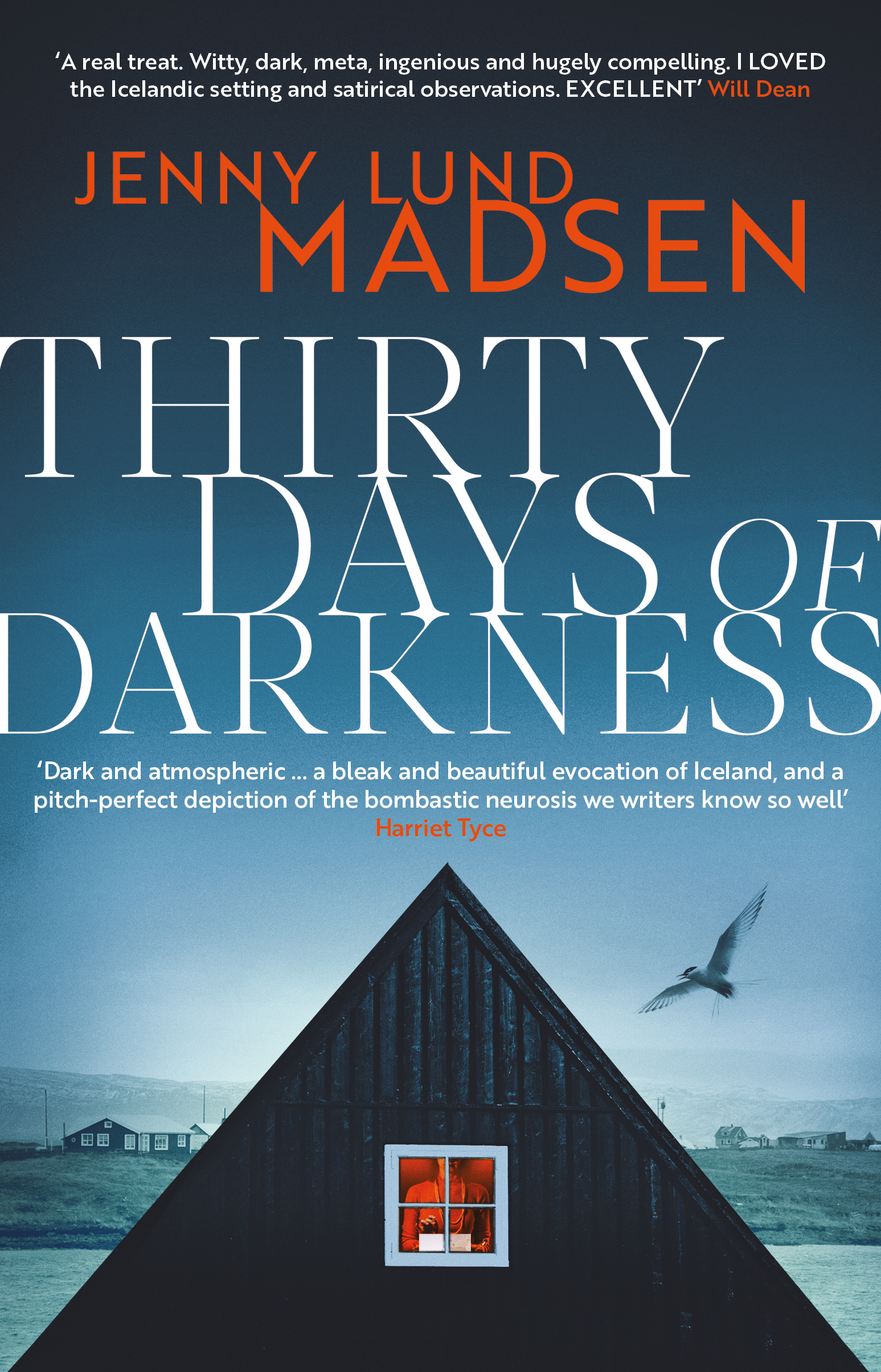
I was so much looking forward to this one - even just from the cover (yes, I know, you mustn't judge a book by its cover, but who doesn't...) which delivered one of my favourite visual tropes, a lit window at night. The synopsis entices too - a literary author taking up the challenge to write crime, travelling to a remote corner of Iceland to do it, and stumbling across the real thing...

Hannah, the litfic darling at the centre of this book, the Danish author of sparse and plotless high fiction, is that controversial thing, an unlikeable main character. Confessedly alcoholic, she seems to be going through "issues" most of which Jenny Lund Madsen keeps from us though boozy Hannah is clearly also suffering from writer's block and from envy of the massively successful crime star Jørn Jensen. It all comes to a head at a book fair when she starts throwing things at him. Only the intervention of her editor Bastian, who converts the spat into a publicity opportunity, saves the day - leaving her with that commitment to write a crime novel in 30 days. But anyone can do that, right?

I suspect many readers of this review (hi, both of you! Hope you're keeping well!) would sympathise with my view here that, no, we shouldn't be dissing anyone's choice of reading. So haughty Hannah is already edging into unlikeability even before she starts insulting her placid landlady (who's driven six hours to collect her from the airport). 

Yet there is something about Hannah. She has a fatal and almost endearing tendency to rush into actions and situations without thinking, resulting in either toe-curling embarrassment (as with Ella the landlady), or actual danger (once the killings begin, and Hannah decides to investigate - it's not clear whether that is more from simple morbid curiosity, or a need for inspiration, though the latter certainly features). Sometimes the result is both embarrassment and peril.

And actually, it's not as though Hannah does a great deal better when she does think it all through. The best you can say is that, perhaps, she doesn't follow through the most outlandish of her ideas. They do though give the book a bit of a comedic edge, and by the end you may have a bit of respect for the forbearance shown her by the people of Húsafjörður.

That comedy shouldn't though distract from a thread of genuine darkness that threads through the core of this book. The title may refer to the dark days of midwinter, but as Hannah comes closer and closer to the truth of the situation she will discover it in the people of Húsafjörður too and begin to suspect everyone of being part of it.

Thirty Days of Darkness didn't disappoint me. In Hannah, Jenny Lund Madsen has given us a vividly portrayed and complex character whom I hope to meet again. The book recognises the expectations that have been generated by the wave of Scandi-noir - both for its readers and for those who get caught up in the events described. Indeed, Jørn's comments about how a crime novel ought to be constructed address both, as the story Hannah is writing gets tangled up with the "actual" events in Húsafjörður. Another layer is added by Hannah's reading an ancient Icelandic saga which has things to say about honour, vengeance and power.

All in all, a distinctive novel that makes full use of Hannah as its protagonist to approach the crime genre from a new angle.

Also, great fun to read - Megan Turney's English translation has to cope with a myriad of challenges: Hannah and the people she meets are mainly communicating in English, their only common language, but not all of them are totally proficient and Ella, for example, tends to write rather than speak, with a lot of Icelandic left in. But the result is smooth and readable - while accented just enough for the reader to recognise the different voices and languages in use here.

I recommend you buy this one at once, it's even on the shelves in Sainsbury's so grab it while you can.

For more information about Thirty Days of Darkness, see the publisher's website here - and of course the other stops on the blogtour which you can see listed on the poster below. 

You can buy Thirty Days of Darkness from your local high street bookshop, in-store at Sainsbury's, or online from Bookshop UK, Hive Books, Blackwell's, Foyle's, WH Smith, Waterstones or Amazon.


19 December 2023

#Blogtour #Review - Yule Island by Johana Gustawsson

Book "Yule Island" by Johana Gustawsson. A pair of scissors, open and points down, in a chilly blue with the device of a skull in the centre. Behind them, a circle divided into eight parts by a repeated, cryptic symbol. There is a snowflake in each section. Behind all this, curving lines which might be branches, or possibly cracks in ice.
Yule Island (Lidingö Mysteries, No1)
Johana Gustawsson (translated by David Warriner)
Orenda Books, 23 November 2023
Available as: HB, 256, PB, audio, e   
Source: Advance copy and purchased
ISBN(HB): 9781914585975

I'm grateful to Orenda Books for sending me a copy of Yule Island to consider for review, and to Anne Cater for inviting me to join the book's blogtour.

Having enjoyed Gustawsson's previous Orenda-published mysteries, I was delighted to see this one coming and eager to review it. It is, I think, in atmosphere, closer to Blood Song than to her Roy & Castells series (though I did note that these books all take place in the same world - look out for the reference to the forensics expert!) That is, Yule Island is quite a "shut in", Gothic experience to read as we follow art and antiques expert Emma Lindahl to the lonely, but hardly isolated, Swedish island of Storholmen to appraise a wealthy family's hoarded collection of artwork.

Storholmen isn't remote - it can be reached by water taxi, a trip of only a few minutes, but once you're there it's another world. It is a place dominated by the Gussman family with their allegedly haunted manor house, where a young was woman was found, dead and hanging naked from a tree, nine years before. Once the taxi ceases, you're trapped, unless you can beg a lift. Moreover, its winter - the cold and the darkness almost palpable in Gustawsson's writing, contrasted to the busy urban scene outside Emma's apartment.

With this story, Gustawsson plunges straight into the mystery. There's no messing around, instead the threads are brought quickly together. Creepy Manor House. Troubled and scary history. The frustrated cop who failed to solve the previous murder. Hints of something or someone in the house not at rest. And in the middle of it all, Emma, a more complex character than she appears at first sight. When another corpse is found, she meets Karl, that detective (I enjoyed the subplot featuring him, his boss and her dog) and begins doing a little sleuthing herself.

It's clear by this stage that Emma has some preoccupation with the island, beyond furthering her career by working through the valuables the Gussmans have accumulated. (To add to the creepiness this is a job she's required to do according to a strict schedule, apparently designed to prevent her meeting any of the family or their staff). Gustawsson takes her time, however, revealing Emma's background and why she wishes to undertake the work when she seems to dread, rather than desire, the task, feelings only heightened when she discovers a note begging for help.

Pushed beyond endurance by what she witnesses, Emma also encounters Anneli, the young woman who runs the island cafe (literally the only other place to go apart from the manor) and they form a sort of alliance (in more senses than one). I felt the relationship between the two women was tenderly and convincingly drawn, as were Emma's difficulties with her mother (which hint at some of the darkness that Emma's dealing with - this is only slowly revealed and I won't say more because in this book you need to learn things at Guistawssson's pace).

Also sharing space in this book with Emma and the rest is Viktoria, who has her own take on things to narrate: exactly how it fits with the other storylines also only becomes clear gradually - but I will say that Viktoria's story is one that has overtones of male abuse (readers may want to be aware of this).

Overall, Yule Island has plenty of different mysteries, but they come together nicely into a coherent whole, rather than being separate threads added in to spice the story up. Once things come to a head it is soon clear what has shaped - is still shaping - the horror on Storholmen - Yule Island - and it also becomes clear that not everything can be wrapped up neatly: there will be consequences to what's gone on here - for the innocent as well as the guilty.

An intriguing and moreish start to a series, ably translated by David Warriner, whose lucid English narrative allows the story to speak for itself.

For more information about Yule Island, see the publisher's website here - and of course the other stops on the blogtour which you can see listed on the poster below. 

You can buy Yule Island from your local high street bookshop or online from Bookshop UK, Hive Books, Blackwell's, Foyle's, WH Smith, Waterstones or Amazon.

Blog tour poster for book "Yule Island" by Johana Gustawsson.


4 December 2023

#Blogtour #Review - Dead Sweet by Katrín Júlíusdóttir

Cover for book "Dead Sweet" by Katrín Júlíusdóttir. The Reykjavík waterfront, with churches and other buildings visible,. The sea is stained a deep red, in contrast to the rest of the image which is in shades of grey, white and black.
Dead Sweet
Katrín Júlíusdóttir (translated by Quentin Bates)
Orenda Books, 1 December 2023
Available as: HB, 256pp, audio, e   
Source: Advance copy
ISBN(HB): 9781914585999

I'm grateful to Karen at Orenda Books for sending me a copy of Dead Sweet to consider for review, and to Anne for inviting me to join the book's blogtour.

Dead Sweet is an intriguing and enthralling debut novel, written by an ex Minister in the Icelandic Government and showing, I think, the insight of an insider in its portrayal of government, police and wider society.

The story follows detective Sigurdís as she attempts to unravel the murder of prominent campaigner turned civil servant Óttar Karlsson. Karlsson was a man accustomed to getting his way but it soon emerges that he was also a man who kept secrets and whose life was lived in compartments. As the police dig deeper and deeper, they begin to uncover a host of potential motives - but there is an understandable caution at digging too deep. Will Sigurdís be able to persuade her boss Garðar to pursue potentially embarrassing leads?

I have to say, I totally loved Sigurdís as a protagonist. Where's a whiff of darkness about her - she is struggling rather in her chosen career after losing it when on patrol one evening and her colleagues are torn between sympathy (she had a difficult upbringing which has left her with trauma) and suspicion. The dynamic between her and them is one of several ways that Júlíusdóttir explores insiders and outsiders: she is both at the same time, as, it seems, was Karlsson. We are all, the author seems to be saying, many different people in the course of our lives and I was reminded of the "All the world's a stage" speech from "As You Like It" with various stages and aspects of both Sigurdís and Karlsson gradually emerging. 

Indeed, Karlsson is, for someone we see briefly at the start of the story when he dies but who is, if not dead "to begin with", at least dead from then on, still very involved with the story. It's basically a process of exploring the impact he had on others: the harms, the impressions, the trauma and the delusions that he left behind. I think that's why Sigurdís becomes so obsessed, pushing the bounds of protocol and eventually stepping right over them in her determination to find the truth. Something in the "victim" resonates with her own sense of pain and hurt and unresolved loss - even as her own history seems to be coming back to haunt her.

If all that sounds a lot in a shortish book, and potentially rather heavy, it's really not - Júlíusdóttir spins a cracking tale and keeps the revelations and teasers unwinding so that there's something to discover on every page, and Sigurdís is an engaging and empathetic heroine who I look forward to hearing more about soon.

I would give a content warning for some scenes of domestic abuse and controlling behaviour.

For more information about Dead Sweet, see the Orenda Books website here - and of course the other stops on the blogtour which you can see listed on the poster below. 

You can buy Dead Sweet from your local high street bookshop or online from Bookshop UK, Hive Books, Blackwell's, Foyle's, WH Smith, Waterstones or Amazon.

Blogtour poster for book "Dead Sweet" by Katrín Júlíusdóttir


8 August 2023

#Review - Expectant by Vanda Symon

Cover for book "Expectant" by Vanda Simon. A blue sea, a blood red beach and a turquoise sky.
Expectant (Sam Shephard, 5)    
Vanda Simon
Orenda Books, 16 February 2023
Available as: PB, 246pp, audio, e  
Source: Purchased/ audio subscription
ISBN(PB): 9781914585579

Detective Sam Shephard's latest adventure treads familiar ground in some respects - she's still suffering under DI Johns - but goes to new places in others - the case we follow here is even more personal than usual. Sam is shortly to give birth, so the murder and mutilation of a pregnant woman in a Dunedin backstreet obviously comes very close to home (and gives DI Johns a new excuse to try and shut her out of the investigation).

Beneath the shocking horror, it's a cleverly constructed mystery, Sam's condition however giving her few natural insights into why somebody would do such a thing. That, and DI Johns' success in keeping her away from the centre of things, leaves time and space to explore how Sam is feeling at this juncture in her life: her partner Paul, and her ever disapproving mother, coming and going through the narrative to give us different perspectives. As readers of this series will be aware, Sam's life is never straightforward and we've seen her change from the carefree young woman of the early books to, well, nearly a mother (but emphatically not one who will be a clone of her own mother - the tension between the two is still palpable, even if here things are a bit more peaceable than before).

But Sam being Sam, she's never going to let herself be kept out of things, is she? It's just a matter of interpreting DI Johns' orders creatively... and of not being afraid to have a stand-up slanging match with him when the time comes (go, Sam!) As ever, Sam places her quest for justice ahead of common sense and self-preservation. And you can guess the outcome of that when Johns finds out about it.

All in all, a satisfying and engaging return to one of my favourite detectives doing what she does best - ie causing trouble. This series shows no sign of flagging and I have high hopes that in the next instalment we'll see Sam coping with new complications as a mother and again firmly keeping Johns in his place. 

For more information about Expectant, see the publisher's website here. 

9 May 2023

#Blogtour #Review - Thirty Days of Darkness by Jenny Lund Madsen

Cover for book "Thirty Days of Darkness" by Jenny Lund Madsen. View over water towards a wintry landscape of low buildings. In the foreground, the triangular gable of a dark, wooden building. In the central of the gable, a single window, it with reddish light, through which is visible a woman working at a laptop.
Thirty Days of Darkness (translated by Megan Turney)
Jenny Lund Madsen
Orenda Books, 25 May 2023, 
Available as: HB, 321pp, audio, e   
Source: Advance copy
ISBN(HB): 978191458616

I'm grateful to Karen at Orenda Books for sending me a copy of Thirty Days of Darkness to consider for review, and to Anne Cater for inviting me to join the book's Random Things blogtour.

I was so much looking forward to this one - even just from the cover (yes, I know, don't judge a book by its cover, but who doesn't...) which delivered one of my favourite visual tropes, a lit window at night. The synopsis entices too - a literary author taking up the challenge to write crime, travelling to a remote corner of Iceland to do it, and stumbling across the real thing...

Hannah, the litfic darling at the centre of this book, the Danish author of sparse and plotless high fiction, is that controversial thing, an unlikeable main character. Confessedly alcoholic, she seems to be going through "issues" most of which Jenny Lund Madsen keeps from us though alcoholic Hannah is clearly also suffering from writer's block and from envy of the massively successful crime star Jørn Jensen. It all comes to a head at a book fair when she starts throwing things at him. Only the intervention of her editor Bastian, who converts the spat into a publicity opportunity, saves the day - but leaving her with that commitment to write a crime novel in 30 days. But anyone can do that, right?

I suspect many readers of this review (hi, both of you! Hope you're keeping well!) would sympathise with my view here that, no, we shouldn't be dissing anyone's choice of reading. So haughty Hannah is already edging into unlikeability before she starts insulting her placid landlady (who's driven six hours to collect her from the airport). 

Yet there is something about Hannah. She has a fatal and almost endearing tendency to rush into actions and situations without thinking, resulting in either toe-curling embarrassment (as with Ella the landlady), or actual danger (once the killings begin, and Hannah decides to investigate - it's not clear whether that is more from simple morbid curiosity, or a need for inspiration, though the latter certainly features). Sometimes the result is both embarrassment and peril.

And actually, it's not as though Hannah does a great deal better when she does think it all through. The best you can say is that, perhaps, she doesn't follow through the most outlandish of her ideas. They do though give the book a bit of a comedic edge, and by the end you may have a bit of respect for the forbearance shown her by the people of Húsafjörður.

That comedy shouldn't though distract from a thread of genuine darkness that threads through the core of this book. The title may refer to the dark days of midwinter, but as Hannah comes closer and closer to the truth of the situation she will discover it in the people of Húsafjörður too and begin to suspect everyone of being part of it.

Thirty Days of Darkness didn't disappoint me. In Hannah, Jenny Lund Madsen has given us a vividly portrayed and complex character whom I hope to meet again. The book recognises the expectations that have been generated by the wave of Scandi-noir - both for its readers and for those who get caught up in the events described. Indeed, Jørn's comments about how a crime novel ought to be constructed address both, as the story Hannah is writing gets tangled up with the "actual" events in Húsafjörður. Another layer is added by Hannah's reading an ancient Icelandic saga which has things to say about honour, vengeance and power.

All in all, a rather distinctive novel that makes full use of Hannah as its protagonist to approach the crime genre from a new angle.

Also, great fund to read - Megan Turney's English translation has to cope with a myriad of challenges: Hannah and the people she meets are mainly communicating in English, but not all of the latter are totally proficient and Ella, for example, tends to write rather than speak, with a lot of Icelandic left in. But the result is smooth and readable while accented just enough to recognises the different voices and languages in use here.

For more information about Thirty Days of Darkness, see the publisher's website here - and of course the other stops on the blogtour which you can see listed on the poster below. 

You can buy Thirty Days of Darkness from your local high street bookshop or online from Bookshop UK, Hive Books, Blackwell's, Foyle's, WH Smith, Waterstones or Amazon.


7 December 2022

#Blogtour #Review - Dashboard Elvis is Dead by David F Ross

Cover for book "Dashboard Elvis is Dead" by David F Ross. Against a light background, a pair of gold-rimmed sunglasses lying diagonally across the page. Reflected in the right hand lens (as the wearer would see things) is a typical US rural gas station with neon sign. Both lenses are cracked. Reflected in the left lens is George Square in Glasgow, under a blue sky.
Dashboard Elvis is Dead
David F Ross
Orenda Books, 8 December 2022
Available as: PB, 300pp, e, audio
Source: Advance copy
ISBN(PB): 9781914585401

I'm grateful to Karen at Orenda Books for sending me a copy of Dashboard Elvis is Dead to consider for review and to Anne at Random Things Tours for inviting me to join the book's blogtour.

In Dashboard Elvis is Dead, David F Ross hacks into the secret history of the early 1980s music industry, giving us an inside account of the rise and spectacular fall of The Hyptones, a band of young Glaswegian hopefuls for who everything goes wrong on a fateful tour of the US.

A tour which is a downfall for Ross too, because David F Ross appears in the book as the failed writer who documented the band's experiences and was badly burned by doing so. (So fact, fiction and identity are blurred form the start with real musicians, actors and artists appearing with and - one suspects, sometimes without - approval throughout the book).

Thirty years later, in the wake of the Scottish independence referendum, Ross picks up with Jude Montgomery, a revered photo journalist, who's arrived in Glasgow. What they seem to have in common is a love for, and a fascination with, the Hyptones and their one hit, An Independent State of Mind, which has become an anthem for the Yes campaign.

It will take the rest of the story to explain how everyone's paths cross, and especially how Jude, who was running away from her Texas trailer park home when she came across The Hyptones the first time, fared in between. That story is an amazing saga of growth and suffering, of finding identity and seeking redemption, that frankly could have driven a whole sequence of novels. I loved Jude's honesty and her self-analysis. I loved Ross's evocation of the racially divided, tense Texan town from which Jude starts. I ,loved the portraits of 1980s San Francisco, of gentrifying New York later in the decade and in the 90s. Most of all I loved Jude. She is a well realised and sympathetic character who just has an awful habit of doing the wrong thing at the wrong time. Generally driven by good intentions, Jude makes mistakes, burns bridges as if she had shares in the ferry company, and generally leaves a trail of damaged and more or less resentful (or, in one case, dead) friends, mentors, exes and employers across the USA. Nevertheless, she perseveres, and through this story she's visibly growing, exploring her own identity and, in a somewhat twisted way, trying to make amends. (Ultimately it's down to her that An Independent State of Mind isn't wholly forgotten). 

I wouldn't say the same of Jamie, a tragic figure who is the other focus of Dashboard Elvis. Jamie is at the centre of The Hyptones, and he's the one who takes the fall when things go wrong. At his core he believes I think that he deserves that - the band has its own secret history - but really that isn't fair. Everyone deserves a chance, or a second chance, but ultimately Jamie's guilt robs him of that, leading him mon a destructive path that only reinforces the guilt. 

In describing the trajectory of the band, Ross brings the same sensibility to the lives and aspirations of young working class Scots in the 70s and 80s as he did in his Disco Days trilogy and in There's Only One Danny Garvey. Their voices ring true, lighting up the pages of the book in expressive Scots, albeit slightly indignant, as though being exhibited in a novel wasn't how they expected to spend the evening. (The exception is Jamie's girlfriend, the enigmatic AFB, 'Anna F*****g Belle' who in contrast uses standard English, a slight marker of class or privilege that prefigures her role in the later parts of the book).

There's an interesting contrast between the lives of Jude, who did manage to "get out" but, as her story makes clear, had to sacrifice a lot along the way, and the band members who as I've alluded to above, are basically on a downward slope throughout the book. Especially Jamie. Like Jude, Jamie makes many bad decisions and ends up with lots of regrets. But he's less in a position to try and put things right. The parallels and differences between Jamie and Jude are fascinating, posing a whole series of what if questions revolving around gender, racial identity and social setting. Both deserve a way out.  Jude gets one, Jamie doesn't, a fate he shares with most of his bandmates. 

This is eventually portrayed in a brilliant piece of non-writing. After sections dealing with the two fairly evenly, eventually Ross sort of has Jamie just... fade away, again contrasting with Jude whose climactic scenes are vivid and consequential. While Jamie's location and eventual fate are key plot points, we don't actually see them, and this building absence of a character is an eloquent way to express what he's become in the lives of those who knew him and those who don't. His absence is almost a more pointed depiction of him than his presence could be.

Oh I could go on praising this book but really, if you don't want to read it by now then what's the point of you? Just take my advice and read Dashboard Elvis is Dead. It's so many things. A very funny book. A sharp examination of young lives, of origins, identity and the complications of living, ageing and "growing up". A bit of a satire on dependence and independence. And a complex, engaging story set where music, crime, social aspiration, lust and politics overlap and mutate. 

Just pure brilliance.

For more information about Dashboard Elvis is Dead, see the publisher's website here - and of course the other stops on the blogtour which you can see listed on the poster below. 

You can buy Dashboard Elvis is Dead from your local high street bookshop or online from Bookshop UK, Hive Books, Blackwell's, Foyle's, WH Smith, Waterstones or Amazon.

Blogtour poster for book Dashboard Elvis is Dead by David F Ross, showing the blogs and other social media sites taking part in the tour.


22 November 2022

#Blogtour #Review - Suicide Thursday by Will Carver

Cover for book "Suicide Thursday" by Will Carver. Against a dark blue background, the title is spelled out in a variety of different typewriter and keyboard keys, in shades of beige, cream, white, black and blue.
Suicide Thursday
Will Carver
Orenda Books, 24 November 2022
Available as: PB, 276pp, audio, e
Source: Advance copy
ISBN(PB): 9781914585388

I'm grateful to Karen at Orenda Books for sending me a copy of Suicide Thursday to consider for review, and to Anne at Random Things Tours for inviting me to join the book's blogtour.

Oh this is a wickedly sharp little book. Take care how you handle it or you may end up bleeding.

In Suicide Thursday, Will Carver returns to a familiar theme of his recent books - the clue is in the title, so the reader should consider themselves fairly warned, it won't be for all. And in this book, I think the subject is handled in an even more personal and, well, creepy vein than he has yet, hard though that may be to believe if you've read Nothing Important Happened Today or The Daves Next Door.

In Suicide Thursday there's no sinister grand scheme for glory, no greater cause, to direct the action. The story is pared down, simple and stark. Three friends, Eli, Mike and Jackie.

Eli is a sort-of failed writer. He churns out first chapters, but is unable to take his books any further. Comfortably off, but not so much that can afford to leave his cubicle-bound job in marketing, he buys an abandoned bagel workshop in trendy North London and sets up his library of first chapters, available for purchase to those who can't get started. By day, he endures the tedium of office life. By night, he unloads his frustrations each night to a therapist. Who doesn't exist.

Jackie, Eli's girlfriend, is by turns haunted by Catholic guilt at her strong sex drive, which drives her to regular Confession, busy indulging that drive with Eli (mostly), and concerned for her friends Eli and Mike.

Mike is... well, Mike is unemployed and spends his life sanding and polishing the floor of his flat.

The book includes Mike's and Jackie's perspectives, and we also see some other points of view and some mysterious and unsettling text messages, but Eli is at the centre of things. 

I think it would be fair to say that Eli is trying to make his life more meaningful. His chapters reflect aspects of his own life (often, very funnily). Conversely he frets and fusses over whether his actual life is following narrative logic, and whether he ought to nudge it so it does. Ought he, for example, to break up with Jackie so that a reconciliation can come in Act 3? Eli hungrily eyes up women who could facilitate that, with little success.

Jackie sees things through a different, simpler narrative lens - one involving potential wedding bells and a relaxation of her crushing guilt.

And Mike... well, Mike sands his floor.

The three weave their dance, the story moving forward and back around that Suicide Thursday, Carver never inviting the reader to judge these characters, they do enough of that for themselves, but making three flawed people sympathetic, in different ways. I love that his books, while going to dark places, frequently - as here - do so with compassion and empathy. They may judge themselves and each other  but the author isn't doing so (yes, I know, the author is writing them judging, but that's not the same, I don't think) making the navigation of this story something of a moral journey for us and in places therefore, a sort of self-condemnation. That sense is heightened because while more or less standalone, readers of Carver's other recent book will recognise in Suicide Thursday hooks, overlaps and references to the wider Carververse, suggesting that it takes place in the same world and that concerns and threats in that world (the perverse suicide cult, the baleful Beresford) are present here in the margins even if largely unseen.

As always, the writing is simple, direct and often questioning: absurdities of modern life are exposed and highlighted without being ridiculed and the author is perfectly comfortable drawing attention to the contradictions and inconsistencies of these characters, especially to their different ways of seeing the world, without telling is who is right or indeed, whether anyone is. The Carververse is painted in a rich palatte of moral grey shades and Suicide Thursday is no exception.

The book is also often very funny, indeed there are some almost slapstick situations as well as excruciatingly embarrassing ones. Mike literally varnishing himself into a corner is one, as is the trouble that Eli's wandering eye gets him into and the reaction he gets form one young woman.

All in all an excellent addition to this writer's output and I'm glad that, in contrast to Eli, he not only starts but finishes his work, giving us more to be entertained by and to think about.

For more information about Suicide Thursday, see the publisher's website here - and of course the other stops on the blogtour which you can see listed on the poster below. 

You can buy Suicide Thursday from your local high street bookshop or online from Bookshop UK, Hive Books, Blackwell's, Foyle's, WH Smith, Waterstones or Amazon.


2 September 2022

#BlogTour #Review - Black Hearts by Doug Johnstone

Cover for book “Black Hearts” by Doug Johnstone. An ornate stone Celtic cross grave monument in the foreground, behind, a bench and in the distance, further gravestones. Behind them, suburban semis and – just visible in the far distance – Salisbury Crags and Arthur’s Seat, hills in Edinburgh. Above the author’s name, “Nobody portrays Edinburgh better than Doug Johnstone – Val McDermaid”
Black Hearts (The Skelfs, 4)
Doug Johnstone
Orenda Books, 29 September 2022
Available as: PB, 260pp, audio, e
Source: Advance copy
ISBN(PB): 978-1914585296

I'm grateful to Karen at Orenda Books for sending me a copy of Black Hearts to consider for review, and to Anne Cater of Random Things Tours for inviting me to join the book's blogtour.

A new book in The Skelfs series, featuring three generations of women who run and Edinburgh undertaker's (with a side line in personal investigations), is always guaranteed to brighten my day. I thought that Johnstone might call it a day after The Great Silence, so it was great to see more goings-on from 0 Greenhill Gardens.

One of the joyous things about these books (sorry if "joyous" sounds like and entry in Poseur's Corner, frankly I don't care, it's what I mean) is the tapestry of closely observed lives at No 0. There is Hannah, whose wife Indy is now working for the firm. Hannah is an astronomy postgrad at the Royal Observatory. She is practical and focussed but reluctant to come out of her shell; Indy has helped a lot with that. Dorothy, Hannah's grandmother, runs the business and also teaches drums (as well as detecting). Originally from California, she remains something of an outsider, observing the Edinburgh scene with a cool eye while frankly being a bit flummoxed by the complexities of her family.

And then there's Jenny, who basically is "the complexities". Hannah's mum, Dorothy's daughter, Jenny is a mess. Readers of the series will be familiar with her storming out of the house to one of Edinburgh's bars, self-medicating with lashings of drink. Notionally she's in therapy, but she rather uses this as an opportunity to cross so many red lines you'd think she was auditing a set of dodgy accounts. Brandon, her therapist, doesn't have a chance.

The three women are gloriously realised, by turns reflective, determined, vulnerable and supportive. You sense they'll always be there for one another, but that means they really do take some shit, especially from Jenny (who is incredibly annoying but also, as she suffers in her black heart, a very empathetic character - I'm struggling slightly for words here). Jenny is suffering - as readers of the earlier books will know - from the aftermath of an abusive relationship (with Hannah's dad, finally revealed as a murdered in The Great Silence). Jenny did what she had to to stop Craig, and he was last seen drifting out to sea on a burning boat. This may have been necessary, but she now finds it hard to come to terms with. The dead are not finished with us, as this book shows in several different episodes of both undertaking and detecting.

I think Johnstone is also very on point in his observations of the Skelfs' customers, by definition people going through a stressful and life event, one forcing them to confront things we normally prefer to ignore. My wife is a Church of England Vicar, so I have seen some of this from close up. While I think the atmosphere is heightened, as it must be in a novel, there's a vein of truth here about that sudden collision with reality, about interrupted relationships and unfinished business - and about how those spill over into everyday life. My wife has only once had to request "police at the funeral" but I recognise the broil of emotions and distress that may lead, as here, to a brawl by the graveside.

Really, I could go on and on about this book. It's just so brilliantly plotted, everyone portrayed so well, the metaphors from Hannah's day job researching exoplanets so apposite - a series of riffs on things so dark they can't be seen, on black holes and much else and their hidden influences: all paralleled in the Skelfs' meticulously described journeys around Edinburgh (I'd love to take a walking tour of the Skelfs' Southside) which also struck me - I lived in Edinburgh for nearly eight years - as straight from life.

All in all, a brilliant continuation of the series. I don't know whether Johnstone will return to this world and I would understand if he tries something else, but I hope that the lights are always on at 0 Greenhill Gardens and that we're back there again soon.

For more information about Black Hearts, see the publisher's website here - and of course the other stops on the blogtour which you can see listed on the poster below. 

You can buy Black Hearts from your local high street bookshop or online from Bookshop UK, Hive Books, Blackwell's, Foyle's, WH Smith, Waterstones or Amazon.

Blog tour poster for book "Black Hearts" by Doug Johnstone, listing stops on the tour.


21 July 2022

#Review - The Daves Next Door by Will Carver

The Daves Next Door
Will Carver
Orenda Books, 21 July 2022
Available as: PB, 277pp, e
Source: Advance copy
ISBN(PB): 9781914585180

I'm grateful to Orenda for an advance copy of The Daves Next Door to consider for review.

I did wonder if I should take the title of The Daves Next Door as being a bit close to home - though I'm a David, not a Dave, he doesn't (I think) live next door, and on a close reading I don't seem too be in here, I've learned never to trust Mr Carver's narratives to be what they seem...

Regardless, a return to the Carververse is always overdue, and in The Daves Next Door, we see the same moral noir as in Carver's previous writing (including a few clues to show that yes, this is the same world as that of Nothing Important Happened Today and Psychopaths Anonymous). Reading these books is like being a fly that's incautiously settled into a patch of honey: they pull you in, they'll be the end of you, but oh how sweet the process is.

The Daves Next Door is perhaps a more fractured story that its predecessors, following a number of different characters who are less obviously linked by a location or involvement in ongoing events. Those Daves, sharing a flat and a disease in mutual loathing, a much overworked and put-upon hospital nurse with an adequate boyfriend, an elderly man who thinks he's died and gone to Purgatory, two grifters, a a sportsman brought down by a seemingly random injury, and others - including a suicide bomber, perhaps. 

They are though linked, and in two ways. 

First, Carver's concern for human motivation, consequences and character comes through as strongly as ever. For example, there's a man here who was devoted to his wife, and bereft since her death. His son, rather than seeing that devotion as the wonderful loving thing it was, is rather resentful, so he's drifted away and won't be there for his dad's torment, which we see depicted here. A little vignette about human nature and a dynamic that's central to one of the plot strands here but also tells us something dark about people, something echoed across all the other mini-stories.

Secondly, one figure - that maybe-bomber - holds the story together, functioning (perhaps) as an all-seeing narrator, recounting the lives of the other characters, so therefore (possibly) a God-like figure or equally (maybe) an Author. Their chapters are composed as questions - such a barrage of questions, from the profound to the trivial, pausing at all stops in between, but especially circling mysteries to which humanity has signally failed to discover answers. The Four Last Things - Heaven, Hell, Death and Judgement - loom over this story, especially, perhaps, Judgement which is passed not only on the characters and the world they inhabit (the world WE inhabit) but also, this being the Carververse, on the reader as well. No other author I know has quite the ability of Carver to involve his readers in the awkward moral failings that he highlights is his stories, though he does it in an utterly disarming, even charming, way. (That's the honey).

He does it, especially, by refusing to let the reader stick the blame on one character or another, even one who has behaved abominably (as many do). There are no neat endings, no convenient resolutions and retribution - people you'd grown fond of have terrible things happen to them, the unpleasant can simply stroll away.

Maybe that's not quite right though. As we would expect, one person who's given an especially hard time here is God, and of course, as They may feature in the story, many of the questions a certain character poses might actually be asked of Themself. (I apologise for the clunky language but given Carver's multi-layered portrayals here, words become rather slippery). This makes for a rather convincing self-prosecution which is genuinely unsettling both in terms of what it implies for the story and as an accusation against religion and those who follow it.

(I have to say that for me, the omnipotent, all-seeing, create-everything-in-seven-days version of God who's in point here is perhaps something of a straw deity. Alternatives are available, and less absurd. But maybe that is slightly mean-minded of me - after all there are plenty of people who hold to this picture).

In short, I'd come to expect from this author, The Daves Next Door is a vivid and thoughtful, and often  angry, book that tells a compelling and absorbing story (across its many threads) but comes with a real moral punch, real engagement with ideas, and shines with compassion even at its darkest moments (of which there are quite few). 

I'd strongly recommend, whether or not you're read any of Mr Carver's previous books: this is essentially a standalone though with some clear links, thematically and in plot terms, to them.

For more information about this book, see the Orenda website here.


23 March 2022

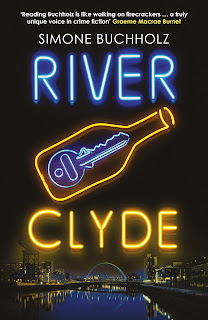
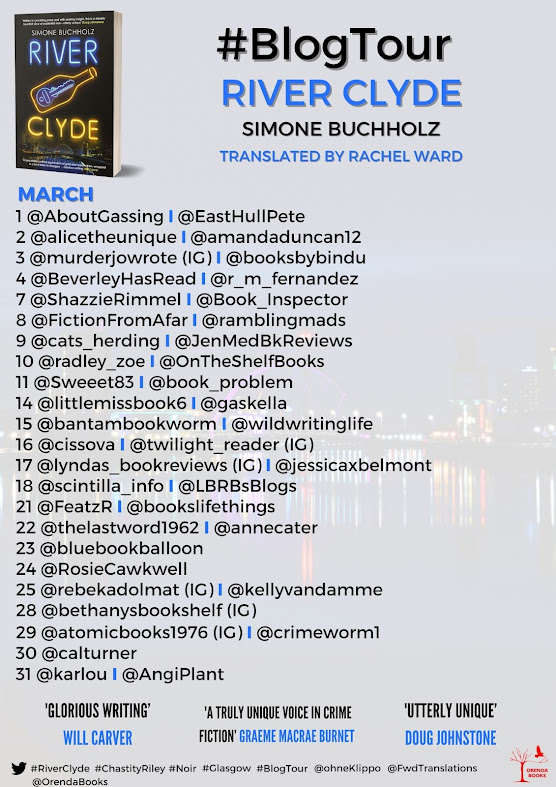
#BlogTour #Review - River Clyde by Simone Buchholz

River Clyde (Chastity Riley, Book 5)
Simone Buchholz (trans by Rachel Ward)
Orenda Books, 17 March
Available as: PB, 276pp, e, audio
Source: Advance copy
ISBN(PB): 9781914585074

I'm grateful to Orenda books for an advance copy of River Clyde to consider for review, and to Anne Cater for inviting me to take part in the blogtour.

There's something about a river that just lends itself to introducing a place, don't you think? Or as a character, a situation, a mood? 'the river lies there like over a hundred miles of dead man' writes Buchholtz. Here comes Chastity Riley, sideswiped by grief, loss ('I think about my dead friend, Faller'), PTSD, call it what you will, after the events of Hotel Cartagena, making a very personal journey into the heart of (her own) darkness and also into her - and her family's - past.

Buchholz is really bold with this one. It's not a crime story. There's a little bit of a crime thing going on back in Hamburg (more about that in a moment) but it doesn't concern Riley so much as show up the effects of the dreadful blow that the group of friends has suffered. Rather, here, the moodiness, the noiriness, the silent scream which has haunted Riley through all these books, has now fully swallowed her, and it looks as though she's run off. But is she running from - or to?

So. Why Scotland? Why Glasgow? Well, it seems Riley's inherited a house from a distant relative, and she's come to take a look and decide what to do with it. But Riley being Riley, nothing is straightforward, so she gets off on a bad footing with the solicitor who's handling the estate, can't find the house and sets to exploring Glasgow's pub scene. She eventually locates the house through a man she meets in a bar, of course - Riley is most enthusiastic in exploring Glasgow's pubs. Indeed the book shows a familiarity with (and love of) the city - and not just its drinking dens - as our heroine orients herself. It's a different Riley we see from when in Hamburg where she's on familiar, if tainted, ground. In Glasgow, she's exploring, evaluating, assembling a relationship with the place. 

As it is with her, for in this story Buchholz doesn't give us hard-boiled noir: there are sections in the voice of the Clyde himself, responding to Riley. There are time-slips, showing glimpses back into the lives that came before her and indeed condensing into a couple of pages what could form an entire family saga - a story of emigration, loss, disillusion, struggle that tells us a great deal about the woman she is. There are, too, moments that approach the ghost story though whether that is an objectively real ghost or a projection of Riley's tormented memories I really wasn't sure.

It's a kind of dark homecoming, Riley finally being forced - by the losses she's been through - do the work, confront the things, we've seen her shutting out all through her Hamburg life. 

And, yes, we do meet the little circle of friend back there: Stepanovic and Calabretta are investigating a wave of outrageous arson attacks, the café is open for business but there is a hollowness, an uneasiness that was hinted at in earlier books but has now finally blossomed. They discover that they are, in fact standing too close to the Blue Night, which is not 'just any old pub, it's a place of yearning, it's the desire for old times, when everything was broken just enough, so not too much, not ripped to shreds'. Rocco and Carla are sitting at a pavement table facing realities: 

'Perhaps Carla's not even this irresistible Venus fly trap but a pub beauty who's no longer in the first flush of youth. Maybe Rocco's not even this audacious survival artist, but a guy with gradually thinning, tousled hair, who's never actually completed a thing'.

Similarly, from the moment that Schulle, Brückner, Inceman and Anne Stanislawski are introduced 'lying on a colourful chequered blanket' in a park, we understand that all is not well. Buchholz is excellent at conjuring the spiritual malaise that has fallen on this vivacious, bawdy group of people but she doesn't present to offer answers to it. Perhaps, by the end of the story they're groping out of the dark, or perhaps not. Riley's still missing and her absence counts for a lot...

As ever, Rachel Ward's translation is glorious, interacting gleefully with Buchholz's text to give gems such as 'I love it, it's the opposite of innocuous small talk. It's enormous talk, and very nocuous indeed' and conveying the different moods of the various point of view characters - including a river. The result is glorious, haunting, sad, funny and breathtakingly readable. A great addition to the series and - if this is where it ends (I hope it doesn't) - a fitting conclusion. 

For more information about River Clyde, see the stops on the tour - listed on the poster below - and also the Orenda Books website here. You can buy River Clyde from your local bookshop, or online from Bookshop UK, Hive Books, Blackwell's, Foyles, WH Smith, Waterstones or Amazon.


10 December 2021

#Blogtour #Review - Fall by West Camel

Fall
West Camel
Orenda Books, 9 December 2021
Available as: PB/ independent bookseller HB edition, 323pp, e, audio
Source: Advance copy
ISBN(PB): 9781913193928

I'm grateful to Karen at Orenda Books for an advance copy of Fall and to Anne Cater of Random Things Tours for inviting me to take part in the tour.

Fall is set mainly on the fictitious Deptford Strand Estate in London. Designed by idealistic architect Zoë Goldsworthy in the 60s to permit - or require - a 'new way of living', by 2021 it's fallen on hard times and is being reworked, the Marlowe Tower in particular into premium, exclusive apartments.

The redevelopment has split the Goldsworthy family. Zoë's twin sons twins Clive and Aaron are intimately connected with the project, Clive as head of the development company, Aaron, a resident (the only resident) of Marlowe Tower, bitterly opposed to it and - when the book opens - holding up the project. Whether this is out of respect for his mother, spite at Clive or simply because he doesn't want to move out isn't clear.

The antipathy between the two men goes back more than forty years, to the scorching summer of 1976, when the estate sizzled and anger rose among the (white) residents because of the arrival of two young Black women, also twins. Not that anybody on the Deptford Strand is 'racialist', oh no - they just don't like outsiders...

In the quartet of Annette, Christine, Aaron and Clive, West creates a complex, simmering group among whom stresses arising from racial discrimination, coming-of-age, and the intricacies of twindom arc like lightning at the end of an overheated day. The double timeline particularly brings this out as Camel is able to examine the attitudes of the 70s from the point of view of the present day, casting additional light both where behaviour was unthinking (the language of the police, the prejudices of the estate residents) or where it was analysed and judged at the time.

Race isn't the only prejudice visible here. Once the estate was complete, Zoë moved her two boys from leafy Blackheath into a flat in the 24th floor of Marlowe Tower (where, four decades on, Aaron still lives). Outwardly an egalitarian gesture - Zoë argues that she should be willing to live anywhere that she designed - there does also seem an element of patronage and even control as, over subsequent years, she seems to see in herself the leading figure on the estate. And despite living alongside the working class residents, Zoë still sends her boys to distant schools rather than the one she designed, and mixes mainly with her own middle-class friends (who make visits akin to anthropological field trips).

One senses that the dislocation of that move, at the age of ten, still rankles with the boys, despite their outward devotion to their mother. As the events of the story unfold, they have just reached eighteen and are beginning to separate from one another, a painful process (though one Camel depicts very subtly) made more painful by some shocking discoveries and twists in this story. In some ways the wounds of that summer will never heal, with Aaron and Clive still estranged even before the redevelopment is proposed - and their relationship with Annette and Christine is part of that breach. Delicately exploring issues of intention, (mis) communication and the search for redemption, this is a fascinating study. There are some dark themes and incidents but none of them are gratuitous and West uses the eccentricity of Zoë's architectural practice to lighten the mood when needed. Apparently seeing the place as much a playground for her kids as a place for people to live, she designed it with a full complement of hidden doors and secret corridors, allowing access (for those who know) via shortcuts to most of the estate. A fun idea - but again one that seems to declare a sense of ownership, a right to dictate who goes where and how. 

Fall is, like West Camel's Attend (shortlisted for several major awards) something of a study in secrets, the private routes and spaces of the estate echoing concealed corners and bits of private history in the lives of the four protagonists. As the estate is torn down and reshaped, the hidden will inevitably be brought to light - as, it seems, will the true events of 1976. Will that be a traumatic revealing, with dust and rubble everywhere? Or will letting sunlight into those unlit places clean and heal?

Never less than grabbily readable, Fall is an exploration of the recent past and our relationship with it. It's a book I'd strongly recommend.

For more information about Fall, see the Orenda Books website here as well as the other reviews and stops on the blogtour listed on the poster below.

You can buy Fall from your local bookshop (a gorgeous independent bookseller edition is available!) or online from Bookshop dot org, Hive Books, Blackwell's, Foyles, Waterstones or Amazon.


1 September 2021

#BlogTour #Review - Black Reed Bay by Rod Reynolds

Black Reed Bay (Detective Casey Wray, 1)
Rod Reynolds
Orenda Books, 1 September 2021
Available as: PB, 367pp, e
ISBN(PB): 9781913193676
Source: Advance copy

I'm grateful to Orenda Books for an advance copy of Black Reed Bay to consider for review and to Anne Cater of Random Things Tours for inviting me to take part in the book's blogtour which begins today, 1 September.

In Black Reed Bay, Rod Reynolds delivers a tricksy, atmospheric dark crime drama focusing on cop Casey Wray, a detective sergeant who - while the Job does eat her up - isn't the beached, desperate  stereotype of much detective fiction. Casey loves her work, is good at it, honest, hard working and seen as something of a star - having come into a sexist and backwards department, risen, reshaped the world around her and moved things forward.

Wray is a likeable and sympathetic central character. Her personality and attitude are conveyed in her thorough and determined attitude to a tricky case, that of missing Tina Grace. Tina called 911 late one night from swanky Ramona Beach, an enclave on one of the coastal barrier islands in New York State. She subsequently disappeared. Concern over Tina's whereabouts mounts when her cellphone goes dark and local residents' accounts of what they saw and heard that night contradict. In response, Casey gets stuck in, chasing down every lead, pressing for more resources and gradually - very gradually - unpeeling a disturbing backstory to Tina's, suggesting she may have been walking a dangerous path.

Oh, and Casey finds bodies. Lots of bodies.

I loved this book. The backchat between Casey and her partner Cullen is sharp, flitting between work and salacious gossip, their partnership complex and trusting. Casey's relationship with Lt Carletti, who's something of a mentor to her, is also complex - one senses something more could come of it but neither is making a move yet. And the atmosphere is thick, whether we're the spiteful, eerie marshlands separating the islands from the main, the isolated mansions of the self-regarding wealthy or the down-at-heel, hollowed out suburbs where the less fortunate live.

As is traditional in a police thriller, Casey is a guide, a sort of Virgil leading us through the various levels of this Inferno and interpreting it to us - her reactions showing us who is to be pitied, who to be trusted, who we should be wary of. (She doesn't always get it right). But perhaps that's not quite right because, at the same time, she's more than a guide, she's a player in a game whose rules we don't quite understand. It seems that, whatever happened to Tina, it wasn't isolated, it's part of a wider pattern and one that seems to be drawing Casey in. 

Black Reed Bay is, as I'd expect from Rod Reynolds, a complex, satisfying mystery with enough twists and turns to keep the reader guessing - but not so many as to be gratuitous. Most of all, by the time a shocking turnaround happens, we know everybody involved well enough to feel the force of events. What goes on here seem real, and I cared about it, and those caught up in it. Casey has some dark moments, especially in the final part of the book, and by then we understand just what they mean to her and what they have taken out of her.

Recommended for crime and thriller fans, those who just love a good read, and anyone caught up in Reynolds' previous books, especially Blood Red City.

For more about Black Reed Bay, see the Orenda Books website here - and also the stops on the blogtour, all listed on the poster below. You can buy Black Reed Bay from your local bookshop, or order online from Bookshop dot com UK, from Hive Books, Blackwell's, Foyles, WH Smith, Waterstones or Amazon.


20 August 2021

#Blogtour #Review - No Honour by Awais Khan

No Honour
Awais Khan
Orenda Books, 19 August 2021
Available as: PB, 289pp, e, audio
Source: Advance copy provided by the publisher
ISBN(PB): 9781913193782

Honour, Falstaff remarks in Shakespeare's Henry IV, Part 1, is 'a mere scutcheon', a symbolic device. It is, though, a device that can affect behaviour. It can drive people on, cause them to kill or make them be willing to be killed. And so we see here, in No Honour, Awais Khan's moving account of a life in contemporary Pakistan, which examines "honour" from all sides.

Abida is a young woman living in a remote village. Her mother is concerned that, at 16, she's still married, so her father Jamil, a poor butcher, makes overtures to the Pir, an influential and wealthy local figure with sons who need wives.  Money (which the family can't afford) is spent on a meal to entertain the Pir, who repays them by being rude, and his ghastly son is introduced. However, Abida has her own ideas and has secretly been meeting Kalim out in the fields. Naturally one thing leads to another and soon Abida is in a mess. 

It's a story as old as time, but one where the stakes are especially high because of the culture and customs of the village. Another girl has recently been murdered in similar circumstances. This book isn't for the fainthearted, we see the villagers, driven by bloodlust, calling for the murder, with the Pir at the centre of things. It's a misogynistic culture, where, for example, the birth of girls is seen as a sign of weakness and male power in enforced ruthlessly (later, Abida encounters a mother whose daughters have, one by one, been murdered at birth).

So Abida's future looks bleak, and this book likely to be grim. But although dealing with brutal events, it contains a thread of hope. Forced to flee the village, Abida seeks to make a life for herself in the city of Lahore, a very different setting from the one she's used to. She has limited education (why would a girl need that?) and is disadvantaged by the society around her. Also, some of those she depends on are weak or selfish. Things become very difficult, and Abida ends up in a very desperate situation - she is treated vilely and her efforts to escape are punished brutally.

Abida remains, however, strong, resourceful and loving, determined to be free and to be with her family. And she has support from Jamil. Appearing at first scared of the Pir's power, he eventually leaves the village and sets out to find his daughter Lahore is as strange to him as it is to Abida, he has no friends or allies there but he, too, is strong and determined. This part of the book reminded me of Dickens at his most stark: a depiction of the teeming humanity in a throbbing, multi-faced city, a city full of perils and snares but also, friendships, acts of solidarity and, yes, love. The relationship between Jamil and Abida is at the centre - he is not a perfect man by any means, but he has a curiosity, and perhaps a streak of bloody-mindedness, as well as a family history, that prevents him from settling for "the way things have always been done" despite the obstacles around him - mainly those created by powerful, corrupt men. The propensity of such men to distort and debase society is laid bare here, making this as much an expose of patriarchal culture as it is a story of hope, love and redemption.

As I have said, there are many different conceptions of honour here; the desire to keep up appearances, to bolster a hierarchical and sexist order; an excuse used by bullies  to act out violent fantasies; or being true to one's family - wife, child, parent; following love; risking much for a loved one; heroic self-sacrifice to protect others; and many more. Is honour something bestowed by others, or does it arise from within? What acts preserve it, and what destroy it? Once lost, can it be regained? The truest expressions of it, as Khan shows, may be modest and hidden acts - charity for a man beaten by thieves; mercy and protection for a desperate young woman; not giving up when life becomes hard and there is no light in the darkness. 

In all, No Honour was a terrific read. We see humanity at its best and worst, enduring love, appalling cruelty and stubborn faithfulness. Many times, as I read this, my heart was in my mouth. Many times, I didn''t want to turn the page for fear of what I might read. Every time, I had to continue with this compelling and convincing story. I hope you will, too.

I'm grateful to Karen at Orenda Books for an advance copy of No Honour to consider for review and to Anne at Random Things Tours for inviting me to take part in this blogtour.

For more in formation No Honour, see the Orenda Books website here or the other stops on the tour, listed on the poster below. You can buy No Honour from your local bookshop, or online from Bookshop UK, Hive Books, Blackwell's, Foyles, WH Smith, Waterstones or Amazon.

Blog tour poster for "No Honour"