Showing posts with label music. Show all posts

23 April 2025

Review - Underscore by Andrew Cartmel

Underscore (The Vinyl Detective, 8)
Andrew Cartmel
Titan Books, 15 April 2025
Available as: PB, 416pp audio, e   
Source: Bought
ISBN(PB): 9781803367989

It's always great to see a new instalment of Andrew Cartmel's Vinyl Detective series (or for that matter, an outing for his spiritual sister the Paperback Sleuth) and I'm especially chuffed because this one quotes Blue Book Balloon in its rundown of reviews. Perhaps I can finally call myself an influencer. 

Not that I am letting that sway me in giving my verdict here. Oh no. I can genuinely say that Underscore maintains the high standard of its predecessors, as the (still unnamed) Detective (who's getting sick of being called that, however, what will Cartmel do?) launches into a search for the soundtrack LP to Murder in London, a gory 1960s Italian film whose events seem to be echoed in modern London...

The Detective, and his girlfriend Nevada, have been commissioned to track down a pristine vinyl copy of the record - but also, if they can, to exonerate its composer, Loretto Loconsole, of murdering his lover during the film's production production. The killing, for which no-one was ever charged, hung over Loconsole's later career, but his granddaughter Chloë now wants to reissue the music - something hard to do if he's still under suspicion (and harder still if she doesn't have a decent copy of it).

The resulting investigation hits all the notes that a Vinyl Detective novel should. I get sheer pleasure from the way that in these novels Cartmel creates a believable, and frankly enviable, lifestyle for his shifting bunch of characters who lunch and drink their way around a beautifully realised corner of the West London suburbs. Yet there are dangers that follow them, and Underscore has some heart stopping moments. Someone is determined to stop Chloë vindicating her grandfather, or reissuing his music, or both. Cass and Desdemona, the grandkids of the murder victim, are also hanging around - they would bribe the Detective to desist if they could (Nevada's tempted, of course) but might they go further?

How to solve a nearly 60 year old mystery? How to find a copy of a recording which - due to the scandal attached - was never issued, with the discs rather being destroyed? How to stay alive while doing both?

It's a tightly written, action filled story (with breaks for those lunches, naturally) which kept me guessing. As ever, Cartmel fills the reader in on the finer points, in this case the giallo genre, the politics of the late 60s recording industry and the surprising fidelity of a pristine vinyl copy. (It's no coincident that the Detective is after vinyl, rather than vintage CDs or tapes). The result is an excellent addition to the canon, and a better knowledge of these essential matters. 

With another Paperback Sleuth novel due this year as well it's going to be a good year, I can already tell.

For more information about Underscore, see the publisher's website here.

3 September 2024

#Blogtour #Review - Jimi Hendrix: Purple Haze by Tom Mandrake, DJ Ben Ha Meen and Mellow Brown

Purple Haze
DJ Ben Ha Meen and Mellow Brown (writers), Tom Mandrake (artist)
Titan Comics, 27 August 2024
Available as: HB, 128pp, e   
Source: Advance copy
ISBN(HB): 9781787731899

I'm grateful to the publisher for giving me access to an advance e-copy of Jimi Hendrix: Purple Haze to consider for review, and for inviting me to join the graphic novel's blogtour.

From the publisher

This is a pure rock and roll space opera featuring the legendary Jimi Hendrix as you’ve never seen him before. 

Fully sanctioned by Experience Hendrix L.L.C.; Authentic Hendrix, LLC - this is the first ever full-length graphic novel inspired by the music of the legendary Jimi Hendrix – arguably the world’s greatest guitarist. 

This 21st Century psychedelic rock ‘n’ roll odyssey sees Jimi Hendrix embark on a quest to the very centre of the universe in search of a magical talisman powerful enough to unlock the incredible latent power of his music so that he can share it with a universe starved of the rock ‘n’ roll by a tyrannical intergalactic force hellbent on silencing all music from the universe and enslaving all life. 


What I thought

Space opera. Rock opera. Seemingly unrelated genres which the collaborators behind this graphic novel nevertheless pull together with aplomb. The result is great as an example of each, but put together, something much more.

Yes, we get zoomy spaceships, vivid alien worlds, combat and awesome vistas, that genuine sense of wonder that space opera must deliver. But we also get what is actually - so far as such a thing is possible - a pretty vivid visualisation of a musical high (is that a thing? I think it's a thing) as the central character here, Hendrix, takes to the stage on a galaxy-crossing tour. Lyrics stream by in a kind of diagetic cloud. The music ignites in the intense shades of a fiery sun, blazing across the page. At once, deeply SFnal, deeply musical.

But, as I said, there is more here too. The story finds Hendrix, mysteriously, playing on an endless tour in this far-future dystopia. The how and why of that's never explained, but that doesn't actually loom large in the story and it doesn't really matter. Rather we have this guitar hero pushing his message of peace and brotherhood in a galaxy embroiled in brutal war. He's doing all he can, he thinks.

But of course he's not (I had vibes here of Springsteen's No Surrender "There's a war outside still raging/ You say it ain't ours anymore to win" and there's a moment of realisation with attempts to coop the tour  for sinister purposes, a moment of truth and decision which leads to a fascinating quest. The ultimate test here is then very much one of those "surely there must be another way?" setups where, behind the spaceships and the zooming, the point is that the hero must, will, reject the constraints imposed on them and do the different thing. The Kobayashi Maru moment, in Star Trek language.

And who better, in such a moment, to use their humanity, their sympathy, their courage, than Jimi Hendrix?

A fine graphic novel with a powerful, beating heart. Recommended.

For more information about Jimi Hendrix: Purple Haze, see the publisher's website here - and of course the other stops on the blogtour which you can see listed on the poster below. 

You can buy Jimi Hendrix: Purple Haze from your local high street bookshop or online from Bookshop UK, Hive Books, Blackwell's, Foyle's, WH Smith, or Waterstones.


30 May 2023

#Review - Conquest by Nina Allan

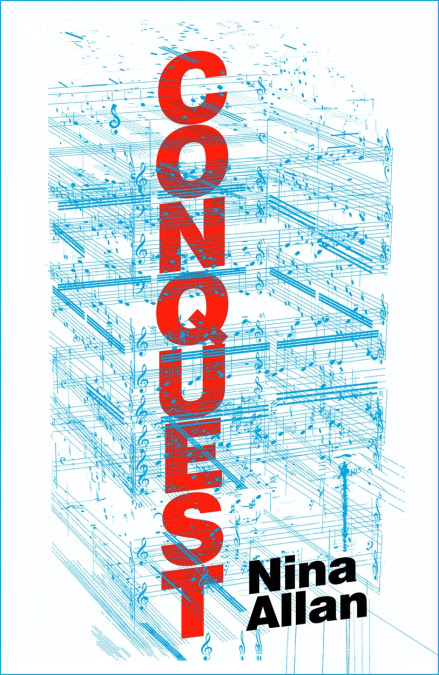
Cover for book "Conquest" by Nina Allan. A tower, formed out of musical staves, with notes flocking on them like figures in a building. The title is spelled out vertically downwards in red letters.
Conquest
Nina Allan
Riverrun, 11 May 2023
Available as: HB, 320pp, audio, e   
Source: Advance e-copy & purchased copy
ISBN(HB): 9781529420777

I'm grateful to Riverrun for sending me an advance e-copy of Conquest via Netgalley to consider for review, this was also a book I had to have on my shelves!

Nina Allan is one of my favourite authors - I love the sense of unease her books deliver, of ordinary lives taking place alongside the "other". In Conquest, we have three characters whose stories are tightly bound. Frank, a rather shy young man who's entranced by the music of JS Bach, has gone missing in France, after travelling (his first time abroad!) to meet "friends" he met online. Has he fallen in with a sinister cult? Are they a criminal ring who have been grooming him? Or "harmless" cranks pushing a conspiracy theory? Or - just possibly - do they see an important truth that others overlook? We don't know.

Rachel is Frank's girlfriend, Allan portraying her, and her (and Frank's) background on a London estate (actually two - the bad estate and the good estate) deftly. She reports Frank missing, but the police aren't very interested, and she's left in limbo, not knowing whether to wait for him, or get on with rebuilding her life.

Robin is the private detective to whom Rachel turns in despair when Frank remains missing. She's the main voice in this story and I really enjoyed Allan revealing Robin's backstory bit by bit. It's a rich and complicated one, taking in Robin's former career with the police (she evidently had a love/ hate relationship with her hard-bitten boss), her personal life (she was adopted, her mother dying when she was young, her father nowhere to be seen) and her run-ins with notorious London crime families. Allan always delivers wonderful characters, people who are many-layered, connected in subtle ways and who simply stroll off the page and into your life.

As does the mystery at the heart of this book. That mystery is approached in several different ways. The book contains the gist of a 50s SF story seen by Frank as key to some sort of cosmic puzzle, but also articles by a film critic who we later meet, and it also connects with Allan's short story "The Lichens" included in the Someone in Time anthology of time-travel romance. It has recurring themes - Frank's (and Rachel's) obsession with Bach isn't coincidental and Allan analyses pieces and even individual recordings and performers to highlight concerns explored here. Ideas of war, of - yes - conquest, and of taint and influence, recur. The atmosphere is haunting, suggestive. Frank's suggestion of an important message coded into a text is relevant, I think, but the "text" is much more then simply a piece of writing and the "decoding" is something that the reader can engage in but that we also see the characters - Rachel, especially - undergo.

As well as resonating with themes form Allan's wider writing - ramified stories, the aftermath of war - there are other echoes too, including to MR James, all giving the sense of a deeply rooted tale, of a heft, a background to the story we read here.

Has Rachel been affected by a war? 

Has the enemy, in fact, already conquered - and if so, what does that leave for her?

Conquest is, simply, a delicious read, that rare book which I wished was twice as long. I'd strongly recommend it.

For more information about Conquest, see the publisher's website here.
7 December 2022

#Blogtour #Review - Dashboard Elvis is Dead by David F Ross

Cover for book "Dashboard Elvis is Dead" by David F Ross. Against a light background, a pair of gold-rimmed sunglasses lying diagonally across the page. Reflected in the right hand lens (as the wearer would see things) is a typical US rural gas station with neon sign. Both lenses are cracked. Reflected in the left lens is George Square in Glasgow, under a blue sky.
Dashboard Elvis is Dead
David F Ross
Orenda Books, 8 December 2022
Available as: PB, 300pp, e, audio
Source: Advance copy
ISBN(PB): 9781914585401

I'm grateful to Karen at Orenda Books for sending me a copy of Dashboard Elvis is Dead to consider for review and to Anne at Random Things Tours for inviting me to join the book's blogtour.

In Dashboard Elvis is Dead, David F Ross hacks into the secret history of the early 1980s music industry, giving us an inside account of the rise and spectacular fall of The Hyptones, a band of young Glaswegian hopefuls for who everything goes wrong on a fateful tour of the US.

A tour which is a downfall for Ross too, because David F Ross appears in the book as the failed writer who documented the band's experiences and was badly burned by doing so. (So fact, fiction and identity are blurred form the start with real musicians, actors and artists appearing with and - one suspects, sometimes without - approval throughout the book).

Thirty years later, in the wake of the Scottish independence referendum, Ross picks up with Jude Montgomery, a revered photo journalist, who's arrived in Glasgow. What they seem to have in common is a love for, and a fascination with, the Hyptones and their one hit, An Independent State of Mind, which has become an anthem for the Yes campaign.

It will take the rest of the story to explain how everyone's paths cross, and especially how Jude, who was running away from her Texas trailer park home when she came across The Hyptones the first time, fared in between. That story is an amazing saga of growth and suffering, of finding identity and seeking redemption, that frankly could have driven a whole sequence of novels. I loved Jude's honesty and her self-analysis. I loved Ross's evocation of the racially divided, tense Texan town from which Jude starts. I ,loved the portraits of 1980s San Francisco, of gentrifying New York later in the decade and in the 90s. Most of all I loved Jude. She is a well realised and sympathetic character who just has an awful habit of doing the wrong thing at the wrong time. Generally driven by good intentions, Jude makes mistakes, burns bridges as if she had shares in the ferry company, and generally leaves a trail of damaged and more or less resentful (or, in one case, dead) friends, mentors, exes and employers across the USA. Nevertheless, she perseveres, and through this story she's visibly growing, exploring her own identity and, in a somewhat twisted way, trying to make amends. (Ultimately it's down to her that An Independent State of Mind isn't wholly forgotten). 

I wouldn't say the same of Jamie, a tragic figure who is the other focus of Dashboard Elvis. Jamie is at the centre of The Hyptones, and he's the one who takes the fall when things go wrong. At his core he believes I think that he deserves that - the band has its own secret history - but really that isn't fair. Everyone deserves a chance, or a second chance, but ultimately Jamie's guilt robs him of that, leading him mon a destructive path that only reinforces the guilt. 

In describing the trajectory of the band, Ross brings the same sensibility to the lives and aspirations of young working class Scots in the 70s and 80s as he did in his Disco Days trilogy and in There's Only One Danny Garvey. Their voices ring true, lighting up the pages of the book in expressive Scots, albeit slightly indignant, as though being exhibited in a novel wasn't how they expected to spend the evening. (The exception is Jamie's girlfriend, the enigmatic AFB, 'Anna F*****g Belle' who in contrast uses standard English, a slight marker of class or privilege that prefigures her role in the later parts of the book).

There's an interesting contrast between the lives of Jude, who did manage to "get out" but, as her story makes clear, had to sacrifice a lot along the way, and the band members who as I've alluded to above, are basically on a downward slope throughout the book. Especially Jamie. Like Jude, Jamie makes many bad decisions and ends up with lots of regrets. But he's less in a position to try and put things right. The parallels and differences between Jamie and Jude are fascinating, posing a whole series of what if questions revolving around gender, racial identity and social setting. Both deserve a way out.  Jude gets one, Jamie doesn't, a fate he shares with most of his bandmates. 

This is eventually portrayed in a brilliant piece of non-writing. After sections dealing with the two fairly evenly, eventually Ross sort of has Jamie just... fade away, again contrasting with Jude whose climactic scenes are vivid and consequential. While Jamie's location and eventual fate are key plot points, we don't actually see them, and this building absence of a character is an eloquent way to express what he's become in the lives of those who knew him and those who don't. His absence is almost a more pointed depiction of him than his presence could be.

Oh I could go on praising this book but really, if you don't want to read it by now then what's the point of you? Just take my advice and read Dashboard Elvis is Dead. It's so many things. A very funny book. A sharp examination of young lives, of origins, identity and the complications of living, ageing and "growing up". A bit of a satire on dependence and independence. And a complex, engaging story set where music, crime, social aspiration, lust and politics overlap and mutate. 

Just pure brilliance.

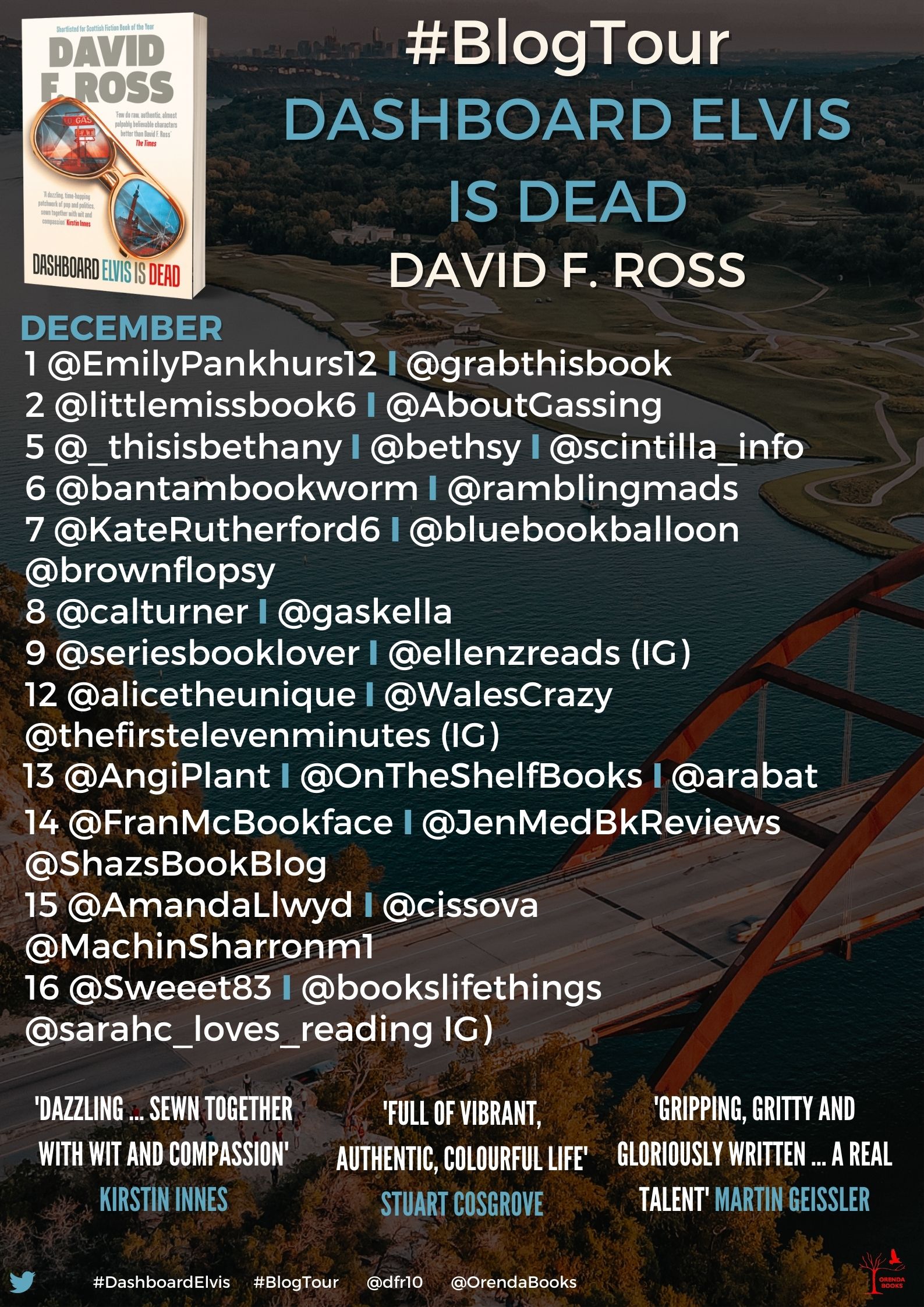
For more information about Dashboard Elvis is Dead, see the publisher's website here - and of course the other stops on the blogtour which you can see listed on the poster below. 

You can buy Dashboard Elvis is Dead from your local high street bookshop or online from Bookshop UK, Hive Books, Blackwell's, Foyle's, WH Smith, Waterstones or Amazon.

Blogtour poster for book Dashboard Elvis is Dead by David F Ross, showing the blogs and other social media sites taking part in the tour.


23 August 2022

#Review - The Pallbearers Club by Paul Tremblay

Cover for book "The Pallbearers Club" by Paul Tremblay. A white/ grey marbled background, like very high quality, grainy paper. Curled across the cover, a spine - a human spine? - intersected by three safety pins, which transforms into what looks to me like the backbone of a fish as it makes loop about itself.
The Pallbearers Club
Paul Tremblay
Titan Books, 15 July 2022
Available as: PB, 288pp, e, audio
Source: Audio by subscription, advance copy
ISBN(PB): 9781789099003

I'm grateful to the publisher for an advance copy of The Pallbearers Club. I also read part of it as an audiobook.

The Pallbearers Club particularly lends itself to that dual approach. The story is told in, literally, two parts - fortysomething Art Barbara is (PURPORTS TO BE) telling his life story while another figure annotates the text with comments, objections (striking out "memoir" wherever it appears and replacing it with "novel"), critical analysis of the text, advice and, increasingly, a counter narrative.

In the physical book, this is done by handwritten annotations (including some doodles). In the audio, the commentary is portrayed by a female narrator (Gemma Carfi), her voice cutting in with among Art Barbara's (James O’Connell's) main narrative in a sharp counterpoint, creating the illusion - almost - of dialogue or debate. I have to say that the audio narration is just superb, O'Connell's narration, interrupted by Carfi's waspish observations (which start in the title page when she queries Tremblay's dedication) create a real sense of dialogue between the two.

Precisely how this second voice has access to Barbara's story [THAT's GOOD - A STORY CAN BE EITHER A MEMOIR OR A NOVEL] and why she chooses to contribute to it (and who she is) emerge slowly though the book. I don't want to preempt that, and I'll only say here that she has a stake in the whole enterprise. The fact is though that The Pallbearers Club has not one but two unreliable narrators. Not only do they mislead us, they also mislead each other, and in hinting at "Art Barbara" being a nom de plume, and via Ms Second Voice playfully threatening to unmask him and reaching out even to the title page - breaking the fourth wall in effect - we have a deliciously confusing metatextual tangle that leaves the reader questioning every page, every line. The reader can decide to trust one or the other of them, or neither, or try to construct an idea of "truth" from the interplay.

It ought to be simple. Art, a young man at highschool in 1980s USA, needs a bit of polish for his CV, so he starts The Pallbearers Club - a group that attends funerals of the lonely and the friendless. In doing so he meets Mercy, an enigmatic and self-contained woman who inducts him into the ways of punk - in particular, the local music scene, transports him in her battered orange car, and in one memorable scene, invades his family's basement.  Art's relationship with Mercy forms the core of the story [HA - "STORY" AGAIN! I APPROVE!] which is structured as three acts. There is the initial meeting and the period following it, up until Art's spinal surgery to correct his scoliosis at this point a horrific event tears them apart. Decades later, Art runs into Mercy again when he's living away from home grubbing for a living in a succession of no-hope bands. That also ends with a very strange episode, this time in Mercy's basement apartment. Finally, the two reunite in Art's home town where he has returned to live with his ageing, ailing mother after her divorce. [ANNULMENT!]

But really, things are neither pure nor simple. Art's perspective is influenced by Mercy's exploration of 
an episode of New England history in which a grave was opened after suspicion that its occupant was rising at night to feed on her family. The book - Tremblay is of course a veteran horror writer - is therefore bedecked with call-outs to vampire mythology (as well as to popular music). Both Art's narration and his interlocutor's remarks are fully alive to this aspect, and actively comment on the resonances of it in Art's story, though they often disagree on its interpretation. This is only one of the way in which Tremblay leaves us with a myriad of alternatives depending not only on how welcoming we are of the supernatural but on our attitudes to the reliability of the different voices.

That ambiguity persists to the very end. Don't read this book expecting neat resolutions or clarity. Tremblay may have written a horror story (he's definitely written a horror story, if only in its bleak portrayal of Art's desperate health situation, caused by a country that refuses to meet its responsibilities to its people) but it's not a conventional one. You have to pick up the pieces and assemble them but many don't fit. And in trying to put them together you can't sidestep the deeply felt portrayal of Art's life - a very mundane life, a very ordinary man, but someone who evokes a great sense of sympathy as he flounders away trying to make something of his life, the firm landmarks of his childhood melting into the mist [NOT A FAN OF  THE PURPLE PROSE, TBH] and no adult consolations replacing them. 

It's a read like nothing I'd encountered before. A novel [YES!] but also a memoir [NO WAY!] if a fictional one. I mean that this story of Art Barbara comes over as deeply realistic, despite the supernatural overtones, or maybe even because of them. A triumphant use of horror to show so much more of life than one could in a naturalistic novel, The Pallbearers Club will remain with me for a long time, I think.

For more information about The Pallbearers Club, see the Titan Books website here

17 June 2022

#Review - Nothing Else by Louise Beech

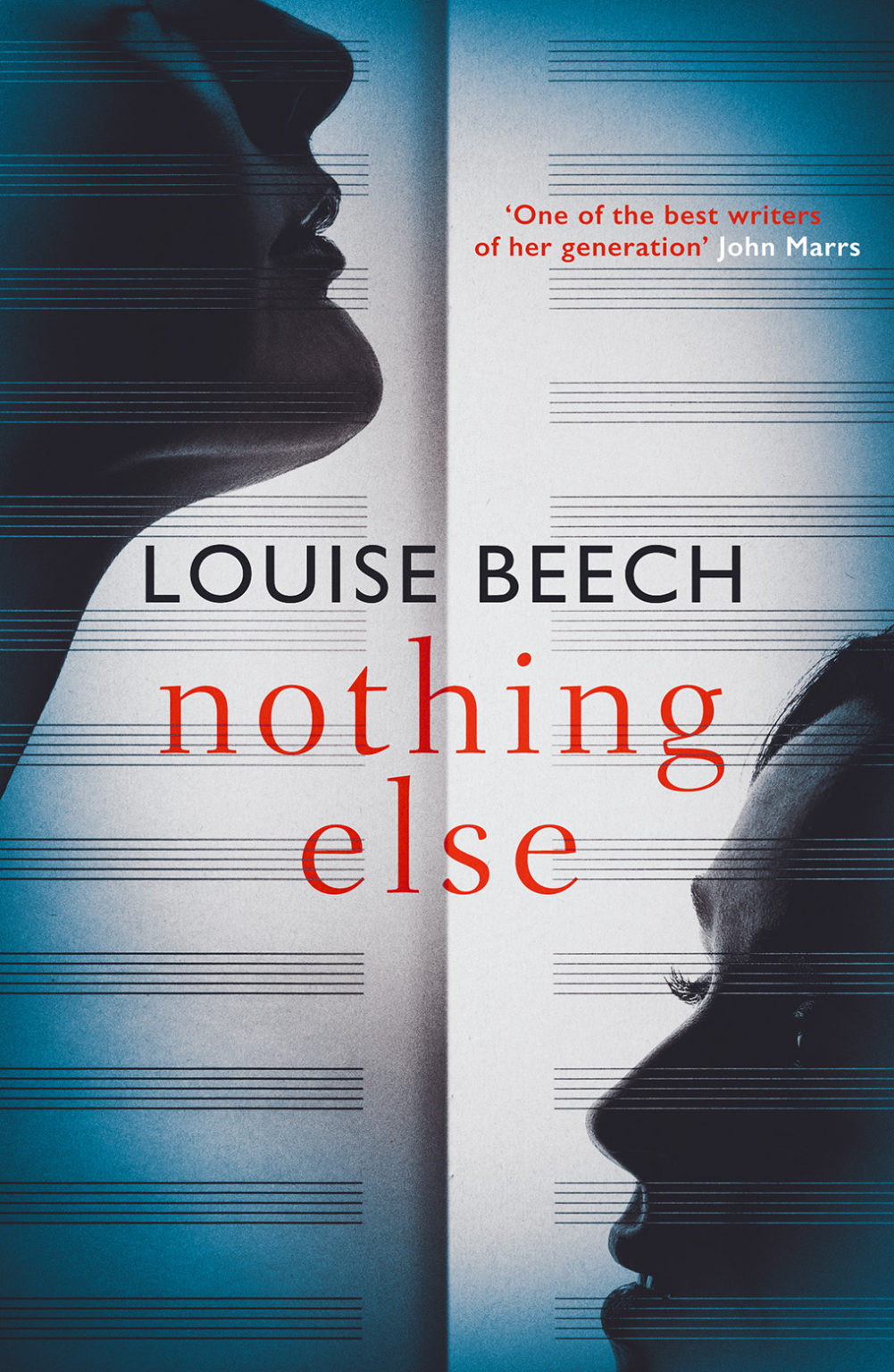
Cover for book “Nothing Else” by Louise Beech. The background is music manuscript paper, bare with no notes. In the centre it is white, fading out to pale blue in the corners. Facing each other across the page, but not lined up, are two female faces. The are almost in profile, but not quite – they are clearly pictures not silhouettes. One is at the top left, the eyes cut off by the edge of the page. The other is bottom right, the full face in view except for the lower part of her chin. At the top is an endorsement by John Marrs: “One of the best writers of her generation”.
Nothing Else
Louise Beech
Orenda Books, 23 June 2022
Available as: PB, 276pp, audio, e
Source: purchased e-copy
ISBN(PB): 9781914585166

Today I'm pleased to be joining the Random Things blogtour for Nothing Else by Louise Beech. Many thanks to Orenda Books and to Anne Cater for inviting me to take part.

I am always very pleased to see that a new book by Louise is on the way. They always grab me, and Nothing Else lived up to my expectations. At the same time heartbreaking, uplifting and compulsively readable, I hope it'll grab you, too.

Heather is a piano teacher, a rather solitary woman who lives - perhaps not for her music, but with it. She's not a total loner - her stepparents are dead, she was married and has parted amicably from her ex-husband - but there is a space in her life, which Beech slowly shows us was left by Harriet, the sister from whom Heather was parted in childhood.

On an impulse, Heather decides to take the job of pianist on a luxury liner. It's most unlike her to do such a spur of the moment thing, but she looks forward to the change and to the opportunity for some reflection. She will cruise across the Atlantic and then travel to the Caribbean, with a stop in New York. It seems exciting, different, a chance to explore a different lifestyle - and Heather is very nervous. But she's recently received the files Social Service kept on her, and hopes that she may find a clue there about Harriet - what happened to her, and, perhaps, where she is now.

Louise Beech
The first part of the novel therefore follows Heather as she settles in aboard the Queen of the Seas, makes acquaintanceships among the crew of the ship (a warm friendship with Frederica, who's a writer and aboard the ship to give workshops, not so much  with Barry Lung, an old-school comedian who sees the trip as an opportunity to drink and chase the girls) and finds her way playing in the different bars and venues. Heather has a good deal of spare time and we also witness her reaction to reading the (heavily redacted) Social Services files and the memories they stimulate of early life. 

Heather's own memories have many gaps. Her childhood wasn't easy, and doesn't make easy reading. There are scenes here of domestic abuse, less the gross, physical side than the creeping atmosphere of dread and restraint, the miasma cast over the girls' early life by their controlling father. It is effective and horrible, and the contrast with the more or less carefree life aboard ship (I really loved the sense of place and community that Beech gives to this) only makes things seem, somehow, even darker. Heather wants to know about Harriet, but one senses that there may be ominous secrets to come out.

One of the things I love about Louise Beech's books is this ability to create menace and depth in situations which nevertheless remain, as it were, bounded and even appealing. The little world aboard a ship is a good example of that. Heather may have spare time to relive her past but she has so much to do, so much to explore, and a public role in the ship - she has to be be there at the right times, a smile on her face, attractively dressed and ready to entertain - so that the buried memories which begin to emerge can't, they just can't, take over completely. So we get a kind of mystery, a deepening of our understanding of Heather's personality, demonstrated through her love for her mother, through her family's tragedy and in her relationship with Mr Hibbert, who taught her and Harriet piano (his story, glimpsed in passing, is rather sad). But it's demonstrated most of all, perhaps, though Beech's use of Heather's music, her choices of what to play and the descriptions of how she does that.

Heather doesn't particularly try to challenge the passengers with her repertoire, but she plays with great feeling and there's a haunting quality to how this is explained in the story, reminding me that Beech's stories often use art or performance to get over the depths of what people are experiencing. That is heightened when Heather plays "Nothing Else", a piece in two parts which she and her sister composed together when their father was at his worst. Heather has never been able to play Harriet's part, pointing at the void left behind, but she is something of a hit playing her own and even becomes a minor online sensation as the music is recorded and shares across social media.

I don't want to say too much more about what happens in the story, because, while the general course of it might be something you'll guess, the detailed working out isn't. Rather it's wrapped round the mystery about Harriet's disappearance. And other mysteries too. Beech, as ever, is queen of the taut, suspenseful plot. This isn't a crime novel (at least not in its present-day parts) or thriller, but Beech still serves up a few red herrings and a few clues as to what was going on - and keeps us guessing about exactly how things will turn out.

This is a story, at its root, of love and loss, and lost time, but one that testifies to the power of truth and the endurance of love. As a complex piece of music moves towards its resolution, so Nothing Else explores its themes, eventually presenting Heather with a very different outcome from what she might have expected - and forcing some choices on her. 

Another excellent book from this author - one that I think may just be her best yet (and that's a high bar).

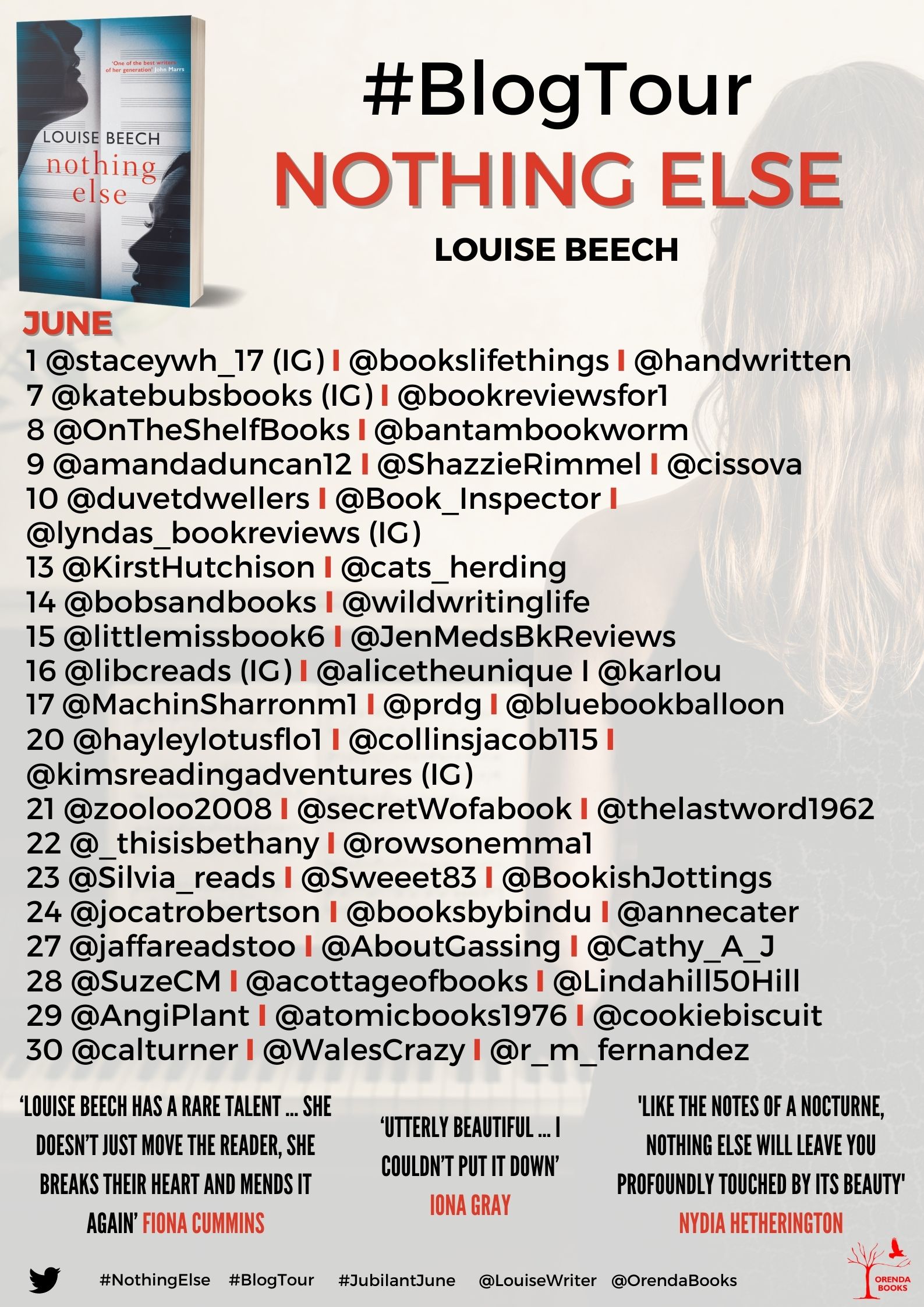
For more information about Nothing Else, see the Orenda Books website here or take in the other stops on the tour, listed on the poster below. To buy Nothing Else, visit your local bookshop, or get it online from Bookshop UK, Hive Books, Blackwell's, Foyle's, WH Smith, Waterstones or Amazon


4 September 2020

Review - The Vinyl Detective: Low Action by Andrew Cartmel

Low Action (The Vinyl Detective, 5)
Andrew Cartmel
Titan Books, 4 August 2020
Available as: PB
Source: PB, bought from Wallingford Bookshop
ISBN: 9781785659003

The band is back together again...

I'm a fan of Cartmel's Vinyl Detective series, so am pleased to report that this latest instalment is fully up to standard. The eponymous hero - we never learn his name - his girlfriend Nevada, embarrassing friend Tinkler, not to forget Agatha "Clean Head", are back and will potter round London and environs searching for rare records and solving crime in the process.

This time though, the crime comes upfront rather than as an adjunct to a record hunt - someone's trying to murder Helene "Howlin’ Hellbitch" Hilditch, guitarist from 80s all-female punk band The Blue Tits. The Vinyl Detective isn't too keen to get involved with murder again, but he's tempted by a side quest to find a copy of the Tits' rarer than rare debut album for a very generous fee - Eric Make Cloud is backing Helene - and off we go.

The search for murderer and record involves locating the surviving members of the group, their friends, and ex-colleagues (together with the band's roadie and Fanzine Frank, who's made a life's work of collecting everything to do with them). There's even an intriguing brush with a character I recognised from another series of books entirely. They're hoping to find who might have a reason to murder Helene - but it turns out easier to find someone who doesn't. In pursuit of the would-be killer, there's much rummaging in charity ships for records (the Detective) and once-cherished designer clothes (Nevada), eating out in pubs and tearooms, and exploring of the more interesting London suburbs.

...and close brushes with death. Because someone really, really wants a kill...

Compared to some of the previous books in the series, there's perhaps less emphasis on investigating and redressing a historical injustice - the mystery here is very much in the present - and it's clear that in focussing on the punk era,  the detective is well away from his favoured period and genre, but still, the task of tracing a disc - running down ex TV hosts, recording studio managers, and whoever else may have a whiff of the desired vinyl - is much the same. Cartmel has a gift for bringing you into his characters' world and making you want to stay there which simply makes this a joy to read. And we find out a bit more about Nevada's life and career.

It isn't gritty realism, by any means, but it's an assured, highly readable and fun story that builds on Cartmel's well-realised characters (even giving a positive, albeit small, role to Stinky Stanmer). These books paint a London you suspect isn't really there but you really, really wish was.

I hope this series will run and run.

For more information about Low Action, see the Titan website here.


21 July 2020

Review - Scabby Queen by Kirstin Innes

Scabby Queen
Kirstin Innes
4th Estate, 23 July 2020
Available as: HB, 385pp, e, audio
Read as: PB advance copy
ISBN: 9780008342296
Snap verdict: Just wow!

Scabby Queen is a beautiful patchwork of a book, told from multiple points of view and in multiple ways, covering a period of fifty years. It's a maze, a kind of intellectual (and emotional) pinball machine, bouncing back and forward, sometimes predictably, sometimes not. But it does all fit together - and the impact isn't so much from the glittering, zinging concept as from the warm, intimate, portrayals of people and relationships which Innes does with aplomb.

The book is about Cliodhna (Clio) Campbell, musician, activist, resident of a squat, Twitter warrior, a shooting star who blazes through peoples' lives to varying effect: inspiring, exasperating, exhausting. The one thing you can't do is ignore her. Springing to fame in the early 90s with her anti Poll Tax anthem, Rise Up! she's then written off as a one hit wonder but comes back again and again.

Clio's life is seen mainly through the numerous women and men who she touches. Some of the encounters are one offs - a nurse in a hospital, a passenger on a train - while some repeat (journalist Neil, Sammi - an ex-comrade in a Brixton squat and later in other settings, Clio's dad's friend Donald). Some are wholly positive: others reflect a wariness both on Clio's part and on those whose lives fall into her orbit. It sounds complicated (and must have been fiendishly difficult to write) but Innes orchestrates everything with great skill and the book carries the reader along through highs and lows, revealing, concealing, stripping layers back, adopting different viewpoints to give new perspectives on all these same relationships - and an ever richer, ever rounder, view of Clio herself. The book is  restless, like Clio, a woman who compels attention even in death: Scabby Queen opens with her suicide - not a spoiler, we learn this almost immediately - but mostly revels in her fierce and blazing life.

There are surprisingly few occasions in which we see Clio gives her own perspective: a desperately sad monologue to her husband as their short lived marriage folds; a self-justifying email; a couple of impassioned speeches. Apart from these we're left to build our picture of Clio from those around her - those who love and those who hate her. It's not a simple picture, but we get a powerful image of a charismatic woman, always in motion, always seeking. She has a hard time, with a fractured family background and an entry into the music industry at the height of the Loaded culture. (There are a few convincingly sexist articles by ubiquitous journal Pete Moss - wasn't that the name given to a prehistoric body found  in a Cheshire bog? That seems just about right.) There is also a touching scene where Clio tries, unsuccessfully, to warn an up-and-coming young female singer of the dangers (though it's very do-as-I-say-not-as-I-do). 

It's a typical scene for Clio, who would I think say if you asked her that she tried to live a life in solidarity. Of course that's easy to say - but life is messy and there are plenty of examples here where Clio's solidarity is misplaced, unwelcome or just badly timed. Innes ranges wide, following Clio's campaigning career. We see Poll Tax protests, Iraq war protests, the Scottish independence referendum, a squat in Brixton, weddings, parties, parties and more parties and the backstage view of band tours. There are so many stories here, so many threads - it isn't only Clio who comes to life but a host of other characters as well, with their regrets, traumas and compromises - and a whole generation of political activism (I loved the portrayal of the nurse who had come alive with the Referendum campaign). The book has a sharp eye for detail. There are insights on the politics of smoking, the class implications of presenting oneself well (it's OK for middle class crusties in a squat to look untidy: the working class, at least working class women in the west of Scotland circa 1990, can't afford it. Being allowed to be scruffy is just another manifestation of privilege), Clio's accent shifting from one social setting to another, and the differences in the way that women and men living unconventional lives are judged (the women will be judged, the men won't).

That, in the end, is at the heart of this book. There's an unspoken question, a judgement, hanging over Clio throughout - how would a man doing similar things be seen? Clio is constantly assessed, measured, weighed up by everyone around her - even those who are devoted to her - in a way that the men doing similar things aren't. Even men who do worse - awful - things (the book gets very dark in places). 

Clio gets frequent criticism. I suspect in real life she'd often be very annoying (ask Xanthe or Sammi) and she makes terrible mistakes. She is impulsive, she isn't following a plan and she sometimes scorches people who get too close. She is, though, in the end palpably, a person of integrity. And many near her, palpably, aren't.

Scabby Queen (the story refers to a card game which stands as something of a metaphor for Clio) is often sad, a story of missed chances, no, expired chances, a story of time bearing things away before we even know they were there (the backwards and forwards between the years makes this very poignant, giving us endings and beginnings commingled). It's also, and paradoxically, often gloriously uplifting. 

An enthralling book both creating a vivid portrayal of Clio and committing a wonderful hack into the backstage, backstreet underpinnings of the last three decades. Never sentimental, but with a whopping emotional punch, Scabby Queen is a great read.

For more information about Scabby Queen, and an intro from the author, see the 4th Estate website here.

21 April 2020

#Blogtour #Review - The Princess of Felling by Elaine Cusack

The Princess of Felling
Elaine Cusack (art by Steve Lancaster, photographs by Rossena Petcova)
Limelight Classic Productions Limited
PB, 88pp
ISBN 978199937539

I'm grateful to the author for a copy of The Princess of Felling to consider for review and to Anne Cater of Random Things Tours for inviting me to take part in the book's blogtour.

One of the things I give thanks for as a book blogger is the opportunity to read books that are just that little bit different, and The Princess of Felling is certainly one of these.

Elaine Cusack grew up in the Tyneside area of Felling in the 70s and 80s and has written a book that's part memoir, part exploration of her home town, but also a reflection on her life, on the times and how they have changed, drawing deep on culture, particularly the music she grew up with, her poetry and on where she finds herself today.

I was slightly taken aback - I am always taken aback - to be reminded that the 70s, which is the earliest decade I can remember, is now source material like this but it undoubtedly is, and this book reinforced that by reminding me of coal fires, everyone smoking, and Green Shield stamps. Even if the Tyneside location of Felling is unfamiliar to you (and I hope this books sells beyond its native heath) Cusack's recollections of houses, local characters, family members and Felling businesses brings them to vivid life. But it's not just rose tinted nostalgia. We also see some of the changes that have occurred over the last 40 years, and the work that is being done now to keep Felling alive and active.

Scattered through the text are the author's own poems - always put into context, so that the poem itself, the story of its origin and the emotion it recollects, almost flow into one. Indeed in a sense the book is itself an extended piece of poetry whose themes are Cusack's life and her places. It's a story of a happy childhood and though there are some darker bits later (a mention of a controlling boyfriend, eating disorders and of bereavements) those are emphatically not the subject of the book (although  I think that if Cusack ever wrote something that was more of a formal biography I think it would be fascinating).

Rather it's a story of growing up, always returning to her beloved poetry and music. Again, her musical journey (or, as she terms it, addiction: 'Pop! Pop! Pop! That's all you ever think about!') is the story of those two decades.

The story ends on a consideration of just who really is the Princess of Felling, leading into the most self-revelatory pages of this book (and I won't spoil the story by saying what conclusion Cusack comes to!)

It's a thought provoking, enjoyable read and I found myself wishing for more. I hope Cusack will expand on her story in the future.

For more information about the book and to buy it, visit the publisher's website here.

Elaine's blog (which is well worth a visit) is at www.dipdoomagazoo.wordpress.com, her Facebook is https://www.facebook.com/CusackMansions/ and you can get tickets for her gigs from www.ticketsource.co.uk/cusackmansions.


11 May 2019

Review - The Vinyl Detective: Flip Back by Andrew Cartmel

Design by Amazing15
Flip Back (The Vinyl Detective, 4)
Andrew Cartmel
Titan Books, 14 May 2019
PB, 425pp

I'm very grateful to Titan for sending me a free copy of Flip Back for review.

"He's the Vinyl Detective, a private detective with a very special set of skills: no matter how rare, no matter how elusive, if you're looking for a record he's the man to find it for you..."

This is the fourth adventure of The Vinyl Detective (we still don't know his name), his partner Nevada, and friends Tinkler (well, I say friend...) and Clean Head. Tracking down rare records is only the beginning: invariably the search leads them into danger, shady dealings, unsolved mysteries and danger.

I should declare myself from the start: I just love this series and I'm pleased it's still going strong (after all it does seem an unlikely premise...) Reading Flip Back reminded why I like these books so much. First, there's the strong setting. While the stories range all over the place - the Detective has visited Japan and the US, not to mention Kent - they are centred on London, display a familiarity with streets, frustrating London travel and have a certain London sensibility, an irreverence, a knowingness. That's where the Detective is at home, scouting record dealers and charity shops and working his dodgy contacts. It's not exactly the London of Holmes and Watson but as these stories open I always feel something of the same thrill, the same eagerness to know what's afoot, as I do read Conan Doyle.

I also like the portrayal of a group of friends who, despite their bickering, try to look out for each other in a crisis (even if, realistically, nobody is actually a hero here) and who are just... well, convincing. And of course the books are full of crises - described with a certain note of dark comedy, for sure, but, even so, often pretty desperate crises. The gang have grown together through the series. And they frequently have fun on their investigations, too, so that expeditions out of London to survey a location or interview a witness are just as much daytrips and likely to include a nice meal or an afternoon in a pub garden (which gives plenty of scope to discuss the case, of course).

Overall, I think these books have just the right balance between action, mystery and... well, life, I suppose. I like reading about life!

Anyway, back to Flip Back. As with the previous books, Cartmel keeps the story humming along. It all starts off with Tinkler this time, of all people, retaining our hero to track down a rare record. It's the first version of Wisht, the last album by notorious folk-rock group Black Dog (you must remember them? Maybe they were before your time).

The version they had withdrawn from sale and destroyed. Not the re-release - the original version. The one with the flip back cover...

Just why the record is so important to Tinkler* that he's actually prepared to pay good money to cover the costs of the search doesn't really matter. In these books, the quest is the thing, invariably bringing mayhem and exploring the shady margins of musical history. Sure enough, someone is soon following the gang, someone determined that the record won't be found - and who's prepared to take extreme steps to make sure it doesn't.  In previous books, there's been some hint or clue about the villain based on who approached the Detective in the first place and what their story was. Here, though, we know nothing about why Tinkler's sudden interested in Wisht has led to... well, to what it leads to.  There's only the record, and Black Dog (named after the Barghest, the spectral hound whose presence heralds a death).

Inevitably, then, the story takes the gang deep into the history of Black Dog. The group were famous for burning a million dollars on a remote island in the North Sea and after they split, most of them settled down there. To get to the bottom of what happened - and track down that missing record - we will need to follow to Halig Island (evading the ever annoying Stinky Stanmer). This being a Vinyl Detective book, and as Tinkler is financing the operation, it proves to be a stay with plenty of good food and fine wine (I love the way the Detective insists on only the best coffee, and Nevada wields her command of wine like a weapon: see a particular episode set in a pub called the Alexander von Humbolt, where knowledge of wine - or not - is used to convey so, so much about a character).

And there is no shortage of danger, double-dealing or unlikely turns.

Overall, Flip Back continues to do what these books do so well. It doesn't bring anything new or very different to the series, but that wasn't what I was looking for. Basically an enjoyable crime-tinged romp in the company of some sharp and enjoyable characters.

*Something to do with impressing a woman.

27 September 2018

Review - We Sold Our Souls by Grady Hendrix

We Sold Our Souls
Grady Hendrix
Quirk Books, 18 September 2018
HB, 333pp

I'm grateful to the publisher for an advance copy of We Sold Our Souls.

"A girl with a guitar never has to apologise for anything."

Dürt Würk was a heavy metal band formed by Kris and Terry back in the day. They did pretty well, and were about to do VERY well and then things went wrong.

Wrong leaving one member in a wheelchair.

Wrong leaving Kris working nightshifts at a Best Western motel, her guitar mouldering in the basement.

Wrong leaving Terry a superstar career as The Blind King.

Now there's some unfinished business to take care of. Kris needs to find Terry and perform one last set...

I had great fun with this book and in fact found it surprisingly moving. I am not now, and ever have been, a devotee of metal yet I found Hendrix's narrative - his grand metaphor, perhaps - of musical success as selling one's soul, and of redemption offered through the creativity and energy of that musical genre, really worked.

It's partly the characterisation. This is Kris's book. Kris has been numb since those events of Contract Night, estranged from the rest of the band, forbidden to play, poor, pitied (or despised) by everyone, including her brother (the town policeman, he won't even help her out when a sleazy guest urinates all over the check-in desk). You know something is going to snap, and it's a relief when it does, but the way Hendrix captures the reality of a woman boxed in by men really convinces.

"And he gave her one of his patronising smiles. The same one when he explained the contract with Black Iron Mountain in the Witch House that night...The same smile men had been giving Kris her entire life."

But the concept, the verve with which Hendrix fills it in, is also compelling. There is a void in all of us, and that's where Black Iron Mountain is. A kind of hybrid, or metaphor, Black Iron Mountain is either infernal, supernatural evil finding an outlet through denatured, commercial music or it is the act of selling out, of watering down and cashing in, of reducing everything to money. Hendrix returns to the theme again and again and in the end I didn't know whether we were supposed to think there are actual diabolical, vampiric entities behind the Blind King's front or whether that's just Kris's impression - Kris, high on who knows what, desperate, dosed up with prescription meds in a sinister, cultish facility to which at one stage she's committed.

I don't think, in the end, it matters. Because the important part about Kris's odyssey isn't what she is fighting against but how, penniless, destitute, and hunted, she discovers the strength to keep fighting

"The girl handed Kris her guitar and pulled the pit bull onto her lap. Kris balanced the guitar on her right thigh and started to play... Finally her strumming started to coalesce into music, and what came out of that cheap, chipped piece-of-shit guitar was the blues.

That didn't surprise Kris. Relax any metal song enough and you went right back into the blues... Every sing was the same song. These were songs for people who were scared to open their mailboxes, whose phone calls never brought good news... People waiting for a check that never came, waiting for a court date... waiting for a break, crushed beneath the wheel".

The wheel, to which millions are chained in the eternal darkness of Black Iron Mountain, features strongly in Dürt Würk's masterpiece, Troglodyte, which never appeared but which points the way to liberation or at least, to continuing the fight ("Just Fight. Don't ever stop.")

I don't, as I said, have the background to understand Hendrix's analysis of the music or the lovingly realised descriptions of it, but that doesn't matter, because he goes way beyond mere scene setting, he injects this book and Kris in particular with real heart, the heart of a heartless world, and the soul of soulless conditions - because what else is there when our souls are sold? - so that the lyrics from Troglodyte sour, even on the page with no accompaniment.

The book doesn't bring cheap comfort. Times are hard, as Kris discovers while crossing America amount the destitute and the left-behind. People are mean too, as she also finds. Black Iron Mountain is strong, yet it can be overcome, if the will is there.

If that makes the book sound preachy, it's not. While it is in many ways a serious book, and grim at times - there is quite a death toll - it is also funny (especially in the extracts Hendrix uses to open the chapters, taken form various media and commenting around the events of the story, ranging from talk radio rants to breakfast shows to clips from ancient music magazines).

Above all it's readable, taking a perhaps obvious idea but really making it live. I'd really, really encourage you to read this book. It's fun, it has heart, it's true.

For more abut the book see the publisher's website here.

30 August 2018

Review - Bloody Rose by Nicholas Eames

Illustration by Richard Anderson,
design by Lisa Marie Pompilio
Bloody Rose (The Band, 2)
Nicholas Eames
Orbit, 29 August 2018
PB, 510pp

I'm grateful to Nazia at Orbit for an advance copy of Bloody Rose.

I can still remember the first time I played Dungeons & Dragons (AD&D, 3rd edition). There were only two of us - me with half a dozen player characters and my friend, who was DM. The party makes its way down a set of stone steps into a room with a pile of straw in the middle. Several giant beetles are wandering around the straw. What do we do? I wondered. They seem like harmless creatures, and they aren't evil... a prompt from my DM friend: You attack them of course!

And therein lies the contradiction - and the wonderful moral heart - of Bloody Rose.  The book is set in a world of mercenaries, wilderness, and monsters. Picking up from its predecessor, Kings of The Wyld, it features a society where the superstars are "bands", groups of mercenaries who go form city to city fighting "monsters" for glory (and gold). Deliberately, this setup is drawn as similar to that of touring rockstars in the 80s. The bad behaviour. The drink and drugs. The sex. The bands have extravagant names and larger than life members, and they tour in "argosies", enormous wagons fitted out with every modern convenience. Eames has a great deal of fun making these comparisons and including real names and echoes of actual rock heroes, at least in the supporting cast (for example, the purple veiled Prince of Ut; and look at the some of the namecheck in the final battle). I don't think Fable, the band on home the story focuses, is based on anyone specific although the components are all there - from the dodgy manager to the sexy dealers who hang around to the smashing of instruments.

But also, of course, there is slaughter and death on the tour. In Kings of the Wyld we saw less of this -  Saga where an older band who'd got together and who'd grown up fighting for their lives in the wilds. They saw the killing of captive monsters in stadiums as pretty abhorrent and the story didn't focus too hard on it, soon breaking out to more traditional fantasy terrain with a terrifying, monstrous Horde in the field.

In Bloody Rose, Eames spends much more time on this morally dubious issue - basically the same as I had with those AD&D dung beetles all those years ago - and also explores the consequences. Who are the monsters really? What happens when you try on a different nature and find yourself changing to fit? This is a point he comes at again and again from different directions - from the shapeshifter Brun to Tam, who wants to be a bard, to Rose herself.

Rose - Bloody Rose. The most kick-ass hero I've come across in a long, long time. The driving force behind Fable, Rose featured in Kings too though that book was more about the quest of her father and his old bandmates to rescue her. Here she's centre stage, and we see the consequences of that "rescue" - both for her and for the wider world of Grandual. Very much taking aim at the "woman as motivation for the quest" trope in fantasy, Eames makes sure we see Rose as a thoroughly active character in her own right, viewing her through the eyes  newbie teenager Tam Hashford who, against her father's wishes, joins away to join the mercs, her head fall of glory and fame.

The book is very much an account of Tam's growth and maturing shows how her childhood dreams fall away. Setting out to follow her Wyld Heart, she joins Rose's band and is plunged into a terrifying series of areas fights, battles, quests - as well as the emotional pressure cooker of touring. Together Tam and Rose are the two pillars which support this story, though there is a wide cast of additional characters including some from Kings (I can reveal without being too spoilery that Arcandius Moog makes an appearance too).

The book has violence, comedy, warfare, comradeship, violence, heroism, loss, violence and, at its heart, a real, beating moral heart. We don't just see amorphous evil (though there is some of that), the antagonists here have real motives, whether revenge, survival or simple fear. ("You didn't get to be the villain of one story unless you were the hero of another.") It also doesn't spare us the aftereffects of combat, and there are plenty of alternative viewpoints to the death-or-glory swagger of the mercs (which is itself, we soon release, often an assumed pose). Eames' world is also determinedly, transparently diverse (Tam is gay; Rose leads her band of mercy; in the old stories that are cited "at the conclusion... the knight and her dragon would fly off together into the sunset).

Eames' writing also crackles. ("Some people know how to kill a conversation. Cora, on the other hand, could make it wish it had never been born") ("...another broken thing with an aching song to sing"). It's the kind of book whose pages simply fly by until, like those teenage D&D sessions, you look up and it's well past midnight and you're in a torchlit cave surrounded by orcs and you don't want to leave...

In short - while Kings of the Wyld was a terrific book, Bloody Rose is even better. It is simply a masterpiece - exciting, complex, true, sad (in a couple of places, very, VERY sad) - both a deeply traditional fantasy and at the same time, something that knocks all those dusty tropes over and gives them a good kicking (with steel toed boots).

You know what to do next!


1 April 2017

Blogtour - The Man Who Loved Islands by David F Ross

The Man Who Loved Islands (Disco Days No 3)
David F Ross
Brenda Books, 30 April 2017
PB, 302pp

I'm grateful to Orenda Books for an advance copy of this book - and proud to be starting off the blogtour.

First, full disclosure: I've read and reviewed the two preceding books in this series, The Last Days of Disco and The Rise and Fall of the Miraculous Vespas, and indeed am quoted at the front of the book. I can't pretend to be disinterested: I loved the earlier books and Islands is one of my eagerly awaited books of 2017.  Ross's trilogy is one of the most interesting and original recent publishing debuts and as someone growing up in the late 70s and early 80s, I find it nostalgic - but also tender, realistic and hopeful.

The third volume is just as good as the first two, bringing the series to a close (perhaps) but also back full circle. In The Last Days of Disco we saw Bobbie Cassidy and Joey Miller launch Heatwave Disco at the weddings, private functions and, indeed, discos of early 80s Ayrshire, and their subsequent entanglements with local hard men and police, alongside the tragedy of Bobby's brother, Gary's, involvement in the Falklands War.

Then, in Miraculous Vespas, Ross told the story of the eponymous band, a parallel tale dominated by the awful - and Mesmeric - impresario Max Mojo. The Vespas were apparently deeply influential on the music scene of the 80s and 90s, despite fading from view, and were due a revival. But it didn't exactly go as planned...

Now, everything is brought together, brought home.

The Heatwave boys, once the closest of friends, have scattered, seen success, seen heartbreak - and are now on the slide. Bobby made a successful career as a DJ on Ibiza but is now fading, haunted by guilt and being edged out of the classier venues. Joey is a successful architect but seems doomed just to wander the world's airports and corporate hotels, always jet lagged. He, too, is being pushed towards the door by the younger partners in a firm he helped to found.

So when Joey, drifting in China, gets a message from Bobby's - and his - old friend Hammy May, warning that Bobby is very ill, he sets out for a last goodbye. Thus begins a fresh roller-coaster ride of misunderstandings, bonkers plans, double crossing, embezzlement and, of course, music, music and more music, culminating in one of the most remarkable concerts Ayrshire will ever have seen.

I enjoyed the way that Ross took the two friends - or ex-friends - and showed what had become of them in later life. While there are some flashbacks, especially to explain Bobby's career ('the following decade passed by in a drugs-fuelled, hedonistic, self-indulgent blur') we don't see that much of the Disco period, nor, as the Vespas' story parallels that,  much of that book either book. Yet everything still dovetails with the earlier stories, picking up characters and plot strands one might not even have realised had been left unresolved and taking them to a conclusion (mostly).

The Ayrshire dialect is as thick as ever, and the characters as foul mouthed; I realised how much I'd missed Bobby especially, indeed, from the very star, while the action may be set in Ibiza or China we're home, as it were, even if the international angle gives Ross chance to skewer a much wider range of human folly and absurdity that the setting of the earlier books allowed or to indulge in comic sub plots (such as Hammy's encounters with the secret society of middle aged women on Ibiza...)

And there's the tender way Ross brings the two boys together again, older, flabbier, less fit and suffering from broken relationships and stupid misunderstandings but - inside - the same starry eyed chancers they always were. And then we also meet other old friends, until in the end it's almost like the best sort of school reunion (I imagine that s school reunion in Ross's retelling would be a wild affair to say the least).

There is nostalgia - Bobby's obsession, in his Ibizan villa, with that old black and white version of Robinson Crusoe that used be shown by the BBC every year in the summer holidays; a sharp dissection of the glory days of club music; recollections of school dancing lessons - 'a brutal and hideous experiment in child cruelty by way of state-promoted embarrassment'. Simply marvellous evocations of times and places gone, for better or worse.

There is also a strand of hope and redemption, with some scores settled, new relationships, and some bad business from the past sorted at last. All in all a satisfying (yet spectacular - you'd expect that) conclusion to the trilogy, and all immensely readable (Ross has some great turns of phrase - 'It was a goodbye kiss from a Goodbye Girl'; 'they also indulged like it was the last days of Caligula'; 'It is beginning to sound like the worts blues song ever').

It was, in the end, sad to part again from the Heatwave boys - but great to see them at their best again.

A book I'd strongly recommend, great summer reading or just great reading, if you don't want to wait.
(And if you haven't read the earlier books - why not? - start with those, you've got a treat in store).


3 May 2016

Review: The Vinyl Detective - Written in Dead Wax

The Vinyl Detective: Written in Dead Wax
Andrew Cartmel
Titan Books, 10 May 2016
PB, ebook, 474pp
Source: Review copy from publisher

He is the record collector — a connoisseur of vinyl, hunting out rare and elusive LPs. His business card describes him as the “Vinyl Detective” and some people take this more literally than others...

They call him The Chef. You don't want to know why, but if you get in his way, you might find out.

I found this book the perfect confection of breakneck, page turning detective noir (or perhaps, detective gris?) on the one hand and absorbing, geeky exposition of a subculture on the other. The subculture is, of course, that of the vinyl record collector: despised by most until recently these records are now mainstream sought after items (you can buy them again at HMV!) But the world of obsessives, disc hunters and commercial middlemen is less well known and (on the evidence of this book) as varied and fascinating as any of the other niche cultures appealing to (mainly) male collectors. Think stamps, with much more storage space needed, or vintage bikes with less. (I don't mean that to be patronising - these subcultures add to the richness of life and stave of the encroaching beigeness of the modern world).

It's a culture that Cartmel portrays with real affection and seemingly exhaustive knowledge and its hidden corners and byways provide a fascinating setting for his protagonist who must delve into a decades old mystery as he searches for a very particular, very rare, record. There's an urgency to this. Our hero is basically penniless and his heating has failed, threatening him and his cats with hypothermia - that record will pay his bills for months, if he can find it - but more to the point, anyone who comes into contact with it - or who may have done so - acquires a bad habit of dying. The only way out is to take to the car boot sales, the charity shops and the backstreet emporia and get crate diving.

Of course there's a beautiful woman involved, setting things in motion (although Nevada is anything but a device to motivate the hero: try saying that to her face). Of course there is double dealing, and a mysterious, all-powerful enemy... But above all there is fun by the bucketload. Once Cartmel gets things going (and he does that pretty quickly) the story continues at a breakneck pace, throwing out clues, red herrings by the slabful and introducing a range of colourful contacts and low life figures in and on the fringes of the record hunting community. And not all of them die.

There is in the end a serious and sad story behind all the mayhem, highlighting a real issue in the history of jazz and much other popular music - but I'll say no more about that because spoilers. Above all though this is absolutely cracking entertainment and I'd highly recommend it. I'm delighted to see that there are followups planned - Cartmel has found a joyously different setup for (hopefully) a string of fun and highly readable crime adventures.

I'm grateful for a review copy of this book. It's published on 10 May but copies were already in the shops on 2nd (see photo!)


26 March 2016

Review: Melissa by Jonathan Taylor

Melissa
Jonathan Taylor
Salt, 2015
PB, 261pp

I'm grateful to have received a copy of this book for review.

Melissa is a brilliant read, although by no means always an easy one. Emotionally - and it is above all, I think, an emotional book - it is raw, the hurt of the main characters almost bleeding off each page. They are all - Harry the father, Lizzie the mother, Serena the sister and daughter - living through a nightmare of grief and guilt after the death from leukaemia of seven year old Melissa Comb, lover of spiders, Harry and Lizzie's daughter, and Serena's younger sister.

As Melissa dies, a strange acoustic phenomenon envelopes the street where she lives, a discordant and alarming noise that evolves into something like - but not identical to - Elgarian music. The "Spark Close Phenomenon" attracts attention and the Close is plagued thereafter by cranks, New-Agers, neuro-musicologists, musico-neurologists, journalists, hawkers and gawpers whose presence is a continued theme in the book. The irony of the Phenomenon is that it wasn't shared by the Comb family. While others experience a presence, a Thing, the Combs know only absence, a nothing - as concrete an illustration of the "Stop All The Clocks" paradox on the death of a loved one as you can ask for: surely the world must end, bowed by the weight of one's grief? But of course it won't. Harry sees this directly: if only, he thinks, there were an end, as with a piece of music. But life will insist on carrying on.

Harry, lost in grief, tries to make an end whether by walking out of his job, locking the piano so Serena can't play it any more, or just sitting:
She glared down at him, and he didn't say anything, didn't answer. Instead, he stared straight ahead, at a blank TV screen. For a few seconds, there was a silence between them - a silence which could have ended with his turning round, breaking down, sobbing with her; a silence which could have ended in his quietly taking her hand; a silence which could at least have ended with mutual rage.
But it turned out to be a silence which ended with his reaching - slowly, deliberately - for a cracker on the plate next to him, cutting off a little piece of Stilton, and placing it in the centre of the cracker. By the time cracker and cheese reached his mouth - slowly, ever-so-slowly - the door of the living room had slammed shut, and Serena had gone, taking all other possible endings of that silence with her. 
He also tries blame, self-loathing and any other emotion that might cut himself off from life, bring an end. As Head of the House, Harry insists on being hurt, refusing to serve up to a guest the turkey leg that is Melissa's favourite part of the bird and seeking comfort from the notorious Ms Kirsten Machin (what really did happen between them? We get different accounts, but there are I think no reliable narratives here).  But he isn't alone in his despair, which is shared by Lizzie and Serena: Lizzie needles her stepdaughter, buying the wrong type of milk or hassling her over how her "image" won't help trap a boyfriend: Serena breaks down in class, seeing echoes of Melissa in everything she reads.

The story is told from different perspectives, mostly by a narrator, partly by quotes from newspapers (and The Sun), reports, emails, medical diagnoses and other sources. As a result it can circle round its subject, sometimes repeating the same events from a different perspective, or jumping forward or back - and significantly leaving a gap, a Melissa shaped gap, which fills with the aforementioned grief, blame and guilt. And with music: the book is suffused with musical analogies, structures and speculations whether implicit - for example the form of the book is a Prelude, Variations and a Code - or explicit (Serena's conversation with her Physics teacher about music and entropy).

It is a powerful story, which is nonetheless very funny in places: the Combs' neighbours provide a degree of relief - though often dark, rather than light, relief - one is a Holocaust survivor, who contributes her own perspective on death and grief, another (Ms Machen) is the subject of a running gag about her babies who are often heard but never seen, a third seems to be a veritable Private Pike but whose mother endlessly goes on about his career in the Territorials as though it made him akin in soldiering terms to the Duke of Wellington: there is also a BNP supporter and a bouncer-turned-Bible basher, all of whom add to the rich tapestry of the novel.

It is not, as I said, an easy read, indeed, actually heart rending in places, but still a compelling and deeply human book, going to the heart of the grieving process (I can hear Harry sneering at that - "grieving process" - and taking another cracker).

It comes to a resolution... of sorts.

Not that there can be a final resolution because, as Harry, again wails, things don't ever stop.


8 March 2016

Blogtour review: The Rise and Fall of the Miraculous Vespas by David F Ross

The Rise and Fall of the Miraculous Vespas
David F Ross
Orenda, 2015(e)/2016(p)
PB/ e, 255pp

Rock 'n' Roll doesn't necessarily mean a band. It doesn't mean a singer, and it doesn't mean a lyric, really. It's that question of trying to be immortal. 

- Malcolm McLaren, quoted in this book

I am grateful to Karen at Orenda Books for a copy of The Rise and Fall of the Miraculous Vespas and - full disclosure - for quoting from this blog's review of Ross's previous book, The Last Days of Disco.

Like Last DaysMiraculous Vespas is set in Ayrshire in the early 80s. It follows on from the events of the earlier book and features some of the same characters. It doesn't though continue the story of the Heatwave Disco boys, but focuses instead on the titular band, formed by would-be music mogul Max Mojo (born Dale Wishart). Injured in the dust-up that concluded Last Days, Max/ Dale rises from a coma, changes his name and personality and sets out to make his dream of immortality real. But it isn't easy. Adopting a florid New Romantic dress sense and at the mercy of a war between two very different inner personalities, the cards seem to be stacked against him. But he has determination. He wants to make it big, and to create something beautiful. So he forms a band consisting of drummer Maggie, (fostered, just out of care, and short of trust in anyone), Grant (whose father - lieutenant to local crime boss Fat Franny Duncan, the would be nemesis of Heatwave - died in the earlier book) and the Sylvester boys (who have never got over the tragic loss of their mother in a lawnmower accident).

Can this collection of orphans, together, produce music that is new and true?

At the same time, the Ayrshire crime families we met before also face challenges. The riot that left Max with brain damage set them against each other, and the McLartys, hard cases from Glasgow, are trying to move back in. While the local gangsters are amateurish and even - at times - a wee bit sympathetic, there's nothing likeable about the McLartys who are about, it seems, to eat the Wisharts, the Quinns and Fat Franny's crew for breakfast.

The two plots run in parallel though the book, alongside Max's recollections, delivered in a 2014 interview. This provides his personal account of what was going on, contrasting with the more dispassionate, even forensic voice of the narrator who not only describes the action but also provides background information and even context (such as on Maggie's trust issues, the looming miners' strike or the local music scene).

Put like that, the technique ought not to work but it is actually very effective. The band parts of the story tend towards hair raising escapades at gigs or in visits to clubs, often featuring toilet cubicles and generally ending in the band as a whole or Max in particular getting chased down a wet backstreet at 2 in the morning. (Though not all of them. He's also chased down a wet High Street in daylight, the result of holding a meeting with a female Pakistani journalist in the Wrong Sort of Pub). Between these, Ross gives a genuinely moving account of their musical development, of Max's creative drive and of musical influences which - like in Last Days - gives him the opportunity to write passionately and even lovingly about the music of the time and to show how that music touches each of the band members. Switching between the two styles allows Ross to produce something like the documentary that Max is taking part in, illuminating the actual events with his unique take.

Max is on the face of things a profoundly unsympathetic character, foul mouthed and driven, yet he has a vision and there are moments of real pathos in the book as the reader knows - from the title and from the framing of the story - that something is going to go wrong for him. Indeed, Ross is very good at getting the reader to view his characters, even those who are on the face of it pretty awful, with a degree of sympathy and understanding. They quickly become real and we care about what happens to them.

The book has its comic aspects, whether it's a trip by the be-kilted Max and Grant to see Scotland play England at Wembley (and to make contacts in the music business), the running joke of the local Shabby Road recording studios, or the bizarre gig the Vespas play in support of "The Heid", a fading local hypnotist who's surprised in his dressing room while enjoying the close attentions of his daughter in law. (The Heid seems to be a fraud with a bunch of stooges, including said D-I-L: but still he manages to leave one of the Sylvester boys believing he's agoraphobic - tricky if you're the guitarist in an up-and-coming band). But the background is bleak, set in the lead up to, and during, the Miners' Strike. It is though less engaged with national events than Last Days was with the Falklands War (although the strike and the uncertainty that preceded it are referred to as one of the reasons that business is so bad for the three rather bumbling local crime families).

As a result this story is I think much more squarely about the music, about the hopes of Max, Maggie, Grant, Eddie and Simon - and especially about the difficulty of being noticed. It's a time when you can't record your breakout single in the bedroom with Garageband and put it up on the web: Max adopts a variety of means to catch the attention of the right producer or DJ - some pretty extraordinary (joining a crew of roadies to get into a club, ascending in a window cleaners' cradle and posting discs through the open windows of Broadcasting House), some more mundane (buying a biryani for the receptionist at a local radio station).

In short, the book is both hilarious and moving. It's well up to the standard of the previous part of what I understand is to be a trilogy and I'm looking forward to the final instalment. (Except, I don't want it to be the final part, I want more!)

Other excellent reviews of this book are available. See the poster below for details.