29 March 2022

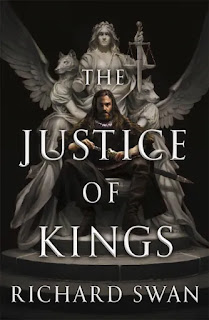
#Review - The Justice of Kings by Richard Swan

The Justice of Kings
Richard Swan
Orbit, 24 February 2022
Available as: HB, 413pps e, audio
ISBN(HB): 9780356516424

I'm grateful to the publisher for an advance copy of The Justice of Kings to consider for review.

Well. this is one of those books that's hard to review, I'm very tempted just to say READ IT, but that wouldn't be very useful, would it?

So I'll try harder. The Justice of Kings is a type of fantasy I don't often read - an epic, sprawling depiction of a world filled with magic, armies, politics and strange names. I think the reason I read few of these books is less that there aren't brilliant ones around, there are, it's more a feeling that this kind of thing has been done so much I will either be let down by a book being derivative, or by it trying too hard not to be. Does that make sense?

Fortunately, I also receive some excellent recs from a certain person at Orbit and when Nazia tells me to take notice, I know I should listen. So here we are and here's The Justice of Kings, a book that for me felt refreshingly different while not visibly straining to do that. 

This is helped immeasurably by the viewpoint. The story is seen from the perspective af young woman - Helena Sedanka - who is employed as clerk to an itinerant judge. Sir Konrad Vonvalt is a sworn upholder of the Common Law, travelling endless muddy backroads from village to village and town to town with just Helena and his assistant, Dubine Bressinger. This is a group of well-realised characters: the rebellious and slightly bored Helena, Sir Konrad, an ex-military man and the slightly mysterious Dubbing who's devoted to Sir Konrad and at times, treats Helena quite harshly when she seems to display and lack of respect for his master. The three know each other really well, and the blurred relationships here - colleague, boss, friend - and endless journeys create a lot of scope for both sympathetic understanding and for drastic misunderstanding. Helena and Dubine are, for example, often forced to share a bed in a scatty inn or leaky manor house, but nothing "happens" between them. A running gag has Helena desperate for something to eat on arrival, cold and saddle saw, at a stopping point but ordered instead to Sir Konrad's chamber to discuss an arcane point of law or politics. This girl really needs to eat, I found myself saying many times as I read the story.

Setting things up for a trilogy always takes a good deal of work, and I think the opening here is as goods as I've seen anywhere. A judge, of course, provides a way in to most parts of society - as part of the apparatus of an Empire, Sir Konrad has a function that allows him to ask questions, even of the functionaries of that Empire - and the nature of the role means there will be varied opportunities to do this, the larger part of this story focusing on one, the murder of a noblewoman in a trading port.

At the same time, Sir Konrad's powers aren't unlimited. They're bound of course by the law itself, but also by a standoff between state and religion, the latter being a vital part of the bonds that hold together a fairly young Empire. They're also limited by the dynamics of that society, formed from many separate, conquered nations (the wars are still fresh in many minds, causing resentment, prejudice and all kinds of frictions). That makes his job hard at times, as in this story where the murder investigation - this book is very much a "whodunnit" -  will tread on many sensitive toes, exposing political and religious schemes and leading in the end to a minor war.

Wider political turmoil is also prefigured from the very start, in Helena's introduction - she makes clear that she is writing this account from the viewpoint of old age, and that unspecified disasters have overtaken the Empire, so while we're assured that she will make it through this book (though not necessarily unscathed) there is a sense of coming darkness over everything, and Sir Konrad's role as the upholder of law and justice seems increasingly menaced.

In short, there's a lot going on in this book but the necessary scenesetting is done very skilfully and always supports the needs of an involving an ingenious immediate plot, while providing the groundwork for a much wider story. The depictions of authorities - whether legal, political or religious - is convincing and subtle and I enjoyed the book's recognition of the dark side of Empire as the characters here deal with the aftermath of war, the absorption or appropriation of natures and cultures, and with discrimination (in an apparently multicultural State) between peoples and groups.

The Justice of Kings was a joy to read, a properly immersive story that demanded attention but also a decent amount of time: there's a lot happening, the text is rich, the characters are well-rounded and don't always do what you expect or want (at times, teenage Helena is quite whiney, but I did sympathise) so the story takes time and attention, not skimming of fast reading. 

To learn more about The Justice of Kings, see the publisher's website here.


24 March 2022

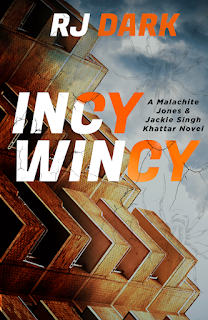
#Review - Incy Wincy by RJ Dark

Incy Wincy (Mal and Jackie, 2)
RJ Dark
Wavesback, 24 March 2022
Available as: e
Source: Advance copy
ASIN: B09DTM61SN

I'm grateful to the publisher for a free advance e-copy of Incy Wincy to consider for review.

Last year's A Numbers Game debuted mystery crime newcomer RJ Dark's not-so-cosy series, featuring psychic fraud Malachite Jones and "respected local businessman" Jackie Singh Khattar who solve crimes on the Blade's Edge Estate, a rough district of an unnamed Yorkshire town. In this follow-up, Dark turns to a story that goes deeper into Mal's and Jackie's backgrounds.

After the events of the first book, Jackie has decided that Mal's psychic business needs rebranding as a detective agency. Of course, Mal gets no say in this, and the first he knows is when Jackie has a new sign installed over the shop. Cue a running gag where Mal says, in effect, I don't know, I'm not a detective and Jackie responds by citing the sign.

It's probably fitting, given Jackie's hand in creating the "agency" that its first case involves tracking down one of his mates (the "Spider" to whom the title nods). Spider is ex-army, like Jackie, and it turns out that other members of his squad live nearby and that understanding their past will be key to explaining what has happened to Spider. Similarly, Mal's earlier life as a homeless drug-user will also be relevant, not least in providing him with contacts to work (fairly likely that an ex-squaddie will end up among the street people, right?)

But it's not a straightforward case (which of Mal's cases ever are?) Pretty soon the usual pattern emerges as figures both familiar -  the 'Kray Twins', Trolley Mick, the town's Russian gangsters - and new - a smooth talking American - turn up at Jackie's shop to threaten him if he either won't give up a line of enquiry or won't take a side job. It gets more and more menacing, as Jackie can't be there all the time to defend Mal (and anyway, Jackie has bigger problems of his own). Mal's by no means a helpless victim in all this, he's actually a pretty shrewd and streetwise character, but the degree of peril in this book felt on a different scale to the previous one.

Add in Yorkshire's own racist front, a missing boy and a crop of UFO sightings and there is almost too much here to wrap one's brain round. Almost, I write, because Dark's story zooms along with brio, carrying us with no apparent effort from nasty fight to intriguing clue to dissecting the nature of the society that has produced Blade's Edge. There's some heartfelt, well argued criticism here, Dark comes across as really knowing his stuff. It's  very, very entertaining read, a book with a punchy plot, hard-hitting but humorous dialogue and developed, relatable characters. 

Oh - and there's a climax that had me biting my nails.

I'd strongly recommend - you can buy the e-book here from Amazon.

23 March 2022

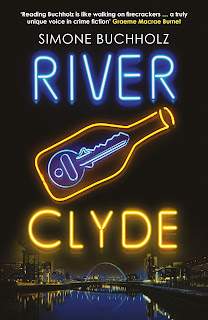
#BlogTour #Review - River Clyde by Simone Buchholz

River Clyde (Chastity Riley, Book 5)
Simone Buchholz (trans by Rachel Ward)
Orenda Books, 17 March
Available as: PB, 276pp, e, audio
Source: Advance copy
ISBN(PB): 9781914585074

I'm grateful to Orenda books for an advance copy of River Clyde to consider for review, and to Anne Cater for inviting me to take part in the blogtour.

There's something about a river that just lends itself to introducing a place, don't you think? Or as a character, a situation, a mood? 'the river lies there like over a hundred miles of dead man' writes Buchholtz. Here comes Chastity Riley, sideswiped by grief, loss ('I think about my dead friend, Faller'), PTSD, call it what you will, after the events of Hotel Cartagena, making a very personal journey into the heart of (her own) darkness and also into her - and her family's - past.

Buchholz is really bold with this one. It's not a crime story. There's a little bit of a crime thing going on back in Hamburg (more about that in a moment) but it doesn't concern Riley so much as show up the effects of the dreadful blow that the group of friends has suffered. Rather, here, the moodiness, the noiriness, the silent scream which has haunted Riley through all these books, has now fully swallowed her, and it looks as though she's run off. But is she running from - or to?

So. Why Scotland? Why Glasgow? Well, it seems Riley's inherited a house from a distant relative, and she's come to take a look and decide what to do with it. But Riley being Riley, nothing is straightforward, so she gets off on a bad footing with the solicitor who's handling the estate, can't find the house and sets to exploring Glasgow's pub scene. She eventually locates the house through a man she meets in a bar, of course - Riley is most enthusiastic in exploring Glasgow's pubs. Indeed the book shows a familiarity with (and love of) the city - and not just its drinking dens - as our heroine orients herself. It's a different Riley we see from when in Hamburg where she's on familiar, if tainted, ground. In Glasgow, she's exploring, evaluating, assembling a relationship with the place. 

As it is with her, for in this story Buchholz doesn't give us hard-boiled noir: there are sections in the voice of the Clyde himself, responding to Riley. There are time-slips, showing glimpses back into the lives that came before her and indeed condensing into a couple of pages what could form an entire family saga - a story of emigration, loss, disillusion, struggle that tells us a great deal about the woman she is. There are, too, moments that approach the ghost story though whether that is an objectively real ghost or a projection of Riley's tormented memories I really wasn't sure.

It's a kind of dark homecoming, Riley finally being forced - by the losses she's been through - do the work, confront the things, we've seen her shutting out all through her Hamburg life. 

And, yes, we do meet the little circle of friend back there: Stepanovic and Calabretta are investigating a wave of outrageous arson attacks, the café is open for business but there is a hollowness, an uneasiness that was hinted at in earlier books but has now finally blossomed. They discover that they are, in fact standing too close to the Blue Night, which is not 'just any old pub, it's a place of yearning, it's the desire for old times, when everything was broken just enough, so not too much, not ripped to shreds'. Rocco and Carla are sitting at a pavement table facing realities: 

'Perhaps Carla's not even this irresistible Venus fly trap but a pub beauty who's no longer in the first flush of youth. Maybe Rocco's not even this audacious survival artist, but a guy with gradually thinning, tousled hair, who's never actually completed a thing'.

Similarly, from the moment that Schulle, Brückner, Inceman and Anne Stanislawski are introduced 'lying on a colourful chequered blanket' in a park, we understand that all is not well. Buchholz is excellent at conjuring the spiritual malaise that has fallen on this vivacious, bawdy group of people but she doesn't present to offer answers to it. Perhaps, by the end of the story they're groping out of the dark, or perhaps not. Riley's still missing and her absence counts for a lot...

As ever, Rachel Ward's translation is glorious, interacting gleefully with Buchholz's text to give gems such as 'I love it, it's the opposite of innocuous small talk. It's enormous talk, and very nocuous indeed' and conveying the different moods of the various point of view characters - including a river. The result is glorious, haunting, sad, funny and breathtakingly readable. A great addition to the series and - if this is where it ends (I hope it doesn't) - a fitting conclusion. 

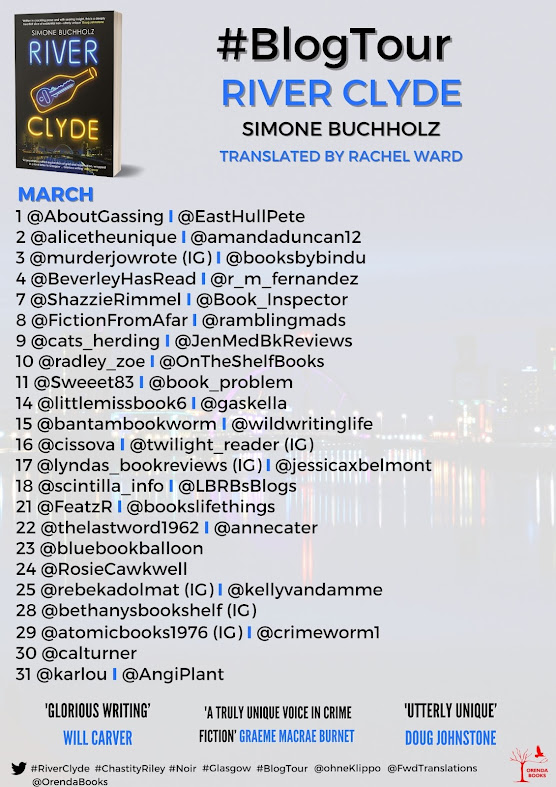
For more information about River Clyde, see the stops on the tour - listed on the poster below - and also the Orenda Books website here. You can buy River Clyde from your local bookshop, or online from Bookshop UK, Hive Books, Blackwell's, Foyles, WH Smith, Waterstones or Amazon.


21 March 2022

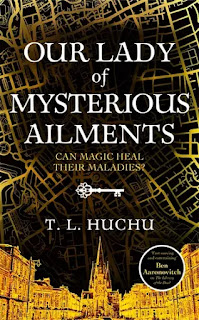
#BlogTour #Review - Our Lady of Mysterious Ailments by TL Huchu

Our Lady of Mysterious Ailments (Edinburgh Nights, 2)
TL Huchu
Macmillan, 3 March 2022
Available as: HB, 372pp, e, audio
Source: Advance copy
ISBN(HB): 9781529039528

I'm grateful to the publisher, and to Black Crow PR, for letting me have an advance copy of Our Lady of Mysterious Ailments to consider for review and for inviting me to take part in the book's blogtour.

Our Lady of Mysterious Ailments sees a welcome return for Ropa Moya, a fifteen year old girl of living in a near-future Edinburgh in the wake of a cataclysm that has changed society. There has also been a civil war of sorts, perhaps an attempt at secession, which has left Edinburgh stricken and firmly under London's heel. Everyone is nervously determined to perform their loyalty: 

'God save the King!'

'Long may he reign'

The city is poorer, in something like its 18th century state with carts in the streets and only the wealthy able to drive motor vehicles. Ropa lives in a caravan on the city's fringes with her Gran and little sister, Izwi. The site they live on is half slum, half refugee camp, and Ropa's their main provider, so at the start off the book considers herself fortunate to have landed herself an apprenticeship with Sir Ian Callender, Secretary to the Society of Sceptical Enquirers, Scotland's leading magical society. It's a development that has put noses out of joint at Scotland's elite magical Schools, and unfortunately Ropa is in for a fall, one that leaves her in desperately needing cash and puts her in the way of a little private business helping out her mate Priya.

Huchu writes this book very much from the perspective of those at the bottom. Ropa has a magical mystery to solve, but she easily spends as much time trying to keep her head above water and her family fed. Grabbing the odd gig at her old role conveying messages form the recently departed. Scrounging food (foraging for plums, killing an unlucky rabbit with her catapult). Trading the results with a web of contacts. Preparing meals. Negotiating with the Edinburgh gangs, whose perpetual Cold War has flared hot. And in the course of this we're shown many of the outcasts on the "informal" side of this magical Edinburgh, as well as the lofty ones who dominate it.

With the basics introduced in the previous book, The Library of the Dead, Huchu combines the mystery which is the ostensible subject here - a posh schoolboy who's fallen into a perplexing magical coma, one the skilled staff at the Our Lady of Mysterious Ailments hospital are baffled by - with a lot more backstory about Ropa, the Society and even Roma's Gran. It seems she has connections with the travelling people as well being known to Sir Ian. Exactly how and why we don't learn, Gran's not talking (I sensed a certain Granny Weatherwax stubbornness in her...) but it seems to have done Ropa no favours with the formal magical world. (In this series of books, prejudice is alive and well, and certain forms of magic are definitely considered less prestigious).

We also learn more about the history of this world, which is tantalisingly entwined with our own. A sub-plot exposes the Society's links to Scotland's shot at colonialism, the doomed Darien schemes, making the point (in an understated way) that many of our institutions have blood at their roots. But history has a way of biting back, and the goings-on in Edinburgh are also mixed up with high politics...

I loved this book, perhaps even more than The Library of the Dead. Ropa is an engaging main character, apt to quote philosophy one moment, philosophy the next and then quantum physics down the page. She's a restless, bright mind, seeing through the superficiality of society and in her magical learning, impatient with having to go through the basics when she's so much more talented than many around her. Which, of course, doesn't make her very popular - she's definitely attracted one Nemesis already.

There's also a sharp eye for injustice here. When all is revealed about who has been pulling strings, old school ties and friends-of-friends are enough to ensure that they dodge trouble and that a scapegoat is found instead. Magic may be fun and powerful, but it's bound up with a net of privilege and influence which is taken more or less for granted. I'm guessing that Ropa's patience with this situation (never abundant) isn't going to last through many more books and I look forward to fireworks ahead.

Overall, an inventive, engaging read, a book with great heart and passion and which is, above all, FUN from first page to last. Do read this - you don't have to have read The Library of the Dead first, but you will want to read it when you are done, I think.

For more information about Our Lady of Mysterious Ailments see the publisher's website here. You can buy Our Lady of Mysterious Ailments from your local bookshop, or online from Bookshop, Hive Books, Blackwell's, Foyles, WH Smith, Waterstones or Amazon.


17 March 2022

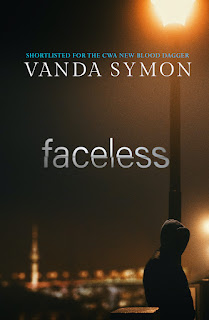
#Blogtour #Review - Faceless by Vanda Symon

Faceless
Vanda Symon
Orenda Books, 17 March 2022
Available as: PB, 276pp, e
Source: Advance copy
ISBN(PB): 9781914585043

I'm grateful to Karen at Orenda Books for an advance copy of Faceless to consider for review, and to Anne for inviting me to take part in the Random Things Blogtour (on publication day too, what an honour!)

I was already familiar with Vanda Symon's Sam Shephard books, crime stories focussing on a young and impulsive New Zealand detective who generally stumbles into more trouble than she expects. While they do sometimes involve, as the film classification people might say, a degree of peril, Sam's adventures are fairly light in tone and at times, are even humorous (in a cynical sort of way).

Well. In Faceless, Symon has produced something altogether darker, much more "psychological" and which is often genuinely disturbing in a "dare I even turn the page?" sense.

We first see Billy, a young homeless woman, decorating a wall with a powerful piece of art. (She doesn't like the word "graffiti"). Short of cash for spraycans to finish the job, Billy has no objection to earning some money as a sex worker and so encounters Bradley; she will later wish she hadn't. It's not long before Billy disappears, and it seems the only person who cares about that is her friend Max, who's also homeless.

Symon's story is built around Billy and Max and, of course, Bradley. 

Each is a powerful study. 

Billy has encountered darkness and suffering in her short life, but she met them face on, with strength, her own goals in sight (such as the 'Pacifica Britannia ruling the waves' we see her create at the start of the story). Billy will soon suffer much more, and she will meet that trial with courage and hope. 

Max has his own darkness, which we will learn much more about it in the course of the book: he has fallen, let people down and lost a lot. But there's a sense here of him as a moral force in this book - scabby, smelly and unappealing as many judge him to be (even the pimps and street gangs reject him). Max has a mission and he won't give up, but events will force him to revisit that darkness and the hurt he caused. Is it too late for any redemption?

Then there's Bradley. At the beginning Symon seems to suggest the reader may have some pity for him, squeezed as he is between a failing marriage and a bully of a boss. (Bradley's an overworked accountant in a white collar sweatshop). This is a very clever way into his character because as Symon's portrayal of Bradley develops, we begin to see that pity is indeed the key to him - but that actually it's Bradley's self-pity. That leads him to commit a terrible act, but it isn't anywhere near the end of what he might do. Like Billy and Max, Bradley is on a journey of self-discovery but it's a journey into the full darkness of his personality - and it's one he finds himself actually enjoying, a flowering of evil, as it were. I found Symon's exploration of Bradley truly enthralling, if often pretty repellant. (I would warn the reader that there are some really grim scenes here). There's a raw sense of male entitlement, of toxicity, to him and I began to wonder how far to trust his protestations that this was all an aberration and he wanted out. I mean, who carries bunches of cable ties in their car?

Symons very skilfully presents these characters. Bradley is a very vivid presence in the book, albeit a much less comfortable one. Billy's position means she is often reactive, but increasingly delves deep to finds ways to survive. Those often draw on her relationship with Max; while, because of the way the story unfolds we don't actually see Max and Billy together much, Symon is very good at portraying their relationship through remembered incidents, little kindnesses and moments of hope - and what Max tells others as he searches for clues about Billy's whereabouts, which also, gradually, reveals his past and shows how far he has fallen.

Written in short chapters and rapidly switching perspectives, Faceless has a real sense of urgency both in its style and pacing and in the competing drives of the participants. It kept me turning pages throughout. The themes are primal: escape, degradation (of self and others), redemption, strength, courage and survival. The tension fairly crackles off the page.

As you may have noticed(!) I really enjoyed Faceless, and I'd like you to, as well. A strong recommendation from me then and I'll be intrigued to see whether Symon's next book returns to the (relatively) gentler territory of Sam Shephard (which would be great) or continues in this more troubling vein (also, great).

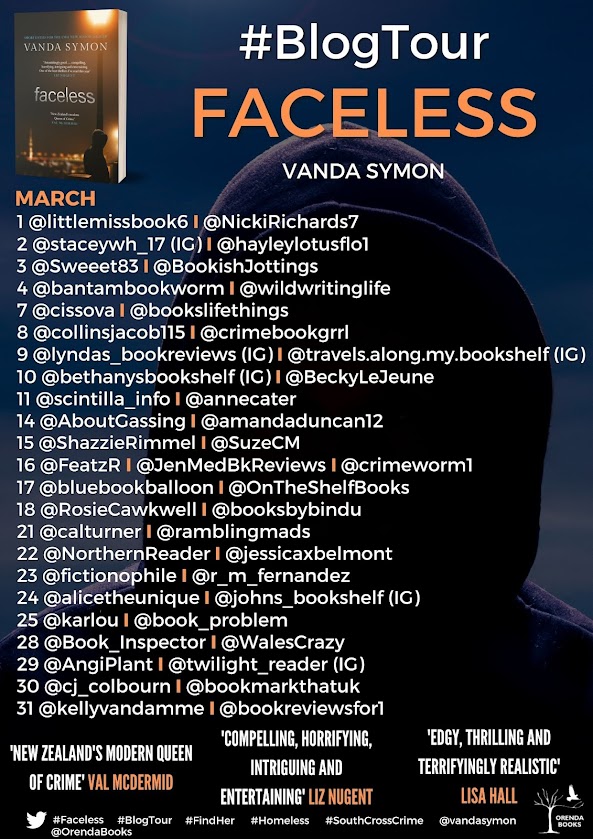
For more information about Faceless, see the stops on the tour listed on the poster, and also the publisher website here. You can buy Faceless form your local highstreet bookshop, or online from Bookshop UK, from Hive Books, Blackwells, Foyles, WH Smith, Waterstones or Amazon.


15 March 2022

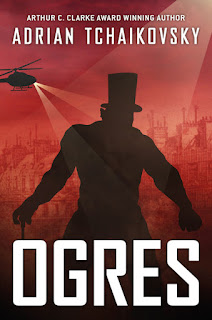
#Review - Ogres by Adrian Tchaikovsky

Ogres
Adrian Tchaikovsky
Rebellion, 15 March 2022
Available as: HB, 144pp (17 March), e, audio
Source: Advance copy
ISBN(HB): 9781786185280

I'm grateful to the publisher for a free advance copy of Ogres via Netgalley to consider for review.

In this standalone novella, Tchaikovsky explores a future where genetic engineering has produced a race of monsters - the "ogres" of the title - who oppress and dominate humans.

The main character is Torquell, the son of a village head, who comes across as a bit of a tearaway, reluctant to tug his forelock before the Masters. Good for him I say - the ogres in this book have adopted the role of feudal overlords, taking what they will and treating the peasants abominably. It later becomes clear that they also operate a form of robber-baron capitalism, with the worst aspects the Industrial Revolution gleefully reintroduced. So I'm all for opposition, but it seems doomed.

As an outlaw, Torquell's challenge is then first to understand how all this came to be and then to do something about it. It's a formidable task, as the ogres are not only collectively in charge but individually stronger and much bigger than any given human. But there is more going on here than that, something hinted at by the story being narrated not by Torquell, but to him, in the second person ('You were always trouble' are its opening words) so we sense other actors on the stage, perhaps.

I really enjoyed this one. The world which is seen through other eyes may seem rather alien, and be set in the future, but increasingly I began to see correspondences with our own world. It's explicitly a near future dystopia (I think it's fair to call it that) representing a world which claims to have solved certain problems - environmental and social - but at the pice of introducing others (you'll have to read it to understand which). Tchaikovsky's argument is though, I think, that those "new" problems, embodied in the society that he describes here may not really be that new at all. As with the best SF, the book holds up a mirror to our own society, both to its evident flaws and also to the damage that may be done in trying to correct them. 

In centring on a driven, if originally reluctant, leader figure it also gently satirises the hero tropes of the dystopian genre: that opening passage continues 'Inevitable, really. And you weren't to know it, but you were following a particular trajectory. The Young Prince is always trouble...' The narrator returns to this theme several times throughout the story, comparing Torquell to the protagonist in the Hero's Journey, not always to his credit. The biological determinism of the process that created the ogres therefore hangs over Torquell himself as a sort of plot determinism, asking us what he is, why, and what he might become.

And whether the template will be followed to the end...

For a short book - I read it in a day - this one packs a tremendous amount in, and truly left me thinking.

For more information about Ogres, see the publisher's website here.
 

10 March 2022

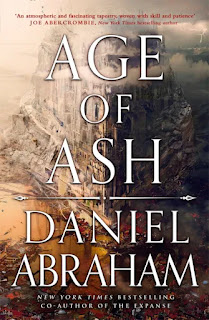
#Review - Age of Ash by Daniel Abraham

Age of Ash (Kithamar Trilogy, 1)
Daniel Abraham
Orbit, 17 February 2022
Available as: HB, 432pp, e, audio
Source: Advance copy
ISBN(HB): 9780356515427

I'm grateful to Orbit for an advance copy of Age of Ash to consider for review.

In Age of Ash's setting, the city of Kithamar, Daniel Abraham has surely created a classic fantasy city to rival Viriconium, Ankh-Morpork or Minas Tirith. His description of Kithamar's different enclaves, from Riverport to Seepwater to Longhill - especially Longhill - is vivid and utterly convincing, bound together by a dizzying web of activity as the citizens try, by means both legitimate and criminal, to keep themselves fed, housed and warm. Everyone has a thing going on - or two, or three - and everyone's position is precarious. We meet a city guard who's going to fall from grace, tradespeople of all descriptions - from wealthy merchants to knife grinders to bakers, butchers and candlemakers - whose prosperity balances on a knife edge, able to be ruined by a bout of illness, a caravan gone awry, a theft. There are prisoners shovelling up shit in the streets. There are thieves and con artists. And there are some even shadier figures. 

The streets of Kithamar are bustling, vibrant and alive, Abraham taking us through one year of the place from the lazy days of later summer, when a ruler dies, through the glut and debauch of harvest with all the produce of the hinterland rolling into town to the perishing cold of winter, the promise of Spring and then, another dead ruler. The effect is simply hypnotic, the hardscrabble warp and weft of unregarded lives playing out against a background of sorcery and political intrigue. It may be a bit of a cliché to say so but Kithamar really is the central character in this book.

But not the only central character. Meet Alys, our guide in all the hurly-burly of Kithamar. Alys is smart, a street girl making her living as part of a pickpocket gang. Alys is a glorious creation, sharp, self-assured (outwardly) and gloriously pigheaded but unable to see what's right in front of her. 

Meet Sammish. She's Alys's best mate, another young woman who has the crush of all crushes on Alys. Maybe "crush" is a bit unfair - Sammish is positively smitten, head over heels, but Alys can't see it. Her focus in this story is rather on her dead brother and her hunt for his killer, and Sammish finds herself being used, willingly used perhaps, but used all the same, as part of that. The tension between the two women drives this story, Sammish suffering as Alys dreams up ever more outlandish schemes to find the truth. Inevitably, Sammish begins to make her own discoveries, threatening the friendship between the two, sending Alys off to new friends, risking Sammish becoming "street bound". And in Kithamar, you need your friends, you can't afford to lose your edge...

I was bowled over by the sheer zest of this book, but also by its meticulous layers of detail, its addressing of various realities of life in a city like Kithamar. For example, half of what we see of Sammish is her simply trying to make a living, running several jobs at once and then getting distracted form them and losing money she can't spare when Alys comes knocking. The whole thing reminded me of a Hogarth etching, the multifarious figures of city life glimpsed about their doings, with dire warnings of what might come and raucous enjoyment of today: eat, drink and be merry, for tomorrow we die. And Alys herself runs into trouble: she's from Longhill, the oldest district of the city and one whose people see themselves as slightly apart from the rest. Longhill tends to look down on anyone who gets a bit of coin together and moves out. Longhill looks after its own, but it's a pinched, inward looking belonging - as Alys is about to find out. 

Alys's grief through most of this story, and Sammish's love - or at least lust - are powerful themes, the primary drivers of the two women's actions even when more abstract strands of plot emerge. Abraham is deliberately slow to introduce these strands, to move from the intricate scene setting of the first hundred pages or so and bring in politics and dark secrets. I've seen some reviewers who didn't get on with that, but for me, I liked that order of priorities. I loved the establishing of these striking, captivating characters and of the city where they live. Age of Ash gives, I think, a gutter level view of fantasy. It's all very well, it seems to be saying, running off in pursuit of magic and conspiracies, but that doesn't put food on the table and it doesn't help when the girl you want has other ideas. This is truly human fantasy. Yes, there is enough chicanery going on here too satisfy any reader, and hints of darknesses and ancient evils, but its effects are mainly personal, intimate: a mother and her son, a broken friendship - and negotiating these is also the, very human, way that right can prevail and a kind of patched up wholeness be restored.

So, really, all I can say is, read Age of Ash! It's simply superb. Don't miss this one, please don't.

For more information about Age of Ash, see the Orbit website here.