I like talking about books, reading books, buying books, dusting books... er, just being with books.
5 February 2021
#BlogTour #Review - Winter's Orbit by Everina Maxwell
3 February 2021
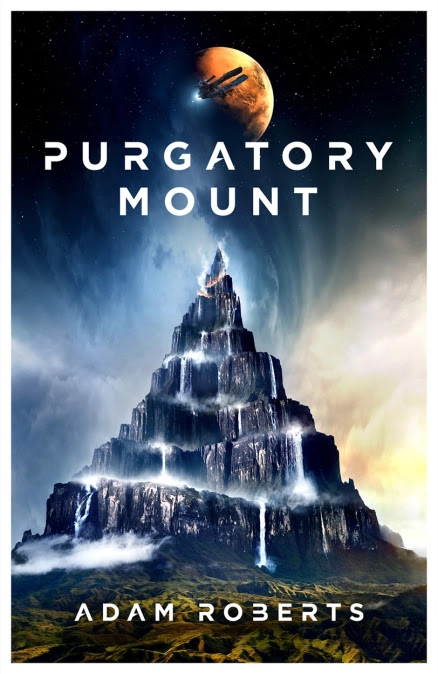
#Review - Purgatory Mount by Adam Roberts
Adam Roberts
Gollancz, 4 February 2021
Available as: HB, 336pp, e, audio
Source: Advance e-copy via NetGalley
ISBN: 9781473230941
I'm grateful to the publisher for an advance e-copy of Purgatory Mount via NetGalley.
The eagles are coming!
The eagles are here!
Adam Roberts is one author I'll always, always take time to read and I'd been sp looking forward to Purgatory Mount. I thought I knew what it was going to be about, and it was that... but also it wasn't, it turned out to be something much bigger and very different and thoroughly ramified. It does, though, rather defy a neat review. I could just say, buy this, and stop at that but I really want to persuade you, so let's try that.
Opening as a city-sized interstellar exploration ship, the Forward, arrives from Earth at a distant planet, V538 Aurigae - gamma, we seem to be in hard SF territory with a description of the long voyage, the peculiar emptiness of space in the interstellar "Local Bubble", the ice-encrusted ship itself (the ice provides both a shield and fuel), the crew - who are able to alter their perception to live faster or slower, surviving the generations long (for their livestock) voyage - and the mysterious alien artefact that has drawn Earthly attention. No, not an obelisk - an immense spire so high that it soars beyond the planet's atmosphere (indeed, beyond the original, deeper atmosphere long eroded by the local star).
What is the spire made of?
What is it for?
Where did the makers go?
Just as we might think we know what's coming - Roberts will describe the crew's exploration and tease out these mysteries - he knocks the reader sideways by adopting a different genre, the near future thriller, and location, the USA a few years from now. That country is on the edge of civil war ('The problem is - there are plenty of people real keen to shoot their guns and run around in combat gear'). Ottoline (Otty to her friends, who call themselves the Famous Five in a reference which I suspect isn't to be found in the cultural life of the typical American teenager, now or near future) is fleeing from the adults. From government law enforcement. From the gun-toting militias. From a mysterious third faction.
The description of the rending fabric of a modern state is terribly compelling and oh so convincing, particularly in that there isn't an overnight collapse. Otty sees a bureaucracy staggering, still trying to function, but losing its coherence and purpose. Even at the level of the combat, the increasingly dislocated refugees, the writing is terrific (in both senses) and remembering the turmoil on 6 January, I couldn't help compare this vision of a USA that has begun eating itself to that coverage on CNN of the swamping of the Capitol by an army of grotesques.
That conjunction, which couldn't have been foreseen, makes this book seem prescient in detail, seem predictive, to an extent that may distract the reader from what I think is more fundamental, and intended, a sort of moral prescience which becomes clearer towards the end. But still, the idea of incipient civil war, of rage and destruction spraying in all directions, the urgency with which Roberts captures the violence, the unholy beauty he finds - look at the description of a coach being blown up ('Boom, boom, shake the room. Crush, crush, flip the bus') - all of this makes the book absolutely, grabbingly, compulsive.
Roberts pulls out all the cultural stops in characterising this process, from the explosion 'like a colossal door being slammed shut somewhere in Hell' (yes, we know what that would be) to the queue jumping mob ('wearing Old Glory jackets and red MAGA caps') who try to barge onto the bus to the sharp eyed lawyers and journalists who prowl through the ruins trying to make a turn from the chaos. It's a purgatorial landscape for a sixteen year old to find herself traversing and there are no more answers as to why all this is going on than there are to why Otty is being targeted. We see a limited explanation from one character, that it's all about the money (in New Model Army, Roberts posited an almost cheerful, open-source approach to urban warfare, with some idealism driving it, here the mood is a great deal darker, more despairing).
I started reading this near-future section thinking, what's this - when do we get back to the Forward? - then found myself more and more drawn by the hectic story, the scrapes, the sheer guile and courage of a young woman whose life has been upended. We don't know, for most of the story, why Otty is on the run. She's far too canny to reveal that, to us or her interrogators. But her pursuers are clearly bad, tainted in some sense by an association with the chaos and destruction raining down and slowly, surely, they push Otty to a desperate place and to an act with unforeseeable consequences.
We do return to the Forward again, eventually, for a final act in which the connection between the two timelines is made clear. Otty's experiences turn out to be foundational to the existence of the Forward and its crew, but also to the position of others on board - to the creatures known as "Pygs" who worship the Crew as gods. And they drive the actions of both in a moral sense, Roberts invoking the concepts of Heaven, Hell and Purgatory - sidestepping the hard physics question of how that incredible, planet-topping spire was built and how it stands up for the more interesting question of what it means and what that means for those who have travelled so far to see it.
That feels like a place I could stop - Purgatory Mount an utterly compelling book, fiercely intelligent and unconventional SF rife with ideas yet completely approachable and fun to read - but I think I also have to point out a couple of further things. First, Roberts' writing is glorious, subtlely varying to fit its subject - for example look at the down to earth, dryly humorous, opening section, even amidst all that science-y exposition, or the beauty he often evokes ('the sky was starting to blush strawberry and yellow-orange, with bars of luminous cream-coloured horizontal shine layered over the top of it'). It can also be mischievous, or mischievously inventive, as with the word 'sidegoogling' which occurs a few times (I NEED that word!) or references to the Forward's 'hal', its AI. And how about 'her heart was beating in her chest like Animal from the Muppets playing the drums'?
Which reference brings me to the second thing I wanted to mention here (and then I'm done, I promise). This book is drenched with Lord of the Rings references and comparisons. Most broadly, there's the whole device of telling us, as Roberts does in several places, that names or cultural references used to describe the ship or its crew have been translated into terms we can relate to from something utterly strange that we wouldn't get. (In fact the most blatant example of this didn't, as the author tells us in an afterword, survive copyright issues - he wanted to give the five members of the Crew the names of the five wizards from The Lord of the Rings and indeed Pan, the one we meet most, 'a figure gifted with magic (in the Clarkean sense of the word) and given responsibility over beats, birds and plants...' would make a fine Radagast). There is also lots of detail, such as tree trunks which 'shuddered and moaned like Ents' at the force of an explosion, way bread, or all those references to eagles - The eagles are coming! The eagles are here! - but also 'Somebody would come to rescue her and she would fly away on the back of a Johannine eagle'. The latter bridges the gap between Tolkienish references and the Christian ones behind Purgatory Mount, with its themes of offence, of sin, redemption and atonement.
In short, this book is a glittering achievement, Adam Roberts in full splendour giving us a novel of ideas, of fun, of beauty. Go and get it.
For more about Purgatory Mount, see the publisher's website here.
1 February 2021
#Review - Slough House by Mick Herron
Mick Herron
John Murray, 4 February 2021
Available as: HB, 307pp, e, audio
Source: advance e-copy via Netgalley and ARC
I'm grateful to the publisher for an advance copy of Slough House via NetGalley and also to Dave for sending me a spare ARC which he received.
Herron's Slough House series always sparkles, but this one was an especial joy to read. All the usual reprobates are here - River, still coming to terms with the death of his grandfather, hoping for clues of some sort from the contents of the OB's study. Roddy Ho, the most self-regarding and empathetically challenged IT whiz you ever met. Lech, with his self-scarred face. Catherine, sneaking drink home from off-licences and corner shops and then pouting it down the drain. Louisa. Shirley the Dancing Queen.
And Jackson Lamb himself, who seems to smoke so much you'd imagine it would be easier simply to pump it in from a tank.
The thing about this lot is they're supposed to be the Secret Service's 'Slow Horses' - the losers and also-rans who are still on the payroll to keep them quiet, but who can't, we are told, be trusted with anything important. As we've seen, though, in truth most are parked in Slough House because of who they've offended or what they are (especially, what they are - often, unmouldable into a conventional team, uncorporate, pig-headed or simply embarrassing) or simply because they have messed up and embarrassed the Service - not because they are incompetent or lazy. It's never stated in so many words but when they are called to action they can be formidable, and naturally they save the day.
This time though, things are a little different. Slough House, that standing joke, has apparently become so much of a laughing stock that it's been removed from the Service's records. And some of its ex-members are beginning to die off. That's the second thing that delighted me about this book - a bit more of the continuity in that we see what happened to some of those who dropped out earlier. (Spoiler: not all of it's good).
The third thing I loved was the delicate relationship that Herron's world has to ours, to recent events, especially You Know What, as he calls it - so I won't say it out loud. But You Know What. In his world, it has devastated Britain's alliances, robbed us of cash and influence and emboldened opportunistic populists. A useless, old Etonian PM has risen to power and he's being pressed hard by a "yellow vest" movement, determined to roll back progress and trying to get their hooks into the Service to advance that aim. Wholly unlike our own reality, of course, though you may feel that some of Herron's sharper darts strike home rather well, all the same.
The fourth thing (I should stop counting) I loved was the delicate tribute that seemed to be being paid at times to John Le Carré* and especially to his final novel, Agent Running in the Field. That book complimented Herron by borrowing the Slough House idea but also contained its own excoriating critique of You Know What. Here Herron repays the compliment both subtly - there are a couple of clever references to circuses; Regents Park, the Service's HQ, has 'database Queens' to match le Carré's 'register Queens' and archivist Molly, who oversees them, is a dead ringer for Le Carré's Connie - and through that central motif of exploring why we fight and whether the means adopted might render assumptions of patriotism, moral superiority and rectitude arguably moot. Certainly Diana, First Desk at Regent's Park, has got herself and her Service into some ambiguous places, even if prompted by the (real life) use by the Russian state of chemical weapons in the UK.
Jackson Lamb is of course your go-to man for walking on the dirty side of the street (not least because if he walks one side of a street, it WILL be the dirty side, even if it wasn't before). We cheer on this chain-smoking, foul mouthed, offensive candidate for a COPD ward because he has an authenticity and a morality that contrasts with all the smoother types here, even if he is just as, or even more, arrogant than them. And Jackson has collected his team of oddballs and no-hopers for a purpose, they're not just going to stand by and let things go bad or what wold have been the purpose of their, various, downfalls and exile?
If all the foregoing hasn't convinced you to read this book, I fear nothing may, but I can add more! This is a well, even deviously, plotted story, with a number of central mysteries that keeps the reader hooked right to the end. The wider roster of characters allows Herron to highlight both tenderness (River and one of the ex-colleagues) and amusing (Shirley and Lech) aspects of their relationships - a strength of course of an ongoing series, or at least it is if, as here, the characters are developed consistently and well. It is terrifically sharp, with many asides that are right on the nose. And of course it is very well written, as you'd expect.
Strongly recommended.
For more information about Slough House see the publisher's website here.
*I know I'm breaking the First Rule of Reviewing here - to not directly compare the book with another - but it's meant as a compliment, I love seeing these two authors in dialogue with each other through their writings and it saddens me that it must now be a one sided conversation.
29 January 2021
#BlogTour #Review - There's Only One Danny Garvey by David F Ross
David F Ross
Orenda Books, 21 January 2021
Available as: PB, 256pp, e, audio
Source: Advance PB provided by the publisher
ISBN: 9781913193508
I'm grateful to Orenda Books and to Anne Cater of Random Things Tours for a proof copy of There's Only One Danny Garvey to consider for review - and for inviting me to take part in the blog tour.
I really shouldn't have enjoyed this book!
I'm not a great follower of football, which is a thing integral to the lives of the characters here, especially Danny and his "uncle" Higgy. Moreover, it's - designedly - obscure, lower league football taking place in the drizzle between tiny, lower league clubs in the unfashionable mid years of the 1990s, before the game turned into the slick money and marketing driven engine it is now. There's no glamour here.
But - I knew from Ross's previous writing - especially his Disco Days trilogy - how he can weave a spell, conveying the nuances of his protagonists' lives through their passions, whether for music or - as here - football. He could probably do it equally for stamp collecting or train spotting - a joke Danny would appreciate here. The utterly compelling writing succeeds totally in getting over that passion, in making it alive because, rather than despite, the flailing state of the central club, Barshaw Bridge, to which one-time high flier Danny has been called back in the hour of the team's need.
Bluntly, Barshaw Bridge is almost done, and Danny is its last hope. The club has been brought to its knees, or perhaps lower, by a combination of bad luck, stupidity, criminality and economics, but the tendency of its games to end as punch-ups didn't help. The description of the club's state is humorous and recalls the tone of the Disco Days books, but despite this and a couple of other moments, the mood of this book is generally much darker. Danny and his half-brother Raymond (neither of their dads stayed around long) had difficult childhoods, Raymond has been in and out of prison (he's currently residing at Barlinnie) and their mother, Libby, is dying. Danny returns to Barshaw reluctantly but with some idea of making amends: he ran out on his team on the eve of a vital cup tie, which they lost (it's a while before we discover why he did that), he is obsessed with the disappearance of a girl from his class in primary school in the 70s, and Higgy, who comes after him to return, is probably about the only positive figure in his life.
The story is told largely from Danny's point of view but - crucially - each section of the book is intercut with comments from another character - Higgy; Damo, Danny's nephew; Nancy, demo's mum (and Raymond's girlfriend); Raymond himself. They are generally brief comments, but enough to give insight into those people and insight into Danny himself. There's only one Danny Garvey? Rather, there are at least four, perhaps others besides.
Behind the football, then, behind the sinking town and its sinking club, is a web of relationships intersecting in Danny, which Ross slowly reveals. While this is quite a short book at just over 250 pages, Ross never gives the impression of rushing things. Rather we see Danny, Higgy, Nancy and the rest speaking for themselves and we sense - rather than being told - the kind of people they are. The distinction between the spoken language and the interior monologues reinforces this. The speech is mainly Scots dialect (and yes, fellow English people! It is perfectly comprehensible! Live a little!) while the "interior" stuff is pretty much standard English, giving the two aspects quite different voices. You might read the interior bits as having some kind of additional authority associated with being in a more "prestigious" dialect. Or you might read them as blander, more considered pronouncements contrasted with the vernacular used in the actual speech. There are so many shades of potential nuance here to be navigated by the reader trying to work out who and what, at a given moment, to believe.
There are also contrasts between three timeframes; the unavoidable "now" in which we're reading this story; the mid-90s - recent, but still a weirdly foreign time when pubs were filled with smoke and people bought newspapers; and the mid-70s when kids could be beaten in school and play out alone after dark. (A subplot concerning Damo, who is clearly a troubled child, in need of extra support which he isn't getting, struck this point home very forcefully. I hope that in the 2020s things would be a bit easier for his family). We range back and forth between Danny's adulthood and his younger days, as Ross deftly forges the chain of events leading to where things are, leading ump to Danny's reasons for wanting to put things right.
I don't think that, in the end, one can doubt his sincerity, but equally, as the story unfolds, I had a profound sense that some things bare etter left alone and that Danny might be rushing in where angels fear to tread.
This is a brilliantly evocative, captivating story, the more so for having moments so deeply sad that at times I just had to put the book aside. It is certainly a story that will remain with me, and one I continue to think about.
I'd heartily recommend it.
For more information about There's Only One Danny Garvey, see the Orenda Books website here. And take a look at the stops in the blogtour - see poster below.
You can buy There's Only One Danny Garvey from your local shop, if they're doing click-and-collect (or phone-and-collect, or email-and-collect). Or you can order online from UK Bookshop dot org, Hive Books, Blackwell's, Foyles, WH Smith, Waterstones or Amazon.
27 January 2021
#Review - The Survivors by Jane Harper
Abacus, 21 January 2021 (HB), 16 September (PB)
Available as: HB, PB, 375pp, e, audio
Source: advance e-copy
ISBN: 9781408711989 (HB) 9780349143743 (PB)
Having loved Harper's previous, Australia-set mysteries I was eagerly looking forward to The Survivors. It's just as atmospheric as them, with just as well drawn characters and an involving mystery plot, but Harper gives us a rather different sort of story - I love it when an author does a swerve like this!
In The Survivors, we visit the small coastal town of Evelyn Bay in Tasmania. It's a place dependent on tourism - busy and bustling in the summer with fierce competition for every parking place, deserted and quiet in winter apart from the keen divers who come out of season to dive the local wrecks. These are a notable local feature celebrated with a statue - the three Survivors of the title - at low tide to mark one particular disaster.
Kieran Elliott, his partner Mia and their baby daughter have come home to Evelyn Bay to help his mother Verity pack up their house. His father, Brian, is suffering from dementia and the time has come for them to move on. It's a bittersweet visit for Kieran, evoking old memories and regrets. Kieran, too, is a survivor - his brother drowned more than a decade ago, on the night of the worst storm in living memory. Kieran escaped, but with a sense of guilt - there are those that blame him for his brother's death, and more besides.
All of this is simmering beneath the calm surface of Evelyn Bay, until the death on the beach of a young woman, Bronte, makes a collision with the past unavoidable. The secrets of Evelyn Bay will be exposed and no-one may ever be the same again...
I would say this is a rather unusual crime story. The central character, Kieran Elliott, is neither a detective seeking to solve the mystery, nor a man accused of some crime and trying to clear his name. (Well, I say that - but while he is held responsible for a death, it's not the one that's central here, and he already blames himself). Rather, Kieran is - more or less - minding his own business, trying to resist getting drawn in and having the past reexamined. There is a detective here - DI Sue Pendlebury, brought in to oversee the local police - but she, and they, are pretty remote, which Harper shows by having them observed by the townsfolk: seen from afar on the telephone, searching a house or striding on the beach. We're shut off from the investigation. Pendlebury and her team are apparently search for something but we don't know what, or why. I think it's only in the last quarter or so of the book that Kieran even talks to her for any length of time.
Rather than the investigation, the focus is on Kieran's tense relationship with his mother, clearly one of those who blames him for his brother's death, and on the web of friendships and former friendships between men - mainly - who grew up together in Evelyn Bay. That's intercut with Kieran's sense of guilt, the disintegrating situation with his father and the additional stress all that places on Kieran's relationship with his partner, Mia. From a certain point of view, despite the death early on, relatively little happens in the first half of the book as Harper follows Kieran and Mia around the town, using them to explore its personalities and their connections and to convey the atmosphere of the place - peaceful and calm, but with something of an undercurrent.
The townsfolk are determined that Bronte's killer must be a stranger, not a local, but there is a sense of something darker behind Evelyn Bay's happy-go-lucky, blokes image. There's malicious chatter on the town's Internet forum. Kieran himself reflects (as he strides confidently along the beach) that he's in no danger, is he? 'Whatever else might come the way of grown men, they didn't wind up strangled to death in the surf'. We hear of boy - among that group whiling away the sleepy summer months, year before - who seduces a girl to get back at her boyfriend over a business dispute. And, most chilling of all, it's not the first time that a young woman has come to grief here, is it? It all gives the impression that a young woman's life may not be of much account.
There is, then, a powerful tension between the urge to uncover secrets, explore and explain the past and thereby, perhaps, find resolution, and the attraction of pushing the blame elsewhere, pinning it all on some unknown stranger, and getting back to business as usual. Those competing pressures meet in Kieran himself, and possibly his family, whose lives, since the storm, are almost a microcosm of Evelyn Bay.
It is all coming to a climax, but what will be revealed, and who will pay the price, is anybody's guess.
The Survivors feels, as I said, like a rather unconventional crime novel, but it is an absorbing and thought-provoking one, with themes much wider than merely identifying a killer. I'd recommend.
For more information about the book, see the publisher's webpage here.
23 January 2021
#Review - Hall of Smoke by HM Long
![]() |
| Cover by Julia Lloyd |
HM Long
Titan Books, 19 January 2021
Available as: PB, 415pp, audio, e
Source: Advance PB copy
ISBN: 9781789094985
I'm grateful to Titan Books for an advance paperback copy of Hall of Smoke to consider for review.
The term "mountain top experience" is often used in a religious context to describe an encounter between believers and their god (think Moses being given the Commandments). You climb up the mountain, away from mundane matters, into a liminal space, encounter the Deity, and return with a message or a mission (or perhaps simply changed).
At the start of Hall of Smoke, the warrior priestess Hessa is seeking such an experience. She has climbed the mountain and made a sacrifice (of her own blood) but hears nothing from Eang, Goddess of War, to whom Hessa is devoted - and who Hessa has offended by not killing the stranger Omaskat who took refuge in her village as she was ordered.
But Hessa receives no reply, only dust and ashes as her home, and the sacred Hall of the title, are destroyed by raiders from the North. It is clear what her duty is: to chase Omaskat down and kill him as she should have done in the first place. Thus begins a frenetic hunt across the Norse-tinged lands of Eangen and Algatt and the somewhat Roman seeming territory of Arpa - not forgetting trespass on the heavenly High Halls of the Otherworld themselves. The High Halls are where the dead of this world go for eternity, and loss of Eang's favour risks Hessa's place there. So she must deal with Omaskat, whatever her feelings, regardless of the laws of hospitality, heedless of the cost.
Hessa is well suited to the task, however. She's not just a priestess but a warrior priestess, trained from childhood to fight, and equipped by her goddess with a magical fire that can heal her own wounds and destroy her enemies. One of the joys - albeit a brutal joy - of this book is to see the formidable Hessa taking on her enemies, whether using weapons or her divine gifts. Another is her general determination and courage. Hessa has actually lost a lot, her family and way of life having been shattered, but with her quest in view and much more at stake - including the life and soul of a baby committed to her care - she presses on, despite growing doubts and suspicions that Eang has been hess than honest.
What follows is a fast-paced, complex and desperate chase. Hessa finds unexpected allies, and deadly enemies, but she also finds that what she's been told about her world, its gods and its history is rather partial, that the truth is complicated and that powers she knew nothing of are in motion. The story really documents her growing-up, both in her understanding of the world and her place in it and in knowing and choosing to whom, and to what, she gives service. Fighting fiercely is good, but fighting knowingly is better, and perhaps the world is less clearly drawn than it seems.
I hope that doesn't sound too sober and preachy. It really isn't Hall of Smoke is first and foremost a rollicking, combat-rich, fantasy adventure in the very best tradition, infused with a sense of active, interfering divinity redolent of the Norse or Greek mythologies. These are gods and goddesses with plans and schemes, who can be bargained with, tricked and even scared but who are also utterly amoral. In a real sense they don't deserve the service of someone like Hessa but equally, she has to live in the world as she finds it, protect what is precious to her, and prevent even worse things from emerging. What can you do? That's the dilemma at the core of Hall of Smoke, giving the book moral complexity and depth.
Great fun, always engaging, and strongly recommended.
For more information about Hall of Smoke, see the publisher's website here.
21 January 2021
#Review and #Giveaway - Radio Life by Derek B Miller
![]() |
| Jacket design by Ghost |
Derek B Miller
Jo Fletcher Books, 21 January 2021
Available as: HB, 477pp, audio, e
Source: Advance HB copy
ISBN: 9781529408584
I'm grateful to the publisher for a free advance copy of Radio Life to consider for review, and for inviting me to take part in the book's social media "blast" - see poster below for more details of that! I also have a giveaway - read on for details...
There's a lot I could say about Radio Life. Beginning with the basics, we are firmly in post-apocalyptic territory, though not a hopelessly bleak form of that as there is some organisation, there is trade, one may make a way of life. Some four hundred years from now (no-one is really sure, it was a pretty thorough apocalypse) a community calling itself The Commonwealth survives in the west of what is now the USA. Occupying the stadium from an Olympic Games held towards the end of the 21st century, they see themselves as seekers after the lost knowledge of "The Ancients", sending out "runners" and "raiders" to scavenge what they can from the ruins of the "Lost World". They store up knowledge in Archives, and work to understand what they've found - from musical scores to cryptic, and dead, electronics. The process of analysing these, lacking even basic knowledge, can seem bizarre, with both broad, top-down generalisations and shrewdly observed, detailed analysis.
Pitted against the Commonwealth are the Keepers, mysterious newcomers who believe that the old world is best left to itself. Surely it's dangerous to explore too far ('Trying to make the world better is what killed the Ancients') since this would only lead to a repeat of the earlier collapse - from which, this time, humanity might not survive?
The story is seen mostly through the eyes of Commonwealth people (citizens? members?)
There is Elimisha, a young Runner on a routine journey across the towers of the Lost World who stumbles into danger - and upon a treasure that no-one knew existed.
Lilly, in her 70s, who is one of the greatest thinkers of the Commonwealth - indeed, her discoveries led to its system for categorising all knowledge under six headings: Geography, Entertainment, History, Arts and Literature, Science and Nature, and Sports and Leisure
Teenage Alessandra is the daughter of Graham and Henry, husband and wife and the Commonwealth's two most celebrated Raiders (at the start of the book they return to the Stadium having found Knowledge under all six headings - an almost unparalleled feat). The dynamic between these three is central to the book: Henry and Graham's deep understanding of and communion with each other, their love for each other coupled with recognition of where their service with the Commonwealth might lead, Alessandra's urge to match them.
It's Alessandra and Elimisha who perhaps most exemplify the Commonwealth's view of what it is and how it should be: stumbling on an incredible treasure of Knowledge ('Trove'), Elimisha quickly fixes her response to that in Commonwealth Protocols centred on the need, above all, to retrieve it and to protect it from others. This is now the central Archive of the Commonwealth and she is its Chief.
However, Elimisha is isolated, injured and trapped and can do nothing else but begin to analyse the information she has found, learning so much more about the world than any of her people, and inevitably meeting moral dilemmas in doing that. Throughout this book, I felt that Miller's depiction of the societies here - and in particular the Commonwealth - as being shaped, or perhaps I should say limited, by the information they held, was one of its great strengths.
Take warfare, for example. In the course of this story, the Commonwealth goes to war, and understandably their attitude and approach to this is shaped by the texts they have available, by what information randomly came down to them from Before: descriptions of Hannibal's campaigns, and Thucydides' histories, apparently some limited knowledge about various Twentieth Century wars (but as we will see from Elimisha's horror when as he learns more of the truth, this is very partial). Isolated from any tradition of scholarship or commentary, will these undeniably very bright people make anything useful of that knowledge or will it mislead and confuse them?
Similarly, when we come to the larger question apparently posed in this book - the great difference between Commonwealth and Keepers over whether to hunt for old knowledge or let it die - both factions are passionate about their point of view, but also very limited by not knowing what led to the catastrophe. It's hard to accord their dispute much respect when it is all based on speculation and generalities, but Miller helps us here by dropping the answer relatively early on, so we soon know the immediate cause. That might make the reader rather lose sympathy with one faction here, but it shouldn't - there is actually more going on in Radio Life than a simple conflict between an enlightened, civilising group and a bunch of destructive nihilists. To hint at this without being too spoilery: both of the societies here are limited by what they don't know, by what they don't see. Both are cramped by the biased and partial nature of what they do know. But isn't that always the way, for humanity? Isn't it just as true for us? What might we be missing which - in Miller's imagination - could lead us over the edge?
This is a very thoughtful, philosophical book, no less so for its arguments being dramatised in the conflict between the two societies and also in the internal politics of the Commonwealth (where firebrand Lilly often rails against the organisation and personnel she helped shape). Questions abound. Is all knowledge equally worthwhile? Are there truths which should be hidden, forgotten, or even suppressed? How to compare the value of a beautiful flower and a musical masterpiece? Which is more important? Can a society flourish if built on lies?
Miller makes all these, and more, into important, alive and, above all, open questions (the answers found by the protagonists being partial, provisional and possibly wrong).
The book is gloriously readable from its opening sentence ('Two riders trace the ridge of the sand sea, miles from the Commonwealth and the protecting walls of the Stadium') to the very end ('"Begin the Crossing" she says') and deeply involving - you care what happens to these people and their society! To that end, Miller hurls ideas, arguments and action at the reader, such an abundance of all three that I could imagine other writers deciding to make this a trilogy. There is one particular section, describing, in a few pages, epic events over a period of two years, which could have been a book itself, but rightly wasn't, I think. While more detail of what happens would be fun to read, the direction, the hard choices and the sacrifices have been made before this point, and they are what matters. The sheer density of material - the maelstrom of ideas we're exposed to - is part of the joy and challenge of Radio Life, and I loved it. I just loved it.
I said there would be a giveaway. I have, through the generosity of Jo Fletcher Books, a copy of Radio Life to share. If you would like a chance to win it, share this review on Twitter, tag me in, and comment with one piece of knowledge from our world you would either want to preserve for the Commonwealth, or prevent it from having. Either can be as broad ("all sport") or focussed ("no cats!") as you like. (You can also follow me on Twitter if you like but you don't have to!) (UK/ RoI I'm afraid).
I will pick a random winner on Saturday 23 January, and announce the result next week. Good luck!
You can buy, or pre-order, Radio Life from your local high street bookshop (check whether they are doing Click and Collect) or online from Hive Books, bookshop dot org UK, Blackwell's, Foyles, WH Smith, Waterstones or Amazon.