15 February 2020

Review - The Catch by Mick Herron

The Catch (Slough House)
Mick Herron
John Murray, 9 January 2020
HB, 105pp

I bought my copy of The Catch.

'They came for him at dawn...'

Even seeking, as I do, to look ahead at what books are coming up, I still sometimes get surprised (and it's always a nice surprise) as I was last weekend when I spotted The Catch in an Oxford bookshop.

While it's set in Herron's Slough House universe - that being the repository for the failed spies and burned out cases of the Security Service - this book and its predecessor, The Drop, are really a little sequence of their own. John Bachelor, the main character here, is certainly washed-up enough to belong at Slough House but he has fallen through even that safety net and in The Drop we saw him only a misstep away from sleeping on the streets. Bachelor was saved form that by taking over the flat of an ex-asset who he's been looking after and who conveniently died, but there's always payback and in The Catch, Bachelor wakes to hear the first of the Service knocking on his front door.

Or rather, on Solomon Dortmund's (RIP) front door.

From that moment we're back in Herron's usual, convoluted, battle of wits. Bachelor knows the Service have him bang too rights - but is there anything about the way they've approached him, about who's approached him, most of all, about what they've asked him to do, that might give him an edge?

It's a clever story, right up to date with current events. The "request" made of Bachelor is for him to track down an ex burglar and blackmailer, someone he should have been monitoring anyway but hasn't - so now he has ground to make up.

I really enjoyed this little slice of Service life. We've seen in the conventional Slough House novels those times when the authorities at Regent's Park need to bring in Jackson Lamb's dregs and sweepings, and we've seen them acquit themselves well, but we shouldn't conclude from that that the Park are always incompetent.

Nor should we conclude that Slough House is where all the sleaze belongs. By the end of this story we'll have encountered plenty of that and, as I said, it's very topical stuff.

Perhaps a degree less noirish than the main Slough House novels, The Catch (The Drop) are deeply atmospheric, following Bachelor from pub to pub across London as he seeks his quarry, showing us a shady world of men who don't have quite enough to do, or enough money to do it with, or frankly, anyone to care what they do.

Things don't look too good for John Bachelor - when I read my next Slough House book I'll be thinking of him out there somewhere and wondering if we'll ever meet him again.

For more information about the book, see the publisher's website here.


12 February 2020

Review - The Library of the Unwritten by AJ Hackwith

The Library of the Unwritten: A Novel from Hell's Library
A J Hackwith
Titan Books, 11 February 2020
PB, 448pp

I'm grateful to Titan Books for an advance copy of The Library of the Unwritten to consider for review.

The Unwritten Wing, presided over by its Head Librarian, Claire, is where all the unfinished - and completely unwritten - books are stored.

It's also situated in a corner of Hell...

The Library of the Unwritten features an entertaining - and slightly scary - band of characters: Claire herself (who as a Librarian is of course pretty formidable), her apprentice, Brevity (an ex-Muse), the angel Ramiel ("The Thunder of God"), novice demon Leto and Hero, who has absconded from his book. (We soon learn that Claire is as much jailer as Librarian, responsible for preventing Characters from escaping their books and wandering the world). While in some ways an odd bunch, they're also reassuringly normal - Brevity suffers panic attacks, Hero is a bit of a poser, Claire has a dazzling sense of duty but is driven by something that I can't say any more about because spoilers, Leto is a vulnerable teenager on the cusp between humanity and demonhood, and Ramiel has spent earns repenting a mistake and trying, with little success, to earn forgiveness. Together they squabble, battle and and hunt their way through a succession of the Realms of the afterlife, hunting for a dangerous - and forbidden - book.

This gives Hackwith the opportunity to set up some intriguing - and exciting - encounters. What happens, for example, when an angel or a demon wanders out of its own context and ends up in Valhalla, or an an Ancient Greek underworld? You'd think it could be something off a mishmash - but in fact Hackwith deploys a forensic logic throughout, which, coupled with the strong characterisation here, makes even the most unlikely scenarios plausible.

As the hunt for that most threatening of books proceeds, Claire and her team are forced to confront parts of themselves they would rather not, or which they have managed to forget, and to reflect where their true loyalties and loves lie. Even Hero, who sprang fully formed form his book, proved to have regrets and unfinished business and also something to prove out in the real world. There are some shocking revelations. Our heroes (and Hero) are also pushed to their wits' end to protect the Library, which is also, it seems, in danger.

There has been a mini wave recently of fantasy featuring resourceful librarians and the importance of books, which is not surprising I think as librarians are important people as are books (yes, I do mean people, books, here, ARE people). It also reflects the delightfully fluid, ambiguous nature of books and reading as both reflecting and creating reality. The Library of the Unwritten is a worthy addition to these, bringing to the genre its own distinct strand of ethical and theological commentary which underlies everything the team here get up and means their actions have visible and serious consequences.

It's all great fun and I look forward to seeing how this series evolves in future books.

For more about The Library of the Unwritten, see the publisher's website here.


9 February 2020

Review - The Unspoken Name by AK Larkwood

The Unspoken Name
Art by Billelis
AK Larkwood
Tor (Macmillan), 20 February 2020 HB, 4 February 2021 PB
HB 462pp, PB 576pp, audio, e

I'm grateful to the publisher for a free advance copy of The Unspoken Name to consider for review.

There's an inevitable comparison (or perhaps reference point) to be made with The Unspoken Name and it seems best to address it right away: The Tombs of Atuan. In the second part of Ursula Le Guin's Earthsea sequence (published in 1970) the young wizard Sparrowhawk comes to the eponymous Tombs seeking an ancient ring, for Reasons, and becomes trapped. The Tombs - an underground labyrinth - are holy to mysterious old gods, served by young priestess Tenar (dedicated to the Old Powers as a child) who eventually rescues Sparrowhawk and escapes with him. Or he rescues her, perhaps.

The setup at the start of Unspoken Name is very similar, with Csorwe, the fourteen year-old Chosen Bride of the Unspoken, a dedicated priestess due shortly to be sacrificed to her god in its underground temple. Close to its start, the book has one of the most arresting sentences I've ever seen: 'One month before the day of Csorwe's death, a stranger came to the House of Silence'. The stranger is wizard Balthandor Sethennai, who will be the one to tempt Csorwe into betraying her god.

Or perhaps to save her from it.

So, yes, there are parallels here which I spotted right away.

All that is, though, only in the first few pages. Once Csorwe has made off, the stage is set for the very interesting followup, the part of the story which Le Guin never wrote - What Happens Next. Even when Le Guin returned to Earthsea decades later, we saw only an older Tenar. Here, we get to see a young woman growing up, while living with crushing shame (she ran away from her life's purposes! She betrayed her god!) and wrestling with a sense of debt and obligation to an older man, who, yes, 'rescued' her - but who then controls and use her as his agent while acting with a complete... blankness? A lack of empathy? towards her.

And that is a fascinating, well-told and involving story.

Of course there's more, much more to it than that "What Happened Next". World-shaking events are going on, or might come about, around Csorwe and Sethennai. He seeks not a ring but a legendary reliquary, an object of great power which, in the wrong hands, could allow a god to be embodied - we're led to believe this would be a very bad thing indeed. There is, of course, another party after the Reliquary so we seem to have the makings of a conflict and there are some well-told, Indiana Jone style setpieces taking places in forsaken ruins on dying worlds.

But that's not where the heart of this book is, I think. What Larkwood is interested in - and this becomes increasingly clear - is the relationships between Csorwe and Sethennai but also with Tal (a young man Sethennai has scooped up in much the same way as Csorwe) and with others whose identities I won't give as they would be spoilers. The theme recurs, though, of how Sethennai uses people, how they feel they owe him, how they long for little moments of attention, for his parse and regard - and of how he can discard and turn away from them.

The highs and lows of Csorwe's life are driven by those relationships.

After her 'rescue' Sethennai has her trained in combat, as well as all the other skills required for skulking round ancient tombs and nicking stuff. She's Sethannai's agent, his operative, driven by a desire to please him and show gratitude - which leads her to great suffering, but never seems to make more impression on him than might say his dog learning a new trick.

Csorwe's relationship with Tal is characterised by jealousy on both their parts and by a desire from both to succeed in whatever task Sethannai sets and to bask in their master's favour.  It's notable that Sethennai does nothing to reassure them that, say, he values them both, rather there's something of a dysfunctional family thing going on here made only worse by the various machinations needed first to restore Sethennai to his ancestral throne and then to seek the Reliquary.

Larkwood continually wrongfoots her readers, setting up alliances and enmities that pressure this triangular relationship but which are then blurred and confused and the plot advances. There is a refreshing lack of moral certainty - absolutely no bright lines of good and evil (the closest to the latter being, perhaps, a certain Inquisitor who does some pretty terrible things but who still thinks that she's acting in the best interests of her state).

Look, for example, at Csorwe's position. She was raised by the House of Silence, fed, educated, sheltered and cared for. All she has to do at fourteen is to go to the Unspoken (and, presumably, die although nobody knows exactly how). The House of Silence is something of a death cult, yes, but it's not trying to take over the world - the Unspoken is one of many gods, or fragments of gods, whose main interaction with the world is through the wizards who channel them (some of these seem to be benign characters, other less so). Running away from all this scarred her and it does have its consequences, but the central facts of Csorwe's life are, really, something very close to being her family situation and, as she learns more of the world, her feelings for another young woman which she has as much difficulty understanding and processing as anyone else falling in love for the first time and having to weigh that against duty and position.

In exploring this, interior, side of life The Unspoken Name does something which I'm still not accustomed to seeing very often in fantasy, goes to places where we don't typically spend much time, and that makes for great reading - an exciting story on all levels, underpinned by emotional truth (especially, the need to plot one's own course, overcoming both manipulation and expectations) and featuring flawed, quirky and recognisable characters.

There's also great worldbuilding - I love Larkwood's idea of the Maze, a kind of extradimensional space of rocky valleys, lakes and islands within which are set gates leading into the various different worlds where the story takes place (including some that are dying: it's clear that the Maze in some sense a substrate for everything else as in the dying worlds it begins to show through). The gates are a key feature, attracting trading posts where Maze ships cluster to refuel and take on supplies, news and passengers.

It is great fun to read, very convincing, has wicked vein of humour (I laughed out loud at, especially, some of Tal's tart remarks) and can I have more please?

For more about The Unspoken Name, see the publisher's website here.


7 February 2020

#Blogtour #Review - The 24-Hour Café by Libby Page

The 24-Hour Café
Libby Page
Orion, 23 January 2020
HB, 416pp

I'm grateful to the publisher for a free advance e-copy of The Twenty Four Hour Café and to Tracy Fenton at Compulsive Readers for inviting me to join the tour.

I've always been intrigued by the night and especially by those who are awake through it. I love the idea that while I doze in my warm bed, there are people in neon lit spaces working; travellers making their way by bus or train to who knows where; restless people sitting in airports surrounded by their luggage; a pack of Nighthawks out of Edward Hopper's dreams propping up a bleak bar. Recently I read about a woman living on the edge of London who, when she can't sleep, gets the Nightbus into town and visits a particular Soho cafe. Respect to her for that - I'm not THAT much of a night owl myself. Though I will stay up reading (as I did last night, when I just HAD to finish this book) I don't go out into it a lot, I'm more fascinated by the idea of the night. It's just fuel for the imagination and positively drips with atmosphere, glamour, sentiment and anticipation.

Of course, that attitude may reflect a degree of privilege on my part, as a man with a secure home who lives in a safe and sleepy English village (even if we do sometimes appear in Midsomer Murders). Other perspectives are available and often, of course, the night can be threatening, especially for women.

Both sides of that vibe feature in this new book by Libby Page. Hannah and Mona are waitresses, doing twelve hour shifts at Stella's café opposite Liverpool Street Station in the heart of London. The book takes us through Hannah's stint (midnight to noon) and then Mona's (round to midnight again). In the course of those 24 hours we are privy to their thoughts and memories, as well as the experiences of customers who come and go at Stella's, and some who return. Gradually, the picture fills out, telling Hannah's and Mona's story - the story of two friends who've drifted apart and which stands I think for so many trying to make a life in London.

Opening with the midnight handoff between their shifts (dancing to "Tutti Frutti" - 'it reminds them both of what it felt like to be is full of hope and ambition') we learn how Hannah came, barely in her 20s, to make it big as a singer, taking temporary jobs in the meantime. Similarly Mona, who has a passion for dancing. Approaching 30, still struggling, both women are aware that they don't have many more chances ('each year a new swathe of eager, bouncy, fame-hungry young performers heads for London') and other distractions threaten: living from one payday to the next, problems with housemates, illness and injury, all conspire againts the dedication and focus that's required for success - the need for practice, practice, practice, the dispiriting round of auditions leading nowhere, the effort necessary to canvass venues and network and follow up possibilities.

And in Hannah's case, her bad luck with men has also set her back, landing her with what seem to have been two superficial charmers only interested in themselves - something that has driven a wedge between her and Mona, who seems the more dedicated of the pair. This book is really a paean to friendship, to the support these women have shown each other over the years, from always showing up for the other's performances to tending for each other in periods of illness (Page makes a point in this book of showing where her protagonists have done this - for example Dan with his dying mother or Sonja and Timur who have waited so long, saving painstakingly for their wedding: 'At work she takes pride in being confident... behind the door of their flat she clings to him at night and asks him to brush her hair when she is unwell...') to simply offer support and a hug.

As we follow Hannah and Mona through the night, it becomes clear that the book is hinged around the future of their relationship, and that it is very much in doubt: grief, loss and anger come between them and may erase what they have been to each other. Page makes both women (as well as the other characters here!) very real, and one comes to understand what has happened and to ache for both of them (perhaps more for Mona, admittedly) and wish they could make up.

Coming and going through that long night and day (12 hours! I couldn't be on my feet working for 12 hours...) are many others: the student who finds himself homeless and shelters all night in the café, the gay couple who face separation due to immigration rules, the man and woman in their 60s who have found love late and are off on honeymoon, the woman who flees her home because she can't bond with her newborn baby. There are also less sympathetic people here - the couple who list what's wrong with London, the woman who stands in the café and screams. There are abusive customers and those who are merely rude. As I said, there are dangers in the night as well as glories.

All these stories and parts of stories - we don't get told everything - seem peculiarly fitting to a café where people kill time waiting for a train or a bus. Stella's is full of people on the cusp of things - waxing, waning; losing, gaining; never at rest (like Dan, some have nowhere to rest), but appraising their past and their future. A daytime customer has lost his job in the City but not told his wife. he come sin every day and sits with his laptop. The Big Issue seller outside has lost one life and is trying to build another. It's a fascinating patchwork of people, of love and friendship, loss and loneliness.

The language in this book is arresting, often beautiful ('The sun rises over London, but at the small table in Stella's, it sets on Joe and Haziq') and shows great insight ('It didn't mean I stopped caring about my friend, though; he just made me carrels with them'). Page uses its single location, narrow focus and 24 hour duration to explore universal themes of love, loss and friendship with great delicacy - and to introduce some great characters.

I'd strongly recommend!

About the Author

LIBBY PAGE is the author of the SUNDAY TIMES bestseller and runaway success of 2018, THE LIDO. THE LIDO has sold in over twenty territories around the world and film rights have been sold to Catalyst Global Media.

After writing, Libby’s second passion is outdoor swimming. Libby lives in London where she enjoys finding new swimming spots and pockets of community within the city. She and her sister run a blog and Instagram account @theswimmingsisters, documenting their swims and the benefits of outdoor exercise for mental health.

About the Book

Day and night Stella’s Café opens its doors for the lonely and the lost, the morning people and the night owls. It is many things to many people but most of all it is a place where life can wait at the door. A place of small kindnesses. A place where anyone can be whoever they want, where everyone is always welcome.

Meet Hannah and Mona: best friends, waitresses, dreamers. They work at Stella’s but they dream of more, of leaving the café behind and making their own way in life.

Come inside and spend twenty-four hours at Stella’s Café; a day when Hannah and Mona’s friendship will be tested, when the community will come together and when lives will be changed...

For more about the book, see the publisher's website here.

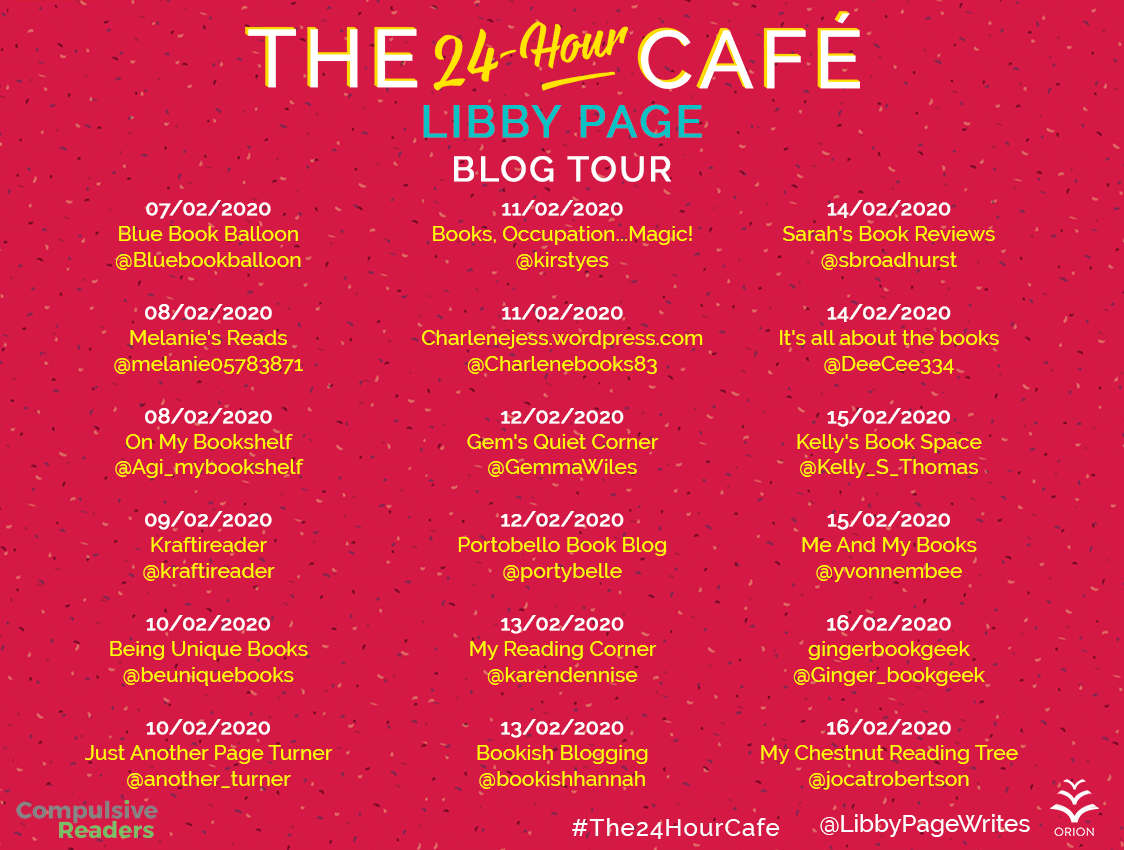
The tour continues with reviews from some excellent bloggers (check out the poster below).

The 24-Hour Café is available from your local bookshop (or online via Hive Books which supports local bookshops) but can also be ordered from Blackwell's, Foyles, WH Smith, Waterstones and Amazon.

6 February 2020

Review - The Last Smile In Sunder City

The Last Smile in Sunder City
Luke Arnold
Orbit, 6 February 2020
PB, 316pp

I'm grateful to Nazia at Orbit for an advance copy of Last Smile in Sunder City.

Fetch Phillips is a Man for Hire, a detective of sorts in tough Sunder City. Sunk in drink, sleeping in a corner of his office, walking the mean streets, he seems a familiar type - but he's not exactly what you might expect. Sunder City is heavily populated by non-humans - Dwarves, Sirens, Vampires, Fae, Gnomes and more. Which is as well for Fetch because he won't work for humans.

Last Smile is as much about how this came about, about Fetch's history and motivation, as it is about his attempts to trace missing vampire Edmund Albert Rye. And that history is, in turn, linked to the state of Sunder City (and the wider world).

Because the magic has gone out of things. In 'the Coda', the world lost the magic that made and animated the non-humans. The magic that used to drive the industry of Sunder City's forges and mills. The magic that the Far used to heal sickness and to make the Earth fruitful.

And Fetch? Fetch thinks it's his fault.

How and why that is, he tells in a number of episodes brought to his mind by the events of this book - from the death of his parents to his escape, years later, from an Opus jail. I'm not going to spoil any of that, except so say that it leaves him bearing a heavy burden of guilt at humanity's - and his own - treatment of the non-humans, and a desire to make amends and to 'Do some good'. That guilt is a strong motivating factor and it is one of the features of the book which, I think, actually marks it out as being different from the noirish thriller that it might others resemble.

The consequences of the magic being gone are many and severe. The creatures that depended on it for life are dying, many of them slowly and horribly. Others used it to make a living and they are now destitute. More subtly, things are going wrong in the world - crops are not growing as they did, for example. Yes, it's a bit of a parable of environmental devastation but here it happened very quickly, six years ago, and while it wasn't down solely to him, Fetch feels a very personal responsibility.

That makes him less of a detached figure - more complicit - than the 'man who is not himself mean' walking those streets. It makes Fetch, at times - many times - a rather unsympathetic character. While you can understand what happened to him and what he did, it's hard not to gloat, a little, when he gets into fights and has his backside handed to him, or ends up robbed and unconscious in the gutter. (I think he feels a bit the same way, to be honest). He's not the disinterested PI, grubby but with a heart of gold, that you might expect. Even in this book, he does mean, ungracious things.

While we meet the usual sorts of secondary characters for a slice of noir - corrupt cops, City officials, a trodden-down mother whose little girl has vanished, heavies in bars (oh so many heavies, oh so many bars) and even an enterprising chap trying to establish a diner close to Fetch's office - there is more going on here. Keep an eye out. Look for the clues, even as you enjoy Arnold's hardboiled dialogue or wince at his injuries. Or as you enjoy the unfolding of this world where Arnold has very cleverly integrated the various ex-magical species' natures and histories and hinted at previous conflicts, rivalries and betrayals.

In one or two places the plot did jolt, with threads left dangling. We hear a lot about a woman with whom Fetch was in love but whom he lost. I'm not going to say too much about that because, again, spoilers, but I lost track of how and when that important event happened - I'm pretty sure we're simply not told. Similarly a catastrophic event occurs in Sunder City but there seems to be little or no aftermath.

The book is, though, an excellent read. The premise - that loss of magic - is intriguing, provides lots of practical and moral issues and Fetch is a protagonist with the real depth. The book is atmospheric, great fun, and clearly going somewhere interesting.

For more about the book including links to buy it, see the Orbit website here.


4 February 2020

Review - Deathless Divide by Justina Ireland

Deathless Divide
Justina Ireland
Titan Books, 4 February 2020
PB, 576pp

I'm grateful to Titan Books for an advance copy of Deathless Divide.

Picking up exactly where 2019's Dread Nation ended, Deathless Divide takes forward the story of Jane McKeene and her... well maybe I shouldn't say friend... associate, perhaps? Katherine Devereux after the Survivalist town of Summerland falls to the zombie ("shambler") horde.

Seeking refuge in the nearby town of Nicodemus, Jane and Katherine soon find old enemies catching up with them - shamblers without, and humans within...

I loved Dread Nation. In Ireland's alt-nineteenth century, the US Civil War was overtaken by a zombie plague. Young people of Colour are dragooned into training schools, learning to fight the shamblers - and none gives a better fighting education than Miss Preston's, where young women are taught and polished to be "Attendants", defending fine ladies from the undead tide. It is, at the same time, a shrewd commentary on racial prejudice, an exciting (if at times gruesome) fantasy adventure and a fine coming-of-age story.

In taking things forward, Deathless Divide has high standards to meet but in fact it surpasses the first book. Told in alternate chapters from the viewpoints of Jane and of Katherine, this story gives us in effect the tale of a stormy but growing friendship. Spiky and distrustful, Jane makes it hared for anyone to get near her, and her first meeting with Katherine wasn't auspicious. To a degree they are now thrown together. The situation in Nicodemus - another Western town best by shambles - is uncannily similar to that of Summerland, with no way for the young women to escape so that they have to depend on each other. Fortunately, the one thing they each have going for them is their fighting skill, something that enables them to respect each other even when feelings are high.

And then Ireland shakes everything up and this book changes...

Deathless Divide is, simply, stunning. Moving from the plains of the Midwest to the golden state of California, Ireland continues to deepen, and to explore, her imaginary world, while also - and doesn't this seem unlikely but it works so well - using the fantasy, fictional setting to starkly depict the situation of people of colour in the Old West. From the higher prices charged them for goods to being burned out of desirable areas of San Francisco to the ruses mean ing that, despite the abolition of slavery, they're still subject to the control of their former owners, this all feels very real indeed.

The situation is one that Jane and Kate are very familiar with, and they're young women of great determination and courage. They are not about to give up. But Ireland shows the debilitating effect of the inequality. Following events in Nicodemus, Jane is bent on revenge and, having to survive in a pitiless world, she loses pity and does things that are gradually destroying the Jane we first met in Dread Nation. That is the whole crux of the book - Jane's descent, and Katherine's determination (despite their differences and initial dislike) to pull her back. It is, at its heart, a tale of friendship. In Deathless Divide, against a backdrop of horrors, little kindnesses and attentions matter - taking in a stray child (or for that matter, a stray dog). Sharing food. Politenesses that seem more appropriate in a genteel drawing room than on a rough trail. Katherine's determination to continue with her corsets, even if they have to be loser than she'd like.

It's a sweeping, compelling story, that defies the normal fantasy goal of achieving Big Things. Here the Big Things (the driven scientist hunting for a cure for the zombie plague, the avenging bounty hunter tracking down their prey) turn out to be hollow, or equivocal, while the things that make us all human - the things that make life a bit better - are celebrated and bring salvation.

An excellent read, deserving of wide attention and also great fun. Strongly recommended.

For more information about Deathless Divide, see the Titan Books website here.


1 February 2020

Review - Bone Silence by Alastair Reynolds

Bone Silence (Revenger, 3)
Cover design www.blacksheep-uk.com
Alastair Reynolds
Gollancz, 30 January 2020
HB, e, 602pp

I'm grateful to Gollancz for a free advance copy of Bone Silence.

The final part of the Revenger trilogy (after Shadow Captain), Bone Silence returns to the universe of Captains Arafura and Adrana Ness. In this far-future solar system, the planets themselves have been dismantled, yielding the material for the construction of tens of thousands of "worlds" - habitable structures a few kilometres across, built in all shapes and sizes (discs, spheres, spindles...) This is where humanity lives now, although civilisation has waxed and waned, with thirteen distinct "Occupations" - phases when people were expanding and settling. The history of this is mysterious, with plenty of powerful artifacts to be recovered from abandoned "baubles".

In this setting the Ness sisters - two young women who ran away from home world Mazarile seeking adventure, but found piracy, fighting and death with Fura ultimately rescuing Adrana from captivity - now scour the spacelanes in their ship the sunjammer Revenger, captured from the dread pirate Bosa Sennen. Unfortunately a bounty has been set on their heads, and they're pursued by a squadron of the Congregation's most ruthless thief takers who believe they are in league with Sennen, or perhaps that they are Sennen (it's complicated).

I love the setting for these books. In Reynolds' hands, the manoeuvrings of the great sail-driven craft, the hazards of calling at unruly and fractious port world, the glory a of a fight, the the salty language, and above all the loot up there for the taking - for me all these evoke the never-was pirate-ridden world of Stevenson and Robinson Crusoe. It's an advanced world with advanced tech but all the familiar themes are there - the long pursuits, the scanning for sight of a sail, the ferocious broadsides (here, delivered with electromagnetic coil guns). And the crew members we meet wouldn't be out of place lurking in a corner of the Admiral Benbow.

If that was all these books had, they might be fun, but no more than a jeu d'esprit (albeit a good one) on Reynolds' part. But there's much, much more than that. Under the surface of this book are serious SF themes: the fate of humanity in the far future, the origins of civilisations, our relationship with alien races. And big human themes: the sisters are coming of age, finding their place in this strange universe, making friends (and enemies) and losing them. Those themes are explored rather more thoroughly in this book than in the previous ones, the Ness sisters having now found one another and constructed some form of relationship again after the traumas they suffered before.

Indeed, solving these mysteries has become more than a matter of casual curiosity. Fura and Adrana have now become convinced that it's key not only to the future of the human race but to their own more immediate survival. There's also a desperation to this book that marks it out from the others. We have had hints before that outside forces may be manipulating events but here it seems there are two sides, rival factions of aliens pursuing some conflict and bringing an even tighter sense of danger to events. It's not clear who can be trusted, or even what is to be gained from those can.

Bone Silence felt to me more focused, basically an extended chase sequence, than the earlier books, and more sober: the sisters are growing up, there's less sheer exuberance and a greater awareness of consequences (as when someone who lost money because of what Fura and Adrana did at the end of the last book plunges to his death. before their eyes). The stakes are higher now - it's not just a question of being dragged back home, and they have enemies with deep pockets and an even longer reach. There is an edge to the battles, a sense of the gloves being off.

It is, though, not all action. I enjoyed the shipboard sections when nothing much seemed to be going on, but the two sisters - and their ragged crew - were learning to trust each other. There are many, many reasons why they wouldn't, and Revenger herself holds dark memories, especially for Adrana. Shudder at what went on in the "kindness room"! Revisit the Bone Room, where the twinkling, alien skull allows communication - at a price - across great distances. In this book the process carries a more deadly edge than ever - there is the prospect of discovery for one thing, and other, darker dangers as well. (The exact origin and nature of the bones and the "twinkly" inside them is never made clear: like many aspects of the Revenger universe, that remains a dark secret, perhaps to be revealed one day, perhaps not). And Reynolds' portrayals of the crewmen and women are rounded and fully formed.

All in all great fun, though this is one trilogy you really do need to read in order.

For more about Bone Silence, and to buy the book, see the Gollancz website here.

Alastair Reynolds' website is here.