Showing posts with label families. Show all posts

28 September 2025

Blogtour Review - A Lethal Legacy by Guðrún Gúðlaugsdóttir

A Lethal Legacy
Guðrún Gúðlaugsdóttir (trans Quentin Bates)
Corylus Books, 20 September 2025
Available as: PB, 234pp, e   
Source: Advance copy
ISBN(PB): 9781917586023

I'm grateful to the publisher for sending me a copy of A Lethal Legacy to consider for review, and for inviting me to join the book's blogtour.

Nothing has changed at Bjargarlækur for as long as anyone can remember – so are moves to bring change to this remote farm in the Icelandic countryside a motive for murder? Three elderly siblings have lived more or less peacefully in this isolated place their whole lives, until Brynjólfur is found dead in his own bed. Called on to help out at the farm, freelance journalist Alma is far from certain that the old man died a natural death. Determined establish the facts of the matter, she finds herself caught up in a vicious family feud. Sisters Klara and Thórdís are unable to agree on the future of the farm, just as others with an interest in the place circle hungrily around them. Echoes of missed opportunities, lost love and age-old crimes surface as a reckoning takes a bitter toll on those left behind – and Alma struggles to get to the truth.

Journalist Alma and her husband Gunnar have just embarked on renovating the wreck of a house they've bought. However a most dramatic call from daughter Gunnhildur summons Alma away to a remote farmhouse. (One of the minor delights of this novel is how - from off, as it were - Gunnar, left back at home, continually reports to Alma that he's found a new problem - the floor, the windows, the heating - that will require either a tradesman he can't find, materials they hadn't budgeted for, or indeed, a complete change of plan about layout. But he never loses his enthusiasm! It'll all be fine!). Gunnhildur, a nurse who needed some time away from things after splitting from her boyfriend, reports that the elderly man she was caring for alongside his two sisters has been found dead. She worries she may be blamed for mixing up Brynjólfur's meds, and asks her mum to come out and support Gunnhildur and her own toddler daughter Una.

This is Alma's intro to the isolated community at Bjargarlækur. Soon she's in the thick of investigating Brynjólfur's death, partly to help Gunnhildur - though dear Daughter happily scarpers part way through the story as Boyfriend has appeared again - but mostly, one senses, from a prickling of her journalist's thumbs and from sheer burning curiosity.

It's a tangled tale that emerges. The siblings were at war with one another. Brynjólfur and Klara, one of the surviving sisters, wanted to preserve the farm and turn into a museum of old Iceland. In a country that has experienced rapid change one can see why this might be worthwhile. (Another of the joys of A Lethal Legacy is the glimpses of that older Iceland that we get in the stories from the sisters and some of their neighbours. One is left in no doubt how much these remote communities were required to be self-sufficient, and the echoes of that run forward to some extent into the present of the novel, with the police remote and the authorities slow to intervene in the escalating situation).

The other sister, Thórdís, was though dead set against the museum idea. Complicating the picture is the presence of a younger couple to whom the farm has been let, and who may or may not be a pair of ne'er do wells. All sorts of accusations are thrown - Slaughtering the sheep! Selling the cows! Brewing moonshine! Behind them are suspicions they may have their eyes on the place, perhaps in a stitch-up with local authorities.

Once the possibility of murder is added to this mix of family dissension, greed and a gossipy local community - a great deal is to be gleaned from the local priest and the doctor - and Alma's shut in at the lonely, slightly spooky, house - one may well expect almost anything to happen. And there is drama. The sense though that something is rubbing under the surface is an even greater source of tension, the contrast with the bleak, static landscape and the changeless decades that the siblings have lived at Bjargarlækur only adding to this.

Is that impression of calm, of retreat, misleading though? 

At its heart a story of family secrets, A Lethal Legacy manages to be both truly Gothic, with the possibility that not everything going in totally natural, and also a fine, taut crime thriller. Alma's rather out on a limb in conducting any sort of investigation here and she lacks institutional backing to ask questions or poke around, having to rely on the sisters' goodwill (which is in short supply) and her de facto position as their nurse/ carer, to gather facts. 

As she does so it slowly becomes apparent that there is more going on here than you'd expect. With a parallel strand of the story focussing on possible past abuse affecting a member of her own family, and the differing attitudes of the sisters resulting in contradictory accounts of their earlier lives, there's a difficult jigsaw for Alma to assemble. She is, though, nothing if not determined.

I really enjoyed this story. The brooding, remote setting is a fitting location for dark deeds. Klara and Thórdís are magnificent characters, well drawn. Neither is exactly likeable - though by the end of the book one knows enough about them to forgive a lot - but they are a great double act. Alma is determined to reach the truth, at first to protect her daughter, but later, it seems, from sheer bloody-mindedness. And as I've said, the glimpses of Icelandic history and culture are fascinating.

As ever, Quentin Bates' translation sparkles, catching the very different characters of the individuals at the heart of this story through their speech - sometimes slangy and modern, at others more formal or even slightly outdated. He does this while navigating a lot of rather abstruse language describing funeral customs - wakes, lyings-in, funeral meats and such - laying clear subtle differences which matter to Klara and Thórdís. A lot of the background here would be known to the Icelandic reader and so it isn't explicitly set out, but the translation makes clear where everyone is coming from, as it were.

Great fun - and also in some aspects, very sad. I'd recommend this one strongly.

For more information about A Lethal Legacy, see the publisher's website here - and of course the other stops on the blogtour which you can see listed on the poster below. 

You can buy A Lethal Legacy from your local high street bookshop or online from Amazon.


20 January 2025

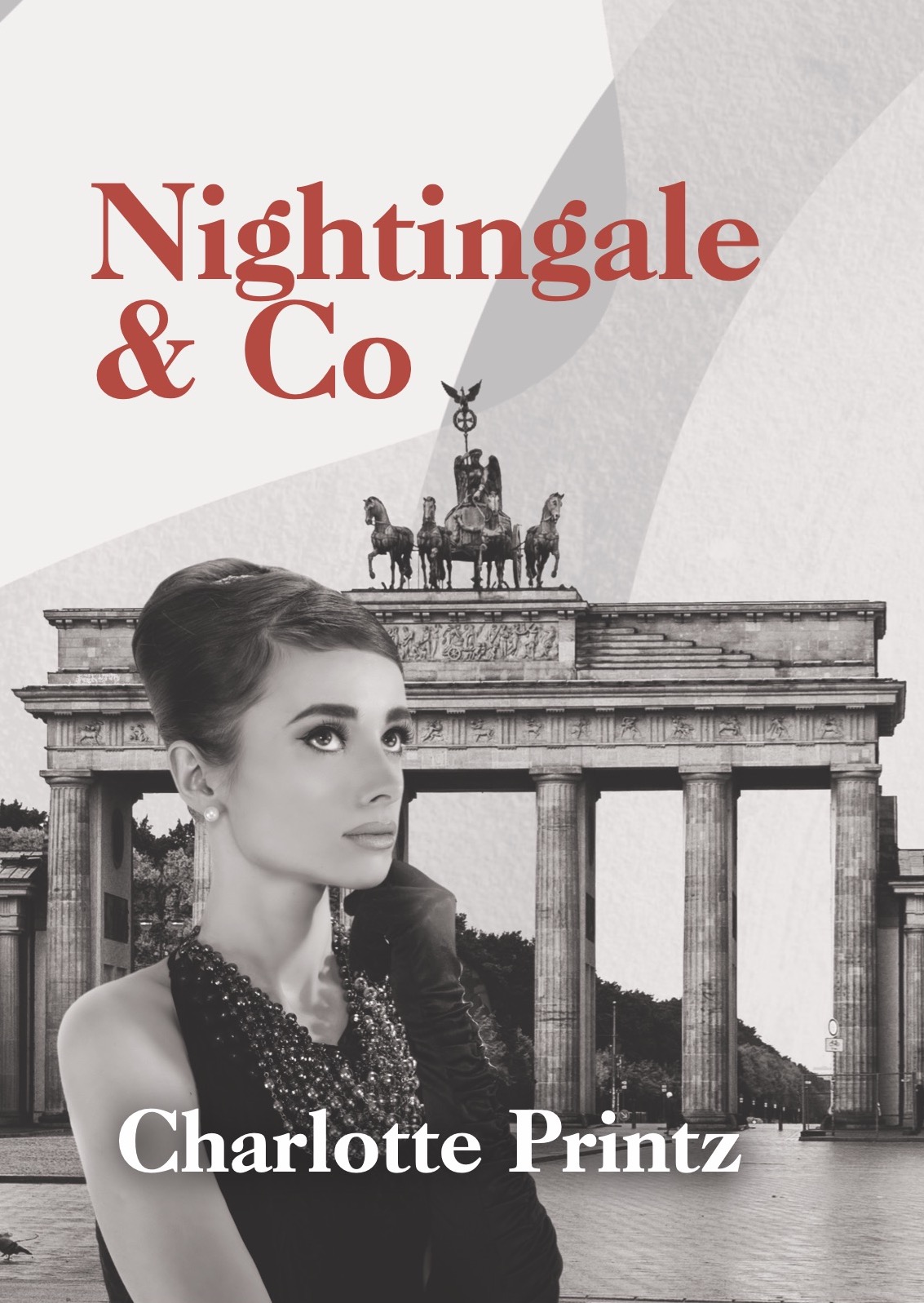
Blogtour review - Nightingale & Co by Charlotte Printz

Nightingale & Co
Charlotte Printz (trans by Marina Sofia)
Corylus Books, 15 January 2025 (e), 1 February (PB) (390pp)
Source: Advance copy
ISBN(PB): 9781739298982

I'm grateful to Corylus Books for sending me a copy of Nightingale & Co to consider for review, and for inviting me to join the book's blogtour.

From the Publisher

Berlin, August 1961.

Since the death of her beloved father, Carla has been running the Nightingale & Co detective agency by herself. It’s a far from easy job for a female investigator. 

When the chaotic, fun-loving Wallie shows up at the door, claiming to be her half-sister, Carla’s world is turned upside down. Wallie needs Carla – the Berlin Wall has been built overnight, leaving her unable to return to her flat in East Berlin.

Carla certainly doesn’t need Wallie, with her secret double life and unorthodox methods for getting results. Yet the mismatched pair must find a way to work together when one of their clients is accused of murdering her husband.

Nightingale & Co is the first in a cosy historical crime series featuring the sisters of the Nightingale & Co detective agency in 1960s Berlin.

What I Thought

I loved it.

Printz gives us a view of postwar Germany, and particularly of West Berlin, that was new to me. We may be familiar with le Carré or Deighton Cold War spy antics involving the Wall, prisoner exchanges on lonely bridges at midnight and the heroics of people trying escape the East.

We know less, perhaps, about the impact of the sudden construction of the barrier - the everyday inconveniences as families are suddenly split, people are cut off from their jobs or homes, and transport disrupted. And, connected with that, the porosity of Berlin before the Wall - a city where citizens could work in one part of the city and live in the other.

Behind that suffering is, of course, a deeper history as the generation affected by this was one that had also lived through the War - whose effects are often pointed out in this book with buildings still ruined and bullet holes visible here and there - and necessarily, under the Nazi regime before and during that. There are plenty of passing comments in this book about how people had accommodated themselves with that regime, and what they had then done after to distance themselves. As well as rumblings in bars and on street corners from those who rather liked the Nazis. The details are fascinating and reach into the present of this novel to, affecting the attitudes of the characters and their position in society.

Alongside those political themes, though, this book also does a very good job at delineating the personalities in this story, women (for the most part) living at a time of enormous change, which some of them welcome and others shun. For example, Ingrid, a saleswoman for the new contraceptive pill who is one of Carla's clients. Carla herself, whose life is dominated by her strained relationship with a domineering and controlling mother. And free spirit Wallie, who breezes into this story upsetting apple carts down every street. Wallie is something of a catalyst for events in the book, given that half-sister Carla is rather cautious and, one feels, left to herself would never take the steps necessary to resolve the two cases here (tracking down a missing American serviceman with whom Ingrid had fallen in love, and solving the murder of a prominent architect whose wife came to her seeking help with a divorce, and who then herslelf naturally falls under suspicion). Wallie, on the other hand, goes in with all guns blazing and seems adapt at everything from setting a honeytrap to spotting a tail. We can only wonder where she learned these skills. Perhaps it goes with the territory if you work the bar in a topless nightclub?

Above all, though, Nightingale & Co is a joyous, thrilling crime narrative that keeps the reader hooked from the first page. Carla is a rather atypical detective, at least by genre standards, and she's often juggling the dramatic - having to race across Berlin to interview a client in prison, contending with the dislocations caused by the Wall, chatting up contacts bin the American military - with the mundane - getting home in time for tea rather than face an earful from her mother, or rescuing her zany aunt from some scrape. It makes for a rich tapestry of life, and that's even before we see things from the perspective of the slightly chaotic Wallie who surely has some secrets of her own. (I should mention that until Wallie turns up suitcase in hand, Carla didn't know that her dad had another daughter in the East - so things are pretty tense between then as you can imagine).

It's all rendered in excellent, taut prose by Marina Sofia, including being clear about - but not intrusively - the points where the distinction in German between familiar and formal pronouns conveys shades of social distance that English has lost. 

In short, strongly recommended - and I hope to see more of Carla & Co in future.

About the Author and Translator 

Charlotte Printz is the pseudonym of a successful former TV editor with a penchant for writing gripping historical novels and screenplays. She is one of the founders of the Munich Writing Academy.

Marina Sofia is a translator, reviewer, writer and blogger, as well as a third culture kid, who grew up trilingual in Romanian, German and English. This is her first translation of a German crime novel to be published by Corylus Books

For more information about Nightingale & Co, see the publisher's website here - and of course the other stops on the blogtour which you can see listed on the poster below. 

You can buy Nightingale & Co from your local high street bookshop or online from Bookshop UK, Hive Books, Blackwell's, Foyle's, WH Smith or Waterstones.


22 May 2024

#Blogtour #Review - Toxic by Helga Flatland

Toxic
Helga Flatland (trans Matt Bagguley)
Orenda Books, 23 May 2024 
Available as: PB, 263pp, audio, e   
Source: Advance copy
ISBN(PB): 9781916788138

I'm grateful to Orenda Books for sending me a copy of Toxic to consider for review, and to Anne for inviting me to join the book's blogtour.

Listen to the dance tune about the two brothers and the woman from Oslo...

If you're looking for multiple unreliable narrators, family tensions that fairly crackle off the page, obscure secrets and a sense of rural menace, then Toxic is just the book for you. If you don't think you're looking for those things, then I offer you Flatland's involving, complicity-inviting narrative which (in Matt Bagguley's excellent translation) lures in the reader, making them almost an accomplice to the moral gymnastics and self-justifications exhibited herein.

Take Mathilde, for example, a young supply teacher who's - let's use neutral language - entered a relationship with one of her pupils, 18 year old Jakob. The moral and ethical position here is clear, she was in a position of authority and she abused it, yet Flatland still gives us plenty of complexity as Mathilde takes most of the book to dodge any consequences and instead to give us her take on things. 

Or consider those two brothers. Andres and Johs, living on their remote farm far from Oslo. These are the days of Covid, and the progress of the pandemic - and the countermeasures for it - mark this book, phases of lockdown and social distancing disrupting everyone's life. (Although I have to say, the strictness of the measures taken in Norway never quite seems to match my recollection of the UK which felt like three years never leaving the house). The two are scrupulously observed, described through Johs's eyes, incidents of childhood painting the picture as we move to the present day where Andres stands to inherit, having acquired a late interest in farming, full of elaborate plans while Johns, the practical one, does most of the work. Meanwhile, their mother lurks, silently judging them every time they take an afternoon off. (The passive-aggressiveness of their mother, who will always, always sneak in and do a job before one of the boys can, is a joy in itself).

Mathilde's downfall precipitates a flight from Oslo to the country, where she rents an empty cottage on the brothers' farm. If Mathilde's background is complex (her parents dead in a car crash, she was brought up by her aunt, who she always refers to as 'Mum', and some of her most honest moments, the clearest revelations about her life and her - evidently complex, unresolved - relationship  with her birth mother seem to be when the two women share a cigarette) that of the brothers is even more so, both having grown up under the shadow of their grandfather, Johannes.  

Johannes emerges in recollection as a sneering bully, an abuser, a misogynist and a past master at coercive control. Also, a drunkard. He was, however, a superlative fiddle player and the identity of his remaining extended family seems bound up with that fact, with his place in the local culture such that no-one - either family or acquaintance - is willing to point up his faults. The book explores a curious dynamic in that local culture, introducing us to various popular ballads and dances, always with a narrative from Johannes at the start explaining where the music came from, what it's about. Inevitably the theme is proud, disruptive women who are punished for their transgressions in some way, blamed for whatever has gone wrong. This hint of folk horror, a sense of retribution imbued in the very landscape, lifts the setting above what could otherwise rather echo Cold Comfort Farm and gives the narrative a distinctly eerie, mournful cast. 

As Mathilde's behaviour spirals out of control (or is it?) we learn more and more about Johannes's outrages, and see the family's imprisonment (I don't think that's too strong a world) in the patterns of behaviour and the routines and casts of mind that he enforced. It makes for a volatile mix, one, as I said above, humming with tension. Yet it is all expressed and portrayed so coolly. Flatland's, and Bagguley's, language, is mild, focused on details, on characters whose minds wander, on the ordinary daily tasks of a farm. Also, perhaps, expressed in what we're not told, only given hints of.

The title of the story is I think well chosen - there is a sense of toxicity here, of taint, but it's hard to pin down. The frequent preoccupation with the virus, the handwashing, the scares and the distancing heighten this sense of contagion, but perhaps the characters here are missing the real source of danger, the thing that will really contaminate, will harm?

All in all, a marvellous, unnerving read, a book that simply creeps up on you, that gets under your skin and can't be picked out.

For more information about Toxic, see the publisher's website here - and of course the other stops on the blogtour which you can see listed on the poster below. 

You can buy Toxic from your local high street bookshop or online from Bookshop UK, Hive Books, Blackwell's, Foyle's, WH Smith, Waterstones or Amazon.


26 October 2022

#BlogTour #Review - Deceit by Jónína Leósdóttir

Cover for book "Deceit" by Jónína Leósdóttir. Against a grey-white background, a red apple with a bite taken out of it and one green leaf attached. Pooling around the base of the apple, red fluid like blood.
Deceit
Jónína Leósdóttir (trans Sylvia Bates and Quentin Bates)
Corylus Books, 30 October 2022 (e), 15 November 2022 (PB)
Available as: PB, 288pp, e
Source: Advance copy
ISBN(PB): 978-1916379794

I'm grateful to Corylus for sending me a copy of Deceit to consider for review, and for inviting me to join the book's blogtour.

It's been interesting over the past couple of years to see the different approaches that authors have taken to the covid-19 pandemic. Some ignore it, some write as though it is past and one with and life is back to normal. Only a few though - at least that I've seen - accept the challenge of setting events squarely in the midst of lockdowns, quarantine rules and public health campaigns.

That is what Jónína Leósdóttir has chosen to do with Deceit and I have to say, the result in absolutely cracking. Set in Iceland in March and April 2020, the book introduces each chapter with a newsflash giving infection statistics and updates on events, and the action closely its characters' varying responses. 

Adam, a psychologist in private practice in Reykjavík, is inclined to take things very seriously, sanitising hands and anything that's newly come into his cosy basement flat, which he leave sonly reluctantly. Adam's ex-wife, detective Soffía, is rather more cavalier, while various owners of local businesses - cafés, a deli, a small hotel - bemoan the impact of the virus and the lockdown on their businesses. The story is interestingly sited at that point where the most serious issue was believed to be physical contact rather than airborne transmission, so there is less focus on masking and ventilation and more on distancing, leading to to some amusing scenes as the characters move around each other, so to speak. Having lived through all this only two years ago it's all very recognisable.

The inhabitants of Reykjavík are soon, however, about to face something much less humorous and indeed malign as potentially deadly tampering with fruit and other foods spreads around the capital and the country. At the epicentre are those same small business owners, but it's frustratingly hard for Soffía to link the cases together, or establish the motivation or perpetrator. She has few resources. Adam reluctantly assists, largely because he's nearly broke and the police will pay him for consultation, but most police time is going into enforcing covid rules so really the two of them are on their own.

They do, though, while bickering gently in the manner you'd expect of a long established couple, gradually come to understand the victims, if not the perpetrator, peeling away layers of lies and deception about a most remarkable - if reprehensible - man and his bizarre family. 

Meantime, Adam is also providing private consultations, including helping a young woman near to despair.

Add in the mysterious Jenný, a woman who we sometimes encounter in Adam's flat but who avoids contact with others, and Deceit provides a gallery of fascinating and complex characters struggling with a wide range of issues. Adam's insights as a psychologist are often the key to understanding what's going on, although he's less adept at using it in his own life and with his family - his wife, his daughter. The mystery behind the events is in the end both simple and fiendishly rooted in real lives and past events, all of which need to be teased out and prove addictively plausible. 

An enthralling and fun read, then, and I hope Corylus can bring us more translations of Leósdóttir's novels (hopefully also rendered into English by Sylvia Bates and Quentin Bates, whose version is lucid, compelling and clear).

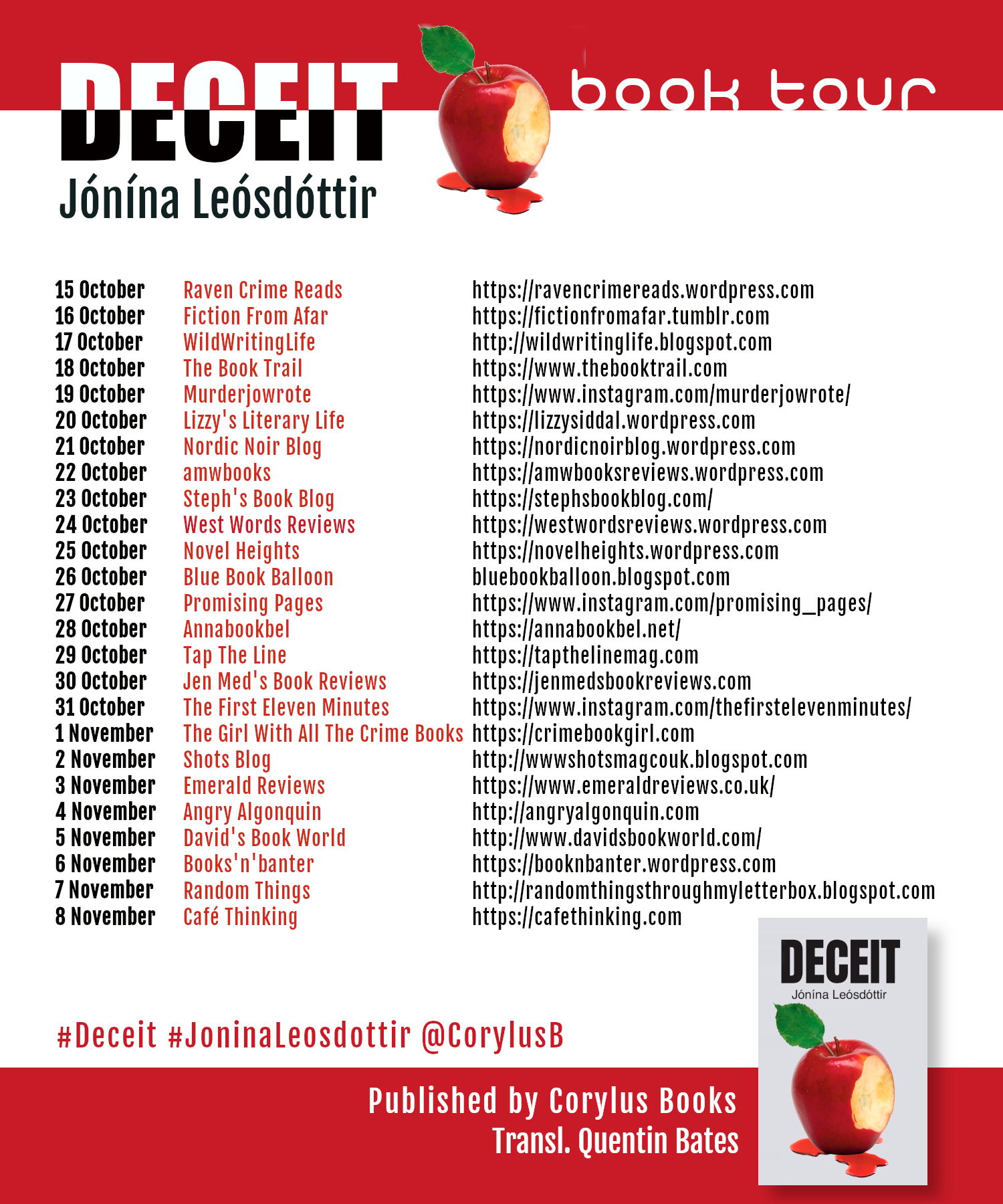
For more information about Deceit, see the publisher's website here - and of course the other stops on the blogtour which you can see listed on the poster below. 

You can buy Deceit from your local high street bookshop or online from Bookshop UK, Hive Books, Blackwell's, Foyle's, Waterstones or Amazon.


28 September 2022

#Blogtour #Review - The Hike by Susi Holliday

A distant, dark peak reflected in still water. Silhouetted against the sky, and reflected in the water, four figures.
The Hike
Susi Holliday
Thomas & Mercer, 1 October 2022
Available as: PB, 269pp, e, audio
Source: Advance e-copy
ISBN(PB): 9781542035347

Trapped and slowly falling apart...

I'm grateful to Susi and to Anne at Random Things Tours for an advance copy of The Hike to consider for review and for inviting me to take part in the blogtour for The Hike, which begins today.

I'm honoured to be starting things off, as the four participants in this particular ill-fated expedition in Switzerland take their first steps on the mountain...

Susi Holliday really is the queen of a certain unsettling subgenre - part Gothic, part crime - where a group comes to grief amidst the bracing air and stirring sights of the Great Outdoors. I'm reminded of Sherlock Holmes's dark attitude to the countryside, expressed during The Adventure of the Copper Beeches: 'It is my belief, Watson, founded upon my experience, that the lowest and vilest alleys in London do not present a more dreadful record of sin than does the smiling and beautiful countryside...' True, but somebody has to take the darkness there, don't they?

It's clear from the outset that has happened, as two bruised and battered walkers stagger into a pretty little Swiss town, an unwelcome problem for police captain Thierry Pigalle on a Sunday when he'd looked forward to a leisurely lunch with his wife. But it's only as Holliday begins to give us the story of sisters Cat and Ginny and their husbands, Paul and Tristan, that we realise just how much sin the four have carried with them into the Swiss mountains. 

As that becomes clear, you may feel, like me, that these have to be four of the most unpleasant people to grace recent crime fiction! But don't let that put you off - Holliday knows how to weave a tale, and she makes it compelling despite that edge of dislike, maybe even, to a degree, because of it. We want to understand why the four are so unpleasant to each other. We want to understand how they can live with what they've done, or, for some, with what they plan to do. We want to understand, perhaps most of all, how they imagine they can go on with their lives after this is all over. Underpinning some of the plans that unfold is a level of self-delusion perhaps even approaching psychopathy.

And scariest of all - you may come to believe that some members of this group may be capable of getting way with it.

It's a twisty narrative in which layers and layers of bad intentions, selfishness, sexual incontinence, greed and lack of any visible moral framework set Cat, Ginny, Paul and Tristan for a deadly march through those beautiful mountains. Perhaps, actually, comparisons shouldn't be with Conan Doyle or Christie but with William Golding, with overtones of Lord of the Flies once everyone is away from their pesky mobile phones and no help can be caught? But there are mysteries here, too, with the actions of this little group worth following closely - even if you observe the wheels in motion, though, I'm not sure you'll anticipate just what direction they may take things in.

Throughout, Holliday maintains a strong degree of psychological plausibility - these may be unpleasant characters, not people to share a train carriage with, but they are well-realised, rounded, believable unpleasant characters whether they are being petty, grasping, lustful, spiteful or - just occasionally - vulnerable and trusting. There's also a taut, threatening atmosphere - with another figure apparently stalking the group - in which anything might happen whether from accident, malice, shifting alliances or cold, deep-laid plot.

All in all, great fun, and the payoff of those characters being so nasty is that I couldn't feel too bad when anything nasty happened to any of the four (though I did feel for Pigalle, who has his Sunday thoroughly spoiled).

For more information about The Hike, see the author's website here - and of course the other stops on the blogtour which you can see listed on the poster below. 

You can buy The Hike from Amazon here.


17 June 2022

#Review - Nothing Else by Louise Beech

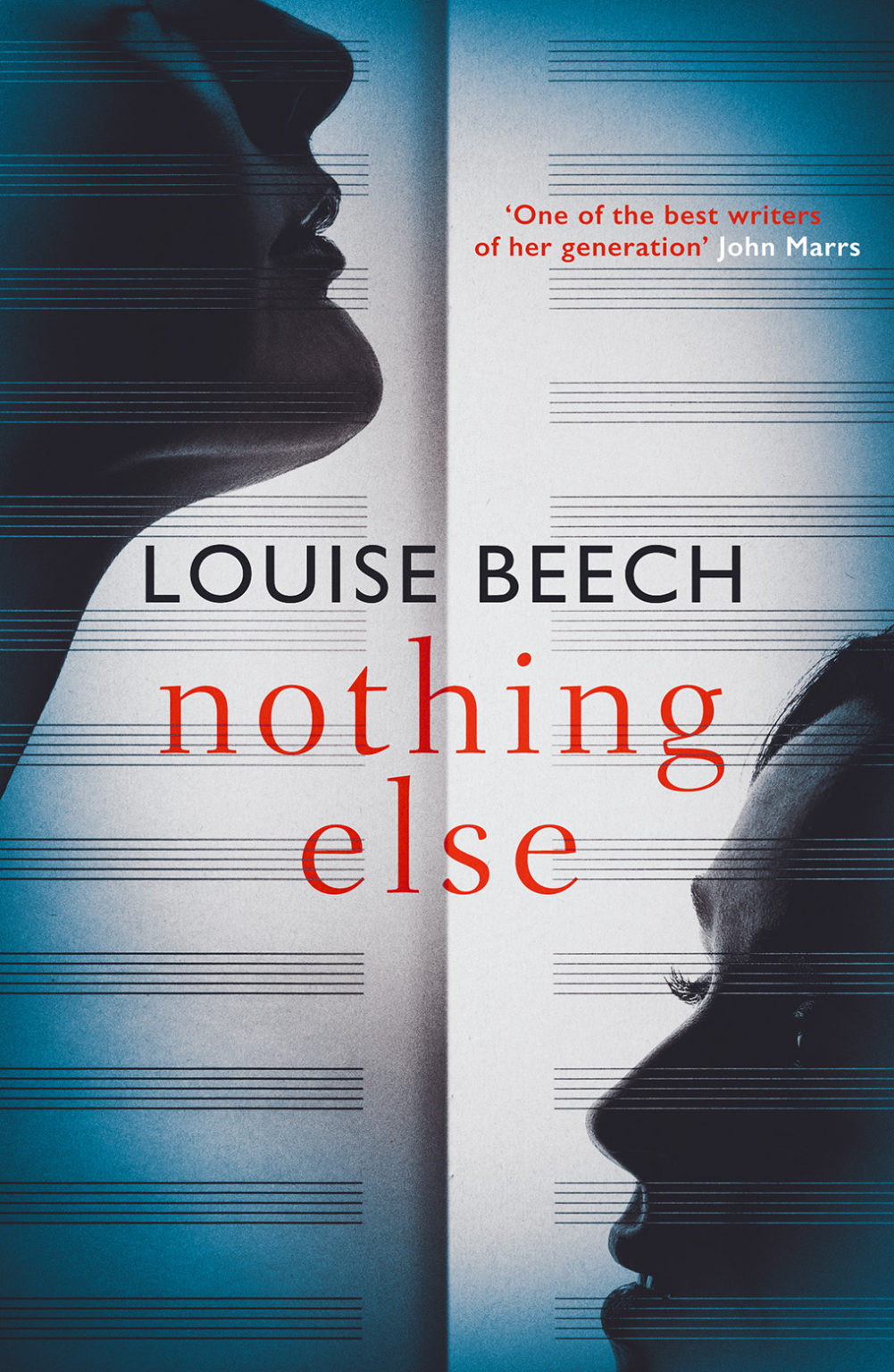
Cover for book “Nothing Else” by Louise Beech. The background is music manuscript paper, bare with no notes. In the centre it is white, fading out to pale blue in the corners. Facing each other across the page, but not lined up, are two female faces. The are almost in profile, but not quite – they are clearly pictures not silhouettes. One is at the top left, the eyes cut off by the edge of the page. The other is bottom right, the full face in view except for the lower part of her chin. At the top is an endorsement by John Marrs: “One of the best writers of her generation”.
Nothing Else
Louise Beech
Orenda Books, 23 June 2022
Available as: PB, 276pp, audio, e
Source: purchased e-copy
ISBN(PB): 9781914585166

Today I'm pleased to be joining the Random Things blogtour for Nothing Else by Louise Beech. Many thanks to Orenda Books and to Anne Cater for inviting me to take part.

I am always very pleased to see that a new book by Louise is on the way. They always grab me, and Nothing Else lived up to my expectations. At the same time heartbreaking, uplifting and compulsively readable, I hope it'll grab you, too.

Heather is a piano teacher, a rather solitary woman who lives - perhaps not for her music, but with it. She's not a total loner - her stepparents are dead, she was married and has parted amicably from her ex-husband - but there is a space in her life, which Beech slowly shows us was left by Harriet, the sister from whom Heather was parted in childhood.

On an impulse, Heather decides to take the job of pianist on a luxury liner. It's most unlike her to do such a spur of the moment thing, but she looks forward to the change and to the opportunity for some reflection. She will cruise across the Atlantic and then travel to the Caribbean, with a stop in New York. It seems exciting, different, a chance to explore a different lifestyle - and Heather is very nervous. But she's recently received the files Social Service kept on her, and hopes that she may find a clue there about Harriet - what happened to her, and, perhaps, where she is now.

Louise Beech
The first part of the novel therefore follows Heather as she settles in aboard the Queen of the Seas, makes acquaintanceships among the crew of the ship (a warm friendship with Frederica, who's a writer and aboard the ship to give workshops, not so much  with Barry Lung, an old-school comedian who sees the trip as an opportunity to drink and chase the girls) and finds her way playing in the different bars and venues. Heather has a good deal of spare time and we also witness her reaction to reading the (heavily redacted) Social Services files and the memories they stimulate of early life. 

Heather's own memories have many gaps. Her childhood wasn't easy, and doesn't make easy reading. There are scenes here of domestic abuse, less the gross, physical side than the creeping atmosphere of dread and restraint, the miasma cast over the girls' early life by their controlling father. It is effective and horrible, and the contrast with the more or less carefree life aboard ship (I really loved the sense of place and community that Beech gives to this) only makes things seem, somehow, even darker. Heather wants to know about Harriet, but one senses that there may be ominous secrets to come out.

One of the things I love about Louise Beech's books is this ability to create menace and depth in situations which nevertheless remain, as it were, bounded and even appealing. The little world aboard a ship is a good example of that. Heather may have spare time to relive her past but she has so much to do, so much to explore, and a public role in the ship - she has to be be there at the right times, a smile on her face, attractively dressed and ready to entertain - so that the buried memories which begin to emerge can't, they just can't, take over completely. So we get a kind of mystery, a deepening of our understanding of Heather's personality, demonstrated through her love for her mother, through her family's tragedy and in her relationship with Mr Hibbert, who taught her and Harriet piano (his story, glimpsed in passing, is rather sad). But it's demonstrated most of all, perhaps, though Beech's use of Heather's music, her choices of what to play and the descriptions of how she does that.

Heather doesn't particularly try to challenge the passengers with her repertoire, but she plays with great feeling and there's a haunting quality to how this is explained in the story, reminding me that Beech's stories often use art or performance to get over the depths of what people are experiencing. That is heightened when Heather plays "Nothing Else", a piece in two parts which she and her sister composed together when their father was at his worst. Heather has never been able to play Harriet's part, pointing at the void left behind, but she is something of a hit playing her own and even becomes a minor online sensation as the music is recorded and shares across social media.

I don't want to say too much more about what happens in the story, because, while the general course of it might be something you'll guess, the detailed working out isn't. Rather it's wrapped round the mystery about Harriet's disappearance. And other mysteries too. Beech, as ever, is queen of the taut, suspenseful plot. This isn't a crime novel (at least not in its present-day parts) or thriller, but Beech still serves up a few red herrings and a few clues as to what was going on - and keeps us guessing about exactly how things will turn out.

This is a story, at its root, of love and loss, and lost time, but one that testifies to the power of truth and the endurance of love. As a complex piece of music moves towards its resolution, so Nothing Else explores its themes, eventually presenting Heather with a very different outcome from what she might have expected - and forcing some choices on her. 

Another excellent book from this author - one that I think may just be her best yet (and that's a high bar).

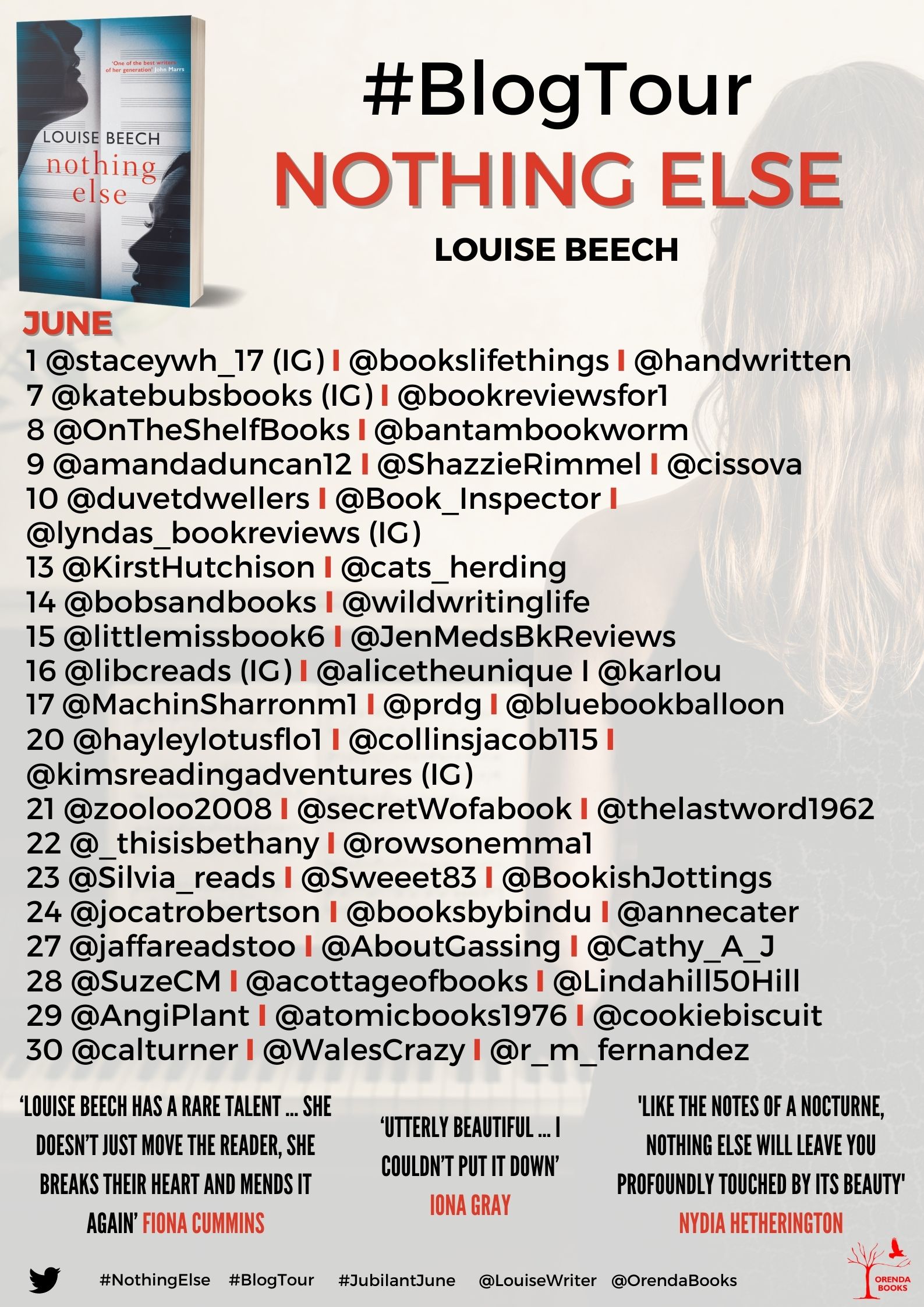
For more information about Nothing Else, see the Orenda Books website here or take in the other stops on the tour, listed on the poster below. To buy Nothing Else, visit your local bookshop, or get it online from Bookshop UK, Hive Books, Blackwell's, Foyle's, WH Smith, Waterstones or Amazon


31 May 2022

#Review - Daffodils by Louise Beech

Daffodils
Louise Beech
Bolinda Publishing
Available as: Audio (narrated by Lesley Harcourt), 9 hours 48 minutes
Source: Audible subscription
ASIN: B09TG3FPMJ

I have been a fan of Louise Beech's books for some time. Her fiction combines real, believable characters in all their human muddle with gripping stories and they always, always have such heart.

In her memoir  Daffodils, Beech pulls the curtain aside and invites us to see some of her own life. It's a difficult story, kicking off from the moment when, in 2019, Beech's mother attempted suicide and loosely following her mum's hospitalisation and - sort of - recovery. We see the author's process of coming to terms (sort of) with what happened in 2019 and also, as part of that, her recollections of and attempts to understand her own earlier life. We also get to meet her younger sisters and brother, who share their own takes on that story, and (inevitably, look at the date) we see life overturned by the covid pandemic and by the lockdown measures necessary to address it.

I thought this book was beautiful, fierce and brave. It keeps coming back to mysteries - the mystery of Beech's mum's behaviour and treatment of her children (which often makes for hard and painful reading) and the gaps's in Beech's own recollection of that. Those gaps might not be surprising, given it was a life split across different houses and children's homes, sometimes with siblings, sometimes not, involving both periods spent at her grandmother's and occasions when her mum's raucous living arrangements disrupted all their lives.

Behind all that, though, Beech suspects things, and people, that she has has blotted out and there are  hints of painful events and possibly even abuse. After consulting everyone who might be able to explain, and all the records that are available, and going over all the different versions, significant gaps remain. This leads to a book that is both raw and painful and yet calm, collected and focussed and it sets down the evidence and speculates. You can see in some of this the the hand of the excellent novelist that Louise Beech is - employed here not to decide how the gaps may be filled, what the plot ends, but to identify them as gaps and catalogue the potential dangers therein. It felt to me a bit like a mine clearance operation, as Beech sifts through the landscape of her memory, raising flags and barriers to show the dangerous ground, the paths to avoid. And then she ventures inside to these dangerous places, not exactly defusing and rendering safe, but exploring the landscape for us and showing how she is transforming it and succeeding in living there.

I want to stress here that you shouldn't read this book thinking, oh look, that's where she gets this incident or that episode from one of the books. Yes, of course, obviously Daffodils does highlight events which have inspired Beech's writing, but I had a sense reading this that the real truths exposed here - sometimes painfully - are moral truths, truths about persistence, integrity, and love. Those are qualities which her readers will recognise at once from her novels and which are more important I think and much more fundamental than details of plot. Yes, reading this book did shed light on the novels, but not in such a cause and effect way.

And it sheds light on much else: the (sometimes amusing) background to being a hard-working author, the frustrations of negotiating for her mother's care with an overstretched and wilting NHS (this even before the pandemic), the solidarity and humour of the sibling group in the face of that adversity, and, in the end, the unknowableness of another human being - even one as supposedly close as a parent. You can feel the struggles that Beech has on this last conundrum, as she wrestles both to see her mother safe and cared for, and counts the cost of what that same mother has done, and not done, to and for her kids. 

Not, as I said, remotely an easy read, but a heartfelt book and I am so grateful to the author and rather humbled that she (and of course also her super sisters and brother) have been willing to let us into their lives in this way. 

The audio is read excellently by Lesley Harcourt, including a variety of voices for the family members - in a story where we get numerous, sometimes contradictory, accounts of past events, as well as flashbacks and a great deal of authorial comment, it's always clear what perspective we are hearing and the story came over naturally and clearly. 

Finally, and not least, I know a lot more now about daffodils than before I listened to this book!

For more information about Daffodils, see Louise's website here. You can buy Daffodils from only retailer sites such as Amazon.

12 May 2022

#Review - A Sh*tload of Crazy Powers by Jackson Ford

A Sh*tload of Crazy Powers (The Frost Files, 4)
Jackson Ford
Orbit, 12 May 2022
Available as: PB, 496pp, e
Source: Advance copy
ISBN(PB): 978-0356514673

I'm grateful to Nazia at Orbit for an advance copy of A Sh*tload of Crazy Powers to consider for review.

With book 4 in a series, there can be a risk of things becoming stale. Still readable, yes, still what you came to it to get, but - flat. After all, why change anything and risk putting people off?

It's a trap that Jackson Ford avoids here with aplomb. Crazy Powers - while I don't want to say too much about its outcome - upends the safe little world (well, for rather exotic values of "safe") that Teagan Frost, possessor of awesome psychokinetic (PK) abilities and would-be chef (if she can ever scrape together the money to train) has inhabited so far.

A recap. Teagan ('She has zero strategic skills, no filter, a constant ability to screw up even the best-laid plans. She can be ungrateful and whiny, and she takes sarcasm to an Olympic level') was gifted her abilities by mad-scientist parents who endowed her brother and sister with equally awesome, but different, powers (seeing infrared and never having to sleep, respectively). Teagan's brother then killed her parents and sister, and she herself was snapped up by the US Government which uses her for black ops in the Los Angeles area. Over the previous three books we've seen this situation gently come apart, culminating, at the end of Book 3, Eye of the Sh*t Storm, in Teagan sitting in hospital with her friend Annie, who's in a coma, and blaming herself for that. 

This story picks up exactly where that previous one ended. Teagan is still battered, drained and haunted by the earlier events, and may have fatally exposed the secret of her powers by saving hundreds of people from a horrifying death, but she gets no rest, oh no. Ford plunges her into the midst of a kidnap attempt which leads up to one of those fabled LA police chases, all broadcast live on ghoulish news networks. From that point it only gets worse and worse. China Shop, the outfit for which Teagan works, is tasked with providing security for a convention of arms dealers (in an LA hotel? Something seems a bit off here) - and she's not even started to recover from recent events...

I loved this book. Totally loved it. Ford blends together a pack of irritable, exhausted operatives, living on shreds of their nerves; a new group of antagonists in the form of a weird, religious cult; and a bizarre location - the hotel itself, a gothic pile with rumoured hidden tunnels, a helipad and secret rooms. And a mystery, whose unpicking will show the whole sequence of books so far in a new light. He's also very sharp on the setting - we meet 'people who are able to take a red pen to black budgets' (watch out, China Shop!) in a milieu where 'Like most crowds of rich people, it's a mostly white, mostly male demographic.')

At the same time, old antagonists also return, affording Annie, who's a likeable and interesting character, a whole adventure of her own in parallel to that of Teagan and the rest. Annie is also battered and bruised, and her escapade - accompanied by Teagan's boyfriend Nic (is there a bit of a spark there? Ouch...) - gives an opportunity for her to reflect on her own early life, sharing details with the reader that we didn't know before. It also illuminates the relationship between her and Teagan, revealing a much more human side to both that Teagan's endless banter and Annie's chilliness has so far concealed. (Teagan's friendship with ex-gangster and drug dealer Annie is touching - 'Teagan is one of the most exasperating, irritating and confusing people that Annie has ever met... but she is also her friend. Maybe her only real friend.')

Both women, basically, get put through the mill here - one can almost taste their weariness and pain - and it's made plain that both care about much more than their own survival. There's a bond there, but there's also a sense of wider ethics and involvement in society, and perhaps also a sense of growing up, maturing (a bit. A little bit.) A reminder that they're not just action heroes. As you'd expect, it makes this a compelling and must-read instalment of this series and one which sets things up for another which I'll eagerly await. Truly, Teagan (and Ford) throw lots of sh*t up in the air and who knows where it will ever come down?

For more information about A Sh*tload of Crazy Powers see the publisher's website here.


19 April 2022

#Review - Kezia and Rosie by Rebecca Burns

Kezia and Rosie
Rebecca Burns
Dahlia Publishing, 26 March 2022
Available as: PB, 128pp
Source: Advance e-copy
ISBN: 9781913624095

I'm grateful to the author for an advance e-copy of Kezia and Rosie to consider for review.

This is a collection of stories which, while being self-contained in their explorations of a moment or an event, link to tell us about the lives of Kezia (8) and Rosie (6),  two young girls staying with their grandparents in the summer of 1986 while their mum is elsewhere. They, especially Rosie, from whose point of view the stories are told, worry about her absence - less about their dad's absence. The reader will see that there is some trouble there. Rosie is also conscious of that, but is focussed very much on the here and now.

Rebecca Burns is very good at developing this split perspective, showing the significant events that matter to Rosie (the forbidden delights of browsing the adult shelves in the library, receiving birthday presents, the weekly routines of life with her grandparents from "Final Score" to swinging on the garden gate) but also her interest in what the grown-ups are doing: overheard conversations and telephone calls 'when the girls were supposed to be asleep', looks between adults, things that don't fit. Both of these have a significance that Kezia ponders. As an eight year old ('Kezia is thrilled too bit it's important not to show it. She's almost eight, and that's too old to be excited by chips') she's interested in limits and boundaries - what is allowed and what is forbidden, what the consequences are of crossing a line, and whether or not it will be discovered. She notes when others cross lines - the unheard-of occasion when her normally demure grandmother swears, for example 

As the elder child, Kezia is also very conscious of her position with regards to Rosie, and the need to keep her in order. But she's also very concerned - Rosie's arm was hurt and causes her pain.

For me, the book beautifully portrays childhood in a certain time and place - pre Internet and media saturation, a telephone call a significant and probably expensive event, the smell of Savlon, mint sauce, cream from the top of the milk... I grew up in the 70s, a little earlier than this, but that same side of that divide and the atmosphere and detail ring very true to me. So  does the sense of wonder and fear that Kezia shows, experiencing so much for the first time, trying to join it all all up, feeling elated at one moment one she works something out, terrified another for the most unaccountable (to an adult) of reasons. 

And while the narrative is driven by those vivid childhood highlights - escaped ferrets from the garden next door and the exaggerated gusto with which the adults join in the pleasing terror, the boredom staying indoors during a rainy spell, loss of a favourite toy - there's always the wider picture in the background, a sense of uncertainty over the future, disruption to little lives, the fact that Grandad and Grandma are clearly worried. Kezia feels an anger, and 'something within her is praying for words that will make sense of this summer'.

It's a gem of a book, both sad in what we glimpse of the wider background and also comforting in its focus on loving relationships and on finding a way through. A great read, and a book I'd strongly recommend.

For more information about Kezia and Rosie and to order a copy, see the publisher's website here and the author's website here. 

1 April 2022

#Review - Our Child of Two Worlds by Stephen Cox

Our Child of Two Worlds
Stephen Cox
Jo Fletcher Books, 31 March 2022 HB, 13 October 2022 PB
Available as: HB, PB, 352pp, e, audio
Source: Advance e-copy
ISBN(HB): 9781787471627

'Save all the humans!'

I'm grateful to Jo Fletcher Books for a free advance e-copy of Our Child of Two Worlds via NetGalley and for inviting me to join the social media blast.

I was really pleased to see this sequel to Our Child of the Stars coming.  Cox takes us back to his alternate early-70s, which is both familiar - the world is stuck in a Cold War and, in the US, the counterculture is running out of steam - and different. The ripples of Meteor Day, when an alien starship crashed near a small US town with one survivor, the child Cory ('Little Glowing Blue Frog' in his own language), continue to spread. The metal creatures known as Snakes are preparing to assault Earth (Moon landings have been attacked and satellites destroyed). Cory's people, the "Purples", have still not turned up, and Molly and Gene - his adoptive parents - are seeing their marriage under strain. Gene yearns to travel, but roaming Earth is impossible because of Cory and his complex situation. He'd really like to go with Cory to the stars ('He wanted to be the first human to breathe those strange, perfumed winds...') if his people ever return, but Molly can't abide the idea. 

Our Child of Two Worlds is about what happens next - about Molly and Gene's attempts to balance their love for Cory with their own hopes and fears in a world utterly changed; about his need, with no role models from his own people, to control the powerful psychic powers with which he's gifted (there is real fear in his recognition of what he can do: 'Cory not-good no-he-isn't Bad Man!'); and about attempts, by various unscrupulous parties, to use or manipulate Cory for their own ends. (Yes, Dr Pfeiffer appears again). 

When danger looms, with wider family threatened, the faultline between Molly and Gene is under even more pressure, with Cory, too, torn in different directions. Cox's nuanced portrayal of Cory is brilliant. We're not given a physical description, as though he was a different sort of thing, rather we see him through Molly and Gene's love - so occasionally a physical detail drops such as his 'strange striped ear', his inner eyelids (so he presumably has several), his tail - but there is no need to form a picture of Cory, rather all such glimpses are there to illustrate his emotions and mental state and the fullest description of him is as a loving, fearful and generous-hearted little boy on whom the hopes and fears of the word are projected.

I love the way that Cox weaves together big, startling, science-fictional ideas - Aliens! Earth under attack! Scary mental powers! - with very personal ones: a failing marriage where husband and wife want very different things, a scared child, a manipulative husband. And indeed, the wonderful, tiny details of parenthood - 'the trance of the midnight parent' or the beauty in 'seeing a child in healthy sleep'. I felt this portrayal of humans under strain - and not just Molly and Gene - was very realistic, and far from judgemental. Cox is at pains to make us understand the history and in all the arguments and disputes there is no absolute right and wrong (even, perhaps, when said Dr P comes on the scene). And he makes his alt-history seem so plausible - all the little details tell (Simon and Garfunkel have a hit called "Meteor Day", there are rumours (of course!) that the Beatles will get back together to sing for Cory). There are also some fun little points to be spotted, I think; I'd swear Cox has put a sign of his passing by into Molly and Gene's journey, I also thought I glimpsed both 2001 and War of the Worlds references as well as a belief that 'The Truth is Out There'. 

None of that detracts from or diminishes the tension, as Earth's defences are stripped away by the Snakes. Rather, the level of jeopardy is emphasised because the crack that runs through the Myers' marriage is all about Cory - if he returns to the stars, should they go with him or stay behind? Will they have that choice? Is it selfish to think of such things, faced with the threat to both humanity and to Cory's people? Soberingly, as I write this in March 2022, we read that Dr Preiffer, considering that threat, 'had been able to stare in to the abyss that was the possibility of nuclear war because he believed the Soviet leadership was not wholly irrational...' - that suddenly seems very on-point. 

Like the best SF, Our Child of Two Worlds is about us, at our best and worst, and how we respond to the best and the worst in others. Cory's people are from a very different, almost Utopian seeming culture and - as in one of Swift's novels - we're judged by that comparison, Cory himself noting it even as his love for his adopted parents and his friends burns bright. Are we worth saving, if we seem willing to destroy ourselves anyway?

A fiercely intelligent, engaged and often angry novel, Our Child of Two Worlds is moving, exciting and deeply readable.

For more information about Our Child of Two Worlds, see the publisher's website here and catch up with other blogs on the poster below


18 January 2022

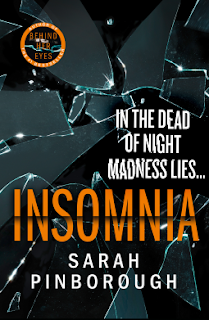
#Review - Insomnia by Sarah Pinborough

Insomnia
Sarah Pinborough
HarperCollins,  31 March 2022
Available as: HB, 400pp, e, audio
Source: Advance e-copy
ISBN(HB): 9780008289126

I'm grateful to the publisher for an advance e-copy of Insomnia to consider for review.

Sarah Pinborough is my go-to author for stories that bring out the horror inherent in everyday life. I consider myself very lucky to not suffer from insomnia, but I know that for those who do, nights spent fruitlessly trying to sleep - and days after, operating on no rest - are one of those horrors. It's a curse that's being visited on high-flying lawyer Emma at the start of this book, just as her oh-so-perfect family begins to fly apart - and she faces her fortieth birthday.

That birthday is often seen as a watershed, but Emma has a special reason to dread it: at the same age, her mother Patricia had a breakdown and tried to kill Emma's sister Phoebe. Thirty five years later, Emma is experiencing the same symptoms as Patricia - insomnia, blackouts, an obsession with a random string of numbers, and a compulsion to wander the house at night checking that doors and windows are locked. Add to this that Emma's 18 year old daughter Chloe seems to be acting out, her 5 year old boy Will is suddenly afraid of his mother, and that husband Robert is distinctly unsympathetic to Emma's worries, and Insomnia delivers a potent mix of internal and external stresses.

We get to know Emma as she tries to navigate these stresses (as well as learning more about her background and history). She's a person who has made superhuman efforts to erase her distressing past - to the extent of telling her family, friends and employers that her mother died all those years when she didn't - and her first instinct, as things begin to go bad, is to clamp down harder, to try to control everything and everyone, herself included. I'm not going to tell you how that goes, you'll have to read the book, but I will say that Pinborough is just superlative here at exposing how Emma unravels. Insomnia keeps the reader both needing to know what happens next, and dreading to see exactly how much worse Emma will make things for herself. The tension is simply electric, the situation more and more complex and intractable, the stakes higher and higher.

At one level, it's a portrayal of a woman driven by demons from her childhood, trying to work out what went wrong all those years ago so that she can put it right and protect her kids.

At another, we see a deeply paranoid and scared woman doubting herself and her own sanity, lacking any place of safety or support network. Most of her circle are in the same competitive business milieu as her, or excel as near Stepford wives. Emma is already out on a limb.

And at yet another level, there are the pressures of modern life: a husband who's not very supportive (he comes over to me as a bit of a pudding), a boss who sees Emma as arm candy as much as a talented and hardworking individual, kids who are, well, you know, kids. 

With so many threats and concerns and these three different sources of stress, clicking round like the wheels on a demon-possessed safe, there must be a risk that suddenly everything will line up, the door swing open, and some very nasty secrets emerge. But what are they, and how can Emma keep them locked away? Should she even try?

As with all Pinborough's writing, the tension simply crackles off the pages of a book you MUST read and one which, once begun, will gnaw at your reading brain till you get to the end. As a central character, Emma is simply magnificent. I didn't actually like her very much to begin with. As a divorce lawyer, she regularly throws other women under the bus to advance her career. (Her clients seem mainly to be middle aged men with an eye for a younger replacement; it's clear Emma is doing what she has to advance in a very patriarchal setting). Her impulsiveness verges on the self-destructive, and her  attempts to distance herself from her past - including her mother and her sister - suggest coldness, even selfishness. But as the story developed and Pinborough's nuanced characterisation drew me in, I felt for Emma more and more - including sharing her fear that she might, in one of those moments she can't remember, have done something truly terrible.

This book is BOUND to be one the highlights of the 2022 reading year. Watch out for it.

For more information about Insomnia, see the publisher's website here.


27 August 2021

#BlogTour #Review - The Great Silence by Doug Johnstone

The Great Silence (Skelfs, 3)
Doug Johnstone
Orenda Books, 19 August 2021
Available as: PB, 309pp, audio, e
Source: Advance copy 
ISBN(PB): 9781913193836

I'm grateful to Orenda Books for an advance e copy of The Great Silence to consider for review, and to Anne Cater for inviting me to take part in the book's blogtour.

The Great Silence is the third of Johnstone's Skelfs books, wrapping up the storylines to date in another instalment of weirdness with the family of Edinburgh women who do a bit of sleuthing on the side. As such, it could be the series will stop here, although I really hope not.

I love these books for so many reasons. The least of these is that I spent seven happy years in Edinburgh as a student last century, walking the same streets as the Skelfs - and Johnstone fully recreates that time for me. (I used to live around the corner from Warrdender baths, which is mentioned here, and would go there for a swim and a warm up when the flat got too cold). But no, there's more to it than that. There's also that these are very entertaining, very well plotted mysteries, Johnstone's habit being to throw several mysteries at the Skelfs, some minor, some life-or-death, as well threats to them directly, AND funeral business, explored in compassionate, empathetic detail. 

But what grabs me most about these books is their sheer heart, their depiction of three generations of women coming to terms with life, love and friendships. They're not the sort to avoid mistakes - Jenny, mother of Hannah and daughter of Dorothy, is particularly prone to these and in The Great Silence she's bitterly regretting one that she made, looping back up with Craig, her ex, but they own their mistakes, admit them, and seek to overcome them. There are regrets in these books - Jenny laments time past, time when she could party all night - but no regrets for good times and for the positives that came from them. Or indeed the positives that can come from very dark times. Abi, introduced in the previous book, The Big Chill, is trying to overcome some very grim family circumstances. Estranged form her mother and living with the Skelfs, she finds that the past comes back for her in a horrifying way - but is supported by Dorothy, Jenny and Hannah (not forgetting Hannah's girlfriend, Indy).

That heart, and I'll say it, soul, breathes through every page of this book. The mysteries are interesting (messages from aliens? A care worker attending to the very intimate needs of his elderly client? Escaped wild cats!) but it's the little, studied moments that give The Great Silence their character: Dorothy's reflections on her long life and her move from California to Edinburgh, her escape to her drum kit in the attic, Indy's relationship with her parents, the antics of cat Schrödinger and dog Einstein or Hannah. There's so much compassion in Johnstone's depictions, even for the most awful of characters (step forward, Craig).

The Great Silence - and this series in general - therefore manage both to be good, absorbing and escapist fiction but also something deeper and more touching, something very human. I'd strongly recommend them if you haven't read them yet - with a bias to saying, read them all in order, yes, but mostly, READ THEM!

For more information about The Great Silence, see the Orenda Books website here - and also the other stops on the tour, listed in the poster below. 

You can buy your book directly from Orenda, from your local bookshop, or online from Bookshop dot org UK, from Hive Books, Blackwell's, Foyles, WH Smith, Waterstones or Amazon.


2 June 2021

#Blogtour #Review - One Last Time by Helga Flatland

One Last Time
Helga Flatland (translated by Rosie Hedger)
Orenda Books, 24 June 2021
Available as: PB, 244pp, e, audio
Source: Advance PB provided by the publisher
ISBN(PB): 978-1913193690

I'm grateful to Orenda Books and to Anne at Random Things Tours for providing a free copy of One Last Time and for inviting me to take part in the tour. I was especially delighted to be asked if I'd join the tour because I totally loved Helga Flatland's previous book for Orenda, A Modern Family. Giving a sophisticated, vivid, portrayal of modern, grown-up life - taking as its peg the decision of middle-aged parents to amicably divorce - A Modern Family was one of my standout favourites of 2019, and I was keen to see what Flatland would do next.

One Last Time is similarly focussed on family dynamics exposed by a shattering event, but it carries an even greater emotional charge since that event is the diagnosis with cancer, of Anne, a stolidly independent woman in her mid 60s. I tend to shy away from stories about cancer and from awareness campaigns and such: my father died of it when I was quite young, I just don't want to go there. 

But, well... with this book, Helga Flatland got right past my defences. 

First, it's not, in the end, a book "about cancer". Anne has a daughter, Sigrid, a doctor, and grandchildren: Mia, the eldest, is a bit of a handful for Sigrid and her partner Aslak. Mia's interested in her dad, Jens, who abandoned Mia when she was pregnant and Sigrid resents that. Anne's husband Gustav has been in a care home for some years after a series of strokes, leaving Anne (happily, it seems) alone in the remote countryside, visiting Gustav often but living her own life (she had a lover for a while). Sigrid lives in Oslo, and her brother Magnus flies in and out from his job on the oil rigs. The family dynamics are complex, and I got the impression that things work because of the space between everyone - as soon as any two of this family get close, sparks seem to fly.

Now, though, that sense of space seems bound to end.

The relationship between Anne and Sigrid in particular, as shaped by Anne's deepening illness, is the emotional heart of this novel. The story is so carefully observed, with chapters told from the perspective of each, sometimes reexamining the same conversations and events, sometimes passing the action like a relay baton from one to the other. There is simply so much here, from the different perspectives on Anne's treatment to radically conflicting accounts of Sigrid's childhood. Sigrid sees Anne as having been a rubbish mother, especially after Gustav became ill, Anne indignantly refutes this. Sigrid silently accuses her mother of being "selfish" regarding her illness, Anne's emotional resources are engaged in worrying over Gustav and over the loss of the little things - like her morning dip in the lake - that form her life. There are troubling episodes around the young Sigrid that are never completely explained or closed, but she seems to have had more support from her bother than from her mum.

Now, perhaps, Sigrid thinks, the prospect os death will persuade Anne to examine her life and make amends. She holds this viewpoint so strongly that I think much of her concern for her mother - the pressure for her to continue treatment, the demands that she drops her moving swimming session - seems motivated by that belief, as though by dying sooner rather than later Anne will somehow avoid that reckoning.

That's only one of the emotional currents in this complex, satisfying book. There are many more. All of it churns away (mostly) beneath the surface, seldom coming to an out-and-out row, although sometimes disagreements about proxy subjects, or developments in the lives of others (like Mia and Jens) move into focus and, as it were, draw down the lightning. One gets a real sense that a whole lifetime of emotional tension and compromise is suddenly coming home to roost, not actually demanding a final resolution (sorry, Sigrid) but still requiring attention, like that rattle in the car's engine which can't be ignored any longer longer. 

The moves and countermoves between Anne and Sigrid and Mia are too many, too subtle, to summarise and I won't try. Flatland is awesomely good at drawing them as characters, making everyone flawed but sympathetic, annoying at times, downright WRONG at others but always engaged, always involved. It's a book that, if you have any heart and soul at all, will just melt them, in a good way. Keep the tissues handy.

Given the subject matter - and that the story here isn't plot driven, doesn't admit of a tidy ending with everything sorted - the ending was never going to be "they all lived happily ever after" but even so, I found it uplifting, as well, of course, as being sad. Exploring courage in all its forms - courage in relationships, courage with illness, the courage, at the right time, not to be brave - this is a deeply human story and for me confirms Flatland as a writer whose books are not to be missed. I'm so glad I read it.

About Helga Flatland

Helga Flatland
Helga Flatland is already one of Norway’s most awarded and widely read authors. Born in Telemark,
Norway, in 1984, she made her literary debut in 2010 with the novel Stay If You Can, Leave If You Must, for which she was awarded the Tarjei Vesaas’ First Book Prize. She has written four novels and a children’s book and has won several other literary awards.

Her fifth novel, A Modern Family (her first English translation), was published to wide acclaim in Norway in August 2017, and was a number-one bestseller. The rights have subsequently been sold across Europe and the novel has sold more than 100,000 copies. One Last Time was published in Norway in 2020, where it topped the bestseller lists, and was shortlisted for the Norwegian Booksellers Award.

For more information about One Last Time, see the Orenda website here or consult the blog on the poster below!

You can buy One Last Time via Orenda at the link above, from your local bookshop, or online from Bookshop, Hive Books, Blackwell's, Foyles, WH Smith, Waterstones or Amazon. 


20 April 2020

#Blogtour #Review - We Begin at the End by Chris Whitaker

We Begin at the End
Chris Whitaker
Zaffre, 26 March 2020
Available as HB, 464pp, e, audio
Read as e-book
ISBN 9781785769627

I'm grateful to the publisher for an advance e-copy of We Begin at the End to consider for review and to Tracy Fenton at Compulsive Readers for inviting me to tale part in the book's blog tour.

Nothing good will come of any of this...

I have just finished We Begin at the End and it was INTENSE. Twenty four hours (I had to eat and sleep) of manic reading, head down, ignoring the family, dogs and the weird slow-motion apocalypse outside, fixated on a tragedy set among ordinary people in small American towns some 20 years ago.

Punctuated by moments when it became SO intense I had to look away. It really is that compulsive.

You will believe these characters are real.

You will care what happens to them.

You will hurt when they hurt

You will want a good ending for them - a good beginning? - although that seems harder and harder to imagine.

We begin, not at the end, but before the beginning, in 1975. The inhabitants of Cape Haven, a small town somewhere on the coast of California, are searching for a missing girl, Sissy Radley. It's Walk who finds her, setting in motion a tragedy that will play out over decades. In that prologue we see the four friends - Walk, his best friend Vincent King, Martha May, daughter of the Episcopal priest and Star, the missing girl's sister - whose lives will be changed forever.

Jump forward to 2005 when Vincent is released from jail, after doing time for Sissy's death, and more besides. Walk is Chief of Police in Cape Haven and has spent all of those 30 years struggling against change, whether it's the loss of those teenage bonds between the four, encroaching development as the Cape is carved up for second homes, or, latterly, change in himself as he faces a debilitating illness.

Star's struggling to bring up her two kids, Duchess, who at 13 is pretty much full time carer for six year old Robin. While Star hangs out in bars and, periodically, overdoses, Duchess sees that Robin gets his water bottle filled, packs his books for school and remembers birthdays.

It's a heartbreaking glimpse of truncated childhood and a theme that recurs throughout the book as Duchess and Robin suffer one rebuff after another, losing one carer after another, sliding down the care system, subject to cruel judgements from both adults and their peers, only having each other. Robin is desperate for a home, Duchess hangs everything on protecting him, declaring herself an outlaw, reacting with spiky anger to anyone who tries to gets to close - because after all, they'll let her down in the end, won't they?

Each time you hope things might run around for the kids, something awful - but seemingly inevitable - seems to happen. It's a testament to Whitaker's writing and to the powerfully drawn characters he births onto the page that you still want to keep reading. You just have to know what will happen next - what defiance Duchess will roar, who she'll swear at, what revenge she'll take - even as you fear for her.

There seems to be a tornado of destruction eating up the lives of the Radley kids. Walk tries to look out for them - whether out of genuine feeling, because of those bonds with their mother, or as part of his generalised and futile attempts to hold up any change, isn't clear. I'm not sure he knows himself. The same motives presumably underlie his interventions on Vincent King's behalf, which take Walk further and further from the strait and narrow road that he, as Chief of Police, should be treading. There's a local gangster, Dickie Darke, who casts a menacing shadow and Walk seems determined to bring him down but as the story shows, even gangsters can have good - or at least pure - reasons for what they do.

At one level this is a crime story - there is an unsolved murder, a man on trial, further killings. Chief Walk fulfils our need to have someone trying to "solve" the mystery and there is enough evidence forensics, testimony, Walk's knowledge of those concerned - to keep the mind engaged.

But really, this is a book you will read with your heart, not your mind. Amidst the trim little American towns with their smart holiday homes or we-ordered farms and, hidden away, the less well maintained residences of the poorer folk, we see a tragedy of operatic proportions play out. There is a very conscious sense of being in a story - supported by Duchess's references to herself as 'the outlaw Duchess Day Radley', by her allusions to the survivors and victims of shoot-outs, escapes and chases, to epic robberies and rescues, to people who 'were turned pages in the darkest chapters of her life. She knew that they would appear agin, the twists, the sting in her tale.' Meeting Duchess at a gas station, the woman behind the counter 'knew the crossroads the girl lived at'.

At the same time, Whitaker counterpoints this sense of melodrama by writing about very ordinary, very recognisable people and places and using such vivid and at times beautiful language that the story seems to stop and hang onto it - whether observing that 'Smoked glass made matt of the world', that 'Thunderheads formed like gathered mistakes' or that an old man 'stooped like he was carrying each of his years on his back'. Again, it is a book that you feel as much as read - deeply poetic and appreciative of those moments of beauty that can come unexpectedly if you watch for them.

But that, for me, only heightens the pain as things get worse and worse - for Vincent, for Walk, for Duchess and Robin - as things are broken that can never be fixed, as changes come. I challenge anyone to read this book without shedding tears, at least inwardly: the degree of loss and betrayed, eroded innocence is so great.

At the same time it's a compelling, not to be missed, read.

Simply superb.

You can buy We Begin at the End from your local bookshop (or you may be able to, some are still managing to operate in the present circumstances and I'd urge you to try because they really need your support and we need them to be there for us). You can order it online from Hive Books, from Blackwell's (who I've noticed often have books available when other outlets don't), from Foyles, WH Smith, Waterstones or Amazon.

For more information about We Begin at the End see the publisher's website here.

The tour continues with many great reviews to come as you can see from the poster below - do check them out!