Showing posts with label portal fantasy. Show all posts

20 February 2024

#Review - Mislaid in Parts Half Known by Seanan McGuire

Mislaid in Parts Half Known (Wayward Children, No 9) 
Seanan McGuire
Tor, HB 20 February, e-book 9 January, audio 9 January
Source: Purchased
ISBN(HB): 9781250848505

I purchased this book as an audio. I will also buy the hardback once that's available, as, while the audio is empathetic and engrossing, I think that the Tor hardbacks of these stories are just beautiful objects to own (and as short books, they use little shelf space!)

Of all the Wayward Children stories so far, Mislaid in Parts Half Known is I think the most direct continuation, picking up Antsy's story from Lost in the Moment and Found more or less where it was left, with Antsy's arrival at Eleanor West's School. As such, it suits reading out of sequence much less than some of the other parts of the series - not only because of spoilers but because the previous book has established Antsy's character, rooted in her terrible experiences and in the betrayal she suffered from her adopted friends in her world-hopping Store. All of those things matter when a nine year old girl in a teenager's body tries to fit in at a school already full of misfits, and they affect how Antsy's very special gift - of being able to find anything - will be seen by those who, more than anything else, want to find their Doors and return to their own adopted worlds.

As with several other of the books in this series, these pressures force Antsy - still basically a nine year old, this bears repeating - into making some very subtle moral judgements and decisions about those who are older and ought to be wiser than her. The whole of McGuire's endlessly fascinating universe is like that, of course. The School is predicated on the existence of diversity, the different worlds from which the Wayward Children have returned representing that diversity, but it highlights a paradox because it brings together those who would rather inhabit their own, less diverse worlds, worlds that call to something distinct inside each of them. (Mine, I'm sure, would be the Moors). 

This tension produces some fascinating dynamics and calls the kids to balance their desire for their one, true and only world with care and love for their very different friends, against a backdrop of their necessary accommodation with a harsh and uncaring primary world (Earth) that doesn't understand any of them. Not all of them pass the test: some may come to this with further experience, some may not. 

While these themes recur in the series, the contradiction is, I think, especially acute for Antsy, possibly because "her" world was a nexus, a hub with many connections, and she was abused by those she trusted, at considerable cost. For her, then, the fantasy landscape has darkness at its core. It's not just the losing of the desired world that has hurt her, it's the core experience of it. How she resolves that and redeems herself and her world is the heart of the story, and it is a beautiful and revealing story which I loved to read.

There is, though, more here - we see alliances and authority in the school shift and Eleanor, that rock, seems to be crumbling somewhat. The School isn't static, and these books continue to explore and develop new themes and challenges. Roll on Book 10!

For more information about Mislaid in Parts Half Known, see the publisher's website here - 

8 June 2023

#Review - Lost in the Moment and Found by Seanan McGuire

Cover for book "Lost in the Moment and Found". A scene of a dim, cluttered room in which shelves bear all kinds of random stuff (an old-fashioned gramophone horn is prominent). In the middle distance, a half open door gives onto vibrant greenery, light streaming into the dusty space.
Lost in the Moment and Found
Seanan McGuire
Macmillan/ Tor/ St Martin's Press, 21 February 2023
Available as: HB, 160pp, e, audio
Source: Audio subscription
ISBN (HB): 9781250213631

Apologies that I haven't given clear publisher details above - frankly, even eight books in, I'm still rather hazy about the identity of the publisher, or whether Lost in the Moment and Found is officially published in the UK at all. (It is certainly available as audio, which is how I read it).

Even after eight books, and several shorts, McGuire continues to break new ground with these stories. Lost in the Moment and Found is the story of Antsy, a young girl who, early on, seems in real peril from an adult. I don't want to spell out the nature of this, and would refer readers to the author's note - but I will say that McGuire handles the issue with great delicacy, never spelling out in the text what may happen but making it totally clear that someone here is trying to cross lines that ought not to be.

Anyway, long story short, Antsy is threatened and runs away. And she finds a Door. Readers of this series will know that Doors can lead to some wonderful places and take people to worlds that will welcome them, worlds they will fit with - but Antsy doesn't need a whole world, does she, she just needs a safe place where lost things such as her can be cherished?

That need perhaps takes us deeper than we have yet been into what I might call Doorology - the principles and workings of the Doors - why they appear (or don't), where they go - and the cost of using them. There have been some hints of that, but not, yet, a full account. Perhaps this still isn't a full account, but we do learn a lot, as does Antsy. It's frustrating to be writing this review because I don't want to give away all the magic, but I will say that this story raises questions about Doorology as well as providing answers and shows that things can go wrong, especially where fallible adults take a hand.

Antsy is especially raw where fallible adults are concerned and I have to say, my heart almost rose to my mouth when I understood the situation that she gets into here. Reading some of the earlier books I've been tempted to think, count me in, when one of Wayward Children finds their world (mine would be The Moors, or course). Lost in the Moment and Found presents a much darker take That corrective was probably due - it's too easy to think that everything will be write if you only step into the right world. I think McGuire's message has always been a bit subtler than that, to be fair, but Lost in... addresses this aspect the most clearly of any so far. I think.

Which is not to say it isn't fun. It's fun! There is wonder! There is joy! Like all these books, there are several levels of meaning, and simple, mischievous, childlike (NB childlike, not childish) amazement is part of the package too.

And while standalone, there are also callouts to the other boys, and eventually, a like of coming-home-but-not that promised more of Antsy and perhaps hints that some of those unresolved questions will be revisited and, er, resolved.

For more details about Lost in the Moment and Found here is the US Macmillan page for the book.


15 March 2021

#Review - Witherward by Hannah Mathewson

Cover by Julia Lloyd

Witherward
Hannah Mathewson
Titan Books, 16 February 2021
Available as: PB, 528pp, e
Source: advance e-copy
ISBN (PB): 9781789094435

I'm grateful to the publisher for an advance e-copy of Witherward via Netgalley.

I found Witherward an exciting and absorbing but at time frustrating read.

Introducing Ilsa Ravenswood, orphan and magician's assistant who is scraping a living on the street of Victorian London, the book gives the barest glimpse of her life - though what we see is fascinating - before whisking her away to a parallel London (the "Witherward" of the title), divided between warring magical factions, each with their own talent, for example, the ability to control others' minds, or to see the future.

The clan to which it turn out Ilsa belongs, the Changelings, are able to transform themselves into any animal they wish - useful for fighting or escaping... or a stage magic act: she's already, before joining the Wiherward, learned what she can do as part of her act with Bill, the much decayed stage magician with whom she performs. Ilsa rapidly polishes her abilities, though, once she's introduced to the "Zoo", the seat of the ruling family in Camden (which occupies the location where in our world London Zoo sits).

This was, though, where the book nearly got stuck for me. The short, early section following Ilsa and her friend Martha in "our" London was gleeful, busy and full of fun. (And scary!) Ilsa's escape to the Witherward is fraught with danger and mystery. But on her arrival, the pace slows. A key plot point is that Ilsa's brother Gedeon, the so-called Prince of Camden, has disappeared, leaving the Ravenswoods leaderless and under suspicion from the other factions. But this also means that (due to his absence) there's no unifying figure to greet Ilsa, no sense of what purpose Ilsa might pursue. She spends a lot of time learning about the strange world she's in, and then begins to investigate Gedeon's absence, but before things can really get moving again, a great deal of conversation is needed. Ilsa needs to get ahead around not only the Witherward itself, but the many figures in her own clan (both relatives and hangers-on) and the history of everything. 

This feels, at times, like a big contrast to the action-y content of the opening pages. It comes alive at times when Ilsa plays truant, for example sneaking out to join in a street party but I did wish there were more of these episodes. The Witherward is though, I have to say, a fascinating, well worked out and complex world. And the conundrum of Gedeon's whereabouts is a challenging and many-layered one, akin in many ways to a crime or spy story. So this book always maintains interest and it's also great seeing Ilsa's background and personality unfold. 

Ilsa has grown up under the thumb of a singularly unpleasant guardian (most details here are held back but there's clearly been abuse) which has marked her in many ways, and she finds it hard to come to terms with a family she never knew about and which left her to suffer alone. Trust is slow to build, understandably, and Ilsa very much wants to do things her way but there is so much she doesn't know - and it seems likely that "her way" may get Ilsa into trouble every quickly.

Ilsa does, through this middle part of the book, keep her wits about her and she does focus on tracking down Gedeon. As she discovers more and more answers (and deeper layers of questions!) she begins to appreciate how complex and dangerous life in the Witherward is, and who in her extended family may have their own agendas. That leads to a furious (and glorious!) climax to the book, another change of pace which made me so glad that I read to the end.

Leaving a number of plot strands open, Witherward is clearly setting up the possibility of sequels in this intricately imaged alternate London and I will be here for them when they appear. Ilsa is a formidable protagonist and she's obviously got lots more to see and do.

For more information about Witherward, see the publisher's website here.


1 January 2021

Review - Across the Green Grass Fields by Seanan McGuire

Across the Green Grass Fields
Seanan McGuire
Tor.com, 14 January 2021
Available as: HB, 176pp, e, audio
Source: Advance e-copy via NetGalley
ISBN: 9781250213594

Seanan McGuire's Wayward Children series is one of my firm favourites, so I was pleased and honoured to have the opportunity to read Across the Green Grass Fields early via a free advance e-copy from NetGalley. 

Across the Green Grass Fields is a stand-alone book in the series, focusing on Regan Lewis, a young girl, and later woman, who is desperate to be taken as normal. There is no overt reason, to begin with, why she shouldn't be seen as 'normal' but McGuire writes as ever with real insight into young peoples' lives (yes, I know writing "young people" marks me as ancient but there we are). In this case, the insight is into that child-growing-up anxiety, bound up with being in and out of friendship groups, in which 'normal' isn't so much a state of being as a state of grace. Not to be normal is to be cast into the outermost darkness and Regan sees that happen to a friend when Laurel, queen of her little circle, excommunicates Heather. Not wanting to suffer a similar fate, Regan's development is bent towards staying in favour. Even if Regan's mother assures her that there are many valid ways of being a girl, Laurel's narrow worldview still prevails.

All of which sets Regan up for a terrible fall when she can't, in the end, stay within the boundaries that Laurel draws - sending her fleeing, as Wayward Children must, into a world that welcomes her. For Regan, a keen horsewoman, this is the Hooflands, a world of centaurs, unicorns, kelpies, hippogriffs and other equine beasts. As you'll know if you have read other books in this series, it is not, though, a safe world, it is not a world of cosy wonders. There are real dangers and challenges here and humans are seen as bringing crisis and change to the Hooflands. There must be a reason for Regan's coming, and while she bonds immediately with foal Chicory who becomes the true friend she never had among other humans, there's a sense of doom having over things from the beginning.

McGuire's writing in this series always has great heart and generosity, exposing hypocrisy and bigotry - whether in the human world or through one of those doorways - mercilessly but also respecting and celebrating friendship and love. Across the Green Grass Fields is no exception, although the message is perhaps more subtle than in some of the previous stories. Ostensibly, Regan's story is a quest - she's a sort of Dorothy, definitely not in Kansas any more - but the real journey she's on is I think more one of coming to terms with, of learning to love, herself, 'normal' be bothered. We never actually see the culmination of that once Regan has sorted out the problems of the Hooflands, but in a sense it's not needed. We are told enough, and having read the preceding books, can fill in Regan's subsequent story and see how things will go and how she will arrive at Eleanor West's school (never mentioned in the book!) without having to be told any more.

In that sense, while completely standalone, this is also a book that should be opened after, at least, reading Every Heart a Doorway, and possibly one or two of the others - not because of particular spoilers, but because these slim, beautiful and true books are all really part of the same wider story and some background will help in understanding it. It's one story that celebrates difference, loyalty and growth, and I would strongly recommend Across the Green Grass Fields (and all the series) to you.

15 October 2020

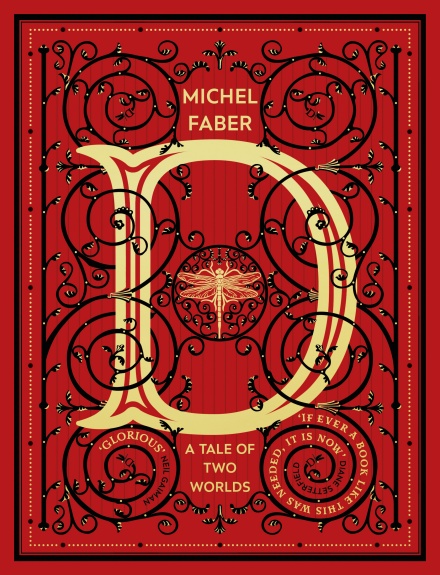
Review - D by Michel Faber

Design by Marianne Issa El-Khoury
D (A Tale of Two Worlds)
Michel Faber
Doubleday, 17 September 2020
Available as: HB, 291pp, e, audio
Source: Advance e-copy via NetGalley
ISBN: 9780857525109

I'm grateful to the publisher for an advance e-copy of D via NetGalley.

Michel Faber's latest novel is a fun children's adventure, with much danger and peril and plenty of humour.

Schoolgirl Dhikilo has already, by the time the story opens, survived more than her share of adventure, having been rescued by her father as a baby from the almost-a-country Somaliland (not Somalia, as she carefully explains). Finding sanctuary in the UK, she is settled in the town of Cawber-on-Sands on the South Coast with her pleasant foster parents Ruth and Malcolm. Faber shows us how, while happy with them and at school, Dhikilo misses the culture and country she was too young to remember, devouring any facts or gossip she can find online or in the local bookshop or library. Those early parts of the story are filled with longing and missingness even while - as Faber explains - Dhikilo isn't quite sure what it is she's missing.

So perhaps Dhikilo is ready for another adventure when it comes along, as come along it does. Things begin to go wrong. To disappear. Specifically, the letter "D" - then things containing it. So soon there are no more ogs, no more octors at the surgery and no onkey derby at the annual fete. Soon, there is a politician on the TV saying that iversity is all very well, but not if it gets in the way of forging a strong, safe nation.

Why can only Dhikilo see what's missing? That's not clear. Maybe because as an outsider, she's more receptive, more ready to ask questions, awkward questions, and get into trouble for doing so? Even to travel to a strange world (after all, it's not the first time) where she might discover the truth about what's been happening and perhaps even do something about it?

That's what happens, courtesy of a mysterious adult whose house has a gateway in the attic to a frozen world. If that makes you think of Narnia, then yes, it's supposed to - Faber is perfectly clear about the inspiration here and some of the events through that doorway will remind you of CS Lewis's books and the films of them. But there are differences too, I think. In particular, while Dhikilo has an animal guardian here - a Sphinx called Nelly, no less - there's no religious aspect, as with Narnia's Aslan, and much of Dhikilo's progress depends above all else on her courage, common sense and kindness. She has a series of challenges to meet, which I won't say anything about - spoilers! - and as the story unfolded I recognised another influence here: Charles Dickens, with many of the settings and creatures named after, or reflecting, his books - we meet the Quilps and the Drood (sorry, the roo), the names of the rooms in a hotel called Bleak House are based on London prisons and most sinisterly of all, there is a Big Bad called the Gamp, supported by unpleasant magwitches, creatures he claims to be enemies but is working hand-in-glove with. (A bit of satire aimed at lying politicians, I think).

Anyone reading this book who doesn't recognise these names (or some of the scenes and events) won't be puzzled of confused by the story, but if you know what they mean, it does add a little bit to your enjoyment, as will the details revealed towards the end about a certain Professor and his home.

This is, as I have said, above all an exciting, dangerous adventure with a resourceful and wise central character. The subtitle, "A Tale of Two Worlds", as well as its allusion to Dickens, may refer to Dhikilo's adventures in England and in Liminus or to her passage from Somaliland to England, or possibly both. There are, I think, many more than two worlds here, giving much to explore and discover.

I'd strongly recommend D.

For more information about this book, see the publisher's website here.


20 September 2019

Blogtour review - The Ten Thousand Doors of January

The Ten Thousand Doors of January
Alex E Harrow
Orbit, 12 September 2019
HB, 371pp

I'm grateful to the publisher for an advance copy of The Ten Thousand Doors of January and to Tracey Fenton for inviting me to take part in the book's blog tour.

The Ten Thousand Doors of January is a book I'd recommend 100%, probably one of my favourite books so far this year (and it's been a good year!)

At times exciting, tearjerking, heart-poundingly tense, and romantic (and sometimes all of these together) this fantasy adventure is both about the urgent need to see, and to cherish, the magic in life, and about growing up, forgiving and living. Every page burns with life, with wisdom and with love.

January Scaller is a young girl growing up in New England in the house of Mr Locke, a gilded age robber baron whose passion is archaeology - or at least, archaeological loot, which he employs January's father to hunt down, sending him all over the world. January's glimpses of Julian grow fewer and fewer, while Locke attempts to mould her into a "good girl" - quiet, well behaved, obedient - with limited success. January is a lonely child but she is comforted by her dog, Bad, by the comics and storybooks shared by the grocer's boy Samuel... and by the strange tokens and gifts which occasionally turn up.

Intertwined with January's story is that of another young women, Ade, who sought adventure, ran away from her childhood home, and found it, at great cost. To begin with it's not clear what the stories have to do with each, nor with the readings January gives us from a strange book she has found. The jumps between these in the early part of the book may seem a bit jarring, but bear with the story, it all makes sense in the end. The point is not the destination but the journey, and Harrow is an excellent guide, leading the reader through a rich, emotional itinerary as January grows up and observes her place in the world. Dwelling within Locke's sphere of wealth and privilege, she has experiences and advantages not available to others of her "mixed" heritage, but she's both aware of how fragile her position is and terribly conscious of loss, of her father seeming to reject her on her endless quests.

A bookish girl, clearly, one prone to seek solace in stories, to dwell in her own imagination, biddable, polite and eager to please.

Well, yes... and NO. As January's life unravels over a few terrifying weeks, and she faces the loss of everything and everyone she knows, she proves to have steel in her, and unsuspected gifts. I don't think I've read anything recently as tense as the pages where January suffers blow after blow - often through being too trusting, just not quite quick enough, too ready to blurt out what she has seen or suspects. Frustrating for the reader at some points, but showing her humanity. January learns some hard lessons, and several time brings disaster on those she loves. While never less than. absorbing there are places where this story is very hard to read - a triumphant token, I'd say, of Harrow's ability to convey the beauty and terror of January's life.

There is a darkness, a destruction, at work in the world, alongside the complacency of the opening chapters - this is 1901, a time of progress, of civilisation, of peace and progress - and January only gradually learns what it may have to do with her and what, unknowingly, it may have cost her. Then she needs to choose her side and question all her assumptions.

In all, this is a glorious book, packed with insights, empathy, humour grim in places) and above all, with the personality, shrewdness and insight - above all, the self-awareness - of this very remarkable protagonist.

January will run. Monsters will follow. Hearts will break...

And remember: "Men are mostly cowards..."

For more about this book, see the publisher's website here.

To buy the book - and you should - you can visit your local bookshop, of course, or use Hive which supports local bookshops - or there is Blackwell's, Foyle's, Waterstones, WH Smith or Amazon.


3 September 2019

Review - The Nightjar by Deborah Hewitt

The Nightjar
Deborah Hewitt
Tor (Pan MacMillan), 5 September 2019
PB, e, 459pp

I'm grateful to the publisher for a free advance copy of The Nightjar to consider for review.

In Hewitt's debut novel, Alice Wyndham, an unremarkable young woman living and working in London, discovers that she has unsuspected abilities and a place in a magical and unseen world, another version of London. This knowledge brings not only wonder - Alice can see the birds which accompany all humans and which safeguard their souls - but danger too; danger to her, and danger to her family and friends.

I love the premiss of this kind of fantasy.

The secret, alternative world, with its own rules and society.

The possibility of escape from the banal, the ordinary, the constricting (Hewitt is rather good on Alice's awful, sleazy boss and her dreadful workmates).

The process of denying, then considering, then accepting the staggering reality - and then of trying to reengineer one's life to include the new while holding on to loved ones, familiar things and what's seen as safe. Hewitt pitches things just right here - too much resistance and the reader wants to shake the protagonist by the shoulders and tell them to get on with things, too little and there's no tension.

And the world she describes - a place called the Rookery, an echo of past London full of disappeared buildings and quaintly old-fashioned scenes - is real, vivid and interesting, as are the people in it. This is clearly the first in a series and the author sets up plenty of stuff for the future: four distinct schools of "legacies" (what we might call varying magical gifts), a police service for the Rookery, a death-cult, necromancers, gangsters, spies. Not all of it is explored fully but that's fine, I'm sure we will get there!

There's also a potential smouldering romance. To my mind this didn't work quite so well as the world building. It's difficult to say a great deal about this without giving away plot and this is one book where plot secrets matter. I will just say that the character to whom Alice is attracted (plainly to us, less so to her) is very mercurial and there are reasons for this - but it makes the idea of there being a relationship between them somewhat daunting. Another factor that impedes this is the sheer flow of events. Once Alice discovers the Rookery, Hewitt doesn't give her any time to acclimatise, things begin to happen to her and she's on a deadline, driven by a crisis back at home. This leads her into a series of scary encounters. For me, things crossed the line from being exciting into just too frenetic - I'd have liked more time to admire the scenery and get to know Jude, Sasha and the other residents of Coram House - but this is very much a personal preference: if you like your fantasy really busy and action filled, The Nightjar should be just what you want.

Overall this is a solid beginning to a series and left me wanting to know more and wondering what will happen next. I'd like a bit more breathing space in future books, possibly, and some exploration of the Rookery and its relation with our world but I will look forward to what Hewitt has coming.

For more information about The Nightjar, and links to buy the book, see the publisher's website here.


23 February 2019

Review - In An Absent Dream by Seanan McGuire

In An Absent Dream (Wayward Children, 4)
Seanan McGuire
Tor.com, 1 February 2019
HB, 208pp

I reviewed In An Absent Dream as an audiobook (even though I've cited the availability of the hardback version above, probably because I fetishise the physical object or something, don't get me started).

The fourth volume in the Wayward Children series is actually a prequel, the events taking place a few decades before the other books. We enter the world of (Katharine) Lundy, an intense, studious girl who has no friends. It's the 1960s, and teachers can easily get away with saying things like, girls need more help with maths. Because her father is the Principal of her middle American elementary school, no-one wants to know her. It's all not fair, and Katharine longs for a world where things are fair and there are rules that everyone follows.

In the manner of the Wayward Children books, of course, she finds just that: a doorway leads her to the Goblin Market where everyone must always give "fair value". (To fail to do so would lead to an escalating series of changes and losses, eventually resulting in... well, I won't spoil that).

The story is bookmarked by two references. At the beginning is an extract from Christina Rossetti's bewitchingly enticing poem, also Goblin Market, stressing the ripeness, the juiciness, the taste, of all those fruits that are on offer. Towards the end, McGuire's authorial voice declares sadly that "this is not a fairy story". (I may slightly misquote, I listened to the audio so can't easily check the text).

It certainly isn't that sort of fairy story - you know, where the Princess and the Handsomse Prince kiss and live Happily Ever After. But I think McGuire's warning is slightly deceptive. That first quote has already given us some orientation as to what sort of (fairy) story the book is. Rossetti's poem may be interpreted as a sort of yearning warning to Victorian young womanhood against temptation, in the form of those oh-so-sweet goblin fruits, but there is more than one level of meaning to it and McGuire deftly exploits another that is a common theme of fairy stories - the bad bargain. Lundy (she chooses to use her surname after a warning that names have power) is told what the rules of the Market are, and soon learns the consequences of failing to keep them, but she is, as well as being a rule-taker, always on the lookout for loopholes. This leads her to (in a sense) gamble with the Market, the stakes becoming higher and higher. Whether that will ultimately buy her freedom and her heart's desire or... not... you have to read the book to see.

It's in some respects a curious book. Part of the Wayward Children series, it is very much a standalone, with little involvement of Miss Eleanor and her School.

Curiouser (and curiouser) still, the focus of this novel is very much on the progress of Lundy's bargaining and how that develops. We hear about high adventures - much Questing goes on, there is talk of defending the Market's borders and even a death of a friend of Lundy's - but this is all off camera, as it were with the book dwelling instead on Lundy's comings and goings, the tension between The Market, the world where she belongs (her "home") and our world, the world of her parents and sister. So we see a lot of her coming and going, with her life in the Goblin Market glossed over. That felt frustrating at times, you just have to trust McGuire though - in a sense we can imagine what we don't see, and putting all that in would make the book a lot longer and smother the theme she's trying to develop. Still, I would like to know more about those skipped over episodes.

Finally, I've referred above to bargaining, to "fair value" and the central metaphor of this book is a market. The Archivist, the nearest thing Lundy has to a guide and mentor in that strange world, is rather fond of lecturing her on the workings of that market. If you listen carefully (remember, I was listening, not reading) I think you'll conclude that this market is not a "market" in the sense that the modern neoliberal consensus would recognise (it's too fair for that; a Goblin Market is, after all, a fair, and so has to give fair value?) but it's still hard for these passages not to resemble economics seminars. And in at least one of them (which explained the background to Lundy's first big gamble) I never quite understood the reasoning. (Sorry this is obscure, spoilers, spoilers, spoilers). I think two things are going on here - first, since Rossetti's day, terms like "market" and "value" have become tainted by what is, after all, referred to as the "dismal science" and secondly, the ideas at the heart of this book are quite complex to convey in what is a short book.

That seems to have taken us a long way from fairy tales and magic doors. Rest assured, those are present here, it's really an enchanting extension to the Wayward Children series. Also present - of course - is Lundy, an engaging and steely young woman whose love, loyalty and courage shine through.

It is really a very enjoyable book, and confirms that McGuire is continually taking this series to new places. I hope she does so again soon.

For more info on the book see the publisher's website here.


15 February 2019

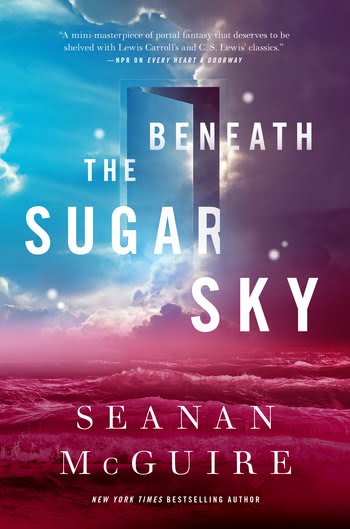
Review - Beneath the Sugar Sky by Seanan McGuire

Cover by Sean Rodwell
Beneath the Sugar Sky (Wayward Children, 3)
Seanan McGuire
Tor, 1 February 2018
HB, e 174pp

Warning: this is the third book in a series and there are some spoilers below for earlier ones.

I bought my copy of this book (another 2018 book I'd left unread too long, and caught up with over Christmas).

I'm loving McGuire's Wayward Children series. To start with the concept is brilliant - Eleanor West runs the Home for Wayward Children, those who've wandered through doorways into other worlds, returned to this one, and don't fit in - but the execution, ah, the execution is sublime. These are real kids, people you will recognise or even people you might have been. Or indeed, be. This series is just so well written, has so much heart and soul and I really, really enjoyed this latest instalment.

Beneath the Sugar Sky opens out the themes of the series somewhat. While the first two books, Every Heart a Doorway and Down Among the Sticks and Bones, told different parts of the same story - that of Jack and Jill, their time on the Moors and their time in the School - in Beneath the Sugar Sky, Rini - daughter of Sumi, who we met in Every Heart - appears from the land of Confection, a place of sugars and baked goods... where everything has now gone wrong. What happened in the earlier book has brought about a catastrophe. The Queen of Cakes is rising again, and Rini's very existence is threatened.

A party of friends sets out to put things right, travelling through various worlds, meeting the Lord and Lady of the Dead and then, inevitably, coming up against the Queen herself.

It's smart, funny, touching and has a pace and tension to it that will keep you turning the pages, as well as smart characters out of their depth - they're in a strange world, not one they would have travelled to. But there is more here and I thought that - after the third book - it might be worth saying something about this series in general.

I understand that one of the hallmarks of science fiction or fantasy is to make metaphors actual. I do find this a hard concept to grasp. I can see for example that "time travel" leaps over our short lives to consider the effect of what we do on the future - or pushes us into the past to consider how similar, and different, we may be to our ancestors. But it's hard to feel this idea other than as a clever talking point, it seems to add little to one's understanding of a book.

In the Wayward Children books, though, McGuire takes this idea and makes it dance and sing. her series has a very clear focus: the kids she conjures up literally don't fit into this (our) world. They want to find a world where they do fit and, if they fall back out of it - those doorways have a pesky habit of reopening just when you don't want them - they need to find their way back in. Eleanor West's Home is a kind of waystation, a safe space where such kids can wait and learn, while they hope to go back.

So we have here, for example, Cora, who's curvy and excellent at swimming and has spent time as a mermaid in a water world. Back home, though, she's taunted for being "fat". Or Kade, whose misfortune is to have been exiled from the world he really wants, where he would be a brave prince - because it identified him, as his parents do, as female. (Not every story has a happy ending).

The Home provides a place to wait, to hope that the door will eventually reopen and - however imperfect this is - the society of others who are in a similar position. It isn't all sweetness and light (witness what happened in the first book) but it is better than a disbelieving and, well, adult world.

The writing therefore speaks to the sense of many young adults that they are misunderstood, out of place, different and it holds out hope of a better future. But there are no promises. This acceptance has to count for a lot, the happy ending may not come (and don't many or even most of us adults go around with similar feelings at least some of the time?) Not every door reopens.

But it goes further than this. By positively identifying with a glorious gamut of diversity (the books acknowledge race, gender, sexuality and many more characteristics - including simply loners and those who identify as weird in various ways) McGuire subtly (well, perhaps not so subtly) renders people visible. In a sense the book is Eleanor West's academy, because that is the place that Christopher, Cora, Sumi, Nancy and all the others have gone because that is where they will accepted and acknowledged..

If that sounds like the worst dream of a certain sort of pallid, angry SFF fan, well, perhaps it is. But I think the reason for that is not because, oh look, here's a SFF book with LGBT people in it, or people of colour, or whatever, and why did she have to do that, and can't we just have a fantastical adventure anymore? No, I think what stands out is that these books don't just have a diverse range of characters, in passing as it were, rather their theme and purpose is that diversity. The whole point of Wayward Children is that with an un-diverse different cast of characters they wouldn't work. The central idea - that we all have, or may have, our own doorway, to a land where we make sense, that we can go there, but we can lose that place - only works on the premise that all those doorways are different. Narnia isn't Never Never Land. Wonderland and Nutwood are different places, even if they have similarities, and the Hundred Acre Wood, to which Christopher Robin escaped, different again.

McGuire's embracing of diversity makes this obvious and - I think - changes that metaphor of falling down the rabbit hole or stepping through a wardrobe forever, making clear that such fantasies, such quests, are about the child stepping into the pond, through the mirror, or into the crack in the tree rather than the ostensible business of the quest or adventure then that takes place. What need is inside someone that they travel to such places so that it can be recognised and met?

So - rather that a nod to diversity through including these characters, McGuire  has full-bloodedly turned it into the subject, the bedrock and the central metaphor of her book (of this series). It's an exemplary use of that 'make the metaphor concrete' idea, in the very best, most mainstream SFF tradition - but it turns this idea on something that, let's admit it, still gets a minuscule share of the action (or perhaps of the attention).

Oh, and in case I wasn't clear above, Beneath the Sugar Sky (as well as Every Heart a Doorway and Down Among the Sticks and Bones) are rattling good stories. I don't think McGuire could produce a dud if she tried.

On, now, to Book 4, In an Absent Dream, which isn't out yet as a physical book (1 February if you're waiting!) but is available on Audible now...