Showing posts with label Military. Show all posts

25 May 2025

Grave Empire by Richard Swan

Grave Empire
Richard Swan
Orbit, 4 February 2025, 
Available as: HB, 509pp, audio, e   
Source: Advance copy
ISBN(HB): 9780356523866

I'm grateful to Orbit for sending me a copy of Grave Empire to consider for review.

Grave Empire ought not to work. Swan has gone back to the world of his Justice of Kings trilogy for a followup, set several hundred years later and with entirely new characters. The setting is recognisable, but beyond a few callbacks to the earlier books, the action is new (though, as the story develops we see that what I might call the theological character of the world is also the same).

There are pitfalls of writing a continuation to a successful trilogy. You may rehash the original, undoing the earlier resolution and making the reader ask what the point was (hello, Chronicles of Thomas Covenant! Hello, Star Wars episodes VII - IX!) Or you may produce something notionally related but not really, and be accused of simply cashing in on the earlier success. Either want you may miss what appealed the first time round.

Swan, however, avoids both of these traps and indeed rather gloriously transcends them. If the first trilogy had a sort of neo-Roman Empire setting, albeing garnished with Northern, rather than Southern, European tropes, Grave Empire picks things up in a more gunpowdery age. The warfare is a bit Napoleonic, the geopolitics more Age of Empires (complete with colonial excesses) than Ancient World. Yet, behind it all, the menace that Sir Konrad discovered, the cosmic horror that drove events in the earlier books, still festers. Only, the re-established Empire of the Wolf has now made the lore that might have allowed it to resists, even more forbidden. Quite the conundrum.

Against that background, Grave Empire gives us some brilliant new characters. There is Peter, a young man recently recruited to the Sovan Army. Swan is good on the motivation for the this, the mix of personal drift, family situation and peer pressure. He also creates a plausible military for Peter to join, and a plausible disillusionment for him to undergo, amidst the coming apart of Sovan political and diplomatic influence and an increasingly precarious strategic position. Peter's arc will lead him to and beyond the fringes of Sovan power and to him becoming the holder of strange secrets.

There's also Renata, a studious if obscure Sovan diplomat in a little-regarded branch of the bureaucracy, that will soon be brought to the centre of matters as the crisis escalates. I rather like the "obscure functionary unexpectedly thrust into the limelight" trope (as a bureaucrat myself perhaps it plays into my wish fulfilment: if only people would actually listen to ME!) and Renata's an ideal subject for it, a mix of high competence and low confidence. 

This opening volume of the new trilogy takes its time, and gives plenty of space, allowing both Renata and Peter to develop and for us as readers to take their measure. (And also introduces a number of others). Plenty else is happening, with military expeditions, plots and a mysterious master-spy whose motives seem deeply dubious, if still rather obscure. Many of these threads remain separate, though Swan uses the alternate viewpoints they provide to provide more information about the "modern" version of his world.

It's a gripping read, one that fairly rattles along in terms of pace and Swan successfully prevents the reader from pining overmuch at the loss of his earlier roster of characters, as she or he might have if it had been set closer in time. 

Recommended.

For more information about Grave Empire, see the publisher's website here.
21 April 2023

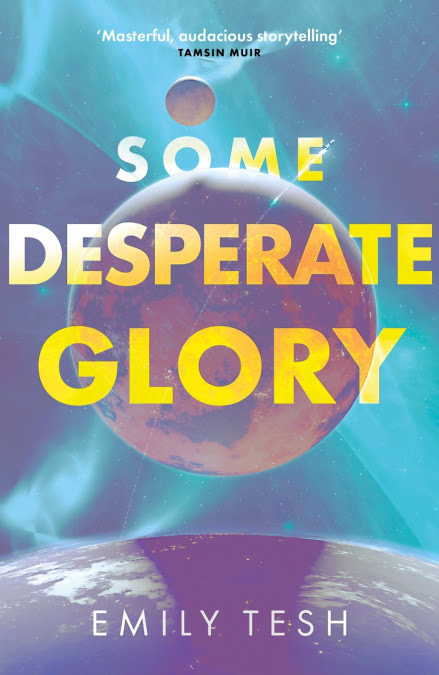
#Review - Some Desperate Glory by Emily Tesh

Book "Some Desperate Glory" by Emily Tesh. One planet rises over another, against a background of blue sky and stars.
Some Desperate Glory
Emily Tesh
Orbit, 13 April
Available as: HB, 438pp, e, audio
Source: Advance copy
ISBN(HB): 9780356521831

I'm grateful to Orbit for an advance copy of Some Desperate Glory to consider for review.

"While Earth's children live, the enemy shall fear us".

This is a wonderful book.

Following Kyr, a young woman growing up in a remote space colony, Gaea, which has a very militaristic culture, we learn about a wider universe. About Earth, destroyed by alien attackers. About the humans - the last remnant living on that rock, and the aliens - all conquering, under the aegis of "the Wisdom", a mysterious force or intelligence that guides entire peoples, entire planets.

Kyr is one of the best warriors of her generation, genetically enhanced for warfare, trained remorselessly to avenge Earth, and now hoping for an assignment to one of the military wings of her people. Imagine her horror when instead she's assigned to the Nursery - facing a future bearing a child every two years to replenish Gaea's population. A future where she's offered as a privilege to the fighting men. Appalled at the prospect, Kyr takes her fate into her own hands and sets out on a self-defined mission to wage terror against those she perceives as traitors and collaborators. Because, no, the inhabitants of Gaea aren't actually the only humans left...

Emily Tesh produces a miracle of characterisation with Kyr. She is, frankly, a very unlikable charcetsr - the perfect little soldier, fanatical and devoted to the cause. She's disliked by her messmates, moody, committed, totally un self-aware. Yet you'd have to have a heart of stone not to sympathise with her, faced with a duty - the one duty - she simply can't bear. It seems she's been totally betrayed by the culture she hero-worships, and while the reader will soon spot just how rotten a culture that is, Kyr is conditioned, no radicalised, to serve it so the only way she can rationalise her rebellion is to commit to a higher cause, almost greedily seeking death for glory.

That's the jumping off point for a remarkable journey of self-discovery, change and growth, in which Kyr discovers far more about the truth behind Gaea, about the paradox of the Wisdom, and about the variety of people who occupy the universe. It's an affirming journey in which we can recognise and celebrate Kyr's true qualities (beyond simply the supersoldier thing). She will need those qualities as all she's ever known is thrown into the melting pot and strange new worlds emerge. 

This is far from a simplistic tale of good vs bad (whether gentle, innocent aliens faced by human colonisers, or hapless humans menaced by monsters from space). It raises questions (on multiple levels) about the role of the individual vs the collective, about personal freedom, about just what constitutes personhood - and about giving up on long nurtured revenge. At heart, perhaps, it is about duty and about that moment when one is forced to think for onself and really, really consider what duty means. 

All that, and this is a book of glorious prose with a driving, urgent pace in service of a rattling good story. Really a book you won't want to put down till you reach the last page.

For more information about Some Desperate Glory, see the publisher's website here.


8 August 2020

Review - Chaos Vector by Megan E O'Keefe

Cover design by Lauren Panepinto
Chaos Vector (The Protectorate, 2) 
Megan E O'Keefe
Orbit, 28 July 2020
Available as: PB, 546pp, e, audio
Source: Advance PB supplied by Orbit
ISBN: 9780356512242

I'm grateful to Orbit for a free advance copy of Chaos Vector.

Following Velocity Weapon, with Chaos Vector O'Keefe takes us further into the twisted world of The Protectorate. 

Further meaning both deeper and higher.

Deeper, because while the first book focussed on a relatively straightforward rebellion in a remote system, where the planet of Icarion was challenging the local leadership of the galaxy-spanning Prime government, Chaos Vector goes beyond that conflict, revealing more about the hidden forces which have been shaping the destiny of Prime. 

Higher, because even beyond those shady figures in the background, there are greater powers at work. O'Keefe's writing is like a constantly revealed map, with each new unfold opening fresh perspectives on what went before, showing things that seemed close together as distinct and offering new symbols and features to fit into the pattern.

We begin, as in Velocity Weapon, with Major Sanda Greeve. All she ever wanted to do was to defend Prime, to protect her brother, Keeper Biran. Yet after her gunship was destroyed at the battle of Dralee, everything went wrong. She's been kidnapped by a rogue AI, put on trial for piracy by Icarion, experimented on, spaced by a traitor Keeper and - now - framed for said Keeper's murder. Sanda is pretty cross and is searching for the truth. 

Probably a bad move, as the hard-bitten gang of Grotta outcasts comprising Jules, Now and Arden discovered for themselves in the previous book when they raided the wrong warehouse for the drug Wraith and poked their noses into the wrong places in that wrong warehouse. Now they're scattered and in hiding.

We saw these two threads of story evolve in parallel throughout Velocity Weapon but not come together and I think this was a brave decision by O'Keefe, allowing each strand to develop at the right pace rather than forcing things together too early. It's not too much of a spoiler (I hope) to say that in Chaos Vector, they finally merge, as Sanda gets command of a ship again and forms her own strange but effective crew, fit to discover the weird corners of this universe. The strange gates that link distant systems. The unknown, powerful military forces that seem to have infiltrated Prime itself. The far-flung research stations pursuing knowledge that Prime forbids. It all takes off here, but to Sanda's frustration she's not free to pursue her own vendetta, but has responsibilities thrust on her - for Prime, for the Keepers and, of course, for her brother Biran. While he fights his own bureaucratic battle in conference chambers and over score links - trying to put out the fire that Icarion lit in the first book - Sanda follows a trail of breadcrumbs halfway across the galaxy.

This is a fast-moving adventure, full of epic battles, treachery, sudden reverses and above all, secrets. EVERYONE here is hiding things and the details are revealed slowly and sparingly - trust is in short supply. The real tension is not only, or not primarily, from physical conflict (although there are moments of high adrenalin conflict you have to read over and again just to be sure you got them right) but from the emotional drumbeat, the rhythm of the story, as all that is dependable, sure, and safe falls away leaving survival to the quick wits and desperate gambles of Sanda, Tomas, Biran and the rest.

If you thought at the end of Book 1 that you were beginning to understand what was going on, you'll soon realise you don't. And while a great deal is clearer by the end of Book 2, I'll guarantee that there are more surprises and twists in store in the next one - which is fine by me, I just need to get my hands on it!

Following up with the second in a series is a tricky thing to do, with the need to offer more of the same while also adding in the new, prompting the reader on what happened in the first part without too much recapping, and offering enough of a self-contained story to satisfy those strange creatures (I am sometimes one myself) who read individual volumes as standalones. O'Keefe succeeds with aplomb, delivering an intelligent space opera with compelling and flawed characters working their way through a messy, shady world where nothing is as it seems... just perfect SF really.

For more information about Chaos Vector, see the Orbit website here.


18 July 2019

#Blogtour #Review - The Rage of Dragons by Evan Winter

The Rage of Dragons (The Burning, Book 1)
Evan Winter
Orbit, 18 July 2019
HB, 523pp

Today I'm joining the blogtour for Evan Winter's fantasy debut, The Rage of Dragons. I'm grateful to Nazia at Orbit for sending me an advance copy of the book and inviting me to take part in the tour.

I tend not think of myself as a reader of epic fantasy but I can be persuaded if the book's something a little different, so I took notice of this.

The Rage of Dragons is indeed very much a work of epic fantasy, and viscerally military fantasy at that - it's also a bit of a break from the Northern European template that's often assumed. Winter's story draws instead on different mythologies, settings, language and characters to give us something arresting and fresh.

Tau is a young man in a deeply hierarchical, military-focussed society, that of the Omehi, who are locked in a bitter war with their enemies the Hedeni - enemies whose land they took hundred of years before.

Defending their barren land, backs to the sea, the Omehi wield both military strength and deadly supernatural gifts.

But still, they are slowly losing the war.

I enjoyed meeting Tau and following his journey from shambling young man to powerful, driven warrior. Well, maybe 'enjoyed' is the wrong word. As Tau's life unravels and he takes his first steps down a grim road - a road of discipline, effort and darker, and yet darker, experiences - we see how he changes, what he holds on to and what he lets go. It's a gripping, arresting progress, psychologically true and at times heartbreaking. Winter's writing is never less than vivid, whether describing a battle or evoking the awkward friendships of young men or the arrogance of the gentry (Tau is a Lesser, despised by the Nobles for all that they rely on him and his kind to lay down their lives in the war). And this vivid writing carries the story forward, leaving the reader both dreading and anticipating the next fight, the next humiliation, the next injustice.

It's a pitiless story in some respects, with a great deal of loss and sadness, but it is redeemed by moments of tenderness, loyalty and even self doubt. For most of the book, Tau is consumed by and focussed on his own quest for revenge - not so much trying to find his place in his society as survive it and conquer. At times the things he does, the risks he runs, in this cause almost made me gasp - but while it may not be a new device, the search for justice is one that Winter uses very well to open up this world to us. In any book that, like The Rage of Dragons, seeks to portray a whole society and show how large scale events and the personal intermesh the reader needs an anchor, someone to identify with and both challenge and love the world that's shown. Someone to be our channel to understanding what's going on. With Tau, Winter succeeds magnificently: there really are only a few moments in this story where it feels as though one is being briefed, and mostly we're left to absorb the structures of Omehi society organically (there is a glossary if you find yourself forgetting the difference between Ihashe and Indlovu).

Overall, an exciting, pacy and involving debut, a very strong start to a trilogy - and, yes, just to be clear: here be dragons!

For more info about The Rage of Dragons, and an excerpt, see the Orbit website here.

You can buy the book from your local bookshop, including online via Hive Books or online from Blackwell's, Waterstones or from Amazon.

The blogtour continues, and there are many more excellent posts and reviews to catch - see poster below for details.


1 April 2019

Review - The Light Brigade by Kameron Hurley

The Light Brigade
Kameron Hurley
Angry Robot, 2 April 2019
PB, 358pp, e

I'm grateful to Angry Robot for a free advance e-copy of The Light Brigade via NetGalley.

I wasn't sure what to expect from this book.

I don't normally read military SF, and can't quite remember what prompted me to ask for The Light Brigade despite it falling in that genre. Possibly Hurley's name - I have wanted to read something by her for a while? Anyway, for the first part of the book, I was worried I'd made the wrong choice. It is very military. We get Dietz, a raw recruit from an impoverished family, joining the Tene-Silvia Corporate Corps and immediately being flung into intensive, not to say gruelling, training by a merciless drill instructor. ('This is how they break you').

Then the missions - the grunts line up on the field and are broken down into beams of light, reassembled at the target and straight into heavy combat, depicted in note-perfect accounts, complete with lost comrades, tactical chaos and atrocities. It's very intense, almost hyper-real, and I wouldn't, I think, want to read a whole book like that.

But.

BUT.

The whole book isn't like that. While the military stuff doesn't go away, and it's not just backdrop, that's not all there is here, by a long, long chalk. For me, three factors lift The Light Brigade to a different plane.

Maybe I should put this differently. I hate that thing where a reviewer says "this book is genre X but it has stuff Y in it that means it transcends that genre". I don't mean that. I mean, "this book is military SF, which is great but not my cup of tea, but it's also something else, which IS my cup of tea, my afternoon scone and my bowl of strawberries, all at the same time". I'm not saying it's a better book for not just being military SF, I'm saying it is a book that overlaps better with my interests and preferences.

So, the first thing that The Light Brigade is, besides being military SF, is a portrait of a dystopian, ruined society. One where all-powerful corporates have supplanted the State, operate their own armies, dictate who is and is not entitled to citizenship and impose a fascistic ideology to underpin their rule (the phrase 'final solution' occurs several times). It's a violent, hierarchical world with graduations from the 'ghouls' at the bottom, non-persons living in labour camps and on rubbish tips  ('being a ghoul means being hungry. Living in other people's waste. Praying a cough won't turn into pneumonia...') upwards to those with residence, to citizens, to the wealthy, all the way to the CEO of the Corporation.

Of course there are aspects of our world in this, as well as hints of the path by which things got to this state ('The more fearful and out of control we feel, the more we look to some big man on a horse of a tank or a beam of light to save us'. 'America... tore itself apart... drowned in a deluge of propaganda foisted upon an uneducated public with no formalised training in critical thinking...') and it's a chilling, plausible vision on both counts.

Then there's the second thing. The, you know, SF bit. That's here not just in the dressing - futuristic plasma rifles, the concept of being at war with a terraformed Mars, the 'knu' ('a complex system of quantum-entangled data nodes...'), 'slicks', suits that recycle the soldiers' wastes and bodily fluids - or in that central conceit of soldiers turned into light, beamed across the Solar System, and reassembled - but in a deeply twisty, mind-bending plot. Very soon after that moment when I wondered if I should go on, I got my answer as strange things started to happen to Dietz. I won't say exactly what they are because although we soon understand (kind of) what is going on, it takes much longer for us (and for Dietz) to understand why - and how the separate events hang together. Indeed it's Dietz's working out of that which drives the plot, as distinct from the ongoing military narrative (one that gets darker and darker, more and more enfolded in atrocity, treachery and bad faith - even as Dietz and comrades try to hold onto a sense of loyalty to each other, the first and last thing soldiers have).

The third thing is the portrayal of Dietz. A soldier, missing parents (father: disappeared by Tene-Silvia's internal police. Mother: dead from cancer. Brother: vanished when that thing, the Blink, took out São Paulo). 'The enemy had eaten my family... I wanted the enemy obliterated.' In a sense, The Light Brigade is a story of Dietz's growing up, coming to terms with the world through a chaotic jumble of disconnected battles, through the discovery of dark truths, anomalies. It's a difficult process, taking place as the world goes (even more) to Hell and everything that was certain melts away. In the course of it we come to know and like Dietz well.

Fittingly, the ending of such a process is murky, and one could argue the book doesn't actually provide much closure. Readers' responses to this will vary. I did find it satisfying - at times I thought we might get a neat and today resolution but that would have been something of a cop out.

Instead we're left to connect the pieces, piecing together what has happened, and how...

So I was glad I read this book, glad I didn't give up. I will certainly read more of Hurley's books and would strongly recommend this one.


6 July 2018

Review - Adrift by Rob Boffard

Cover design by Charlotte Stroomer
Adrift
Rob Boffard
Orbit, 7 June 2018
PB, 371pp
Source: Review copy provided by the publisher

While meticulous in its space opera setting - the remote space station, the wormhole "gate", fusion reactors and inertial dampers - this is at hear a very old fashioned survival story, which reminded me of books by authors like Alastair Maclean. Following a surprise attack which destroys Sigma Station, newbie tour guide Hannah, who's on her very first shift, finds herself alone in a beat-up shuttle, the sole crew apart from drunken pilot Volkova and in charge of a vocal and ill assorted group of passengers.

Classic disaster movie material they are - the restaurant critic running from a broken relationship, the honeymoon couple, a high-ranking politician, her husband and sons, a widow who's sold up the business she and her husband built up and gone - literally - to see the stars. None of them are particularly helpful in an emergency, but they all have strong opinions ("I'm gonna sue... I'm here on business, and your company just ignored all safety precautions.") In the face of such an overwhelming crisis, can Hannah hold herself together, overcome self-doubt and inexperience, and survive?

It's a riveting read, barely pausing as one catastrophe flows into the next. The Red Panda was never designed to do much more than paddle round the outside of Sigma Station, allowing tourists to gawp and the might leisure-couplex-cum-mining-colony. But, as it turns out, the ship doesn't even have a minimum of emergency provisions. Low on food, water and medical supplies, beset by internal arguments and menaced by a mysterious attack ship, survival seems a remote possibility.

I enjoyed the way that Boffard animates the story, giving all the passengers and crew distinct characters - there's a real danger with this kind of thing that the reader won't be able to tell who is who, or remember why they should care, but in Adrift you surely will very quickly learn who's who (and what's what).

The political background - which is relevant to the story and setting - is also convincingly portrayed. It's fifteen years since the war between the Colonies and the Frontier (i.e. Earth) ended with a treaty that's only been grudgingly accepted. All the characters look back to that history and the older ones have direct experience - whether fighting, reporting, taking part in the negotiations that ended the conflict or losing someone they loved. I sensed the tension and pain of that in much of the bickering aboard Red Panda, as well as in the heroics that are needed to address the crisis.

In the end it is, perhaps, a very personal story in which the protagonists - especially Hannah (who is, after all, wearing the "red shirt of command") and Jack, the cynical (and, frankly, rather unlikeable) journalist - need to come to terms with who they are and with who they want to be. (That might also be said for another character but I won't mention their name as it would be a spoiler).

This, too, reminded me of survival stories like South by Java Head or River of Death. In the end it's all about character, determination and pushing through.

All in all, a great, entertaining read filled with twists and moments of real dread. Recommended.

For more about the book, see Rob Boffard's website here or the Orbit site here.


29 November 2017

Review - A Matter of Oaths by Helen S Wright

Cover by Phil Beresford
A Matter of Oaths
Helen S Wright
Bloomsbury Caravel, 23 November 2017
PB, e, 424pp

I'm grateful to the publisher for an advance e-copy of this book.

A Matter of Oaths was, as the preface by Becky Chambers (The Long Way to a Small Angry Planet, A Closed and Common Orbit) makes clear in an interesting introduction first published in 1988 but seems to have gone relatively unnoticed then. Bloomsbury Caravel have now rescued it from obscurity and republished it.

The book certainly deserves that second chance, for at least two reasons.

First, we are endlessly told that women writing SFF, or SFF that features female or POC or LGBT protagonists, is a recent development (and, a certain sort of SFF fan implies, an unwelcome one which means sacrificing plot to diversity).

It shouldn't need saying, but both assertions are rubbish, and A Matter of Oaths is one data point that shows that argument up for what it is.

Secondly, it's simply a rattling good story, the sort that would capture the imagination of any space opera aficionado.

Prepare for a galaxy where endless war is fought between two immortal Emperors who have divided it between them; for modified humans ("webbers") who can mesh with their spaceships and who provide the forces who fight for both Emperors as part of a semi-independent Guild; a mysterious officer whose memory was wiped (a disgraceful thing, as it suggests he broke his Oath); Outsiders who menace the Empire's Convoys (and a very well realised escort sequence which made me recall CS Forrester's Hornblower novel - surely the original inspiration for this whole genre?); and real, credible human interactions between the ship's company.

Prepare to meet Rallya, Commander of the patrolship Bhattya, currently assigned to convoy escort duties, and her officers Vidar and Joshim. Rallya is a celebrated Commander, renowned for her abilities as a webber, but now ageing rather and facing the decay of those abilities. So she's apprehensive about her future, just as Joshim is facing up to the need to manage her replacement. As the story opens, though, these three are more concerned about filling their vacancy for a First Officer. A candidate presents himself - but it soon becomes clear that Rafe has something of a Past...

The plot is very much driven by the interaction between the four officers, and by the gradual unravelling of Rafe's memory-wipe. There's a background of high honour, as the title suggests: the Oaths sworn by the webbers, their Guild and by the two Emperors. For any to break these would put them outside the pale: but as becomes clear, that leaves plenty of scope for mischief (in which regard, I was reminded rather of the murky status of Asimov's Laws of Robotics).

Wright is especially good at taking her weird, hypothetical technologies and describing them so that they sound utterly unexceptional, part of everyday life. Of course a ship can't Jump when it's in the "mass shadow" of a space station or fleet. That just seems obvious. Of course the webbers would interact with the hardware using code systems such as "the standard fives used upon the cargoships, the eights of a surveyship, the extended tens of a patrolship". Just look at the passages where Rafe  finds, commissions and explores an ancient web system ("He sent [Magnify] with a pointer to the area of the diagram and watched it reform on a larger scale, spanning four of his input matrices. he thought he would go crazy, shifting them from their old relationship to the new upside-down back-t-front world...") or where the team are engaged in combat with an Outsider raider.

I don't think I've seen such a convincing description of an invented technology since Terry Pratchett's history monks and their time cylinders (complete with load shedding). (I note from the biography on the Bloomsbury website that Wright worked "in a wide variety of Information Technology roles in the electricity generation and supply industry". Pratchett was at one time press officer in the Central Electricity Generating Board... I wonder if that industry spawned other first class SFF writers in the 1980s...)

She also makes the story seem vividly part of a larger whole, of being in media res, as though it's the middle volume of a trilogy - there is a central plot against the Empire which is partly, but not wholly resolved, leaving everything set up for a sequel; that ancient web which points to some previous story (plus the whole epic that's hinted at of the Empires being divided); Rallya's regrets over what happened thirty five years ago (no details are given) or Rafe's whole backstory.

Despite being nearly thirty years old, the story doesn't seem particularly dated (though of course the dominant technology being "The Web" made me smile) except perhaps that were this book written now it would probably be twice as long; there is little delay here between the ship setting out on a journey and it arriving. But that's not necessarily a bad thing!

To sum up, an engaging story that definitely has that stay-up-till-midnight, just-one-more-chapter vibe, that features a blazingly diverse cast of characters and that plays exuberantly in a convincing and feature-rich universe.

I wish I could read more about Rallya, Rafe & co.

The author's website is here. Bloomsbury's page is here. The book is available here, here or here. Liz Bourke's "Sleeps with Monsters" review here is excellent.

26 April 2017

Review - Cold Welcome by Elizabeth Moon

Cold Welcome (Vatta's Peace Book 1)
Elizabeth Moon
Orbit, 13 April 2017
PB, 431pp

I'm grateful to Orbit for a copy of this book to review.

Admiral Ky Vatta should return to her childhood home a war hero, but on the way her shuttle is downed by sabotage. Marooned in a hostile landscape it’ll take every bit of wit, skill and luck she can muster to lead her fellow survivors to safety, knowing that the mysterious enemies who destroyed the ship are on the hunt, and may have an agent in the group ready to finish the job at any moment. And was the sabotage an attempt on Ky’s own life, or someone else’s?

Reading this book was in several ways an unfamiliar experience for me. I hadn't read anything by Moon before - in particular her central character Admiral Vatta has featured in a whole series ("Vatta's War") and so has plenty of backstory and I don't read a great deal of military SF or spaceopera.

Still - something about this book grabbed me.

In many respects it's a survival tale. When the shuttle goes down, Vatta is left as the most senior officer commanding a ragtag of passengers who just happened to be sharing a flight with her. They're not even members of her fleet. They land in the inhospitable Southern Ocean of her home planet, in the winter, and she's responsible for keeping them safe and leading them back to civilization. It's an appealing concept for a story, made more so by the possibility that there may be a traitor on board the life rafts, and doesn't really depend at all on any SF - survival is survival and, as Moon makes clear in her acknowledgements, the principles remain the same whether you're writing about Shackleton's voyages or remote events on a planet far, far away.

As are the burdens of command, the prejudices, fears and divisions that can doom an expedition, and the depths of endurance that can be drawn on to defy the odds. Those, really, are the themes of this story: there is some plot about Vatta's family, her lover, and wider events which eventually intersects with her story, but mainly it's down to her. The loneliness of command is perhaps similar whether exercised on the bridge of a starship or on a liferaft.

Moon plays something of a blinder here. If, like me, you haven't encountered Vatta before you may find her admirable, but hard to immediately like. (A little too correct and perfect, perhaps (though thankfully not protocol-bound like her aide, Jen). Readers who followed the earlier adventures will I'm sure have got past this, but it took me a whole to be at ease with the Admiral. However, the opening sections of the book are so action filled and challenging that one scarcely notices this - by the time things let up a bit, Vatta has got under one's skin, so to speak. It's a clever structure, helping to introduce a solid and compelling character even if you haven't read the earlier series.

From then on, the book introduces elements of a mystery, as well as some murky commercial rivalries and politics, which both affect Ky in the remote Southern winter and her family, spread across the galaxy. Exactly what is going on is never quite clear - there are further books to come and no doubt some of these events will be explored there. Certainly the book stops right in the middle of things, leaving the reader desperate to know what will happen next. By then, Ky Vatta has set herself a quest. There are some obstacles to achieving it but if we've learned one thing form this book it's that she's not easily put off.

Excellent start to a new series, whether you have already read Vatta's War or not.