Showing posts with label SF. Show all posts

18 November 2025

Review - Slow Gods by Claire North

Slow Gods
Claire North
Orbit, 18 November 2025 
Available as: HB, 422pp, audio, e   
Source: Advance copy 
ISBN(HB): 9780356526188

I'm grateful to Orbit for sending me a copy of Slow Gods  to consider for review.

After three books telling the story of what happens at home while Odysseus is adventuring, Claire North still has something to say about the gods - though here they are not Olympian deities but mighty computer systems, going about their inscrutable business across the galaxy. One, in particular, is referred to as "the Slow" because it eschews faster-than-light "arc travel". But one might equally accuse them of being "slow" to act against injustice and oppression in human affairs, which are illustrated in the opening sections of this book by the sad story of Mawukana na-Vdnaze. 

Maw has the misfortune to be born in the polity known as the Shine, a nakedly exploitative territory that works its common people to the grave to support the small minority who are Shiny - possessed of an indefinable mix of wealth, flair and assertion which gives them a passport to success. 

Maw does not have Shine, and his fate follows from that, leading him to a transformation ("I am a very poor copy of myself") which makes him, in the eyes of some - including himself - a monster, a ghost. 

The focus of the book is, in part, how Maw deals with that monsterdom, and seeks to be, if a monster, then a monster on the side of the angels - whether that means resisting the Shine, or working hard on the crisis of his time, the foretold collapse of a binary star system. When it occurs, this supernova will create an intense expanding shell of radiation and extinguish life for hundreds of lightyears. This will obliterate many of the Shine worlds, but also the planet Adjumir, on which a galaxy-wide rescue effort focusses.

I loved the way that North describes Adjumir and its people - "describe" is perhaps the wrong world, they conjure it up through stories, songs, language and the behaviour of the Adjumiris and especially Gebre, a spiky archivist who Maw meets on his rescue mission. Throughout this book we get snippets of history, turning into laments for what's been lost, for the fractured lives of exiles in the Adjumiri diaspora.

There's also haunting love story between Gebre and Maw, who only meet on two occasions - a fusion of duty, desire, loss and inevitable fate which gives the book its core, and a core of steel.

Entwined about that core are conspiracies, plots, secrets and lies, as well as the reprehensible behaviour of the Shine authorities. They see the threat of the coming supernova and refuse to act, indeed suppressing knowledge of it in their territories. (Thank goodness no nation today would act like that, ignoring a planet-killing threat for their own selfish convenience!) 

Through all this, we see Maw's gradual coming to terms with what he is and what he's done. This is often through the exploration of the myriad languages of the Galaxy and their customs and social structures, particularly a diverse assembly of genders (expect multiple systems of pronouns). It's a slow awakening for him, the dry tones of the editorial Maw writing this at some later point in his life counterpointing the passion of what he did and said in his story (and we're warned, this won't always be a reliable account). He's a character who finds it hard to forgive himself for some terrible things, something that, perhaps, allows him an insight into the otherwise inscrutable minds of the gods. I recall the frequent pleas in the Bible to a mighty God who yet permits suffering. How long, O Lord, how long? How long will the unrighteous prosper? How long will the innocent be oppressed? Rescue your people! Reveal yourself before the nations in your might, and cast down the evildoer!

A question we, in our day, might well ask...

Slow Gods gives a hint, a flavour, of the true complexity of that prayer, and of what it might take to answer it. Because there's always a cost to action - as Maw discovers one awful night on Adjumir. And it does so in a warm, generous narrative where monsters and failed, imperfect beings may contemplate their own very essence and deeds and seek redemption, even if - as suggested in a coda to the story - that seems to obliterate justice. 

Slow Gods is an enthralling, intelligent and absorbing story which revives the genre of space opera and adds North's distinct tone of moral questioning. A brilliant book. Buy this one as a present for the SF nerd in your life, and if that's yourself, just buy it!

For more information about Slow Gods, see the publisher's website here.

25 April 2025

Review - Sleeper Beach by Nick Harkaway (Cal Sounder, 2)

Sleeper Beach
Nick Harkaway
Corsair, 10 April 2025 
Available as: HB, 312pp,  audio, e   
Source: Advance e-copy
ISBN(HB): 9781472158895

I'm grateful to the publisher for giving me access to an advance e-copy of Sleeper Beach to consider for review.

Sleeper Beach is the second book featuring Cal Sounder, PI in a near-future, fractured reality. In the first story, Titanium Noir, we saw (spoilers!) Cal fatally injured and treated with the drug T7, which prolongs life and increases body mass, strength and endurance. 

Five years on, Cal is still learning to live with his new body and with the profound change to his status in his own - and wider society's - perception. Cal is now a "Titan", one of of a tiny number of reengineered supermen (and women) who seem set to inherit the earth, poisoned and heated as it is. Titans can live for hundreds of years, with many acquiring great wealth over their prolonged lifetimes. They have a different view of the world, losing track of relationships and of the lives of the ephemeral "baselines", many of whom are resentful, forced to the sidelines of life in what is a nakedly capitalist, dog-eat-dog world.

Despite his new status, Cal continues to do what good he can, rather than allowing himself to be enfolded by the cushion of money and privilege that might be afforded by his girlfriend's, Athena's, membership of the powerful Tonfamecasca corporate family. This is how he comes to be investigating the suspicious death of a young woman in the seaside town of Shearwater. Harkaway lovingly portrays the atmosphere of the peeling resort/ fishing town, a place dominated by the Esrkine family who've been having trouble with their workers. It's a complex plot featuring potential revolutionaries, trades unions and family tensions all of whom have only one thing in common - a preference for Cal to mind his own business. Lurking in the background is the mysterious organisation the 1848, a revolutionary sect that may or may not exist and may or may not be set to avenge the massacre that happened some decades earlier in a place called Tilehurst.

That name is one of the few familiar anchors for me to the present - I regularly travel through Tilehusrt on the train, although it's not the small city portrayed here - the action in the book taking place in a strange, almost dreamlike place that's hard to connect, either spatially or temporally, to now. From the hard boiled tone of the narration one might think the story was based in the US, but other place names, and the geography, seem frustratingly off for that. Maybe there's more going on here than one might think - perhaps Cal, who is our narrator, is already succumbing to the Titan outlook, telescoping time and the b brief lives of baseline humans. Perhaps history is being rewritten, and the centuries the Titans have allegedly been around for are a myth, or something worse? It's all tantalising.

Harkaway is certainly having fun with all this, and, I felt, perhaps poking fun at another current project, the continuation of the George Smiley books. There's perhaps a thin line between Cal's profession and that of the spy, the Communist organisation in the shadows suggests, of course, a subtle enemy and I definitely spotted allusions ion the language - as for example when there is a need for a "legend for a girl". 

But the fun doesn't take over. Cal is not in fact a spy, he is a hardboiled detective - a man who may walk down the mean streets but is not himself mean, hard though it may be to grasp his humanity changed as he is - and in Sleeper Beach he does just want he ought to, carrying out the instructions of his mysterious client, who may or may not be fatale, she is definitely femme but not a stereotype dangerous blonde, to discover who is the murderer. There may or may not be a Titan angle here - it's so easy for them to become killers, so easy to escape justice. There may or may not be a political angle. Cal makes alliances and enemies, explores the roots of the town and spends a great deal of time on that beach where the hopeless come to let their lives drain away.

It's a glorious book, a knotty detective mystery wrapped round a peeling dystopia. I can't think of anything quite like this series. It's got noir, obviously. It's got echoes of M John Harrison's Viriconium. It's got a scorching moral centre as Cal processes the nature of the creature he's become and debates its right to exist. So maybe add Frankenstein to that mix? And I could go on. It's weird, it's sad, it's fun and it's all its own thing.

Strongly recommended.

For more information about Sleeper Beach, see the publisher's website here.
22 August 2024

#Review - Ninth Life by Stark Holborn

Ninth Life (Factus Sequence, 3)
Stark Holborn
Titan Books, 23 July 
Available as: PB, 416pp audio, e   
Source: Advance e-copy
ISBN(PB): 9781803362984

I'm grateful to the author and publisher for giving me access to an advance e-copy of Ninth Life to consider for review.

Ninth Life is a return to the universe of Ten Low and of Hel's Eight - a future dominated by the militaristic Accord, which ruthlessly exploits its colony planets for raw materials, assisted by various warlords, gangster capitalist federations and oligarchs. Opposition has arisen on the mysterious but especially harsh world of Factus with its spirits, the probability-bending Ifs, who are able - sometimes - to turn likelihood on its head. Also featuring are the Seekers, with their semi-religious trade in organs and blood.

Ninth Life follows the career of ex General Gabriella Ortiz, originally a child soldier and a former hero of the Accord. Gabi featured in the earlier books, and her arrival, dragged from the wreck of a crashed spacecraft, nods to that. Here, though, her story is given in full - although it's contradictory to say that because as the narrator of Ninth Life makes clear, he has limited, uncertain sources and somebody is trying to erase his work.

Military Proctor Idrisi Blake himself is as much a character here as Gabi. We see his understanding of, and sympathy with, the former general turned pirate and rebel develop as his researches proceed. The framing is complex, with at least two different timelines for Gabi and numerous witnesses and accounts used to substantiate her career, but it's made more so by a fourth wall breaking effect where she seems at times to be directly addressing Blake. Failing to heed the often repeated instruction not to listen to her, Blake falls more and more under Gabi's spell, as do most of those she encounters and as, I am sure, will most readers.

Yet Gabi remains something of a mystery. Through a series of battles, fights, escapes, downfalls, injuries and betrayals we learn a lot about her origins, motivation and fears - but less about her intentions. Hers has been a life with loss (you'll know that if you've read the previous books) and she's suffered both betrayal and failure, but even so, everywhere she goes, everything she does, seems to align with some unstated purpose. It's less than clear how far she knows and understands this herself (the asides to Blake suggest that she does) and how far she is is actively cooperating with it or how much she is being drawn along. The best I can put it is, the Ifs, who are an important part of this story, will offer their help but only on their own terms, and there is a cost. Gabi is clearly paying that price, but we don't know - and I don't think she does - how far she is being given fair weight in exchange for her coin.

All in all a heart-pounding and exciting story with a core of steel. As ever Stark Holborn is superlative in bringing alive these actively hostile, dead-end-of-the-galaxy locations, places which make each day's survival a heroic act and every character, therefore, a hero. They're like the desert environs of the typical Western raised to the power 100.  That will be familiar from the earlier books, but the story has now expanded beyond that Western-in-Space metaphor to a whole new level of weird, anarchic, punkiness that is just a glory to read.

I'm not sure if there will be more in this series - the ending is I think deliberately unclear - but if there are I will be delighted. Holborn's books provide something - a spice, a feistiness - which, while impossible to pin down, is I think unique in current SF and which I just can't get enough of.

For more information about Ninth Life, see the publisher's website here.


15 August 2024

#Review - Lake of Darkness by Adam Roberts

Lake of Darkness
Adam Roberts
Gollancz, 25 July 2024
Available as: HB, 320, audio, e   
Source: Advance e-copy
ISBN(HB): 9781399617673

I'm grateful to the publisher for  giving me access to an advance e-copy of Lake of Darkness to consider for review.

In Lake of Darkness, we are introduced to a medium-to-far future human interplanetary society of a Utopian bent - and to the thorny problem of evil, which seems to have been eradicated but proves tenacious. 

This is a world of abundance, permitting its members to do pretty much what they want, subject to some basic rules about consent. Effectively people devote themselves to hobbies, forming "fandoms" that act in common to pursue goals. These goals range from art projects to the pursuit of pure science to exploration. We see an attempt by one man to be the first to walk on the surface of the planetary core (Roberts addressing the technical difficulties this presents in some (convincing) detail). The aim is basically status, earned by the acclamation of one's fandom. This is seen as a healthier approach than accruing resources or power.

It's all done with the help of AI, which undertakes the real work. This allows a staggering level of achievement, but it all feels a little empty. The people we meet here reminded me of those in EM Forster's The Machine Stops - they sustain a lively degree of chat and engagement with one another but it all feels brittle, shallow, with the real action taking place elsewhere. Representative of this is that nobody can read, everyone relies on the AIs to translate historic documents, resulting in a whole layer of ignorance and misunderstanding arising from the failure of sounds to represent or differentiate underlying ideas. 

It's also a short-attention-span society, one where those AIs don't just speak texts but summarise and recommend them too. As a result the adults in this book are contradictory, at the same time both erudite and childlike. When things begin to go wrong, when the system is challenged, nobody is really able to pull together a response (another echo of Forster, I think?)

In Lake of Darkness, what goes wrong is slightly mysterious. It may be a threat from an Ancient Evil which meddling scientists have unleashed from its prison (cue a great deal of speculation about who or what would be capable of constructing this prison and the paradoxes it builds into the universe). Or it may be that the evil has been loose and ac time for aeons. Or it may be that both things are true, with the evil (possibly not the right term, really) representing a part of humanity that the Utopia has suppressed. We are reminded that there are laws of balance and conservation in the Universe and that therefore, at least in the long run, certain things may be impossible - such as firewalling off areas of experience and motivation. Or, putting it another way, some things may be certain, such as human traits and behaviours surviving.

As presented to the reader, this paradox is framed in terms of the event horizon of a black hole. A couple of futuristic ships arrive, capable of FTL travel, to investigate black hole QV Tel but madness and obsession will soon destroy their crews. There is a great deal of debate, both among the characters of this novel and from the narrator (or narrators - the way the book represents how it is being told is twisty, reminding me of Tolkien in its insistence that it is being translated - but from what and to what and by whom is unclear) about whether it might be possible to communicate with whatever life might exist within a black hole. This apparently abstract point of physics, indeed, motivates characters to extremes, up to and beyond murder. (I enjoyed the way in which Roberts uses his apparently consensual society to show an individual with aberrant views can impose this on the wider culture - the grounding in consensus meaning that there are no real checks in place. It all reminded me of a version of social media gone septic. Sorry, gone even more septic). 

This question engages real, unresolved issues of physics but it also, I think, represents the gist of the book. The existence of black holes poses a puzzle whose solution allows for real choices in the design of the universe - it's left deliberately uncertain whether it is this fact that drives a succession of characters in this story to defy, indeed trample, the norms of their civilisation, or whether they have indeed been affected by some kind of serial taint that derives from the black hole itself and is being communicated through society, thereby posing a deep contradiction.

This is a novel of ideas, that debate about the nature of reality coming over as more solid that the rather insipid characters who fail to face up to its consequences. And, just to be clear, by "insipid" I don't mean these are badly or weakly drawn characters, I think Roberts depicts them just as he intends to, they are insipid members of an insipid society which has forgotten things about itself that it ought to to have help on to.

Overall, a riveting and strange book, alive with alternatives and a haunting sense of the past and the future debating with each other.

For more information about Lake of Darkness, see the publisher's website here

19 April 2024

#Review - Alien Clay by Adrian Tchaikovsky

Alien Clay
Adrian Tchaikovsky
Tor,  28 March 2024
Available as: HB, 400pp,  audio, e   
Source: Advance copy
ISBN(HB): 9781035013746

I'm grateful to Black Crow PR for sending me a copy of Alien Clay  to consider for review.

Before Nineteen Eight-Four was published, George Orwell played with many of its themes in his other writings, especially his regular newspaper columns. In one of these he wrote something to the effect that even the strictest of totalitarian regimes would have, for a time, to respect natural laws: when designing a rocket, one had to proceed on the basis that two plus two equals four, even if the Party decided that the answer was five. 

But only for a time. Complete power would dissolve this need, and in his new book Alien Clay, Adrian Tchaikovsky gives us a world - worlds - past that point, where the natural, as well as the social, sciences are expected to toe the line of The Mandate, the cabal that runs Earth now. The problems that leads to when they encounter alien life - truly alien life, not Star Trek style bipeds with funny faces - is a focus of this book. The narrator, a respected academic who's been purged for unorthodoxy, is condemned to a penal colony on an alien world, Kiln, where the effort is on to portray the missing race that constructed strange, ceramic towers now overrun by jungle, as a human analogue.

For humans, it's basically a death world, the alien flora and fauna aggressive, adaptive and dare I say it, subversive. Protective gear and decontamination are essential, yet only provided half-heartedly - after all, the workforce is expendable, and destined never to go home. Even the ships that bring them are minimal, as cheap as will serve, breaking up on arrival. Life is then brutal.

It's a tough gig, and Arton Daghdev, thirty light years from home, is hampered in his task by doubts - doubts about who betrayed him, doubts about who he may have betrayed, doubts about who he can trust now. That's how they get you, he tells himself several times. That's how we get you. In another parallel with Nineteen Eighty-Four, it's understood that, cornered by the Mandate, everyone will crack. And this is equally true of the invasive, ineluctable wildlife of Kiln, a tour de force of invention that Tchaikovsky manages to make both truly alien, almost incomprehensible, and therefore deeply threatening - but also, precisely because it so different, also utterly beyond the silly political games being played out by the invaders from Earth. It's a long time since I read SF with such a strange native flora and fauna. As I said above, it's not people in elaborate costumes, it's not life as we know it, Jim, it's - well, simply weird, challenging the human sense that we "are the first of things". I won't try and describe it both because that would rather spoil the story and because I'm not sure I can. You'll have to read the book to find out what's going on here.

What I will say is that Tchaikovsky is not only playing with exobiology here, he's also riffing off parallels between revolution - its failure modes explored at length - and that alien life, he's studying the powerful and their failures of imagination, their inability to understand that the world will not be what they wish, because they wish - in a salvo that could be aimed at climate denialism and species destruction we see here the ultimate consequence of that failure and it's not a safe or pretty story.

At the same time, Daghdev himself (the g is silent) is a fascinating study, a figure who gives away very little of his past - his story leaking out rather than being set down - and whose relationships and likely behaviour in his new setting are mysterious. The novel is as much a discovery of him as it is of Kiln - and what a novel it is, one I'd strongly recommend, deeply compelling form the first page to the last.

Alien Clay draws an eerie parallel between Arton's radical past, with its "revolutionary sub-committees" and the roiling, baffling array of alien life to be found on Kiln.

For more information about Alien Clay, see the publisher's website here.

5 September 2023

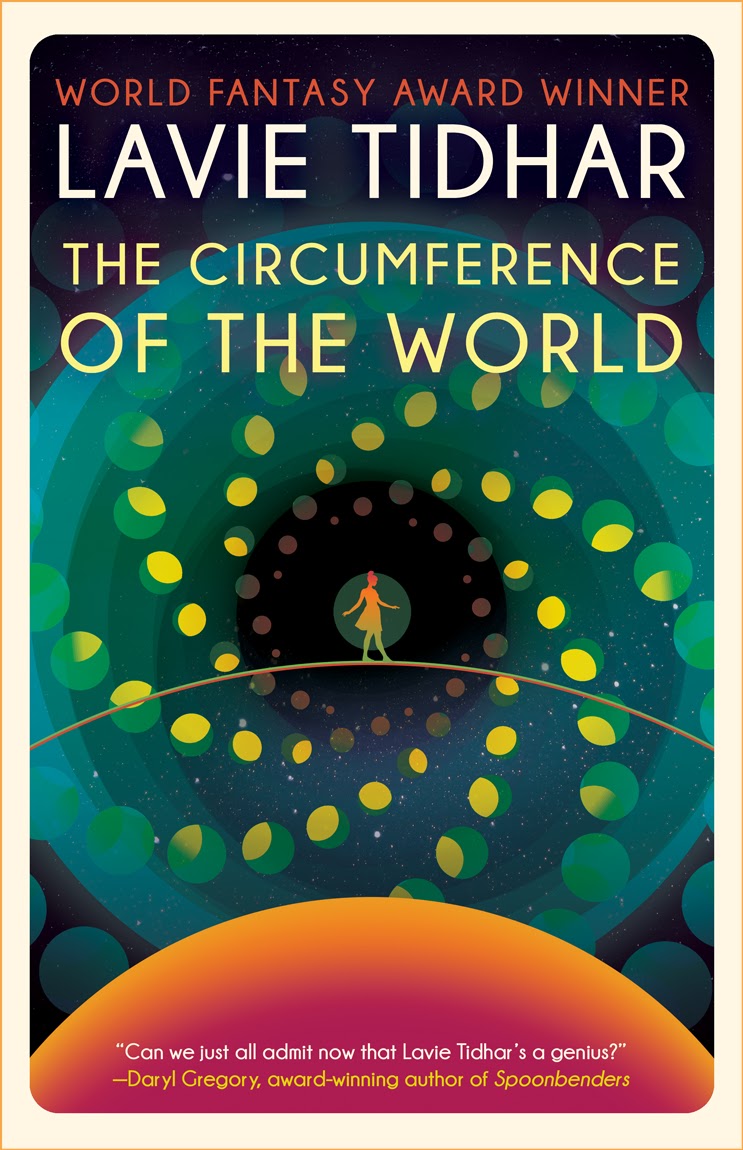
#Review - The Circumference of the World by Lavie Tidhar

The Circumference of the World
Lavie Tidhar
Tachyon, 5 September 2023
Available as: PB, 256pp, audio, e
Source: Advance copy
ISBN(PB): 9781616963620 

I'm grateful to Tachyon for sending me an advance e-copy of The Circumference of the World to consider for review.

Lavie Tidhar's new novel is a fiendishly ramified mixture of narratives. In late 90s London, Delia Welegtabit's husband, Levi, has disappeared. Levi may or may not have owned a copy of the elusive novel Lode Stars, upon which pulp legend Eugene Charles Hartley apparently founded a religion (no, definitely NOT that one, despite one of the categories Amazon has filed this book under). A London gangster and his pliant police stooge want the book and engage second hand book dealer, Daniel Chase, to find it. 

That's the first layer. We also learn about Delia's early life on the island of Vanuatu (also visited by Hartley) and about Hartley's career and life - part of this is told through letters to and about Hartley by various early SF luminaries - Tidhar rendering many different voices here, all totally believably.

We also read an extract from The Book itself, the story of (another) Delia seeking her lost father deep in space, the setting keying into a mythology that Hartley either believed or invented. It's all about the destination of humankind, which is to both swept into a black hole at the centre of the galaxy and preserved as information. All of these narrative levels interact, with coincidences, names and versions of names, apparent timeslips and repeated themes (shadows, eyes). Some of these might be explained by Hartley's authorship of Lode Stars and his making allusions to the works of his contemporaries: others - less so.

Gangster Oskar Lens's career as a black market dealer in the failing Soviet Union features too, as does the London second-hand book scene ('My highest ambition had always been to open my own bookshop on Cecil Court'). It's a bewildering ride through 20th century history and the birth of modern SF (taking in the rise of modern conventions, as well as gatherings in a Holborn pub) something Tidhar has deep knowledge of (it was fun to spot allusions, especially in the Lode Stars extract, to names, themes and artefacts from various genre classics: I'm sure I missed many). It is though much more than that, touching on questions about the nature of reality and the meaning of life as well as - perhaps - commenting on how the SF writer of a religion may be affected by that and, possibly, escape the trap he's set himself. 

There is some lovely wordplay here ('Dewey-eyed librarians') as well as nice pulpy (but culturally appropriate) language ('Paperbacks started back at me from the shelves without saying a damn thing', 'My aunt had died of cancer. She wasted away like a cigarette.') as well as starkly beautiful language ('I felt the press of stars overhead, and they were cold, and bright, and indifferent.')

I really enjoyed The Circumference of the World. As a book, it is a thing of its own, not like anything I'd come across before, but a great read crammed with ideas and glorious writing: there is simply so much material here, I think some writers could and would make 3 or 4 books of it but we have all that concentrated in a short novel. Somehow that compression means that - like matter spiralling into a black hole - everything here simply lights up, bathing the reader with its intense radiation.

An amazing read, strongly recommended.

For more information about The Circumference of the World, see the publisher's website here

17 August 2023

Review - Bridge by Lauren Beukes

Cover for book "Bridge" by Lauren Beukes. Against a red-pink background, a picture of a young white woman wearing a white sleeveless top. Cutting across her eyes and nose is a rectangle within which are flowing shapes in black and green - perhaps a medical scan or a heat map?
Bridge
Lauren Beukes
Penguin, 17 August 2023 
Available as: HB, PB, 432pp, audio, e  
Source: Advance copy
ISBN(HB): 9780718182823 (PB): 9781405923750

I'm grateful to the publisher for providing me with an advance e-copy of Bridge via Netgalley to consider for review.

Bridge is an absolute cracker of a novel from the author of The Shining Girls, Afterland and Broken Monsters. It had great resonance for me as an exploration of bereavement and also raises profound moral questions for its protagonists (at least one of whom doesn't come very well out of that test).

Bridget - Bridge - is the daughter of neuroscientist Jo, who has recently died of cancer. We see Bridge in the numbing coils of bereavement, wishing she'd spent more time with prickly Jo and astonished at what she didn't know about her mum. I felt this was well observed and written with real feeling, my mother having died several months ago it rang absolutely true to me that there could be discoveries in the loved one's paper, online activity and possessions.

My mother wasn't keeping such scary secrets though. Bridge, working with her friend Dom, soon discovers that her mother believed there were alternative versions of her in other worlds and that these could be accessed via a narcotic substance called "dreamworm". Taking us into a domain of obsession and paranoia, Beukes shows how this belief had taken over Jo's life, driving away her family and her lover and leading her to some very dangerous places indeed.

As it does Bridge. Across multiple universes, anything can happen, but it seems certain patterns recur - and Jo (and Bridge) repeatedly come up against Jo's brain cancer, against a stalkery vein of domestic abuse and coercive control, and also against a sinister cult that believes it knows all the answers and must control events at all costs. It's a tense novel, particularly in the way that things slowly - and them more quickly - escalate, Bridge throwing aside caution without realising that's what she is doing.

Fairly dancing along, this is a novel you'll want to read in a sitting, not least to spot the repeating patterns, the clues as to Jo's earlier life and discoveries, and to enjoy how Beukes conveys in her prose the subtly different natures of the various worlds she describes. I'm not sure I can convey just how well she does this, you'll have to read the book - it's almost as though you can breathe the different realies' atmospheres - the textures come right into the mind, almost like you had taken some of that "dreamworm". 

The characters also come over well. From staunch, non binary Dom, determined to back up their friend Bridge but perhaps getting in much, much deeper than they expected, to obsessed ex cop Amber who travels everywhere with her dog, Mr Floof II (Mr Floof I came to a bad end - it happens a lot to dogs in this story) to selfish, messy Caden who has a legend all of his own, Beukes flawlessly inhabits them all, conveying their essence, even evoking sympathy for some pretty nasty people.

Bridge really is, as the subtitle states, a novel of suspense - but also one of big ideas, raising questions not only about our responsibilities to those parallel selves but also to our relatives and friends. Bridge wants to find her mother, but how much harm is she prepared to inflict to do that? How much collateral damage is acceptable?

Also dipping a toe into the sewers of Internet obsession and delusion, with some hilarious scenes in a support group for a non-existent  conditions, Bridge entertains throughout - and ends on a note of genuine uncertainty leading me to hope that a sequel might be in the works.

Strongly recommended.

(CW for domestic violence, abuse and coercive control).

For more information about Bridge, see the publisher's website here

17 July 2023

#Review - Beyond the Reach of Earth by Ken MacLeod

Book "Beyond the Reach of Earth" by Ken MacLeod - a background of fiery swirling clouds through which can be seen a dark sphere and pinpoint lights, with the curve of a planet's surface in the foreground.
Beyond the Reach of Earth (Lightspeed Trilogy, 2)
Ken MacLeod
Pyr, 18 July 2023
Available as: PB, 328pp, audio, e
Source: Advance copy (UK edition)
ISBN(PB): 9781645060659

Warning - there are spoilers here for Book 1 in this trilogy, Beyond the Hallowed Sky, which I'd strongly advise you to read first. (If you haven't read it, or are hazy about the details, there is a helpful precis in Book 2, but the first book is so much fun, you really ought to read it).

In a clever sequel to Beyond the Hallowed Sky, MacLeod returns to his near future world (the book is largely set in the 2070s) dominated by three blocs - the Alliance (Anglosphere including rump UK), the Union (ex EU, including Scotland) and the Co-ord (Russia and China). The Union is particularly interesting, embodying a post-Revolution society and therefore viewed with especial suspicion by the other two (this is hilariously illustrated in some spoof tabloid headlines that crop up towards the end of the book).

MacLeod is very good, as we've seen in other books, at plausible just-over-the-horizon politics and societal development - indeed his portrayal of societies and their relationship with their citizens is one of the things I always look forward to. As a subject it's as fascinating and important as the future tech in these books. Or perhaps I should say that unlike many SF writers he appreciates the interplay between both: the societies influenced by the tech, the path of the tech driven by the science, and all deeply enmeshed with strong, relatable characters who just belong in their background. 

Above and beyond that, this book has a deeply satisfying, ramified plot involving espionage, slightly scary AI (I really want to know more about Iskander, the universal intercase to the Union's predictive/ assistive AI which attempts to preempt the needs of its citizens - but also, it's hinted, serves other goals besides) and a more than slightly scary robot. For me, all that made Beyond the Reach of Earth very enjoyable to read.

A spirited rendition of The Internationale didn't go amiss either, performed here when some Union settlers arrive on the newly discovered planet Apis, albeit escorted by the perfidious Alliance English who have shuttled them there for obscure reasons in their FTL spacecraft. And indeed the settlers bring their own distinct approach to Apis, refusing to fall into the "homesteader" mode urged by their hosts. Politics are never far beneath the surface here, whether the politics of superpower deterrence, threatened by the discovery of FTL travel and restored by the strangest of means, politics between the constituent entities of the "economic democracy", the Union, which come into play when the state gets its own FTL craft though the ingenuity of a small shipbuilding firm and a causal loop, or the attempts by the various powers to deal with the enigmatic Fermi, aliens of unimaginable power who occupy outcrops of rock on Earth, Venus... and Apis.

And if aliens incarnated in rocks shaping the future of humanity sounds familiar to you, it's an idea that MacLeod himself has fun with, some of his characters spotting the parallel to a certain bestselling SF series of the late 20th century. (This being Book 2 of 3 we don't get to find out how close a parallel that will turn out being).

In summary, this is smart, well-written SF, great fun to read and every bit as good as Beyond the Hallowed Sky. It's a middle volume of a trilogy that builds on the first, rather than just marking time waiting for the conclusion - which nevertheless I'm really looking forward to. I'd recommend.

You can purchase Beyond the Reach of Earth from Amazon here.

12 July 2023

#Review - Translation State by Anne Leckie

Cover for book "Translation State" by Ann Leckie. The background cover is graduated from red on the left to green on the right, ranging through shades of orange and yellow. At the top and bottom of the page is a device formed from nested rectangles with curved corners. Within the upper one is a black triangle in a white circle; within the lower one, a face in silhouette inside a white circle.
Translation State (Imperial Radch)
Ann Leckie
Orbit, 8 June 2023
Available as: HB, 432pp, audio, e
Source: Advance copy
ISBN(HB): 9780356517919

I'm grateful to Orbit for providing me with an advance e-copy of Translation State via Netgalley, to consider for review.

Translation State is a delicious serving of SF, taking place in a universe so odd I don't how Leckie imagined it, let alone made the story into something as coherent and compelling as it is.

The main protagonists are Qven, Enae and Reet. We meet Enae at the start of the book. Enae has just attended the funeral of a  grandmother (henceforth referred to as the "Blessed Deceased") and there are surprises as the estate is divided, a division that ultimately leading to Enae taking up a new life as a diplomatic troubleshooter. Enae is a fascinating person, who has spent an entire life under Grandmother's thumb and who isn't sure now what to feel about being free of that. There's a convincing portrayal here of Enae's mixed feelings - grief and loss but also resentment at somebody who seemed capricious and manipulative. Nevertheless Enae is intelligent and inventive and soon succeeds in solving a diplomatic mystery which had been left to fester for centuries, tracking down a fugitive who make or may not be a danger to the order of things.

Qven has an even stranger background, being one of a number of siblings genetically engineered to be Presger Translators. The Presger are aliens, indeed, unimaginably, indescribably, alien, and their Translators mediate between them and humanity, especially on matters concerning the vital Treaty whose existence protects all. Qven, destined for a high place in the clade, has been dishonoured by another juvenile Translator (who suffers a terrible fate as a result) and is now threatened with being forcibly "matched", a fate that Qven fears.

Reet, in contrast, is trying to live a quiet life. An orphan raised by foster parents, Reet has been singled out by a cult of exiles as the descendent of their revered leader. Having never previously felt any great sense of belonging, Reet is somewhat flattered by their attention - but will soon be presented with quite another potential origin...

All of this rapidly leads to a Big Mess with diplomatic implications (that Treaty!) and the fates of individuals seem likely to be sacrificed for political expediency - until some determined foster parents, Enae (regretting good intentions that messed up others' lives) and a clutch of ingenious lawyers, take the whole matter to the highest authority and demand justice.

I had great fun reading this book. It isn't, for the most part, full of drama and action: rather the plot is driven by the unrolling of Enae's, Reet's and Qven's feelings and their gathering understanding of themselves and of the universe around them, and by the politics and horse trading that others insist on tangling up with those things. All three are sympathetically drawn, with emotional depths and a growing awareness of themselves and their own desires. It doesn't hurt that Leckie has a wicked sense of humour (I would quote but you need to read this for yourself) and a real appreciation for social interaction and structures. So for example, here you'll find painfully-familiar prejudices against minority communities, putting them on guard against manifestation of the law; stereotypes used unthinkingly even by the apparently well-intentioned, sometimes followed by a quick apology, sometimes not, and that painful dance where people are trying to do what they think others want or need without either asking them or being honest about their own feelings.

Also, a glorious complexity of genders.

I love this kind of story where the stakes are high both at the personal and the global level, with the ostensible threat - here the future of the Treaty - really just getting in the way of resolving deep personal issues. Leckie's resolution of the two strands is little short of genius. 

Strongly recommended.

For more information about Translation State, see the publisher's website here.


18 May 2023

#Review - Titanium Noir by Nick Harkaway

Cover of book "Titanium Noir" by Nick Harkaway. All done in shades of red and black. Filling most of the cover, a bulky man in a dark coat, looking away from us. Behind him - in direct view - a syringe, needle pointing upwards. the barrel resembles a skyscraper. In front of it are shapes which might be further tall buildings, or smaller figures.
Titanium Noir
Nick Harkaway
Hachette, 18 May 2023
Available as:  HB, 256pp, e, audio
Source: Advance copy
ISBN(HB): 9781472156938

I'm grateful to the publisher for providing me a free advance e-copy of Titanium Noir to consider for review.

The title of this book is particularly apt. The noir is real. 

Cal Sounder is a typical outsider detective, a loner - but not exactly though choice - scraping a living on the mean streets. The book features femmes fatales, a powerful company that seems to pretty much own the city, and cops who have negotiable allegiances. There are shady nightclubs, down-at-heel offices and a deep lake apt for hiding bodies.

It also has... giants.

In what I took to be a near-future world - while seamy and hardscrabble, there are mitigations in place against global heating: for example electric vehicles, and the wealthy can afford the filters needed to extract the carbon so they can enjoy a log fire - a wonder drug called Titanium-7 can heal all ills, at the cost (or with the side benefit) of boosting growth and strength. Those who have taken the drug once are stronger and larger, those who have had two or three courses are the Titans, huge, powerful, and longlived. The only problem is, the drug is also titanically expensive, and with its recipients essentially immortal, there are implicatiions to creating too many of them. This moral problem, of an ongoing 'speciation' separating Titans from common humanity, is an ethical dilemma that haunts the story.

Sounder's speciality is, in many respects, managing this issue. He earns his living keeping Titans in line, mediating between them and between them and humanity, preventing things getting too heated too quickly. Neither a cop nor a traditional PI, he's called in when a scientist is murdered, a scientist who just happens to be a Titan...

The story that then develops is a delightful mosaic of the hard-boiled and the fantastical. Cal's backstory, which is gradually revealed, shows him to have feet in both the human and titan camps, with consequent vulnerabilities - and secrets. The price of digging into the case may be to touch some delicate toes, not least those of Stefan Tonfamecasca, the billionaire owner of T7. But it may also lead back to Cal's own scruffy front door, and his relationship with a member of the Tonfamecasca clan.

Titanium Noir was for me a delight to read, whether I was enjoying Cal's hard-boiled affect, seeing him get way WAY in deeper then he realises, or enjoying him hustle his way out of danger in the underside of the city. In the course of all this Harkaway takes us to some truly memorable scenes, whether a club where anything goes, a revolutionary commune or the (underground?) lair of a monstrous crime boss. There's a lot of riffing off the classics with talk of being sent to the bottom of the lake wearing concrete overshoes, wisecracking goons, and Sounder seen by both cops and villains as an irritating but necessary part of the furniture. That gives him a narrow and tortuous safety zone if he wants to reach the end of the book, and also a narrow line which he manages to (mostly) walk between hope and despair, corruption and martyrdom. Because somebody has to, right?

HIGHLY recommended, and great fun.

For more information about Titanium Noir, see the publisher's website here.

21 April 2023

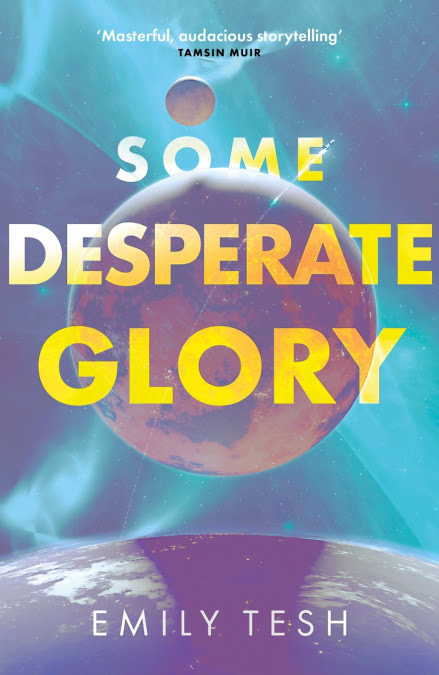
#Review - Some Desperate Glory by Emily Tesh

Book "Some Desperate Glory" by Emily Tesh. One planet rises over another, against a background of blue sky and stars.
Some Desperate Glory
Emily Tesh
Orbit, 13 April
Available as: HB, 438pp, e, audio
Source: Advance copy
ISBN(HB): 9780356521831

I'm grateful to Orbit for an advance copy of Some Desperate Glory to consider for review.

"While Earth's children live, the enemy shall fear us".

This is a wonderful book.

Following Kyr, a young woman growing up in a remote space colony, Gaea, which has a very militaristic culture, we learn about a wider universe. About Earth, destroyed by alien attackers. About the humans - the last remnant living on that rock, and the aliens - all conquering, under the aegis of "the Wisdom", a mysterious force or intelligence that guides entire peoples, entire planets.

Kyr is one of the best warriors of her generation, genetically enhanced for warfare, trained remorselessly to avenge Earth, and now hoping for an assignment to one of the military wings of her people. Imagine her horror when instead she's assigned to the Nursery - facing a future bearing a child every two years to replenish Gaea's population. A future where she's offered as a privilege to the fighting men. Appalled at the prospect, Kyr takes her fate into her own hands and sets out on a self-defined mission to wage terror against those she perceives as traitors and collaborators. Because, no, the inhabitants of Gaea aren't actually the only humans left...

Emily Tesh produces a miracle of characterisation with Kyr. She is, frankly, a very unlikable charcetsr - the perfect little soldier, fanatical and devoted to the cause. She's disliked by her messmates, moody, committed, totally un self-aware. Yet you'd have to have a heart of stone not to sympathise with her, faced with a duty - the one duty - she simply can't bear. It seems she's been totally betrayed by the culture she hero-worships, and while the reader will soon spot just how rotten a culture that is, Kyr is conditioned, no radicalised, to serve it so the only way she can rationalise her rebellion is to commit to a higher cause, almost greedily seeking death for glory.

That's the jumping off point for a remarkable journey of self-discovery, change and growth, in which Kyr discovers far more about the truth behind Gaea, about the paradox of the Wisdom, and about the variety of people who occupy the universe. It's an affirming journey in which we can recognise and celebrate Kyr's true qualities (beyond simply the supersoldier thing). She will need those qualities as all she's ever known is thrown into the melting pot and strange new worlds emerge. 

This is far from a simplistic tale of good vs bad (whether gentle, innocent aliens faced by human colonisers, or hapless humans menaced by monsters from space). It raises questions (on multiple levels) about the role of the individual vs the collective, about personal freedom, about just what constitutes personhood - and about giving up on long nurtured revenge. At heart, perhaps, it is about duty and about that moment when one is forced to think for onself and really, really consider what duty means. 

All that, and this is a book of glorious prose with a driving, urgent pace in service of a rattling good story. Really a book you won't want to put down till you reach the last page.

For more information about Some Desperate Glory, see the publisher's website here.

13 April 2023

#Blogtour #Review - Infinity Gate by MR Carey

Book "Infinity Gate" by M R Carey. Darkness, with distant stars. In the left, a planet formed from narrow vertical stripes each of which shows its image in a different overall hue - so one is green-blue, another orange, another very dark red-black and so on. Some of the stripes extend beyond the orb of the planet, and some are displaced so that the star field can bee seen within its boundary. Rising beyond the top right of the planet is a bright light - a sun or a moon?
Infinity Gate (Book One of The Pandominion)
MR Carey
Orbit, 30 March 2023 
Available as: HB, 512pp, e, audio   
Source: Advance copy
ISBN(HB): 9780356518015

I'm grateful to Orbit for sending me a copy of Infinity Gate to consider for review, and to Tracy for inviting me to join the book's blogtour.

It feels a long time since the last new book by MR Carey, but Infinity Gate was certainly worth waiting for. Set across multiple Earths, and mainly in various instances of Lagos, the book delves into the many-worlds interpretation of quantum mechanics - that every time something can go two ways, it goes both, splitting the universe into a structure with countless branches. The twist here is that on some of those worlds at least, that reality is understood, and travel between universes - or at least Earths - is regular.

In contrast, we're introduced to Hadiz Tambuwal, a scientist on our Earth (or at least one very like our own) where climate change, pollution, and warfare are close to destroying civilisation. Working at a research institue which has brought together the best minds on the planet to find a solution, she stumbles on something that may well help - but is it too late?

I loved this book's bold, very classically SF approach to the possibility of other Earths, other worlds, first hitting us with a Big Idea then dismantling it by showing the consequences. The stars themselves may be massively out of rich - but given the prospect of boundless resources less than an atom's breadth away, surely all our problem are solved? If the problem is shortage of stuff, rather than its distribution and management, everything will be alright, won't it? 

No it won't, is the answer that Infinity Gate provides. Behind the veil of the many worlds, we see a society plagued by the same problems as our own - in particular, a colonialist, grasping perspective that sees anything strange as Other and to be overcome. The Pandominion, a network of parallel Earths that have discovered one another and more or less federated, miscalculates spectacularly when it meets a society that is very Other indeed. That is a special irony when its "humanity" is composed of multiple species, from multiple worlds, many of them with a different evolutionary history than H. Sapiens. The Pando thinks of itself as the ideal, most evolved society there can be but it still relies on a massive armed force to secure its ends, it fights endless wars, and oh, when you have a big hammer, what does every problem look like?

We are led from Hadiz's very particular, very personal difficulties to a wider perspective. She is first presented as a sort of Robinson Crusoe figure, left marooned on a dying world, albeit provided with an abundance of resources (abundance and scarcity are central concepts in this book) and with an inkling of how to build a life-raft. As a somewhat introverted scientist who's already more or less cut herself off from friends and family, she doesn't have too much problem with being solitary, but then, as one can see coming, she will also have to cope with the multiverse being less solitary than she expects.

How she copes with that is one strand in this book but Carey follows other characters too - there's also Essien, a rogue (so-called here) who grew up in the harsh Lagos slums and bears their scars, and Topaz, a schoolgirl from a planet populated by rabbit descendents. Much of this story shows how the chain of events that Hadiz sets going influences all three. It's a story of intelligence and adaptability set against crushing forces, of cross and double-cross, of desperate combat and last-moment escapes. On the way we see the brutality of the military, grinding poverty, and bureaucratic cruelty as well as courage and solidarity. 

I particularly enjoyed how the story juxtaposes "big" themes - politics and the futures of worlds - and petty, self-serving ones. Also, human frailty and stupidity.

It is a gripping and imaginatively bold novel, a magnificent start to a series and I hope I can read the next part soon! 

For more information about Infinity Gate, see the publisher's website here - and of course the other stops on the blogtour which you can see listed on the poster below. 

You can buy Infinity Gate from your local high street bookshop or online from Bookshop UK, Hive Books, Blackwell's, Foyle's, WH Smith, Waterstones or Amazon.


6 April 2023

#Review - Nona the Ninth by Tamsyn Muir

Cover for audiobook "Nona the Ninth" by Tamsin Muir. Main image is a young woman with brown hair and fair skin. She is smiling. Her right arm is half raised, her right arm lowered (matching the pose of the cover images for the covers of the previous two books in this sequence). To the woman's left is a misshapen skeleton. To her right, a dog with six legs. Around her feet, more bones. Behind her, a landscape of orange-lit dunes and a night sky containing a moon and what seems to be an enormous eye.
Nona the Ninth (Locked Tomb, 3)
Tamsyn Muir
Recorded Books, 13 September 2022 
Available as: HB, 477pp, audio, 17 hours 46min, e  
Source: Audio subscription 
ASIN: B0B1QRHPH9

Nona the Ninth is the third part of the Locked Tomb sequence, after Gideon the Ninth and Harrow the Ninth

It is very hard to describe the relationship between this book and the previous because, first, that requires both of the other books to be thoroughly spoiled and secondly, the relationship is pretty obscure. (If you like things neat, cut, and dried, you'll find the progression infuriating).

On the other hand, as a self-contained story, it's s bit easier to describe what is going on, and I think Nona can be read perfectly well at that level (though you will then miss some allusions to the others).

Nona is a young woman living on a planet or colony world that is either itself in rebellion against the Galactic Empire or part of a wider uprising (details are not exactly clear). The rebellion is driven by a faction called the Sons of Eden who are themselves riven into cliques will to fight each other. The Sons of Eden object to the Emperor's necromantic power (necromancy is the fundamental fact of all the books). Nona is cared for by three adults called Camilla Heat, Palamedes and Pyrrha who are either sheltering from the conflict among other refugees, or outright lying low. The four, and Nona in particular, are of interest to the Sons of Eden (which features members with names like We Suffer and We Suffer, and Crown Him With Many Crowns). Nona is either attending or working at a school for refugees kids, at which she becomes entwined with Hot Sauce and her gang.

There is a lot more going on here of course. Key issues in the book include Nona's identity - both the nature of the strong, kind and resourceful girl we see stepping off the page here, and who she might really be (whatever that means - if you've read the other books you may have a hint of the issues but no spoilers!)

Camilla and Palamedes do seem to be the same characters as their namesakes in early books, although there is a wrinkle on that which is never directly stated but which you'll work out.

I should add that it's actually a lot easier to follow all this if you read the audio. As ever, Moira Quirk performs miracles in bringing the various characters to vivid life and she gives them distinct voices which makes it much more straightforward to follow what is going on when some of the more, er, obscure things happen. If you can I'd strongly recommend reading the book that way.

In terms of plot development within the Locked Tombiverse, at one level there are few surprises here - the rebellion, and the Empire's difficulties, were already established - but at another, there is a lot of detail about the deep origins of the Emperor, making clear that, yes, this is our universe, and sort-of showing what the original sin was that led to the Locked Tomb.

On the other hand, Nona the Ninth is an absolutely brilliant episode in the wider story, Nona herself being a gloriously character who is absolutely having a great time in her life, despite the variety of weird and creepy things going on around her. Muir allows her a much more uncomplicated network of relationships and friendships that anyone in the earlier books did (even if we suspect there are some ulterior motives going on) and that gives the book a much lighter atmosphere than its predecessors. Away from the gothicism of the Nine Houses, it seems that humans can still breathe a bit and that is good to see.

All in all, a delightful story which I'd highly recommend. It seems this trilogy has now stretched to four books and I won't argue with that, not one bit, if Muir keeps delivering such sharp, engaging episodes.

30 March 2023

#Review - Beyond the Reach of Earth by Ken MacLeod

Cover for book "Beyond the Reach of Earth" by Kim MacLeod. At the top, the edge of a blue-grey planet. Heading upwards towards it, a spacecraft trailing streaks of blue light. In the background, a field of stars.
Beyond the Reach of Earth (Lightspeed Trilogy, Two)
Ken MacLeod
Orbit, 23 March 2023
Available as: PB, 368pp, audio, e
Source: Advance copy
ISBN(PB): 9780356514802

I'm grateful to Orbit for an advance e-copy of Beyond the Reach of Earth via Netgalley to consider for review.

Warning - there are spoilers here for Book 1 in this trilogy, Beyond the Hallowed Sky, which I'd strongly advise you to read first. (If you haven't read it, or are hazy about the details, there is a helpful precis in Book 2, but the first book is so much fun, you really ought to read it).

In a clever sequel to Beyond the Hallowed Sky, MacLeod returns to his near future world (the book is largely set in the 2070s) dominated by three blocs - the Alliance (Anglosphere including rump UK), the Union (ex EU, including Scotland) and the Co-ord (Russia and China). The Union is particularly interesting, embodying a post-Revolution society and therefore viewed with especial suspicion by the other two (this is hilariously illustrated in some spoof tabloid headlines that crop up towards the end of the book).

MacLeod is very good, as we've seen in other books, at plausible just-over-the-horizon politics and societal development - indeed his portrayal of societies and their relationship with their citizens is one of the things I always look forward to. As a subject it's as fascinating and important as the future tech in these books. Or perhaps I should say that unlike many SF writers he appreciates the interplay between both: the societies influenced by the tech, the path of the tech driven by the science, and all deeply enmeshed with strong, relatable characters who just belong in their background. 

Above and beyond that, this book has a deeply satisfying, ramified plot involving espionage, slightly scary AI (I really want to know more about Iskander, the universal intercase to the Union's predictive/ assistive AI which attempts to preempt the needs of its citizens - but also, it's hinted, serves other goals besides) and a more than slightly scary robot. For me, all that made Beyond the Reach of Earth very enjoyable to read.

A spirited rendition of The Internationale didn't go amiss either, performed here when some Union settlers arrive on the newly discovered planet Apis, albeit escorted by the perfidious Alliance English who have shuttled them there for obscure reasons in their FTL spacecraft. And indeed the settlers bring their own distinct approach to Apis, refusing to fall into the "homesteader" mode urged by their hosts. Politics are never far beneath the surface here, whether the politics of superpower deterrence, threatened by the discovery of FTL travel and restored by the strangest of means, politics between the constituent entities of the "economic democracy", the Union, which come into play when the state gets its own FTL craft though the ingenuity of a small shipbuilding firm and a causal loop, or the attempts by the various powers to deal with the enigmatic Fermi, aliens of unimaginable power who occupy outcrops of rock on Earth, Venus... and Apis.

And if aliens incarnated in rocks shaping the future of humanity sounds familiar to you, it's an idea that MacLeod himself has fun with, some of his characters spotting the parallel to a certain bestselling SF series of the late 20th century. (This being Book 2 of 3 we don't get to find out how close a parallel that will turn out being).

In summary, this is smart, well-written SF, great fun to read and every bit as good as Beyond the Hallowed Sky. It's a middle volume of a trilogy that builds on the first, rather than just marking time waiting for the conclusion - which nevertheless I'm really looking forward to. I'd recommend.

For more information about Beyond the Reach of Earth, see the publisher's website here.


24 March 2023

#Blogtour #Review - The Space Between Us by Doug Johnstone

Book "The Space Between Us" by Doug Johnstone. The words of the title are spelled out in block white letters each in a black disk. Between the disks, black lines form a network, converging at the top of the cover into a column leading upwards and fading to grey. Amongst the network are smaller coloured disks - red, orange, blue, purple, cyan.
The Space Between Us
Doug Johnstone
Orenda Books, 2 March 2023
Available as: PB, 276pp, audio, e
Source: Advance copy
ISBN(PB): 9781914585449

I'm grateful to Karen at Orenda Books for an advance copy of The Space Between Us to consider for review, and to Anne Cater for inviting me to take part in the book's blogtour.

In his new novel Doug Johnstone - whose most recent works include the Skelfs detective series set at an Edinburgh undertaker's - really doesn't hang about, plunging us right into a fantastical plot with three varied and intriguing protagonists. Told in short chapters with dramatic changes of view, we quickly learn who is who.

Lennox is a lonely teenager living in a children's home. 

Ava is pregnant and trying to escape her coercive, in fact outright abusive, husband. 

Heather has lost her daughter and her husband, she has cancer and, when we first see her, is trying to end her own life.

All are about to have their destinies and lives changed when they encounter first, a strange light in the sky which leaves them hospitalised then miraculously healed, and secondly, a peculiar octopus-like creature washed up on the Edinburgh shoreline and affectionately named Sandy by the three.

In chapters told from their alternate perspectives, and those of a couple of other characters who are drawn in, we follow events during a frantic road trip across Scotland with several different but equally sinister authorities intent on capturing Sandy (I have tagged this review "Men in black") and a furious husband chasing down Ava.  (An interesting juxtaposition). The different viewpoints make for a clever technique - Ava, Lennox and Heather have a lot to come to terms with, both their own variously troubled lives and Sandy's unique nature. Their developing relationships with each other complicate this, and plot shock about. Johnstone's approach allows him, though all this, to both reveal and, at  times, to conceal, just what is happening, allowing the author sometimes to not describe things from the perspective of whoever has the clearest view, preserving ambiguity and building tension.

That ambiguity is at the heart of the story - we know how the scared authorities will react to Sandy, we know that Ava's husband has no good intentions for her, but what we don't know is how the gang will ultimately process what's going, how they will assimilate the incredible moral challenge presented by Sandy's existence and his need. Nor how those on whom whey will depend for help will react.

It all comes down to empathy, to the balance between their fears for their own future and their capacity for love, their ability to go on hoping. 

I don't want to over intellectualise this or make it sound over solemn, because its not. It's the very opposite. The Space Between Us is a thriller about human (and non human) nature, but it's a fun read, morally clear in that you can happily hiss at a couple of the characters and root for the others, (even if at times they do play fast and loose with legal niceties). As a science fiction adventure (that's not really a spoiler) the setup is by no means original - I could draw parallels with at least one well known film and a couple of other recent novels - but Johnstone brings to it his ability to create fresh and lively characters who quickly become very real to his readers. They are people you feel for - full of complexities and quirks and above all very very human. 

Additionally, the Scottish setting gives the whole thing an air of familiarity and localness which makes it all seem very plausible. And who doesn't love a good road trip?

In summary, The Space Between Us is a fresh and enjoyable story which explores some fundamental themes about what it is to be connected - or not. Tears may well have been shed over it... definitely recommended!

For more information about The Space Between Us, see the Orenda Books website here, and also the other steps on the tour, listed in the poster below.

You can buy The Space Between Us from your local bookshop or online from Bookshop UK, Hive Books, Blackwell's, WH Smith, Foyles, Waterstones or Amazon.


21 March 2023

#Review - Hel's Eight by Stark Holborn

Book "Hel's Eight" by Stark Holborn. A woman's face. She is wearing a facemark over mouth and nose, and has a pair of goggles pushed on her forehead. Behind her, distant towers and sky. the image is all done in shades of blue, black and grey.
Hel's Eight
Stark Holborn
Titan Books, 21 March 2023
Available as: PB, 353pp, e
Source: Advance copy
ISBN(PB): 9781803362298

I'm grateful to the author for sending me a copy of Hel's Eight to consider for review.

One day older and deeper in debt...

Taking place in the same setting as Ten Low, Hel's Eight picks up the story a few years later with ex-convict "Doc" Ten living in a shack in the forsaken wastes of the moon Factus.

As soon becomes clear, Ten isn't out there for her own good. She is doing what she can to treat the desperate people who scratch a living in the dust, trying to level the score, to atone for the great wrong she believes she did. And by living in isolation, accompanied only by her battered robot dog Rowdy, she hopes to avoid bringing down further trouble on anyone else. She's cut herself off from such friends and acquaintances as she still has, including her sometime lover Silas. 

Then one day, the past comes knocking on Ten's door. A showdown is looming with the acquisitive Xoon Futures corporation, which seems to have money - or at least, company tokens - to throw around and which has been muscling in on Factus, threatening the fragile lives and fragile independence of its inhabitants.  You'd think Factus a place so wretched and perhaps cursed that surely anyone sane would stay far away. We saw in the previous book how the moon is haunted by the bizarre Ifs - generally referred to in superstitious areas as just "They". They might be fates, gods or who knows what but They seem able to surf the possibilities of the future, feeding off the alternates. It seems now that Ten may have unfinished business with Them - or They with her - but others may now have learned that and have plans to make use of her. So Ten has to decide whether to listen to the call and come back for one last adventure...

As Ten struggles with that dilemma, we are given additional context about Factus through diary entries written decades earlier by 'Pec "Eight" Esterházy', a convict who came to Factus and whose fate may explain a little of what is going on. 

Ten is a fascinating and complex character who has lived a fascinating and complex life. One senses the tension in her, the regret at what she's done, the fear of what it may do to her, but also her desire to protect and to rescue the inhabitants of Factus from a grim choice between a grinding existence and ownership by Xoon. In this remote part of space (on the edge of 'the Void') those endless alternate outcomes that feed Them seem to be opposed by a commercial monoculture in which everything and everyone is owned and controlled. What play of possibilities can there be in that, what freedom?

It's just brilliant how Holborn takes the tyranny embodied by the "company town" and dials it up to, oh, twenty three or something, weaving it into a truly existential, spiritual menace that is only heightened because out here on the edge, there is nobody to ride to the rescue.

That concept is sharpened by the obvious fun that Holborn is having here with a setting that while firmly futuristic and more than a little bit weird, also echoes there classic Western - transport by some sort of vehicle referred to as a "mule", dusty, dead-end towns and trading-posts, abandoned mines and the gangs of 'Road Agents'. 

I just loved this book, equal parts horror, Western and SF (and some other things too) and fully, gloriously itself, its own twisted, wonderful thing, an absorbing read and a truly distinctive one.

For more information about Hel's Eight, see the publisher's website here.

15 March 2023

#Review - Hopeland by Ian McDonald

Cover for book "Hopeland" by Ian McDonald. Against a background of stars with constellations marked out, the steeple of a Wren church, with lightning forking upwards.
Hopeland
Ian McDonald
Gollancz, 16 February 2023
Available as: HB, 656 pp, audio (narr Esther Wane), e
Source: Advance copy
ISBN(HB): 9781399605731

I'm grateful to the publisher for an advance e-copy of Hopeland to consider for review. I also listened to parts of the book on audio.

Hopeland is a fierce storm of a book, a story on an epic scale - covering thousands of miles and centuries of time, and also satisfying chunky in the hand. Yet it still has plenty of space for the personal and the small. No, it is the personal and the small - used to tell a big story.

We begin in 2011 as riots engulf London. Amon Brightborne - aka Tweed Boy - a young Irish musician from a wealthy, old established family, is booked for a select gig but unable to find the address. Instead he find Raisa Peri Antares Hopeland - or perhaps she finds him. Raisa is engaged on a sort of parkour selection challenge against the shadowy Finn, the winner to receive a sought-after role in the extended Hopeland clan. Each is to cross London, one from the north, one from the south, not deviating more than 50 metres from an invisible line, the aim being to reach a certain rooftop first. And Raisa is losing - until she enlists Amon to help.

And there, at one level, you have it - like a system of three stars in motion, Raisa, Amon and Finn will weave complex, unpredictable paths through two decades and more, and their perturbations will ring down the centuries. That's the book. At another level of course we have only just begun. We will learn about the Hopelands - a chaotic, sprawling "family" ('Don't fall in love with my family!') which anybody can join, across time, space and cultures and which has its own centres, or 'hearths' everywhere, its own ways of doing things, even its own religion. We will also learn about the Brightbornes, a formidably eccentric clan whose house can't be found unless somebody shows you. Some magic there, surely, but it's matters of fact magic. 

When Brightbornes encounter Hopelands, what might happen?

The setting in which that encounter takes place is a world that's increasingly restive as weather, populations and trends are increasingly disrupted by climate change. The book takes us to Iceland, to Greenland, to the Pacific kingdom of Ava'u and to points in between as humanity struggles to move into its future. I might use the term "sprawling" for this book except that might imply something less disciplined and focussed than Hopeland actually is. Better perhaps to say that McDonald is happy to set things off in one direction, then jump several years and three continents to pick up the story elsewhere, trusting the reader to make the leap with him - which I always did, not least because of the gorgeous writing and command of emotion and pace that Hopeland displays. 

I'm not going to quote bits to illustrate that, I don't know where I'd even begin, you just have to read this and experience the rhythms, the lists (THE LISTS! They are nothing short of poetry!) the almost sneaky way the text comes back to the same point from different directions, the range of reference (McDonald calmly suggests that the word "Padowan" used in Star Wars lore for an apprentice may actually have been lifted from the Hopelands...) The book is like a feast and simply gives so much (my favourite section perhaps being the one where a whisky soaked and self pitying Amon, exiled in Ava'u like a figure out of Jospeh Conrad, or perhaps Graham Greene, becomes involved in political chicanery, a subplot that many writers would base a whole book around).

What else? Corporate and geopolitical shenanigans, the squabbles of gods and an element of possible fantasy or magic that is very much part of the texture of the story but kept as subsidiary theme. Again, any other author I can think of would make 'electromancers' fighting duels with Tesla coils across the rooftops, and declaring themselves the protectors of London, the centre of the story. Or else the cursed family with its own haunting spirit. Or... Instead, here those things are real and important but very far from being at the centre of things, rather they deepen and add weight to what is a glorious, complex and engaging story, one that creates an entrancing world of its own and one that it is simply a joy to visit. 

And McDonald dares not to give answers to some of the mysteries here. It's just the way things are, alongside all the other marvels of Hopeland - the water driven musical engine playing its thousand year melody, for example. In short, Hopeland is a book that simply draws one in, a wonderful book full of so much. I strongly recommend it.

In narrating the story, Esther Wane wonderfully articulates the voices of a dizzying range of characters, form Amon's slightly gruff Irish English to Raisa's sassy Londonish to the Ava'uans to Greenlanders and Icelanders. The audio is magnificent.

For more information about Hopeland, see the publisher's website here.