I never seem to get organised enough to offer up a list of favourite books of the year as many other bloggers do. Hats off to them, as these lists are endlessly fascinating, but instead I'm going to look to the future, not the past.
Here are some of the books I'm aware of coming in 2018 which I think look exciting. I've put this list together from catalogues, what I've been told by publishers, what I've picked up on Twitter and of course from that old standby, the Amazon database. This part covers January - March, Part Two will cover the rest of the year (though focussing on April - June as I have less information further out).
I'm hoping to read many of them, although I might not manage all.
As always, details may change, dates may go back, books may even not appear. Time and chance happeneth to all. Any errors are of course down to me. Cover images are from authors' or publishers' websites: happy to remove these if the owners wish that.
January
First, some crime suitable for the cold, dark time of the year.
Dark Pines by Will Dean is out on
4 January from Point Blank - I'll be reviewing it or the blogtour. It's a tense mystery set in the Swedish forests where a young reporter tries to penetrate layers of local obstruction to discover who is murdering hunters in the woods... and cutting out their eyes.

Continuing with the crime, on
5 January Steph Broadribb's
Deep Blue Trouble is out from Orenda. A followup to
Deep Down Dead, this is another adventure for bounty hunter Lori Anderson, now cutting dodgy deals with the FBI (topical or what?)
Deep Down Dead is a very violent, very
real, story and I may just have fallen a bit for Lori and oh I want to read more about her.
On the SFF side I'm really looking forward to
Dark State by Charles Stross (Tor,
11 January) and I have this one on NetGalley so WILL be reviewing. The second in his Empire Games follow-up trilogy, revisiting the world of the Merchant Princes ten years later, it pits a corrupt and genocidal US Administration and its shadowy agents against a revolutionary alt-US.

In the middle is the granddaughter by adoption of a deep-cover East German agent - who happens to be the daughter of Miriam Beckstein, the main protagonist in
Merchant Princes and now rather important in the revolutionary government. With both sides nuclear armed, the stakes are high.
Iron Gold by Pierce Brown is out on
16 January from Hodder.
Just let me say that again.
Iron Gold by Pierce Brown is out on 16 January.
THIS IS NOT A DRILL.
Picking up ten years after
Morning Star left off (hmm.. what is it about 10 years...?) this carries forward the Red Rising trilogy (
Red Rising/ Golden Son/ Morning Star) to address new challenges, new enemies and new protagonists. But never fear! Darrow, The Reaper, is back, as pig-headed as ever, and his Howlers with him. Like the previous trilogy, this is a book that'll have you afraid to turn the page for fear of what's going to happen next... full review to follow soon.
Interestingly, both
Iron Gold and
Dark State are in their different ways about how to build a just society
after the revolution. Stross even references the "early days of a better nation" catchphrase. (See also
The Force Awakens and
The Last Jedi.) Perhaps it's a healthy sign in the current dire state of politics that writers are looking ahead like this?
 Binti: The Night Masquerade by Nnedi Okorafor is also published on 16 January by Tor.com, completing the trilogy of short novels that started with Binti and continued in Binti: Home. This is compelling SF told from an African perspective.
Senlin Ascends
Binti: The Night Masquerade by Nnedi Okorafor is also published on 16 January by Tor.com, completing the trilogy of short novels that started with Binti and continued in Binti: Home. This is compelling SF told from an African perspective.
Senlin Ascends by Josiah Bancroft (Orbit,
18 January) introduces a world where the Tower of Babel survived... and how. The story of how Senlin, a retiring schoolteacher who's lost his wife Marya
in what seems like the world's most chaotic market, promises wonders as this less than perfect man strives to be better.
Back to crime with
The Confession by Jo Spain
(Quercus, 25 January). Here's the blurb: "Late one night a man walks into the luxurious home of disgraced banker Harry McNamara and his wife Julie. The man launches an unspeakably brutal attack on Harry as a horror-struck Julie watches, frozen by fear. Just an hour later the attacker, JP Carney, has handed himself in to the police. He confesses to beating Harry to death, but JP claims that the assault was not premeditated and that he didn't know the identity of his victim. With a man as notorious as Harry McNamara, the detectives cannot help wondering, was this really a random act of violence or is it linked to one of Harry's many sins: corruption, greed, betrayal? This gripping psychological thriller will have you questioning, who - of Harry, Julie and JP - is really the guilty one? And is Carney's surrender driven by a guilty conscience or is his confession a calculated move in a deadly game?"

The Feed by Nick Clark Windo (out on
25 January from Headline) is a post-apocalyptic story which explores the impact of a networked society, when the network is in your head... and breaks down. Think EM Forster's
The Machine Stops, dialled up to 11. I'm reviewing this for its blogtour and please believe me, it's good.
Finally, for January,
Shadowsong by
S Jae Jones (Titan,
30 January) promises the same intoxicating mix of music, romance and fantasy as her
Wintersong and I'm looking forward to that A LOT.
"Six months after the end of Wintersong, Liesl is working toward furthering both her brother s and her own musical careers. Although she is determined to look forward and not behind, life in the world above is not as easy as Liesl had hoped. Her younger brother Josef is cold, distant, and withdrawn, while Liesl can't forget the austere young man she left beneath the earth, and the music he inspired in her. When troubling signs arise that the barrier between worlds is crumbling, Liesl must return to the Underground to unravel the mystery of life, death, and the Goblin King who he was, who he is, and who he will be. What will it take to break the old laws once and for all? What is the true meaning of sacrifice when the fate of the world or the ones Liesl loves is in her hands?"
Wintersong was good company on a foul wet night in a cheap hotel (it was a work trip) in Manchester so I can testify to its power!
February
 Beneath the Sugar Sky
 by Seanan McGuire is published on
1 February by Tor.com. This is the third in McGuire's series which asks who provides care afterwards for the kids who visited Fairyland or Wonderland or an Otherworld. You can't expect they'll just slip back into normal life, can you?
Force of Nature by Jane Harper (Little, Brown,
1 February) follows up her
The Dry which was a blazing murder mystery set in rural Australia.
Force of Nature again features Aaron Falk, this time searching for a missing woman, Alice Russell, who's disappeared on a teambuilding hike. Falk knows that Russell knew secrets about a case he's involved with, and takes an especial interest in her whereabouts.
Spare and Found Parts by Sarah Maria Griffin (Titan,
6 February) is a debut described by Marian Keyes as "a unique, feminist coming-of-age novel, set in a fascinating post-technology world. Clever, beautifully written and compelling." Nell Crane lives in a city devastated by an epidemic. The survivors all have parts missing, replaced by biomech. So does Nell, but for her, it's her heart.
Moonshine by Jasmine Gower is published by Angry Robot on
6 February. It's a fantasy about a young woman starting a new job in sophisticated Soot City (which is not unlike 1920s Chicago). She has, though, a secret and it's one that could destroy her new life as the Mage Hunters close in.
 The Toymakers
 by Robert Dinsdale (Del Rey,
8 February) features a magical toy emporium that provides an island of enchantment during the grim years of the Great War. But it has secrets (of course it does...)
Also on
8 February, Zaffre are publishing the latest instalment of David Young's Karin Müller series (
Stasi Child, Stasi Wolf).
A Darker State sees Müller investigate the murder of a teenage boy. But she's under the eyes of the Stasi, and events begin to touch her team... this sounds another tense and intelligent thriller from Young.
8 February is going to be busy - it also sees publication of
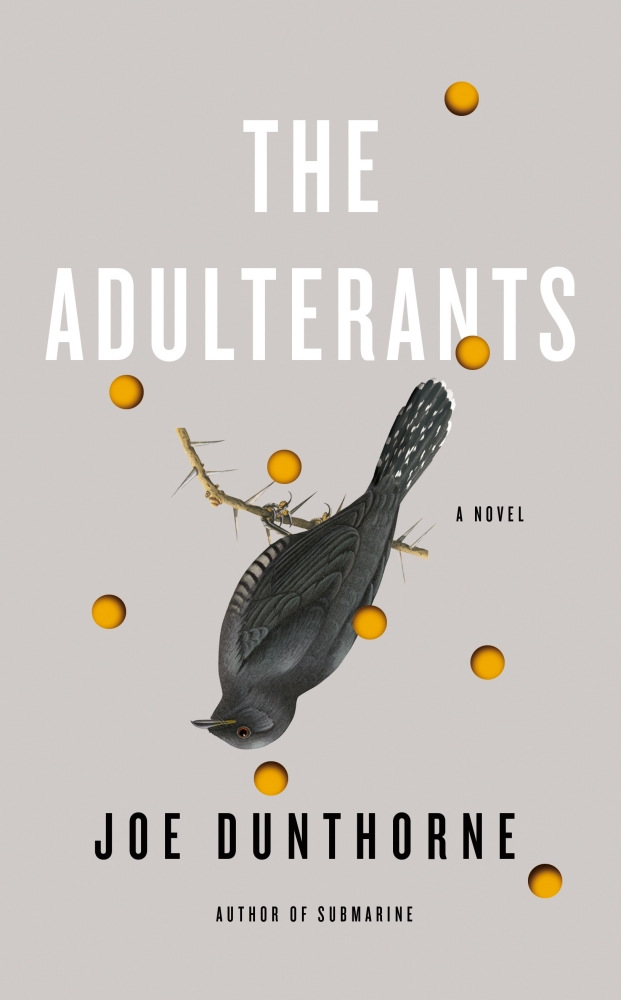
The Adulterants by Joe Dunthorne (Hamish Hamilton) is described as "a tragicomic tale of modern living... a tale of sadistic estate agents and catastrophic open marriages, helicopter parents and Internet trolls, riots on the streets of London, and one very immature man finally learning to grow up." I loved Dunthorne's Wild Abandon and I'm pleased to see another book by him coming.
 Blood of Assassins
 by RJ Barker is out from Orbit on
13 February. MOAR Girton Club-Foot! Whoop! I'm not normally the greatest fan of straight fantasy but I loved
Age of Assassins. But then it's not straight fantasy!
Look at the blurb for the new book. "To save a king, kill a king. The assassin Girton Club-foot and his master have returned to Maniyadoc in hope of finding sanctuary, but death, as always, dogs Girton's heels. The place he knew no longer exists. War rages across Maniyadoc, with three kings claiming the same crown - and one of them is Girton's old friend Rufra. Girton finds himself hurrying to uncover a plot to murder Rufra on what should be the day of the king's greatest victory. But while Girton deals with threats inside and outside Rufra's war encampment, he can't help wondering if his greatest enemy hides beneath his own skin."
Barker's writing presents a strikingly different take on the "hero", the fantasy society and its relationship with magic. Age is something of a coming-of-age story, which I know is a sub-genre some are wary of, but I thought it was all the better for that as it grounds Girton in a very recognisable setting (among the weirdness). I'm looking to see how a slightly older, wiser Girton behaves.
London Rules by Mick Herron (John Murray,
15 February) is the 5th Jackson Lamb thriller. Lamb's job is esssentially to mind MI5's collection of "slow horses", officers who are less high fliers than low ploughers. But despite having been filed away in decaying Slough House, they have a knack for being at the centre of things, and in London Rules, it sounds as though Herron's fund a zinger of a plot for them to gatecrash.
"London Rules might not be written down, but everyone knows rule one.
Cover your arse. Regent's Park's First Desk, Claude Whelan, is learning this the hard way. Tasked with protecting a beleaguered prime minister, he's facing attack from all directions himself: from the showboating MP who orchestrated the Brexit vote, and now has his sights set on Number Ten; from the showboat's wife, a tabloid columnist, who's crucifying Whelan in print; and especially from his own deputy, Lady Di Taverner, who's alert for Claude's every stumble..."
Kiss Me Kill Me by JS Carol (Zaffre,
22 February) is a psychological thriller focussed on Zoe, who meets a man. he's everything she wants... until they're married, when she discovers the truth and wants out. Be careful who you trust, as the streamline notes...

Finally for February,
Blue Night (Orenda,
28 February) is a German crime thriller, the first in the Chastity Riley series by Simone Buchholz. Describes as having a strong female protagonist and as "very literary, very Chandler" it sounds like an exciting debut from a publisher that definitely keeps delivering the goods.
March
Jo Walton's
Starlings (Tachyon) is out on
1 March, a collection of stories that "shines through subtle myths and wholly reinvented realities. Through eclectic stories, subtle vignettes, inspired poetry, and more, Walton soars with humans, machines, and magic—rising from the everyday into the universe itself."
Kin by Snorri Kristjansson (Jo Fletcher, 8 March) is the first of the Helga Finnsdottir mysteries, described as "Viking noir" as Finnsdottir attends a family reunion and finds herself having to solve a mystery with an impossible suspect.
The Hollow Tree by James Brogden (Titan,
13 March). I enjoyed Brogden's
Hekla's Children last year - a full on fantasy rooted in the real world, and real lives, of the Midlands, and I'm pleased see this story, of a woman who, following an accident in which she loses her hand, begins to have nightmares in which she reaches out to someone in a hollow tree - someone she pulls into the real world...
Autonomous by Analee Newtiz (Orbit,
15 March) looks FUN. "Earth, 2144. Jack is an anti-patent scientist turned drug pirate, traversing the world in a submarine as a pharmaceutical Robin Hood, fabricating cheap medicines for those who can't otherwise afford them. But her latest drug hack has left a trail of lethal overdoses as people become addicted to their work, doing repetitive tasks until they become unsafe or insane. Hot on her trail, an unlikely pair: Eliasz, a brooding military agent, and his indentured robotic partner, Paladin. As they race to stop information about the sinister origins of Jack's drug from getting out, they begin to form an uncommonly close bond that neither of them fully understands. And underlying it all is one fundamental question: is freedom possible in a culture where everything, even people, can be owned?"
 Stone Mad (Karen Memory) by
 Elizabeth Bear
is out on 20 March from Tor.com - really looking forward to reading more about Karen, and her steampunk-Victorian Pacific Northwest US setting.
Karen Memory, the previous book, introduced the irrepressible Karen Memery (note spelling) and she's now back in a story about spiritualists, magicians, con-men, and an angry lost tommy-knocker--a magical creature who generally lives in the deep gold mines of Alaska, but has been kidnapped and brought to Rapid City.
Ragnar Jonasson, author of the Dark Iceland sequence, has a new mystery,
The Darkness (Michael Joseph,
22 March), the first in the Hidden Iceland sequence - which is being told in reverse order beginning with this story of Hulda Hermannsdottir who is about to retire from the Reykjavik Police. What will her last case be?
The Darkness will be followed by
The Island and
The Mist. On the evidence of his earlier books this promises to be a treat for the crime reader and especially for lovers of Nordic noir.
 We Were The Salt of the Sea
 (Orenda, 30 March) is described as a beautiful literary thriller from French Canadian author Roxanne Bouchard, set on the Gaspe Peninsula in Quebec, and is bound to draw comparisons with Annie Proulx. "As Montrealer Catherine Day sets foot in a remote fishing village and starts asking around about her birth mother, the body of a woman dredges up in a fisherman's nets. Not just any woman, though: Marie Garant, an elusive, nomadic sailor and unbridled beauty who once tied many a man's heart in knots. Detective Sergeant Joaquin Morales, newly drafted to the area from the suburbs of Montreal, barely has time to unpack his suitcase before he's thrown into the deep end of the investigation...."
End Game by Matt Johnson (Orenda, 31 March) is the final book in Johnson's Robert Finlay trilogy which has been informed by Johnson's own experiences in the Metropolitan Police, including his struggles with PTSD which are reflected in Finlay's story. Both
Wicked Game and
Deadly Game were unsparing in the pain inflicted on Finlay, or the violence he was prepared to deal out to see right done. Both wove fascinating, compelling narratives far removed from being routine, hairy-chested thrillers. I'm looking forward to seeing how Johnson closes the story (but also dreading what may happen!)
In Part Two I'll cover the rest of the year. Don't go away...
Note on gender balance: If I've counted right, the books listed here split 15:13 between male and female authors (so far as I can tell).
 Sea Change