Showing posts with label 1950s. Show all posts

14 September 2024

#Review - The Seventh Veil of Salome by Silvia Moreno-Garcia

The Seventh Veil of Salome
Silvia Moreno-Garcia
Arcadia, 6 August 2024 
Available as: HB, 312pp, audio, e   
Source: Purchased
ISBN(HB): 9781529431001

The Seventh Veil of Salome is a clever juxtaposition of the story of Salome, daughter of Herodias who is the wife of the tetrarch Herod Antipas in first century Palestine, and Vera Larios, a Mexican actress in 1950s Hollywood who has been chosen to portray Salome in a sword-and-sandals epic.

The background of the historical Salome is one of power politics involving Ancient Rome and its client states. Rome is expanding its influence but not yet ruling absolutely. Its allies and collaborators therefore need to tread carefully, and Herod is concerned about a fiery preacher who been denouncing his rule (and morals). Salome, however, by Jokanaan...

Larios also inhabits a complex world. She has come into an increasingly paranoid Hollywood, a place  stalked by the House Un-American activities Committee and still subject to the Puritan moral hypocrisy of various self-appointed censors but also one, haunted by racism (Larios, as a Mexican, is firmly an outsider and looked down on). Things are starting to change as the studio system declines, but this uncertainty only makes everyone even more insecure. Gossip sheets exploit this, trading in innuendo and stereotypes.

Beyond this dichotomy, the book is structurally fascinating since the film Larios is involved in is clearly the same "story" as that which the Salome sections tell (for example, some of the dialogue echoes). But the story is being rewritten as the book progresses (in a late episode, we hear the screenwriter describing the closing scene as he would have had it, the studio bosses having insisted on somethings else). The historical Salome's life is not, therefore, fixed, but mutable, a matter of contention and at the mercy of those same prejudices, Puritan constraints and political and commercial imperatives that rule Hollywood itself. That's appropriate for a character being portrayed by another woman, Vera, who is in turn manipulated and (mis)represented by family, publicists, witnesses, and the Press.

Witnesses? I use that word because while there are lengthy narrative sections where the camera follows Vera (if I can use that analogy) of Samole, there are also interventions in the voice of the many characters who play a part in this story - other actresses and studio figures, for example, and people who were lucky or unlucky enough to witness the events - and they all have their own spin, often informed (again) by prejudice and jealousy. 

Vera has - as soon become evident - stepped into a nest of vipers, with others convinced that she doesn't merit the part - or that she doesn't, morally, deserve it. A Mexican? Surely not! The outworking of jealously and resent meant in an industry that embodies whim and fashion is both fascinating to see unfold and awful to anticipate, giving a real edge of noir as scenes unfold in seedy hotel rooms and down-at-heel diners, all leading up to... well I don't want to be spoilery... all leading up to the inevitable conclusion in the final reel. As a nasty chain of events unfold, innocents will be caught up, reputations ruined and the truth left to wither.

All in all and exciting, complex and atmospheric novel with a steely core of accusation.

For more information about The Seventh Veil of Salome, see the publisher's website here.

26 September 2023

#Review - Noir Burlesque by Enrico Marini

Cover for "Noir Burlesque" by Enrico Marini. A red-headed woman wearing a black corset and stockings poses. Behind her, the figure of a man wearing a hat and holding a pistol. Behind him, the skyline of a US city.
Noir Burlesque
Enrico Marini
Titan Comics, 26 September 2023
Available as: HB, 228pp, e  
Source: Advance copy
ISBN(HB/ PB):

I'm grateful to the publisher for providing me with an advance e-copy of Noir Burlesque to consider for review.

As one would expect from a Hard Case Crime graphic novel, Noir Burlesque is a very visual, very cinematic story that carries the reader along, scene dissolving into scene, its characters performing for the reader at various levels - providing an entertainment, but also engaging in what seems to be a dance of death - of which there is plenty here.

Some of that performance is of a decidedly adult nature and both for the explicit content and more particularly the violence, the publisher's site gives it a 17+ rating and I'd agree with that. One effect throughout the book - that it's all in monotone, except for the red - accentuates the impact: red is the colour of burlesque dancer Caprice's hair, and of her car, but also, of course, the colour of the blood that's liberally spilled here.

The dance here is mainly between Caprice, now performing nightly at the club belonging to her mobster boyfriend, Rex, and Slick, the ex-lover who left her to fight in the war (the book is set in the 50s New York). Slick is back now, and there is a question about whether the two will pick up where they left off and if so, what Rex will make of that (well we sort of know don't we!)

That central question runs through the story, alongside various killings, couplings and double crosses. Complications abound. There is a rival, Italian gang on the scene, Rex's boys being Irish (I would add to the CW above some very frank slurs addressed at the Italian mobsters by Rex's crew). There is a McGuffin in the form of a stolen Picasso. Besides Caprice, there is also another sultry femme fatale - and there are even some innocents who may be in danger (the principals here are though mainly far from innocent).

Wreathed in cigarette smoke, noir atmosphere and amorality, Noir Burlesque has a satisfactorily twisty plot, a vein of grim humour, a tarnished hero in Slick (while he's often hunted and is a criminal, he of all those who appear actually went off to fight Nazis) and even some comic goons to lighten the mood at times.

Entertaining and fast moving, this is a story that needs to be read at a single sitting.

For more information about Noir Burlesque, see the publisher's website here

30 June 2020

#Blogtour #Review - Mexican Gothic by Silvia Moreno-Garcia

Mexican Gothic
Silvia Moreno-Garcia
Jo Fletcher Books, 30 June 2020
Available as: HB, 301pp, e
Read as: e-copy via NetGalley
ISBN: 9781529402650

I'm grateful to Milly at Jo Fletcher Books for an advance e-copy of Mexican Gothic via NetGalley and for inviting me to take part in the book's blogtour.

Silvia Moreno-Garcia is one of the authors whose next book I always look forward to. Apart from anything else she's so versatile - this year we've already had an excellent Mexican noir from her (Untamed Shore), while last year saw her previous novel for Jo Fletcher Books, the 1920s Mexican-set fantasy Gods of Jade and Shadow (which you should read, if you haven't already).

Now we have - well, the title says it all, Mexican Gothic.

Mexico City, 1950. A young socialite, Noemí Taboada, is summoned from the latest party by her father and instructed to sort out a tricky family problem. Recently married cousin Catalina is unwell, and Naomí's father - who is also Catalina's guardian - wants Naomí to investigate. I loved the way Moreno-Garcia establishes both Naomí's self-possession - she is a confident young woman who knows what she wants and how to present herself to get it ('Naomí' looked a bit like Katy Juarado when she struck the right pose, and of course she knew what exact angle to strike') - and her place within wider Mexican society: a student of anthropology, in no hurry to be married (though she enjoys partying and social life, she's in no hurry to commit to any of the boys who are interested in her).

Noemí travels to the remote (and somewhat faded) town of El Triunfo outside which stands High Place, the home of the Doyle family into which Catalina has married. The Doyles are English and refuse to speak Spanish: they made their fortune mining silver, though the mine is now derelict and they have fallen on hard times (hence the alliance with Noemí's own wealthy family). This is a genuinely Gothic setting: High Place is a decayed mansion full of mouldering rooms and dust-sheeted furniture. There's a family graveyard wreathed in mist, a collection of hostile relatives - in particular matriarch Florence who present Noemí with a list of rules: no smoking, no noise, no visits to El Triunfo, limited contact with Catalina - and a series of mysteries: about the house, the family, and Catalina's physical and mental health.

There was a bit of a flavour here, I thought, of Cold Comfort Farm in the contrast between the modern young woman and the benighted Doyles, but unfortunately the inhabitants of High Place aren't to be easily reformed and the tension between them and Noemí fairly crackles. You can't miss the extent to which they cling to their Englishness: the family has been in Mexico for decades yet they doggedly speak English and maintain a Victorian outlook on life. It's easy to read this as a commentary on colonialism and post-colonialism, the source of the family's wealth having dried up and their whole purpose having been swept away by civil war and revolution even while they maintain their peculiar forms and customs, their foreignness clear in Mexico (they 'even brought European earth here').

Noemí is, as I have said, confident. She's used to getting her own way, both within her family and, as a wealthy young woman, in society more widely. ('She had experience dealing with irritating men'). Yet she may have met her match in the Doyles: older, established, arrogant and even rude in that specific way the English upper class still has, even in decay. ('You are much darker than your cousin, Miss Tabadoa'). It's clear there's a struggle for control going on here. Noemí is isolated, without allies, and doesn't have a clue what is happening. Because there is certainly something very sinister going on. As Noemí unravels the tragic family history of the Doyles, based on portraits, tombstones and fragments of stories she manages to collect in the town, it becomes clear that tragedy has followed them for generations with more than one untimely death. But how does this relate to what's happening to Cataline - and Noemí - now?

The unfolding of the story, with the creepy Gothic atmosphere growing thicker and thicker, combines with Noemí's growing doubts and fears, makes for an exciting and compulsive read. The family members present different threats, different challenges, from the haughty Florence to the monstrously unpleasant patriarch Howard to the smoother Virgil, Catalina's husband ('He was, likely, not used to being refused. But then, many men were the same.') I found myself torn between wanting Noemí to press them harder, to discover more, and fear of what might happen if she did. There's something dangerously unstable in the Doyle household with its devotion to eugenics, to taxonomical classification and to understanding the right place for every one, with its almost captive family members - younger son Francis has never travelled further than El Triunfo and seems almost hypnotically controlled by Florence and Virgil - and a history of violence gradually emerges.

While there's clearly something very wrong here, Moreno-Garcia kept me guessing almost till the end about the nature of the threat in High Place and about how that might influence a possible romance. Dark, scary, Romantic and deeply, deeply Gothic this is a remarkable book and an intense read. It's one I'd strongly recommend.

You can buy Mexican Gothic from your local bookshop, or online from Hive Books, which supports local shops, Blackwell's, Foyles, Waterstones, WH Smith or Amazon.

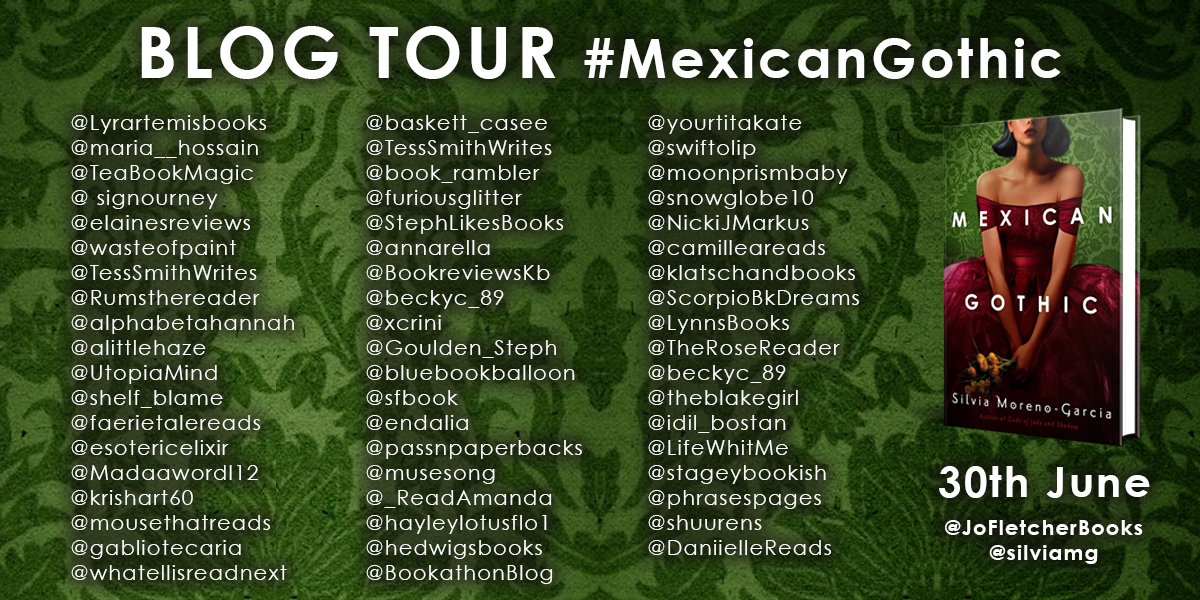
For more information about the book, see the publisher's website here - and the reviews on the other tour sites, listed on the poster below!


28 December 2018

Review - Transcription by Kate Atkinson

Design by Richard Ogle
Transcription
Kate Atkinson
Doubleday, 6 September 2018
HB, 337pp

I bought my copy of this book.

I should have read Transcription when it came out in September but with a lot of distractions, it slipped and I picked it up to read over Christmas. Once I did, I couldn't put it down.

Atkinson's latest is, simply, masterly. It's an immersive, compelling account of one woman's war (a phrase borrowed from the title of one of her source books, sorry) and of the price she pays for it later.

Following the death of her seamstress mother, Juliet Armstrong - a bright, scholarship girl with Oxbridge ambitions - attends secretarial college instead, then joins MI5 as a typist at the beginning of the Second World War. She assigned to monitor Nazi sympathisers in 'Operation Godfrey'. This basically means transcribing covertly recorded conversations between an MI5 agent, Godfrey Toby, and the sympathisers ('the neighbours'). They think he's a German agent, allowing him to prevent them passing on useful information to anyone who might make use of it.

The story moves backwards and forwards between 1940 - those fatal weeks around the fall of France - and 1950, by which time Juliet is ensconced at the BBC as a producer of schools programmes. Atkinson plays a long game here, gradually introducing elements looking back and hinting at how the events of 1940 played out, and how they may still haunt Juliet. More is implied than said, but it soon becomes clear that she wasn't just transcribing but at one stage actively infiltrating the 'Right Club'. (This contains just the kind of ghastly people you'd expect - traitors and cryptofascists happy to  collaborate with tyranny just to protect their privileged position in the world. Mostly, rather stupid people, of a type that, unfortunately, doesn't die out). That leads her into danger, at first of a rather 'Girls' own' type but soon becoming more serious - Atkinson drops more hints, about deaths, even as Juliet's role in 1950 becomes more complex too.

At the heart of the book are two mysteries. What really is going on at the BBC? With old MI5 contacts apparently popping up and threatening messages being sent, the past seems to be reaching out for Juliet, the corridors of Broadcasting House no longer safe, a series of mistakes threatening her position at the BBC. And what really was going on in Dolphin Square in 1940? Who, exactly, was on what side? Might a network of collaborators have been a useful asset for an MI5 agent wanting to hedge their bets?

As the story becomes more complicated, truth being reflected around that labyrinth of mirrors to which spy fiction is prone, Atkinson keeps the reader focussed less on the 'what' than on the 'why' and on the consequences. There are consequences; one character spells this out explicitly towards the end, but really, we've been aware of that all along. Just look at Juliet. She is a composed, resourceful and self-aware young woman - whether in 1940 or 1950 - yet continually speculates on the future, the past, her place in MI5 or the BBC, on the effect of what she did on others (especially this). Juliet is, really, our window into some very strange worlds at a time when so much hung in the balance. The story has often been told about how in May 1940, the UK wavered on the brink of capitulation, with an influential factor in favour of peace. This is not that story - the story of Cabinet debates and Parliamentary oratory - but it also is that story - the story of what ordinary (and extraordinary) people were doing and saying that lets us imagine how they might have responded had things been different.

Readers of Atkinson's last two books, Life After Life and A God in Ruins will be familiar with some of these themes (responsibility; consequences; the price that might be paid) which she also examined there, through the lens of a kind of of multiple worlds universe and she - teasingly - alludes to this I think. In the opening scenes, set in 1981, a Royal Wedding is coming, reminding me of the framing of A God in Ruins, and there's a certain amount of overlap too in the 1940s setting and in what we might imagine Juliet's later life to have been like. But this isn't a book in that world. The alternate paths taken here are choices made and fixed and then reflected on, not points that might yet go a different way in another life. That makes the stakes, I suppose, higher, and the things Juliet has done graver.

The book is tremendous fun, shrewdly observed (a great deal of this revolving around the internal politics of a bureaucracy such as the BBC or MI5 - Juliet wonders if these two are not really fundamentally the same organisation - but also taking in things such as class and the state of British food in the 1950s) and very human in the way it deals not only the murky shenanigans of espionage but with the frail people caught up in it. Monstrous as they are, there is still some sympathy for Mrs Scaife and her entourage of would-be collaborators and Quislings. While some readers may think they never really got what was coming too them, I'm not sure; they see their hopes and plans dashed and many suffer personal loss - and as we seen, the forces of the State pretty much play fast and loose with law and decency to achieve their ends.

Best of all though, this is a thunderingly good story, the kind of thing you won't want to be parted from till it's finished.

Those are the very best books, and this is among the best of them.


12 April 2018

Blogtour - Friends and Traitors by John Lawton

Friends and Traitors (Inspector Troy)
John Lawton
Grove Press, 5 April 2018
HB, 342pp

I'm grateful to Ayo and to the publishers for inviting me on the blogtour for Friends and Traitors and providing me with a copy to review.

If I were looking for a snappy title for this review (as for example you have to on Amazon) I might lift a phrase from the novel itself and use "The Burgess Game". The spy, traitor and (in this book) friend Guy Burgess is at the centre of this intricately plotted, chewy novel.  (In case anyone doesn't know, Burgess was a real man, one of a famous spy ring composed of ex Cambridge men who, working for the USSR, blew the UK's spy service, MI6, apart in the 1930s, 40s and 50s. This caused ructions even into the 70s and 80s. I remember the fuss when it became generally known that one of the group, Anthony Blunt, had been protected by the Establishment he betrayed and given a cushy job counting the Queen's pictures; and when the self described "spycatcher" Peter Wright published his memoirs - without official approval, and banned in the UK - in 1987s, alleging that another senior officer, Roger Hollis, had also been a traitor).

Here, Lawton devotes ten years or more of the life of his fictional detective, Freddie Troy, to a tale that unfolds in a leisurely fashion, as the lives of the two men cross and recross - from Freddie's early days as a naive police recruit to his ascendency to the rank of Detective Chief Inspector in the Murder Squad at the Yard. Treading lightly around various cases documented in earlier books of the series, and revisiting some earlier characters, Lawton uses the world he's created to give a convincing depth to the story although this does mean that in the earlier sections Troy does comparatively little (you can't meddle with an established timeline!) and the burden of the story is with Burgess.

Rather, this part of the book is used to good effect to convey some of the moral ambiguity necessary to understand a man like Burgess and also the attitude of his friends and acquaintances. Burgess is suspect from the very start: Troy's emigre Russian family have him pretty much nailed. (They are rather grand - as a policeman Troy's wealthy, well-connected and possessed of a small house in the West End, making him something of a ringer for Margery Allingham's Albert Campion - complete with a hefty Cockney manservant). Yet nobody thinks to report their suspicions and Burgess continues to waft through Society and through the supposedly secret world, hiding in plain sight, surely too indiscreet and unreliable to really be what he appears? Can we trust our judgements here? Perhaps seventy years of Cold War and terrorism have made us all cynical and incorrigibly suspicious about such things, and the answer to the success of Philby, Burgess, MacLean and the rest (Third Man, Fourth Man, Fifth... that's "The Burgess Game" I mentioned above) is less a sinister Establishment conspiracy than an attitude we simply cannot, in these more devious times, now understand.

Whatever, Lawton does an excellent job of bringing alive older attitudes and dilemmas. Troy is, we slowly learn (even if we didn't know before) morally compromised in various other ways, with his (perhaps) turning a blind eye to Burgess a comparatively minor matter. As somebody points out here, British spooks tend to die near Troy. When Burgess reaches out to Troy for a chance to "come home" and Troy is drawn into a catastrophic operation in Vienna, his past comes into question as never before. Which is where Lawton's clever recapitulation of those ten years really pays off. There is, you sense, real jeopardy here, real skeletons that might claw their way into daylight - and real risk to Troy's life, liberty and relationships. I felt especially for his brother, a rising politician, and for his partner, Shirley Foxx (who has her own reckoning with her past as well the possibility of being hurt through Troy).

There is also - and without any anachronistic imposition of 21st century attitudes - the matter of Burgess's sexuality. He is a gay man, in a milieu of gay men (as well as a wider, Blitz induced, sense of moral freedom in which other characters, including Troy's sisters, take part) and this brings a hovering sense of danger to him (though in the end, it is not Burgess but someone else who suffers directly from prejudice on this score).

It is, as I said, meticulous, clever and well observed, the kind of book you need to read slowly and carefully because every line, every word matters. Which is as well, because it's also a book to be savoured. With its pages crowded by spies, femmes fatales, detectives, old friends and enemies and, yes, traitors as well, it can be appreciated as a masterpiece of atmosphere, character and motive as much as a thrilling story and continuation of Troy's career.


20 June 2017

Review - The Paper Cell by Louise Hutcheson

Image from http://saraband.net/contraband/
The Paper Cell
Louise Hutcheson
Contraband, 8 June 2017
HB, 121pp

I'm grateful to the publisher for sending me a copy of this book.

This is the first in what will hopefully be a series of pocket crime from Contraband. It really is pocket sized and handy for a commute (I read it in a day, slightly annoyed by having to break off for work and such) as well as being a lovely little book.

As you'd expect, given the length, it's a focussed story, with few characters, alternating between 1953, where young publishing assistant Lewis Carson is struggling to establish himself in a London publishing house, to Edinburgh in 1998 where, as a Man of Letters, he's alternately encouraging and swatting away the inquisitiveness of reporter Barbara.

The two segments proceed in parallel, neither giving away too much too soon about what has happened nor dragging out the mystery. It's clear there is a dark secret and the suspense comes as much from waiting to see how it will be revealed as from its nature: I should say that this book isn't really crime in the "whodunnit" sense. There is crime in it, but while there's a bit of teasing, there's never really any doubt about the perpetrator and even less business over detection. Rather the strength of this book is in the build up, and it is really a character study of those involved - and a study of how they (I'm being a bit cagey what I say here, to prevent spoilers, such as they may be) unravel afterwards over time: of the effect of the crime on the guilty.

The Paper Cell is good on the social hierarchies in the publishing firm and in 50s London: the slightly desperate outsider trying to find their way, the boarding house, the heroic drinking sessions and forbidden passions. Not new ground by any means, but very well done.

Throughout, there's a bit of a sense of distance to Lewis.

1953 Lewis doesn't seem to initiate much. Through most of the story things happen to him and he takes advantage or suffers, his emotions always a bit ahead or behind what's happening. Even in a group he's alone. Not a sympathetic man but perhaps one who attracts sympathy. When events are made clear, his stance becomes, maybe, more understandable. In a sense, as an author, he's a thief, something of a hollow man, trying on styles and friendships for size both in his writing and his life.

1998 Lewis is a slightly different fish but to say more about that would risk giving too much away.

It's a well told story, the 50s atmosphere done well (perhaps with one or two slips: to me, 'What does that even mean?' is a very 2000s expression) and evoking those characters well in what is, as I said, a very short book (at least by the standards of modern crime).

A good debut for both Contraband Pocket Crime and for Hutcheson - I hope to see more from both soon.