Showing posts with label translated. Show all posts

28 September 2025

Blogtour Review - A Lethal Legacy by Guðrún Gúðlaugsdóttir

A Lethal Legacy
Guðrún Gúðlaugsdóttir (trans Quentin Bates)
Corylus Books, 20 September 2025
Available as: PB, 234pp, e   
Source: Advance copy
ISBN(PB): 9781917586023

I'm grateful to the publisher for sending me a copy of A Lethal Legacy to consider for review, and for inviting me to join the book's blogtour.

Nothing has changed at Bjargarlækur for as long as anyone can remember – so are moves to bring change to this remote farm in the Icelandic countryside a motive for murder? Three elderly siblings have lived more or less peacefully in this isolated place their whole lives, until Brynjólfur is found dead in his own bed. Called on to help out at the farm, freelance journalist Alma is far from certain that the old man died a natural death. Determined establish the facts of the matter, she finds herself caught up in a vicious family feud. Sisters Klara and Thórdís are unable to agree on the future of the farm, just as others with an interest in the place circle hungrily around them. Echoes of missed opportunities, lost love and age-old crimes surface as a reckoning takes a bitter toll on those left behind – and Alma struggles to get to the truth.

Journalist Alma and her husband Gunnar have just embarked on renovating the wreck of a house they've bought. However a most dramatic call from daughter Gunnhildur summons Alma away to a remote farmhouse. (One of the minor delights of this novel is how - from off, as it were - Gunnar, left back at home, continually reports to Alma that he's found a new problem - the floor, the windows, the heating - that will require either a tradesman he can't find, materials they hadn't budgeted for, or indeed, a complete change of plan about layout. But he never loses his enthusiasm! It'll all be fine!). Gunnhildur, a nurse who needed some time away from things after splitting from her boyfriend, reports that the elderly man she was caring for alongside his two sisters has been found dead. She worries she may be blamed for mixing up Brynjólfur's meds, and asks her mum to come out and support Gunnhildur and her own toddler daughter Una.

This is Alma's intro to the isolated community at Bjargarlækur. Soon she's in the thick of investigating Brynjólfur's death, partly to help Gunnhildur - though dear Daughter happily scarpers part way through the story as Boyfriend has appeared again - but mostly, one senses, from a prickling of her journalist's thumbs and from sheer burning curiosity.

It's a tangled tale that emerges. The siblings were at war with one another. Brynjólfur and Klara, one of the surviving sisters, wanted to preserve the farm and turn into a museum of old Iceland. In a country that has experienced rapid change one can see why this might be worthwhile. (Another of the joys of A Lethal Legacy is the glimpses of that older Iceland that we get in the stories from the sisters and some of their neighbours. One is left in no doubt how much these remote communities were required to be self-sufficient, and the echoes of that run forward to some extent into the present of the novel, with the police remote and the authorities slow to intervene in the escalating situation).

The other sister, Thórdís, was though dead set against the museum idea. Complicating the picture is the presence of a younger couple to whom the farm has been let, and who may or may not be a pair of ne'er do wells. All sorts of accusations are thrown - Slaughtering the sheep! Selling the cows! Brewing moonshine! Behind them are suspicions they may have their eyes on the place, perhaps in a stitch-up with local authorities.

Once the possibility of murder is added to this mix of family dissension, greed and a gossipy local community - a great deal is to be gleaned from the local priest and the doctor - and Alma's shut in at the lonely, slightly spooky, house - one may well expect almost anything to happen. And there is drama. The sense though that something is rubbing under the surface is an even greater source of tension, the contrast with the bleak, static landscape and the changeless decades that the siblings have lived at Bjargarlækur only adding to this.

Is that impression of calm, of retreat, misleading though? 

At its heart a story of family secrets, A Lethal Legacy manages to be both truly Gothic, with the possibility that not everything going in totally natural, and also a fine, taut crime thriller. Alma's rather out on a limb in conducting any sort of investigation here and she lacks institutional backing to ask questions or poke around, having to rely on the sisters' goodwill (which is in short supply) and her de facto position as their nurse/ carer, to gather facts. 

As she does so it slowly becomes apparent that there is more going on here than you'd expect. With a parallel strand of the story focussing on possible past abuse affecting a member of her own family, and the differing attitudes of the sisters resulting in contradictory accounts of their earlier lives, there's a difficult jigsaw for Alma to assemble. She is, though, nothing if not determined.

I really enjoyed this story. The brooding, remote setting is a fitting location for dark deeds. Klara and Thórdís are magnificent characters, well drawn. Neither is exactly likeable - though by the end of the book one knows enough about them to forgive a lot - but they are a great double act. Alma is determined to reach the truth, at first to protect her daughter, but later, it seems, from sheer bloody-mindedness. And as I've said, the glimpses of Icelandic history and culture are fascinating.

As ever, Quentin Bates' translation sparkles, catching the very different characters of the individuals at the heart of this story through their speech - sometimes slangy and modern, at others more formal or even slightly outdated. He does this while navigating a lot of rather abstruse language describing funeral customs - wakes, lyings-in, funeral meats and such - laying clear subtle differences which matter to Klara and Thórdís. A lot of the background here would be known to the Icelandic reader and so it isn't explicitly set out, but the translation makes clear where everyone is coming from, as it were.

Great fun - and also in some aspects, very sad. I'd recommend this one strongly.

For more information about A Lethal Legacy, see the publisher's website here - and of course the other stops on the blogtour which you can see listed on the poster below. 

You can buy A Lethal Legacy from your local high street bookshop or online from Amazon.


22 August 2025

#Blogtour #Review - The Burning Stones by Antti Tuomainen (trans David Hackston)

The Burning Stones
Antti Tuomainen (trans David Hackston)
Orenda Books, 24 October 2024
Available as: PB, 300pp, audio, e   
Source: Advance copy
ISBN(pB): 9781916788435

I'm grateful to Orenda for sending me a copy of The Burning Stones to consider for review, and to Anne for inviting me to join the book's blogtour.

Anni Korpinen is the star saleswoman at sauna stove maker Steam Devil.

But is Anni also a serial killer?

All the facts seem to suggest it. Anni's colleagues have her down as a cold-blooded killer (albeit one who employs hot steam for her murders) and local police chief Kiimaleinen is determined to make charges stick. 

Only one person believes in Anni's innocence - herself. But can she really hold out in the teeth of the evidence?

The Burning Stones was a fun book to read. It's described as comedy crime, but I think the truth is more nuanced than that - while the story does have its humorous aspects, it's a very dark humour, and the comedy arises from a desperate human predicament. The crime we see is also very, very gruesome. And the eventual revelation of who the killer is and what their motives are points less at human wickedness but at small, rather pathetic and plaintive motives - certainly compared with the nature of the killings. So it's equally a rather sad book, the record of a few days that turn Anni's world upside down, stressing all her relationships and breaking some behind repair. 

I enjoyed the way that Tuomainen throws the burden of proving her innocence on a woman who manifestly has no special talents in that line. As she repeats several times, she is a saleswoman (though a very good one) not a detective. Anni's attempts at tracking down the real killer often seem apt to land her in more trouble, and there's a murky secret in her past that makes it hard for her to be frank with (possibly) sympathetic policemen who might be willing to help - so she's very much on her own, surrounded by colleagues who mistrust her and who, let's be plain, all have questions to answer themselves.

Anni does though have one resource to fall back on - the peace she gains from her regular sauna sessions and swimming in the local lake. Many times in the story she retreats to ponder matters in the steam. But might even this, her understanding of the uses of the sauna, be evidence of her guilt? 

A real mystery, an involving and enjoyable story with well drawn and plausible characters and a tale with ratcheting tension, as Anni waits for that knock on the door, this is a book I'd strongly recommend. It's also a window onto Finnish sauna culture which was enlightening to say the least! I'd never, for example, heard about the concept of a "bumlet" (you'll just have to read the book!) I think that David Hackston's translation is brilliant here, it's as though Tuomainen is deliberately posing challenges, using colloquialisms, songs and jingles, technical terms and very specific language for which, clearly, there are no direct English equivalents and which require words to be created. Hackston deals with all this and more with aplomb and gives us a very readable text besides.

For more information about The Burning Stones, see the publisher's website here - and of course the other stops on the blogtour which you can see listed on the poster below. 

You can buy The Burning Stones from your local high street bookshop or online from Bookshop UK, Hive Books, Blackwell's, Foyle's, WH Smith or Waterstones.


17 October 2024

#Blogtour #Review - The Burning Stones by Antti Tuomainen

The Burning Stones
Antti Tuomainen (tran David Hackston)
Orenda Books, 24 October 2024
Available as: HB, 276pp, PB audio, e   
Source: Advance copy
ISBN(HB): 9781916788329

I'm grateful to Orenda for sending me a copy of The Burning Stones to consider for review, and to Anne for inviting me to join the book's blogtour.

Anni Korpinen is the star saleswoman at sauna stove maker Steam Devil.

But is Anni also a serial killer?

All the facts seem to suggest it. Anni's colleagues have her down as a cold-blooded killer (albeit one who employs hot steam for her murders) and local police chief Kiimaleinen is determined to make charges stick. 

Only one person believes in Anni's innocence - herself. But can she really hold out in the teeth of the evidence?

The Burning Stones was a fun book to read. It's described as comedy crime, but I think the truth is more nuanced than that - while the story does have its humorous aspects, it's a very dark humour, and the comedy arises from a desperate human predicament. The crime we see is also very, very gruesome. And the eventual revelation of who the killer is and what their motives are points less at human wickedness but at small, rather pathetic and plaintive motives - certainly compared with the nature of the killings. So it's equally a rather sad book, the record of a few days that turn Anni's world upside down, stressing all her relationships and breaking some behind repair. 

I enjoyed the way that Tuomainen throws the burden of proving her innocence on a woman who manifestly has no special talents in that line. As she repeats several times, she is a saleswoman (though a very good one) not a detective. Anni's attempts at tracking down the real killer often seem apt to land her in more trouble, and there's a murky secret in her past that makes it hard for her to be frank with (possibly) sympathetic policemen who might be willing to help - so she's very much on her own, surrounded by colleagues who mistrust her and who, lets be plain, all have questions to answer themselves.

Anni does though have one resource to fall back on - the peace she gains from her regular sauna sessions and swimming in the local lake. Many times in the story she retreats to ponder matters in the steam. But might even this, her understanding of the uses of the sauna, be evidence of her guilt? 

A real mystery, an involving and enjoyable story with well drawn and plausible characters and a tale with ratcheting tension, as Anni waits for that knock on the door, this is a book I'd strongly recommend. It's also a window onto Finnish sauna culture which was enlightening to say the least! I'd never, for example, heard about the concept of a "bumlet" (you'll just have to read the book!) I think that David Hackston's translation is brilliant here, it's as though Tuomainen is deliberately posing challenges, using colloquialisms, songs and jingles, technical terms and very specific language for which, clearly, there are no direct English equivalents and which require words to be created. Hackston deals with all this and more with aplomb and gives us a very readable text besides.

For more information about The Burning Stones, see the publisher's website here - and of course the other stops on the blogtour which you can see listed on the poster below. 

You can buy The Burning Stones from your local high street bookshop or online from Bookshop UK, Hive Books, Blackwell's, Foyle's, WH Smith or Waterstones.


28 July 2023

#Blogtour #Review - Deadly Autumn Harvest by Tony Mott

Cover for book "Deadly Autumn Harvest" by Tony Mott. A street in later afternoon - the pavement and road shimmer with rain and the lights of the cars dazzle slightly.
Deadly Autumn Harvest
Tony Mott (trans Marina Sofia)
Corylus Books, 1 August 2023
Available as: PB, 230pp, e
Source: Advance copy
ISBN(PB): 9781739298913

I'm grateful to Corylus for sending me a copy of Deadly Autumn Harvest to consider for review, and for inviting me to join the book's blogtour.

Deadly Autumn Harvest introduces us to Romanian forensic pathologist Gigi Alexa (it's the first book translated into English to feature her, although there is backstory especially with one of her police colleagues; through much of this books she's negotiating the trauma of one particular relationship with someone she still has to work with). Gigi is clearly at the top of her profession, slightly resented by the cops and uninclined to suffer fools gladly. I enjoyed the value she ascribes to being alone: while being perfectly capable of getting along with others, she really, really needs her time away from them. 

The mystery we're presented with here is a perplexing one. As the tourist season comes to an end, visitors thin out in the town of Braşov, the days shorten, and the weather turns cool, a series of killings begins. We know they are connected (the story, while coy about identities, does give us the perspective of the killer at times, as well as of some of the victims) but they don't seem to have much of a common thread. Taken together, the murders put a lot of strain on the Braşov police, still reeling from a previous botched investigation, and bring national attention. Alongside the minutiae of the investigation, the book raises issues about what crimes are prioritised and about how an investigation may be driven - or derailed - by press attention and public concern.

The story with Gigi's earlier lover and colleague also gives us an insight into the aftermath of an abusive relationship, something she's finding it hard to move on from (one might think her speciality would help here but really "physician, heal thyself" doesn't cut it). Mott also gives us insights into Gigi's family background and earlier life, including an incident which might deserve a content warning for sexual violence. Indeed, the wrinkles and creases of Gigi's personality are as fascinating as the events unfolding in Braşov, as Mott gives us a carefully managed, slow revelation of the mischief that's at work. The balance between the two is perfect, current events and past history - and the personalities of the different victims - combining to present a many-faceted portrayal of suffering, of wrongness - and of overcoming.

I did, actually, spot the murderer before they were revealed and was very pleased with myself... until I realised I hadn't! The mystery is actually deceptively complex and all the more so for everything (apparently) being set out before us. 

All in all a most enjoyable crime novel, with Marina Sofia's translation excellently readable, rendering the story into English without flattening out the Romanian-ness of it - for example, making clear where a choice of pronouns indicates familiarity. 

I hope to hear more about Gigi Alexa, and maybe to catch up oil some of her earlier adventures too.

The blurb

A series of bizarre murders rocks the beautiful Carpathian town of Braşov. At first there’s nothing obvious that links what look like random killings. With the police still smarting from the scandal of having failed to act in a previous case of a serial kidnapper and killer, they bring in forensic pathologist Gigi Alexa to figure out if several murderers are at work – or if they have another serial killer on their hands.

Ambitious, tough, and not one to suffer fools gladly, Gigi fights to be taken seriously in a society that maintains old-fashioned attitudes to the roles of women. She and the police team struggle to establish a pattern, especially when resources are diverted to investigating a possible terrorist plot. With the clock ticking, Gigi stumbles across what looks to be a far-fetched theory – just as she realises that she could be on the murderer’s to-kill list.


About the Author

Tony Mott
Tony Mott was born and bred in Braşov, which often forms the backdrop for her novels. She has worked internationally as a coach and HR professional, but her real passion remains writing. In 2022 she received the Romanian Mystery&Thriller Award. Deadly Autumn Harvest is the first novel in the Gigi Alexa series to be translated into English. 

About the Translator

Marina Sofia is a translator, reviewer, writer and blogger, as well as a third culture kid who grew up trilingual in Romanian, German and English. Her previous translations for Corylus Books are Sword by Bogdan Teodorescu and Resilience by Bogdan Hrib. She has spent most of her winters in Braşov skiing, so is delighted to translate a book set in her favourite Romanian town.

For more information about Deadly Autumn Harvest, see the publisher's website here - and of course the other stops on the blogtour which you can see listed on the poster below. 

You can buy Deadly Autumn Harvest, from your local high street bookshop or online from Bookshop UK, Hive Books, Blackwell's, Foyle's, WH Smith, Waterstones or Amazon.


4 May 2023

#Blogtour #Review - Skin Deep by Antonia Lassa

Skin Deep
Antonia Lassa (translated by Jacky Collins)
Corylus Books, 30 April 2023 
Available as: PB, 136pp, e   
Source: Advance copy
ISBN(PB): 9781739298906 

I'm grateful to Corylus for sending me a copy of Skin Deep to consider for review, and for inviting me to join the book's blogtour.

About the Book - from the Publisher

When police arrest eccentric loner Émile Gassiat for the murder of a wealthy woman in a shabby seaside apartment in Biarritz, Inspector Canonne is certain he has put the killer behind bars. Now he just needs to prove it. But he has not reckoned with the young man’s friends, who bring in lawyer-turned-investigator Larten to head for the desolate out-of-season south-west of France to dig deep into what really happened. 

Larten’s hunt for the truth takes him back to the bustle of Paris as he seeks to demonstrate that the man in prison is innocent, despite all the evidence - and to uncover the true killer behind a series of bizarre murders.

Skin Deep is Antonia Lassa’s first novel to appear in English.

My review

Skin Deep is a short but addictive novella, of a length to gobble down in one or two sittings and written with an urgency which kept me wanting to know more. We're introduced to several spiky, interesting characters and I relished the way that the detective we meet first - Canonne, sparring irritably with the new know-it-all pathologist while lamenting his own dental problems - isn't, in the end, the focus of the story.

Rather, we're led to two equally - or even more - intriguing personalities. 

There's Larten, the private investigator and former lawyer, who operates from his mobile home - he likes to drive it to the scenes of his enquiries - which contains his office and wine cellar. And then there's Gassiat himself, the suspect, who shows an odd reluctance to talk, despite the legal danger he's in. What does he do on his mysterious nighttime boating trips? Is he a heartless gigolo, preying on elderly ladies - as Canonne believes? - or is there something stranger going on? Larten's investigation turns on his ability to walk the streets and uncover facts, but even more, on a sensibility he has which Lassa conveys as almost eerie, a sensibility for people and a willingness to see more than others do. It may be related to a certain unconventionality Larten shows (not giving details because I think the reader should discover this themself but he has depths to him! I felt of him as something of an outsider and one with a degree of daring, giving him a perspective that eludes those who exist in a more mundane rut.

Whatever, this is an excellent mystery, one which also poses questions about relationships, about convention and the value - or not - of appearances. It also examines our need for love and how that makes us vulnerable, while moving between superbly rendered locations in Paris and on the southern coast of France, as summer fades away and winter rolls in.

Great fun to read, and - when they ultimately come on the stage - there is a truly despicable villain here, see if you can spot who it is!

About the Author

Born in Paris, Antonia Lassa is an enologist who works as a consultant for different private wineries around the world. This passion for wine has been instilled in her singular detective Albert Larten, for whom each new investigation is like a meticulous tasting. Wine is savoured through the eyes, the nose and the mouth, just like the crimes found in Skin Deep, with readers being invited to get involved with their five senses.

Antonia Lassa is the pseudonym of Luisa Etxenike.

About the Translator

Dr. Jacky Collins, lecturer in Spanish and Latin American Studies at Stirling University, is the Festival Director for Newcastle Noir. As ‘Dr Noir’ she regularly interviews a range of internationally acclaimed and emerging crime fiction authors at national and international events. Her series of author ‘consultations’ on the Newcastle Noir YouTube channel - The Doctor Will See You Now - is where lovers of everything crime fiction can catch up on news about latest publications.

For more information about Skin Deep see the publisher's website here - and of course the other stops on the blogtour which you can see listed on the poster below. 

You can buy Skin Deep from your local high street bookshop or online from Bookshop UK, Hive Books, Blackwell's, Foyle's, WH Smith, Waterstones or Amazon.


26 October 2022

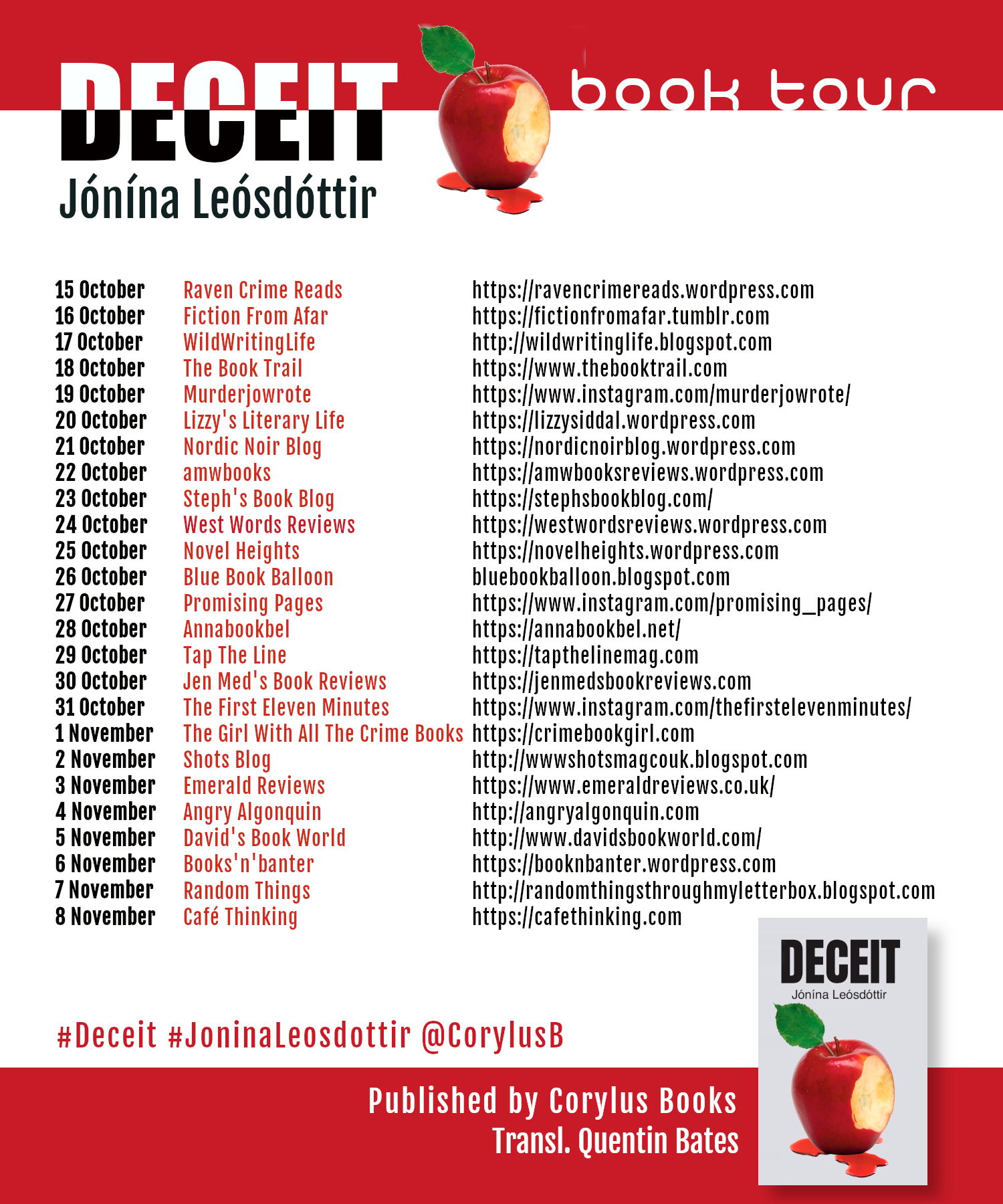
#BlogTour #Review - Deceit by Jónína Leósdóttir

Cover for book "Deceit" by Jónína Leósdóttir. Against a grey-white background, a red apple with a bite taken out of it and one green leaf attached. Pooling around the base of the apple, red fluid like blood.
Deceit
Jónína Leósdóttir (trans Sylvia Bates and Quentin Bates)
Corylus Books, 30 October 2022 (e), 15 November 2022 (PB)
Available as: PB, 288pp, e
Source: Advance copy
ISBN(PB): 978-1916379794

I'm grateful to Corylus for sending me a copy of Deceit to consider for review, and for inviting me to join the book's blogtour.

It's been interesting over the past couple of years to see the different approaches that authors have taken to the covid-19 pandemic. Some ignore it, some write as though it is past and one with and life is back to normal. Only a few though - at least that I've seen - accept the challenge of setting events squarely in the midst of lockdowns, quarantine rules and public health campaigns.

That is what Jónína Leósdóttir has chosen to do with Deceit and I have to say, the result in absolutely cracking. Set in Iceland in March and April 2020, the book introduces each chapter with a newsflash giving infection statistics and updates on events, and the action closely its characters' varying responses. 

Adam, a psychologist in private practice in Reykjavík, is inclined to take things very seriously, sanitising hands and anything that's newly come into his cosy basement flat, which he leave sonly reluctantly. Adam's ex-wife, detective Soffía, is rather more cavalier, while various owners of local businesses - cafés, a deli, a small hotel - bemoan the impact of the virus and the lockdown on their businesses. The story is interestingly sited at that point where the most serious issue was believed to be physical contact rather than airborne transmission, so there is less focus on masking and ventilation and more on distancing, leading to to some amusing scenes as the characters move around each other, so to speak. Having lived through all this only two years ago it's all very recognisable.

The inhabitants of Reykjavík are soon, however, about to face something much less humorous and indeed malign as potentially deadly tampering with fruit and other foods spreads around the capital and the country. At the epicentre are those same small business owners, but it's frustratingly hard for Soffía to link the cases together, or establish the motivation or perpetrator. She has few resources. Adam reluctantly assists, largely because he's nearly broke and the police will pay him for consultation, but most police time is going into enforcing covid rules so really the two of them are on their own.

They do, though, while bickering gently in the manner you'd expect of a long established couple, gradually come to understand the victims, if not the perpetrator, peeling away layers of lies and deception about a most remarkable - if reprehensible - man and his bizarre family. 

Meantime, Adam is also providing private consultations, including helping a young woman near to despair.

Add in the mysterious Jenný, a woman who we sometimes encounter in Adam's flat but who avoids contact with others, and Deceit provides a gallery of fascinating and complex characters struggling with a wide range of issues. Adam's insights as a psychologist are often the key to understanding what's going on, although he's less adept at using it in his own life and with his family - his wife, his daughter. The mystery behind the events is in the end both simple and fiendishly rooted in real lives and past events, all of which need to be teased out and prove addictively plausible. 

An enthralling and fun read, then, and I hope Corylus can bring us more translations of Leósdóttir's novels (hopefully also rendered into English by Sylvia Bates and Quentin Bates, whose version is lucid, compelling and clear).

For more information about Deceit, see the publisher's website here - and of course the other stops on the blogtour which you can see listed on the poster below. 

You can buy Deceit from your local high street bookshop or online from Bookshop UK, Hive Books, Blackwell's, Foyle's, Waterstones or Amazon.


3 October 2019

Blogtour review - Cage by Lilja Sigurðardóttir

Cage (Reykjavík Noir 3)
Lilja Sigurðardóttir (translated by Quentin Bates)
Orenda Books, 17 October 2019
PB, e, 227pp

I'm grateful to Karen at Orenda Books for an advance copy of Cage and to Anne Cater for inviting me to take part in the blogtour. (I'm so pleased to be on another Orenda tour! Look at the great bloggers on the poster - and me!)

Cage is the third and final part of Sigurðardóttir's Reykjavík Noir trilogy, following Snare and Trap. The title's well chosen - not only does a cage feature, but in various ways the principal characters here are all caged.

Agla, of course, is literally imprisoned, serving time for financial chicanery (a sensitive subject in Iceland after the financial crash) and at a very low point, her lover Sonja having deserted her at the end of Trap.

Sonja herself is riding a tiger. She's now a leading figure in the drug smuggling cartel, but aware that at any moment her usefulness may end. She must keep her son Tómas on the move, in case he's located by her enemies, she's had to abandon Agla and she is continually reminded of her crimes and her guilt.

Ingimar - the lynchpin of the fraud in the earlier books - is apparently happier. He is still free and wealthy. But his marriage seems to have died on him and he resorts to increasingly frequent sessions with a woman he pays to flog him.

And María... well, María has lost her job at the public prosecutor's, her marriage has collapsed and she's scrabbling for a living as an investigative journalists, forced to rent a poky office from the right wing station, Radio Edda. The existence of Radio Edda, pumping out noxious racist memes, is a dark thread running through this book, radicalising the young and inciting some truly frightening goings on.

These are all characters you will know well if you've read the previous books, and while Sigurðardóttir delivers nothing less than a tense, nail biting thriller here, I really liked the fact that she gives them more space, more time for reflection. In this book we really see a psychologically satisfying conclusion to all the stories which braided together have made this trilogy strong.

That all takes place, of course, while María continues to seek justice, Sonja safety and Agla - perhaps - love. To a large extent these various strands are kept separate for much of the book, though the shortish chapters mean we never leave anyone alone for very long.

Cage packs a lot into into a small space. There is the continuing scandal around the aluminium market. I never quite understood what the scam was here, but that didn't really matter much. María investigates this, engaged by Agla of all people (those scenes are fun). There is the drugs theme that has run through all the books, and there is also a terrorist subplot that feels especially dangerous because we're genuinely unsure how it will turn out. I went back and reread some of those sections once I'd finished - you won't realise, reading them for the first just, just how clever Sigurðardóttir is being here.

Sigurðardóttir, and of course her translator Quentin Bates who as ever delivers clear prose that maintains just that hint of otherness, a very slight reminder that the book is about another country where they do things (slightly) differently. I like that, I don't want a translation to smooth away all the colour so that the story might be taking place anywhere.

So overall a tense and enjoyable conclusion to this trilogy which may be just a bit lighter than the earlier books and which allows all its characters to grow by the end of the story (even Ingimar does something noble, if perhaps misguided!)

For more information about the book, see the Orenda website here.

You can buy Cage from your local bookshop, or online from Hive Books, from Blackwell's, Waterstones, WH Smith or Amazon.


15 August 2018

Review - Resin by Ane Riel

Resin
Ane Riel (Translated by Charlotte Barslund)
Doubleday, 9 August
Trade paperback, 313pp

I'm grateful to the publisher for an advance copy of Resin.

This is a hard book to review. At times, it was a hard book to read. There are some grim scenes, with a central character mistreating their family and also its animals. There are murders. There is a sort of self-reinforcing, almost cultish, thing going on and at times I wanted to scream at one character or another to just get out, or at least, step back, and notice what is happening to them.

But of course they don't, because they're caught in the moral stickiness, the resinous, clammy trap that is set.

That makes for painful reading. The greater difficulty, though, for both reading and reviewing is coming to terms not with what happens here but why. The title - and a recurring image in the book - Resin, goes to the heart of that. Here is a man who is obsessed with preserving what he has, with not letting go -  just as the lump of amber he cherishes preserves an ant, caught millions of years ago in the sticky resin from a pine tree. That fixation oozes through the book, bubbling up again and again, and the tragic consequences are set out here in shocking detail - the more shocking for a certain affectless style which (you soon realise) is normalising this stuff, making it seem like everyday life.

It's only towards the end, when we see events through the eyes of someone who has not been involved, that the full state of affairs becomes clear.

And yet, in the end, the why still remains, I think, a living mystery. I didn't ever really understand Jens, or his making - or I don't yet: again, this book is sticky, it lingers and there's a bit of my mind now that is still pondering him just as, in the book, one character takes away what has happened and will, it seems, be spending a lifetime coming to terms with it. Or not, based on a horrifying sentence that comes just as you think things are calming down.

This is the story of a family living on a remote island off the Danish coast. We see three generations of the Horder family (aptly named, at least in English, though I don't know whether in Danish the name has implications of one who piles up and keeps junk). There is grandfather Silas and grandmother Else, father Jens, mother Maria and children Liv and Carl. Riel takes her time in building up the oddness of this family, the train of accidents and losses that befall them - and the developing condition of Jens. There is all manner of weirdness here: a scavenging lifestyle, deaths due to both accident and murder, a bleak and inward looking family. It's as if The Borrowers went evil: Jens teaches his young daughter that the nearby village is there to be raided, not only for useful items but simply for stuff which he will then "keep safe".

The book is written from a number of viewpoints: a narrator, who sometimes follows a particular character for a chapter, giving a close insight into their thoughts, and sometimes gives a more general perspective, but also letters and other writings by Maria, Jens' wife and Liv's mother. And Liv's voice, telling her own story.

We see Else - controlling, attention-seeking and hypochondriac as Jens, relatively young, falls for Maria, who's been employed to care for Else. For a while, things teeter on the edge of normality - before catastrophe strikes.

We later see Maria, stricken by illness and overeating, gradually withdraw from the world.

And we see Jens withdraw into himself.

And we see the effect on Liv.

The writing is sharp and has a knack of nailing both the literal and the metaphorical at the same time ("Lars suffered from gout and struggled to walk, and his wife never went anywhere but crazy...", "My eyes had grown so used to darkness that in time I saw best at night"). The detail is painted in patiently, those different perspectives I mentioned before giving a kind of discordant and jarring view of the world: Liv's viewpoint, especially, is well done, a convincing portrayal of a child mostly saying and doing childish things but occasionally plunging into much darker, much more adult moments. This is truly unsettling and is another aspect of the book that will haunt me.

It's one of those stories that has you reluctant to turn the next page, fearing what you might read. The discord begins right at the start - that first sentence "The white room was completely dark when my dad killed my granny" - with almost immediately after, a lament that there wasn't a "proper White Christmas" that year. All is out of joint, the times and skew, something is rotten here.

And slowly, painstakingly, Riel explores and exposes that rottenness in compelling, slick writing that sticks in your head.

Like resin...

7 August 2018

#Blogtour Review - The First Prehistoric Serial Killer and other stories by Teresa Solana


The First Prehistoric Serial Killer and other stories
Teresa Solana (Translated from the Catalan by Peter Bush)
Bitter Lemon Press, 15 August 2018
PB, 208 pp

I'm grateful to Bitter Lemon Press for an advance e-copy of this book and to Anne for the opportunity to take part in the blogtour for the book.

This is a collection of very sharp, often fantastical, and always entertaining stories, many of which place women's viewpoints or positions to the fore. These stories manage to have, at the same time, a cool mastery of the everyday and also - when Solana switches context slightly or brings in some detail previously avoided - their own deliciously skewed viewpoint, a bigger picture that comes into focus.

For example, the titular story, The First Prehistoric Serial Killer, seems a very playful piece - at first.  A serial killer apparently strikes among a tribe of Neanderthal people. Over a period of months, three men are found at the back of the cave with their heads beaten in. The chief appoints one of the tribe to investigate. Solana touches on the conventions and language of the traditional detective narrative, hitting deliberately anachronistic notes (such as references to autopsies, psychological profiles and scientific evidence, or the order "Come on, Mycroft, [the name of the 'detective'] stop being such a Sherlock and get cracking". Underneath, though, there is a more serious mystery - one that affects the balance between the men and women of the tribe. Can it be that the deaths are connected with this? can the secret be preserved?

Another story that turns on the relations between men and women, The Son-in-Law sees an elderly mother become concerned by the way her son-in-law is treating her daughter. Notable for its well thought-out detail, as well as the macabre twist at the end, this story shows how ways will be found runs oppressive social structures and feeble law enforcement to ensure justice.

Still Life No 41 represents another theme in the book - the self-obsessed protagonist, who sees everything very much from their own point of view. Here it's a gallery director, and she's the most self-centred and entitled character I've met in a story for a long time. Running a gallery because of the influence of her daddy, she has to accept blame when things go wrong. We start the story feeling some sympathy - she's lost her job - but as the awful details emerge all this drains away, at least nearly all. Solana is good at showing a piece of terrible behaviour but still keeping the reader sympathising. So for example, in Flesh-Coloured People, a young woman woman has witnessed a shooting. She's being interviewed by the police about this and her inner monologue suggests, again, total self-absorption - from a distancing narrative about the ethnicity of the killers to a coldly calculating plan to select mugshots at random so she can get away to attend a concert. But then... well, Solana shows us something about Eulària and the effect of what she's seen that suddenly puts the rest of the story in a different context.

Flesh-Coloured People is one of a group of stories subtitled Connections, which are loosely described here as "Barcelona Noir".  ("...that delinquent scenario of intrigue on seedy side streets, in warehouses on the city's outskirts or down-at-heel bars...") They are interrelated and form a larger, loose narrative. So for example the next story, The Second Mrs Appleton, is linked to Flesh-Coloured People as well as being a self-contained little tragedy of its own, turning on the relation between a British diplomat and his trophy wife. It's a sad little piece, showing neither partner in a very good light and raising sympathy for all concerned (including the first Mrs Appleton).

Happy Families and I'm a Vampire are two stories that - while not connected - share a common theme: they both explore class in a modern Catalonia that - thanks to that element of the an elements of the supernatural - literally has deep roots in the past. In one case, we have a 900 year old vampire, in the other, a family (tribe? coven?) of ghosts haunting a country mansion who have, some of them, been there for hundreds of years. In both cases, there is a struggle to come to terms with the present day. Both stories are witty and spare, allowing one to fill in the details from popular mythology and focussing on peculiar local features (like German bombing in the Civil War) that matter to the story.

Paradise Gained is another of the Connections stories, and I spotted the connection which ties together Sergi's crime boss Uncle with the earlier stories. Rather than being noir as such, Paradise Gained has a slight atmosphere of Ealing comedy as criminals try to hide a large quantity of cash. Mansion with Sea Views has a more direct connection, and brings up a theme of concealment, of long-hidden crime and of knowing where the bodies are buried which goes back to that idea of a hidden history, of crimes suppressed. Rafael is a darker figure than Sergi, more adapt at concealment, sharper to suspect, a man with secrets.

I Detest Mozart is one of the most standalone stories in this part of the book, its connection with the others being limited to two characters having a nodding acquaintance. But in its theme - the relations between men and women, secrets, the toxic politics of the Franco era poisoning the present, concealed crimes - it is squarely in line with the rest and its portrayal of an elderly widow whose life has, literally, been stolen by these things but who has created her own way of getting by - is both tender and chilling.

Birds of a Feather is also less 'connected' (I think). It's the story of six women serving time (which gave a nice resonance, for this UK reader, because of the long-running sitcom, albeit that was about prisoners' wives). The new arrival, referred to as "posh pussy", is stand-offish as well as apparently wealthy - making her an easy target, you'd think. But appearances can deceive...

Barcelona, Mon Amour and But There Was Another Solution are more closely connected both with each other and with the wider 'connection' theme, and together they represent something of a climax to the sprawling underworld theme of the collection. In Barcelona, Mon Amour a woman who has made her living as a translator for criminal syndicates is called back to Barcelona to undertake one last job, prompting her to reflect on why she ever thought she wanted to moulder in the countryside. It's as much a tribute to the life of the city as it is a perfect vignette of the gangster life. But there was Another Solution gives us almost a different view of the same events. The chief protagonists of the two stories never actually meet, but at the same time they are living around and profiting from the same events in different ways, almost a microcosm of the Connections stories as a whole.

Overall, these are excellent stories giving a very distinct view of life in the 21st century, haunted as it is by the recent and less recent past. I should also mention the translation by Peter Bush. This reads excellently in English, ranging in tone to suit the story from the slightly fatuous in the more comic of the stories to a steely note in the noirish parts.

For more information about Solana and about the book see the publisher's website here.


28 February 2018

Review - The Darkness by Ragnar Jónasson

The Darkness
Ragnar Jónasson (translated by Victoria Cribb)
Michael Joseph, 22 March 2018
HB, 312pp

I'm grateful to the publisher for an advance copy of The Darkness.

I enjoyed Jónasson's Dark Iceland sequence, set in the far north of the island. With The Darkness and its forthcoming companion books, he's moved things to the more populated area around the capital, Reykjavik and introduced a new protagonist, DI Hulda Hermannsdottir. Hermannsdottir is reaching the end of her career in the police, a career during which, we're told, she's investigated a number of high profile cases and become highly regarded member of the team: but that isn't how she sees things, rather she feels passed over and excluded by the clubby maleness of the team. And indeed, throughout this story she's pretty much alone - and the title of her book reflects her experiences.

Quite simply, the book seems to record everything going wrong for Hulda as she faces losing the job that's the only thing left which gives her some identity. The book documents, in flashbacks, some of the events that brought her to that position, but makes no judgements: it's left to the reader to join the dots and I don't want to say more for fear of spoilers. What I will say is that Hulda begins to make mistakes and goes out on a dangerous limb. At first this seems mysterious, but as the story rattles along - it's a quick book to read, organised in short chapters, the tensions building and building - we begin to see where she is coming from and to appreciate both why she makes those mistakes and also what the stakes may be.

Faced with imminent retirement, Hulda sets out to investigate a cold case, the death of a Russian asylum seeker. Nobody else seems to care about Elena and by paying some attention to her life, Hulda almost seems to commemorating her, bringing her back to life and memory, in the face of an uncaring bureaucracy. This work of memory, of un-forgetting, is at the heart of what the book is trying to say, I think. It almost overtakes the point of "solving" a "case" and becomes a moral crusade, touching something deep in Hulda.

Which brings us to this series as a whole. We're told that in successor volumes (The Island and The Mist) we will see Hulda's earlier life. The book hints at a couple of major cases she has been involved with and I don't know whether they will be covered in those books but I hope that they do shed more light on Hulda and on the events of this book - because I want to know more as I'm sure you will once you've read it!

Finally, a word about the translation - the English of this book reads very well and clearly, while retaining just enough of a sense of foreignness to match the unfamiliar landscape - the black lave fields! the white highlands.

Overall a VERY strong start to this new series.


2 February 2017

Review: Kill the Next One

Kill The Next One
Federico Axat (Trans David Frye)
Text Publishing, 26 January 2017
PB, 414pp

I'm grateful to the publisher for an advance copy of this book.

This is a very hard review to write without spoilers, in fact, impossible, although I have tried to keep them as mild as I can to protect enjoyment of the book. But there is a twist in this book you really do not want to know about so I recommend stopping reading where I warn below.

(But then please come back after you've read the book and let me know what you think - I'd love to discuss this book with others who've read it).

We begin in media res. Ted McKay is about to shoot himself in the head. He's made meticulous preparations; chosen a time when his wife, Holly, and daughters, Nadine and Cindy are away; stuck a note on his office door to warn Holly - and he's hidden the family photographs.

Ted is suffering from an inoperable brain tumour and sees this as the only way out.

Then he's shown another way.

A stranger, Justin Lynch, turns up, offering a deal. If Ted kills two men, he will in turn be added to a death list maintained by "The Organisation". One of the men, Edward Blaine, is a murderer who's got away with his crime. The other, "Wendell" is a fellow member, who wants to die. Ted will still die, but this way, he gets to inflict a little justice, and his death is murder, not suicide - supposedly some comfort to his family. (Not sure I go along with this - the idea that suicide is a uniquely shameful thing, that is. On the other hand if you can't nerve yourself to do the deed, maybe it's better to have someone do it for you...)

How Lynch knows about Ted's intentions is not explained.

The story really takes off from there this most thrillery premise. We see Ted attempt to carry out his side of the bargain - and then when things inevitably go wrong, to escape from the situation he's got himself into. He finds out, of course, that all is not entirely as Lynch said - and that there are connections between himself and the victims. Trying to track down Lynch, he seems to have stumbled on something both deeper and more complex than he thought, with twists, turns and false information aplenty.

This first part of the story is taut, convincing (if you accept the suicide premise) and adrenaline-soaked, an atmospheric thriller enhanced by hints that something odd was going on - for example, the repeated eruptions into the text of an opossum, always described as evil, disgusting or predatory, which Ted along can seen, or the contradictory versions of certain events. If Ted is suffering from a brain tumour, how much of what he's seeing is real? What effect might that have - or have had - on his (always absent) family?

Then, the story shifts abruptly to something very different, focussing on Ted and his history. The remainder of the book lets this play out, including a look back at Ted's childhood and college years.

It's at this point that I find it hard to discuss the detail os the story further without spoilers. So here is the warning - look away now if you haven't read the book and want it to have its full effect...

Still with me?

Are you sure?

Well...

Then you'll know that in the remainder of the story, Ted is seeking to understand his past. He doesn't have a tumour, but has been behaving strangely and his experiences in the first part were not wholly real. Wendell hinted that he might be the victim of a deeper plot: perhaps this is why psychologist Dr Laura Hill is now interrogating him? Why she's delving into his past?

And what has become of Ted's wife and girls?

Who was Wendell - and is he alive, or dead?

Will Ted ever escape the situation he got into, and find happiness with his family?

This part of the story is such a change that it's almost like starting again. Axat has very deftly set up the story as one thing and then it turns into something very different. There is much probing of responsibility, much outing of hidden secrets, with the theme of childhood and the impressions that it makes on us explored repeatedly from different angles (Ted's story and those of some others here are counterpointed with glimpses of Dr Hill's own son and of Ted's daughters).

But those pesky possums keep showing up...

I think your view of this book will be coloured by how prepared you are to accept the shift. For me, it didn't quite work. Despite Axat's compelling narration and Frye's able translation, I felt perhaps there is just too much material to be covered to keep the suspense - highlighted, perhaps, by the way an epilogue is used to explain some of the backstory, material which might have been in the main text but which I can see would have been difficult to integrate. There's also the issue that while much of what we learn in the present day parts of the story is based on Ted's recollections, and he is a very unreliable narrator, when we go into the past there is a more neutral point of view and a suggestion we're getting the unvarnished truth. The two approaches jar slightly.

So while it's often a thrilling and compelling story, and concludes with a blaze of action which injects real excitement, I felt this book did lose its way in the middle somewhat. But you may well disagree - and I'd be interested to know if you do.

5 June 2015

Blogtour Review! We Shall Inherit the Wind by Gunnar Staalesen

We Shall Inherit the Wind
Gunnar Staalesen (translated by Don Bartlett)
Orenda Books, 2015
Paperback, 262 pages

I'm grateful to Liz at http://lizlovesbooks.com/ for kindly inviting me to join this blogtour alongside a number of excellent bloggers (for a full list see poster below).

This was the first time I'd heard of Norwegian private investigator Varg Veum, hero of a series of noirish detective novels.  he's apparently famous in his adopted home town of Bergen where there is even a statue of him.  One mark down for English insularity, then, and I'm glad Orenda Books have now made some of these available in the UK.

In this book, Varg is asked to investigate the disappearance of Mons Maeland, a businessman interested in bringing windfarms to a small island in the west of Norway.  Mons has family troubles, there is oppositional from environmentalists to the windfarms, and also a fundamentalist religious faction on the island that looks upon such developments with dour disapproval.

For me, this mix of social and personal issues was fascinating. I don't know much about Norway and it's easy to assume that some very lazy Nordic stereotypes will apply - liberal, easygoing people, consensus on environmental issues and lots of pine furniture.  So it's jarring and unexpected to see Veum asking, for example, whether "Dancing was allowed then?" and getting the answer "Not in all circles, of course".  Or to see environmental campaigners resort to violence to stop wind turbines (of all things!)

Other aspects of the book are more familiar, perhaps - dodgy business deals, family tensions and inheritances.

It's less unsettling, but equally stimulating, to see cultural references such as to "the Havamal, an old Norse poem" or to the "potato pioneering priests of yore" establishing the book's atmosphere as very different from a crime novel set in England, Scotland or the US. This is a land of fjords, islands, bridges and ferries. Travel invariably requires a ferry or a boat. And our detective isn't an ex policeman but a retired social worker - but don't let that give you the impression he's any kind of pushover. "Varg" means "wolf" and Veum bares his teeth serveral times in the book, including facing up to a thug with the memorable phrase "Tell your mongrel to stay on its mat!" which I am determined to use myself one day.

In discovering what has happened to Maeland, however, Veum's greatest strength is his patient ability to unpick what he's told by wife, children, friends, the inhabitants of Brennoy and those militant environmentalists. The picture builds up, step by step: there are no blinding flashes of deduction or revelations from the forensics lab.

Veum's greatest weakness, perhaps, is his inability to leave things alone, which leads to disaster - indeed there are foreshadowings of that disaster through the early part of the book, from simple feelings of unease to the comment that a blind has been drawn has been drawn as Veum passes, as if to shut out evil.

Not having read any previous books about this detective I don't know much backstory, beyond the little given away here (an account of how he met his girlfriend and a tally, towards the end, of injuries he's suffered).  This did mean I wasn't particularly invested in Veum as a character, seeing him more as a narrator, perhaps. However while not telling the reader a great deal, Staalsen hints a lot and I would imagine Veum has a distinctly chequered past which I look forward to reading more about

A good addition not just to the roster of Scandi detectives but also to the range of crime writing available in English.  More please...