31 May 2022

#Review - Daffodils by Louise Beech

Daffodils
Louise Beech
Bolinda Publishing
Available as: Audio (narrated by Lesley Harcourt), 9 hours 48 minutes
Source: Audible subscription
ASIN: B09TG3FPMJ

I have been a fan of Louise Beech's books for some time. Her fiction combines real, believable characters in all their human muddle with gripping stories and they always, always have such heart.

In her memoir  Daffodils, Beech pulls the curtain aside and invites us to see some of her own life. It's a difficult story, kicking off from the moment when, in 2019, Beech's mother attempted suicide and loosely following her mum's hospitalisation and - sort of - recovery. We see the author's process of coming to terms (sort of) with what happened in 2019 and also, as part of that, her recollections of and attempts to understand her own earlier life. We also get to meet her younger sisters and brother, who share their own takes on that story, and (inevitably, look at the date) we see life overturned by the covid pandemic and by the lockdown measures necessary to address it.

I thought this book was beautiful, fierce and brave. It keeps coming back to mysteries - the mystery of Beech's mum's behaviour and treatment of her children (which often makes for hard and painful reading) and the gaps's in Beech's own recollection of that. Those gaps might not be surprising, given it was a life split across different houses and children's homes, sometimes with siblings, sometimes not, involving both periods spent at her grandmother's and occasions when her mum's raucous living arrangements disrupted all their lives.

Behind all that, though, Beech suspects things, and people, that she has has blotted out and there are  hints of painful events and possibly even abuse. After consulting everyone who might be able to explain, and all the records that are available, and going over all the different versions, significant gaps remain. This leads to a book that is both raw and painful and yet calm, collected and focussed and it sets down the evidence and speculates. You can see in some of this the the hand of the excellent novelist that Louise Beech is - employed here not to decide how the gaps may be filled, what the plot ends, but to identify them as gaps and catalogue the potential dangers therein. It felt to me a bit like a mine clearance operation, as Beech sifts through the landscape of her memory, raising flags and barriers to show the dangerous ground, the paths to avoid. And then she ventures inside to these dangerous places, not exactly defusing and rendering safe, but exploring the landscape for us and showing how she is transforming it and succeeding in living there.

I want to stress here that you shouldn't read this book thinking, oh look, that's where she gets this incident or that episode from one of the books. Yes, of course, obviously Daffodils does highlight events which have inspired Beech's writing, but I had a sense reading this that the real truths exposed here - sometimes painfully - are moral truths, truths about persistence, integrity, and love. Those are qualities which her readers will recognise at once from her novels and which are more important I think and much more fundamental than details of plot. Yes, reading this book did shed light on the novels, but not in such a cause and effect way.

And it sheds light on much else: the (sometimes amusing) background to being a hard-working author, the frustrations of negotiating for her mother's care with an overstretched and wilting NHS (this even before the pandemic), the solidarity and humour of the sibling group in the face of that adversity, and, in the end, the unknowableness of another human being - even one as supposedly close as a parent. You can feel the struggles that Beech has on this last conundrum, as she wrestles both to see her mother safe and cared for, and counts the cost of what that same mother has done, and not done, to and for her kids. 

Not, as I said, remotely an easy read, but a heartfelt book and I am so grateful to the author and rather humbled that she (and of course also her super sisters and brother) have been willing to let us into their lives in this way. 

The audio is read excellently by Lesley Harcourt, including a variety of voices for the family members - in a story where we get numerous, sometimes contradictory, accounts of past events, as well as flashbacks and a great deal of authorial comment, it's always clear what perspective we are hearing and the story came over naturally and clearly. 

Finally, and not least, I know a lot more now about daffodils than before I listened to this book!

For more information about Daffodils, see Louise's website here. You can buy Daffodils from only retailer sites such as Amazon.

26 May 2022

#Review - The Fall of Babel by Josiah Bancroft

The Fall of Babel (Books of Babel, 4)
Josiah Bancroft
Orbit, 11 November 2021
Available as: PB(638pp), audio, e
Source: Advance copy and audio subscription
ISBN(PB): 9780356510866

Another in my occasional series "David catches up with reviews he should have done last year, but didn't".

I'm grateful to Nazia at Orbit for an advance copy of The Fall of Babel to consider for review.

This is the fourth in Bancroft's series, The Books of Babel, set in a massive tower that stands over a desert. The tower contains, stacked one upon another, numerous polities ("kingdoms") some of which have been explored in previous books and which contrast wildly with each other. It also has its downtrodden serfs, the Hods, who are in rebellion; an enigmatic technologist, the Sphinx, who whole not exactly running the whole tower, influences events; and a host of characters, chief among whom is Thomas Senile, once an innocent schoolteacher who came to the tower on honeymoon with his wife Marya. Separated in the hustle outside the Tower, the two have been trying to find each other ever since, accumulating adventures on the way.

The Fall of Babel, though, doesn't begin with Senlin, it follows another character, Adam, who disappeared a couple of books ago attempting to reach the very peak of the Tower. Bancroft indulges the reader whose memory of precisely who is who and who is where by giving a summary of the position in the style of one of the Tower's periodicals, "The Daily Reverie" - ('A Refresher for the Devotees of the Senile Saga'). This reinforces the sense that Bancroft has been cultivating, in various ways, of the whole sequence as taking place before our eyes, perhaps on a stage, but it's also very useful to the reader who finished the previous book some time ago!

I won't try to summarise events here, but will just say that everyone we've come to know and love (or n to love) returns here: Maria and Senlin, of course, but also Edith, Voleta, Reddleman, Bryon and their enemies, principally Luc Marat, the leader of the rebellion. There's perhaps a more focussed, linear plot than in some of the earlier books, with Adam doing his best to understand the history and origin of the Tower from his study of the strange society that lives atop it, to Maria and co on the Sphinx's flag (air)ship, the State of Art, seeking to prevent a disaster in the Tower's workings by frustrating Marat's sabotage plans. Senile, and his friend John Tarou, are aboard The Hod King, Marat's vessel, which wreaks havoc as it burros through the masonry of the Tower. 

There's lots of satisfying combat, and lashings of the quotations, historical references and steampunk(ish) technology that makes these books stand out - they have their own peculiar, slightly sulphurous, tang, rooted I think in the degree to which the Tower has "gone wrong" and fails to live up to the intentions of its creator, the mysterious Bricklayer. His purposes becomes much clearer in the final section of the book which overturns one's whole understanding of the origins, and destination, of the Tower. Bancroft also manages - a minor miracle I think -  to draw together not only the threads of plot (hard enough) but the, how can I say this, moral threads that link the characters: primarily of course the complex relationship between Senlin and Maria, but also the various histories, animosities and misunderstandings between the other characters. 

Indeed, this book possibly pays more attention to the latter than the former. I hadn't expected this. In previous instalments the story felt very much as one of Our Heroes desperately seeking to defeat Marat's evil plans/ save the Tower from a catastrophic malfunction. While that aspect is still here and still very much the explicit driver of the story, once I got to the end I did wonder if the group had actually done much of this themselves or if other forces would have sorted it anyway. Nevertheless, at the same time, the story had explored much more than I expected of the relationships and histories of the main characters and in very different ways - Senlin, imprisoned by Marat, has lengthy and deep conversations with him, Adam finds his and his sister's life literally made into a spectacle by a ghoulish documentary producer, and so on. These histories and the way they play out on this final instalment of the series were often rather moving and always deeply interesting, rounding everything off in a much more satisfying way that mere action (also, much more satisfying than my poor description conveys).

So, a good ending to this series, I think - if a rather different one than I'd have expected given the first three books. I'd recommend, though of course of you've been reading these you'll want to read this one anyway and if you haven't, it's is obviously NOT the place to start.

For more information about the Fall of Babel, see the publisher's website here


24 May 2022

#Review - Ordinary Monsters by J M Miro - #extract

Ordinary Monsters
J M Miro
Bloomsbury, 7 June 2022
Available as: HB, 672pp, e
Source: Extract via NetGalley
ISBN(HB): 9781526650054

I'm grateful to Bloomsbury for providing an advance extract of Ordinary Monsters by J M Miro. The review below is based on that extract and may not reflect the full contents.

Publisher's blurb: 1882. North of Edinburgh, on the edge of an isolated loch, lies an institution of crumbling stone, where a strange doctor collects orphans with unusual abilities. In London, two children with such powers are hunted by a figure of darkness – a man made of smoke.

Charlie Ovid discovers a gift for healing himself through a brutal upbringing in Mississippi, while Marlowe, a foundling from a railway freight, glows with a strange bluish light. When two grizzled detectives are recruited to escort them north to safety, they are confronted by a sinister, dangerous force that threatens to upend the world as they know it.

What follows is a journey from the gaslit streets of London to the lochs of Scotland, where other gifted children – the Talents – have been gathered at Cairndale Institute, and the realms of the dead and the living collide. As secrets within the Institute unfurl, Marlowe, Charlie and the rest of the Talents will discover the truth about their abilities and the nature of the force that is stalking them: that the worst monsters sometimes come bearing the sweetest gifts.

The first in a captivating new historical fantasy series, Ordinary Monsters introduces the Talents with a catastrophic vision of the Victorian world, and the gifted, broken children who must save it.

What I thought: the opening of Ordinary Monsters reads almost as the origin story for a superhero tale.  Marlowe is discovered in a railway van by a young woman fleeing from her abusive master. Charlie, a Black man in the US South, is a victim of racism, framed for murder and locked in a warehouse where he is daily beaten - and miraculously recovers. The two have come to the attention of a mysterious organisation which wants them.

For good or ill? I honestly don't know. There's a hint, perhaps, in the mismatched pair of detectives sent to retrieve them: Alice, a woman out of place, and the enigmatic Coulton. Both seem marginal figures like Charlie and Marlowe themselves, so perhaps they're on the right side. But what became sin the future, I don't know.

What I do know is that the opening of the story is atmospheric, intriguing and very readable. Miro depicts two very different settings - the dire poverty of London's East End, in an age when the poor might resort to picking up coal in the street or raking through the filthy river mud for lost trinkets. When an avenging "gentleman" can more or less have his way regardless of police or the legal system. It's the dark side of Sherlock Holmes, the disease-ridden, starving and tainted end of town. And then there's Natchez, Mississippi, where an overseer can wield a whip 'just like it was still 1860, just like no war had ever happened and nothing had been abolished and freedom wasn't yet the lie it was proven to be.' 

Perhaps, actually, there isn't a great difference. But the story switches fluidly from one locale to another with the special atmosphere of each delineated and within them, as well as the, well, the different weirdness of the two special people who will be important to the later story. Miro is good with character, taking in Alice and Cotton as well, and a number of almost Dickensian personages in London, especially the tattooed wrestler Brynt and her mountebank evangelist friend, Reverend Walker, who take in Marlowe and his saviour Eliza for a time.

All in all, what I've read of this book promises a cracking good read which goes to the weird size of Victoria's time without getting all steampunky.

For more information about Ordinary Monsters, see the publisher's website here.

19 May 2022

#Review - Someone in Time (ed Jonathan Strahan)

Someone in Time
Edited by Jonathan Strahan
Solaris, 12 May 2022
Available as: PB, 416pp, e, audio
Source: Advance copy
ISBN(PB): 9781786185099

I'm grateful to the publisher for an advance e-copy of Someone in Time to consider for review.

This is a collection of stories of time-crossed lovers, by some major names in contemporary SFF - there are stories here by Alix E. Harrow, Carrie Vaughn, Catherynne M. Valente, Elizabeth Hand, Ellen Klages, Jeffrey Ford, Lavanya Lakshminarayan, Margo Lanagan, Nina Allan, Rowan Coleman, Sam J. Miller, Sameem Siddiqui, Sarah Gailey, Seanan McGuire, Theodora Goss and Zen Cho.

As with any such collection, part of the fun was reading pieces by authors I hadn't encountered before, as well as recognising the styles and approach of some I was more familiar with, and seeing how those addressed the overall theme of the anthology. Blending time travel and romance sounds straightforward, but it's not just a matter of two time travellers (or a time traveller and a citizen of the past or future) falling for one another, is it? With the possibilities of forbidden knowledge from another timeline, or of losing a lover in the multiverse, or, with whole futures at stake, having to do the Right Thing, there is much to explore.

Among my favourites were Allan's story The Lichens, in which future time-adventurer Joe (Josephine) falls for Helen, a woman living at the time of Culloden. It has a sense familiar in her writings of taking part in a wider universe with various mysteries alluded to but left unresolved. I enjoyed Joe's and Helen's delicate dance around each other, expressed by each separately in the idioms of their own times which combine to create a narrative with emotional depth. 

Or there's Sam J Miller's Unabashed, or: Jackson, Whose Cowardice Tore a Hole in the Chronoverse, which is a story of a lost love, a young man who's lost his just-met boyfriend and sees through a whole life all the ways that things could have gone differently. More, he inhabits a myriad of possible worlds of regret and self-blame - a vivid way to bring to life those times when the multiverse tips and it's impossible inability to fix it. This reminded me of themes in Miller's forthcoming collection Boys, Beasts and Men

And in Ellen Klages' Time Gypsy, there's a glimpse of California in the bad old days as time travel enables a moment heroine to travel back to the 50s to unravel an issue of scientific attribution. It's so vividly imagined - both the casual sexism and homophobia, and the human connections that route around it. I simply love Klages' writing.

But really, all of the stories here are excellent. In Alix E Harrow's Roadside Attraction, I loved the idea that a working time "machine" - actually, a sandstone obelisk in a remote rural community in the US - could become one of those local attractions that brings in a trickle of tourists and has an extensively stocked gift shop. Such is the fate of the object here, which attracts Floyd Butler - heart not really broken by Candace Stillwater - to seek out adventure. The presence of time travel is almost incidental, simply providing a means of escape as Butler runs into increasing levels of danger rather than face what his heart is telling him. A beatifully imagined story, all the more so for the balance between the personal and the cosmic.

In a slightly different conception of time travel,  Zen Cho's The Past Life Reconstruction Service imagines a service that can immerse the subject in their own previous incarnations. It's time travel, but then again, it's not. Setting the scene, perhaps, for self-discovery rather than messing with the timeline (an issue many of the stories here have to navigate) we see Rui, a brilliant film director who is stymied creatively after the poor reception of his most recent film, distract himself by exploring past iterations of himself, taking in different genders, different periods of history, and even different species - in one iteration, he has the life of a cow. Each time, a perplexing presence appears - can that be telling him something?

Seanan McGuire's First Aid takes Taylor back in time for research purposes. It's a strictly one-way trip, intended to immerse the subject in her era so that she can bury notes for the future, and the prep is extreme - including surgery to help her blend in with the folk of Elizabethan England. You can't prepare for every eventuality, though, and surgery can't anticipate matters of the heart. This was a sweet story juxtaposing the grim near-future financial necessity which drives Taylor to do what she does and the possibility of fining something - someone - that can redeem her from it.

Moving from time exploration to the "Time Police" idea which had to feature here, Sarah Gailey's I Remember Satellites features a young woman being sent back for a "short straw" operation. You'll recognise the setting, though the names have been changed. It's a sacrificial assignment to change the the past - or, perhaps, prevent it being changed, but the reality of what's going on is less important than the dilemma here: the pull of love against duty as two young women, far away from home, weigh their passion against world-changing consequences.

The Golden Hour, by Jeffrey Ford, introduces its time traveller in the first sentence. Our narrator's encounter with him is slightly beguiling, allusive, taking place in a quiet town that seems to be nowhere in particular or perhaps, everywhere at once. It's a story of quite observation and the working out of a puzzle, whose nature isn't actually revealed until almost the end. 

Also among my favourites here, Elizabeth Hand's Kronia takes this sense of wonder, of having no firm ground, even further. It's a story that, read closely, seems to contradict itself, presenting alternatives and crossings over, enhanced by being written in the second person and therefore posing the question, is this being told to the Other or is it somehow hypothetical? Sometimes I thought it was one, sometimes the other, but the sense of possibility seems very apt for the story of a romance, or a potential one.

If I had to name an absolute favourite in this book it might well be Bergamot and Vetiver by Latanya Lakshminarayan. This none has it all. There is a hopeless quest for a lost love, a burning injustice to be resolved and a massive, irredeemable tragedy. We see a traveller from the - a - future visit a past, a past which, unknowing, she is bound to affect. Positing the advanced technology and knowledge advantage of the future as a potential source of exploitation, Bergamot and Vetiver is I think the story here that seems to question the whole ethical basis of time travel, not just point up its potential unintended consequences.

Catherynne M Valente's  The Difference Between Love and Time is very difficult to sum up. Of all the stories here, it's perhaps the most distinct, introducing us to "THE SPACE/ TIME CONTINUUM" as a character ('It is, as you have probably always expected, non-linear, non-anthropic, non-Euclidean, and wholly non-sensical'). It is also dangerous to fall in love with, or dangerous not to fall in love with, depending - in this surreal, Cubist painting of a narrative, all truths are true and all untruths as well, the beginning is the middle and the end, the beginning. 

Romance: Historical by Rowan Coleman was always going to delight me, because it's a story about a bookshop. Beth, a young assistant who wants nothing more than to disappear into the bookshelves, finds that something else got there first. You'll find no time machines or paradoxes here (well, not exactly any paradoxes) but instead rather a sweet romance, the more so for being clearly, hopelessly, doomed. Really enjoyable.

The Place of All the Souls by Margo Lanagan takes us both to a near future bless with longevity but perhaps cursed by infertility, and a Victorian past, linked by time travel, and is one of the few stories here that examines infidelity and jealousy as a daughter learns some truths about her mother. It rather splendidly illustrates the theme of love finding its way, as does Timed Obsolescence by Sameem Siddiqui which imagines a future where one can employ a time-traveller to go back and record a Significant Moment featuring an ancestor. But where there are employees there will be office romances, whether the employees are desk bound or ferreting back through the timelines.

In A Letter to Merlin, Theadora Goss gives us the real background to The Matter of Britain as a dying woman form the future endlessly revisits one corner of history - or mythology - seeking to change the timeline. But that aspect is actually almost incidental, what really impressed me here was what is only hinted at, an interior view of the whole fantastical tale of Arthur, Guinevere and Merlin which would make a cracking novel, I think. 

Carrie Vaughan's Dead Poets features one of the most inventive methods of time travel I can recall, although in a sense it's of a piece with several stories in this book that portray it as a mental exercise, rather than the creation of elaborate physics. That's in keeping with the theme of the story: 'The study of literature is the process of continually falling in love with dead people'. And how. The protagonist here follows her heart and in return, receives a wholly unexpected insight into one of the darkest love stories of history. Creepy, beautiful and entrancing, this one is simply glorious.

So - time travel as accident, as profession, as mental exercise; alternate timelines precious and to be preserved (until forbidden love says otherwise) or the subjects of manipulation and exploitation, love both attained and deferred, its object gloriously present or lost in a myriad of dimensions, realities and alternatives - they're all here, and much more. A collection that will get the pulse racing in place, or evoke a sigh in others. But always fun, readable and heartfelt.

For more information about Someone in Time, see the publisher's website here.


17 May 2022

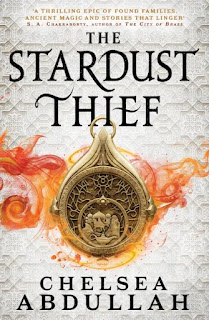
#Review - The Stardust Thief by Chelsea Abdullah

The Stardust Thief
Chelsea Abdullah
Orbit, 19 May 2022
Available as: HB, 467pp, audio, e
Source: Advance copy
ISBN(HB): 9780356517438

I'm grateful to Nazia at Orbit for an advance copy (a SIGNED ARC!) of The Stardust Thief to consider for review.

The Stardust Thief delivers all you could want from intelligent, engaging (and engaged) fantasy: a sweeping, well-realised setting, ancient magics, devious plots and schemes and - most important - a band of absorbing, flawed and complex characters. 

It's good on so many levels. It really is.

Loulie al-Nazari is a notorious thief, the "Midnight Merchant", renowned throughout the kingdom for her ability to source priceless magical artefacts which she then sells to her clients. Accompanied by her faithful friend and bodyguard, Qadir, she cuts a glamorous figure - but hides a desperate sadness, having lost her family and indeed her entire tribe at a young age to murderous bandits.

Qadir, too, has secrets: yes, there are things that Loulie, who he trusts absolutely, knows about him which could get him into deep trouble, but he carries an air of mystery even beyond that. An exile, with dangerous powers and skills, whose life depends on not attracting attention, he's appalled when Loulie is summoned by the Sultan, who wishes to employ her.

Also introduced here are Mazen, the Sultan's younger son, and Aisha, a thief employed by Omar, Mazen's elder brother. Without wanting to, the four end up sharing a journey out of town, towards the dreadful Sandsea, habitation of jinn, ghouls and worse.  Deception and double-dealing abound, to be gradually revealed over a series of hair-raising adventures. The story is held together in the meantime by traditional tales, printed here as they are given by storytellers or by one of our faithful band. Reality and folktale blur as we hear of ifrit, magic lamps, cunning bargains driven with fearsome jinn, forty thieves, a storyteller who protects her life by the tales she recounts every night to her lord. And revenge. So much revenge! You will recognise some of the elements, but Abdullah brings them together into a whole that adds depth (and clues) to her narrative. The background is the persecution of the jinn by Mazen's father - we only gradually learn why he is doing this - and human greed for the precious relics that they enchant and which are left behind when they die. My sympathies were rather with the jinn than with humans, but at the same time it's clear they are dangerous, unbiddable beings. (Though the same could be said for other characters here).

Overtly, the story is a quest: Loulie, Mazen and Qadir, in particular, but also several other characters, have a simple - if difficult - task to accomplish, and they think they know what's going on and who they are. But in reality they won't get anywhere unless they learn to trust each other, and to trust they need to understand one another - and themselves. Secrets between friends prove deadly when enemies begin to appear, and while everyone is physically brave and determined (I loved seeing bookworm Mazen learning to understand that about himself) it's clear that other forms of courage than the physical will be needed, including the courage to let go of long-nursed grudges and griefs, to trust, and to forgive.

The Stardust Thief is glorious, not just a well-plotted and exciting adventure story but one where the characters - even the villains - are deeply sympathetic, with all their failings and faults. The adventure is as much internal as external. (It does add a lot though that externally, this is a gloriously portrayed world with a real sense of the numinous in every description and scene).

This is not to be missed, you should go and order (or pre-order) a copy NOW!

For more information about The Stardust Thief, see the publisher's website here.


14 May 2022

#BlogBlast #Review - Momenticon by Andrew Caldecott

Momenticon
Andrew Caldecott
Jo Fletcher Books, 12 May 2022
Available as: HB, 362pp, e, audio
Source: Advance copy
ISBN(HB): 9781529415421

I'm grateful to Jo Fletcher Books for an advance copy of Momenticon to consider for reviews and for inviting me to take part in the social media blast.

If, like me, you are a fan of Caldecott's Rotherweird series and eager to get another the fix of that slightly out-of-kilter world, then your wait is over - while Momenticon is set in a different (and in many ways darker) world, there is more than enough kinship between this book and the eccentric characters, contrivances and convolutions of the earlier series to satisfy. Momenticon is, thoug,h rather more direct about what's going, making it generally tauter with a greater sense of peril from the start.

We are in a post-apocalyptic world, some years after the "Fall" (but not so many that it has passed out of memory). Fogg, to whom we're introduced first, is the curator of a museum which contains many of Earth's greatest artworks. Shielded by a chitin dome to keep out the caustic gases that have destroyed most life, the museum is isolated, and has no visitors. (There's a digital counter, just to make sure). Three years into this role, Fogg has settled into a routine, taking his meals as paste from the "rearranged", doing exercise under the stern eye of his AI personal trainer, and inspecting the exhibits. Nobody comes, and nobody leaves, and Fogg doesn't enlighten us about his history.

Until Morag appears.

Fogg's and Morag's meeting provides an excuse for them both to tell their stories (or bits of them), explaining more about the world they're in which is dominated by two organisations, Tempestas and Genrich, broadly working in the arts and the sciences respectively; about its dependance on dwindling stocks of chitin and tantalum; about the array of strange characters they've met and who have directed them where they are now. It's a complex, desperate story full of loss and abandonment, co-option into others' plans, ambition, and revenge. The upshot is that the scattered communities which have survived the Fall are in danger, but also that a faction or factions are placing Fogg and Moral in danger. They must leave the Museum Dome and find a way to live outside.

That's the cue for a series of breakneck adventures, including journeys by airborne ships (not airships, proper ships but flying), encounters with the enigmatic Lord Vane, head of Tempestas, and his disturbing son, Cosmo; flights from danger into danger and a deeper and better understanding of art. I really mean that - just one of the threads here is the "momenticons", little pills which allow the taker to be present at the creation of a work of art, briefly ("moment icon", yes?) Building further on this idea, there are villages and town set up to recreate paintings from Fogg's museum and roving characters taken from books (especially, the Alice books). Fogg's perfect memory for every last detail of those artworks will prove important - as well as a ragged and committed band of holdouts who are opposed to Vane's, and Lord Sine's (of Genrich) plans... whatever these are.

What else? lost parents. Families where all is not what it seems. Arcane machinery. Postcards. And, at every turn, those spillovers from Alice - not only characters, but themes such as the Looking Glass chess-world that Alice moves through and, most of all perhaps, an air of puzzle-ality, if I may invent a word, to everything - a layering of mysteries and challenges where, just as one is about to solve a riddle, another pushes it aside, leaving a nested series of conundrums which it is vitally important to understand. (Not so easy when you're being pursued by mechanical huntsmen, minions with crossbows, or actual slithy toves).

Quite simply, Momenticon packs an enormous lot in, keeping its protagonists (and the reader) on their toes througout, if rather dizzy, and taking both into a deeply strange but also deeply compelling world. 

I'd strongly recommend.

For more information about Momenticon, see the publisher's website here

You can buy Momenticon from your local bookshop, or online from Bookshop, from Hive Books, Blackwell's, Foyles, WH Smith, Waterstones or Amazon.


12 May 2022

#Review - A Sh*tload of Crazy Powers by Jackson Ford

A Sh*tload of Crazy Powers (The Frost Files, 4)
Jackson Ford
Orbit, 12 May 2022
Available as: PB, 496pp, e
Source: Advance copy
ISBN(PB): 978-0356514673

I'm grateful to Nazia at Orbit for an advance copy of A Sh*tload of Crazy Powers to consider for review.

With book 4 in a series, there can be a risk of things becoming stale. Still readable, yes, still what you came to it to get, but - flat. After all, why change anything and risk putting people off?

It's a trap that Jackson Ford avoids here with aplomb. Crazy Powers - while I don't want to say too much about its outcome - upends the safe little world (well, for rather exotic values of "safe") that Teagan Frost, possessor of awesome psychokinetic (PK) abilities and would-be chef (if she can ever scrape together the money to train) has inhabited so far.

A recap. Teagan ('She has zero strategic skills, no filter, a constant ability to screw up even the best-laid plans. She can be ungrateful and whiny, and she takes sarcasm to an Olympic level') was gifted her abilities by mad-scientist parents who endowed her brother and sister with equally awesome, but different, powers (seeing infrared and never having to sleep, respectively). Teagan's brother then killed her parents and sister, and she herself was snapped up by the US Government which uses her for black ops in the Los Angeles area. Over the previous three books we've seen this situation gently come apart, culminating, at the end of Book 3, Eye of the Sh*t Storm, in Teagan sitting in hospital with her friend Annie, who's in a coma, and blaming herself for that. 

This story picks up exactly where that previous one ended. Teagan is still battered, drained and haunted by the earlier events, and may have fatally exposed the secret of her powers by saving hundreds of people from a horrifying death, but she gets no rest, oh no. Ford plunges her into the midst of a kidnap attempt which leads up to one of those fabled LA police chases, all broadcast live on ghoulish news networks. From that point it only gets worse and worse. China Shop, the outfit for which Teagan works, is tasked with providing security for a convention of arms dealers (in an LA hotel? Something seems a bit off here) - and she's not even started to recover from recent events...

I loved this book. Totally loved it. Ford blends together a pack of irritable, exhausted operatives, living on shreds of their nerves; a new group of antagonists in the form of a weird, religious cult; and a bizarre location - the hotel itself, a gothic pile with rumoured hidden tunnels, a helipad and secret rooms. And a mystery, whose unpicking will show the whole sequence of books so far in a new light. He's also very sharp on the setting - we meet 'people who are able to take a red pen to black budgets' (watch out, China Shop!) in a milieu where 'Like most crowds of rich people, it's a mostly white, mostly male demographic.')

At the same time, old antagonists also return, affording Annie, who's a likeable and interesting character, a whole adventure of her own in parallel to that of Teagan and the rest. Annie is also battered and bruised, and her escapade - accompanied by Teagan's boyfriend Nic (is there a bit of a spark there? Ouch...) - gives an opportunity for her to reflect on her own early life, sharing details with the reader that we didn't know before. It also illuminates the relationship between her and Teagan, revealing a much more human side to both that Teagan's endless banter and Annie's chilliness has so far concealed. (Teagan's friendship with ex-gangster and drug dealer Annie is touching - 'Teagan is one of the most exasperating, irritating and confusing people that Annie has ever met... but she is also her friend. Maybe her only real friend.')

Both women, basically, get put through the mill here - one can almost taste their weariness and pain - and it's made plain that both care about much more than their own survival. There's a bond there, but there's also a sense of wider ethics and involvement in society, and perhaps also a sense of growing up, maturing (a bit. A little bit.) A reminder that they're not just action heroes. As you'd expect, it makes this a compelling and must-read instalment of this series and one which sets things up for another which I'll eagerly await. Truly, Teagan (and Ford) throw lots of sh*t up in the air and who knows where it will ever come down?

For more information about A Sh*tload of Crazy Powers see the publisher's website here.