1 November 2022

Cover reveal - The Space Between Us by Doug Johnstone

Exciting News!

I've got something a bit different today...  read on to see the cover of the thrilling new novel coming next year from Doug Johnstone via Orenda Books - The Space Between Us is which is out on 16 March 2023.

The Book

But I'm not going to show it to you straight away. Oh no. You need to find out a bit first. let me introduce Lennox, Ava and Heather.

Lennox is a troubled teenager with no family. Ava is eight months pregnant and fleeing her abusive husband. Heather is a grieving mother and cancer sufferer. They don’t know each other, but when a meteor streaks over Edinburgh, all three suffer instant, catastrophic strokes... 

...only to wake up the following day in hospital, miraculously recovered. 

When news reaches them of an octopus-like creature washed up on the shore near where the meteor came to earth, Lennox senses that some extra-terrestrial force is at play. With the help of Ava, Heather and a journalist, Ewan, he rescues the creature they call 'Sandy' and goes on the run. 

But they aren’t the only ones with an interest in the alien … close behind are Ava’s husband, the police and a government unit which wants to capture the creature, at all costs. And Sandy’s arrival may have implications beyond anything anyone could imagine…

The Author

And did I mention that this is by DOUG JOHNSTONE? 

Doug Johnstone is the author of fourteen previous novels, most recently Black Hearts (2022). The Big Chill (2020) was longlisted for the Theakston Old Peculier Crime Novel of the Year and three of his books, A Dark Matter (2020), Breakers (2019) and The Jump (2015), have been shortlisted for the McIlvanney Prize for Scottish Crime Book of the Year. 

He’s taught creative writing and been writer in residence at various institutions over the last decade, and has been an arts journalist for over twenty years. Doug is a songwriter and musician with six albums and three EPs released, and he plays drums for the Fun Lovin’ Crime Writers, a band of writers. He’s also co-founder of the Scotland Writers Football Club, and has a PhD in nuclear physics. 

The Space between Us is Doug’s first foray into science fiction. Follow Doug on Twitter @doug_johnstone and visit his website: dougjohnstone.com.

The City

As if all that isn't enough, it's set in EDINBURGH, a city I spent nearly eight years in when I was at University (it's complicated). Read Doug's novels and you'll walk the streets of Edinburgh, you really will...

But I sense you're getting impatient. Where is this cover then, Mr Blue Balloon, I hear you say. 

Well...

...wait...

...hang on...

...here it is!

Cover for book "The Space Between Us". Against a white background, four black discs contain the words of the title, in white lettering. Flowing through and between them, sinuous black lines which move closer and some of which merge towards the top of the cover. Between them, smaller coloured circles in green, orange, purple, red, pink and blue.

I hope you agree that is just GORGEOUS. And that it does credit to what's described as a "breathless, adrenaline-soaked road trip anda meditation on communication, identity and connection to others and our environment … emotionally complex science fiction that sits alongside recent authors like Sue Burke, Tade Thompson, Nnedi Okorafor and Chris Beckett."

For more information about The Space Between Us, and to preorder a copy, see the Orenda Books website here.

27 October 2022

#BlogTour #Review - Red as Blood by Lilja Sigurdardóttir

Cover for book "Red As Blood" by Lilja Sigurdóttir. A largely read background, slashed diagonally into four parts with the author's name and title stamped through them from top to bottom. The exception is the second diagonal slash from the top, in which is a greyish image of a far shore, buildings and water, with snow falling. In front of these is the outline of a female figure in a bright red cloak or dress. It's not clear whether she is looking towards the viewer or away across the water, because the slashed cover cuts her head away just above the neck.
Red as Blood (An Áróra Investigation, 2)
Lilja Sigurdardóttir (trans by Quentiin Bates)
Orenda Books, 13 October 2022
Available as: PB, 300pp, audio, e   
Source: Advance copy
ISBN(PB): 9781914585326

I'm grateful to Orenda Books for sending me a copy of Red as Blood to consider for review, and  for inviting me to join the book's blogtour.

Following up Cold as Hell, Red as Blood sees Áróra still in Iceland - in fact she's bought a flat - searching for her missing sister, Ísafold. However, she soon becomes involved in the search for another missing woman, Gudrun, whose husband Flosi returns home one evening to find the kitchen wrecked and a ransom demand on the table.

Áróra's skills at tracing missing money prove to be very useful in what follows, as, working with, Daniel, her will-they, won't-they distraction in the Reykjavík police and his team, she attempts to unravel a most perplexing mystery - one with family, business and potentially, criminal aspects but where it's never clear which is at the root of events.

This was a thoroughly engaging crime novel, Áróra's romantic tension with Daniel palpable. He's introduced as a thoroughly nice guy, a real exception to the rule of the grizzled, burnt out cop, and from what we see of him here, that's truly deserved (see for example the subplot with his neighbour, drag artist Lady Gúgúlú who has a thing about the "hidden people" inhabiting a corner of Daniel's garden forbidding him form mowing it, but whom he protects here). 

But there are other tensions too. Daniel is supposed to be investigating Ísafold's disappearance, but that seems to be going nowhere. Is he actually as dependable as he might be? Is meticulous, work-focussed Helena (a member of the team who looks up to Daniel as her mentor but is of a rather different temperament) getting distracted by her casual hook-ups, and losing focus on the enquiry?

The book manages to pack a great deal into a fairly small space. Daniel sets about getting a clear picture of Gudrun and Flosi's lives, soon discovering that with ex-wives, mistresses and step-daughters, not to mention business dealings, it's all a lot more complex than you'd imagine. The unravelling of Gudrun and Flosi's family was especially fascinating - in the sense that a car crash is fascinating. So many levels of misunderstanding and deception are going on here, one of which embroils Helena. As the truth emerges, it's nicely accounted for by the character and background of everyone we meet here - rather than being crowbarred in to fit a plot. There's real depth to them all - plenty of interesting backstory, but more, a sense of them as real people about whom one comes to care.

With hints of wider events and other players at the end, Red as Blood is an excellent middle volume to a trilogy and indeed a fine example of a detective novel. It's rendered ably into English by Quentin Bates who as ever manages both to make the language show that this is taking part in a foreign language while at the same time making the words clear and absorbing

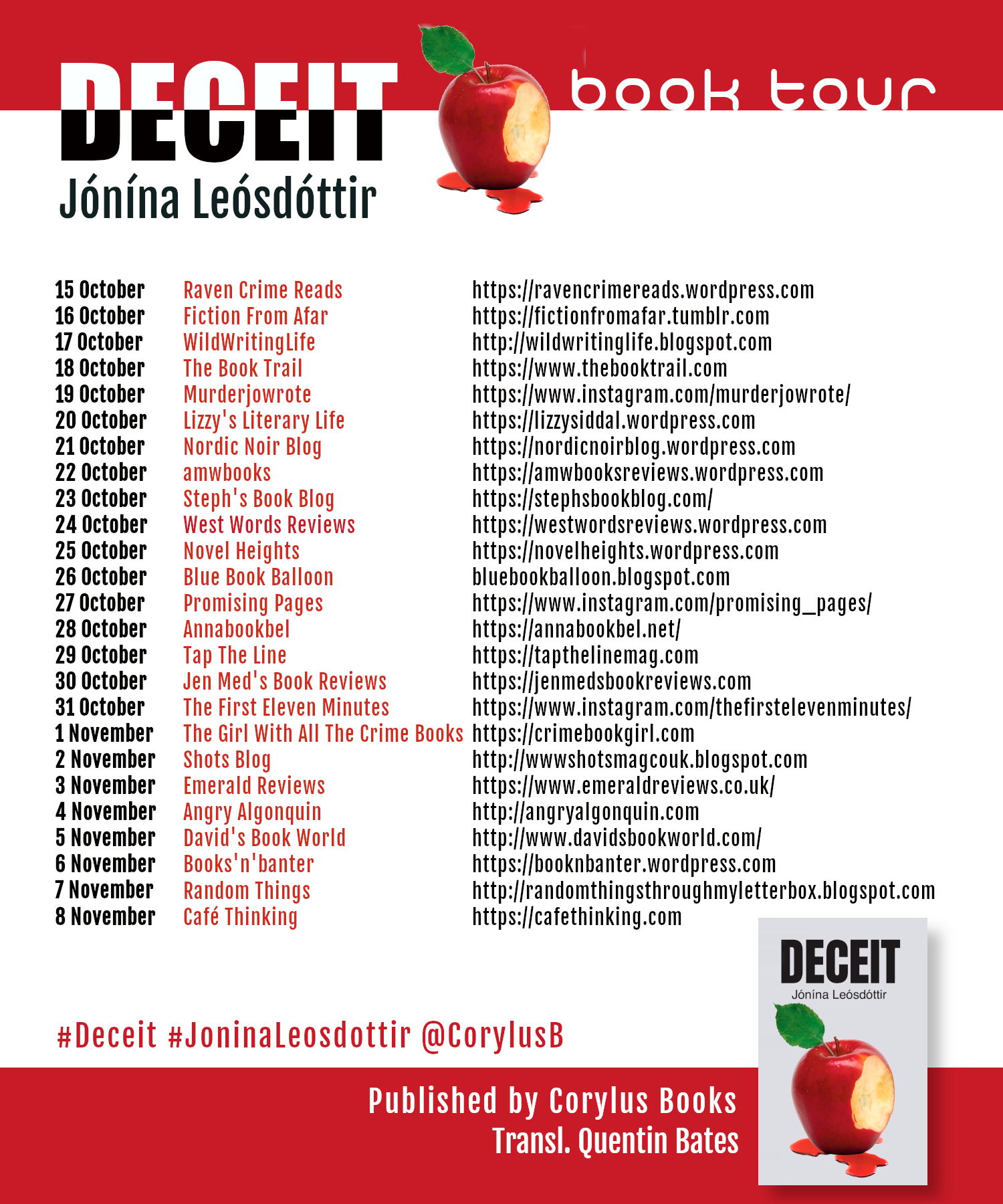
For more information about Red as Blood, see the publisher's website here - and of course the other stops on the blogtour which you can see listed on the poster below. 

You can buy Red as Blood from your local high street bookshop or online from Bookshop UK, Hive Books, Blackwell's, Foyle's, WH Smith, Waterstones or Amazon.


26 October 2022

#BlogTour #Review - Deceit by Jónína Leósdóttir

Cover for book "Deceit" by Jónína Leósdóttir. Against a grey-white background, a red apple with a bite taken out of it and one green leaf attached. Pooling around the base of the apple, red fluid like blood.
Deceit
Jónína Leósdóttir (trans Sylvia Bates and Quentin Bates)
Corylus Books, 30 October 2022 (e), 15 November 2022 (PB)
Available as: PB, 288pp, e
Source: Advance copy
ISBN(PB): 978-1916379794

I'm grateful to Corylus for sending me a copy of Deceit to consider for review, and for inviting me to join the book's blogtour.

It's been interesting over the past couple of years to see the different approaches that authors have taken to the covid-19 pandemic. Some ignore it, some write as though it is past and one with and life is back to normal. Only a few though - at least that I've seen - accept the challenge of setting events squarely in the midst of lockdowns, quarantine rules and public health campaigns.

That is what Jónína Leósdóttir has chosen to do with Deceit and I have to say, the result in absolutely cracking. Set in Iceland in March and April 2020, the book introduces each chapter with a newsflash giving infection statistics and updates on events, and the action closely its characters' varying responses. 

Adam, a psychologist in private practice in Reykjavík, is inclined to take things very seriously, sanitising hands and anything that's newly come into his cosy basement flat, which he leave sonly reluctantly. Adam's ex-wife, detective Soffía, is rather more cavalier, while various owners of local businesses - cafés, a deli, a small hotel - bemoan the impact of the virus and the lockdown on their businesses. The story is interestingly sited at that point where the most serious issue was believed to be physical contact rather than airborne transmission, so there is less focus on masking and ventilation and more on distancing, leading to to some amusing scenes as the characters move around each other, so to speak. Having lived through all this only two years ago it's all very recognisable.

The inhabitants of Reykjavík are soon, however, about to face something much less humorous and indeed malign as potentially deadly tampering with fruit and other foods spreads around the capital and the country. At the epicentre are those same small business owners, but it's frustratingly hard for Soffía to link the cases together, or establish the motivation or perpetrator. She has few resources. Adam reluctantly assists, largely because he's nearly broke and the police will pay him for consultation, but most police time is going into enforcing covid rules so really the two of them are on their own.

They do, though, while bickering gently in the manner you'd expect of a long established couple, gradually come to understand the victims, if not the perpetrator, peeling away layers of lies and deception about a most remarkable - if reprehensible - man and his bizarre family. 

Meantime, Adam is also providing private consultations, including helping a young woman near to despair.

Add in the mysterious Jenný, a woman who we sometimes encounter in Adam's flat but who avoids contact with others, and Deceit provides a gallery of fascinating and complex characters struggling with a wide range of issues. Adam's insights as a psychologist are often the key to understanding what's going on, although he's less adept at using it in his own life and with his family - his wife, his daughter. The mystery behind the events is in the end both simple and fiendishly rooted in real lives and past events, all of which need to be teased out and prove addictively plausible. 

An enthralling and fun read, then, and I hope Corylus can bring us more translations of Leósdóttir's novels (hopefully also rendered into English by Sylvia Bates and Quentin Bates, whose version is lucid, compelling and clear).

For more information about Deceit, see the publisher's website here - and of course the other stops on the blogtour which you can see listed on the poster below. 

You can buy Deceit from your local high street bookshop or online from Bookshop UK, Hive Books, Blackwell's, Foyle's, Waterstones or Amazon.


24 October 2022

#Review - Isolation (ed by Dan Coxon)

Isolation
Edited by Dan Coxon
Titan Books, 13 September 2022
Available as: PB, 400pp, e
Source: Advance copy
ISBN(PB): 9781803360683

I'm grateful to the publisher for an advance copy of Isolation to consider for review.

This anthology is very timely. With various periods of covid lockdown in most of our recent pasts, the experience of isolation - its advantages and disadvantages - have been much discussed. While the conversation will certainly continue, and experiences clearly varied according to circumstances, personality and location, it's clear that many of us were not fans. Nor was the experience evenly distributed. Many office workers were expected to do their jobs from home, perching on beds with laptops or if more fortunate, taking over a spare bedroom, but others had to continue, often bearing a disproportionate share of the virus risk. 

Speculative fiction offers a powerful lens to examine these impacts and inequalities - which is just what Coxon's new anthology does, delivering some disturbing takes from both well-known authors and some new voices. And as the chill mists of Autumn gather, the horrific side of things seems particularly appropriate. The anthology contains a broad range of stories and as well as enjoying familiar voices, reading it has opened up my TBR  to several writers I hadn't read before - which is a GOOD thing (although my bank may not agree). 

Among my favourite stories here, Alison Littlewood's The Snow Child opens the collection with  highlighting some dangers and sadness inherent in being left alone. Nobody, in my view, does snow-bound horror as well as Littlewood. Her A Cold Season and Mistletoe are creepy, compelling masterpieces of the genre and she repeats the effect in miniature in The Snow Child, a glorious, enclosure-laced story of a mother and a daughter in a remote cabin close to the Arctic circle. Things have gone badly wrong out there, and Tilda feels guilty that she left her mother to cope alone. Slowly though, guilt gives way to fear, as it must in horror. A chilling start to the collection. 

Another of my favourites was Second Wind by M.R. Carey. Not apocalyptic except in the curious sense that the dead no longer remain dead, we follow a successful banker determined to endure, who sees that he has a safe lair prepared, a place he won't be disturbed... until the local homeless find their way in. I loved this story that poses questions about priorities, about what makes us what we are. And there's Letters to a Young Psychopath by Nina Allan, to show that isolation is not always a physical thing but may be an aspect of personality. Written as advice to an unknown reader, this story explores the bounds between what you do and what you nearly do. The writer explains freely where he's coming from and what he's done - and might yet do. The isolation is in his (it's always a him, right?) place in the world, in his head, not in his social position or physical location. It's a moral isolation, but it still has consequences. A chilling and genuinely upsetting story.

I also highly rated Ready or Not by Marian Womack. This blends a really chilling sense of isolation with a vein of threat. Alison is alone in her house, actually her parents'-in-law house. Her partner is missing - we're not quite sure how - and as a German citizen in the UK post Brexit she already feels out on a limb. Julian's behaviour has not been supportive. The old woman living next door radiates malice. The story makes Alison seem to shrink and fade, pressed as she is by so many forces that seem determined to erase her identity and autonomy. 

Among the stories that do reference the pandemic, or its aftermath, Friends for Life by Mark Morris stands out. It's a story of loners getting together for one night week to enjoy a little companionship and seems almost heartwarming, until it takes a turn. Daniel is still mourning his mother - whose care he'd devoted himself to - and Morris adroitly plants doubts about that whole situation, before taking things to a much darker place than I'd expected. Chalk. Sea. Sand. Sky. Stone. by Lynda E. Rucker is set during the first lockdown, when Claire, a young (and recent) widow but a 'geriatric' (ie over 40) mother-to-be, retreats to the safety her grandmother's house by the sea, taking advantage of the isolation brought by the pandemic to explore her grief in private. A simple story, at first sight, until another, jarring element intervenes. Rucker expertly teases this, leaving us to wonder whether it's an alien, intruding thing or something that comes from Claire herself? This one haunted me.

The Blind House is a story of a type I suspect we will see more of - Ramsey Campbell uses the now common experience of home working to evoke horror (as well as to poke fun at the publishing industry which may be a more particular trop). Our hero, Simon, is a proofreader who has taken himself off to work remotely from what seems a most unappealing apartment block. As in Ready or Not, there is a distinct spirit of place, a spirit draws in not only the reader but Simon too. Campbell's skill with slightly off-kilter speech patterns and multiple layers of meaning allowing Simon to, as it were, deliver his own commentary on his fate even before he suffers it. 

Of course, an isolated character surviving after some sort of apocalypse is a fairly common feature of horror, and there are several of them here. Lone Gunman by Jonathan Maberry begins with  the hero buried under a pile of corpses, one man left standing (as it were) amidst a swarm of monsters. As he flees from situation to situation, the question is posed starkly - what to do? I enjoyed seeing Maberry work through the answer. Full Blood by Owl Goingback is a full-blooded (sorry) post-apocalyptic story written from an Indigenous perspective (if only those Western scientists had consulted local knowledge before they meddled...) The isolation is of the last-man-standing sort, the ending certain, the interest in how we get there. The Long Dead Day by Joe R. Lansdale is another zombie story, nicely echoing How We Are by showing again that isolation may not be something we can sustain, whatever that leads to.

If there's a timeline in apocalypses, Fire Above, Fire Below by Lisa Tuttle might come next. If you could know of the horrors that were coming - would you want to? My answer would be "no"- worry about the future can be numbing when one feels powerless to affect it - but Tuttle poses the question, what if you could affect it (maybe, a bit?) The curse of prophecy is well known yet Tuttle gives it a new spin with a twist of foreknowledge for her protagonist as things get worse and worse. But her knowledge is as in a glass darkly, she may glimpse outcomes of this or that but misses the big picture, leaving her truly alone.

The prospects of those last survivors never look good, but a story can still allow them space for some final reflection or realisation as in There's no Light Between Floors by Paul Tremblay which takes place on the cusp of a disaster, a man waking in the midst of destruction and struggling to accept the meaning of what he's going through. It's story in which the reader will soon work out what's going on, leaving us to watch in pity and dread as those going through the end of the world struggle to keep up.

Of course, something may survive the collapse of society. In Across the Bridge, Tim Lebbon gives us a choice of futures. Decades after a calamitous infection, or perhaps simple environmental disaster, the last humans are either rebuilding a new, more harmonious way of life in rural bliss, or sheltering from the storm in a blasted, withered hellscape. These things can't both be true, surely? But isolation can play tricks with reality... a truly though-provoking story with no easy way out.

I'm something of a fan of what I call "unexplained horror" - scenarios far away from even the weird but self-consistent setting of a pandemic or monster plague, scenarios that you simply have to accept and work through. Two here are Under Care by Brian Evenson and The Peculiar Seclusion of Molly McMarshall by Gwendolyn Kiste. Under Care explores a creepy hospital. Creepy hospitals! What could be worse? Imagine being a patient in one of these - never seeing anyone but the mysterious nurse, beginning to doubt who you are and why you are there. Until you find out. A real, incrememental horror, building on that sense of unease many of us feel at the sterile smelling, squeaky floored environment. In The Peculiar Seclusion of Molly McMarshall by Gwendolyn Kiste, Molly herself is seen little, in fact she vanishes, fades, ceases to be quite as others are, in her own house. (Maybe shades of lockdown after all?) Unlike in other stories in this book where a character loses identity when overlooked by wider society, here the outside world takes a prurient interest in what has happened (a bit of satire on the online world and the appetite for 24 hour news perhaps there) but it might have been better for them if they hadn't?

You can't have horror without a decent monster or two, and the best monsters are those who evoke sympathy, I think. 

In Solivagant by A.G. Slatter we have a sad horror, a story where one may have sympathy for a monster. While this is a fantasy story featuring a supernatural monster, the isolation here is very familiar, a young woman separated from her family and friends by a man, left with nowhere to run and nobody to turn to. It's doubtful whether the supernatural horror is the greatest threat here, but in a brilliant study of character and circumstance we are given a little hope that there may be a way out.

How We Are by Chịkọdịlị Emelumadu is a story of witches. Gifty is isolated by choice, as the bearer of a family curse (and because she is under the thumb of a watchful grandmother). A reminder that isolation may serve a purpose, we see her toy with relaxing the constraints she's under - but can that come to any good? 

In Alone is a Long Time by Michael Marshall Smith we might think that the character who is isolated here is "Mr Jones", the client of carer Karen. In a sense that's true, but in parallel with the gradual revelation of Karen's (and Jones's) situation and lives, there is a suspicion of something else at play and so it proves. Alone is, indeed, a long time. A well-paced and absorbing story.

Finally, So Easy to Kill by Laird Barron is very much a hard SF horror, spanning unimaginable eons almost to the end of the universe and featuring god-like beings who, while recognisably human in their failings, have become so... much. Still though, they play their games and in this story motives, histories and potential are nested and layered until neither we nor the protagonists can see where things are heading. 

So many ways to be alone. So many futures and choices. The stories in Isolation truly explore the richness and dread of being by oneself, whether that's permanent or temporary, voluntary or forced or, indeed, physical, spiritual or temporal separation.


21 October 2022

#Review - Her Fierce Creatures by Maria Lewis

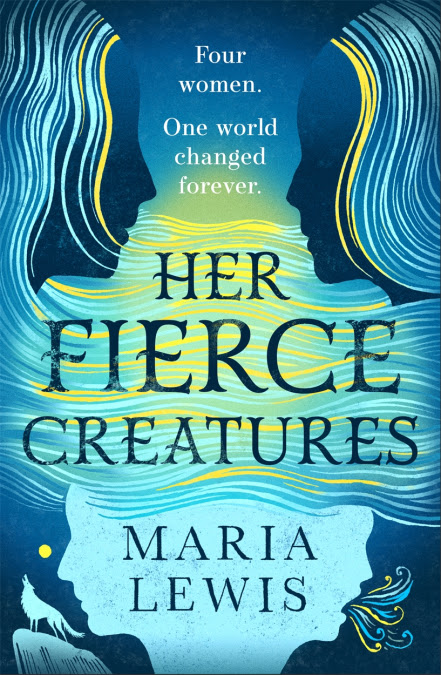
Her Fierce Creatures (Supernatural Sisters)
Maria Lewis
Piatkus, 4 October 2022
Available as: PB, 390pp, e
ISBN(PB): 9780349427263 

I'm grateful to Piatkus and especially to Nazia for an advance copy of Her Fierce Creatures to consider for review.

When I read Lewis's first book in the sequence, Who's Afraid?, I was a little wary. Werewolves? But it was soon clear this wasn't your typical UF, introducing Tommi Grayson, who has a foot in both the supernatural and mundane camps. Successive stories followed Tommi's further adventures as well as introducing a succession of women who are members of different supernatural peoples - a sprite, a medium, a banshee - and their world - oppressed by an authority known as the Treize.

Now the time is coming to turn on the Treize and the stakes are suddenly higher. Her Fierce Creatures is Lewis's necessary final volume in the Supernatural Sistersbut, gosh, how difficult this must have been to write! Unlike the previous books it has too maintain the viewpoints of all four women - Tommi herself, Dreckly (the sprite), Caspet (medium) and Sadie (the banshee). While they have appeared in each other's stories before, those were generally minor, walk-on appearances and each had a full book (or more) in which to develop (my favourite of those being Dreckly in The Rose Daughter, living her life through the long 20th century, encountering all manner of prejudice and adversity and coming out on top).

Here, there is more of a team-up with the need to keep track of parallel events taking place around the world, at the same time as tying off stories, romances, rivalries and foes. That inevitably makes Her Fierce Creatures a slightly different type of story - but Lewis delivers a perfect completion to her saga, resisting any temptation to make this one endless kick-ass battle and allowing each woman some space. For me, that really pays off. These are not just characters, they are friends we've come to know, women whose stories and struggles have struck a chord, and they deserve an opportunity to reflect on that as they await the end.

And this isn't just a story of endings, it also contains new beginnings. Sadia is pregnant - VERY pregnant - with the triplets who may be the hope for the supernatural world. And revolutions are, as we know, built on hope. In making one of the story threads here focus on the challenges and rewards of pregnancy and childbirth, Lewis is still I think - even after seven books in this series - saying something important and new here about that experience. I think it a glorious way to end.

For more information about Hew Fierce Creatures, see the publisher's website here.

18 October 2022

#Blogtour #Review - The Moose Paradox by Antti Tuomainen

Cover for book "The Moose Paradox" by Antti Tuomainen. Against a blue background, a giant CGI moose. You tell it's giant, because a tiny human figure hangs by one hand from its left horn...
The Moose Paradox (Rabbit Factor Trilogy, 2)
Anti Tuomainen (trans David Hackston)
Orenda Books, 27 October 2022
Available as: PB, HB 261pp, audio, e
Source: Advance copy
ISBN(HB): 9781914585340

I'm grateful to Karen at Orenda Books for sending me a copy of The Moose Paradox to consider for review, and to Anne for inviting me to join the book's blogtour.

Pity poor Henri Koskinen. In the sequel to The Rabbit Factor, he has inherited YouMeFun, the adventure park founded (and laden with debts) by his deceased brother, Juhani. After much hard work by Henri, YouMeFun's finances are turning round and he thinks he may be able to take a breather and think of the future - until calamity strikes in the form of an attempt on his life.

As events unspool, it seems as though, even from the grave, Juhani is able to create complications for Henri, and financial acumen won't be enough to solve them. With attempted extortion, commercial sharp practice, a striking workforce and suspicious police on the prowl, how will Henri ever be able to do that forward planning - still less find a bit of quality time to spend with Laura Helanto, the former YouMeFun manager with whom he's thoroughly besotted?

I absolutely loved The Moose Paradox. (The name refers to a top-of-the-range new bit of equipment which Henri wants to secure to keep the park at the forefront of the Helsinki leisure scene). Henri is a very atypical protagonist - not a man of action, but a man of numbers, of figures and calculations. He's perhaps a bit odd, but Tuomainen makes him much more than a 2D eccentric, an outsider or a wimp. Henri watches, gathers information and makes plans. He acts. His realationship with Laura Helanto isn't hopeless, unrequited love, it's a mutual thing which (with its frustrations and misunderstandings) blossoms through the book and is portrayed movingly. 

Laura is also clearly drawn and I really enjoyed the scene when Henri, expressing himself in the best way he can, sets out his feelings for her in terms of percentages and she, rather than laughing at this, picks up the same language - producing one of the most bizarre yet touching conversations I've read in recent fiction.

Aside from all the business dealings, there is also something very odd and sinister going, setting up a mystery that Henri will have to solve if he is to keep the park afloat, indeed, if he s to survive. But with the police taking an interest he may not have much time or freedom of action. The darkly humorous crime plot here keeps the story humming along nicely, in an atmosphere reminiscent of one of the more madcap Ealing comedies - think Kind Hearts and Coronets crossed with Scandi noir, perhaps.

There is a fine cast of supporting characters - the employees of the park, its unlikely new manager and the sinister owners of Toy of Finland, the company from which Henri wants to source the moose ride and who are behaving very oddly in the negotiations.  But really, it's Henri who steals the show. Clearly he's been the slighted, ignored brother, and in a sense taking over the park gave him his chance too shine, to come out from behind the ledgers and spreadsheets. Now it's all threatened, he has choices to make and we see quite a different side of him.

Recommended, whether you're already a Tuomainen/ Rabbit Factor fan or not. The Moose Paradox is perfectly readable as a standalone but obviously does gain if you've read the previous book. The translation by David Hackston is dryly humorous where it needs to and always lucid, serving this story very well and taking in its stride some little points of language that must have been very tricky to render.

For more information about The Moose Paradox, see the publisher's website here - and of course the other stops on the blogtour which you can see listed on the poster below. 

You can buy The Moose Paradox from your local high street bookshop or online from Bookshop UK, Hive Books, Blackwell's, Foyle's, WH Smith, Waterstones or Amazon.

Blog tour poster for book "The Moose Paradox" by Antti Tuomainen.


14 October 2022

#Review - Silverweed Road by Simon Crook

Cover for book Silverweed Road by Simon Crook. A winding, blood red road alongside which are white skeletal trees and white, elemental houses. At the top, the words "There's a horror behind every door".
Silverweed Road
Simon Crook
HarperCollins, 29 September 2022
Available as: HB, 336pp, e, audio
Source: Advance e-copy
ISBN(HB): 9780008479930

I'm grateful to the publisher for an advance e-copy of Silverweed Road via NetGalley, to consider for review.

"All that is loved will be lost."

The addresses along Silverweed Road on the fictional Corvid Estate in Kent hide many secrets, many horrors. It's a place you probably wouldn't want to visit, still less move to. I'd imagine living there would be like experiencing, in real life, the entire run of Inside No 9

Loosely framed as blog entries written by ex DCI Jim Heath, an embittered man who lost his job because he was unable to explain or prevent the horrors described here, each story gives us much more detail and explanation than Heath was ever able to find. His conclusions and complaints, contrasted with the reality of the horrors described here, therefore have a slightly (if darkly) humorous effect.

It's a nice contrast, slightly relieving the awful things that happen to so many of the resident of Silverweed Road. Most of the stories (each named after a house number) are self-contained, though we see protagonists cross paths (and sometimes swords) before and after their own story so that through the book a clearer and clearer picture emerges of what is going on. However the exact reasons for it all, while hinted at in recurring motifs - such as the jackdaw - are teasingly vague until the last story, where there is an explanation of sorts.

The stories are varied in atmosphere and style, raging from the folk-horrific to outright gore-fests to creepy encounters with the supernatural force that inspires all that goes on here. The extent to which that supernatural visibly intrudes varies a lot, with a clear sense in some stories that the victim brings their fate on themselves (for example, Victor Hagman at no 31) while in others the innocent are ensnared (Shanta at no 10). Not all of the activity takes place on Silverweed Road - one protagonist here is the victim of a supernatural horror from far off, another meets a grisly fate far from Kent but it seems that the street then takes part in their revenge. Horror mixes with domestic strife and business or personal rivalries, the grim events in Silverweed Road sometimes reflecting wider themes of abuse and at others, taking a very particular local form.

There is humour, aside from Heath's increasingly exasperated (and mistaken) commentary, for example in one story where a darts enthusiast makes an unwise bargain to win a big tournament leading ultimately to tragedy (and one of Heath's most perplexing cases) but creating some hilarious moments on the way. Crook reaches into many different worlds for his stories, including a dodgy antiques dealer, a furious film craftsman upset that CGI has replaced his replica monsters and - perhaps most creepy of all - a scientist who chooses the Road as the ideal site for his sinister research into cuttlefish. 

If you do visit Silver weed Road, be aware that there are traps here, ancient and malign forces preying on the unwary. There are ancient secrets in the woods about, and the night is not friendly. You won't come here and leave without being altered, compromised, changed. 

Still interested in that affordably priced semi...?

Overall, an excellent collection of interlinked stories, which is really much more than the sum of its parts.

For more information on the book, see the publisher's website here.