27 September 2019

Review - The Bone Ships by RJ Barker

The Bone Ships (The Tide Child Trilogy, 1)
Cover: illustration by Edward Benson,
design and lettering by Hannah Wood, LBBG
RJ Barker
Orbit, 26 September 2019
PB, 466pp

I'm grateful to Orbit (hello Nazia!) for a free advance copy of The Bone Ships to consider for review.

Tell of the sea, Topboy...

Well.

This book wasn't just a read, it was a journey.

A voyage.

A passage.

If, like me, RJ Barker burst onto your SFF radar a couple of years ago with his Wounded Kingdom trilogy, stories of assassins and cursed magic, then you will be expecting good things - and you won't be disappointed. But you might not be expecting something quite so nautical as The Bone Ships. It seems a risky thing for an author to take to something so different - such. different element - but it's a risk that has paid off here, in a rollicking story that succeeds, and more than succeeds, that triumphs, with bags of aplomb, heart-thumping tension and (of course) much dark humour.

Barker has, you might say, conquered the seas.

The Bone Ships is set in an oceany world, a world of islands and reefs where two powers - the Hundred Isles and the Gaunt Islands - are perpetually at war. In this world there is no wood: ships - necessary for trade and for war - are built from the bones of great sea-dragons, Arakeesians, which have, inconveniently, been hunted to extinction. So the two nations' fleets squabble, seizing ships back and forth as the stock of bone for beams and spars dwindles. Other things are seized as well. It's a harsh world, where child sacrifice is bound with the safety of the Fleet and the place of every woman and man is determined by fitness for breeding or for service in the Fleet.

Barker really gets under the skin of his invented world, laying out details of the bone- built, slate-decked vessels, of the culture, the religion, the taboos and shame. Walking that world is his hero Joron Twiner, condemned, like many others, to service on a Black Ship, to infamy and eventual death. Joron has suffered a loss that leaves him fearful and addicted to drink and he leads a crew of murderers, thieves and scoundrels - yet it's this beggarly lot who are chosen to hunt the last Arakeesian when rumour of it comes back to Shipshulme. But not before Joron loses his command and finds a mentor, the redoubtable and mysterious Shipwife, Lucky Meas, herself condemned to the Black Ships

As the crew are hammered into shape by Meas, RJ embarks us on a great adventure, complete with naval battles, spies, treachery, and strange alliances. Reading this gave me a feeling I haven't had for years, the same sense of space and possibility and achievement as when I first read CS Forrester's Hornblower stories. Like those books, The Bone Ships is as much about the building of human connections as it is about spars, wind or salt waves. It's about forging trust, about men and women developing competence, learning to work well together, overcoming differences and creating routines that will withstand the ultimate tests of battle and storm. It's about a crew forming, and how you can make that happen. This is all, at first, mysterious to Joron - he begins as a rather self-pitying creature - so the story is very much also about his growing up.

Barker captures all this perfectly, as he does the particular rhythms and cadences of a whole way of life. I don't know how but in writing of Tide Child and the other ships he has created an authentically nautical language, full of wind, waves, orders, shipboard terms and behaviours that simply convinces but - and this is the important bit - without coming over as sub Treasure Island pirate talk. It's a recognisable language but doesn't use terms you will have heard. The ship's sails are "wings", the ships have "seaward" and "landward" sides, sailors are "deckchilder" and so on.

Barker makes it all so real, whether he's describing how to handle one of the great crossbow mounted on Tide Child's deck, how the ship is cleared before battle, or the rituals and moments of ship life - the Shipwife leading prayers, or the singing of a shanty:

I've always loved the sea, my love
So deep and blue and true
I've always loved the sea, my love
As much as I loved you

Barker could - as much as Melville, Forrester or London - be reporting what he'd seen and heard aboard ship himself, so convincing and engaging is it. I don't think he's served three years before the mast, but you never know...

And that's not all this book has! It has layers and layers besides. There is the pitiless, endless war. There is (some) chance for peace. There is suspicion. There is a whole aspect of the plot to do with the origin of the arakeesians, and the strange, and sad, weather-manipulating creatures called the Gullaime.

And there is the most involving, gut-clenching naval combat I'd read for years.

The Bone Ships simply took my breath away, especially in its second half, where we face one shock after another and see Joron, no longer a cast-off wretch, facing dark choices and taking responsibility. It's an enthralling read and is one of my favourite books of 2019 so far.

For more about The Bone Ships and to buy a copy, see the Orbit website here.

26 September 2019

#Blogtour #Review - Hire Idiots by Prof. I.M. Nemo

Cover by Jenny Haines
Hire Idiots
I M Nemo
Fox Spirit Books, 25 August 2019
PB, 214pp, e

I'm grateful to the publisher for a free e-copy of Hire Idiots and to Emma @damppebles for inviting me to take part in the blogtour.

Hire Idiots opens with a murder on campus, but the (surely pseudonymous?) I M Nemo keeps the reader guessing as the story doesn't follow the routines of the Whodunnit but swerves off into campus politics and the new-liberlisation of education.

Kingsley College is a small US liberal arts college, about to suffer the full force of a modernising, business-friendly, profit-oriented management team. The situation is analysed, I'd say, with some bite by Prof Nemo and while the - never fully explored - murder and the - mysteriously unclear - occupation of the campus theatre by a protester/ gunman/ whoever function as two instances of the slightly strange, setting the scene for the beginning and end of the book, most of it is about that takeover and the struggle of a motley collection of academics to keep their ideals and academic freedoms.

Central to all this is Clarence Van Dyke, a specialist in the poetry of William Blake (one of whose couplets opens the book: Degrade first the arts, if you'd mankind degrade; Hire idiots to paint with cold light and hot shade). Van Dyke is British (cue various jokes about his connections with that fellow from Mary Poppins) but is comfortably settled on campus, bustling between lecture hall, pub and his apartment (the "campus cottage"). Over the course of several days we see his growing realisation of what is in store as a collection of management consultants, Vice Presidents for this-and-that, and fancy management types with glossy titles swarm in, speaking an alien language (benchmarking, assessing, synergy) and looking to make cuts.

Is Nemo using this society in miniature to stand for the wider world - as above, so below - with the methodology of the "disaster capitalists" dissected? Create a crisis. Apportion blame what it can't be settled. Move in and pillage. We see it here as the campus's support services are first contracted out, with the bell soon to toll, it seems, for faculty as well.

While most of the view point is Van Dyle's, we do see a little from the perspective of Happy Winter, the new Chief Academic Officer, a woman more comfortable with her charts and metrics than actually doing any teaching. I would have liked to see more of her point of view, to understand a little better what the motivations of the forces of barbarism are here, but I think that Nemo's heart and passion is really with Van Dyke and the upstart academics (and I sense that's rather the point of this book: it breathes anger and revenge and is dedicated 'For my colleagues who fight on' even if it also claims to be wholly a work of fiction).

That makes the story something of a polemic and if you're not sympathetic to Nemo's point of view you might not enjoy this book, so be warned. For my part, I rather got along with the anger and passion, which gives it a slightly different feel. While perhaps rough in one or two places (I think it effectively telescopes twenty or thirty years of creeping managerialism into one, nasty shock - could Van Dyke really have as been näive about modern trends as he seems here) it effectively draws in the sides and almost becomes a bit of an allegory for wider society and politics in the early 21st century.

An entertaining, fun and thought provoking read.

You can buy Hire Idiots from Amazon UK or Amazon US. Or visit the Fox Spirit Store at

https://www.foxspirit.co.uk/product/hire-idiots-by-professor-i-m-nemo/ 


For more information about damppebbles blog tours see www.damppebbles.com

24 September 2019

Blogtour Review - Wonderland ed by Marie O'Regan and Paul Kane

Design by Julia Lloyd
Wonderland: An Anthology of Works Inspired by "Alice's Adventures in Wonderland"
Edited by Marie O'Regan and Paul Kane
Titan Books, 17 September 2019
PB, e, 352pp

I'm grateful to Titan Books for a free advance copy of Wonderland to consider for review and for inviting me to take part in the book's blogtour.

I love themed anthologies. It's always interesting to see what a diverse group of top-grade authors make of a meaty subject, what similarities and differences there are between their take on it, and how the editor juxtaposes things. Recently there seems to have been a resurgence of anthologies playing with classic stories - understandably because, really, with something like Alice, there is always something new to say, not least because times change, we change, and our approach to these stories must also change.

This anthology is bookended by poems from prolific author and poet Jane Yolen. Alice in Armor muses on an Alice taking her own life into her hands and arming herself against injury. The implications of this are made clearer in Yolen's closing poem, Revolution in Wonder. It's fitting that Yolen both opens and closes the book, echoing the range of approaches followed by the stories in between (especially given her contributions elsewhere to this whole area of reinterpreting and reimagining those classic tales we all have as part of the furniture of our minds.

Overall this collection has teeming variety. There are stories inspired by Wonderland, using its look and feel, as it were, stories which expand upon aspects of the original books, prequels, sequels, real-world stories where a "Wonderland" aspect might be taken as objective reality or equally, may reflect a state of mind or be a metaphor for the distance from childhood. There are transpositions of Alice to varied settings - the Wild West, a dystopia future, urban Japan - and all manner of other reimagining (including some which touch on uncomfortable aspects of Dodgson - Lewis carroll - and his circle.

They are all strong stories and it would be invidious to try to rate each one, but I particularly enjoyed Genevieve Cogman'' The White Queen's Pawn, Good Dog, Alice by Juliet Marillier, About Time by George Mann, LL McKinney's story What Makes a Monster and Alison Littlewood's Eat Me, Drink Me.

In Wonders Never Cease, the first story proper, Robert Shearman picks up where Alice itself ends, imagining her leaving Wonderland and rejoining a very prosaic Earth of roundabouts, typing and switchboards. Or has she left? The story is effectively timeless, weaving together Wonderland weirdness with moments in an ordinary life, while keeping the sense of being in a dream which Carroll's novels depend upon.

There Were No Birds To Fly by MR Carey presents a Wonderland-tinged, but post-Apocalyptic, Brighton. Deadly aliens walk among us, and a small party is fleeing - but to where? And why? 'If you follow the rules' the Narrator (who wears an apron, and carries a set of carpenter's tools) is told at the start, 'you'll live a whole lot longer.' And there do seem to be rules in this story, but they are frustratingly hard to grasp. A grim, allusive take that seems to inhabit the spirit of Wonderland while being rooted in a real place.

Genevieve Cogman presents a different Alice in The White Queen's Pawn, set in the 1930s where dreams of dozing by the river and drinking resizing potions are long gone and the nasty realities of the later decade take the foreground - with, however, the order 'Off with her head!' still ringing. A neat reversal involving a looking glass is a nice commentary on the politics of those, and perhaps these, times.

Cavan Scott's Dream Girl plunges into what seems to be a world of classic horror - a dark and bloodstained Wonderland with its own secrets where the March Hare's madness has taken a sinister turn. Alice is missing - if she is found will she be able to restore order or will she just bring ruin? There is a clever conceit to this story which I didn't spot coming, but it's one that casts a shadow at the end of the story. I wasn't sure whether the was a Happy Ever After here.

In Good Dog, Alice by Juliet Marillier the protagonist is Dorothea, not Alice, but there is a small doorway, there is a magical food that can resize the eater and there are - in the background - Oxford dons. Here Wonderland (if that's what it is) is both a refuge and a source of strength, with the real hours outside, in our world. A neat and haunting story, one of my favourites in this book.

Jonathan Green's The Hunting of the Jabberwock gives us the true story of this famous quest - in which things turn out to be both less, and more, heroic than the legend which has been handed down. Drawing on the possibilities for the Hunt as a self-contained episode Green creates what could almost be a Dungeons & Dragons module, complete with an eager young Squire, a battered, world-weary knight and an unfriendly Hermit. Liberally spattered with gyres and gimbles, more raths and fearsome Jubb Jubb birds, this story is fun and entertaining.

In About Time, George Mann gives a thoughtful interpretation of Alice in a wider context, dwelling on childhood and adulthood and the responsibilities each has to the other. Here, as in several other stories, Wonderland serves several purposes, including being a refuge, a comfort and a mirror (of course!) to "real life". Another of my favourites.

I previously knew Angela Slatter for her Verity Fassbinder series of urban fantasy sets in Brisbane (excellent - read them!) so it's good to see her do something every different in Smoke 'em if You Got 'em which is... how to describe it? A kind of Alice "Western" complete with six-shooters, a sheriff and a saloon. An excellent, rounded story in itself giving its Alice plenty of action and agency and, perhaps, a peep into a wider world we might see more of? I can hope.

Rio Youers's Vanished Summer Glory takes a more sentimental vein, being one of those stories that looks back on a (sort of) past Wonderland, or Wonderland experience, making no judgement on objective reality (I had thoughts) but definitely using the whole concept to convey vanished youth, innocence and childhood joy. As a native of Cheshire I was pleased to see the Daresbury setting.

Black Kitty by Catriona Ward might be, perhaps, a prequel to the Alice stories? It very cleverly weaves elements from the Alice mythos into a deeper, scarier world but - and I think this is unusual in this sort of story - gives its Wonderland participants real hopes and fears, which are perfectly rational in their (irrational) world.

Laura Mauro's The Night Parade takes us to Osaka, to a humid night where Airi, unable to sleep, lights a moody cigarette and observes the city from her tiny balcony. That might seem as unlikely a jumping off point for a Wonderland story but it really isn't - as Mauro shows, everything joins up. Another of my favourites, both for its distinctive atmosphere and for its resourceful central character.

LL McKinney has form in reimagining Wonderland, her A Blade so Black using it as the basis for an urban fantasy set in modern Atlanta, so What Makes a Monster already has a whole world to draw on - one she uses with relish in this story of London, gaslight and fog which also serves as something of a prequel for ABSB.

James Lovegrove's The White Queen's Dictum is perhaps more tangentially Wonderland-ish - the title refers to the idea of believing "six impossible things before Breakfast" but with that nod we're into rather a different kind of story - still an effective and twisty one, though.

In Temp Work, Lilith Saintcrow gives us a grim, corporate-ruled and environmentally degraded future. Not a Wonderland, you'd think, and temping maid Alise, required to dress pleasingly for someone else's fantasy, is just making it from one day to another, staving off hunger and getting by. Its not though only her bosses who have have strategies and plans.

Alison Littlewood's Eat Me, Drink Me, like a number of other stories here, picks up on the atmosphere and trapping of the original stories and deftly turns them round to reflect on its Alice's situation and dilemmas. A claustrophobic, harrowing and tense story, another favourite in this collection.

Cat Rambo's story How I Comes to be the Treacle Queen is a slightly different take, written in - at first - a slightly difficult language but it's an intriguing and passionate story that quickly grew on me. It is really Wonderland from below. Excellent.

The final story in the book, Six Impossible Things by Mark Chadbourn complements Vanished Summer Glory in meditating on "real life" (whatever that is) but doing with both a more direct take on the Alice books (looking at the people who inspired then, including some darker aspects concerning Carroll) and a less direct one: it involves an Alice, exploring something very like a canonical Wonderland... but not exactly like. Fittingly, the story raises many questions, bringing the anthology towards its end in a very open way, before Yolen's closing poem of high revolt rounds things off.

A super anthology showcasing a range of authors doing splendid stuff. Great fun.

For more about the book, see the publisher's website here and the other reviews and pieces in the blogtour set out in the poster below.


22 September 2019

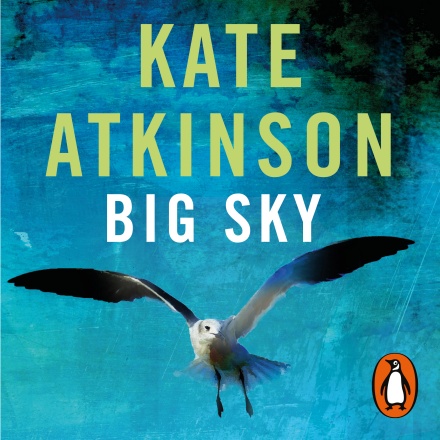
Review - Big Sky by Kate Atkinson

Cover design by Richard Ogle/TW
Big Sky (Jackson Brodie 5)
Kate Atkinson
Doubleday, 18 June 2019
HB, e, audio, 368pp, 11 hours 20min

I bought my copy of this book and listened to the audio version via a subscription service.

It's all Kate's fault. Not Atkinson (though I'[ll come to her in a moment), no I mean Kate of For Winter Nights. I had this on my pile to read over Christmas, but then Kate's review came along and I couldn't leave it till then, but I had blogtour commitments and stuff, so I Audioed it while driving between home and station.

The upshot of which is that I now have NO Atkinson to read over Christmas AND I have to catch up on Jackson Brodie... which actually means I have four Atkinsons to read over Christmas, I think? So perhaps I should be thanking the Kates, actually.

Anyway. Let's frame things right. This is not a crime novel. It doesn't have a detective who, in the teeth of the police, gets to the bottom of things. it doesn't feature a DI who has gone maverick, a cynical pathologist, or a picturesque country setting.

Well, it kind of does. Jackson Brodie is a detective, but he doesn't defy the police and find the truth. He kind of stumbles along, musing on life, and plays his part. There is a DI but she is peripheral, a pair of detective constables are more central but, again, they don't really solve anything. And there is a pathologist but she's a character in a long running TV drama, Collier, and played by Brodie's ex, Julia (whose comments on various things intercut this book). Collier is filmed on the East Coast of Yorkshire so, really, there is a picturesque setting.

But I hold to my view that this isn't crime. While crimes occur in the book - oh so many crimes - and there is even a body found in a garden, the book is not about the process of solving the crimes so much as about people - about women - getting out from under their shadow. No, this is a book about the evil that men do, and I have to say, it didn't make me feel great about being a man.

The background to the story is that a child trafficking and exploitation ring, wound up several years before, is being reinvestigated (by the two DCs, Reggie and Ronnie (I know)). This has caused various guilty parties some concern and arms are being twisted to command silence. At the same time, a human trafficking operation run by three unlovely men is raking in money hand over fist. The book is about those caught up in the two schemes, the women who were scarred by the earlier one, and the women deceived and abused in the second. It makes for very raw, very distressing reading (if you let yourself think about it, that is, which of course you should) and, as I have said, for me, quite shaming reading because really the men in here do not acquire themselves well (mostly - there are exceptions, Jackson himself, of course, a young man named Harry and drag queen Bunny).

I've seen criticism of this book that it ends too soon, that it's not, well, crime-y enough but I think that misses the point. This book is about lives. It's about consequences. About fear and complicity. All of that needs space to develop and - while obviously it can be done - that doesn't require a Mystery, Clues and a Solution. (I'm really not trying to diss crime fiction here, I love it, especially a decent series and this is a series so we have that, I'm just saying, come to this book with the right expectations).

So I loved that, even after the crime-y bit was resolved, the story would down gently, sorting out other threads concerning Jackson, Harry, his stepmum and others, bringing bits of redemption, showing some of the guilty being punished - and others escaping. It's a tense story focussed on unbelievable levels of suffering and betrayal and it felt right to come back up gradually. At least it did to me.

I also don't want to give the impression this book is dark or depressing. Well yes it is dark, in places, the overall impression I took away was its spot-on portrayal of a while gallery of contrasting, alive, real people. The different voices come through so strongly - Julia in the little asides that come in to Jackson's mind all the time (both their appositeness and the fact that he keeps recalling them), the repeated motif of 'Tina [or Christina, or Christina and Fi] running away', Jackson recalling the label of 'Luddite' flung at him by his daughter, Harry's mild teenage angst and his incomprehension of Miss Dangerfield's feelings - which the reader will have spotted as well as the action she has taken, and so much more. Of course the audio version has Jason Isaacs' (who played Brodie in a TV adaptation of Case Histories) who injects life and action into all the voices - coping superbly with the interjections, and range of accents.

As I have said, all this now gives me the wonderful dilemma of when and how I can go back through the previous Jackson Brodies...

20 September 2019

Blogtour review - The Ten Thousand Doors of January

The Ten Thousand Doors of January
Alex E Harrow
Orbit, 12 September 2019
HB, 371pp

I'm grateful to the publisher for an advance copy of The Ten Thousand Doors of January and to Tracey Fenton for inviting me to take part in the book's blog tour.

The Ten Thousand Doors of January is a book I'd recommend 100%, probably one of my favourite books so far this year (and it's been a good year!)

At times exciting, tearjerking, heart-poundingly tense, and romantic (and sometimes all of these together) this fantasy adventure is both about the urgent need to see, and to cherish, the magic in life, and about growing up, forgiving and living. Every page burns with life, with wisdom and with love.

January Scaller is a young girl growing up in New England in the house of Mr Locke, a gilded age robber baron whose passion is archaeology - or at least, archaeological loot, which he employs January's father to hunt down, sending him all over the world. January's glimpses of Julian grow fewer and fewer, while Locke attempts to mould her into a "good girl" - quiet, well behaved, obedient - with limited success. January is a lonely child but she is comforted by her dog, Bad, by the comics and storybooks shared by the grocer's boy Samuel... and by the strange tokens and gifts which occasionally turn up.

Intertwined with January's story is that of another young women, Ade, who sought adventure, ran away from her childhood home, and found it, at great cost. To begin with it's not clear what the stories have to do with each, nor with the readings January gives us from a strange book she has found. The jumps between these in the early part of the book may seem a bit jarring, but bear with the story, it all makes sense in the end. The point is not the destination but the journey, and Harrow is an excellent guide, leading the reader through a rich, emotional itinerary as January grows up and observes her place in the world. Dwelling within Locke's sphere of wealth and privilege, she has experiences and advantages not available to others of her "mixed" heritage, but she's both aware of how fragile her position is and terribly conscious of loss, of her father seeming to reject her on her endless quests.

A bookish girl, clearly, one prone to seek solace in stories, to dwell in her own imagination, biddable, polite and eager to please.

Well, yes... and NO. As January's life unravels over a few terrifying weeks, and she faces the loss of everything and everyone she knows, she proves to have steel in her, and unsuspected gifts. I don't think I've read anything recently as tense as the pages where January suffers blow after blow - often through being too trusting, just not quite quick enough, too ready to blurt out what she has seen or suspects. Frustrating for the reader at some points, but showing her humanity. January learns some hard lessons, and several time brings disaster on those she loves. While never less than. absorbing there are places where this story is very hard to read - a triumphant token, I'd say, of Harrow's ability to convey the beauty and terror of January's life.

There is a darkness, a destruction, at work in the world, alongside the complacency of the opening chapters - this is 1901, a time of progress, of civilisation, of peace and progress - and January only gradually learns what it may have to do with her and what, unknowingly, it may have cost her. Then she needs to choose her side and question all her assumptions.

In all, this is a glorious book, packed with insights, empathy, humour grim in places) and above all, with the personality, shrewdness and insight - above all, the self-awareness - of this very remarkable protagonist.

January will run. Monsters will follow. Hearts will break...

And remember: "Men are mostly cowards..."

For more about this book, see the publisher's website here.

To buy the book - and you should - you can visit your local bookshop, of course, or use Hive which supports local bookshops - or there is Blackwell's, Foyle's, Waterstones, WH Smith or Amazon.


19 September 2019

#Review #Giveaway - The Monster by Seth Dickinson

The Monster (Masquerade, 2)
Seth Dickinson
Tor UK, 19 September
PB, 544pp

I'm grateful to Tor UK for an advance copy of The Monster to consider for review. (Thanks, Jamie!)

The Review

Dickinson's first book The Traitor (or The Traitor Baru Cormorant, depending where published) was a truly different take on fantasy, introducing us to Baru, a young woman in a newly colonised territory now ruled by the Imperial Republic of Falcrest. As well as showing the economic and cultural damage done to Baru's people, the book gave us a determined and ruthless hero who set out, by rising within the Falcresti administration, to destroy the oppressor from within.

The Monster - published today - picks up right where The Traitor [etc] left off. To earn a place in the hierarchy of Falcrest, Baru fomented a rebellion (destroying a Falcresti fleet to demonstrate her bona fides to the rebels) which she then betrayed. As a coup de grace, she executed her lover, the duchess Tain Hu, by drowning her, a powerful scene repeated at the start of The Monster. Now Baru has the "in" she wanted to the élite of Falcrest and she can do as she wishes.

If only life were so simple.

The Monster pulls off the awesome feat of being, if anything, even better than The Traitor. While the latter was superb in demonstrating the rottenness of colonialism, and the corruption of Baru in her quest for its overthrow, it was very preoccupied with strategy, tactics and war. The present book, on the other hand, takes the struggle every much into Baru's soul and visits its consequences on her. The betrayals she has made have unmade her; the injuries she suffered have cut off part of her sight (or is that, too, an outworking of guilt?)

And what she did has set enemies on her. The Falcresti Navy, whose ships Baru burned and whose sailors she murdered as an agent provocateur,  has not forgiven. Nor have the erstwhile rebels. But it also turns out that far from being a disciplined, orderly polity, the powers in Falcrest are effectively warring barons, contesting as much among themselves as with their external enemies. Wielding different powers and representing different interests - navy, secret service, science, church, Parliament - they blackmail, bribe and scheme in the name not only of Falcrest but of different, longer term goals. Masks are worn in the Empire of Masks, loyalties unclear, and politics is a great game.

In The Monster the apparent central question is whether or not there will be war with the Oriati Mbo, a southern power very different and very alien to Falcrest. This potential conflict between two mighty opponents seems to hold the seeds of world chaos, yet there are those who would plan exactly that.

The real question is, I think, slightly different. As these devious cryptarchs play their game, I found myself asking, what does winning mean? Falcrest itself is, interestingly, not portrayed except through it agents: we don't meet its people at home while we see a lot of its rivals and subject peoples and their lands. What even is Falcrest? is it real at all? I wondered.

In contrast to that mystery, loved the Oriati Mbo and its people. Here Dickinson gives us a very different culture from those in the previous book, a world revolving around the idea of trim, something never exactly defined but which seems to be a mixture of fate, luck and being in good spiritual standing. In a couple of flashbacks we see the impact of this on the lives of characters who will be important later on - and eventually, when Baru collides with an Oriati ambassador, we also see their horror at the spiritual knots she has bound about herself through her actions in the first book.

It's, in many ways, a grimmer read than The Traitor, focussing on a wounded Baru who is no longer manipulating events but rather being driven by them; drink sodden, fleeing enemies who are able to strike and strike again. The fact that Dickinson still makes this compelling and at times even funny illustrates his eeriest knack for producing writing that gets under your skin - or perhaps inside your mind - and continually comes back with pithy asides and observations about power, human nature and human frailty.

I was also impressed by the range of characters here - represented as from a teeming mix of races and cultures, with non-binary people very visable and women in many active roles, especially in the Falcresti Navy. (There is a running joke of these Navy women assuming that men will be impulsive and emotional).

This is the sort of book that cannot be rushed, each conversation, each scene, reveals and conceals new layers of meaning with the relationships between old allies and new enemies bringing whole new dimensions even to events I thought I'd understood.

A great read, with a rollicking sense of life whether in its depiction of the Falcresti navy women, of the scheming Cryptarchs or the teeming world of the Oriati Mbo. Don't deny yourself, get it now.

The Giveaway

And I might be able to help with that... due to the generosity of Tor and the fact that I found a bookshop that already had The Monster on sale, I have a spare copy. So I am declaring this GIVEWAY season.

Share this review on Twitter (I'm old-fashioned, I don't have other social media) and tag me @bluebookballoon (yes, @ me!) and on Sunday 22 September at 6pm I'll pick someone at random to get the spare copy. (UK and Ireland only I'm afraid).

You don't even have to follow me, though if you would like to, that's fine too.

For more about The Monster and to buy the book, see the publisher's website here.


18 September 2019

Blogtour review - The Penny Black by Rob Parker

The Penny Black (Ben Bracken, 3)
Rob Parker
Endeavour Media, August 2019
E-book, paperback (225pp)

I'm grateful to the author and publisher for a free advance copy of The Penny Black and for inviting me to take part in the book's blogtour.

This is Parker's third thriller featuring ex soldier and ex con Ben Bracken, following A Wanted Man and Morte Point. I'm interested how Parker is developing the series. While Bracken (under a variety of aliases) remains centre, in this book he feels rather more detached from the conspiracy themes of the first two (though some familiar and unwelcome faces still pop up).

Bracken is hiding out in the remote village of Horning on the Norfolk Broads. I last read about Horning in Arthur Ransom's Swallows and Amazons children's series, about forty years ago and as one might expect Bracken's experience of it is rather different from how it is portrayed there! Behind the idyllic seeming English village with its boatyards and quaint pubs, there are dark goings-on. Bracken ought to leave well alone - he's hunted by an entire alphabet of acronymed law enforcement agencies, crime syndicates ands spooks and should be keeping his head down.

Needless to say, being Ben Bracken, he doesn't, and thus begins a fast-paced and tension-filled story. It isn't, though, perhaps quite as relentless as Morte Point with more time for Bracken to reflect on who he is, where he has been and on his responsibility to those around him. Put simply he is a target and those hunting him have shown that if he appears in their sites they won't be too fussy about who else gets hurt. That's part of the atmosphere of these books - it's not a question of who Bracken can trust or the lengths they are prepared to go to, it's a matter of how bad things will get and what he might have to do. That's what triggers his sense of guilt and responsibility.

I wouldn't have it any other way but that didn't stop me almost shouting "don't do it!" several times as he stuck his neck out.

So, all in all, another fun and tense episode with some deeper themes beginning to emerge. A couple of details seemed a little far-fetched, perhaps, but the think that's inherent in this genre (go back and re-read The Thirty Nine Steps if you want proof of that).

Ideal reading, I'd say, if you're off for that boating holiday on the Broads...

To connect with Rob on Twitter, go here. His website is https://robparkerauthor.com/.