28 October 2017

Review - The Beautiful Ones by Silvia Moreno-Garcia

The Beautiful Ones
Silvia Moreno-Garcia
Thomas Dunne Books, 24 October 2017
HB, 323pp

I'm grateful to the publisher for an advance e-copy of this book via NetGalley.

Moreno-Garcia's new novel is an engaging fantasy-romance with a hint of magic. It's set in Levrene, a country like... well, perhaps a bit like somewhere in central Europe, on a planet a bit like Earth, around the turn of the 20th century. While clearly an imaginary world, many of the place names, both local (Loisail, Montipouret, Luquennay) and remote (Port Anselm, Yehenn, Carivatoo), evoke that, as does the atmosphere of carriages, telegraphs and newly built railways.

Despite these stirrings of modernity it is still a ferociously traditional society, not to say patriarchal, with women's roles in particular fiercely constrained by the rules of etiquette and the fear of what Society will make of any scandal. A woman's only asset is, it seems, her reputation.

Against this background we follow the lives of Antonina (Nina) Beaulieu, a young woman from the country in the capital for her first Grand Season and Hector Auvray ("a castaway who had washed up on a room of velvet curtains and marble floors").

Nina would rather be at home collecting beetles and exploring the woods. She'd certainly prefer not to be under the dominion of her martinet Aunt Valérie. Valérie despises Nina and takes delight in being cruel to her: Nina, young and inexperienced, chaffed at the restrictions imposed on her and unknowingly torments Valérie with visions of what she has lost.

Hector is a performing magician - and here we meet the first feature that makes this book a little different. Hector can, in reality, perform magic - he can move objects by thought alone and has made a spectacular career of this. The place of magic in this book is well thought out - it's not high fantasy, we have no duelling mages here, and on the whole, "Talents" as they're called are accepted, if treated with a bit of suspicion. But there's no doubt Hector is an outsider to the carefully modulated social set who call themselves The Beautiful Ones.

This isn't only because of his abilities - Hector is of humble birth and that isn't forgotten, but he has amassed a fortune, and The Beautiful Ones do crave money for the upkeep of their ragged castles and their lavish lifestyles. ("Nothing matters more than money to us, the proper people who walk down these city streets in pristine gloves and silk-lined garments").

Silvia Moreno-Garcia (picture by Martin Dee)
In fact, the quest for money via an advantageous marriage is ever present in this book, giving distinct echoes of Austen: Aunt Valérie in particular wouldn't be out of place in a drawing room weighing up newly arrived officers and considering which daughter should pair off with which. But there's more to Valérie than that - a tragically romantic past that has marked her life and drives here still. It wouldn't be too much to say she's the presiding spirit of this book, setting much of the plot in motion and pulling strings behind the scenes to get what she wants. It's a chilling, at times frightening role that makes one both hate and pity her. Warped by having had to conform herself and enter a loveless, childless marriage ten years, she's something of a cross between Lady MacBeth and Anna Karenina, she's now determined to inflict the same on others, her own hatred a measure of the love she believes she could have had.

I enjoyed the way that Moreno-Garcia makes Valérie both the voice, and the victim, of the stuffily rigidity society. It's a very character-driven, people-focussed story - beyond names and cultural trappings we don't learn a great deal about wider society, we don't see ordinary people at work or see anything of the politics (apart from learning, in a couple of throwaway lines, that there is a King). Yet by skewering that one one aspect - the position of women in the more privileged layer - we can I think infer the rest.

A very enjoyable read, with characters who felt real to me and about whom I found myself caring a great deal, and gripping to the very end.


25 October 2017

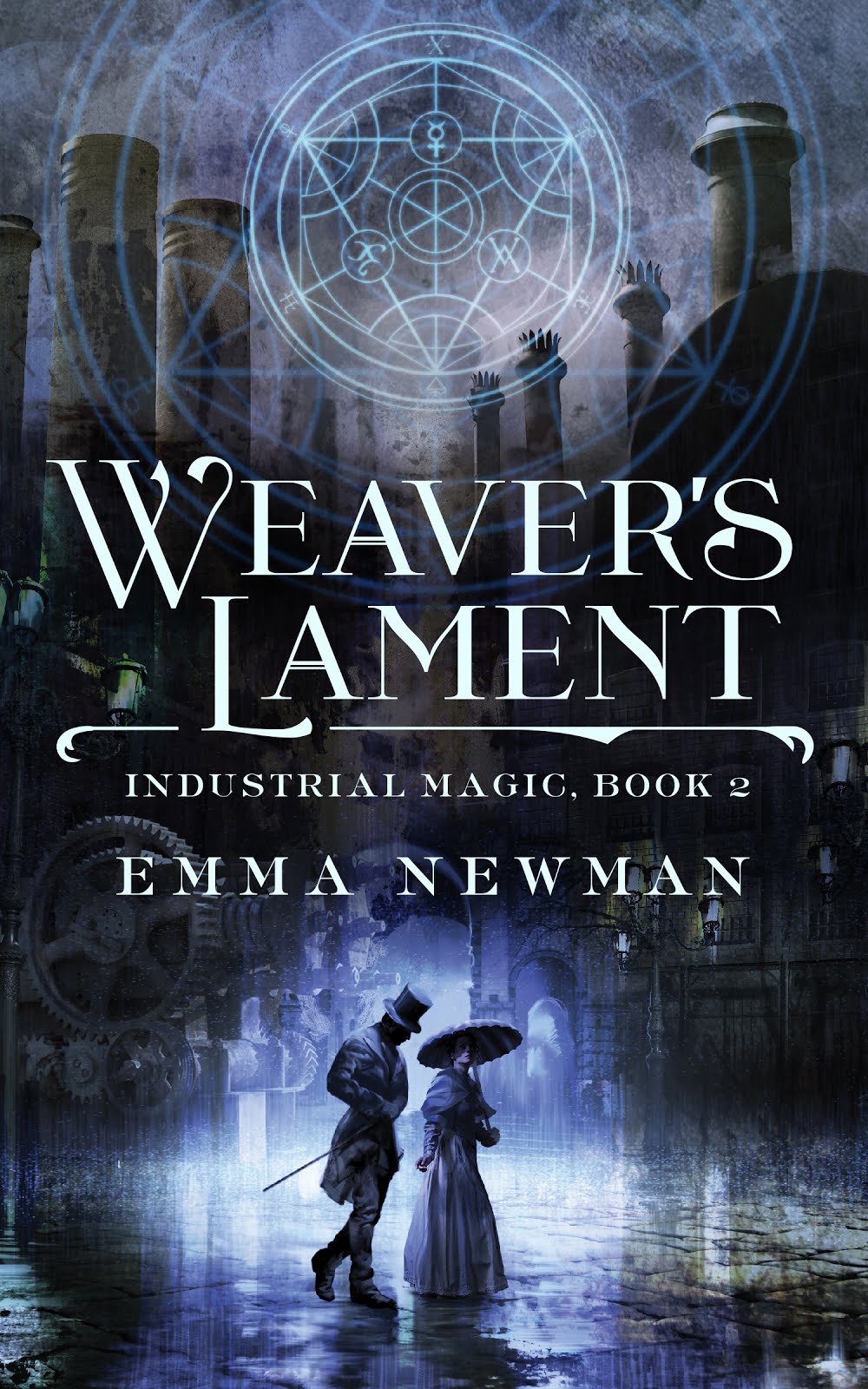
Review - Weaver's Lament by Emma Newman

Weaver's Lament (Industrial Magic, 2)
Emma Newman
Tor.com, 17 October 2017/ 1 Nov2017
e, PB 160pp

I'm grateful to the publisher for an advance copy of this book via NetGalley

If it wasn’t for the weavers, what would you do?       
You wouldn’t have your clothes that’s made of wool
You wouldn’t have your coat of the black or the blue
If it wasn’t for the work of the weavers

- Chartist song (see http://thejovialcrew.com/?page_id=1639)

Another adventure for Charlotte Gunn, following Newman's Brother's Ruin, published earlier this year, and again in novella form as is becoming increasingly popular in SFF.

This time, Charlotte's off to Manchester, Cottonopolis, seat of the Industrial Revolution, where vast profits are to be made by the mill-owners. In Newman's world these mills are driven by magic, not steam, so we can expect less smoke in the air, but the workers are nonetheless sweated by their overseers, put up in filthy, cramped conditions and doing fifteen hour shifts in stiflingly hot, dangerous conditions. And they face other threats, too, as looms shatter and the overseers wield their straps to maintain discipline.

Charlotte's brother, Ben, has summoned her to this living hell (what's the quickest way out of Manchester? Drink) to assist him. Once again, she puts love for her brother first and agrees to go undercover in the mill to investigate the nest of Socialists he believes responsible for the damage. But Ben is working for Ledbetter, the magus who Charlotte knows has dark secrets.

This book was great fun, if that's possible in something that also sets out grotesque inequalities and cruelties that are often lost in the soft focus, Hovis-ad language of drama and storytelling. In particular, fantasy, whether epic, pseudo-medieval fantasy or its edgier urban cousin, still too often sees curation of the social hierarchy as the greatest good. In contrast, what Charlotte discovers here will, I suspect, drive her to seek the otherthrow of the hierarchy. It remains to be seen if she will carry her brother with her in that - I fear not, Ben comes across as something of a milksop, a man keen to ingratiate himself with the bosses, wanting his own mill to run.

I'm even doubtful of Charlotte's mysterious ally/ tutor, Hopkins, who pops up Gandalf-like to give advice a couple of times. Is his heart really in a challenge to the authority of the Royal Society of Esoteric Arts or does he have an agenda of his own? (Charlotte certainly has an agenda of her own when it comes to Hopkins, even if she hasn't realised it yet, one her stuffy fiance George may not like much - I can see some of that absent steam reappearing before long...)

In short - and this is quite a short book - this is an eminently readable and at time unflinching view of the Industrial Revolution, blended skilfully by Newman with a dose of magic. Charlotte's awareness of the world around her is developing and she's pitted against a particularly nasty form of exploitation.

I will look forward to the new Industrial Magic, hoping, though, that Newman will be able to write some full-length stories set in this world. The novella form is great but it would be wonderful to let these stories breathe a bit more.


17 October 2017

Review - Shadowblack by Sebastien de Castel

Shadowblack (Spellslinger, 2)
Sebastien de Castell (illustrated by Sam Hadley)
Hot Key Books, 5 October 2017
HB, 352pp

I'm grateful to the publisher for an advance copy via NetGalley.

Shadowblack takes up Kellen's story from Spellslinger soon after his flight into exile from his homeland and the haughty magicians of the Jan'Tep, accompanied by the mysterious Argosi woman Ferius (whose real name, we learn here, is The Path of the Wild Daisy) and the thieving squirrel cat Reichis.

The story is rather simpler, rather more pared down than that of Spellslinger, which introduced not only the Jan'Tep and their magic (most of which Kellen has been blocked from) but their world (and especially the freespirited Argosi).  It's all about the shadow black, the demon-haunted marking which has cursed Kellen and caused him to be exiled. Others are beginning to show the signs too. is this the start of a plague? If so, Ferius's fellow Argosi, Rosie, maintains that the ominous-sounding Way of Thunder may need to be invoked. Kellen, Ferius and Reichis must investigate.

The book is well written and the story fairly rattles along, presenting Kellen with successive challenges: combat, new forms of magic, and, perhaps, the stirrings of romance when he meets Seneira (the scene where Ferius tries to teach Kellen how to be "handsome" is both funny and touching). Like Spellslinger, it consciously has some of the atmosphere of a Western - most obviously in the outlaw setup and in Ferius's drawling language, but also in Kellen's response to his surroundings: "I might have found the landscape pretty if people here would just stop trying to kill me". Unlike Spellslinger that comes across as... perhaps if I say it's a bit purer? We don't have the Jan'Tep ritual magic setup, we open with the outlaws attempting a heist and move on quickly to them riding the scrub and sage of the Seven Sands. The theme seems clearer, perhaps (not that I'm saying Spellslinger isn't great, it is, but I think Shadowblack is slightly better).

The secondary characters here are also well drawn, from Seneira and her father to Dexan, another spellslinger who knows the trials kelley's going through and offers help - at a price - and the Whisper Witch, about whom I'd like to know a LOT more. They people this world convincingly, and present kelley with new kinds of challenge and as has to ask himself what path he will follow. That of the Argosi? Of the spellslinger? of the student, with people of his own age and background?

Kellen is starting to grow up, to become more confident in his power and in who he is. he is still angry at what has been done to him and at the danger his friends and family are placed in, but we can begin to see him mature into somebody who will be able to do things about that.

I can't wait for Charmcaster, due next May.


14 October 2017

Review - A Long Day in Lychford by Paul Cornell

A Long Day in Lychford (Witches of Lychford 3)
Paul Cornell
Tor, 1 November (PB), 10 October (e)
144pp

I'm grateful to the publisher for an advance copy of this book via NetGalley.

This book is a continuation of the Witches of Lychford series, but it's rather different from Witches of Lychford and The Lost Child of Lychford.  The change of approach may put some readers off: I felt it makes this book decidedly the best of the series so far.

The story again revolves around Autumn, Judith and Lizzie, shopkeeper, wise woman and Vicar, collectively the Witches of Lychford, protectors of that ancient Cotswold town from outside supernatural threats. Except that, in this book, they're not. Not exactly.

That's where the review gets tricky because I don't want to give too much away. I'll just say that this is a more psychological book, more internally focussed, more driven by the character and experiences of the three and especially, of Autumn. Indeed, Autumn's identity as the only woman (indeed person) of colour in the town is key, here, to understanding what happens. In a story that cleverly hooks into threats in the wider outside world - the divisions caused by the Brexit referendum, the evil banality that is Trump - we see the impact on what are now well-loved characters.

That political angle may alienate some, like Cornell's last book, Chalk, which picked up on the Thatcherite 80s, although of course that is further off and less relevant, perhaps, to non British readers. But it gives the book a real sense of groundedness.

The other respect in which this book is different is that - to a degree - it challenges some conventions of fantasy. For example - and relevant to Autumn's experience - the use of the word "dark" for "evil" is questioned (by Lizzie). And in a story that's pointing up real-world developments around control, exclusion and access, the role of the Witches in "guarding Lychford's boundaries" raises some discomfort. Does this whole outlook not come uncomfortably close to the "let's build a wall and keep them out" rhetoric that we're now seeing?

Cornell isn't so presumptuous as to provide answers to all this, but in a short novella, he certainly raises issues and that gives this story a freshness and interest. No, some may not like it, but I think this is nonetheless an important book in its genre and more widely.

Excellent, and with the seeds, clearly, of further stories planted, I'm looking forward to more.

11 October 2017

Blogtour review - Blue Shift by Jane O'Reilly

Blue Shift (The Second Species Trilogy, 1)
Jane O'Reilly
Piatkus, 5 October 2017
PB, e 327pp

I'm grateful to the publisher for a copy of this book and for inviting me to take part in the blogtour.

This is the story of Jinnifer Blue, privileged offspring of Senator Blue, child of the protected Dome, and of dread pirate Caspian Dax, scion of the squalid Underworld.

It's set in a not so distant future where climate collapse - though cooling, rather than heating - is rapidly making Earth uninhabitable. While some colonies have been established nearby on asteroids and the like, the future of humanity lies in the stars - if we can get there.

And if the aliens whose territory lies in the was allow transit.

It's a harsh, almost dystopian, world that O'Reilly describes, one where the privileged have it easy while the poor suffer. It's grim in other ways, to, from the conditions on the prison ship A2 to the routine use of sexbots for pleasure to a trade in Underworld children to the political machinations behind the plot of the novel. Blue's, and Dax's, stories intertwine as they rightly shouldn't - she a pilot for the Security Service, he a bold outlaw - but they also come to the attention of powerful people.

I was impressed by the way that O'Reilly creates convincing worlds on the variety of space stations, mining bases and craft. It's very much written in tones of industrial grime. These are used settings, not the pristine, optimistic colonies and ships of a 2001 or a Star Trek. In these settings she deploys pretty much non stop action - both combat, and, in a couple of scenes, some very steamy sex, making the descriptions of both effective in driving the plot forward.

For all that, my favourite character in this book wasn't either of the main human protagonists but the intelligent droid, Theon, whose cool, slightly detached humour often lightens the writing and provides a contrast to both the passion and the violence of the humans. He has history with Dax and I'd like to hear much more about this.

The story is very much the first part of a trilogy, with things ending on a cliffhanger: I felt they'd perhaps been somewhat pushed into that, perhaps slightly against the way I'd understood the characters - but it might equally be I hadn't understood how damaged Dax has been by her mother's attempts to control her. The remaining volumes will, I hope, shed more light on that.

For more about the book, see here. You can buy it here, here or here.


9 October 2017

Blogtour - Fox Hunter - Q&A with Zoë Sharp

Today I'm hosting the blogtour for Zoë Sharp's new book, Foxhunter, the latest adventure for her hero Charlie Fox:

Charlie Fox is sent to Iraq to find her missing lover, Sean Meyer, and her mission is clear: to find Sean Meyer and stop him. By any means necessary.

Her boss at the New York-based close-protection agency spells it out chillingly: "If he can't be reasoned with, he must be stopped …"

Zoe has very kindly answered some questions I put to her about her writing and her life. So  over to you, Zoe!

BBB: What inspired you to write in the first place (particular books, something that happened...) —how did you get started writing?

ZS: I can’t really remember a time when I didn’t want to write. I do recall starting an awful lot more stories than I ever finished, though. I suppose there must have been some short stories, but it wasn’t until I was fifteen that I managed to sustain a plot idea to its logical novel-length conclusion. I still have that manuscript somewhere, but am determined it will never see the light of day. I’m grateful, looking back, that there was no real opportunity for self-publishing back then. Some apprentice pieces are never supposed to be widely shown to anyone.

My first experience with the publishing industry convinced me that I ought to seek an alternative way of working with words, so I started writing non-fiction instead. First came reports for a local classic car club newsletter, then articles for the classic car magazines, and then I branched out into freelance writing for the motoring press in general. I seem to remember giving up my day-job to write full-time on the strength of one accepted article and the promise of more work to come. That was in 1988. I haven’t had a ‘proper’ job since.

It was during the years I worked as a photojournalist (the photography rapidly followed the initial words-only commissions) that I received death-threat letters. They were proper cut-out-of-newspaper things, like a ransom note, telling me my days were numbered and they knew where I lived. It was scary at the time—particularly as the police never pinned down who sent them—and my way of dealing with this unresolved threat was to write through it. So, I started on the book that became KILLER INSTINCT. I finished that book in 1999, and by the following year had an agent and a publisher.

I think that in many ways it’s easier to get into writing now—anyone can start a blog, or indie-publish short stories or a novel—but in other ways it’s harder to earn a living doing so. As I said, anyone can do it, and so many people are that it’s difficult to make one voice heard among the many. The arts are an area where the quality of what you do has absolutely no bearing on how successful you might be.

BBB: ... and what did you expect from it? How did it compare with what you expected?

ZS: I supposed I hoped, like anyone, that writing would be self-sustaining. It has never been simply a job for me—it’s a compulsion bordering on obsession. The idea that I might be able to make a living doing the thing I loved best was a very attractive one. And yes, there are days when I seem to have to fight for every full-stop and comma I get onto the page, but these are balanced by the other (occasional) days when the words just flow, apparently channelled from the ether.

While the business side of things has often proved very frustrating, and the amount of criticism an author can face on a daily basis would make a rhino weep, overall I can’t envision a time when writing would not be an important part of my life. The wonderful thing is, it can be done anywhere I can plug in a laptop and access the internet. I’ve just been crewing on a yacht in the eastern Mediterranean, researching a possible book, and managed to get part of the current work written while I was out there. What’s not to love about that?

BBB: I'm always interested to ask authors if the protagonist came first, or emerged from the story. You write in the endnote to Fox Hunter that the idea of Charlie as a "tough, self-sufficient heroine" had been with you for some time—but was it any more specific than that? Did she change much as you wrote her?

ZS: The protagonist came first, definitely. Charlie Fox arrived more or less fully fledged right from the start. I sometimes joke that she walked in out of the blue one day, pointed a gun to my head and said, “I have a story to tell. You’re going to listen. And you may want to write this down …”

I remember writing the very first piece featuring her, years before I started on the first book. It was a scene of her over-reacting to a close-protection training exercise. At the time I had no idea where that scene might be going, or even quite where it had come from. Eventually it made its way, almost wholesale, into the third book, HARD KNOCKS, which is set at a bodyguard school in Germany. Charlie goes in undercover to find out what happened to a previous trainee, and has to try to play down her skill-set in the face of what proves to be overwhelming provocation.

Yes, she has changed over the course of the series—after all, FOX HUNTER is book twelve. Either you choose to let the character evolve as the series goes on, or you try to keep them forever frozen in time, like an insect in amber. I knew right from the beginning that she was going to change, and although I didn’t plan it, the books have fallen naturally into a series of trilogies as her life and circumstances have altered. The first three are her amateur period; the next three have her working for Sean Meyer’s UK-based security agency; then the following three see her and Sean working for Parker Armstrong in New York, and include major upsets in Charlie’s life. The last three have Charlie coming to terms with the aftermath of that turmoil. And, without giving any spoilers, the next book will be the start of a new period, with new challenges up ahead.

BBB: You've written a string of books now about Charlie. Do you ever find her taking over—or are you firmly in control as you write?

ZS: It’s a nice theory that writers are in control of the world we create, but in practise I find I’m usually just along for the ride. I think this is partly down to the way I plan a novel. I don’t write by the seat of my pants, but neither do I try to work out every tiny detail before I begin. I plan the main structure of the story, the dramatic high points of the plot, but I leave the reactions of the characters to those events to coalesce in a more organic fashion.

Likewise, I don’t do complicated character biographies for new characters in each book, but rather I like to leave them to introduce themselves to me on the page. Some have turned out very differently to the way I originally envisioned them—usually for the better, I hope …

BBB: Is it difficult working with a long-running series and characters?

ZS: I think the difficulties with a series are twofold. How to keep presenting fresh challenges for the protagonist is the first of these, but I suppose the same could be said of any author writing standalone crime novels. I’m always trying to think of a new take on a plot—an approach or a scenario that I haven’t explored before.

In the latest book, FOX HUNTER, Charlie’s role is more that of a detective than a straightforward bodyguard. She is trying to protect Sean, certainly, but by finding out who is really responsible for the crimes he is suspected of committing rather than putting herself physically between him and any dangers he faces. At the same time, it contains elements of the hunt the title suggests—before she can protect Sean, first she has to find him. And she’s not the only one on his trail.

The other difficulty is far more closely related to the fact this is indeed a long-running series, and that is how to present backstory in a new and engaging way. For a start, Charlie’s got history—history with Sean; history with their boss in the New York security agency, Parker Armstrong; and history dating back to when she was still in the military. I try to include a slightly different facet of the story so it will build up into a cohesive whole over a number of books.

With each instalment, I need to get all that across for the benefit of new readers, without labouring the point for people who’ve read the previous books. And in this case there’s also explaining Charlie’s relationship with recurring characters who appeared in earlier books and have popped up again now. Plus, I like to insert something in an earlier book that I know—or at least have a feeling—will come in useful at a later date. Nothing too cryptic, but a nod for those who’ve followed Charlie’s story from the beginning.

So, the brand new Honda FireBlade motorcycle Charlie receives for professional services rendered at the end of HARD KNOCKS, for example, enables part of the storyline of book five, ROAD KILL. A character in ABSENCE OF LIGHT returns to play an important off-stage role in FOX HUNTER. Something that happens in DIE EASY: book 10, will return in the next in the series, so watch this space!

BBB: I can see from Fox Hunter that there's more to come—can you drop any hints about what's next for Charlie?

ZS: Next for Charlie is a change of direction. She’s been changing over the course of the series, as we’ve already discussed, but within the world of close protection. Now she’s going to step slightly outside the safety of that zone. She’s going to move from a profession that is, by its nature, re-active, to something that’s a little more on the pro-active side. More than that, I’m not prepared to say at the moment …

BBB: The book reflects your travels in Jordan—do you normally do a lot of research (and travel!) for the books? (That sounds to me like a great perk of being a writer!)

ZS: I try to do a huge amount of research for the books … and then I try to leave as much of it as possible out of the story. Research is necessary for flavour, atmosphere, and authenticity, but at the same time I am acutely aware that I’m writing a book designed to entertain, not to lecture. It’s not supposed to be a travel guide, or a textbook. But, people love to feel they’ve been privy to trade secrets and otherwise hidden bits of detail, so those are the snippets I try to include.

Besides, there’s a limit to how much you can glean from outside sources—sometimes you are in danger of merely repeating the errors of others. Yes, you can do an enormous amount of research from books, or over the internet, but at the end of the day there’s no substitute for being there if you can make it happen.

Q: You mentioned that you have a book locked away that you wrote when you were 15. Is there any chance of it seeing the light? Or will it get the Terry Pratchett steamroller treatment? (I suppose that's a roundabout way of asking—are you on the side of those who always want to know more about the writing process, or do you think a line needs to be drawn?)

ZS: Oh, the steamroller, ever time! I love insider notes—I’m one of the only people I know who loves to listen to the director’s commentary on movies and TV episodes on DVD, and watch the making-of documentaries, but I don’t necessarily want to see all the outtakes where the actors cracked up, fluffed their lines, or tripped over their own feet. I may want to know how the magic is created, but that doesn’t mean I want it destroying before my very eyes.

BBB: Where do you stand on genre (every time I look there seem to be more of them…)—useful in writing or just a marketing label?

ZS: I’m a bit ambivalent about genre classifications, I have to confess. They’re useful as a general guide, but I think these days there are more books that fall outside the traditional boxes than are contained within them. And authors do try to stretch the definitions. Everyone wants to think they’ve written a page-turning story that is hard to put down, but that doesn’t necessarily make it a thriller in the general sense of the word. When asked this question, I usually quote the one category that caused me the most confusion: cutting-edge cosy. Anybody care to explain that one to me?

Readers do want—and deserve—to know what they’re getting, however. If you invest time and money by purchasing a book, you want the confidence before you begin that it’s going to fall within your sphere of enjoyment, on all kinds of levels. If you start reading what seems to be a straightforward police procedural about a serial killer with seemingly superhuman strength who exsanguinates his victims, you want to be able to trust that you’ll be wowed by how the criminal has been carrying out his crimes and how the detective put together the clues to catch him. You don’t want to find out at the end that the killer is a vampire and the detective used their heightened werewolf senses to hunt him down. If you wanted and were expecting a supernatural element, great. But if not …

I understand there have recently had to be more classifications for erotica, in order to make it clear to both retailers and readers what they might be getting into. Books containing certain taboo themes will find very few retailers prepared to stock them, and I can’t say I’m surprised by this. Just because you can now write and publish a book about any deviation under the sun, that doesn’t mean you should do so.

BBB: Finally, a question that isn’t (directly) about the books. You’ve stumbled into a devious plot while researching a new novel, as a result of which you’re trapped in a lonely forest tower. A rescue party is on its way but will take several days to reach you. You have plenty of food and water, and you can have one book with you. Which would it be?

A: Ooh, that’s a tricky one. Besides, I’m already off down the road of wondering what the devious plot that I’ve stumbled into might be, and what the interior of this lonely forest tower might look like or contain, and what perils the rescue party might be encountering on its way to me. And …

Anyway … one book, huh? A dictionary. Preferably a very large and comprehensive one, that not only gives the meaning of words and phrases, but their original derivations and altering usage as well. I love words in all their forms, and strolling through such a dictionary of treasures would keep me occupied no matter what obstacles were put in the path of my plucky rescuers. Maybe even long enough for my hair to grow so they could climb up into my tower? Nah, who am I kidding? Soon as their couple of days was up, I’d improvise some weaponry out of ordinary household items and fight my own way out.

Zoë, thanks for those answers, which shed a lot of light on your writing and on Charlie Fox in particular. Before I go off to ponder what "cutting edge cosy" might be (razor sharp knitting needles?) can I remind you that you can buy the book through Zoë's website (link below) or from various flavours of Amazon - and to catch the other stops on the blogtour (see poster for details).

Zoë Sharp’s criminal tendencies were predisposed when she was born in Nottinghamshire within sight of Robin Hood’s hangout in Sherwood Forest. She opted out of mainstream education at the age of twelve and blames her lowbrow sense of humour on spending far too long hanging round with mechanics. She believes life should be lived the same way as riding a motorcycle—with one knee on the deck and the throttle wide open. www.ZoeSharp.com


7 October 2017

Review - Strange Sight by Syd Moore

Image from https://oneworld-publications.com
Strange Sight
Syd Moore
Point Blank, 5 October 2017
PB, 369pp

I'm grateful to the publisher for an advance copy of this book.

This is the second in Syd's new series about "witches, magic and Essex Girls". My review of the first, Strange Magic, is here and a piece she kindly wrote for the blog, about Essex Girls and Essex witches, is here.

Another adventure for museum owner and Benefit Fraud investigator Rosie Strange and her curator and sidekick, Sam Stone. Barely having drawn breath from the events of Strange Magic, they're contacted by erstwhile hardman Ray Boundersby who's having a spot of bother at his restaurant.

Psychic bother.

Ray's not a man you say no to - at least, not if you're fond of your kneecaps - so Rosie and Sam pack up their (well, his) spookhunting equipment, leave the Essex Witch Museum, and begin to ask questions. Of course, by the time they do this we know - from the rather gripping prologue - that there is rather more than a few ghostly knockings in play here. Murder has been committed, murder of a specially gruesome kind, and Ray's daughter Mary is in the frame...

Moore's pair of investigators - not, please, "ghostbusters" as they keep telling everyone - are well placed here, in pursuing their own enquiries, to also unravel the murder mystery - a perennial difficulty for modern-day amateur and private investigators in crime stories. And make no mistake, this is a crime story - whether or not the perpetrator turns out to be living flesh and blood. But it has other aspects too, of course and indeed one of the things I enjoyed about this book was the sharp way that the investigation bobs to and fro between criminal and psychical investigations, with information often relevant to both sides.

Another was the personalities of Moore's two main characters. I have to be honest and say they might not appeal to everyone - neither is exactly likeable: Strange is, well, a strange combination: excellent good at reading others (except for Stone) and ultra confident, but often almost clunkingly un self-aware. As a result her narration is very funny at times, but you might well not warm to her (I did!)

Stone is more enigmatic, but then we don't get his viewpoint, only Strange's perception and this is - I think - distorted by the fact that she fancies him but doesn't ever quite come out and admit to herself. Yes, I think I see where this going but I hope Moore keeps them apart for a few more books because it's more fun that way.

The story takes Strange and Stone out of Essex into London, where the restaurant "La Fleur" stands, just off Fetter lane, north of Fleet Street. (Weirdly I was walking past that corner only yesterday). The spooky goings on require them to delve into the nastier side of London't past and, indeed, present. While that was very interesting I felt the book slightly lost its distinctiveness there - a LOT of UF has been written in the vein of "London's past comes back to haunt us" and one of the things I liked about Strange Magic was that it wasn't drawing on London.

Nevertheless, Moore does an excellent job here of highlighting a real historical scandal with echoes in the present day and this also means the story is a bit more grounded than Strange Magic was so I think the visit to London pays off - I just hope our heroes are back in Essex soon. I think they will be, because alongside the main plot, Rosie's been learning more about her family background and that, also, screams MYSTERY in 36pt flashing neon gothic. So while there was perhaps less in this book concerning the Museum, and Essex, we have some pointers that more is to be learned about both.

Overall, then, a good followup to the earlier book, keeping things moving nicely, baffling the reader as to just how much of what's going is supernatural, and setting up an intriguing mystery for the future. Not all the loose ends from the crime were tied up (why the flour?) but I can live with that as long as I've got plenty of Rosie and Sam to distract me.