12 March 2019

Review - The Near Witch by VE Schwab

Cover by Julia Lloyd
The Near Witch
VE Schwab
Titan Books, 12 March 2019
Available as HB (355pp) or e-book
Format read: HB
Source: Free copy from publisher (thank you!)

I was really excited and felt very privileged to be sent a copy of this, VE Schwab's first published book, which - as can be the fate of early books - had fallen out of print in the US (it was never published in the UK). It's wonderful that Titan have put it out again, in a handsome edition with some beautiful illustrations on the cover and title pages well as a new introduction by Schwab herself and an additional, related short story...

It starts with a crack, a sputter, and a spark...

So begins this story of yearning, prejudice, revenge and of love.

If the wind calls at night, you must not listen. The wind is lonely, and always looking for company.

If you ever visit York, do take in the Castle Museum, housed in the old prison. It has its share of the gruesome - you can visit the condemned cell where Dick Turpin spent his last night of life - but more interesting to me is that the wings have been adapted to house displays of everyday Yorkshire life though the ages. Among these is the interior of a moorland cottage form the 18th or 19th century. One family living in a single room, surrounded by the harrowing wind. It could be very cosy - or, if you are at all nervous, it could almost be a living nightmare.

In The Near Witch we see both sides of moorland living. The village of Near is - ironically - near nothing at all, surrounded by wild moors across which the wind plays, almost seeming to talk to the villagers inside the boundary. (And such a clear boundary, almost like that between different worlds). We learn little of the world in which Near is set - I think there is a wider world, but, in a way that reminded me of Meryvn Peake's Gormenghast and Titus Groan, that world isn't present, important or of much interest to anyone.

Instead we have the village - more a scattering of houses and fields than a heavily built up settlement - and the moor, where it's dangerous to go, though nobody seems sure why. Beset by old legends of a Near Witch, of the dangerous wind and by the expanses of the moor, the arrival of a stranger is a big event, a threatening event, announced in dream and visions rather than in the clear light of day. And he's greeted with suspicion as, at the same time, children begin to go missing, vanishing from their beds at night...

I simply loved this book. It reads as Wuthering Heights' younger, weirder sister, with much of the same atmosphere - the moorland otherworldliness, the sense of wild forces at play, forces nobody understand or can control, not Lexi, the hero, not the two Witch Sisters, not Otto, Lexi's Uncle, the fatuous Guardian of the village - but an extra layer of the dark, of the perverse.

Despite searches, the missing children can't be found and it soon seems more important to blame someone than to rescue them. As the teasing winds get stronger and something from the village's past seems to be stirring, a mob mentality, a desire to hurt and blame, begins to whisper through Near.

So there's a mystery at the centre of the story - in fact, two mysteries. Who's taking the children, and who's the stranger?

There's an atmosphere of claustrophobia, of finger-pointing, of fear and recrimination

There's also Lexi, into whom Schwab breathes a spirit of absolute reality. A young woman mourning her dead father, Lexi fiercely protects her sister, Wren, and tries to keep at bay the influence of Uncle Otto. But it's hard when her mother has become hollow and Otto insists on Lexi knowing her place and keeping to it. Lexi's family are hunters and trackers but Otto thinks she should tend the bread ovens and deliver loaves instead - and not carry a knife, wear boots - or interfere with mens' business, like the hunt for the missing kids.

As a Schwab hero, of course, Lexi has absolutely no time for this, setting the stage for a conflict with Otto and his gang. They have muscle, but Lexi isn't without her own resources, whether friendships, knowledge or simple determination. In a way - and I know this is being fanciful and using hindsight - I could see a bit of Lila Bard from A Darker Shade of Magic peeping out of Lexi.

And there's Cole, about whom I shall say nothing at all because you need to discover this elusive, haunted young man for yourself. (The story that's included, The Ash Born Boy, does tell more about him but you should definitely read that afterwards: it is itself a marvel of a story, turning complex emotional truth into unleashed power, but if you read it first you'll just know too much about him).

It all makes for a powerful, even heady story, romantic in all ways at once, imbued with the spirit of moonlight on the purple moor. A haunting story, about a haunted place but one which manages at the same time to keep itself rooted in humanity, in love and in family rather than going totally gothic.

A fine first novel, and I hope that if I'd read it in 2011 I'd have guessed the author was bound for great things.


11 March 2019

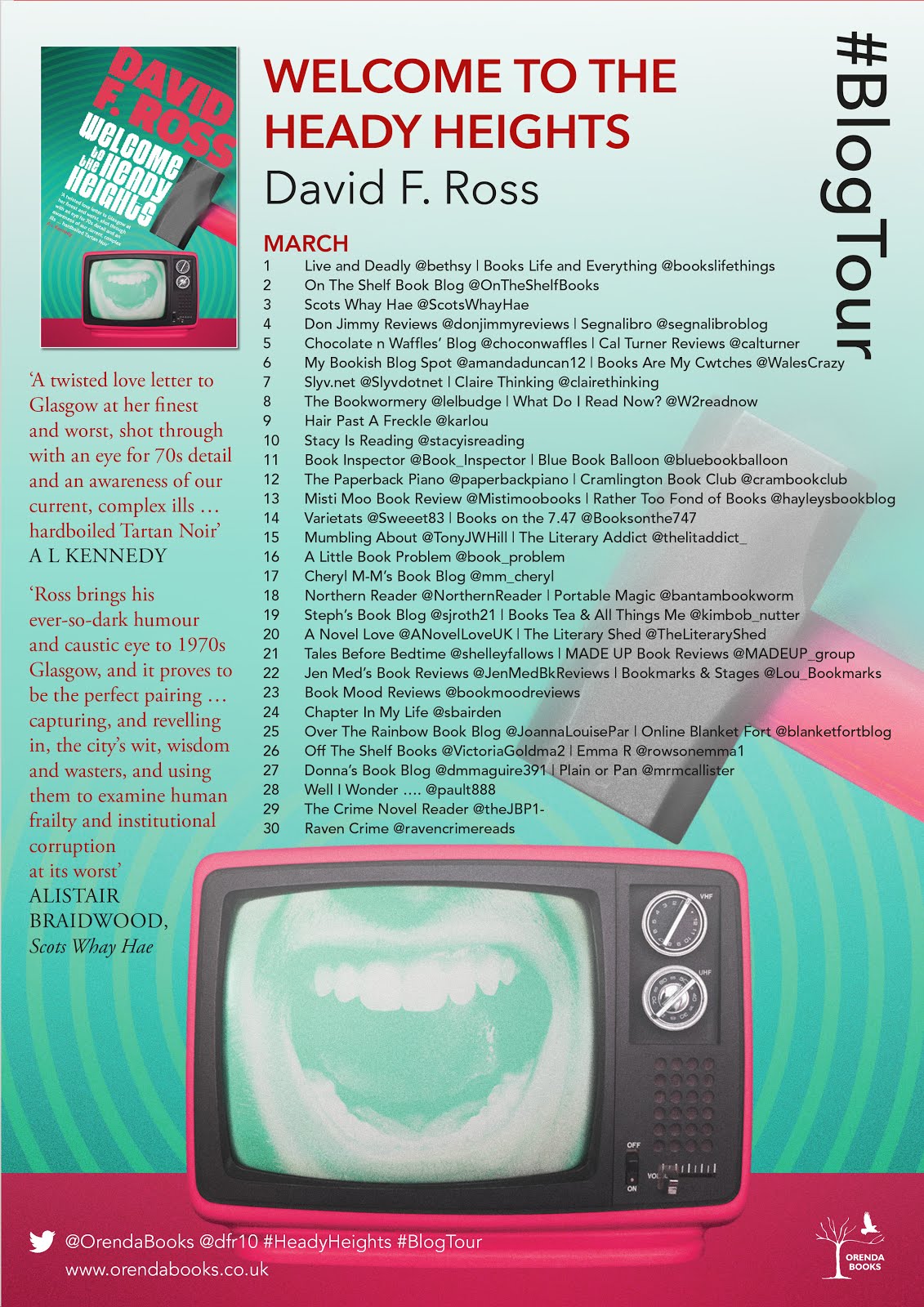
#Blogtour review - Welcome to the Heady Heights by David F Ross

Cover design by kid-ethic.com
Welcome to the Heady Heights
David F Ross
Orenda, 21 March 2019
PB, e 264pp

Today I'm joining the blogtour for David F Ross's new book, Welcome to the Heady Heights. I'm grateful to Anne Cater and to Orenda for inviting me onto the tour and providing a free copy of the book for review.

I was especially looking forward to this book, having immensely enjoyed Ross's previous Disco Days trilogy, featuring the lives of a group of young men (and later, as older men) growing up in the 70s in the West of Scotland. Now, he returns to that decade, with something of the same vibe, but the story's largely set in Glasgow and his protagonists are older, the chief among them, Archie Blunt, being in his 50s.

That means looking at the decade through the other end of the telescope, as it were, which is fascinating. In Disco Days there was the joy of discovery, of new things: new music, new life experiences - such a lot to learn. There were some alarming moments but one sensed that youthful optimism must win through - as, by the end of the third book, The Man Who Loved Islands, it kind of had, after many twists and turns.

Heady Heights is darker, more cynical. Archie's lost his wife and lost his job on the buses, his dad is succumbing to dementia, he's a middle aged man defying the demographics just by still being alive in the East End of Glasgow - and that city is being torn apart, razed, as solid tenements are replaced by flimsy tower blocks or new urban highways. Even Glasgow Corporation is giving way to the new Regional Council.

David F Ross
And behind that is a darker theme still as rumours spread about beloved popular entertainers. Rumours nobody takes seriously.(Who'd have thought it?) And homeless young men are going missing. Disappearances nobody takes seriously (who'd have thought it?) except for one young WPC, Barbara Sherman, who's already out of place in an Ashes To Ashes retro style nick with degrading initiation rituals and ingrained sexism.

So there is plenty of the dark side of the 70s here - but Ross also conveys a jauntiness, a zest for life, through his characters which does I think carry over from his earlier books. Yes, there are almost suicidal quantities of drink, of heart-attack inducing food, run-ins with Glasgow gangsters. Archie's got a lot to despair over - indeed more and more as the book goes on - but he's determined throughout, constantly spotting angles, respecting of no-one, scamming and scheming and when opportunity knocks as he accidentally rescues a beloved TV star from a jealous husband, he's ready with a scheme to take a new band to the top. Yes, outwardly Archie's confident almost to the point of arrogance.

Inwardly - well, a man doesn't talk about these things, does he?  And that "almost" is redeemed. Almost. There are plenty here - Establishment figures, wealthy men, entitled men - who abuse their position and who are truly, deeply arrogant. A well known, white haired DJ. A star of light entertainment. A mercurial and self-interested Glasgow ex Labour MP who's set up his own party. Figures living in a world of mahogany and privilege. What will happen when the two worlds collide?

It's a fun, compulsively readable, rollercoaster of a book with a real bite to it and some genuinely sad moments. The extensive use of Glasgow vernacular adds to the atmosphere (and no, this English reader didn't have any problem following it) but really, Archie, Geordie and their pals are just infectiously compelling characters you want to keep reading and reading about. It would have been nice to read more about Barbara Sherman and journalist Gail Proctor - perhaps in another book, Mr Ross? - but with this one I really, really felt it was a shame when the book had to end.

You can buy or preorder Welcome to the Heady Heights variously from your local bookshop, including online via Hive Books, or from Blackwell's, Waterstones or Amazon - and doubtless elsewhere too.

And you should.


9 March 2019

Review - The Devil Aspect by Craig Russell

The Devil Aspect
Craig Russell
Constable, 7 March 2019
HB, 496pp

I'm grateful to the publisher for a free advance e-copy of this book via NetGalley.

Czechoslovakia in the mid 1930s, and psychiatrist Dr Victor Kosárek is travelling to take up a new appointment at the Hrad Orlu asylum - where the most dangerous of the criminal insane, the "Devil's Six", each with a nickname (The Clown, The Vegetarian, The Glass Collector and so on) are confined in a medieval castle among the central European forest.  Meanwhile, Kapitán Lukáš Smolák of the Prague City Police patiently, methodically hunts down a serial killer - Leather Apron - who murders and butchers women in Prague.  Against a background of rising political tensions, as the Nazis in Germany stir up trouble among German Czechs and it becomes important to watch what you say and who you say it to, the young doctor struggles to understand the Six, treating them to a revolutionary new "therapy" - bringing them close to death with sedatives in search of their "Devil Aspect", the dark part of their psyche that holds clues to their evil behaviour.

I found this book impressive in many ways. From the opening scene, Russell plays with our expectations, exploiting the reader's familiarity with, or even just knowledge of, horror tropes. Take that opening scene. A doctor named Viktor. A "patient" in restraints. The isolated castle. It's hard not to see this as a reference to Frankenstein, just as, later in the book, the fear and hatred of the villagers for the castle and its inhabitants brings to mind Dracula. There's even a reference at one point to a mob of villagers hunting down what they think is a monster.

But the book also makes other connections - the comparison between that "Devil Aspect" in all of us, and the rising tide of evil and hour soon to swamp Europe, hardly needs to be pointed out. It's felt by Jewish Judith Blochová and expressed in nightmares of her and her family being led out into the forests to be killed. It's there in the attitudes of Nazi-sympathising staff at the asylum, whose proposals for the imprisoned criminals are easy enough to guess. And it's there when Kosárek and his friend Filip Starosta run into trouble one night with a group of Czech Germans.

The whole atmosphere - drawing deeply on Slavic mythology and European history, as well as an impressive deployment of Jungian psychology - is one of subtle menace, even before we are given graphic details the murders in Prague and told (via Kosárek's interviews) of the crimes of the asylum's residents, and before comparisons are made with jack the Ripper. I did begin to find that succession of crimes a little much. With six prisoners in the castle, all of whom have committed multiple murders, it's quite a lot to hear even if, thankfully, we generally get the setup rather than all the details. The Prague murders are fewer but we're told more about the killings and mutilations. On the whole I preferred the parts of the book that deal with the subtler threats - the suspicious villagers, the dancing bars with their political and ethnic tensions, even the distressed man who Kosárek encounters at the station after his friend fails to appear at the start of the book.

I also enjoyed the slyer aspects of the book such as Smolák's deputy who, while perfectly competent, is clearly waiting for him to fail, and in the meantime, trying to scatter a little doubt and suspicion around, or Judita's history, with her thwarted ambition to study medicine. If the book has any message it is, I think, to watch out for seemingly inconsequential things - dreams, coincidences, mistakes - and to join the dots.

So - on the whole a satisfyingly creepy horror/ psychological thriller, especially in the opening part, establishing that stressy atmosphere, and in the final third where the hunt for the killer really gets moving. Overall I think that in the middle part, more could have been made of the political aspects, and there could have been a bit less gore. But well worth reading if you like your horror a little different.

For more about the book, see the publisher's website here.

7 March 2019

#Blogtour review - Murder on the Rocks by J S Strange

Murder on the Rocks (Jordan Jenner Mysteries Book 1)
J S Strange
Panther Publishing, 1 March 2019
e-book, 416 pages

Today we're joining the blogtour for Murder on the Rocks, the first in a series featuring private investigator Jordan Jenner who lives and works in Cardiff and has a semi-regular gig assisting the Cardiff police.. The book is described as "cosy crime" which to my mind generally conjures up leafy English villages, vicars on bicycles and fetes - so it was refreshing to read one which very definitely broke that mould.

Indeed, Strange evokes his Cardiff setting - with excursions into the hinterland - very well, characterising the various districts which range from the run down to much posher, gated areas. He
sets the story at Christmas with the rest of the world apparently caught in a whirl of fun while Jenner alternately pursues his case and broods. The interleaving - and contrast - of investigation and festivities creates a distinct contrast, emphasising just how alone Jenner is. His mother has recently died, he has pushed away his father and brother and lives alone with his cat, Oscar, in a scruffy flat over a dilapidated shop. Indeed, one might detect a thread of noir in Jenner which you'd think would be at odds with any idea of "cosiness" - but actually, it's a blend that worked rather well for me.

J S Strange
When it comes to the actual crime, things are a bit less tricksy although I think the killing and its background must have been a brave choice - an aspiring novelist had been poisoned at a writers' group. Solving the crime requires Jenner to unpick the rivalries, love affairs and deceptions among the group, many of whom seem to be fundamentally unlikeable people. I have to say that all the authors I've met have been splendid people who would never poison a rival, so I can only congratulate Strange on his imagination here. The multiple layers, red herrings and motives here make for a satisfying plot, which Jenner uneasily discovers ensures his own family, with a  dramatic denouement that had me clicking through the pages compulsively.

The story doesn't explain how the Cardiff police come to be employing a PI - that is all set up before the story opens - and I felt that there were one or two liberties taken with police procedure, but Strange isn't aiming at gritty realism (despite that dash or noir) and the story still works well; by and large these things just serve the purpose of giving Jenner support when he needs it but allowing him to work the case. Because Jenner is the star of this book, Strange taking plenty of space to explore his loneness, his life as a gay man (and the book isn't featuring him as a token character here, Strange backs that up with a number of other gay characters too) and his - at times - plain awkwardness. You sense Jenner wouldn't actually be an easy person to live with, although - despite what he himself asserts - he clearly does have loyal, loving friends.

A very promising start to a series, which I hope does well for both Strange and newborn publisher Panther.

You can buy Murder on the Rocks as an e-book from Amazon.


2 March 2019

Review - The Raven Tower by Ann Leckie

Jacket design by Lauren Panepinto
The Raven Tower
Ann Leckie
Orbit, 28 February 2019
HB, 411pp

I'm grateful to Orbit for a free advance copy of The Raven Tower.

THERE. WILL. BE. A. RECKONING.

My First Law of Book Blogging is that the best books, the ones that really wow me, that keep me awake till the small hours and have me tired on my train the next day, are the hardest to review. There are lots reasons for this, sometimes different ones for different books. Sometimes the book is so good I'm just speechless. Sometimes the book simply is the best expression of itself. There's probably a way to express this mathematically but for me it comes down to, what can I say about this that doesn't actually take away from the unique, wonderful edifice the author has made?

That is certainly true of The Raven Tower, but as if if things weren't already tricky enough, Ann Leckie also does things in the book.

She does things to her protagonists.

She does things to her setting.

She does things to the reader.

And frankly, she does things to the genre. To be too clear about these things would reduce the impact of the book in ways that the term "spoiler" doesn't even begin to capture. So I have to be very circumspect now, and so this is a hard review to write, but I have to try because I do want you to read this book.

The first thing to say is, I think, that The Raven Tower is not at all what it seems.

The package may appear familiar. There is a land - Iraden - with a ruler ("the Raven's Lease") bound to die for his god. The heir, Mawat, hurries home to take his father's place. There are enemy armies in the South, beyond the Silent Forest, and strangers in the capital about who knows what business. Iraden's gods (the Raven, the Silent) have turned elusive. We even have a map, showing a vaguely Mediterranean-like geography, with the capital city of Iraden, Vastia, sited on the channel where the Shoulder Sea connects with the Northern Ocean.

Almost as the story begins, however, Leckie begins to do her things.

Who, exactly is, narrating? Not Mawat or his lieutenant, Eolo. Rather, the narrator seems to be addressing them (specifically, Eolo.) "I first saw you" the book begins "when you rode out of the forest". The story continues to be told to "you", despite the fact that "you" are often the subject of it. It's as if the narrator is, at some later time, recounting what he saw and inferred of Eolo's reactions, thoughts and history. Not entirely omniscient, but privy to a great deal of information, this narrator is also aware of other characters, other events - but what they choose to tell is selective.

So - and I think it's safe to be plain about this - Leckie is doing is adopting a very unusual viewpoint. In places it's not quite first person (when the narrator tells their own history) in others it's not quite second person, and indeed when they are telling Eolo about the doings of some other individual, it becomes not quite third person either. That sounds very tricksy and clever but it really isn't, I think it reads very naturally but it does give the whole book an air of distance, a very particular tone. This narrator has a clear and reasoned style, and the way Leckie tells the story enables many issues to be addressed - reasoned over, debated - which would often be ignored in fantasy.

For example, a central theme here - unsurprisingly, given the importance of those elusive gods - is how gods can do what they do, what their limits are, and what dangers they face. A god may "speak something true", altering the universe, but had better be careful that he, she or they can back up their statement or they risk draining their power and ceasing to be. And that takes us to the nature of language, what can be said and what can't. All things absolutely germane to the story being told here, which may begin with a blast on the horn of epic fantasy, as it were, the Kingdom in peril and all that - promising politics, backstabbing and treason - but gradually transitions to something much more complicated, less a horn solo than a fugue exploring variations on the nature of reality, the long term - and I really mean, long term - history of the land, the development of trade and above all, the interconnectedness of things.

Here we see the development of life, the arrival of humankind, the gradual evolution of interdependence between peoples, nations and gods and the drive for power. Leckie is actually using an enormous canvas, and the story she's telling is far from straightforward. Indeed, exactly what story she is telling is one of those things I don't want to say too much about. I will just say that while that horn of epic fantasy never falls completely silent, by the end of the book it's as though it has fallen into the hands of quite different musicians and when I realised what had happened I gasped at what Leckie had actually done.

(Sorry if that sounds convoluted but I am trying to give an impression of this book without telling you any secrets).

The Raven Tower is a breathtaking achievement, really, a really distinctive book that simply demands to be read. Marat and Eolo are colourful, engaging characters and Leckie realises them well, rooting their backgrounds in the reality of the world she's created (Mawat a born leader but headstrong, worrying the nobles that he might take after his domineering father; Eolo with his own secrets). That world benefits from the "deep time" perspective we're privy to - it's a fantasy world with fossils. A place where shallow tropical seas have converted to limestone hills. Where the nutritional needs of humans are investigated by gods in scientific terms alongside demands for blood sacrifice. This feels like a real world where things work, for the most part, as you'd expect, and where they can be understood. It's a world where things develop, rather than being stuck for thousands of years in a sort-of Iron Age.

Reading this book felt at times as though Leckie was reconstructing fantasy itself while she span her story, as though she was reconstructing it by spinning her story. I thought that was brilliant though I'd expect some will be uneasy with what she's doing - change can be difficult. It's also great fun and in places - especially the dry dialogues between The Myriad and The Strength and patience of the Hill - (two of the other gods encountered here) actually rather funny and even touching, as a friendship builds over literally millions of years.

I really can't recommend this strongly enough. You just have to read it.


28 February 2019

#Blogtour Review - The Outcast Hours ed by Mahvesh Murad and Jared Shurin

The Outcast Hours
ed by Mahvesh Murad and Jared Shurin
Solaris, 22 February 2018
PB, e 384pp

I'm honoured today to be joining the blogtour for Mahvesh Murad and Jared Shurin's new anthology themed around night and the dark. I'm grateful to the publisher for a free advance e-copy of the book via NetGalley and to Tracy Fenton for inviting me to take part in this blogtour - when I heard this anthology was coming out, I knew I would have to read it and so I was delighted to be asked to take part.

Why did I want to read these stories? Not only do the editors have a seriously impressive track record - and look at the authors' names! - but the theme, night, is something that's always intrigued me and fired my imagination. One of the stories here notes that "By the time you're twelve you have a pretty good idea of whether or not you like the night". I think that's right. Old enough to get over - or mostly get over - the terrors of childhood, not old enough to appreciate some of the darker realities: your view can be set then, only to be moderated, not erased, by subsequent experience.

Me, I love the idea that, while I doze in my warm bed, there are people in neon lit spaces working; travellers make their way by nightbus or midnight train to who knows where; restless people sit in airports surrounded by their luggage; a pack of Nighthawks out of Edward Hopper's dreams prop up a bleak bar; and so forth. Recently I read about a woman living on the edge of London who, when she can't sleep, gets the nightbus into town and visits a particular Soho cafe. Respect to her for that - I'm not so much of a night owl myself though I will stay up reading but I'm fascinated by the idea of the night. It's just fuel for the imagination and positively drips with atmosphere, sentiment and anticipation.

Of course, that attitude may reflect a degree of privilege on my part, as a man with a secure home who lives in a safe and sleepy English village (even if we do sometimes appear in Midsomer Murders). Other perspectives are available and often, of course, the night is threatening, especially for women ("not for all the gold in the world would she have stepped outside the car in that moment" states the unnamed young woman in Sleep Walker by Silvia Moreno-Garcia "Because the night was yawning.")

So, all that said, what about the stories? The book contains 26 full length stories arranged into nine sections, each unopened by an enigmatic "microstory" by China Miéville. The stories in the book engage with all aspects of the theme: some are, perhaps only "coincidentally" nighttime stories, and might as easily be set in day (or are even notionally nighttime, as one set during the long Northern summer so while it is chronologically "night", actually it's as bright as day),  others demand the nocturnal in some way, featuring a security guard or a woman on shift at a dog hotel - while still more have that "something of the night" about them. In genre, they range from horror, to crime, science fiction, fantasy, noir and romance and everything in between.

This is, overall, a strong collection of stories. I had my favourites - for example Everyone Knows That They’re Dead. Do You? by Genevieve Valentine is a well-turned out ghost story, whose twist is that it's a very meta, self-aware story which stops every so often to ask the reader questions, point out what's happening structurally ("Susan has invoked the past, one of the early warning signs of a ghost story") and discuss where things might go. That sounds as though it shouldn't work, but the interventions rather add to the tension, giving the whole things a taste of preordained doom. It also has some neat characterisation, especially of resigned women mixed up with unpleasant men ("She's pretty sure she doesn't want to actually marry Greg any more, now that she knows he's a fucking grave robber...")

Or Indrapramit Das's The Patron Saint of Night Puppers which examines the life of a young woman surviving the gig economy in Vancouver, living from task to task. As she sets out to a night's work at a dog hotel one Hallowe'en, we sense Kris actually doing something she enjoys, and gradually learn why her lonely life is completed by spending a night with these loyal, abandoned animals. A sad story yet one with real feeling and heart, it gives a chilling sense of a young woman's everyday fears when on the street alone after dark ("she hoped it wasn't a man, because it wasn't easy to cross over to the other side of the road on Terminal") as well as the fears and hopes of the dogs she cares for ("The dogs surrounded her in worship and terror, begging for guidance. They loved Kris. They feared Kris. They asked only that she love them like their human families once had, only to abandon them here for who knew how many forevers...") I know it seems weird to quote those passages together but it reflects the way Das weaves together Kris's approach to the dogs and their vulnerability with her own life.

And there's SL Grey's The Dental Gig which reminded me of Terry Pratchett at his best. This non-so-sweet little fantasy revolves around the lives of the fairies who collect children's teeth, but it's far from being a soothing fairytale as we see the worst features of the modern workplace feature, not least a very dubious product resulting from all the activity. Another of my favourites, not only for the weird but successful mashup produced here but for the sharp characterisation, the credibility of the whole thing and a surprising ending. Or One Gram by Leah Moore in which Bette, an alienated young wage slave, scratches a living doing nightshifts at a pub where the customers are unpleasantly hands on ("Bette's attention was dependent on which of the customers were acting like pricks") and the management pitiless. How much can Bette take? And what will she do if she decides she's had enough? A naturalistic story where the nighttime breathes off the page and the moment to moment tasks Bette must complete jostle with her feelings to produce a crackling tension.

But there are so many strong stories here. The very first story in the book, This Book Will Find You by Sam Beckbessinger, Lauren Beukes and Dale Halvorsen is out and out horror, fitting for the hours of darkness. Something must be done at 3am - not before, and not after. Focussing on a woman driven to the edge of reason by what she's encountered, this was a chilling opener to the anthology.

Picking up the vibe of the #MeToo age, Will Hill's It Was a Different Time is set amongst the tawdry glamour of fading Hollywood, staging a nighttime encounter in which an abuser rails against the inevitable.

Sami Shah's Ambulance Service describes Nazeem's ("Karachi's only exorcist") nighttime shift at the Edhi Ambulance Centre, which serves the more esoteric emergency needs of the city's night hours. In what reads like a taster for a longer novel (please!) we see a range of supernatural crises defused with skill and aplomb and I enjoyed reading about these from a quite different religious/ mythical perspective to that with I'm familiar.

Sleep Walker by Silvia Moreno-Garcia is one of those stories that intrigues by what it doesn't reveal. Why has the city fallen on hard times? (Or perhaps they all do, in the end?) What is the mysterious, nocturnal "show" that eager men drive so far - to such a place - to see?

Francis Hardinges's Blind Eye picked up a different aspect of the nighttime economy - wondering who looks after babysitting for the less... regular... nighttime workers. And then it takes an even darker twist. I enjoyed reading about Erin and the way she's found of making a living.

Bag Man by Lavie Tidhar is something of a romp, setting a noir-ish gangster ridden tale in the scruffy backstreets of an Israeli town, spinning a tale worthy of Hitchcock as hoodlums, youths and, perhaps, terrorists vie for possession of a veritable McGuffin of a briefcase.

Maha Khan Phillips' Gatsby alludes to her original both in the theme of a lavish 20s- themed party thrown for Karachi's gilded youth by the mysterious Saqib, and in the role that Saqib himself plays in relation to Ra, a young woman who's missing her friend. Evoking a real sense of 20s decadence and even wickedness, it left a thrill of terror with me.

Swipe Left by Daniel Polansky brilliantly blends the dating adventures of a rather self-absorbed young man (the story punctuated by his online evaluation, selection, and assessment of potential partners) with an older form of hunting behaviour. Nicely done horror.

MiDNIghT MaRAuDERS [sic] by M. Sudan would be striking as cli-fi even if it were no more than that. Set in a Russian town in the Arctic Circle post some unspecified future disaster, there is mention of the Water Wars in Africa, sea levels have risen, towns been submerged and "Families with radios search for voices, or music, or some other sign the world still exists" it focusses on Lidya and her family's involvement in a dust-up between two rival chemist/ drugstores - both rather splendid establishments but caught up in a struggle involving local politicians, the Mob and the happily drunken, drugged-up townsfolk. It's great fun, with a bit of a bite (13 year old Lidya seems old beyond her years).

Sally Partridge's The Collector rather chillingly distils the essence of an unreconstructed young man working as a security guard in a Cape Town gated community ("He stopped talking to the residents after a while, in case he said the wrong thing about the Jews or working mothers"). It's one of those stories where a minor incident suddenly sends everything off the rails, revealing a real sense of rage and entitlement. A chilling story.

Tilt by Karen Onojaife opens among the peeling romance of a suburban casino in West London. Iyere has suffered a loss and drifted into gambling, something that wakes her up and gives her a thrill. A meeting with a new croupier reveals Iyere's past and present her with a choice about her future. A sad story, which presents Iyere with a choice.

In the Blink of a Light by Amira Salah-Ahmed is another story in which lives change in an instant. Contrasting the parallel lives of a wealthy young party girl and the pair of poor, if devout, young men who run the light and sound decks at the events she attends, it seems to show worlds, cultures, classes in collision. And that never ends well.

Marina Warner's This Place of Thorns is a story of the present or near future Middle East focussing on the lives of desperate refugees, people who just want their lives back. The thorns of the title are bushes that yield myrrh, in what is only the first of a series of Biblical parallels. A tender, sad and touching story.

Not Just Ivy by Celeste Baker is a nice fantasy, which Baker tells partly in her protagonist's Caribbean island patois (dipping in and out depending on setting and who she's speaking to). Arriving for a mini break in the sun, the unnamed advertising exec whose job is selling dubious remedies has what amounts to a spiritual experience which, as in Warner's story, seems to be mediated by plant life. It's a story where the experience is more important, I think, than the consequence - a moment of changed life with the future left uncertain.

Dark Matters by Cecilia Ekbäck is set in Finland, where a family of Seventh-Day Adventists is abut to meet a challenge that tests their picture of the world. Featuring Death, Resurrection and a perspicacious older woman, the story very clever shows us events through a child's eyes, leaving much unclear but creating a moving and true through-line, even if the ending is a bit sad.

Above the Light by Jesse Bullington is my favourite story in this volume. Exquisite in detail, it describes the lives of two young people who have taken to a strange hobby - night hiking. As they grow older they meet yearly to pursue this, becoming more and more proficient and taking greater and greater risks. As the demands of adult life crowd in, escape to the moonlit hills or the woods becomes more and more (and moor!) precious - but how long can this go on? If you've ever walked at night and felt that something else is moving around you... or wondered whether you were in a dream or waking remembering a dream... or just felt life closing in... then this story is for you. Just wonderful.

Yakima Ozawa's Welcome to the Haunted House teases by hinting that the point is for the collection of bizarrely animated household objects introduced as characters to, somehow, achieve freedom and safety. But actually it's darker than that and there is real horror here.

William Boyle's Lock-In is a tender story about a young girl growing up in a New York suburb in the 80s. Over the course of a night she has an opportunity to strike out on her own - a creepily effective section, especially when she's alone on the subway train with a man she doesn't know - but also has to reassess what she thought was secure in her life. An enjoyable story, where the night does seem to catalyse a change - but what change?

Jeffrey Alan Love's The Night Mountain is a gloriously obscure take, whether dream quest, spirit journey or account of real travel isn't clear. perhaps it has aspects of all three. Perhaps it's about fatherhood. In any case there is a true sense of the night as an uneasy place that must be got through. Whatever it means this is an effective and haunting story.

A Partial Beginner’s Guide to The Lucy Temerlin Home for Broken Shapeshifters by Kuzhali Manickavel is a delightfully bizarre set of instructions - or warning - for dwellers in the eponymous Home. Conjuring up a vision of Hogwarts' evil twin, this is funny and scary and operates by prodding all those buttons from other forgotten stories that tell you how such a place might operate. Clever and beguiling.

China Miéville's microstories, while never less than fascinating, had less of an obvious link with the nighttime theme. All of them made me want to know more about their wider worlds or characters, though, leaving me receptive for the theme stories that followed - so they served a purpose in stimulating the imagination among the longer pieces.

Finally - that cover catches both the tawdry nightime glamour, with its neon-sign vibe, and the idea of moonlight, setting up the perfect mood for these stories. Close the curtains - is that something moving across the street? Probably not - settle down in your chair, open this book, and experience the darkness...

To catch all the stages of this tour, see the poster below. Al do buy the book - you can get it from your local shop, including here via Hive, or order from Waterstones, Blackwell's, WH Smith or Amazon.


26 February 2019

Review - Dread Nation by Justina Ireland

Dread Nation
Justina Ireland
Titan Books, 26 February 2019
PB, e 444pp

I'm grateful to Titan for a free advance copy of Dread Nation to read and review.

Sometimes when you're considering what to read, the description of the book can be its own worst enemy. Looking at Dread Nation, the phrase "walking dead" very nearly put me off - I've never really got the zombie thing (not that you'll find that world in this book) - but fortunately, on this occasion the cover came to the rescue, that depiction of a young Black woman in formal 19th century dress about to wield a sickle against... what? We may be told not to judge a book by its cover but in this case it really does represent the story very well.

This is Jane's story, Jane McKeene that is, a young women born in what are clearly very irregular circumstances on a planation in Kentucky during the American Civil War. As if that wasn't dramatic enough, history is about to take a swerve as the dead rise - Union dead, Confederate dead, any dead - and set about the living. (Ireland uses the term "shambles" for these revenants). The Civil War is soon put on hold as the country struggles to keep the dead at bay (yes, I do feel there's a metaphor going on here) and one result is combat schools for Native Americans and people of colour who are to bear the burden of the combat. (Odd, that...) Jane is one such, the star of Miss Preston's School of Combat. Needless to say, she's a headstrong, wilful girl who gets into a lot of trouble and is soon heading off on an adventure...

Despite my coolness towards zombies, I really loved this book. First, I enjoyed the way Ireland integrates her story fully with the politics and culture of the time, so it arises from the reality of people who were previously enslaved but now are barely free, and certainly bear the burden of prejudice. Having them co-opted by the authorities to the front line in the war with the shamblers encapsulates this brilliantly.

As Jane soon finds out, it's actually worse than that. The rules she thinks govern her life turn out to be worth little, with political machinations, criminal gangs and mad scientists rampant. Such stability as Jane enjoyed is blown to bits and she's left with little to rely on but her courage, her skill at fighting and an inner strength that derives, ultimately from her sufferings and her desire to be reunited with her mother.

In chapters punctuated by a somewhat Jane Austenesque correspondence between Jane and her mother, which contrasts with the grim and violent world Jane now inhabits, we see the consequence of that. It's pretty much nonstop action, some parts of which are very grim, but leavened by Jane's opinions on life, her narration of her earlier life (she's already survived at least three attempts to kill her) and - which I found quite moving - her solidarity with her friends, even those who've hurt her in the past. There are also insights into issues such as people of colour who can "pass" as White, and the cost of doing that and the maintenance of authority by perverted religion.

Besides the political/ cultural resonances of the story, I  also loved that Ireland takes an idea - zombies - which is often done in a modern, post-apocalyptic kind of way, and locates it instead in a different setting - but one which appeals strongly to the imagination, for example allowing the panoply of the Western (the bad Sheriff, the besieged town) to appear.

Add in the mystery of how the shamblers began, the equivocal role of several of the characters here, and the wider - and perilous - situation of humanity, and you get a roller-coaster of a book with plenty to grab the attention. Jane is heroic, the villains are satisfyingly villainous, behaving like brutes and spouting a vile everyone-should-know-their-place philosophy to justify their own privilege, and the threat of the shamblers is ever present.

Looking forward to reading the next instalment of these adventures!